It looks like you're using an Ad Blocker.
Please white-list or disable AboveTopSecret.com in your ad-blocking tool.
Thank you.
Some features of ATS will be disabled while you continue to use an ad-blocker.

New Activity at Mt. Rainier Confirmed to Be Seismic (...or ICE?), Right here on ATS!
page: 3share:
Originally posted by westcoast
The earthquakes tend to break a little deeper, and are coupled better to the ground, so also have more high frequencies than the current events.
But the current events are showing typical quake high frequencies as well... Has this person seen spectros of the latest microquakes?
And not sure about that explanation. 20 Hz is not going to generate 3-4 Hz by being next to something with a 3-4 Hz resonant frequency. The source is producing 3-4 Hz! The high end attenuation, while pertinent, still does not produce the 3-4 Hz we are seeing. In other words, I cannot rationalize that if the seismometers were closer, on the ice, the frequencies would be higher overall. I agree that the content may contain additional high frequencies the closer the seismo gets to the activity- because they haven't been as attenuated as farther away.
But that still does not explain the presence of 3-4 Hz center frequency- unless they believe the ice itself can produce it. And that is still unclear to me at this point. And apparently, unclear to them as well.
So I'm watching the graph, the link you have up. This thing is still moving around. Like no joke. somethings going on inside that beast right now. I
was also looking at the Mt St Helens one before it blew, it was 14 hours ish before it blew, and the charts were looking like Rainer is looking now. I
really hope this thing doesn't pop, but to me is seems like it may. what do you think?
Here is an excellent link from the PNSN site for following listed quakes on Rainier. They are still updating the site (have been doing so for a few
weeks now) with a bunch of new stuff and I keep finding so much cool stuff! This is a brand-new feature, so check it out!!!
Mount Rainier Site
ETA: For whatever reason, this link isn't loading right for me. click on the Mount Rainier option to the left after you get there and it'll finish loading for ya
Only one quake listed so far for the 31st. That might be updated later though.
Mount Rainier Site
ETA: For whatever reason, this link isn't loading right for me. click on the Mount Rainier option to the left after you get there and it'll finish loading for ya
Only one quake listed so far for the 31st. That might be updated later though.
edit on 1-1-2012 by westcoast because: (no reason
given)
edit on 1-1-2012 by westcoast because: (no reason given)
reply to post by westcoast
That's from the description tab on that page.
And so how to differentiate the two, when you have 3-4 Hz center frequencies? From the lack of higher frequencies? Those higher frequencies could be getting attenuated by the ice, and these still could be seismic. And until someone has some proof that ice can produce 3-4 Hz, Houston, we got a problem...
Background Seismicity
The Cascades Volcano Observatory and the PNSN cooperatively operate 11 seismometers on or near Mount Rainier. On average, we locate 0 to 2 earthquakes within 10 km of the volcano each week. Mount Rainier and the nearby Western Rainier Seismic Zone occasionally produce swarms of many small earthquakes. An additional challenge on Mount Rainier is that its glaciers also produce small swarms of icequakes.
That's from the description tab on that page.
And so how to differentiate the two, when you have 3-4 Hz center frequencies? From the lack of higher frequencies? Those higher frequencies could be getting attenuated by the ice, and these still could be seismic. And until someone has some proof that ice can produce 3-4 Hz, Houston, we got a problem...
edit on Sun Jan 1st 2012 by TrueAmerican because: (no reason given)
Well here is some interesting info:
en.wikipedia.org...-VGS-7
Lower frequency than earthquakes? ok, then this might make sense...
Effects
Cryoseisms are often mistaken for minor or intraplate earthquakes.[3][8] Although the outward signs often appear similar to those of an earthquake, with tremors, vibrations, ground cracking and related noises[2] such as thundering or booming sounds,[4] cryoseisms can be distinguished from earthquakes through meteorological and geological conditions.[3] Cryoseisms can have an intensity of up to VI on the Modified Mercalli Scale.[3] Furthermore, cryoseisms often exhibit high intensity in a very localized area,[2] in the immediate proximity of the epicenter,[8] as compared to the widespread effects of an earthquake.[3] Due to lower frequency vibrations than earthquakes,[5] some seismic monitoring stations may not record their occurrence.[8] Although cryoseisms release less energy than most tectonic events,[9] they can still cause damage or significant effects at the site.[2]
en.wikipedia.org...-VGS-7
Lower frequency than earthquakes? ok, then this might make sense...
And, I suppose, the final dagger?
www.king5.com...
more at link. Sounds like these doesn't it?
www.king5.com...
Thousands of 'ice quakes' detected on Mount Rainier
by GLENN FARLEY / KING 5 News
Posted on June 9, 2010 at 4:51 PM
Updated Wednesday, Jun 9 at 8:43 PM
SEATTLE - You can see them on the seismometers at the Pacific Northwest Seismic Network at the University of Washington. There are thousands of them - little squiggles that come every few minutes. Scientists call them "ice quakes" along with a few other names.
"We think it's glacial noise coming from the bottom of a glacier." said Dr. Steve Malone, a UW professor emeritus and expert on the seismicity of volcanoes. Among other things, he tracked the buildup to the explosive eruption of Mount St. Helens in 1980.
But Malone does not think Mount Rainier is coming back to life because of where the quakes are, high on the mountain and on the surface of the rock, not deep down inside where signs of moving magma would be detected.
more at link. Sounds like these doesn't it?
edit on Sun Jan 1st 2012 by TrueAmerican because: (no reason given)
reply to post by TrueAmerican
Cool find. This is from the same link:
Geology is just so very cool.....
ETA: in regards to your last post. Final dagger only to the affect that they are very likely being caused by the same mechanism. One that is pure speculation.....it makes sense, so there is a good chance that is what it is, BUT: We will never know unless something else evolves. Also, even if it is the glacier, they don't know WHY. I mean, could this be a sign of things heating up under there? What is causing this shift or movement whithin that glacier?
Cool find. This is from the same link:
Some reports have indicated the presence of "distant flashing lights" before or during a cryoseism, possibly due to the electrical changes when the rocks are compressed.[4] Cracks and fissures can also appear, as the ground may contract and split apart from the cold.[2][8] These, usually superficial, cracks range from several centimetres to several kilometres long, with either a single linear fracture or multiple ones as well as small vertical and moderate lateral displacement.[3]
Geology is just so very cool.....
ETA: in regards to your last post. Final dagger only to the affect that they are very likely being caused by the same mechanism. One that is pure speculation.....it makes sense, so there is a good chance that is what it is, BUT: We will never know unless something else evolves. Also, even if it is the glacier, they don't know WHY. I mean, could this be a sign of things heating up under there? What is causing this shift or movement whithin that glacier?
edit on 1-1-2012 by westcoast because: (no reason given)
The signature on the seismometer is also different. Where volcanic earthquakes start with a sudden bang and then peter out, these start with a whimper, get bigger and then trail off.
There's another one every few minutes, but they are small, less than a magnitude 1. In other words, they can't be felt.
They are also showing up on just three seismometers higher up on the mountain, one of them located near a popular stopping point for climbers known as Camp Muir.
They have been seen before. There were similar swarms in 1990 and 1998, but not this long. This latest wave began on May 21, faded away as June began and has picked up to a steady clip ever since.
"It's interesting. It's one of these scientific curiosities," said Malone.
Exactly the situation we have here with STAR, RCM and RCS. Yup, that's probably it. Ice quakes on Mt. Rainier.
Well, there ya have it folks. The most likely explanation. It has been my pleasure entertaining you today with more failed doom.

reply to post by westcoast
That kind of makes sense. If you remember I said the were muffled.
reply to post by TrueAmerican
No but it could act as a massive low pass filter - remember you yourself have commented on how much longer the lower frequencies last.
send their waves out through the lossy shallowest few hundred meters of the volcano, which damps out the high frequencies
That kind of makes sense. If you remember I said the were muffled.
reply to post by TrueAmerican
No but it could act as a massive low pass filter - remember you yourself have commented on how much longer the lower frequencies last.
edit on 1/1/2012 by PuterMan because: (no reason given)
reply to post by TrueAmerican
BS my friend! ONLY if the earthquake is close to the seismo. And look at one of the very small ones that I put up a trace for. That does not start with a whimper. Listening to them they are a double thud P and S but a bit muffled.
Here is one I picked completely at random. Opened the file swiped an area and homed in on a single quake.
It sounds like a duck. RCM-Randowm-event.WAV
It looks like a duck.
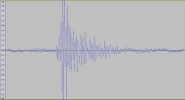
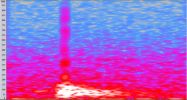
(That spectrum is x10)
I want my whimper. Someone stole my whimper. So where was this duck?
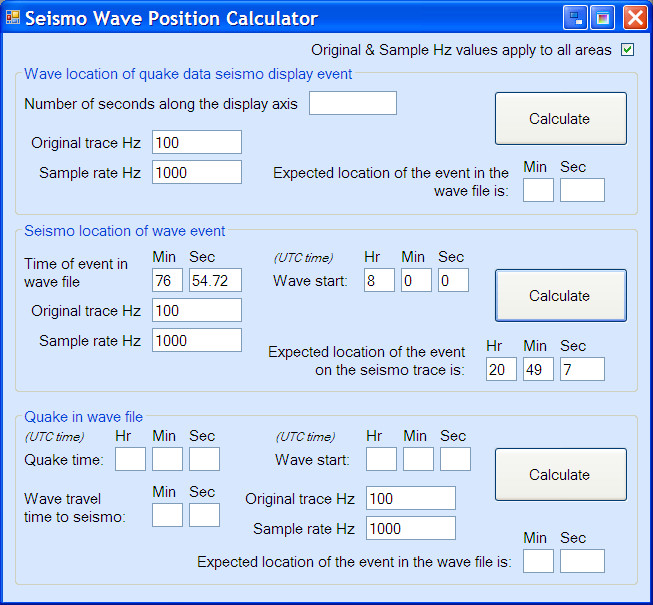
which is
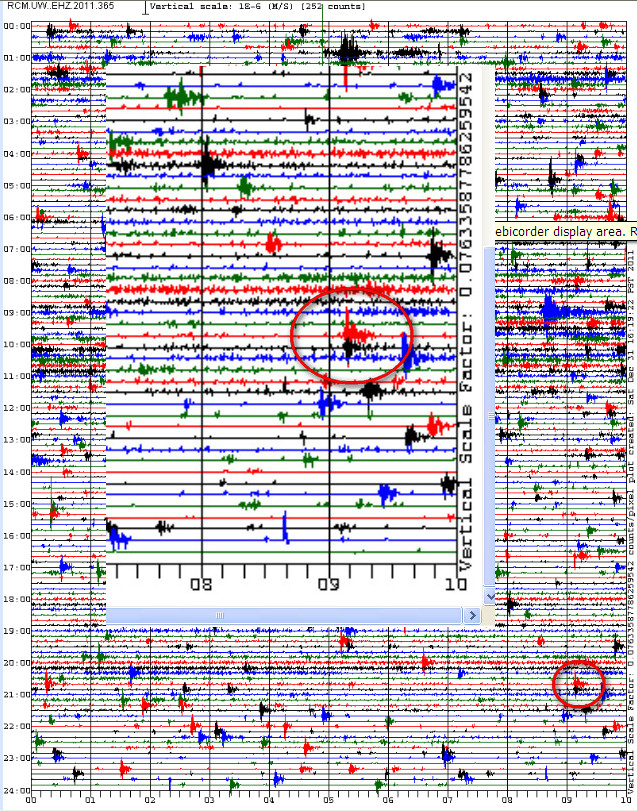
and you (almost don't) see the next tiny signal? Well that looks like a duck as well.
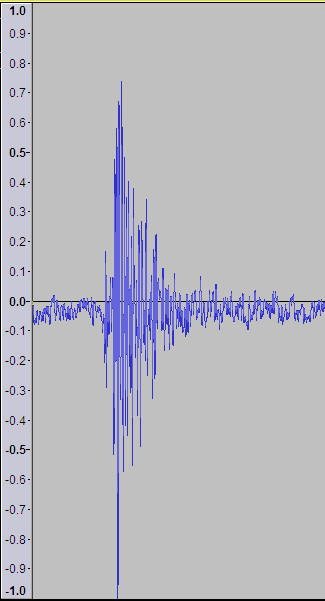
With so many looking like ducks and sounding like ducks, I guess they are ducks.
So I am getting very confused here. It was the same people that responded to westcoast that said ice quakes had a higher frequency, and that say the higher frequency is masked by the glacier and then in the next breath say that ice quakes create lower frequencies not 'seen' by seismos. Conjones. Seismographs pick up sub 1 Hz microseisms. Just as an aside, when a signal comes through as a teleseism the frequency can be as low or lower than 0.05 (1/20 Hz). As I have pointed out before what is called Hz by the geologists is not actually Hz when talking about the instruments. A 100 Hz channel is 100 samples per second. That is not actually Hz. The wave can be way way slower. V channels are normally 0.1 samples a second which is why they are so good for seeing teleseisms.
Why do I get the distinct feeling that (1) they haven't got a clue, (2) they don't bother to look and (3) there is an aroma of pork pies in the air.
I am glad to see you changed the thread title to 'or ICE?' because I did say it could be, but I find their explanations less than convincing - which does NOT mean it is about to go boom in case anyone is worried.
The sort of reply on Glacier Peak read like - "Oh was there a quake? Oh yes so there was. No it was not ice that would be higher frequency" - the response to was that ice?
No the response to was that a quake is "Oh no that's ice"
Do you think if we asked the if it was a lahar they would come back and say "Oh no it was a tsunami"
:shk: :shk: :shk: :shk: :shk: :shk:
Where volcanic earthquakes start with a sudden bang and then peter out, these start with a whimper, get bigger and then trail off
BS my friend! ONLY if the earthquake is close to the seismo. And look at one of the very small ones that I put up a trace for. That does not start with a whimper. Listening to them they are a double thud P and S but a bit muffled.
Here is one I picked completely at random. Opened the file swiped an area and homed in on a single quake.
It sounds like a duck. RCM-Randowm-event.WAV
It looks like a duck.
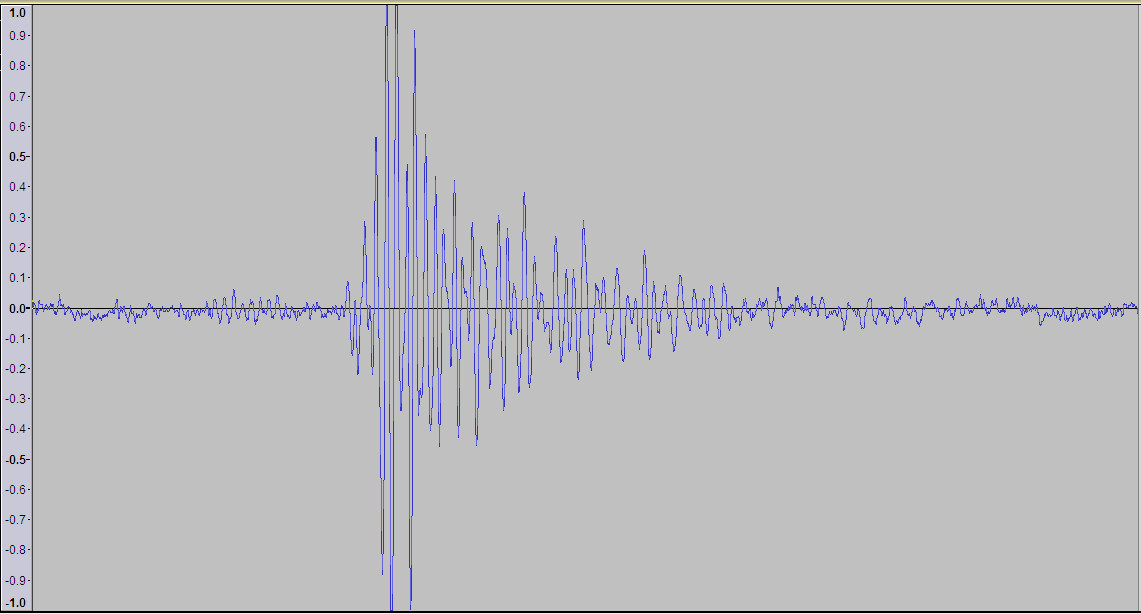
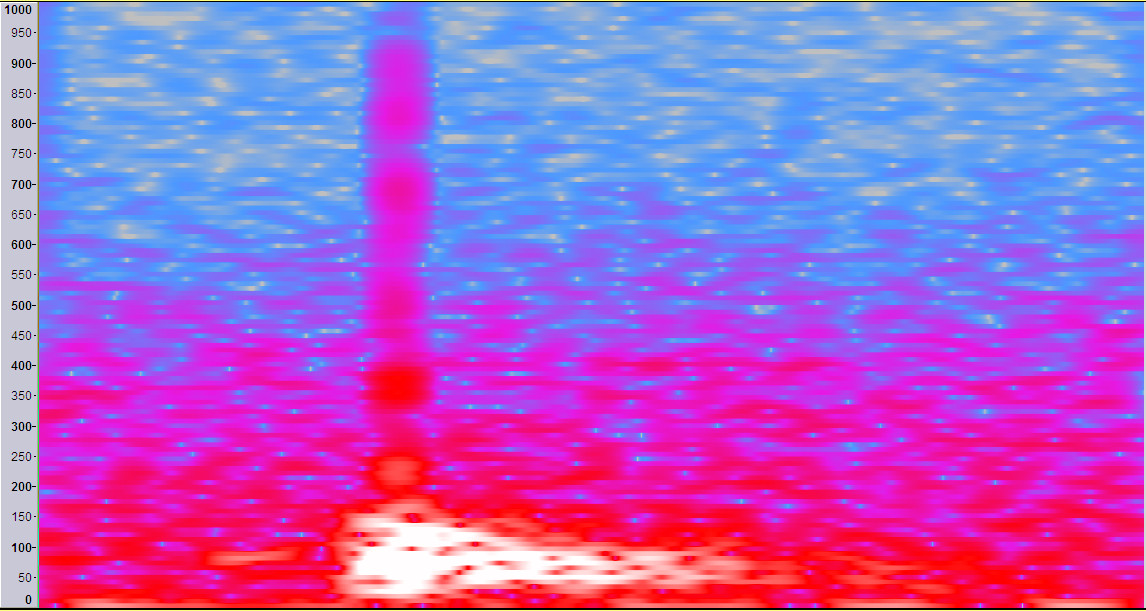
(That spectrum is x10)
I want my whimper. Someone stole my whimper. So where was this duck?
which is
and you (almost don't) see the next tiny signal? Well that looks like a duck as well.
With so many looking like ducks and sounding like ducks, I guess they are ducks.
So I am getting very confused here. It was the same people that responded to westcoast that said ice quakes had a higher frequency, and that say the higher frequency is masked by the glacier and then in the next breath say that ice quakes create lower frequencies not 'seen' by seismos. Conjones. Seismographs pick up sub 1 Hz microseisms. Just as an aside, when a signal comes through as a teleseism the frequency can be as low or lower than 0.05 (1/20 Hz). As I have pointed out before what is called Hz by the geologists is not actually Hz when talking about the instruments. A 100 Hz channel is 100 samples per second. That is not actually Hz. The wave can be way way slower. V channels are normally 0.1 samples a second which is why they are so good for seeing teleseisms.
Why do I get the distinct feeling that (1) they haven't got a clue, (2) they don't bother to look and (3) there is an aroma of pork pies in the air.
I am glad to see you changed the thread title to 'or ICE?' because I did say it could be, but I find their explanations less than convincing - which does NOT mean it is about to go boom in case anyone is worried.
The sort of reply on Glacier Peak read like - "Oh was there a quake? Oh yes so there was. No it was not ice that would be higher frequency" - the response to was that ice?
No the response to was that a quake is "Oh no that's ice"
Do you think if we asked the if it was a lahar they would come back and say "Oh no it was a tsunami"
:shk: :shk: :shk: :shk: :shk: :shk:
edit on 1/1/2012 by PuterMan because: (no reason given)
What about the temperature increase PM? I asked and explained over on page2...sorry it was`rather late and you beat me to bed!
Rainbows
Janr
Rainbows
Janr
My God, I settled down to read the item I link here, and frankly I need
not have bothered.
Because it was entitled "Characteristic seismic signals associated with ice sheet and glacier dynamics, Eastern Dronning Maud Land, East Antarctica" I thought this might be an interesting an enlightening document.
I screwed my face up and soldiered on after
because I realise that if things do not mention climate change they don't get looked at.
The summary is this
They did not need the rest of the paper and could have cut it into squares to serve a more useful purpose because the whole 'content', if you can call it that, was in the summary.
Of the tiny amount of time they spend talking at all most of it was discussing X-Phases. Is it any wonder that science is in the state it is if this is the sub-standard shoddy work that is all copy and repetition coming from people who are supposed to be 'in the know'
I have seen way better posts on ATS than this complete and utter load of absolute unadulterated drivel that said nothing at all.
Somewhere, in some long forgotten library sitting on a dusty shelf there is a set of documents from which ALL other papers are derived. No new work is ever done. Everything is a rehash of what was said before, but that does not matter because the document will be 'cited' in the next rehash and the number of citations is all that matters.
Drivel drivel drivel! I do not believe anything they say and every day I believe less and less of the nothing they say.
Is there a REAL geologist out there somewhere? One who does original research? One who makes sense and does not speak with rehashed tongue?
:shk: nah - wishful thinking PuterMan
ETA: I found another paper by the same lead author entitled "Greenland Ice Sheet Dynamics and Glacial Earthquake Activities" - it was longer. 8 pages of toilet paper this time waffling the whole way through and saying absolutely nothing yet concluding that
They did nothing of the sort. Just a load of references and descriptions.
Here is an example
Where did they apply the ETAS model. There is not one single stitch of data or workings in the whole document. Probably because the basically is no content again.
Link if you can be bothered with this drivel
Because it was entitled "Characteristic seismic signals associated with ice sheet and glacier dynamics, Eastern Dronning Maud Land, East Antarctica" I thought this might be an interesting an enlightening document.
I screwed my face up and soldiered on after
They include not only tectonic earthquakes, but also ice related phenomena possibly involving recent global climate change.
because I realise that if things do not mention climate change they don't get looked at.
The summary is this
Summary Several kinds of natural signals were recorded by a seismic experiment on the continental ice sheet in Eastern Dronning Maud Land during the 2002 austral summer. They include not only tectonic earthquakes, but also ice related phenomena possibly involving recent global climate change. The recorded signals are classified into (1) a teleseismic event, (2) local ice-quakes and (3) an unidentified event (X-phases).
Interestingly, the frequency content at 2.0 Hz is small in the waveforms recorded by stations in middle part of the seismic profile. On the other hand, 5.0 Hz and 1.5 Hz components are large at these stations which are above a valley in topography at the interface between the ice sheet and topmost crust. The abrupt change of topography in the valley might cause both the anomalous frequency content and travel times. The estimated origin of the unidentified event might be an intraplate earthquake or possibly a large ice-quake around East Antarctica.
Citation: Kanao, M., A. Yamada, M. Yama#a and K. Kainuma (2007), Characteristic Seismic Signals Associated with Ice Sheet & Glacier Dymanics, (sic ) Eastern Dronning Maud Land, East Antarctica, in Antarctica: A Keystone in a Changing World – Online Proceedings of the 10th ISAES, edited by A.K. Cooper and C.R. Raymond et al., USGS Open-File Report 2007-1047, Extended Abstract 182, 4 p.
They did not need the rest of the paper and could have cut it into squares to serve a more useful purpose because the whole 'content', if you can call it that, was in the summary.
Of the tiny amount of time they spend talking at all most of it was discussing X-Phases. Is it any wonder that science is in the state it is if this is the sub-standard shoddy work that is all copy and repetition coming from people who are supposed to be 'in the know'
I have seen way better posts on ATS than this complete and utter load of absolute unadulterated drivel that said nothing at all.
Somewhere, in some long forgotten library sitting on a dusty shelf there is a set of documents from which ALL other papers are derived. No new work is ever done. Everything is a rehash of what was said before, but that does not matter because the document will be 'cited' in the next rehash and the number of citations is all that matters.
Drivel drivel drivel! I do not believe anything they say and every day I believe less and less of the nothing they say.
Is there a REAL geologist out there somewhere? One who does original research? One who makes sense and does not speak with rehashed tongue?
:shk: nah - wishful thinking PuterMan
edit on 1/1/2012 by PuterMan because: (no reason given)
ETA: I found another paper by the same lead author entitled "Greenland Ice Sheet Dynamics and Glacial Earthquake Activities" - it was longer. 8 pages of toilet paper this time waffling the whole way through and saying absolutely nothing yet concluding that
We have described several features of cryoseismic signals, particularly involved in the glacial earthquakes associated with the recent ice sheet dynamics in Greenland.
They did nothing of the sort. Just a load of references and descriptions.
Here is an example
The last four decades of seismicity in Greenland and surrounding regions were investigated by Kanao et al. (2010), as for the all tectonic and volcanic events plausibly include the glacial earthquakes (Fig. 8). Here, we applied the statistical model of the Epidemic Type Aftershock Sequences (ETAS), on the basis of the Gutenberg–Richter’s magnitude frequency distribution. The ETAS model is a statistical tool for analyzing the occurrence times of earthquakes associated with magnitude, and has been used for the discrimination of seismicity patterns in many regions (Ogata, 1988). The model stochastically classifies earthquakes into aftershocks and background events. The background events are obtained by stochastically removing clustered events or aftershocks. The same procedures were applied for the space-time analyses in seismicity around the Antarctic Plate, particularly in the vicinity of the Balleny Island region (Himeno et al., 2011).
Where did they apply the ETAS model. There is not one single stitch of data or workings in the whole document. Probably because the basically is no content again.
Link if you can be bothered with this drivel
edit on 1/1/2012 by PuterMan because: (no reason given)
reply to post by angelchemuel
I don't think anyone actually said there IS a temperature increase. The document extract in this post mentioned 'steam caves' and then westcoast said that the signatures reminded her of the steam eruptions on Mount St Helens.
The glacier could of course be moving if there is some heat around melting it's botty.
I don't think anyone actually said there IS a temperature increase. The document extract in this post mentioned 'steam caves' and then westcoast said that the signatures reminded her of the steam eruptions on Mount St Helens.
The glacier could of course be moving if there is some heat around melting it's botty.
Originally posted by Kaworu
Darn...will have to keep an eye on this thread now. My fiance and I were planing on moving up there within the first quarter of 2012. Seattle to be exact. Don't think this will change are minds but if things get real active then well definitely have to reconsider.
Go anyway. You can be part of the rebuild!
Thanks for all the info Puterman. It does make it a bit questionable as to what this activity really is.
It appears to me that whatever the cause, they are getting bigger. I will let you all be the judge though:
Camp Shurman from Dec 30th:
Camp Shurman today: (1st)
source
It appears to me that whatever the cause, they are getting bigger. I will let you all be the judge though:
Camp Shurman from Dec 30th:
Camp Shurman today: (1st)
source
edit on 1-1-2012 by westcoast because: (no reason given)
Juanuary 1, 2012
Mount Rainier National Park is closed until further notice
Ranger Shot At Mount Rainier National Park
UPDATED, 1:15 P.M.
A ranger at Mount Rainier National Park was shot this morning near the Longmire Ranger Station. Mount Rainier National Park is closed until further notice, and the Pierce County Sheriff's Department reports that shots are still being fired in the park.
www.thenewstribune.com...
edit on 1/1/2012 by this_is_who_we_are because: offsite
bb code
reply to post by this_is_who_we_are
This is horrible. Here is another article from a news source in Seattle with some more info:
Park ranger fatally shot near Mt. Rainier, gunman still on loose
Now. As much of a coincidence as this is, and as much as I HATE coincidences.....I simply can not see there being a connection. They give the officers name....she was married with two young children. While my gut is screaming...."what? convenient that the park is now closed...." I really think that this time it IS a coincidence.
My sincere condolences to this young womans family and I hope they find the shooter quickly.
To stay more on topic: There was a definite quake up there about about a half hour ago. I am hoping we don't see a growing trend.
This is horrible. Here is another article from a news source in Seattle with some more info:
Park ranger fatally shot near Mt. Rainier, gunman still on loose
Now. As much of a coincidence as this is, and as much as I HATE coincidences.....I simply can not see there being a connection. They give the officers name....she was married with two young children. While my gut is screaming...."what? convenient that the park is now closed...." I really think that this time it IS a coincidence.
My sincere condolences to this young womans family and I hope they find the shooter quickly.
To stay more on topic: There was a definite quake up there about about a half hour ago. I am hoping we don't see a growing trend.
new topics
-
StormyD Accused of Falsification of Business Records to Hide Money From Trump
US Political Madness: 9 hours ago -
Judge Postpones Trump Classified Docs Trial INDEFINITELY
US Political Madness: 11 hours ago
top topics
-
Judge Postpones Trump Classified Docs Trial INDEFINITELY
US Political Madness: 11 hours ago, 31 flags -
Don’t Obstruct the Leftist Implosion
US Political Madness: 15 hours ago, 27 flags -
StormyD Accused of Falsification of Business Records to Hide Money From Trump
US Political Madness: 9 hours ago, 17 flags -
To all ATS members of Faith - Prayer request
Religion, Faith, And Theology: 14 hours ago, 13 flags -
NASA Black Hole Visualization - Go Beyond the Brink
Space Exploration: 15 hours ago, 4 flags
active topics
-
Don’t Obstruct the Leftist Implosion
US Political Madness • 24 • : Beesnestbomber -
StormyD Accused of Falsification of Business Records to Hide Money From Trump
US Political Madness • 28 • : Beesnestbomber -
Really Unexplained
General Chit Chat • 169 • : Beesnestbomber -
Chinese scientists create new mutant Ebola strain with horror eye symptoms
Breaking Alternative News • 27 • : twistedpuppy -
Russia police launch major manhunt after troops massacred by comrade in occupied Ukraine
Other Current Events • 14 • : Freeborn -
Black kids in the Bronx don't know what the word 'computer' is
People • 13 • : KrustyKrab -
Mood Music Part VI
Music • 3162 • : Hellmutt -
Modern Mind Control
General Conspiracies • 54 • : whereislogic -
Medvedev: “No one can hide, a global catastrophe is coming”
World War Three • 261 • : andy06shake -
Russia Ukraine Update Thread - part 3
World War Three • 5763 • : F2d5thCavv2