It looks like you're using an Ad Blocker.
Please white-list or disable AboveTopSecret.com in your ad-blocking tool.
Thank you.
Some features of ATS will be disabled while you continue to use an ad-blocker.

Leaked images of Nibiru orbited by Planet X taken by South Pole Station Telescope
page: 26share:
reply to post by WhiteWash
The stars in our Galaxy (Milky Way) orbit a central spot believed to be a super-massive black hole. They orbit due to the gravatational pull of the therorised black hole, it is just like the gravitational pull our star has on the planets in our solar system, keeping them in orbit, but on a much larger scale a time frame.
The stars in our Galaxy (Milky Way) orbit a central spot believed to be a super-massive black hole. They orbit due to the gravatational pull of the therorised black hole, it is just like the gravitational pull our star has on the planets in our solar system, keeping them in orbit, but on a much larger scale a time frame.
Oye I am so going to get bashed for this... you can see it at sunrise from the southern most tip of africa. I know the person who put out the pics of
it and they are real. In all the pics he took it was right along side the sun at its rising and could be seen with the naked eye till about noonish.
reply to post by xoxo stacie
If it's alongside the sun, you don't have to be at the southern tip of africa to see it, you could be anywhere in the world and see it eventually. I saw it at sunrise this morning too, it was the planet mercury. That and the crescent moon are the only things rising just before the sun right now. Here's a picture:
farm4.static.flickr.com...
[edit on 27-10-2008 by ngchunter]
If it's alongside the sun, you don't have to be at the southern tip of africa to see it, you could be anywhere in the world and see it eventually. I saw it at sunrise this morning too, it was the planet mercury. That and the crescent moon are the only things rising just before the sun right now. Here's a picture:
farm4.static.flickr.com...
[edit on 27-10-2008 by ngchunter]
dont know if this has been posted or if you have seen it before....
I followed this myself and what this guy says is real....you need to download and install Microsoft Worlwide telescope and follow this guide...
uk.youtube.com...
interesting discovery.....
I followed this myself and what this guy says is real....you need to download and install Microsoft Worlwide telescope and follow this guide...
uk.youtube.com...
interesting discovery.....
reply to post by booda
Can't view youtube atm, could anyone post a screenshot? Sounds like another google sky "missing panel" in some well-studied part of the sky again. I don't know why people bother to make videos about this when static screenshots are the more appropriate medium, but I guess it's just to get attention on youtube.
Can't view youtube atm, could anyone post a screenshot? Sounds like another google sky "missing panel" in some well-studied part of the sky again. I don't know why people bother to make videos about this when static screenshots are the more appropriate medium, but I guess it's just to get attention on youtube.
Originally posted by ngchunter
reply to post by booda
Can't view youtube atm, could anyone post a screenshot? Sounds like another google sky "missing panel" in some well-studied part of the sky again. I don't know why people bother to make videos about this when static screenshots are the more appropriate medium, but I guess it's just to get attention on youtube.
Yes and no....something is missing but when you change the filters..something really bright shows up....bed now but Ill try do it tomorrow....
reply to post by booda
Is it this thing again?
If it is, it's just a regular planet, venus I believe, which happened to get caught in an IRIS image used to make the google sky and WWT IR maps, but wasn't there when the optical surveys were done. That's why it only shows up when you "change filters" and it's also why it just happens to be sitting on the ecliptic line perfectly. You have to remember that neither are real telescopes, they're just compositions of previously conducted sky surveys and they were not recorded simultaneously.
[edit on 25-11-2008 by ngchunter]
Is it this thing again?
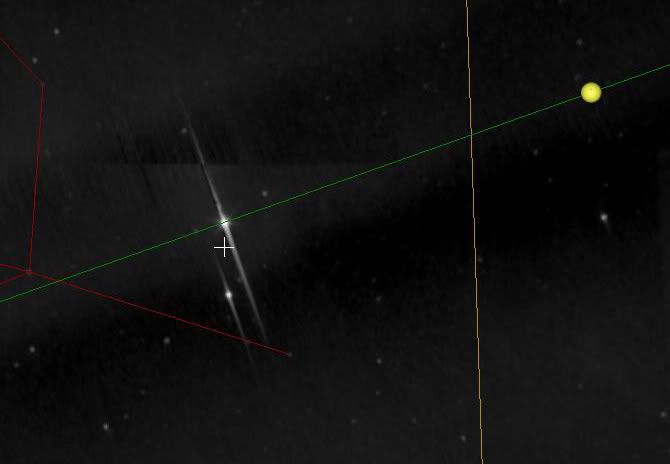
If it is, it's just a regular planet, venus I believe, which happened to get caught in an IRIS image used to make the google sky and WWT IR maps, but wasn't there when the optical surveys were done. That's why it only shows up when you "change filters" and it's also why it just happens to be sitting on the ecliptic line perfectly. You have to remember that neither are real telescopes, they're just compositions of previously conducted sky surveys and they were not recorded simultaneously.
[edit on 25-11-2008 by ngchunter]
All this planet x stuff might be very clever marketing for the up and coming film 2012 coming out in the cinema's very soon.
Any one remember the marketing ploy for the blair witch project a long time ago? Made people think it was based on a true story
i may be wrong i may be right, i guess we will have to wait and see.
Any one remember the marketing ploy for the blair witch project a long time ago? Made people think it was based on a true story
i may be wrong i may be right, i guess we will have to wait and see.
I think this planet x stuff is a marketing ploy for the up and coming film 2012 coming out in the cinema's soon.
They did the same marketing tactics for the blair witch project back then before release. Does anyone remember?
i may be wrong i may be right we just have to wait and see.
They did the same marketing tactics for the blair witch project back then before release. Does anyone remember?
i may be wrong i may be right we just have to wait and see.
As with any of this stuff, you can take it for what it is, or blow it off as a fabrication.
Some interesting and pretty pictures tho.
What blew the credibility off of the video on the first page, was the disclaimer at the end..."oh I cant tell you who I am or when I will release more pictures"...blah blah blah.
It would have been better to not say anything at all!!!!
Cheers!!!!!
Some interesting and pretty pictures tho.
What blew the credibility off of the video on the first page, was the disclaimer at the end..."oh I cant tell you who I am or when I will release more pictures"...blah blah blah.
It would have been better to not say anything at all!!!!
Cheers!!!!!
reply to post by ngchunter
that seems to make sense - never thought of the ecliptic line...thanks for the education...
that seems to make sense - never thought of the ecliptic line...thanks for the education...
Any who doubt the validity of niburu only need to look into the sumerian writings, they knew so much about the procession of the equinox' and other
stellar events any thinking person has to conclude that they were taught these things. The "great year" is almost thirty thousand years long, yet
they were privvy to this knowledge. We only in the last hundred and fifty years or so found the existance of neptune and uranus, not to mention pluto,
yet the sumerians knew of these things and even recorded the color of the planets. Research things yourself, dont listen to anyone else, come to your
own conclusions. I believe any intelligent people will come to a similiar way of thought. It would explain the missing link, how we came to be made in
our creators image, all covered in 5000 year old writings. Seems a bit close to the truth for coincidence.
no? I worked for nasa for past 3 years in a remote facility. Just got back and this is the first I'm hearing this (yes surprisingly). I hope this
scare tactic is over because your pretty much wasting your time...I would love to give everyone proof that a"planet x" ( even tho that is a term we
use all the time ) will not hit us, but we never seen this planet x. So unless a planet spontaneously appears no one has anything to worry about.
Never been seen and those photos look like a supernova..what do i know, I just research these things. Don't believe me? If you have a telescope that
can see Jupiter's rings you would be able to see this "planet X" especially if it is only 4 years away. Last the whole alignment of stars on Dec.
21 2012..Yeah that happens every year but its more on the 18th then the 21st. Look it up. on the 21st its more 5 degrees off. Sorry everyone. Spread
the word.
niburu isnt real head over to badastronomy.com they have a whole section on it.
If niburu was real, and follows the path given by it believers, it would be the brighest object in the Night sky
If niburu was real, and follows the path given by it believers, it would be the brighest object in the Night sky
to me it looks like 2 dots on photoshop with some words of fear so u will belive in it
how long ago was jesus and for that matter sumerains?
sorry timelines change since 100,000 years 25,000 years etc what if the annukaki died out? who knows what can change in that time period and if it is coming what are we going to do about spend trillions of dollars to build cities underground? sorry our tax dollars are well spent across the world they are set.
how long ago was jesus and for that matter sumerains?
sorry timelines change since 100,000 years 25,000 years etc what if the annukaki died out? who knows what can change in that time period and if it is coming what are we going to do about spend trillions of dollars to build cities underground? sorry our tax dollars are well spent across the world they are set.
reply to post by WhiteWash
Well there's two primary ways that come to mind. One, Sol and another star began as orbiting accretion disks. In fact, the gravity of one could affect the accretion process of the other. Two, Sol catches a smaller star and its planetary system into its orbit.
The second idea appeals more to me somehow. If our solar system was in a binary orbit with another star without our being able to observe it directly, it would have to be a pretty small star--the smallest of red dwarfs even. Dim little suckers, and long lived. There are supposed millions upon millions of them out there, wandering our galactic plane with us, too dim to register on our land or space based telescopes.
The planetary system of such a star might be no broader than two or three times the orbital reach of Jupiter's moons, which would allow it to pass through Sol's orbital plane without hitting or even necessarily affecting much of anything. But that star would be dragging its own load of stuff around, it's heliosphere, it's cloud of crap, it's comets and asteroids. Any one of these or any part of one of these could jump orbits and join our own little family of debris.
Could also make an interesting theory for explaining how Neptune's pole got knocked atilt, if a red dwarf whipped by her one day close enough to throw her off and tangle her moons into spaghetti orbits.
Well, it's fun speculating.
Well there's two primary ways that come to mind. One, Sol and another star began as orbiting accretion disks. In fact, the gravity of one could affect the accretion process of the other. Two, Sol catches a smaller star and its planetary system into its orbit.
The second idea appeals more to me somehow. If our solar system was in a binary orbit with another star without our being able to observe it directly, it would have to be a pretty small star--the smallest of red dwarfs even. Dim little suckers, and long lived. There are supposed millions upon millions of them out there, wandering our galactic plane with us, too dim to register on our land or space based telescopes.
The planetary system of such a star might be no broader than two or three times the orbital reach of Jupiter's moons, which would allow it to pass through Sol's orbital plane without hitting or even necessarily affecting much of anything. But that star would be dragging its own load of stuff around, it's heliosphere, it's cloud of crap, it's comets and asteroids. Any one of these or any part of one of these could jump orbits and join our own little family of debris.
Could also make an interesting theory for explaining how Neptune's pole got knocked atilt, if a red dwarf whipped by her one day close enough to throw her off and tangle her moons into spaghetti orbits.
Well, it's fun speculating.
This is odd, I swear I saw it officially mentioned a couple of times that there is another large planet that we are unable to locate.
In the discussion I saw they mentioned that there are certain behaviors in our system that all suggest that there is another large mass, on an elliptical orbit, and that it will likely come into view in the following few years.
I assume they were talking about the same thing?
I thought it was well known scientific fact that there was another planet that we haven't seen yet, and I'm certain I saw this on the BBC in an interview with a spokesman of a leading agency.
I'm going to have to go off and start searching for links now
In the discussion I saw they mentioned that there are certain behaviors in our system that all suggest that there is another large mass, on an elliptical orbit, and that it will likely come into view in the following few years.
I assume they were talking about the same thing?
I thought it was well known scientific fact that there was another planet that we haven't seen yet, and I'm certain I saw this on the BBC in an interview with a spokesman of a leading agency.
I'm going to have to go off and start searching for links now
reply to post by Zahhar
Interesting theory but Im afraid it holds no water, the gravitational effects of another system so close would have prevented the formation of our solarsystem as it is. The planets would not have the perfect round orbits they have because they would be pulled slightly towards the other system.
Also two solarsystems simply can not form within each other or co-exist like you are suggesting. A red dwarf that close orbiting would "steal" the oort clout from our sun.
The binary system you are suggesting is possible but it would result in elliptical orbits of the planets and possibly create small planet sized comets. It would be very chaotic from the start and earth as we know it would never have formed even.
Interesting theory but Im afraid it holds no water, the gravitational effects of another system so close would have prevented the formation of our solarsystem as it is. The planets would not have the perfect round orbits they have because they would be pulled slightly towards the other system.
Also two solarsystems simply can not form within each other or co-exist like you are suggesting. A red dwarf that close orbiting would "steal" the oort clout from our sun.
The binary system you are suggesting is possible but it would result in elliptical orbits of the planets and possibly create small planet sized comets. It would be very chaotic from the start and earth as we know it would never have formed even.
reply to post by detachedindividual
There was a group of Japanese dudes that theorized based on their computer model that there might be another planet in the far outskirts of the solarsystem. It is due to their model lacks a mass in that area to resemble 4 billion years of simulation. It is far fetched to say the least, it is 30% of the earths mass and is not necessary one body but could be thousands of asteroids. Elliptical orbit is the norm that far out, the "shell" around us is tear shaped and egg shaped orbits on the edge is nothing to worry about.
There was a group of Japanese dudes that theorized based on their computer model that there might be another planet in the far outskirts of the solarsystem. It is due to their model lacks a mass in that area to resemble 4 billion years of simulation. It is far fetched to say the least, it is 30% of the earths mass and is not necessary one body but could be thousands of asteroids. Elliptical orbit is the norm that far out, the "shell" around us is tear shaped and egg shaped orbits on the edge is nothing to worry about.
new topics
-
Gov Kristi Noem Shot and Killed "Less Than Worthless Dog" and a 'Smelly Goat
2024 Elections: 29 minutes ago -
Falkville Robot-Man
Aliens and UFOs: 43 minutes ago -
James O’Keefe: I have evidence that exposes the CIA, and it’s on camera.
Whistle Blowers and Leaked Documents: 1 hours ago -
Australian PM says the quiet part out loud - "free speech is a threat to democratic dicourse"...?!
New World Order: 2 hours ago -
Ireland VS Globalists
Social Issues and Civil Unrest: 2 hours ago -
Biden "Happy To Debate Trump"
Mainstream News: 3 hours ago -
RAAF airbase in Roswell, New Mexico is on fire
Aliens and UFOs: 3 hours ago -
What is the white pill?
Philosophy and Metaphysics: 4 hours ago -
Mike Pinder The Moody Blues R.I.P.
Music: 5 hours ago -
Putin, Russia and the Great Architects of the Universe
ATS Skunk Works: 8 hours ago
top topics
-
A Warning to America: 25 Ways the US is Being Destroyed
New World Order: 13 hours ago, 21 flags -
Biden "Happy To Debate Trump"
Mainstream News: 3 hours ago, 7 flags -
Mike Pinder The Moody Blues R.I.P.
Music: 5 hours ago, 7 flags -
What is the white pill?
Philosophy and Metaphysics: 4 hours ago, 5 flags -
Australian PM says the quiet part out loud - "free speech is a threat to democratic dicourse"...?!
New World Order: 2 hours ago, 5 flags -
RAAF airbase in Roswell, New Mexico is on fire
Aliens and UFOs: 3 hours ago, 4 flags -
Putin, Russia and the Great Architects of the Universe
ATS Skunk Works: 8 hours ago, 3 flags -
Ireland VS Globalists
Social Issues and Civil Unrest: 2 hours ago, 3 flags -
James O’Keefe: I have evidence that exposes the CIA, and it’s on camera.
Whistle Blowers and Leaked Documents: 1 hours ago, 3 flags -
Falkville Robot-Man
Aliens and UFOs: 43 minutes ago, 1 flags
active topics
-
Candidate TRUMP Now Has Crazy Judge JUAN MERCHAN After Him - The Stormy Daniels Hush-Money Case.
Political Conspiracies • 799 • : matafuchs -
Gov Kristi Noem Shot and Killed "Less Than Worthless Dog" and a 'Smelly Goat
2024 Elections • 15 • : cherokeetroy -
Biden "Happy To Debate Trump"
Mainstream News • 34 • : Dandandat3 -
University of Texas Instantly Shuts Down Anti Israel Protests
Education and Media • 297 • : cherokeetroy -
-@TH3WH17ERABB17- -Q- ---TIME TO SHOW THE WORLD--- -Part- --44--
Dissecting Disinformation • 699 • : Thoughtful3 -
Putin, Russia and the Great Architects of the Universe
ATS Skunk Works • 25 • : SchrodingersRat -
Ditching physical money
History • 22 • : StudioNada -
Falkville Robot-Man
Aliens and UFOs • 3 • : KKLOCO -
Krystalnacht on today's most elite Universities?
Social Issues and Civil Unrest • 10 • : xuenchen -
Russia Ukraine Update Thread - part 3
World War Three • 5736 • : YourFaceAgain