It looks like you're using an Ad Blocker.
Please white-list or disable AboveTopSecret.com in your ad-blocking tool.
Thank you.
Some features of ATS will be disabled while you continue to use an ad-blocker.

Gigantic Alien Craft Photographed By Cassini! NASA’s Cover-Up Blown?
page: 10share:
These are the entities that leave us relatively protected. Otherwise we would be roasting over a bed of coals in a tasty Candanian way.
Wait...these pictures from NASA are supposedly evidence of alien craft in our solar system, but isn't NASA a super-evil organization that airbrushes
every picture from space and routinely deceives the public? Why would they allow us to see this?
reply to post by johnlear
John, thanks for taking the trouble of contacting Norman. Needless to say, it is disappointing to know that he has not given permission for reproducing the photographs.
However, Norm has mentioned that “The photo is a ‘kluged-up” image primarily based upon Ringmakers of Saturn Plate 27 page 50.” What does 'kluged-up' imply?
Is what internos posted above, a genuine scan of the one printed in Norman's Ringmakers of Saturn?
John, thanks for taking the trouble of contacting Norman. Needless to say, it is disappointing to know that he has not given permission for reproducing the photographs.
However, Norm has mentioned that “The photo is a ‘kluged-up” image primarily based upon Ringmakers of Saturn Plate 27 page 50.” What does 'kluged-up' imply?
Is what internos posted above, a genuine scan of the one printed in Norman's Ringmakers of Saturn?
Originally posted by Postal76
Wait...these pictures from NASA are supposedly evidence of alien craft in our solar system, but isn't NASA a super-evil organization that airbrushes every picture from space and routinely deceives the public? Why would they allow us to see this?
They didn't want us to see it. Check out John Lear's post on the previous page where Norman mentions that, "The image shown is a latent image that was hidden in a NASA Voyager image because of a very dark background."
So fortunately for us, they screwed this one up as it seems to have passed 'muster' due to an oversight. I betcha those airbrushers must've been fired! But then it's a typical case of shutting the stable after the horse has bolted!
reply to post by pjslug
You mean like a Malon garbage scow? How dare those aliens, dumping toxic waste into our Sun! If anyone has any right to use our Primary as a garbage furnace, it's us!
You mean like a Malon garbage scow? How dare those aliens, dumping toxic waste into our Sun! If anyone has any right to use our Primary as a garbage furnace, it's us!
Originally posted by Beachcoma
You mean like a Malon garbage scow? How dare those aliens, dumping toxic waste into our Sun! If anyone has any right to use our Primary as a garbage furnace, it's us!
Silly Beachcoma! But it might be their sun, too! For all we know, they could have some federation guildelines that say this whole region of space is like a public park. We puny humans can't stop them, since we haven't even tamed spaceflight at reasonable distances yet.
Originally posted by pjslug
Silly Beachcoma! But it might be their sun, too! For all we know, they could have some federation guildelines that say this whole region of space is like a public park. We puny humans can't stop them, since we haven't even tamed spaceflight at reasonable distances yet.
Heck, man! For all we know, this Solar System could actually belong to them and they've just shoved us on planet Earth like monkeys in a zoo!
AND WE THINK WE'RE THE CENTER OF THE UNIVERSE! THE GREATEST THING TO HAVE HAPPENED THIS SIDE OF THE BIG BANG!!
Hmmm....Food for though, eh? Lol
Cheers!
Originally posted by Beachcoma
Pshaw, we haven't even reached 1/8th impulse yet.
haha engage
Guys, not to sound like a debunker, but there have been asteroids in the vicinity of Saturn, and i mean lots of them (at least more than could be expected) and some asteroids are so young that they havent differentiated yet, and the spin on that one could have made it form oblong instead of spherical.
But anyway, good hunting.
Lets not forget about this guy
www.youtube.com...
Here are a couple more pics. Cassini snapped the photos on Feb. 23, 2004, from a distance of 62.9 million kilometers (39 million miles). Notice the
two ELONGATED objects which I've marked 'A' and 'B'.
These have not been satisfactorily explained so far.
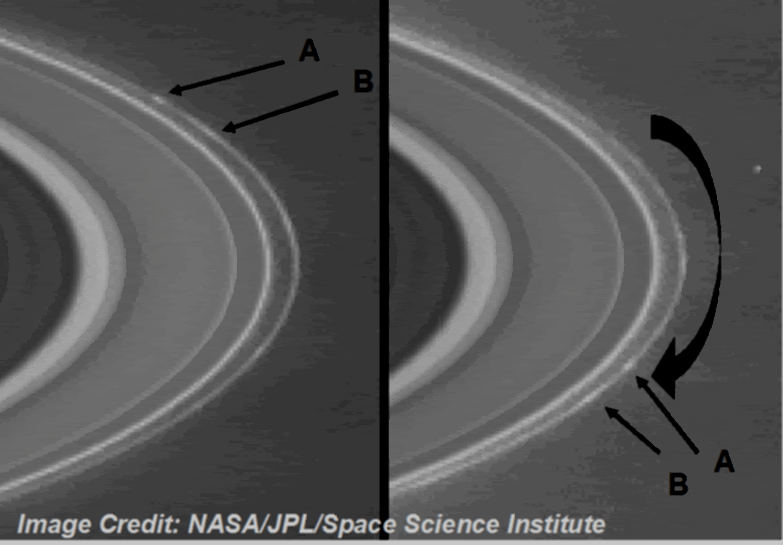
And what's this 'streak' across the rings?
The image was taken in visible light by the
spacecraft's narrow-angle camera from a
distance of approximately 1.4 million miles
(2.3 million kilometers).
Image courtesy: NASA/JPL/Space Science Institute
[edit on 10-9-2007 by mikesingh]
These have not been satisfactorily explained so far.
And what's this 'streak' across the rings?
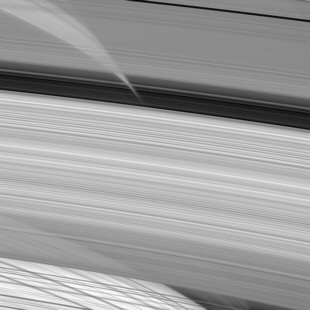
The image was taken in visible light by the
spacecraft's narrow-angle camera from a
distance of approximately 1.4 million miles
(2.3 million kilometers).
Image courtesy: NASA/JPL/Space Science Institute
[edit on 10-9-2007 by mikesingh]
reply to post by johnlear
John thank you for your thoughts and efforts. I did a little digging and I hope that this is not a violation in any way, but I found the image in question:
link giving proper credit...
This is the ORIGINAL NASA/JPL image P-23876C composed from 4 Voyager 1 images.
John thank you for your thoughts and efforts. I did a little digging and I hope that this is not a violation in any way, but I found the image in question:
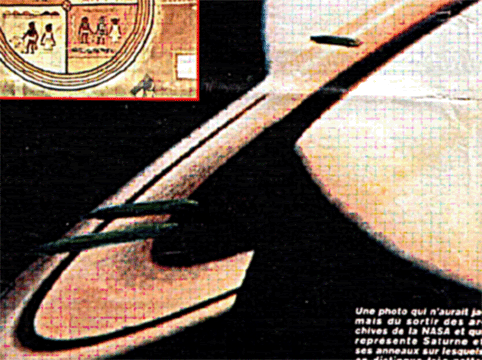
These following series images are jpg files of the original news release images, and a comparison to the NASA /JPL image used in "Ringmakers of Saturn" by Dr. Norman Bergrun. Following the images is the actual news release as published by NASA in 1981. No comment need be made regarding them, as they pretty well speak for themselves, demonstrating the composed nature of the material.
link giving proper credit...
This is the ORIGINAL NASA/JPL image P-23876C composed from 4 Voyager 1 images.
reply to post by 1nL1ghtened
I am not too convinced of Tibble's explanations. As what he says..
So? A composite image will not result in anything remotely resembling this image...
Cheers!
[edit on 10-9-2007 by mikesingh]
I am not too convinced of Tibble's explanations. As what he says..
In my opinion, and supported by evidence detailed below, the image used in Ringmakers of Saturn is a composite image created from 4 separate Voyager I images, and used by NASA/JPL in a news release compaing Voyager I & II images.
www.anomalog.com...
So? A composite image will not result in anything remotely resembling this image...
Cheers!
[edit on 10-9-2007 by mikesingh]
Walter Vincenti: Maybe John knows him; the french article claims that Norman and Vincenti revealed the
existence of the pics.
Guy Tarade
sebastoc.free.fr...
The caption of the pic claims that Guy Tarade drawed it,
but now we know it isn't so (thanks to Jonh Lear for his efforts)
and the copy he keeps in his left hand looks to have been copied by a book
(RMoS ?).

In according to what Bergrun wrote in response to John's request,
this guy may have (somehow) published the pics somewhere
(i know it isn't so much, but is anyway a step).
The pic that John asked the permission to post, is not this:

but plate 5 on page 17.
mikesingh,
is the one that 1nL1ghtened previously posted... (btw, Great work, 1nL1ghtened )
[edit on 10/9/2007 by internos]
Guy Tarade
sebastoc.free.fr...
The caption of the pic claims that Guy Tarade drawed it,
but now we know it isn't so (thanks to Jonh Lear for his efforts)
and the copy he keeps in his left hand looks to have been copied by a book
(RMoS ?).
In according to what Bergrun wrote in response to John's request,
this guy may have (somehow) published the pics somewhere
(i know it isn't so much, but is anyway a step).
The pic that John asked the permission to post, is not this:
but plate 5 on page 17.
mikesingh,
i guess that the pic which anomalog was talking about
So? A composite image will not result in anything remotely resembling this image...
is the one that 1nL1ghtened previously posted... (btw, Great work, 1nL1ghtened )
[edit on 10/9/2007 by internos]
Originally posted by mikesingh
And what's this 'streak' across the rings?
The image was taken in visible light by the
spacecraft's narrow-angle camera from a
distance of approximately 1.4 million miles
(2.3 million kilometers).
Image courtesy: NASA/JPL/Space Science Institute
That's a nice picture. I've got the false colour composite of the same thing that makes it clearer, but it's in the other HDD which I've disconnected from the PC. But from that picture you can see that the streak is actually behind the rings. In false colour image, you would've instantly recognized it as Saturn itself, or rather, her outline. It looks that way because Cassini was capturing it at a very artistic angle, with the rings in the foreground and Saturn in silhouette behind it. Truly beautiful shot.
The ones above are the so called "shepherd moons" that seem to maintain the shape of Saturn's rings through their small gravitational influences. I forgot their names, but I'll try to look for it later, along with the colour composite.
Edit: Sorry my bad, the shepherd moons are within the rings, specifically within the gaps. Those things are either "transient clumps of dust" or little "icy moonlets". In other words they've no idea exactly what it is. However they've provisionally named it S/2004 S 3 and S/2004 S 6. It's probably what they say it is, but speculate away until they actually name it something more creative
Also, the known shepherd moons and inner satellites:
Oh yeah, one more thing,
Not exactly the colour composite I mentioned, but you can see the similarity.
[edit on 10-9-2007 by Beachcoma]
reply to post by Beachcoma
Thanks Beach! I wish you could get hold of that color composite. It sure must be worth the trouble getting it back, what?
Cheers!
Thanks Beach! I wish you could get hold of that color composite. It sure must be worth the trouble getting it back, what?
Cheers!
I found a wider-angle shot of the B&W above.
You can see the shadows cast by the ring-system on Saturn, and the bright band between the shadows is actually sunlight passing through one of the ring divisions.
Still looking for the colour shot, I'm really not up to plugging in the HDD. It's an old IDE, meaning I've got to look for the cable AND turn off the PC. No!!
You can see the shadows cast by the ring-system on Saturn, and the bright band between the shadows is actually sunlight passing through one of the ring divisions.
Still looking for the colour shot, I'm really not up to plugging in the HDD. It's an old IDE, meaning I've got to look for the cable AND turn off the PC. No!!
Originally posted by Beachcoma
It's an old IDE, meaning I've got to look for the cable AND turn off the PC. No!!
Darn! You're a real kill-joy! A party pooper if ever there was one!!
Anyways, that pic you posted above was awesome!
Cheers!
has anyone else noticed the very odd perspective of the objects relative to the rings? take a look at the picture and ignore the planet itself. if
you look at the rings it appears you're looking at the top of them and the ufos' are floating in an easy to comprehend formation on top of the
rings. now ignore the objects and notice the angle - we're looking at the bottom of the rings. now try to make sense of the objects' positions.
could be nothing, but it seems odd to me.
Originally posted by internos
In the Acknowledgments section of his book, the Ringmakers of Saturn, Norman has this to say:
"To Dr. Walter Vincenti, Professor of Aeronautics and Astronautics at Stanford University, special thanks are given for his valuable suggestions at the final phase of the manuscript."
www.americanheritage.com...
Walter Vincenti: Maybe John knows him; the french article claims that Norman and Vincenti revealed the existence of the pics.
In the Acknowledgments section of his book, the Ringmakers of Saturn, Norman has this to say:
"To Dr. Walter Vincenti, Professor of Aeronautics and Astronautics at Stanford University, special thanks are given for his valuable suggestions at the final phase of the manuscript."
What ENGINEERS Know
WALTER VINCENTI has had whole careers both as a cutting-edge aeronautical engineer and as a leading historian of technology. Looking back over them, he discusses what his dual vantage point has taught him about how technological innovation works.
AN INTERVIEW by ROBERT C. POST
www.americanheritage.com...
Originally posted by mikesingh
When I was typing that sentence from his fax I looked it up and it was not in the dictionary. I then googled and found this:
Yes, that is a scan of Plate 27 on page 50. It shows the relative size of the vehicles to Saturns rings and Saturn itself.
John, thanks for taking the trouble of contacting Norman. Needless to say, it is disappointing to know that he has not given permission for reproducing the photographs.
However, Norm has mentioned that “The photo is a ‘kluged-up” image primarily based upon Ringmakers of Saturn Plate 27 page 50.” What does 'kluged-up' imply?
When I was typing that sentence from his fax I looked it up and it was not in the dictionary. I then googled and found this:
kluge up: vt. To lash together a quick hack to perform a task; this is milder ... “I've kluged up this routine to dump the buffer contents to a safe place. ...
Is what internos posted above, a genuine scan of the one printed in Norman's Ringmakers of Saturn?
Yes, that is a scan of Plate 27 on page 50. It shows the relative size of the vehicles to Saturns rings and Saturn itself.
new topics
-
Gaza Genocide Real or Propaganda
Middle East Issues: 35 minutes ago -
Akkabadori: history of tolerant euthanasia
History: 4 hours ago -
Don Trump-Quixote
Political Issues: 6 hours ago -
Paranoia that will tear apart Russia and China
World War Three: 7 hours ago -
SecretKnowledge sez howaryiz all, im back.
Introductions: 9 hours ago
top topics
-
Egypt to join South Africa genocide case at ICJ
Middle East Issues: 12 hours ago, 8 flags -
SecretKnowledge sez howaryiz all, im back.
Introductions: 9 hours ago, 3 flags -
Don Trump-Quixote
Political Issues: 6 hours ago, 3 flags -
Paranoia that will tear apart Russia and China
World War Three: 7 hours ago, 2 flags -
Akkabadori: history of tolerant euthanasia
History: 4 hours ago, 2 flags -
Gaza Genocide Real or Propaganda
Middle East Issues: 35 minutes ago, 2 flags -
Kingdom of the Planet of the Apes
Movies: 15 hours ago, 1 flags
active topics
-
Candidate TRUMP Now Has Crazy Judge JUAN MERCHAN After Him - The Stormy Daniels Hush-Money Case.
Political Conspiracies • 1509 • : matafuchs -
Gaza Genocide Real or Propaganda
Middle East Issues • 6 • : BernnieJGato -
Don Trump-Quixote
Political Issues • 7 • : budzprime69 -
Truth Social goes public, be careful not to lose your money
Mainstream News • 135 • : matafuchs -
Bibi’s Dilemma
Middle East Issues • 286 • : Lazy88 -
Trump Record Breaking Campaign Rally 5/11 in New Jersey Draws 100,000 People
2024 Elections • 112 • : CarlLaFong -
Ashley Biden's 'INAPPROPRIATE SHOWERS WITH DADDY' Diary is Real--DOJ
US Political Madness • 138 • : WeMustCare -
"We're All Hamas" Heard at Columbia University Protests
Social Issues and Civil Unrest • 322 • : FlyersFan -
Can Anyone Give Just One Reason To Trust The Pharmaceutical Industry
Medical Issues & Conspiracies • 57 • : chiefsmom -
Paranoia that will tear apart Russia and China
World War Three • 10 • : Freeborn