It looks like you're using an Ad Blocker.
Please white-list or disable AboveTopSecret.com in your ad-blocking tool.
Thank you.
Some features of ATS will be disabled while you continue to use an ad-blocker.

How they Built the Great Pyramid of Egypt
page: 1Let me begin by saying I too enjoy reading about ancient Astronauts or possible lost civilizations lending a hand in the Great pyramids construction this thread however will not address those nor will we be discussing time-lines....
Ever since I could read I've always been fascinated with Ancient history and Ancient monument builders. I would spend hours at our local Library reading books on the ancient Egyptians, Mayans, Aztecs etc. Luckily the books available contained many high quality photos. In those photos they would occasionally show some physical artifacts that would hardly be mentioned [if at all] only leaving me more curious as to their purpose. I'll try to address those possibilities in this thread. The Great pyramid is said to be an enigma wrapped in a mystery surrounded by myths. Accepted Egyptology states it took roughly twenty years of back breaking labor to build it. I as do many here question not the why or even the when but the how...
[atsimg]http://files.abovetopsecret.com/images/member/d7291f6bd78a.jpg[/atsimg]
Khufu
Khufu (in Greek known as Cheops; pronounced "key-ops") was a Pharaoh of Ancient Egypt's Old Kingdom. He reigned from around 2589 BC to 2566 BC. Khufu was the second pharaoh of the Fourth Dynasty. He is generally accepted as being the builder of the Great Pyramid of Giza, the only one of the Seven Wonders of the Ancient World still standing.
The above image and brief description is of the the Pharaoh who has caused us so much grief. Unlike many other Egyptian monuments his creation has no real internal hieroglyphics to speak of. Come with me as we explore some the lesser known aspects and mysteries surrounding the Great Pyramid...
The Egyptians were very pragmatic and everything in the Great pyramid had a purpose IMHO. Whether we in the 21st century can figure them out is a whole other story. Imagine trying to assemble a complex puzzle while missing all the primer pieces? Well this is the exact situation we find ourselves confronted with. So what do we make of some of the less obvious or discussed aspects of the remaining physical evidence they left behind? I'm a firm believer in the saying that Form follows Function
We will explore some of those less talked about evidence/remnants. Hopefully this will spur further discussion and or debates. No, I'm not claiming to have all the answers just posting what I've read and found from too many hours of reading and trying to get up to speed on this topic. I know for a fact that there are many members with a much better understanding and command of the topic than do I, so I wont bore them with too many already known details.
I watched a great video on the topic which was linked in a thread I read here at ATS. Which became the driving force behind writing this thread. In it French architect, Jean-Pierre Houdin describes his theories about how the Great pyramid of Egypt was built. With cooperation with DASSAULT SYSTEMES they were able to create a possible solution on how it was accomplished I'll be posting their solution a little later in the thread...
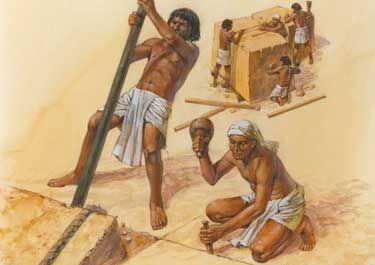 The first thing we need to do away with is the myth that Egyptians couldn't
have done it themselves or that they didn't have rope. I laughed the first time I read that somewhere in a more speculative forum. They showed us how
they did things. Not only were they capable of building such awesome creations they excelled at them. Many of their creations are still here to this
day. Admittedly all have seen better days. These are the people who built two of the seven wonders of the ancient world.
The first thing we need to do away with is the myth that Egyptians couldn't
have done it themselves or that they didn't have rope. I laughed the first time I read that somewhere in a more speculative forum. They showed us how
they did things. Not only were they capable of building such awesome creations they excelled at them. Many of their creations are still here to this
day. Admittedly all have seen better days. These are the people who built two of the seven wonders of the ancient world. The Great pyramid and the Alexandria lighthouse. Which is no longer with us. They used simple tools combined with basic math skills. Seems reasonable to me. Have we found examples of their basic mathematical skills? I may have found an interesting correlation between their known mathematical writing and a possible practical applications. I'll delve into that possibility a bit later.
The Rhind papyrus
[atsimg]http://files.abovetopsecret.com/images/member/730d3479cc23.jpg[/atsimg]
The Rhind papyrus
The Rhind papyrus contains geometry problems that compute the slopes of pyramids and the volume of various-shaped granaries. And the Moscow papyrus, from about 1850 B.C., has about 25 problems, including ways to measure ships’ parts and find the surface area of a hemisphere and the area of triangles. Especially interesting are problems that calculate how efficient a laborer was by how many logs he carried or how many sandals he could make and decorate. Or the problems that involve a pefsu, a unit measuring the strength or weakness of beer or bread based on how much grain is used to make it.
No Aliens here ma!
Just good old fashion backbreaking blood, sweat and tears.
The Egyptians left us some hieroglyphics showing how they moved large objects. With simple manpower and ropes while using some sort of lubrication. It wouldn't be that hard to imagine them using this basic technique on the smaller pyramid stones.
[atsimg]http://files.abovetopsecret.com/images/member/778d658097d9.jpg[/atsimg]
Knowing that many of our members are unable to view or simply refuse to watch You-tube videos I'll post a mostly visual presentation of the possible techniques described in the various videos presented throughout this thread coupled with questions I've had all these years.
So before we begin lets run down some of the competing building scenarios...
Long external ramp
[atsimg]http://files.abovetopsecret.com/images/member/bcf7a3aee975.jpg[/atsimg] [atsimg]http://files.abovetopsecret.com/images/member/4ce4b581da8c.jpg[/atsimg]The argument against such a system is the size and length of the ramp. Some have speculated that the Ramp itself would require as much or more material in it's construction that would be needed to build the Great pyramid. The length of said ramp in order to maintain a gradual enough slope to make hauling stones practical would have dictated a great distance which in modern times and even in ancient times just was impractical with regards to the supposed academically accepted time-line of construction...
Internal/External ramp
[atsimg]http://files.abovetopsecret.com/images/member/5ee2403100c1.gif[/atsimg] [atsimg]http://files.abovetopsecret.com/images/member/fa4c342f9b9a.gif[/atsimg]Here again we are back to the nasty fact that this scenario would also still require a great deal of material to build the ramp itself. I've often wondered if the Egyptians ever used the opposite reverse down-slope of the pyramid as a counter weight in hauling up the stones? Seems like using gravity would be something they would have considered. Why not?Various Winding External ramps
[atsimg]http://files.abovetopsecret.com/images/member/86b5de7423fc.gif[/atsimg]The following are some artists conceptions
of this possible construction technique
The supposed problem with the external winding ramp theory is lack of line of sight to align the four corners in order to maintain a strict and accurate angle. They may have made that mistake once before and that system could have been a contributing factor with the Bent Pyramid
[atsimg]http://files.abovetopsecret.com/images/member/8e3557479fda.jpg[/atsimg]
Another possibility is the Zig-Zag ramp system. The problem here is the turning of he stone to make he sharp turn heading in the opposite direct. Also as demonstrated in Jean-Pierre's video the edge would be very narrow and almost impossible to create a large enough footing on which to maneuver the building stones.
[atsimg]http://files.abovetopsecret.com/images/member/a59b17663384.gif[/atsimg]
This next theory is rather interesting. I liked this gentleman's approach. I can't speak for the accuracy in it's applications. He presents such a well thought out analyzes I thought it worthy of sharing with you. I'll just post a few videos and screen shots of it's possible pyramid construction contribution.
Djed possible uses
Pyramid construction theory Part-1
Djed[atsimg]http://files.abovetopsecret.com/images/member/facc1d5de88a.jpg[/atsimg]
The Djed symbol is a pillar-like ancient Egyptian symbol representing stability. It has been interpreted as the backbone of the Egyptian god Osiris, especially in the form Banebdjedet (the ba of the lord of the Djedet). Djedu is the Egyptian name for Busiris, a centre of the cult of Osiris. During the Renewal Festival, the djed would be ceremonially raised as a phallic symbol symbolising the "potency and duration of the pharaoh's rule".[1] It has been compared to the Sumerian concept of temen. The hieroglyph for "djed" may have given rise to the letter Samekh.
Exterior Djed rope rigging in use...
[atsimg]http://files.abovetopsecret.com/images/member/3665f3267145.jpg[/atsimg]
Djed possible uses
Pyramid construction theory Part-2
He seems to have found some practical use for these artifacts. I have yet to read any other non ceremonial explanation for their use or function. Even if his theoretical system is wrong what other practical purpose would they have? They look very much like some sort of stone age/megalithic tool. Great for a pivot ball joint?
[atsimg]http://files.abovetopsecret.com/images/member/437191c83918.jpg[/atsimg]
[atsimg]http://files.abovetopsecret.com/images/member/f330fcd4a600.jpg[/atsimg]
Djed possible uses
Pyramid construction theory Part-3
I don't know.. I see where he is going with this supposed rigging system. But I ask myself if it's plausible or even practical? I have no doubt they used some sort of rope/pulley/block and tackle etc system but which type? Are there any remnants or remaining physical evidence? Maybe, there is some rather tantalizing clues in the Grand Gallery, Stay tuned...
[atsimg]http://files.abovetopsecret.com/images/member/0f813b87e763.jpg[/atsimg]
[atsimg]http://files.abovetopsecret.com/images/member/67f8cd8bce18.jpg[/atsimg]
So in conclusion, it's an interesting theory. Does it demonstrate and hold to [Form following Function]? Outside of a few odd remnants it doesn't really address the mysteries of the internal structure of the Great pyramid, The Grand Gallery, The Antechamber or The Queens chamber. It does however bring into the fold the possibility of rope-rigging and or the use of pulleys. We'll be viewing that a bit later. I'll next be presenting another theory. This one is very exciting and has been posted here at ATS a few times. [Much to Byrd's and others frustration]
Timewatch: Pyramid - The Last Secret (Part 1 of 5)
French architect, Jean-Pierre Houdin and DASSAULT SYSTEMES Internal Ramp system
Presented by Bob Brier, a popular egyptologist from Long Island University, this documentary from the BBC's long-running "Timewatch" series presents a radical new theory proposed by a French architect, Jean-Pierre Houdin. According to Houdin, the blocks were raised via an internal ramp. This ramp is still inside the pyramid waiting to be discovered. If correct, Houdin's discovery will be the most significant in Archaeology since Tutankhamun.
The basic premise of his theory is that there were several ramps used. 1. A long ramp to build the first 1/3 of the pyramid. 2. Then an ascending interior ramp system winding its way towards the top as the pyramid grew in height and finally. 3. The internal "Grand Gallery mechanism. Which provides us with a possible function for it's long postulated use.
[atsimg]http://files.abovetopsecret.com/images/member/e1134e5e1f2f.jpg[/atsimg]
[atsimg]http://files.abovetopsecret.com/images/member/1d680982ce28.jpg[/atsimg]
In these two transparent 3-D representation you can see how this system may have worked. There would have been a long winding interior passage built as the pyramid grew coupled with open corners to turn the stones with some sort of rope rigged winching system...
[atsimg]http://files.abovetopsecret.com/images/member/f115ecbbe516.jpg[/atsimg]
[atsimg]http://files.abovetopsecret.com/images/member/4c57f3f48c47.jpg[/atsimg]
The internal ramp would have a ceiling consisting of a corbel vault similar to the Grand Gallery. Which if true means there are still undiscovered locations within the Pyramid. Could you imagine if in fact this system pans out and they found this sealed passage? I'd love to walk it's length and look for artifacts that have been sealed off all these centuries.
[atsimg]http://files.abovetopsecret.com/images/member/2ddd369ae894.jpg[/atsimg]
[atsimg]http://files.abovetopsecret.com/images/member/55e224351e54.jpg[/atsimg]
Once the laborers reached the open corners they would use a system of pulleys to lift and reposition the stone in a new direction to continue it's journey upwards towards it final resting place within the Pyramids matrix. There seems to be some tantalizing circumstantial evidence for this possible scenario...
[atsimg]http://files.abovetopsecret.com/images/member/f959f40624da.jpg[/atsimg]
[atsimg]http://files.abovetopsecret.com/images/member/7108c84c3284.jpg[/atsimg]
[atsimg]http://files.abovetopsecret.com/images/member/8f1512f9f4ff.jpg[/atsimg]
[atsimg]http://files.abovetopsecret.com/images/member/98deb52f7f74.jpg[/atsimg]
[atsimg]http://files.abovetopsecret.com/images/member/2597de560472.jpg[/atsimg]
The following few animations could simply be the result of my overly active imagination. It seems to me that no matter which angle you view the Great pyramid from there seems to be slight indications that there may have been some sort of winding ramp used. Whether it was either an internal or external one only time will tell...
[atsimg]http://files.abovetopsecret.com/images/member/1fd77d46e626.gif[/atsimg]
[atsimg]http://files.abovetopsecret.com/images/member/0f7c55d3bd86.gif[/atsimg]
[atsimg]http://files.abovetopsecret.com/images/member/007a31176726.gif[/atsimg]
[atsimg]http://files.abovetopsecret.com/images/member/925d6db14a14.gif[/atsimg]
[atsimg]http://files.abovetopsecret.com/images/member/b9da77fa7d6a.gif[/atsimg]
Grand Gallery mechanism...?
[atsimg]http://files.abovetopsecret.com/images/member/59eebeb8c015.jpg[/atsimg]
The Grand Gallery itself is an architectural marvel. Even as a child I could see from the photos in those old books that there was another function to it's design and wasn't just a corridor for the tomb. If you'll notice the center ascending path has no steps or even a practical way to climb up not to mention the evenly placed niches on either side. There is disagreement as to the function of the low ramps which skirt the sides of the gallery. Twenty-seven square openings in the ramp corresponding to twenty-seven niches in the side walls.
At the top of the Gallery there was a very well worn stone. "The Great Step"
[atsimg]http://files.abovetopsecret.com/images/member/f02b29e9afdc.jpg[/atsimg]
Below is a recent image. The stone in question has been repaired and that once well worn stone is now all but forgotten. Now, I'm not saying there isn't a legitimate reason for the repair but If you hadn't seen a photo of the original condition one would not have known how badly is was worn. The stone indicates that it was heavily used and NOT the result of Tomb raiders etc. In fact the entire interior of the Great pyramid shows massive amounts of Wear and tear from some sort of repeated activity.
[atsimg]http://files.abovetopsecret.com/images/member/cb385f90993d.jpg[/atsimg]
Also notice in both the above and below images the small passage leading through the Antechamber to the Kings chamber there is what appears to be yet again another repair job. These repairs have covered up some very important clues for the use of the Grand Gallery and the Antechamber.
[atsimg]http://files.abovetopsecret.com/images/member/202ff86c9a7d.jpg[/atsimg]
The "Groove" in the Great Step has been conjectured to be a purposely planed and used guide for some sort of rope pulley system. Exactly how this may have worked is still a mystery. I'll post the image below to give you a visual perspective.
[atsimg]http://files.abovetopsecret.com/images/member/10dc0115e315.jpg[/atsimg]
Again we will turn to French architect, Jean-Pierre Houdin and DASSAULT SYSTEMES for a cut away view of the interior. In his video representation of his theory he has demonstrated one possible use for the Grand Gallery. To me it makes a lot of sense,
[atsimg]http://files.abovetopsecret.com/images/member/29ecaa553f69.jpg[/atsimg]
However if you look closely it really doesn't show how the Antechamber was possibly used. As a matter of fact the video animation completely bypasses the Antechamber and shows rope rigging going up through the still open roof of the Grand Gallery.
[atsimg]http://files.abovetopsecret.com/images/member/1c72314283c3.jpg[/atsimg]
After having viewed his theory. [Yes, it's still just a theory] There hasn't been enough physical evidence found to declare it fact YET. I had many more questions. It eludes to the antechamber as being a part of some sort of winching mechanism but doesn't really describe how that functioned. It talks about the Grand Gallery as part of a massive counter weight to haul the gigantic stones for the Kings chamber. This seems possible. Let's now discuss the possible use of "Pulleys"
Basic engineering and physics demonstrates that the more intricate the rigging the more you can do with less and makes any lifting or hauling tasks that much easier. Explained further here...
[atsimg]http://files.abovetopsecret.com/images/member/79b9ac60cdf3.png[/atsimg]
[atsimg]http://files.abovetopsecret.com/images/member/30b27c9b9ba5.gif[/atsimg]
I'm going to stop here and discuss briefly "Egyptian Mathematics" The following is a simplified view of their mathematical table. Is this a simple example of Form following Function?
[atsimg]http://files.abovetopsecret.com/images/member/52dc752563fe.jpg[/atsimg]
This seems to resemble a pulley system physics break down. I could imagine some Egyptian engineer checking over the lift requirements and pulley layout using a similar calculation table...[atsimg]http://files.abovetopsecret.com/images/member/9cb2e1815d7b.jpg[/atsimg]
Next, I'll post first some images of the Antechamber and present my observations. Please feel free to reply and add your opinions and comments. Again I don't claim to have all the answers. If anything the more I've read and viewed the more questions I found myself pondering. Let's continue one....
Antechamber mechanism?
[atsimg]http://files.abovetopsecret.com/images/member/076960ae756a.gif[/atsimg]The argument surrounding it's function really begins with it's other given name and or function as a Portcullis
A portcullis (from the French "porte coulissante" or gliding door) is a latticed grille or gate made of wood, metal or a combination of the two. Portcullises fortified the entrances to many medieval castles, acting as a last line of defence during time of attack or siege. Each portcullis was mounted in vertical grooves in castle walls and could be raised or lowered quickly by means of chains or ropes attached to an internal winch.
Yadda Yadda Blah Blah Blah....
Ok, I have no doubt that being a Portcullis was it's final function. I like to think of the Antechamber as the Great Pyramid's multipurpose Swiss Army Knife. I'll try to keep the following as simple as possible. If you're like me the orientation can get a bit confusing sometimes. Below is a basic representation of the Antechamber. [atsimg]http://files.abovetopsecret.com/images/member/6d68b071d287.gif[/atsimg]
The Grand Gallery on the Right and the Kings chamber on the left. Notice how there are what appear to be some sort of horizontal pole supports facing you? They could have been used for a pulley system. Also in the following images I'll show some more of what appears to be "Wear and Tear" and again NOT tomb raider caused damage...
Looking straight up from within the Antechamber with the Kings Chamber on the left and the Grand Gallery on the right. Notice the grooved notches..[possibly rope guides] on the left above the passage leading to the Kings Chamber?[atsimg]http://files.abovetopsecret.com/images/member/56930e5f92fa.jpg[/atsimg]
[atsimg]http://files.abovetopsecret.com/images/member/d4d8248412fd.jpg[/atsimg]
Below we see what appears to be yet another repair job. I can imagine the bottom wear from the rubbing of ropes back and forth as the Antechamber was in use during the construction. Also notice that the "Guides" on either side are broken off? I doubt some "Tomb Raider" would take the time to chisel away at them for no other purpose than just simple vandalism. It looks like a very well worn stone age purpose built mechanism showing massive amounts of wear.
[atsimg]http://files.abovetopsecret.com/images/member/04c1b683b64b.jpg[/atsimg]
Old sketching showing the amount of possible
wear before the modern repair work was done...
Let's continue with our visual tour. Next we are facing towards the Grand Gallery. Notice the second stone block above the facing entrance? The second image below is a close up and shows what could also be wear from some sort of rope system. You may have a different opinion and or theory to why it is in the shape it is. I'd love to hear it.
[atsimg]http://files.abovetopsecret.com/images/member/9b01773f7601.jpg[/atsimg]
[atsimg]http://files.abovetopsecret.com/images/member/e26d5519b761.jpg[/atsimg]
Below we have a closer look at what appears to be guides for massive blocks used in the Antechamber. What were their purpose? Why are some broken away? If they were vandalized wouldn't they show jagged edges instead of smooth edges?
[atsimg]http://files.abovetopsecret.com/images/member/d712b3677a26.jpg[/atsimg]
Next I'm posting some more visual representations so you can get a better feel for it's possible uses. I'm wondering if it could have been used also as some sort of breaking system in conjunction with Jean-Pierre Houdin's Grand Gallery theory or something similar?
[atsimg]http://files.abovetopsecret.com/images/member/b91ace5b4988.jpg[/atsimg]
[atsimg]http://files.abovetopsecret.com/images/member/12ad8860d419.jpg[/atsimg]
[atsimg]http://files.abovetopsecret.com/images/member/2aebd9114a09.jpg[/atsimg]
[atsimg]http://files.abovetopsecret.com/images/member/e1169a2243d6.gif[/atsimg]
Ok so let's Head down towards the bottom of the Grand Gallery. Here we will find some other less discussed remnant anomalies. The first images shows both the ascending Grand Gallery above and the descending passage blocked by a steel gate heading towards the lower Queens Chamber. If you look closely you'll notice several niches on either side.
[atsimg]http://files.abovetopsecret.com/images/member/ae235478bb3d.png[/atsimg]
Below are some renderings showing their relative size and locations in reference to the ascending and descending passages. What were their purpose or use? Could they have been a lower part of a much larger mechanism? If so how were they utilized?
[atsimg]http://files.abovetopsecret.com/images/member/83327d3336cd.jpg[/atsimg]
[atsimg]http://files.abovetopsecret.com/images/member/499e14bbdddd.gif[/atsimg]
Keeping with the Idea that Form follows Function what possible use could they have had? Remember that the Egyptians most likely were very focused on what was critical and wouldn't have lent themselves to non purposeful additions. It has been conjectured that they once held torches to light the entrance. Well why so many and why so unevenly spaced and sized? If the Antechamber was a breaking or pulley system and the Grand Gallery was used for some sort of counter weight lifting mechanism we may be seeing the signs of anchoring and or remains of a lower gig mount for some sort of counter weight sled return system?
Queens chamber mechanism?
[atsimg]http://files.abovetopsecret.com/images/member/f38beb91f687.jpg[/atsimg] [atsimg]http://files.abovetopsecret.com/images/member/24100f1c782e.jpg[/atsimg] In the Queens chamber we find a corbelled arched niche. You'll notice in the above two renderings that there has been some exploration of the niche [possibly looking for Treasure] and by doing so they could have destroyed valuable evidence about how the Pyramid was constructed or how the Chamber could have been used.Now supposedly this chamber really wasn't for a Queen. Some have postulated that the Niche once had a stature of Khufu/Cheops. The Chambers other possible use was the "Treasure room/Possession Chamber" for the Pharaohs after life. But what if it as well had another purpose during the construction? We have explored this Dual purpose scenario in other locations inside the Pyramid so why not here as well? [atsimg]http://files.abovetopsecret.com/images/member/ff60bff28fec.jpg[/atsimg]
Is it possible that the Queens chambers story has yet to be figured out? One could imagine it being a crucial part of construction. Again the Egyptians were very pragmatic and everything in the Great pyramid had a purpose. I thought this was a rather interesting prospect. Did the Chamber house a large wheeled device that used the Niche as a bracing mount for a counter weight sled return mechanism?
[atsimg]http://files.abovetopsecret.com/images/member/0683155460ff.gif[/atsimg]
[atsimg]http://files.abovetopsecret.com/images/member/99d6cb98d3ed.jpg[/atsimg]
Pure speculation on my part. No evidence of any such wheel exists. Another problem with this theory is that it would require a much more complex pulley rope rigging system up top in the Antechamber. We just don't see any physical evidence for this type of rigging.
[atsimg]http://files.abovetopsecret.com/images/member/6595df49f8e3.gif[/atsimg]
Little known Relics found inside the Great pyramid
[atsimg]http://files.abovetopsecret.com/images/member/a8b58a3623a4.jpg[/atsimg][atsimg]http://files.abovetopsecret.com/images/member/239407040cf7.jpg[/atsimg]
Dixon Relics
The shafts in the Queen’s Chamber were first discovered in 1872 by a British engineer named Waynman Dixon. The ancient Egyptians had blocked them with stones, making it appear that the walls of the chamber were completely solid. Dixon, however, decided to probe all the joints in the masonry of the Queen’s Chamber with a wire to see if anything might be hidden behind them. When he discovered a hollow in the southern wall, he chiseled through to reveal the shaft. He realized that there was probably a corresponding shaft in the northern wall, and was indeed able to locate one. In the southern shaft, Dixon and his associate James Grant found a small, bronze hook.
The northern shaft yielded a granite ball and a piece of cedar-like wood. These objects became known as the Dixon Relics. Both sets of artifacts lay in the rubble at the bottom of the sloping shafts. A report on the discovery of the relics was published in the journal “Nature” on December 26, 1872, including a drawing of the items. In 1993 a search led to the discovery of the ball and hook in the British Museum, where they remain today. The piece of cedar-like wood was missing until 2001, when it was traced to the Marischal Museum in Aberdeen, Scotland.
[atsimg]http://files.abovetopsecret.com/images/member/2675e4553992.jpg[/atsimg]
[atsimg]http://files.abovetopsecret.com/images/member/95490c62d091.jpg[/atsimg]
So where is the small piece of wood? This and the next items seem to be missing. I'd love to see the C-14 dating on the wood and would also love to have a modern lab take a good hard look at the next item as well. This brings us to the supposed "Air Shafts" I highly doubt that's what their main or original purpose was for or the other purpose as channels for the pharaohs soul. Being plugged seems like a lousy way to provide "Air or a smooth passage for a soul"
There could be another purpose for them. I'll go with a simple communication system. As the pyramid rose higher and wider [If in fact the Grand Gallery was a mechanism] there needed to be a simple and easy way to communicate with to and fro the outer or upper levels of construction. The ball was found inside one of the air-shafts. How about this for dual purpose. They would roll down the stone balls signaling the need for some yet unknown action from the Grand Galley mechanism? Just a thought...
The Iron Plate in the Great Pyramid
[atsimg]http://files.abovetopsecret.com/images/member/0f0ac7261467.gif[/atsimg]
[atsimg]http://files.abovetopsecret.com/images/member/09a8093aace7.gif[/atsimg]
Great Pyramid Iron plate
In 1837, Colonel Howard Vyse, with the assistance of two civil engineers (John Perring and James Mash), investigated the air shafts in the King's Chamber of the Great Pyramid described by George Sandys more than 200 years earlier. A man in Vyse's team, J.R. Hill, was put in charge of clearing the mouth of the southern shaft. Vyse's methods were not subtle, and the use of explosives was employed resulting in the vertical gash that can still be seen on the south side of the pyramid.
On Friday, 26 May 1837, after a few days of blasting and clearing, Hill discovered a flat iron plate about 26 cm (10.2") long, 8.6 cm (3.4") wide, with a thickness ranging from .4 cm (.2") to nearly zero. The plate weighs about 750g. Vyse proclaimed it to be "the oldest piece of wrought iron known." Hill affirmed that his find was legitimate:
In conclusion I'll leave you with these few remaining images of the other Large pyramid at Giza Khafre's pyramid. I'm excited about the possibility of a still yet to be discovered hidden ramp winding it's way up through the Great pyramid. If this is true then what do we say about a possible similar system used in Khafre's pyramid construction as well? It seems plausible because Khafre's Pyramid followed his fathers Khufu relatively soon after. Can you see any hint of a possibly hidden ramp system in Khafre's pyramid?
[atsimg]http://files.abovetopsecret.com/images/member/7fab4b35e3ec.gif[/atsimg]
[atsimg]http://files.abovetopsecret.com/images/member/01c74c37fd5c.jpg[/atsimg]
[atsimg]http://files.abovetopsecret.com/images/member/7e6c7e564229.jpg[/atsimg]
[atsimg]http://files.abovetopsecret.com/images/member/0c187e0ca01b.jpg[/atsimg]
I'm looking forward to your replies. Please state your opinions both pro or con. Hopefully we may even get a spirited debate or discussion going. I'd love to hear about other theories and any new information. This is how I learn. Thanks for taking the time to read.
As always my friends
have a good day
Originally posted by thisisnotaname
Try this theory: Pyramids, Kundalini, and the Master Numbersedit on 19-3-2011 by thisisnotaname because: (no reason given)
love this, but still it intrigues me to think just how can people come up with this theories i strongly believe there are other source and there is a greater meaning to the pyramids than just a tomb..
I was rearranging my bedroom the other week with my girlfriend, and we had a massive heavy cupboard to move from one end of the room to the other. So we used an old 'Egyptian' trick my Dad taught me when I was a kid.
Got a load of plastic poles from a shelving unit and a plank of wood. Made a slope onto the first pole then slid the wardrobe up the ramp. Then we tilted it placing more poles underneath. When we pushed it along, we took the poles from the back and placed them in front allowing the wardrobe to roll along on top.
If we managed that in 20 minutes I have no doubt these highly skilled and intelligent folks could build the monuments they did!
You should write a whole thread about that endeavor and other related experiences.
how dare you sir!
I said good day!
one of the main ideas was that most of our current knowledge on the pyramids is false and actually insults the capabilities of the cultures who built them. they suggest the pyramids are are much older than we think, and the notion that the "bent pyramid" was a mistake is foolish, and that the pyramids where possibly generators of some sort (hence their placement atop a limestone aquifer).
anyhow, excellent stuff Slayer. provocative and thorough. you are on a roll.
Well there are plenty of other stories from the same bedroom, that might get more stars and flags. Although the wardrobe story obviously has all the makings of a classic.
"What do you do when the best of hydraulic cranes fail to lift a wreck? Call the Mappila Khalasis, ofcourse! Where state-of-the-art machines fail, the 37 men Khalasi teams of Kozhikode in northern Kerala"
www.keralatourism.org...
en.wikipedia.org...
They recovered the train plunged into a river where modern technology failed
www.jstor.org...
Nice thread Slayer s&f...
The amount of stones that needed to be moved is what gets me..
If done with pulleys it must have been very well organized..
Multiple stones being moved at all times...
Here's a site that only talks about the numbers...
www.cheops-pyramide.ch...
I personally believe in the internal ramp theory being the way the Egyptians built the pyramids. It makes the most sense to me.
Thanks again for a great thread.
Omg Slayer, I got to get some coffee, but this is perfect timing. I will consume all of the cream this thread has to offer.
Snf- You maniac.
The Egyptians were very pragmatic and everything in the Great pyramid had a purpose IMHO.
Whether we in the 21st century can figure them out is a whole other story. Imagine trying to assemble
a complex puzzle while missing all the primer pieces? Well this is the exact situation we find ourselves
confronted with. So what do we make of some of the less obvious or discussed aspects of the remaining
physical evidence they left behind? I'm a firm believer in the saying that Form follows Function
I would need to ask you about the complexity,
of this puzzle and the principle, of form follows function,
in relation to the fact most mainsteam academics claim
ancient man didn,t even have a wheel. Yet, how far back
does the chariot go? I'm positive it goes back, well before
the exodus.
whos the great big giant guy in the above hyro?
one of the giant aliens they keep on about, or a statue of one of the giant aliens?
Enjoy...
[atsimg]http://files.abovetopsecret.com/images/member/08293841c671.jpg[/atsimg]
This is for me the best explanation as of yet. The pulley system I mean.
The South American people were also geniuses when it came on rope use and there is no reason to assume the Egyptians weren't capable of an equal or even better use...
Very thought provoking. Thank you
-
BIDEN Admin Begins Planning For January 2025 Transition to a New President - Today is 4.26.2024.
2024 Elections: 7 hours ago -
Big Storms
Fragile Earth: 9 hours ago -
Where should Trump hold his next rally
2024 Elections: 11 hours ago
-
James O’Keefe: I have evidence that exposes the CIA, and it’s on camera.
Whistle Blowers and Leaked Documents: 14 hours ago, 17 flags -
Australian PM says the quiet part out loud - "free speech is a threat to democratic dicourse"...?!
New World Order: 14 hours ago, 15 flags -
Biden "Happy To Debate Trump"
2024 Elections: 16 hours ago, 14 flags -
Ireland VS Globalists
Social Issues and Civil Unrest: 15 hours ago, 11 flags -
BIDEN Admin Begins Planning For January 2025 Transition to a New President - Today is 4.26.2024.
2024 Elections: 7 hours ago, 9 flags -
Big Storms
Fragile Earth: 9 hours ago, 8 flags -
Shocking Number of Voters are Open to Committing Election Fraud
US Political Madness: 12 hours ago, 7 flags -
What is the white pill?
Philosophy and Metaphysics: 17 hours ago, 6 flags -
Gov Kristi Noem Shot and Killed "Less Than Worthless Dog" and a 'Smelly Goat
2024 Elections: 13 hours ago, 5 flags -
Where should Trump hold his next rally
2024 Elections: 11 hours ago, 5 flags
-
Definitive 9.11 Pentagon EVIDENCE.
9/11 Conspiracies • 429 • : Lazy88 -
University of Texas Instantly Shuts Down Anti Israel Protests
Education and Media • 320 • : burritocat -
Man possibly killed by werewolf in Texas
Cryptozoology • 28 • : RustyShack78 -
Most Compelling Loch Ness Monster Pictures Defy Explanation
Cryptozoology • 60 • : RustyShack78 -
Hate makes for strange bedfellows
US Political Madness • 54 • : Terpene -
A Warning to America: 25 Ways the US is Being Destroyed
New World Order • 30 • : glen200376 -
Eclipse picture taken by my son from the NH-ME border - Cool!
General Chit Chat • 26 • : EyeoftheHurricane -
-@TH3WH17ERABB17- -Q- ---TIME TO SHOW THE WORLD--- -Part- --44--
Dissecting Disinformation • 705 • : cherokeetroy -
Falkville Robot-Man
Aliens and UFOs • 10 • : billxam1 -
Gov Kristi Noem Shot and Killed "Less Than Worthless Dog" and a 'Smelly Goat
2024 Elections • 64 • : cherokeetroy