It looks like you're using an Ad Blocker.
Please white-list or disable AboveTopSecret.com in your ad-blocking tool.
Thank you.
Some features of ATS will be disabled while you continue to use an ad-blocker.

The truth about Native Americans
page: 3share:
reply to post by speaknoevil07
Probably Comanche: central Texas was the heart of their territory.
But there was also the nearby Oklahoma areas, since the US used Oklahoma for a sort of "semi-free-range" concentration camp for Native Americans, it's hard to say with certainty. The Cheyenne and Sioux tend to tallness, as do the Lake People, a lot of northern tribes were sent there.
[edit on 27-1-2009 by apacheman]
Probably Comanche: central Texas was the heart of their territory.
But there was also the nearby Oklahoma areas, since the US used Oklahoma for a sort of "semi-free-range" concentration camp for Native Americans, it's hard to say with certainty. The Cheyenne and Sioux tend to tallness, as do the Lake People, a lot of northern tribes were sent there.
[edit on 27-1-2009 by apacheman]
Originally posted by cautiouslypessimistic
What I dont get is why no one mentions pangea in all of this. To me, just being in a different region of pangea when the split occured(over time, of course), would put native peoples in different areas of the world, in different climates, which would change features. Dunno, makes sense to me.
Somebody else mentioned this on the first page, so I will reiterate why this is impossible.
Pangaea existed 250 million years ago. Taking into account that it broke apart in three major phases (the last of which would've been 40 million years......give or take) spanning some two hundred million years, humans didn't emerge until many millions of years after; hence, humans did not exist during pangaea's existence and therefore had to populate the new world by some other means.
Well, since no one quite mentioned this (someone almost did when they mentioned that the PTB are hiding things...), I think I will put this out there
for general consideration.
The OP posted a link to a page titled "DNA Evidence for Atlantis," so I suppose it's not entirely out of her/his mind. In fact, I found it interesting that the article said this:
There was a continent much like Atlantis (but was "founded" quite a while before) called Lemuria, or Mu, which was in the general area of where the B haplogroup was found. It is said that the population of Lemuria went underground to escape the Flood and came above ground after it was all over and migrated around the area and others for thousands of years. I would assume one of the destinations is some North and South American mainlands.
Then, even before that, I think we were ultimately genetic science projects or interbred with aliens. Sounds fairly reasonable to me, considering the striking similarities of mythologies, etc. But that's another discussion.
The OP posted a link to a page titled "DNA Evidence for Atlantis," so I suppose it's not entirely out of her/his mind. In fact, I found it interesting that the article said this:
The B haplogroup was traced to aboriginal population groups in Southeast Asia, China, Japan, Melanesia, and Polynesia.
There was a continent much like Atlantis (but was "founded" quite a while before) called Lemuria, or Mu, which was in the general area of where the B haplogroup was found. It is said that the population of Lemuria went underground to escape the Flood and came above ground after it was all over and migrated around the area and others for thousands of years. I would assume one of the destinations is some North and South American mainlands.
Then, even before that, I think we were ultimately genetic science projects or interbred with aliens. Sounds fairly reasonable to me, considering the striking similarities of mythologies, etc. But that's another discussion.
Originally posted by asmeone2 It seems that some of these tribes have oral traditions that say they lived in the Americas for tens of thousands of years.
That is beginning to be accepted because of sites that are being confirmed as being that old. Monte Verde in Chile could be as old as 40K.
Western archaeologists just discount that as impossible, because they can't see a written record of it.
No, they require proof. That's why it's called science.
It's arrogant, here they have the cultures they are studying right in front of them, but act like these people are too stupid to keep their own past straight!
Then why should the Bible not be accepted as the truth? It's the word of the people, passed on down, right? The paradigm has been changing, but oral tradition is only so useful...be it in a First Nations context, or that stuff that you don't seem to recall quite the same as your pal did. That's why it comes down to science. That's not to say it should disrespect your traditions.
In the bad old days, archaeologists were saying "Let me tell you about who you are." Nowadays, there's more of a tendency to say "Let me help you to see where you've been".
reply to post by NativeAmerican
asia is very ancient...there were civilizations there long before other areas of the world...
My great grandfather was full blood Blackfoot Tribe...
What does that make me? 1/16th? "Redline" was his westernized surname.
It made be a tiny bit in me -- but I fully embrace whatever is still there. Living in Alaska and being so close to nature, I at times can feel a connection (similar to my father) to the land that many others cannot.
Has anyone mentioned the Clovis people and how they disapeared?
What does that make me? 1/16th? "Redline" was his westernized surname.
It made be a tiny bit in me -- but I fully embrace whatever is still there. Living in Alaska and being so close to nature, I at times can feel a connection (similar to my father) to the land that many others cannot.
Has anyone mentioned the Clovis people and how they disapeared?
reply to post by Lifthrasir
What's interesting is that the tribe Chippewa they say has the most X gene DNA or whatever that could be Atlantean. That's the tribe part of me is descended from. A while ago I was perscribed Bentyl for muscle spasms. I took too much by mistake and entered a deep slumber where I left my body and thought I had died. I was watching my body from outside of it. During this time I was basically given a story of my life. It began with who I am but am too afraid to show to people. Then it showed who I was to become and for some reason I was shown an ancient civilization and told that it was Atlantis....though that part doesn't make sense since I can't become an adventurer to Atlantis or anything since if it existed it's been destroyed. Then I was told before going back to my body that "your people came from Atlantis on your father's side" (this was long before reading that article and my father's side is the part that is Chippewa) and that "the proof of this experience would be shown". At which point I awoke and a tumor that had been growing over my kidneys had some how disappeared. Honestly I just thought I was really F'd up but the part that got me was the tumor not being there. That's not normal. Also for 2 days I did not have a disability I have (again, not normal). Unfortunately over time it all came back. I still think it was just way too much Bentyl but the physical body being healed like that temporarily and being told I was Atlantean (then reading this article) still makes me wonder to this day.....
And now I officially sound insane
What's interesting is that the tribe Chippewa they say has the most X gene DNA or whatever that could be Atlantean. That's the tribe part of me is descended from. A while ago I was perscribed Bentyl for muscle spasms. I took too much by mistake and entered a deep slumber where I left my body and thought I had died. I was watching my body from outside of it. During this time I was basically given a story of my life. It began with who I am but am too afraid to show to people. Then it showed who I was to become and for some reason I was shown an ancient civilization and told that it was Atlantis....though that part doesn't make sense since I can't become an adventurer to Atlantis or anything since if it existed it's been destroyed. Then I was told before going back to my body that "your people came from Atlantis on your father's side" (this was long before reading that article and my father's side is the part that is Chippewa) and that "the proof of this experience would be shown". At which point I awoke and a tumor that had been growing over my kidneys had some how disappeared. Honestly I just thought I was really F'd up but the part that got me was the tumor not being there. That's not normal. Also for 2 days I did not have a disability I have (again, not normal). Unfortunately over time it all came back. I still think it was just way too much Bentyl but the physical body being healed like that temporarily and being told I was Atlantean (then reading this article) still makes me wonder to this day.....
And now I officially sound insane
reply to post by MystikMushroom
Sorry I cannot answer your question because I do not know but you mentioned being in touch with nature. It's strange, do you think certain mental thought traits can be passed down genetically? It's a strange story about me. Before learning that I was part Native American and visiting my biological family (since I was adopted) I would always just go out into nature, usually by a creek and sit there. Even when I was 3 my parents told me I'd start getting all giggly and smiley going into the woods. They called me the "Happy Wanderer". I would (and to this day) always walk around barefoot (I'm actually all calysted from it). I would even visit friends who lived in my neighborhood barefoot. My parents thought it was some type of hippy-ites (lol) or something. I would be captivated when we'd take school trips to museum's to learn of Native American history. Everyone thought I was a dork because at those hands on type tribe museum's I'd start freaking out because I wanted to be the one who would skin the animal or make the drum (actually looking back on it it's kinda weird they were letting middle school kids skin animals in a public school....but anyway....). I was also obsessed with Hiawatha for some reason and always wanted to play the "Indian" in games from elementary school like in 2nd-3rd grade. I never took to the whole cowboy thing. I actually disliked cow boys even though my adoptive father was heavily into John Wayne. I would always cheer for the Native Americans. I also found the Native American headdresses and clothing so cool. I had some when I was a little kid and would wear them around.
[edit on 27-1-2009 by NativeAmerican]
Sorry I cannot answer your question because I do not know but you mentioned being in touch with nature. It's strange, do you think certain mental thought traits can be passed down genetically? It's a strange story about me. Before learning that I was part Native American and visiting my biological family (since I was adopted) I would always just go out into nature, usually by a creek and sit there. Even when I was 3 my parents told me I'd start getting all giggly and smiley going into the woods. They called me the "Happy Wanderer". I would (and to this day) always walk around barefoot (I'm actually all calysted from it). I would even visit friends who lived in my neighborhood barefoot. My parents thought it was some type of hippy-ites (lol) or something. I would be captivated when we'd take school trips to museum's to learn of Native American history. Everyone thought I was a dork because at those hands on type tribe museum's I'd start freaking out because I wanted to be the one who would skin the animal or make the drum (actually looking back on it it's kinda weird they were letting middle school kids skin animals in a public school....but anyway....). I was also obsessed with Hiawatha for some reason and always wanted to play the "Indian" in games from elementary school like in 2nd-3rd grade. I never took to the whole cowboy thing. I actually disliked cow boys even though my adoptive father was heavily into John Wayne. I would always cheer for the Native Americans. I also found the Native American headdresses and clothing so cool. I had some when I was a little kid and would wear them around.
[edit on 27-1-2009 by NativeAmerican]
reply to post by NativeAmerican
Maybe a train of thought for you on this point brother, though I am not native American, though welsh so who knows lol.
Is it your genes?
Collective ancestoral consciousness?
Or is it your Guides?
Or even your anscestors watching over you?
Or maybe the land itself, its spirit, the spirit of the nature there?
and then is it one of these things, two, three or all?
and if soo to what degree each one?
Much peace on your path to understanding yourself and heritage more.
Go within? why not, visit a reservation, speak to an elder why they still are around.
Kind Regards,
Elf
Maybe a train of thought for you on this point brother, though I am not native American, though welsh so who knows lol.
Is it your genes?
Collective ancestoral consciousness?
Or is it your Guides?
Or even your anscestors watching over you?
Or maybe the land itself, its spirit, the spirit of the nature there?
and then is it one of these things, two, three or all?
and if soo to what degree each one?
Much peace on your path to understanding yourself and heritage more.
Go within? why not, visit a reservation, speak to an elder why they still are around.
Kind Regards,
Elf
There was a huge study down on languages, including the Bella Coola language is a written one, and the conlusion was there were similarities and
origin from Japan, Korea, China and numerous places. One of my sons who is 1/4 Bella Coola native, and they have a 10,000 year history in that valley
with carvings that are similar only to the Hawaiian, was, like many asians, a blue bottomed baby, with the mongolian spots that took years to fade,
like bruises on his lower spine/buttocks, and is lactose intolerant.
reply to post by MischeviousElf
My scientific upbringing says that it is most likely genes. But I have had some weird experiences. If I recall correctly some of my relatives were actually considered shamans and I know on my moms side there were psychic mediums. I've always been an emotional, sensitive child. Which was both good for understanding deep philosophical meanings at a young age, but bad for being bullied. I spent a good portion of my younger years in deep thought and was labeled a dreamer as well as possible ADD. I also got in some fights in high school for sticking up for people that were being bullied, once I had gained more confidence. As well as women in my life. I actually looked very German, and at that time had raging blond hair. But if you looked closely you could see some traits that Native Americans share. These are a lot more noticeable in my uncle and cousin.
Anyway, before I had known about the shamans or psychic mediums in my family. Yes, my relatives would quite blatantly see dead people. I met a Shaman from North Korea. Who had lived there in some strange temple or something for a year or so as well as with the Native Americans. He actually claimed he had developed an ability while living with these people (I have no idea what it's called) where there was a certain white parchment that after doing the daily meditations words would appear in different languages in gold script. These words were supposedly messages from the masters. I never really looked up what this could be but anyway the second he saw me he sat me down and said "You know you are a shaman right and energies and spirits walk with you?" I wasn't sure how to react, I was somewhat in awe, happy, and scared because it seemed to make sense given all the strange things that had happened that I could never verbalize to other people for fear of being mocked. Over time we established a relationship and he shared great tales. He always referred to me as someone special and I over time saw the same in him. He showed me how simplistic magick could be. Even things that would seem like parlor tricks, although actually psychic in nature became much more when he did them.
My scientific upbringing says that it is most likely genes. But I have had some weird experiences. If I recall correctly some of my relatives were actually considered shamans and I know on my moms side there were psychic mediums. I've always been an emotional, sensitive child. Which was both good for understanding deep philosophical meanings at a young age, but bad for being bullied. I spent a good portion of my younger years in deep thought and was labeled a dreamer as well as possible ADD. I also got in some fights in high school for sticking up for people that were being bullied, once I had gained more confidence. As well as women in my life. I actually looked very German, and at that time had raging blond hair. But if you looked closely you could see some traits that Native Americans share. These are a lot more noticeable in my uncle and cousin.
Anyway, before I had known about the shamans or psychic mediums in my family. Yes, my relatives would quite blatantly see dead people. I met a Shaman from North Korea. Who had lived there in some strange temple or something for a year or so as well as with the Native Americans. He actually claimed he had developed an ability while living with these people (I have no idea what it's called) where there was a certain white parchment that after doing the daily meditations words would appear in different languages in gold script. These words were supposedly messages from the masters. I never really looked up what this could be but anyway the second he saw me he sat me down and said "You know you are a shaman right and energies and spirits walk with you?" I wasn't sure how to react, I was somewhat in awe, happy, and scared because it seemed to make sense given all the strange things that had happened that I could never verbalize to other people for fear of being mocked. Over time we established a relationship and he shared great tales. He always referred to me as someone special and I over time saw the same in him. He showed me how simplistic magick could be. Even things that would seem like parlor tricks, although actually psychic in nature became much more when he did them.
Hope these links may help about the 2 different ways that the Americas were populated
The Solutrean Hypothesis
The Clovis Culture
I've always been fascinated about why the Clovis people suddenly vanished at the same time the mega fauna/Animals disappeared.
Stone Age Columbus - programme summary
[edit on 27-1-2009 by greenfruit]
Typo
[edit on 27-1-2009 by greenfruit]
The Solutrean Hypothesis
The Clovis Culture
I've always been fascinated about why the Clovis people suddenly vanished at the same time the mega fauna/Animals disappeared.
Stone Age Columbus - programme summary
[edit on 27-1-2009 by greenfruit]
Typo
[edit on 27-1-2009 by greenfruit]
the answer is exciting, but not as exciting as realizing that we all come from the earth. all we are are walking clumps of earth, and our physical
selves will once again become earth.
The Lakota people, whom I primarily learned from, have many similarities to the cultures all over the world. But when you really take a look at all cultures, you realize that they all have similarities.
One of the biggest things that made me better understand the Lakota phrase, AHO MITAKUYE OYASIN, which means ALL MY RELATIONS, is the medicine wheel.
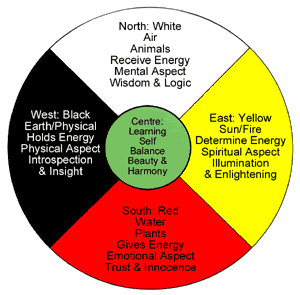
The Medicine wheel is a symbol, and has many different interpretations and definitions and meanings. Besides the above and other meanings that the wheel represents, it also represents unity and the unification of the four races of the earth.
watch this
Lakota Wisdom Keepers
I wonder more on who the ancestors of the Aztecs and the Mayans were, than the more recent tribes....
The Lakota people, whom I primarily learned from, have many similarities to the cultures all over the world. But when you really take a look at all cultures, you realize that they all have similarities.
One of the biggest things that made me better understand the Lakota phrase, AHO MITAKUYE OYASIN, which means ALL MY RELATIONS, is the medicine wheel.
The Medicine wheel is a symbol, and has many different interpretations and definitions and meanings. Besides the above and other meanings that the wheel represents, it also represents unity and the unification of the four races of the earth.
watch this
Lakota Wisdom Keepers
I wonder more on who the ancestors of the Aztecs and the Mayans were, than the more recent tribes....
I am glad to share some hopefully helpful resources to the OP.
I am Cherokee/Osage/Irish. I first started doing research about my heritage due to the prevalence of blue eyes in my family when brown eyes are theoretically dominant in native North Americans.
I discovered that the Caribe or Kalinago natives of the Lesser Antilles Islands of the Caribbean Sea also had a prevalence of blue eyes.
The origin and routes of migration of native population to North America is still one of the most highly debated in archaeology today.
There are four major routes that are generally accepted as viable theories with some evidence. Please remember that these are really just "best guesses" based on current evidence.
archaeology.about.com...
The discovery of the Monte Verde site in Chile has given some credence to the theory that there were cultures in the Americas more than 15,000 years ago. Some researchers have postulated that there is evidence dating to 50,000 years ago. This would imply that while some may have come over the northern land bridge, there is evidence of cultures in North America that would have to come from other routes due to glaciation blocking the path from the North.
It's all very interesting especially if you have a genetic link to the heritage.
I hope this gives you some research directions.
I am Cherokee/Osage/Irish. I first started doing research about my heritage due to the prevalence of blue eyes in my family when brown eyes are theoretically dominant in native North Americans.
I discovered that the Caribe or Kalinago natives of the Lesser Antilles Islands of the Caribbean Sea also had a prevalence of blue eyes.
The origin and routes of migration of native population to North America is still one of the most highly debated in archaeology today.
There are four major routes that are generally accepted as viable theories with some evidence. Please remember that these are really just "best guesses" based on current evidence.
Four Theories about the American Population
* Clovis and the Ice Free Corridor
* Preclovis and the Pacific Coast Migration
* Solutrean Precursors to Clovis
* Trans-Pacific Contacts
One reason there is so much unsettled discussion has in part to do with the timing and character of the Last Glacial Maximum. The most widely accepted routes into the Americas come via the Bering Strait across what scientists call Bering Land Bridge. During the LGM, the routes into North America were blocked by glacial ice between at least 24,000 and maybe 30,000 and 18,000 years ago, at least so it seems, and yet there are archaeological sites that appear to have dates older than 18,000 years ago.
DNA and linguistic analysis have been brought to the discussion, but neither provides an unequivocal answer. One paper published by Perego et al. in January of 2009 suggests that Native Americans arrived in several waves into the Americas using two of these entry ways: the Ice Free Corridor and the Pacific Coast Migration model. The paper studied two mtDNA haplotypes and is well worth investigating.
It remains a puzzle.
archaeology.about.com...
The discovery of the Monte Verde site in Chile has given some credence to the theory that there were cultures in the Americas more than 15,000 years ago. Some researchers have postulated that there is evidence dating to 50,000 years ago. This would imply that while some may have come over the northern land bridge, there is evidence of cultures in North America that would have to come from other routes due to glaciation blocking the path from the North.
It's all very interesting especially if you have a genetic link to the heritage.
I hope this gives you some research directions.
Read Vine Deloria's books, especially The World We Used to Live In. There you will find the answers you look for my friend.
It seems that the currently accepted theory is that Central and South America was populated by older cultures from North America.
www.archaeology.org...
This is from a site in South Carolina:
www.archaeology.org...
Other resource sites I use:
www.centerfirstamericans.com...
www.uark.edu...
www.personal.psu.edu...
www.nps.gov...
pidba.utk.edu...
It's ironic to me that we seem to know as much about our way of life 5 - 10 thousand years as we can agree upon what our way of life was 5 - 10 years ago; and disagree just as adamantly about the facts.
The most widely accepted theory of the peopling of South America suggests that over a period of 3,000 years Paleoindians left Asia, crossed the Bering Strait on a land bridge that has since been submerged, then migrated through what is now the western United States and Central America into South America, settling along the Andes. Paleoindians in the Andes and those in North America had similar cultures, known as the Clovis tradition. These early hunters lived in open, temperate lands where they hunted large game with stone-pointed spears. The humid tropical forest environment of the Amazon was thought to have been too harsh for early people, and until now this area had not been investigated intensively by archaeologists.
www.archaeology.org...
This is from a site in South Carolina:
"We now have hundreds of artifacts dated between 14,000 and 18,000 years ago," Goodyear says, standing deep in the pit from which he and an army of volunteers have been excavating them over the past several field seasons.
Then he points to a chert boulder and a streak of charcoal embedded in dun-colored clay six feet below him. Fragments were broken off the basketball-size boulder, he says, and used to make crude stone tools. The charcoal stain is, perhaps, an ancient hearth.
"Based on the radiocarbon dates of the charcoal, I think we have evidence of human activity here in the interior of America 40,000 to 50,000 years ago," he says. "It looks like people came here periodically to get chert for their tools. Where they came from and when, I still have no clue."
www.archaeology.org...
Other resource sites I use:
www.centerfirstamericans.com...
www.uark.edu...
www.personal.psu.edu...
www.nps.gov...
pidba.utk.edu...
It's ironic to me that we seem to know as much about our way of life 5 - 10 thousand years as we can agree upon what our way of life was 5 - 10 years ago; and disagree just as adamantly about the facts.
reply to post by NativeAmerican
Do DNA research on the research about the origins of the Native Amercians' DNA.
It does come from Asia.
in fact, I think they now think it was only 2 major migrations. And that all the tribes in North and South America with few exceptions evidently came from essentially the same single or few sources in Asia.
The DNA doesn't lie.
The National Geographic DNA study is one place to go but I think the Native American stuff is available on other sites. I don't have any links.
My Great Grandfather was Cherokee.
Do DNA research on the research about the origins of the Native Amercians' DNA.
It does come from Asia.
in fact, I think they now think it was only 2 major migrations. And that all the tribes in North and South America with few exceptions evidently came from essentially the same single or few sources in Asia.
The DNA doesn't lie.
The National Geographic DNA study is one place to go but I think the Native American stuff is available on other sites. I don't have any links.
My Great Grandfather was Cherokee.
reply to post by kerontehe
My great granddad was Cherokee.
I'm also part Irish.
I've taken part in the Nat Geo DNA study.
Would be interested in any data you have if you are willing to U2U me.
My great granddad was Cherokee.
I'm also part Irish.
I've taken part in the Nat Geo DNA study.
Would be interested in any data you have if you are willing to U2U me.
new topics
-
Putin, Russia and the Great Architects of the Universe
ATS Skunk Works: 20 minutes ago -
A Warning to America: 25 Ways the US is Being Destroyed
New World Order: 4 hours ago -
President BIDEN's FBI Raided Donald Trump's Florida Home for OBAMA-NORTH KOREA Documents.
Political Conspiracies: 10 hours ago
top topics
-
President BIDEN's FBI Raided Donald Trump's Florida Home for OBAMA-NORTH KOREA Documents.
Political Conspiracies: 10 hours ago, 28 flags -
A Warning to America: 25 Ways the US is Being Destroyed
New World Order: 4 hours ago, 10 flags -
Gaza Terrorists Attack US Humanitarian Pier During Construction
Middle East Issues: 16 hours ago, 8 flags -
Las Vegas UFO Spotting Teen Traumatized by Demon Creature in Backyard
Aliens and UFOs: 15 hours ago, 6 flags -
2024 Pigeon Forge Rod Run - On the Strip (Video made for you)
Automotive Discussion: 16 hours ago, 4 flags -
Is AI Better Than the Hollywood Elite?
Movies: 12 hours ago, 3 flags -
Maestro Benedetto
Literature: 12 hours ago, 1 flags -
Putin, Russia and the Great Architects of the Universe
ATS Skunk Works: 20 minutes ago, 0 flags
active topics
-
A Warning to America: 25 Ways the US is Being Destroyed
New World Order • 8 • : Shoshanna -
SETI chief says US has no evidence for alien technology. 'And we never have'
Aliens and UFOs • 75 • : Hecate666 -
Las Vegas UFO Spotting Teen Traumatized by Demon Creature in Backyard
Aliens and UFOs • 13 • : FlyersFan -
Putin, Russia and the Great Architects of the Universe
ATS Skunk Works • 4 • : CosmicFocus -
Mood Music Part VI
Music • 3105 • : BrucellaOrchitis -
The Acronym Game .. Pt.3
General Chit Chat • 7752 • : bally001 -
Is AI Better Than the Hollywood Elite?
Movies • 18 • : Hecate666 -
Hate makes for strange bedfellows
US Political Madness • 49 • : network dude -
Truth Social goes public, be careful not to lose your money
Mainstream News • 131 • : burritocat -
Cars and Coffee - Knoxville, TN 2023
Automotive Discussion • 12 • : adamfrank