It looks like you're using an Ad Blocker.
Please white-list or disable AboveTopSecret.com in your ad-blocking tool.
Thank you.
Some features of ATS will be disabled while you continue to use an ad-blocker.

Egyptian statue on mars?
page: 10share:
Originally posted by Tuning Spork
I was just thinking. (uh-oh.) If there was an ancient civilization on Mars when there were presumed oceans and rivers, there would neccessarily have to have been a much thicker atmosphere.
Hey Sporky long time no see... 'much thicker atmosphere'
LOL umm yeah like one that NASA's MARS1 Humvee currently being tested in the Arctic can operate in ...
Like the one that has clouds...

Their are very few recognizable craters on Earth because the weather quickly ("quickly" in geological terms, anyway) gets rid of them.
Ummm no there are hundreds of craters recognizable on Earth... all the best ones are naturally in drier desert climates...
Wolfe Creek Australia
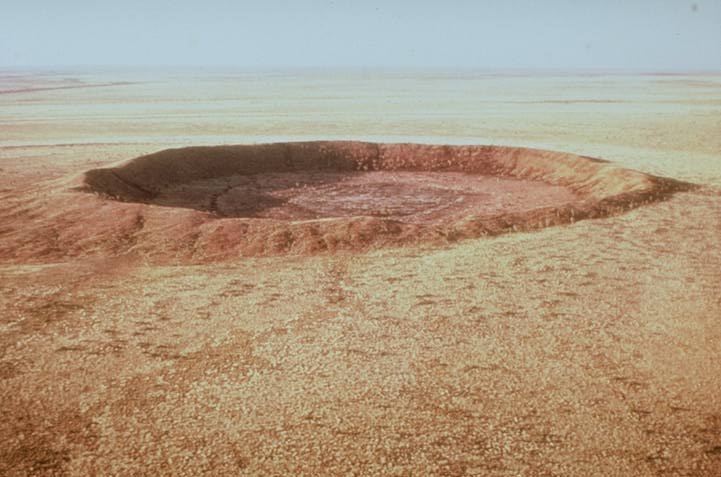
Gosses Bluff Crater
Australian Craters
Amguid Crater Algeria
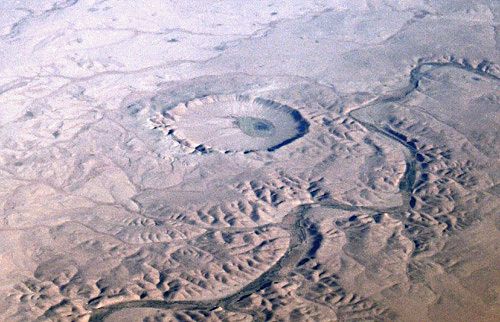
Tenoumer Crater Mauritania
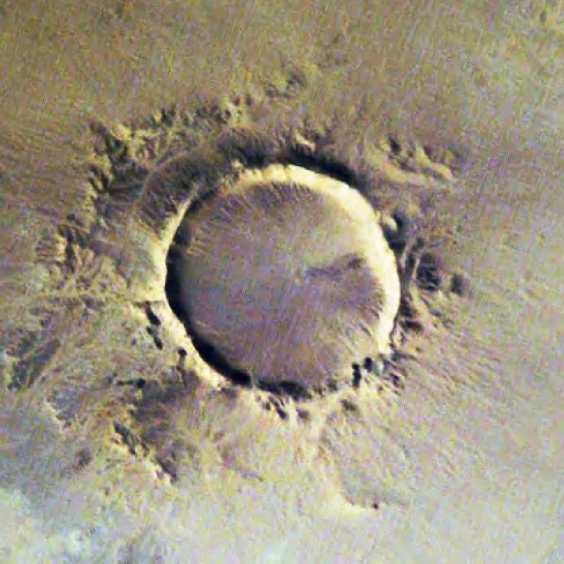
Aouelloul Crater Mauritania
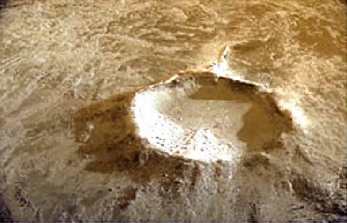
www.unb.ca...
That atmosphere and water would result in weather patterns that continuously erode and reshape the terrain.
As I have just shown, the atmosphere and water on EARTH do not erode craters especially in desert regions... why would I expect it to erode EVEN MORE on Mars if as you say the atmosphere on Mars is less and there is no rain?
The crater in Arizona exists because it was created relatively recently and in a desert.
Well from what I have seen from the rover pictures, I do not see lush vegetation, I see what lloks like dry desert terrain... perfect for preserving those monuments in Egypt... so why would not the same thing happen on Mars?
And iammonkey has shown that erosion is evident
it was carved in the side of a crater that was formed recently to that civilization (since it existed in their time), but shortly before Mars lost it's significant atmosphere (since it hasn't been eroded away since the carving).
A lot of assumptions here...
How do you know this area has not always been Desert, even when oceans existed on Mars and the atmosphere was thicker?
How do you know WHEN this Martian civilization existed and met its demise? We have only been looking a few hundred years, and the recent digs in Turkey show that we are even wrong here on Earth...
the impact that created it would have been very destructive and perhaps left the surrounding area uninhabitable for a very long time.
Why? Was it radioactive? The Tunguska Event in 1908 did not leave it "uninhabitable for a very long time" A little messy maybe with all the blown down trees, but look at Mt St Helen... was that area "uninhabitable for a very long time"
being skeptical is fine, but you need to get your facts straight or be just as ridiculed as us 'loonies' are
reply to post by ziggystar60
If you look at this platform...just above and left you will see heiroglyphics of some sort on a rectangular area. If you can zoom in and clean it up a little you will see a face here as well. It is obvious that we are not seeing cliffs that are only 20 feet high and a statue that is only 6 inches tall (absurd). You can also clearly see alot of water errosion and that the water receded over a period of many,many years. It appears that this may have been a small village on the edge of a sea (hence only one statue as opposed to many). It would have been established at a time when the water level would have been at the feet of the statue. That is why there are no anomalies below that are worth noting. If one draws a left slanting and curving line (how the water would have slanted and curved around the cliff as it headed towards the beach)one will see that all of the platforms or flat areas appear to line up (not a straight line...follow the contour of the stone). These platforms would have been seaside dwellings entrances. The road leading up from the statue probably went to the main village located on the plateau above the cliffs. There are many things in this picture that show that this is the real thing. We are all slowly being allowed to see bits and pieces of the big picture that is coming.....soon.
If you look at this platform...just above and left you will see heiroglyphics of some sort on a rectangular area. If you can zoom in and clean it up a little you will see a face here as well. It is obvious that we are not seeing cliffs that are only 20 feet high and a statue that is only 6 inches tall (absurd). You can also clearly see alot of water errosion and that the water receded over a period of many,many years. It appears that this may have been a small village on the edge of a sea (hence only one statue as opposed to many). It would have been established at a time when the water level would have been at the feet of the statue. That is why there are no anomalies below that are worth noting. If one draws a left slanting and curving line (how the water would have slanted and curved around the cliff as it headed towards the beach)one will see that all of the platforms or flat areas appear to line up (not a straight line...follow the contour of the stone). These platforms would have been seaside dwellings entrances. The road leading up from the statue probably went to the main village located on the plateau above the cliffs. There are many things in this picture that show that this is the real thing. We are all slowly being allowed to see bits and pieces of the big picture that is coming.....soon.
reply to post by zorgon
Well, like I said, I was just thinking and thought I'd throw it out there for some good old-fashioned mulling over.
Sheesh, I offer some food for thought and one guy calls me "narrow-minded" and you "ridicule" me.
Nice reply, by the way. Thanks.
Well, like I said, I was just thinking and thought I'd throw it out there for some good old-fashioned mulling over.
Sheesh, I offer some food for thought and one guy calls me "narrow-minded" and you "ridicule" me.
Nice reply, by the way. Thanks.
www.nasa.gov... ... it's foto from mars with false color ....
Is this water or some effect? You can see the effect that would wind did to water
Well i think it's just an effect ... i saw similiar on other pics now .. but this1 is really strange
[edit on 18-5-2008 by baburak]
Is this water or some effect? You can see the effect that would wind did to water
Well i think it's just an effect ... i saw similiar on other pics now .. but this1 is really strange
[edit on 18-5-2008 by baburak]
The image scares the heck outa me!
It's obviously a relic from a time when
'Egyptian'-like taces moved around the
cosmos.
The statue is there, for all to see.. and
woah-betide any politician that could deny
that aliens exist now.
Another ATS first! I've printed the pic out
and I'm gonna show Dr. Canning it, he'll flip!
The 'deflated' alien image looks abit kooky though.
Be back soon.
It's obviously a relic from a time when
'Egyptian'-like taces moved around the
cosmos.
The statue is there, for all to see.. and
woah-betide any politician that could deny
that aliens exist now.
Another ATS first! I've printed the pic out
and I'm gonna show Dr. Canning it, he'll flip!
The 'deflated' alien image looks abit kooky though.
Be back soon.
Still either way im mighty impressed that everyone here still has an imagination and a good keen eye to see minor details in images.
Why is it obvious? Could you explain it?
Originally posted by FutureAbductee
It is obvious that we are not seeing cliffs that are only 20 feet high and a statue that is only 6 inches tall (absurd).
The same applies here, could you explain what makes you think that? Thanks.
You can also clearly see alot of water errosion and that the water receded over a period of many,many years.
reply to post by baburak
Mars has many places like that, with a very fine dust that makes these small dunes that may look like waves, but if you see two different photos from different times or dates you will see that the "waves" are always in the same place.
Mars has many places like that, with a very fine dust that makes these small dunes that may look like waves, but if you see two different photos from different times or dates you will see that the "waves" are always in the same place.
i saw it now on other pics too .. but stil this1 is looking great ...
... still thx for the explanation
... still thx for the explanation
i have been following this thread and have continually been on www.nasa.gov...
i can get on everyone of my bookmarks and my online service is fine but this site won't load anymore. are they shut down to comb threw their photos? has this thread gotten to someone in charge? been about 20 minutes for me anyone else having trouble?
i wonder what there doing.hahaha now this site has got me thinking something is up with every odd event.
i can get on everyone of my bookmarks and my online service is fine but this site won't load anymore. are they shut down to comb threw their photos? has this thread gotten to someone in charge? been about 20 minutes for me anyone else having trouble?
i wonder what there doing.hahaha now this site has got me thinking something is up with every odd event.
Like I said before
Maybe NASA is sitting back and laughing at us because they know these images are DOCTORED. Meaning there is such thing as "filtered" images the ones you and I see released to the public and you can clearly tell there are some black marks on the images or small things that are covered up. And then there is "unfiltered" the ones ONLY TOP clearance people get to see.
Say theres a Holiday INN sitting up on mars. Would be see it. Nope. The rover tho would be getting a room tho
Because YOU know if there was something we WON'T know anything about it.
Maybe NASA is sitting back and laughing at us because they know these images are DOCTORED. Meaning there is such thing as "filtered" images the ones you and I see released to the public and you can clearly tell there are some black marks on the images or small things that are covered up. And then there is "unfiltered" the ones ONLY TOP clearance people get to see.
Say theres a Holiday INN sitting up on mars. Would be see it. Nope. The rover tho would be getting a room tho
Because YOU know if there was something we WON'T know anything about it.
I'm suprised this hasn't been on the news yet, considering that the "mars figure" was.
It would be good to get this out to the mainstream as its pretty convincing evidence.
It would be good to get this out to the mainstream as its pretty convincing evidence.
reply to post by dodgygeeza
The Mars figure appeared some two weeks after its appearance on ATS, give them time.
PS: the NASA site is working for me, is it still not working for you?
The Mars figure appeared some two weeks after its appearance on ATS, give them time.
PS: the NASA site is working for me, is it still not working for you?
reply to post by ArMaP
Hi, ArMaP, I am very interested in your thoughts about the feature in the biggest red circle in this part of the Mars image. I don't think anyone has commented on this specific feature before:

Hi, ArMaP, I am very interested in your thoughts about the feature in the biggest red circle in this part of the Mars image. I don't think anyone has commented on this specific feature before:
reply to post by internos
I especially think this part of your external text from NASA is interesting considering the topic of an egyptian statue. If it is somehow an egyptian statue then perhaps they decided to make it there because it was familiar to them with the sand dunes and everything? (just like NASA sais was similar to the Sahara long ago). Fascinating.
These super-resolution images have allowed scientists to discern that the rocks at Victoria Crater once represented a large dune field, not unlike the Sahara desert on Earth, and that this dune field migrated with an ancient wind flowing from the north to the south across the region. Other rover chemical and mineral measurements have shown that many of the ancient sand dunes studied in Meridiani Planum were modified by surface and subsurface liquid water long ago.
-ChriS
[edit on 18-5-2008 by BlasteR]
[edit on 18-5-2008 by BlasteR]
I especially think this part of your external text from NASA is interesting considering the topic of an egyptian statue. If it is somehow an egyptian statue then perhaps they decided to make it there because it was familiar to them with the sand dunes and everything? (just like NASA sais was similar to the Sahara long ago). Fascinating.
These super-resolution images have allowed scientists to discern that the rocks at Victoria Crater once represented a large dune field, not unlike the Sahara desert on Earth, and that this dune field migrated with an ancient wind flowing from the north to the south across the region. Other rover chemical and mineral measurements have shown that many of the ancient sand dunes studied in Meridiani Planum were modified by surface and subsurface liquid water long ago.
-ChriS
[edit on 18-5-2008 by BlasteR]
[edit on 18-5-2008 by BlasteR]
It is definitely a nice find...
But, personally, I doubt that there is more than nature itself at work here.
Having hiked through many different landscapes, I've seen many perfectly (and demonstrably) natural rock formations that sometimes looked shockingly similar to human figures or man-made sculptures - much more so than these on Mars, by the way.
I do hope this is not going to be interpreted as nay-saying just for the sake of it. I know for a fact that there are many, many VERY "strange" things between the heavens and the Earth - and I derive great joy from their presence. :-)
[edit on 18-5-2008 by Vanitas]
But, personally, I doubt that there is more than nature itself at work here.
Having hiked through many different landscapes, I've seen many perfectly (and demonstrably) natural rock formations that sometimes looked shockingly similar to human figures or man-made sculptures - much more so than these on Mars, by the way.
I do hope this is not going to be interpreted as nay-saying just for the sake of it. I know for a fact that there are many, many VERY "strange" things between the heavens and the Earth - and I derive great joy from their presence. :-)
[edit on 18-5-2008 by Vanitas]
reply to post by InterestedObserver
Ha, yeah I see the resemblance. I just thought I'd offer a few different view points. I didn't post a picture of it but if you look just below the face you can see two large stones that could have tumbled directly from the 'Egyptian statue'.
Here is a rough sketch of what I'm talking about.
The green stars show cracks or worn areas which could be part of the original breakup. It would also explain why the area is smoother since it was not exposed to the elements as long as the surface pieces.
Just a thought.
Ha, yeah I see the resemblance. I just thought I'd offer a few different view points. I didn't post a picture of it but if you look just below the face you can see two large stones that could have tumbled directly from the 'Egyptian statue'.
Here is a rough sketch of what I'm talking about.
The green stars show cracks or worn areas which could be part of the original breakup. It would also explain why the area is smoother since it was not exposed to the elements as long as the surface pieces.
Just a thought.
new topics
-
Where should Trump hold his next rally
2024 Elections: 58 minutes ago -
Shocking Number of Voters are Open to Committing Election Fraud
US Political Madness: 1 hours ago -
Gov Kristi Noem Shot and Killed "Less Than Worthless Dog" and a 'Smelly Goat
2024 Elections: 2 hours ago -
Falkville Robot-Man
Aliens and UFOs: 2 hours ago -
James O’Keefe: I have evidence that exposes the CIA, and it’s on camera.
Whistle Blowers and Leaked Documents: 3 hours ago -
Australian PM says the quiet part out loud - "free speech is a threat to democratic dicourse"...?!
New World Order: 4 hours ago -
Ireland VS Globalists
Social Issues and Civil Unrest: 4 hours ago -
Biden "Happy To Debate Trump"
2024 Elections: 5 hours ago -
RAAF airbase in Roswell, New Mexico is on fire
Aliens and UFOs: 5 hours ago -
What is the white pill?
Philosophy and Metaphysics: 6 hours ago
top topics
-
A Warning to America: 25 Ways the US is Being Destroyed
New World Order: 15 hours ago, 21 flags -
Blast from the past: ATS Review Podcast, 2006: With All Three Amigos
Member PODcasts: 7 hours ago, 11 flags -
Mike Pinder The Moody Blues R.I.P.
Music: 7 hours ago, 8 flags -
Biden "Happy To Debate Trump"
2024 Elections: 5 hours ago, 8 flags -
James O’Keefe: I have evidence that exposes the CIA, and it’s on camera.
Whistle Blowers and Leaked Documents: 3 hours ago, 7 flags -
Australian PM says the quiet part out loud - "free speech is a threat to democratic dicourse"...?!
New World Order: 4 hours ago, 7 flags -
What is the white pill?
Philosophy and Metaphysics: 6 hours ago, 5 flags -
Ireland VS Globalists
Social Issues and Civil Unrest: 4 hours ago, 4 flags -
RAAF airbase in Roswell, New Mexico is on fire
Aliens and UFOs: 5 hours ago, 4 flags -
Putin, Russia and the Great Architects of the Universe
ATS Skunk Works: 10 hours ago, 3 flags
active topics
-
Candidate TRUMP Now Has Crazy Judge JUAN MERCHAN After Him - The Stormy Daniels Hush-Money Case.
Political Conspiracies • 811 • : Oldcarpy2 -
Shocking Number of Voters are Open to Committing Election Fraud
US Political Madness • 3 • : Disgusted123 -
Meadows, Giuliani Among 11 Indicted in Arizona in Latest 2020 Election Subversion Case
Mainstream News • 28 • : yuppa -
SETI chief says US has no evidence for alien technology. 'And we never have'
Aliens and UFOs • 77 • : yuppa -
Biden "Happy To Debate Trump"
2024 Elections • 39 • : underpass61 -
Where should Trump hold his next rally
2024 Elections • 6 • : WeMustCare -
University of Texas Instantly Shuts Down Anti Israel Protests
Education and Media • 306 • : Xtrozero -
Russia Ukraine Update Thread - part 3
World War Three • 5737 • : Arbitrageur -
Gov Kristi Noem Shot and Killed "Less Than Worthless Dog" and a 'Smelly Goat
2024 Elections • 26 • : CarlLaFong -
James O’Keefe: I have evidence that exposes the CIA, and it’s on camera.
Whistle Blowers and Leaked Documents • 8 • : Athetos