It looks like you're using an Ad Blocker.
Please white-list or disable AboveTopSecret.com in your ad-blocking tool.
Thank you.
Some features of ATS will be disabled while you continue to use an ad-blocker.

John Lear's Moon Pictures on ATS
page: 116share:
Originally posted by ArMaP
I do not consider myself an expert, but I do know that the shape of a shadow does not depend only on the shape of the object casting the shadow, it depends on the surface where the shadow is cast and the relation between that surface and the place from where we see the shadow.
A cylinder lying on the ground with the light shining perpendicular to the longer axis casts a rectangular shadow.
I will try to show what I mean with some examples.
This was the best I could do in some minutes.
As you can see, the shadow looks "normal" in this photo. That is because the surface where the shadow is projected is flat.
In this one, because the surface where the shadow is projected is not flat the shadow changes shape. This was the best I could do to try to make a rectangular shadow, to do a better job I would need something more flexible than paper to create that surface and probably take the picture from a different angle.
In this you can see that the shape of the shadow can be almost anything, the object has remained the same but the surface where the shadow is projected is different, giving a different shadow.
This is why I never trust shadows to try to see the shape of and object, unless I am sure of the characteristics of the surface where the shadow is cast.


Awesome job with that example ArMap! I was thinking the exact same with the surface angles/light source stuff... I was wanting to do something similiar, but I didn't have the "imagination" to do al that this morning... Very good job with your "simple" example though. You get the point across very definitively...
Originally posted by zorgon
Oh and NASA calls this one "House Rock"
"View of House Rock from John's Station 11 pan. Smoky Mountain in the background."
That "House Rock" is bigger than it looks, at least to me.
source (scroll down until you reach 166:50:14)
Fendell is now looking at House Rock. This boulder is 12 meters tall and has lateral dimensions of 16 by 20 meters. Near the boulder, the surface slopes down toward the north and, consequently, we are not seeing the full vertical extent. The southwest flank of Smoky Mountain is the background and the slope is littered with boulders ejected from North Ray.
If that boulder is that large then the "cylinder" must be big as well.
There is at least one more photo with this "cylinder", this one.
The astronauts did some work on the "House Rock", so they were very close to the "cylinder". Apparently they did not think it worth of study or did not saw it as we see on those photos.
Originally posted by TheBorg
It's quite possible that that could be the remnants of a previously failed mission to the moon. It may be the crash debris from the craft, if it crashed.
Now that would be something I would easily accept. And if true it would be simple to verify that... However NASA calls that photo simply "House Rock", a name unusual in itself... but there is no mention of this being debris of another spacecraft.
I think that THIS image might indeed be one that we should send to NASA and ask them what they think it is.
OH and I forgot to send you a copy of a letter I received... I think you would appreciate this one...
ADDED...
Is this the one you are referring to Borg? The Area that Undo spots a "City in the Hills?
I especially like the one on the right, one wall in shadow, the other at 45 degrees and in sunlight...
[edit on 17-3-2007 by zorgon]
Originally posted by ArMaP
This is why I never trust shadows to try to see the shape of and object, unless I am sure of the characteristics of the surface where the shadow is cast.
Uh huh granted, but that doesn't explain Zarni's observation of two angles of light in the same photo...
Originally posted by ArMaP
The astronauts did some work on the "House Rock", so they were very close to the "cylinder". Apparently they did not think it worth of study or did not saw it as we see on those photos.
Apparently not, because we know they would't hesitate to give us all the details...
:shk:
There is at least one more photo with this "cylinder", this one.
There are several actually as they did a pan...
Originally posted by zorgon
Uh huh granted, but that doesn't explain Zarni's observation of two angles of light in the same photo...
Only in part, because the area with the shadows to the left is the area with a different angle, being the start of the side of the crater.
The rest may be accountable to the camera lens, it looks like a wide-angle camera, and a lens like that makes a distortion of the image that is very noticeable when we try to stitch two images together to make a panorama.
But I may be wrong, it has happened.
Originally posted by ArMaP
But I may be wrong, it has happened.
What? Say it isn't so!!
But at least we have you on one saying "That does not look like a common rock, it looks like a dirt filled tube. "
There may be hope for you yet... Care to explain what a dirt filled tube is doing there?
As to the shadow angle... yes the slope changes, I looked at that when Zarni posted it, And a wide angle lens might give those results... so I gather those might be the "tricks of light and shadow" that NASA is talking about to distract us from the good stuff...
But I must thank you for posting that other image showing the as you call it "cylinder"
continued next post....
[edit on 17-3-2007 by zorgon]
The "machine parts" or "cylinder" are very grainy and hard to detail in this image. I would really like to have the original full resolution .tiff file for this one. Isn't it curious that you can get them for some photos, but not the ones of interest to us? Hmmm...
Papajake made a comment about subject matter in the photos...
posted by papajake on 17-3-2007 at 02:15
"Also, what is the subject matter in the original photo? (AS16-116-18603) If you're going to travel 250,000 miles away from home, you'd sure better have a good subject matter in your lens when taking photos. This photo, at first glance, just looks like a bunch of rocks. But something is very off here, in my opinion."
This is a very important observation. The image at the top of the page certainly looks like the photograph is centered on the anomaly. But in the second image provided by ArMap we have House Rock on the left, the Astronaut on the right, and we are STILL centered on the anomaly, though this version is to grainy to hep us much.
Clarification: I had originally called the first photo "House Rock", but the anomaly is only near "House Rock", which is the 12 meter high round white rock in the image below.
Seems the astronaut is also easily confused... [from your reference)
166:50:14 Duke: Okay, Tony. The inside...(Stops to listen) It really is. I see no bedrock, though. All I see is boulders around the crater. There's nothing that reminds me of bedding, just loose boulders. Though it might very well be that it's so shocked that there could be real boulders...I mean, real bedrock there.
:shk: And these guys get paid for this? So a 12 meter tall round boulder was ejected from the crater... neat trick
This is a clip from AS16-106-17340HR.jpg. I gotta tell you though the pose in THAT (see full size) picture looks goofy... And that rock still doesn't look 12 meters tall feet maybe, but not meters..
While looking at the new images, I spotted a curiosity in the helmet reflection that I think is noteworthy...
Awaiting Comments.....
[edit on 17-3-2007 by zorgon]
[edit on 17-3-2007 by zorgon]
Originally posted by zorgon
But at least we have you on one saying "That does not look like a common rock, it looks like a dirt filled tube. "
There may be hope for you yet... Care to explain what a dirt filled tube is doing there?
Well, although it would be cool to think that it was a "baseball machine" for a lunar batting cage, or an ancient space mariner's ship's cannon (with cannonball laying nearby ), I came across this excerpt from a book, and thought I would add it here as a "possible" explanation for the dirt filled tube... I am not saying this is the answer to what that is, but I just thought it could be an alternate view of what the tube "could be"...

Originally posted by zorgon
While looking at the new images, I spotted a curiosity in the helmet reflection that I think is noteworthy...
Awaiting Comments.....
Yeah, I noticed that too Zorgon, but I passed it off as the shadow is that of the Astronaut right there, and the photographer is the dude standing way in the background of the reflection... At least that is the way the shadows look to me aren't they? If that shadow was that of the photographer, wouldn't his shadow be contradictory with the shadows in the rest of the picture? It looks to me like the astronaut pictured is looking down, so his curved glass piece is reflecting his own shadow right off the ground, no?
[edit on 3-17-2007 by IronDogg]
Originally posted by IronDogg
I am not saying this is the answer to what that is, but I just thought it could be an alternate view of what the tube "could be"....
Well okay... then we need to ask...
A) How did the Apollo 11 core drill tube get left behind at Apollo 16's landing site..
or
B) Did the A16 crew do core samples
C) How big was that tube they hammered on (the one in this image look to be about a foot across)
Perhaps you could look up a photo of Apollo 11 equipment? I am sure I saw one somewhere...
As to the shadow... compare the reflection in the helmet to the one below his feet. They do not look the same to me... Also the shadow would be opposite as it would be a mirror image... The "figure" in the background has no shadow...
It may be nothing but it just looks wrong...
But the really cool thing here is that everyone is at least seeing it is NOT A NORMAL ROCK...
Machinery, Tube, Cylinder, Dirt filled tube, whatever it is... is not a normal occurence... and that afterall is what we are seeking to show... things that shouldn't be there
[edit on 17-3-2007 by zorgon]
Originally posted by zorgon
Uh huh granted, but that doesn't explain Zarni's observation of two angles of light in the same photo...
the fallacy of " shadow anomolies " comes uup so often if ceases to be funny
GET OUT MORE

that took me < 1 minute back in 2006 , i had to look out the back , then front of my mothers old house
Originally posted by ignorant_ape
the fallacy of " shadow anomolies " comes uup so often if ceases to be funny
Hey nice to see you back Ape...
Nice to see we can still count on you to ignore the artifacts and pounce on the shadows. Consistency is good Not quite sure what the house pictures proves but hey...
:shk:
[edit on 17-3-2007 by zorgon]
Originally posted by zorgon
There may be hope for you yet... Care to explain what a dirt filled tube is doing there?
I do not have any idea, but that is what it looks to me, a tube, like a large water pipe, filled with dirt.
Originally posted by zorgon
Clarification: I had originally called the first photo "House Rock", but the anomaly is only near "House Rock", which is the 12 meter high round white rock in the image below.
I think the "House Rock" is the large rock that can be seen on the back of the picture, with the "Outhouse Rock" on the right, near the "cylinder".
That large rock near the astronaut is one large breccia boulder where they started their work, after that they moved to the "House Rock".
Look at this and see if am I right.
Originally posted by zorgon
Here is the tools they used on Apollo missions...
The core sampler is very narrow... So nice try but no cigar
Aghhh... You beat me to it... I did find some similiar photos I was going to post of basically the same tools. They did have some bigger core samplers but the biggest was still only 4 cm inside diameter... Thanks Zorgon for eliminating that explanation...
In my searches for tools though I came across this similiar photo of the shadow photo above... I think this is similiar in the respect of the shadow at his feet, the astroanaut looking down, and the reflection of the photographer in the background of the reflection. Do you think this photo is similiar in explaining the possible positions of the shadow, and the reflections? Sorry to not provide a "zoom in".
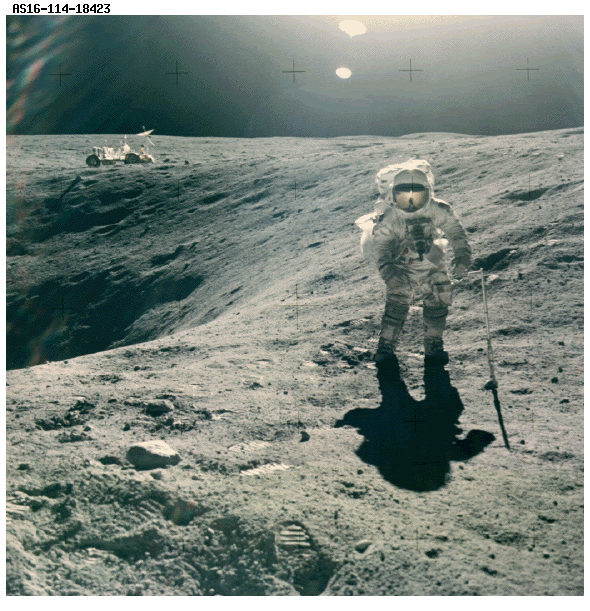
I think we can safely assume from IronDogg's last post that the reflection in the visors are consistent with the shadow of the astronaut and the
photographer.
I also think the site with the cylinder is a crash site. It looks as if there are a number of anomalies consistent with debris from something either having crashed, blown apart, or any number of scenarios that wouild leave machinery scattered on the surface.
Well, that is my take.
I also think the site with the cylinder is a crash site. It looks as if there are a number of anomalies consistent with debris from something either having crashed, blown apart, or any number of scenarios that wouild leave machinery scattered on the surface.
Well, that is my take.
Originally posted by IronDogg Do you think this photo is similiar in explaining the possible positions of the shadow, and the reflections?
Yup it is indeed similar and the most likely case. Its funny though how many pictures they have of "Hi, here's me in front of this rock..."
I found this little video clip... I watched a bunch of them... the drop things a lot... and misplace stuff... its actually funny... In this one he drops his bags then falls trying to pick them up...
One clip has them struggling up a hill using their tools as a walkig stick... are out of breath... and heart rate elevated to 128...
One thing that gets me in all these clips is that they appear to be struggling more with gravity than I would expect in 1/6th G. In one clip Houston suggests they turn over a large rock and they answer "no way"
www.hq.nasa.gov...
The dust he stirs up is very interesting to watch... moves like a shimmering wave...
[edit on 17-3-2007 by zorgon]
Originally posted by zorgon
Here is the variety of camera equipment. It seems we only get to see images from certain cameras, not all of them. I wonder why that is...
Why do you believe that you've only seen images from certain camera's? All the images from all those camera's are publicly available. What photos from which camera's haven't you seen?
EDIT to add: You asked if Apollo 16 did core samples. The answer is yes. All of the missions collected core samples except for Apollo 14 as far as I can tell.
EDIT 2: I only meant to reply about the camera thing originally, but I'm find more things I can give you answers for now. But anyway...
One thing that gets me in all these clips is that they appear to be struggling more with gravity than I would expect in 1/6th G. In one clip Houston suggests they turn over a large rock and they answer "no way"
Things may weight less on the Moon, but objects will still have the same mass. An astronaut in his suit will weight up to about ~300lbs on Earth, on the Moon, he'll only be ~50lbs, but his mass will still be 300lbs. So it can still take a fair bit of effort on their part. For example, when in 0G, an astronaut can't push the Shuttle around, because its mass is too great even though they are in 0G and it weighs nothing. That and the space suit is also fairly stiff, so it can be hard to bend and move around too.
Also if I remember correctly. The astronauts found it harder to slow down if they needed to stop suddenly when they got their forward momentum going at a decent speed. Because they'd build up speed and if you wanted to stop suddenly, you'd have to apply a lot of force to stop your 300lbs of mass wanting to continue in its current direction. Make sense?
[edit on 18-3-2007 by jra]
new topics
-
President BIDEN's FBI Raided Donald Trump's Florida Home for OBAMA-NORTH KOREA Documents.
Political Conspiracies: 17 minutes ago -
Maestro Benedetto
Literature: 1 hours ago -
Is AI Better Than the Hollywood Elite?
Movies: 1 hours ago -
Las Vegas UFO Spotting Teen Traumatized by Demon Creature in Backyard
Aliens and UFOs: 5 hours ago -
2024 Pigeon Forge Rod Run - On the Strip (Video made for you)
Automotive Discussion: 6 hours ago -
Gaza Terrorists Attack US Humanitarian Pier During Construction
Middle East Issues: 6 hours ago -
The functionality of boldening and italics is clunky and no post char limit warning?
ATS Freshman's Forum: 7 hours ago -
Meadows, Giuliani Among 11 Indicted in Arizona in Latest 2020 Election Subversion Case
Mainstream News: 8 hours ago -
Massachusetts Drag Queen Leads Young Kids in Free Palestine Chant
Social Issues and Civil Unrest: 8 hours ago -
Weinstein's conviction overturned
Mainstream News: 9 hours ago
top topics
-
Krystalnacht on today's most elite Universities?
Social Issues and Civil Unrest: 11 hours ago, 9 flags -
Supreme Court Oral Arguments 4.25.2024 - Are PRESIDENTS IMMUNE From Later Being Prosecuted.
Above Politics: 11 hours ago, 8 flags -
University of Texas Instantly Shuts Down Anti Israel Protests
Education and Media: 14 hours ago, 7 flags -
Weinstein's conviction overturned
Mainstream News: 9 hours ago, 7 flags -
Gaza Terrorists Attack US Humanitarian Pier During Construction
Middle East Issues: 6 hours ago, 7 flags -
Massachusetts Drag Queen Leads Young Kids in Free Palestine Chant
Social Issues and Civil Unrest: 8 hours ago, 6 flags -
Meadows, Giuliani Among 11 Indicted in Arizona in Latest 2020 Election Subversion Case
Mainstream News: 8 hours ago, 5 flags -
Las Vegas UFO Spotting Teen Traumatized by Demon Creature in Backyard
Aliens and UFOs: 5 hours ago, 4 flags -
President BIDEN's FBI Raided Donald Trump's Florida Home for OBAMA-NORTH KOREA Documents.
Political Conspiracies: 17 minutes ago, 3 flags -
2024 Pigeon Forge Rod Run - On the Strip (Video made for you)
Automotive Discussion: 6 hours ago, 2 flags
active topics
-
University of Texas Instantly Shuts Down Anti Israel Protests
Education and Media • 234 • : cherokeetroy -
Nearly 70% Of Americans Want Talks To End War In Ukraine
Political Issues • 95 • : Irishhaf -
Sunak spinning the sickness figures
Other Current Events • 23 • : NoCorruptionAllowed -
Meadows, Giuliani Among 11 Indicted in Arizona in Latest 2020 Election Subversion Case
Mainstream News • 14 • : WeMustCare -
HORRIBLE !! Russian Soldier Drinking Own Urine To Survive In Battle
World War Three • 44 • : theshadowknows -
President BIDEN's FBI Raided Donald Trump's Florida Home for OBAMA-NORTH KOREA Documents.
Political Conspiracies • 0 • : WeMustCare -
God's Righteousness is Greater than Our Wrath
Religion, Faith, And Theology • 31 • : glend -
Post A Funny (T&C Friendly) Pic Part IV: The LOL awakens!
General Chit Chat • 7135 • : underpass61 -
VP's Secret Service agent brawls with other agents at Andrews
Mainstream News • 62 • : ByeByeAmericanPie -
SETI chief says US has no evidence for alien technology. 'And we never have'
Aliens and UFOs • 72 • : yuppa