It looks like you're using an Ad Blocker.
Please white-list or disable AboveTopSecret.com in your ad-blocking tool.
Thank you.
Some features of ATS will be disabled while you continue to use an ad-blocker.

John Lear's Moon Pictures on ATS
page: 117share:
Originally posted by jra
You asked if Apollo 16 did core samples. The answer is yes. All of the missions collected core samples except for Apollo 14 as far as I can tell.
Yes they did, however the point was did they have a core drill big enough to be the cylinder?
I only meant to reply about the camera thing originally, but I'm find more things I can give you answers for now. But anyway...
LOL forget the standard NASA oriented answers and give us your opinion of the "compound" in AS11-41-6156 and the "cylinder" in AS16-116-18603
After all we have been finding some pretty interesting artifacts and we have covered enough about cameras and shadows and just plain rocks. Those two anomalies defy easy explanation...
Of course I can see why NASA brainwashed skeptics would wish to ignore those At least ArMap conceded he sees a tube...
I haven't been following this thread at all. I just thought i'd take a peak in since it's been a while and just to point out that photos from all
those cameras are indeed available. And to be honest I don't really take the "anomalies" that are found in here too seriously, sorry. Call it
"NASA brainwashing" if you wish.
But, I do see what could be considered a cylindrical shape, but even the high res images aren't clear enough. I'd have to see some close-ups of it, (and by that, I don't mean heavily zoomed in images) and photos from other angles would be a huge help before making a final judgment.
I don't see any "compound" in the Apollo 11 image.
But, I do see what could be considered a cylindrical shape, but even the high res images aren't clear enough. I'd have to see some close-ups of it, (and by that, I don't mean heavily zoomed in images) and photos from other angles would be a huge help before making a final judgment.
I don't see any "compound" in the Apollo 11 image.
Originally posted by zorgon
Is this the one you are referring to Borg? The Area that Undo spots a "City in the Hills?
I especially like the one on the right, one wall in shadow, the other at 45 degrees and in sunlight...
[edit on 17-3-2007 by zorgon]
Those would be the ones, yup.
The one I noticed was the one in the middle, as it's definitely got an odd shape to it. Not to mention the way that I seem to be able to look under it and see light on the other side of the structure. I can't explain that any other way than the obvious one that there's something there. What that something is has yet to be determined. I can assure you of this though; we're not being told everything by NASA. I'm sure they know what it is, and for some reason if they don't, they have a pretty good idea who would.
TheBorg
Found this Anomaly on an image of the moons farside. What is that thing sticking up there on the crater rim?
And if you'll notice there is a little shiny round object that is just to the right of the tower looking object.
Link: images.jsc.nasa.gov...
[edit on 18-3-2007 by anathema777]
And if you'll notice there is a little shiny round object that is just to the right of the tower looking object.
Link: images.jsc.nasa.gov...
[edit on 18-3-2007 by anathema777]
I noticed looking at these two different NASA moon photos that you can see a blue plasma like color in the same spot, on two different photos from two
different angles.
!st Photo:
www1.filehost.to..." target='_blank' class='tabOff'/>
2nd Photo:
www1.filehost.to..." target='_blank' class='tabOff'/>
EDIT: And now a 3rd!
3rd Photo:
The source is NASA's main site and the images can be searched and located by the number in the file name as I have not changed them.
Search Link:
search.nasa.gov...
~Anathema
[edit on 18-3-2007 by anathema777]
!st Photo:
www1.filehost.to..." target='_blank' class='tabOff'/>
2nd Photo:
www1.filehost.to..." target='_blank' class='tabOff'/>
EDIT: And now a 3rd!
3rd Photo:
The source is NASA's main site and the images can be searched and located by the number in the file name as I have not changed them.
Search Link:
search.nasa.gov...
~Anathema
[edit on 18-3-2007 by anathema777]
Originally posted by anathema777
I noticed looking at these two different NASA moon photos that you can see a blue plasma like color in the same spot, on two different photos from two different angles. !
Excellent work anathema777! I will get right on this and find out where it is. Looks identical to the 'reactor' at Aristarchus. Thanks.
Originally posted by anathema777
Found this Anomaly on an image of the moons farside. What is that thing sticking up there on the crater rim?
And if you'll notice there is a little shiny round object that is just to the right of the tower looking object.
Link: images.jsc.nasa.gov...
[edit on 18-3-2007 by anathema777]
Wow.
What is that?
Are these links talking about that image?
science.ksc.nasa.gov...
www.astrosurf.com...
www.lpi.usra.edu...
[edit on 18-3-2007 by Orion437]
[edit on 18-3-2007 by Orion437]
[edit on 18-3-2007 by Orion437]
[edit on 18-3-2007 by Orion437]
[edit on 18-3-2007 by Orion437]
Maybe this is the answer:
www.astrosurf.com...
LPI has a print of the photo in their archives, and from looking at it, it
was clear that the "upright" object is not real. It is a bright region on the
rim of the small crater. Digitizing images has a tendency to make small
features appear to be aligned with the scanning axis, and I think that's what
happened here.
In any case it would be great to have a good enlargement of that section.
However, the black area is real, although it's not a shadow. It appears to be stuff that has oozed out of the small crater on the rim of Lobaschevsky. This really is a strange location for a lava flow. I thought that these occurred
>mostly on the floors of craters where the surface material has been weakened and thinned by the impact excavation, not on a crater rim where the rock has been piled up by the impact. I don't see how there could be a vent for the lava to escape on the top of a crater rim.
[edit on 18-3-2007 by Orion437]
Originally posted by johnlear
Excellent work anathema777! I will get right on this and find out where it is. Looks identical to the 'reactor' at Aristarchus. Thanks.
No problem John, I thought you might like that discovery. I actually discovered it after I downloaded a zillion images. Luckily as I download and save them I will add (LOOK) to the end of the file name if I notice something right away, so that I can start with the images that have the best chance of yielding a good anomaly first. I just spent the last 3 hours downloading images off one of the NASA sister sites. I have quite a few different angle shots of messier crater shots, and a few real good close ups of the Tsiolkovsky Crater on the Farside. Something strange though, I have a shot from earth of the messier crater duo by an amatuer that seems to be missing two rather large craters that are in NASA shots.
Amatuer Shot:
NASA Picture:
www3.filehost.to..." target='_blank' class='tabOff'/>
Part Missing From Amatuer Shot:
Picture Showing Where Missing Craters Should Be:
Also John something else. Under a little but of scrutiny and even including the Messier photo you posted at the bottom of the last page it would seem that most pictures of the messier craters kinda look like they have altered/airbrushed/algorithm enhanced aspects to them, and all over the images. On the photo you posted if you zoom in to the spot where the big blurry box should be "as shown by the poster a few posts above your on the last page" it looks like that spot has been enhanced with a program designed to mask or create fake terrain that looks real. I will spend some time to try and illustrate what Im getting at.
I have been very busy the last week that is why I havent been able to dedicate a large amount of time to this thread as I was about a week or so ago. I am back now and ready to get busy.
I have about 200-300 pictures to go through looking for UFO PeekaBoos in the horizon and anomalies and would love access to any pictures you would like to share with me so I may help more.
Just let me know or U2U me and Ill send you my Email and/or Cell Phone and properly introduce myself.
Regards,
~Anathema
[edit on 18-3-2007 by anathema777]
Originally posted by johnlear
Originally posted by anathema777
I noticed looking at these two different NASA moon photos that you can see a blue plasma like color in the same spot, on two different photos from two different angles. !
Excellent work anathema777! I will get right on this and find out where it is. Looks identical to the 'reactor' at Aristarchus. Thanks.
Hmmm I thought that was Aristarchus and we are looking at the moon with a prtial view of the front and back, but I might be wrong...
Originally posted by Orion437
Are these links talking about that image?
Yes but it seems all the images that they had collected are no longer on the website. Google AS16-121-19407 images brings them up in thumbs, but they no longer link...
I think I had them saved somewhere I will have to look them up They did a lot of detail study on them.
Also finding a copy at LPI doesn't help much... LPI images are sanintized As John says, you need originals from before 1972
Originally posted by jrait's been a while and just to point out that photos from all those cameras are indeed available.
Alright then If as you say all the images are indeed available, please be so kind as to point me to the complete set of Lunar Orbiter photos...
And its the high resolution ones that I want, the ones the company who made the cameras says are good enough to make out a card table on the surface.
And were are the high res .tiffs of the Apollo images? I am sure they are all available as you say, but I have yet to find them. Even AS16-121-19407 at the Apollo Journal sight is only available by order and then they will scan it from a print for you...
Now if you have linked to these images in the past, I apologize for missing them, but please be so kind as to share the locations
Thanks
Magazine 121/PP (Color) Frames 19345-19458
Some images are currently available only as low-resolution scans provided by NASA Johnson in the mid-1990s. The individual scans have TARGA filenames. Markus Mehring has compiled cross-references between those filenames and the NASA photo ID designations customarily used. Other images are available as higher resolution scans from prints
And you are honestly telling me that you see nothing unusual in the anomaly we call the "compound" ??
Mon Dieu, Incroyable
:shk:
[edit on 19-3-2007 by zorgon]
Originally posted by anathema777
I have about 200-300 pictures to go through looking for UFO PeekaBoos in the horizon and anomalies and would love access to any pictures you would like to share with me so I may help more.
LOL Help is good! I know all about short on time and I have at least a few hundred to go through myself, and those are just the ones people liked me too...
You can email and clips to me at [email protected] to add to the collection on The Living Moon site... just ummm a few at a time though
Source and NASA ID numbers is always good when availble
Originally posted by zorgon
Also finding a copy at LPI doesn't help much... LPI images are sanintized As John says, you need originals from before 1972
Crappy job to have right now...

[edit on 19-3-2007 by Zarniwoop]
Originally posted by zorgon
LOL Help is good! I know all about short on time and I have at least a few hundred to go through myself, and those are just the ones people liked me too...
You can email and clips to me at [email protected] to add to the collection on The Living Moon site... just ummm a few at a time though
Source and NASA ID numbers is always good when availble
Sounds good to me bud. I honestly can't get enough of this stuff. My only regret is most likely one that we both share... the limited access to source material! What I wouldn't give for just one hour to pick out unedited source images and video, and then open the flood gates.
~Anathema
Originally posted by zorgon
Hmmm I thought that was Aristarchus and we are looking at the moon with a prtial view of the front and back, but I might be wrong...
Aparently the crater we are looking at is Lobachevski.
Originally posted by zorgon
Alright then If as you say all the images are indeed available, please be so kind as to point me to the complete set of Lunar Orbiter photos...
I was referring to all the images from those Apollo cameras. The Lunar Orbiter images are something else entirely. But here's one of the better sites i've found for Lunar Orbiter images. www.lpi.usra.edu...
And its the high resolution ones that I want, the ones the company who made the cameras says are good enough to make out a card table on the surface.
For the Lunar Orbiter images? As far as I know, the highest was a resolution of 2m in selected areas. I'm not sure if those images are on that site I linked to or not. Lunar Orbiter images seem to be harder to find. Probably due to not being as popular as the Apollo stuff.
And were are the high res .tiffs of the Apollo images? I am sure they are all available as you say, but I have yet to find them. Even AS16-121-19407 at the Apollo Journal sight is only available by order and then they will scan it from a print for you...
As for .tiff images. I don't think they ever saved them in that format. And I never said they were available in that format either. I just said that all the images themselves are available.
The sites I use mostly are,
www.hq.nasa.gov...
www.apolloarchive.com...
www.lpi.usra.edu...
And then there's this site. eol.jsc.nasa.gov... it's really not the easiest site to use. It's quite a confusing pain the in the ass to be honest. But I found your Apollo 16 image here: eol.jsc.nasa.gov... and then you can request for a higher res one and it gives you some options as to how you want to get it. Here's the direct link, it's fairly large (about 1mb). eol.jsc.nasa.gov...
And you are honestly telling me that you see nothing unusual in the anomaly we call the "compound" ??
I really don't see much of anything in that image other than a very pixelated crater. Looking at the bottoms of the other craters in
6156 I notice a lot of them are pitted with smaller craters inside. I would think this would be the same for the one you cropped out. My first conclusion would not to assume it's a "compound" that's for sure.
Originally posted by anathema777
Something strange though, I have a shot from earth of the messier crater duo by an amatuer that seems to be missing two rather large craters that are in NASA shots.
The craters are there, I see them.
The problem is that those craters are less marked and less visible when the light is less horizontal.
There are eventually more intersting features of the "compound".
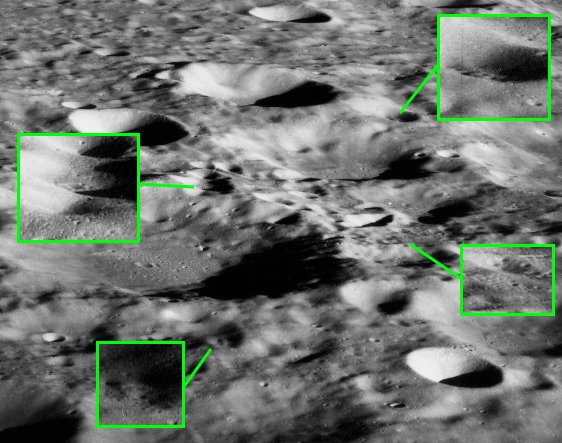
Originally posted by anathema777
Found this Anomaly on an image of the moons farside. What is that thing sticking up there on the crater rim?
And if you'll notice there is a little shiny round object that is just to the right of the tower looking object.
Link: images.jsc.nasa.gov...
[edit on 18-3-2007 by anathema777]
At first look i saw the same thing but why a tall structure on the craters rim? Why not the floor or near the top of the rim.. But then in MS photo You can see the craters edge is lit and seems to appear as a standing structure and the black is the back blast material from the smaller crater IMO. However the rectangular shape in the crater seems a bit interesting.
And weird that the NASA official pic link is hosed. What gives NASA? You guys got all kinds of servers,space and advanced cpu tech so why the limited availability?
Originally posted by jra The Lunar Orbiter images are something else entirely. But here's one of the better sites i've found for Lunar Orbiter images. www.lpi.usra.edu...
Better sites? Hmmmm
I have THAT one...compare their version of LO_III_162 with that John provided at the start of this thread.. You will see MANY differences and an overall quality difference. Seems certain anomalies are no longer in the LPI image collection....
For the Lunar Orbiter images? As far as I know, the highest was a resolution of 2m in selected areas. I'm not sure if those images are on that site I linked to or not. Lunar Orbiter images seem to be harder to find. Probably due to not being as popular as the Apollo stuff.
No they are NOT on that site...
No they are as popular, but they do not have them because the high resolution images were taken for the department of defense, not for astronomers...It is why if you find copies in print BEFORE 1971 you will find anomalies
As far as the resolution here is a quote from the Defense contractor ITT who made the cameras..
On a typical Lunar Orbiter mission, the photographic system provided high-resolution pictures of 4,000 square miles of the Moon's surface with enough clarity to show objects the size of a card table. At the same time, medium-resolution photographs covering 20,000 square miles could be made with overlap for stereo viewing and analysis of surface topography.
Notice for those who care the following link is a secure link to a Defense Contractor so if you worry about being tracked.... you WILL be
SOURCE
As for .tiff images. I don't think they ever saved them in that format. And I never said they were available in that format either. I just said that all the images themselves are available.
I do not believe you said they were, however I KNOW they do have them as I have several of them... and one they even posted was the one with the "rolling rocks" The .tiffs are available to scientists and someone in the thread some time back posted a link to a different file format were some were available I will have to look it up... And I have those sites and many more... I will add a full list of image resources to my site in the next few days [There are a LOT to sort through ]
Interesting enough, the site you linked to has several .tiff files in that collection starting at 100 meg to one that is 206 megs... To bad they are of Earth though Now THATS the size I am talking about
Here's the direct link, it's fairly large (about 1mb). eol.jsc.nasa.gov...
I meg is small 30 meg .tiff is usually what I call high resolution
Thank you for finding that one... Its amazing how washed out it is considering its high res...
I would think this would be the same for the one you cropped out. My first conclusion would not to assume it's a "compound" that's for sure.
Well thats the thing about this one though, you don't have to think anything about my "cropped" image. Anyone can simply open the high res one I linked to at NASA and simply zoom in and see it themselves. If a rectangular and shaded "anomaly" of that size looks like small craters to you... well...
And just because its labeled "compound" as thats what it reminds me of doesn't mean I assume its a compound. I have no idea what it is, I just know its NOT a natural rock formation
[edit on 19-3-2007 by zorgon]
new topics
-
Krystalnacht on today's most elite Universities?
Social Issues and Civil Unrest: 2 minutes ago -
Chris Christie Wishes Death Upon Trump and Ramaswamy
Politicians & People: 29 minutes ago -
University of Texas Instantly Shuts Down Anti Israel Protests
Education and Media: 2 hours ago -
Any one suspicious of fever promotions events, major investor Goldman Sachs card only.
The Gray Area: 4 hours ago -
God's Righteousness is Greater than Our Wrath
Religion, Faith, And Theology: 9 hours ago
top topics
-
VP's Secret Service agent brawls with other agents at Andrews
Mainstream News: 13 hours ago, 10 flags -
Cats Used as Live Bait to Train Ferocious Pitbulls in Illegal NYC Dogfighting
Social Issues and Civil Unrest: 17 hours ago, 8 flags -
Nearly 70% Of Americans Want Talks To End War In Ukraine
Political Issues: 14 hours ago, 5 flags -
Sunak spinning the sickness figures
Other Current Events: 14 hours ago, 5 flags -
Electrical tricks for saving money
Education and Media: 12 hours ago, 4 flags -
Late Night with the Devil - a really good unusual modern horror film.
Movies: 16 hours ago, 2 flags -
Any one suspicious of fever promotions events, major investor Goldman Sachs card only.
The Gray Area: 4 hours ago, 2 flags -
University of Texas Instantly Shuts Down Anti Israel Protests
Education and Media: 2 hours ago, 1 flags -
Krystalnacht on today's most elite Universities?
Social Issues and Civil Unrest: 2 minutes ago, 1 flags -
God's Righteousness is Greater than Our Wrath
Religion, Faith, And Theology: 9 hours ago, 0 flags
active topics
-
University of Texas Instantly Shuts Down Anti Israel Protests
Education and Media • 25 • : DBCowboy -
SETI chief says US has no evidence for alien technology. 'And we never have'
Aliens and UFOs • 63 • : andy06shake -
Krystalnacht on today's most elite Universities?
Social Issues and Civil Unrest • 0 • : TheSingleBillie -
Nearly 70% Of Americans Want Talks To End War In Ukraine
Political Issues • 61 • : YourFaceAgain -
Chris Christie Wishes Death Upon Trump and Ramaswamy
Politicians & People • 3 • : ImagoDei -
Hate makes for strange bedfellows
US Political Madness • 45 • : YourFaceAgain -
Post A Funny (T&C Friendly) Pic Part IV: The LOL awakens!
General Chit Chat • 7134 • : baddmove -
President BIDEN Vows to Make Americans Pay More Federal Taxes in 2025 - Political Suicide.
2024 Elections • 140 • : ImagoDei -
Sunak spinning the sickness figures
Other Current Events • 17 • : Ohanka -
So this is what Hamas considers 'freedom fighting' ...
War On Terrorism • 261 • : YourFaceAgain