It looks like you're using an Ad Blocker.
Please white-list or disable AboveTopSecret.com in your ad-blocking tool.
Thank you.
Some features of ATS will be disabled while you continue to use an ad-blocker.

The Whole Solar System is Undergoing Global Warming.
page: 11share:
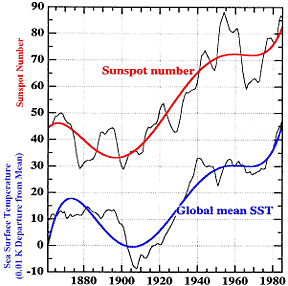
Here are some other graphs from NOAA which shows the correlation betwen an increase in sunspots and temperature increases in the earth.
Here is another graph from NOAA of the temperature in the North Hemisphere during the same time period.
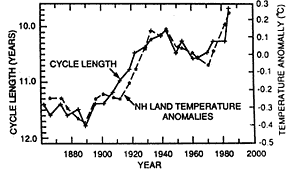
Those two graphs can be found at.
www.research.noaa.gov...
Here is another graph from NOAA of the temperature in the North Hemisphere during the same time period.
Those two graphs can be found at.
www.research.noaa.gov...
Originally posted by Muaddib
We know that the output of the Sun has been increasing in the past 60 years more than during the last 8,000 years. Changes that happen in the Sun affect not only Earth but the other planets in the solar system too.
True. I think Solanki puts it at about 70 years. So, how do we know that the current warming of these few planetary bodies is due to increased solar activity?
I also notice you have used Solanki's data for sunspot analysis but decided to use 16 year old erroneous data from Friss-Christensen & Lassen (see Damon & Laut, 2004) for the correlation between solar irradiance and temperature? Why didn't you also use Solanki's data for this? It is correct, unlike the data you have selected, and the most recent data.
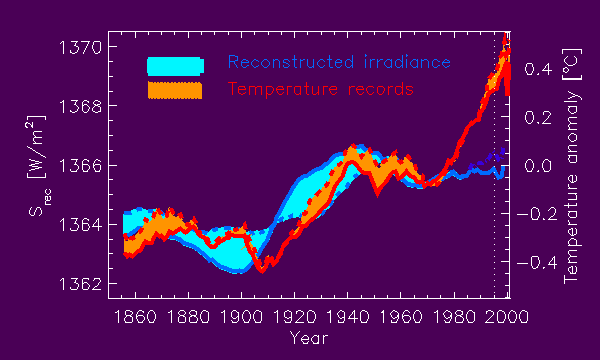
www.mps.mpg.de...
If the increased sun irradiance cannot account for warming here, how is it going to account for around 2'C warming on Pluto?
[edit on 26-4-2007 by melatonin]
That graphs which you gave shows almost no increase in the irradiance of the sun for the last 40 years... How is that so when we know for a fact that
the irradiance of the sun has been increasing 0.014 degrees K per year for the last 60 years?
The difference between 60 years ago and today in the irradiance shown in that graph should be 0.014 x 60 = 0.84 degrees K. Of course appart from the natural fluctuations of temperature which happen in the sun during it's 11 year cycles.
And the most important question, if the sun is not the cause for the current warming observed in several planets in the solar system, then what is causing the Climate Changes in the form of warming we are seeing in several planets of our solar system?
[edit on 26-4-2007 by Muaddib]
The difference between 60 years ago and today in the irradiance shown in that graph should be 0.014 x 60 = 0.84 degrees K. Of course appart from the natural fluctuations of temperature which happen in the sun during it's 11 year cycles.
And the most important question, if the sun is not the cause for the current warming observed in several planets in the solar system, then what is causing the Climate Changes in the form of warming we are seeing in several planets of our solar system?
[edit on 26-4-2007 by Muaddib]
Originally posted by Muaddib
That graphs which you gave shows almost no increase in the radiance of the sun for the last 40 years... How is that so when we know for a fact that the radiance of the sun has been increasing 0.014 degrees K per year for the last 60 years?
The difference between 60 years ago and today in the radiance shown in that graph should be 0.014 x 60 = 0.84 degrees K. Of course appart from the natural fluctuations of temperature which happen in the sun during it's 11 year cycles.
The thing is, Muaddib, the graph you presented earlier from Solanki (the thousand year scale solar data) is the same data I gave above - just looking at the more recent period. It's Solanki's data.
As for the 0.014K data, you'll have to point out where it came from.
And the most important question, if the sun is not the cause for the current warming observed in several planets in the solar system, then what is causing the Climate Changes in the form of warming we are seeing in several planets of our solar system?
Orbital variations? Internal variations? Plus maybe a bit of variation in solar irradiance.
Originally posted by melatonin
The thing is, Muaddib, the graph you presented earlier from Solanki (the thousand year scale solar data) is the same data I gave above - just looking at the more recent period. It's Solanki's data.
The things is that the data in that graph has been extrapolated from different sources all which have different calibration, accuracy and reliability issues.
“The problem is that no one sensor has collected data continuously over this time period, and so to make a long-term dataset, we have to splice together the results from different instruments, each with its own accuracy and reliability issues, only some of which we are able to account for,” says solar physicist Judith Lean from the U.S. Naval Research Laboratory in Washington, D.C.
earthobservatory.nasa.gov...
Originally posted by melatonin
As for the 0.014K data, you'll have to point out where it came from.
Monitoring the Solar Temperature: Spectroscopic Temperature Variations of the Sun
Author(s) David F. Gray and William C. Livingston
Identifiers The Astrophysical Journal, volume 474, part 1 (1997), pages 802–809
DOI: 10.1086/303489
Bibcode: 1997ApJ...474..802G
Availability This site: PS | PDF (390.2k) | HTML (46.5k)
Copyright © 1997, The American Astronomical Society.
Abstract The C i 5380 line in the solar flux spectrum was measured over the 19781992 interval. Analysis of the data shows seasonal and instrumental effects, but after allowance for these, the ratios of spectral line depths, C i 5380 to Fe i 5379 and to Ti ii 5381, are shown to be robust indicators of effective temperature. These data show the solar temperature to have varied systematically during the activity cycle and nearly in phase with other indicators of the cycle. The amplitude of the variation is 1.5 K ± 0.2 K, similar to but slightly less than the range implied by the variations of the sunspot-corrected irradiance. There is also evidence for a secular trend amounting to +0.014 K per year.
www.journals.uchicago.edu...:10.1086/303489&erFrom=2713573717974126232Guest
Originally posted by melatonin
Orbital variations? Internal variations? Plus maybe a bit of variation in solar irradiance.
So it is just coincidence that we are seeing warming in several planets in the solar system then? There is no such thing as coincidences in science.
[edit on 26-4-2007 by Muaddib]
Here is another one.
www.astro.ucla.edu...
In this last link Kaisler states that GHGs also amplify the effects of the sun, but then we go back to exactly how much does CO2 amplifies the heat trapping effect? How much of the CO2 levels have been produced by natural sources? We know for a fact, despite some people wanting to claim the contrary, that GHGs increase naturally during warming cycles, and we are in a warming cycle.
You like to excerpt some sources which take the highest values meanwhile I point to the ones which show lower values such as Eastman et al 2001 who states and I quote:
blue.atmos.colostate.edu...
His research in fact points out that a doubling of air's CO2 content led to a temperature increase of 0.014°C.
---edited to add comments---
[edit on 26-4-2007 by Muaddib]
We tend to think of our Sun as a paragon of stability. While other stars pulsate, go nova, collapse, or bubble and churn like overheated pots of oatmeal, Sol provides us with steady, dependable radiance. Of course there are variations, such as the 11 year sunspot cycle, but these are predictable and benign.
Recent evidence, however, suggests that we don't know all there is to know about the nearest star. Drs. David Gray (University of Western Ontario) and William Livingston (Kitt Peak) have been studying the Sun's temperature with a technique that compares the strength of absorption lines in the solar spectrum. Gray finds that in addition to a fluctuation of 1.5 degrees Kelvin over the 11-year cycle, the temperature of the sun is steadily increasing by 0.014 degrees/yr.
Of course, this doesn't mean that the Sun will just continue to heat up. The observed change may just be part of a much longer cycle. During the 17th to mid-18th centuries, astronomers noticed a complete absence of sunspots and geological records show that the Earth's temperature dropped by 1 to 2 degrees during that time. This may not seem like much, but it was enough to freeze the Thames river and shorten Europe's growing season, causing famine in many countries.
www.astro.ucla.edu...
In this last link Kaisler states that GHGs also amplify the effects of the sun, but then we go back to exactly how much does CO2 amplifies the heat trapping effect? How much of the CO2 levels have been produced by natural sources? We know for a fact, despite some people wanting to claim the contrary, that GHGs increase naturally during warming cycles, and we are in a warming cycle.
You like to excerpt some sources which take the highest values meanwhile I point to the ones which show lower values such as Eastman et al 2001 who states and I quote:
A change in albedo will alter the absorption and
re¯ection solar radiation. A modifed albedo can result
from all of the factors investigated, although it is obvious
that the 2 x CO2 radiation impact would be minimal as
it is addressed in this study.
blue.atmos.colostate.edu...
His research in fact points out that a doubling of air's CO2 content led to a temperature increase of 0.014°C.
---edited to add comments---
[edit on 26-4-2007 by Muaddib]
Originally posted by Muaddib
The things is that the data in that graph has been extrapolated from different sources all which have different calibration, accuracy and reliability issues.
Which do you think is most reliable? The last 50 years, or however long before that?
You do realise you are also criticising your own data from earlier?
Monitoring the Solar Temperature: Spectroscopic Temperature Variations of the Sun
So you are looking at 1.5K on top of what solar temperature? What is the current increase? That was for up to 1992.
And I guess this data has the same problem as all the other solar data you seem to want to criticise.
So it is just coincidence that we are seeing warming in several planets in the solar system then? There is no such thing as coincidences in science.
There are. One example is illusory correlation.
[edit on 26-4-2007 by melatonin]
Originally posted by melatonin
Which do you think is most reliable? The last 50 years, or however long before that?
What do you think the conclusion is from several research all which say the sun's output has increased during the last 60 years more than for at least 1,000 years while others show it has increased more than during the last 8,000?...
They all point to the same conclusion, during the last few decades of the 20th century the sun's output and the number of sunspost has increased. Not only that but the Earth's magnetic field is weaker now than at any time during the last 780,000 years, which also affects how much radiation we get from the sun.
Originally posted by melatonin
You do realise you are also criticising your own data from earlier?
Not when there is other reseach which corroborates that the sun's output has increased during the late 20th century.
Ilya Usoskin (Geophysical Observatory, University of Oulu, Finland) and his colleagues have investigated the solar activity over the past centuries. Their study is to be published this week in Astronomy & Astrophysics Letters. They compare the amount of Titanium 44 in nineteen meteorites that have fallen to the Earth over the past 240 years. Their work confirms that the solar activity has increased strongly during the 20th century. They also find that the Sun has been particularly active in the past few decades.
www.physorg.com...
Every study done shows this, that the output of the sun has increased during the late 20th century more than in the past.
And not all research extrapolates different data like that graph you gave. Even the latest Mann/Jones and associates graphs on the temperature of Earth is another "extrapolation of different graphs all which if viewed separately show a different picture to the claims made by Mann and associates.
Originally posted by melatonin
So you are looking at 1.5K on top of what solar temperature? What is the current increase? That was for up to 1992.
The 1.5 degrees K is a fluctuation in temperature that the sun goes through in it's 11 year cycle. On top of that the sun's output and the number of sunspots have been increasing strongly during the last few decades more than for thousands of years.
Originally posted by melatonin
There are. One example is illusory correlation.
Yes, such as the illusion that it is because of anthropogenic CO2 that the current warming is happening on Earth, despite the fact that the warming started 260 years for most of the world before CO2 levels began to increase...
Originally posted by Muaddib
What do you think the conclusion is from several research all which say the sun's output has increased during the last 60 years more than for at least 1,000 years while others show it has increased more than during the last 8,000?...
They all point to the same conclusion, during the last few decades of the 20th century the sun's output and the number of sunspost has increased. Not only that but the Earth's magnetic field is weaker now than at any time during the last 780,000 years, which also affects how much radiation we get from the sun.
But which has been pretty stable since reaching a peak. It doesn't seem to be increasing, and as Solanki clearly shows, the relationship between solar irradiance and temperatures has been broken over the later 20th century.
Every study done shows this, that the output of the sun has increased during the late 20th century more than in the past.
And when the data is plotted correctly, there is no correlation for the latter 20th century, suggesting another influence.
And not all research extrapolates different data like that graph you gave. Even the latest Mann/Jones and associates graphs on the temperature of Earth is another "extrapolation of different graphs all which if viewed separately show a different picture to the claims made by Mann and associates.
Obviously you never bothered to read Damon & Laut. The Friis-Christensen data is not correct. Mann et al has been vindicated, this data is far from any vindication, it's just plain incorrect.
The 1.5 degrees K is a fluctuation in temperature that the sun goes through in it's 11 year cycle. On top of that the sun's output and the number of sunspots have been increasing strongly during the last few decades more than for thousands of years.
None of which can completely account for current warming, even the 2001 article from the NOAA researcher suggests this.
Yes, such as the illusion that it is because of anthropogenic CO2 that the current warming is happening on Earth, despite the fact that the warming started 260 years for most of the world before CO2 levels began to increase...
You misunderstand what an illusory correlation is. So, using the oft-used FSM example, we can make a scatterplot of the number of pirates and global temperatures. We find that as pirates go down, global temperatures go up, maybe we should dress as pirates to reduce warming. Of course, we know that pirates cannot have a causal link with global temperatures. That would be silly.
However, for CO2 and temperature we do have a causal link, it is a GHG. By definition, they trap heat - increase CO2, increase trapped heat, increase tropospheric temperatures. No illusory correlation.
I keep asking you to show where this 260 years warming was?
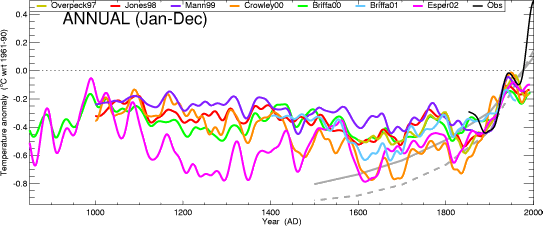
1750? How come the 1000 year CO2 data seems to miss any similar previous warming induced CO2 release in the last 1000 years? What about the 260 year delayed CO2 increase from the MWP you seem attached to, didn't that happen? Why doesn't the CO2 data show this?
We even know that the CO2 is not from the biosphere, it is anthropogenic. We could go over the basic maths again...
6.2 GtC human release per year
2.8 GtC accumulating per year
3.4 GtC removed by oceans and terrestrial sinks.
[edit on 27-4-2007 by melatonin]
Originally posted by Muaddib
His research in fact points out that a doubling of air's CO2 content led to a temperature increase of 0.014°C.
Where? A 0.014'C increase where?
I hope your not quote-mining again...
Originally posted by melatonin
Where? A 0.014'C increase where?
I hope your not quote-mining again...
Since i have already responded to your other statement in another thread, and since apparently you did not notice the link I gave before, here it is again with an excerpt...
The contribution to maximum temperature is small for
2 X CO2 radiation, with a mean of 0.014 °C, while the
2 X CO2 biology indicates a relatively large cooling
contribution of 0.747 °C.
blue.atmos.colostate.edu...
The contribution of a doubling of CO2 will cause a 0.014 C increase...
Keep trying to twist things around melatonin.
Originally posted by Muaddib
Since i have already responded to your other statement in another thread, and since apparently you did not notice the link I gave before, here it is again with an excerpt...
The contribution of a doubling of CO2 will cause a 0.014 C increase...
Keep trying to twist things around melatonin.
Yes, that's exactly what the paper says, I have read it. So what does this mean, what is the context?
A 0.014'C increase where? Global? Regional? In your pants?
Originally posted by melatonin
.................
A 0.014'C increase where? Global? Regional? In your pants?
Well you are probably right about this one...... Now that spring is here, which somedays it feels more like summer, my pants would probably produce more heat than doubling CO2 levels in the atmosphere.... I have to start wearing shorts before I heat up the atmosphere too much....
Originally posted by Muaddib
Well you are probably right about this one...... Now that spring is here, which somedays it feels more like summer, my pants would probably produce more heat than doubling CO2 levels in the atmosphere.... I have to start wearing shorts before I heat up the atmosphere too much....
Well, I know for sure that a lot of hot-air is emitted from your vicinity...
So, anyway, you do know that the Eastman article is a regional scale model based on one particular type of ecological environment? And therefore doesn't really tell us much for the global scale effects?
Originally posted by melatonin
Well, I know for sure that a lot of hot-air is emitted from your vicinity...
Naa, the "hot air" comes from the ignorant masses, which does includes some scientists such as Mann and associates, who claim that even thou the RWP, the MWP and the LIA happened all over the globe, some people claim that these were not "global events"....
Originally posted by melatonin
So, anyway, you do know that the Eastman article is a regional scale model based on one particular type of ecological environment? And therefore doesn't really tell us much for the global scale effects?
Nope, sorry, a doubling of CO2 in Earth's atmosphere would not increase temperatures much, and CO2 levels have not even doubled.
[edit on 30-4-2007 by Muaddib]
Originally posted by Muaddib
Nope, sorry, a doubling of CO2 in Earth's atmosphere would not increase temperatures much, and CO2 levels have not even doubled.
'Nope, sorry' what? You didn't quote-mine and still believe this article means something for global climate change?
The article you are using is based on a model of central USA grasslands, one particular type of environment. The article even states in the discussion that the data cannot be extrapolated to global effects.
Finally, the model results suggest that the 2x CO2 biological effect can dominate the overall effects on temperature. This must be interpreted in the context it was presented. This is a regional-scale sensitivity study. These results cannot be linearly scaled up to global scales.
blue.atmos.colostate.edu...
Did you get that? This must be interpreted in the context it was presented - a regional model of central USA grasslands. Quote-miners need not apply.
There are enough studies outlining the global effects of doubling CO2, taking account of feedbacks, the best estimate is 3'C with a range of 1'C or so. This is well-established.
[edit on 1-5-2007 by melatonin]
melatonin...the facts still remain water vapor is more of a significant greenhouse gas than CO2 ever will.
Everyone of your claims are based on "proxies" or guesses and not on on observing the research and data which shows that, despite your claims, the RWM, the MWP were warmer than today and CO2 levels were lower..... and the geological record shows the same trend in the past... temperatures have been similar to the present with higher levels of CO2 and also lower levels of CO2...not to mention the fact that CO2 lags temperature.... The current warming began 260 years + well before the evil CO2 levels began increasing.....
BTW, stop yelling at the top of your lungs, you are exhaling too much CO2...and using your computer too much too....
Everyone of your claims are based on "proxies" or guesses and not on on observing the research and data which shows that, despite your claims, the RWM, the MWP were warmer than today and CO2 levels were lower..... and the geological record shows the same trend in the past... temperatures have been similar to the present with higher levels of CO2 and also lower levels of CO2...not to mention the fact that CO2 lags temperature.... The current warming began 260 years + well before the evil CO2 levels began increasing.....
BTW, stop yelling at the top of your lungs, you are exhaling too much CO2...and using your computer too much too....
At least the CO2 from one's lungs comes from food, which ultimately comes from atmospheric CO2 = little or no net change. Efficient computers and
alternative energy investment should help with the computer usage.
The water vapor and CO2 lags warming arguments are common, but they don't hold up under analysis. On water vapor (a feedback), see the link in the intro here. Also see #10 and #13 on warming preceding CO2 (forcing and/or feedback depending on the situation). Right now, we have a strengthening warming trend in the presence of a rapid CO2 accumulation, and the absence of a natural forcing sufficient to explain it. So apparently it's not just a continuing natural thaw.
[edit on 6-5-2007 by Alex2]
The water vapor and CO2 lags warming arguments are common, but they don't hold up under analysis. On water vapor (a feedback), see the link in the intro here. Also see #10 and #13 on warming preceding CO2 (forcing and/or feedback depending on the situation). Right now, we have a strengthening warming trend in the presence of a rapid CO2 accumulation, and the absence of a natural forcing sufficient to explain it. So apparently it's not just a continuing natural thaw.
[edit on 6-5-2007 by Alex2]
Originally posted by Alex2
At least the CO2 from one's lungs comes from food, which ultimately comes from atmospheric CO2 = little or no net change. Efficient computers and alternative energy investment should help with the computer usage.
CO2 exhaled from our lungs does not come from food, it comes from the diffusion process in our bodies as oxygen mixes with carbon, the carbon does come from food, and is exhaled as CO2. As for the carbon, or the CO2 of plants coming only from air, that is not true, it also comes from the soil.
Originally posted by Alex2
The water vapor and CO2 lags warming arguments are common, but they don't hold up under analysis. On water vapor (a feedback), see the link in the intro here. Also see #10 and #13 on warming preceding CO2 (forcing and/or feedback depending on the situation). Right now, we have a strengthening warming trend in the presence of a rapid CO2 accumulation, and the absence of a natural forcing sufficient to explain it. So apparently it's not just a continuing natural thaw.
Not true in the least. In fact proxies using CO2 as the main factor do not account for most of the past climate changes, but when using Milankovitch variations in such proxies, every climatic change in the past can be traced.
You should read what Professor Reid A. Bryson actually has to say on the matter.
The Northern Hemisphere temperature history as modeled using Milankovitch variations in solar radiation modulated by volcanic aerosols, using oceans and carbon dioxide only as minor dependent variables. BP means before 1955 CE.
This figure captures very well, the “little ice age”, the Medieval Warm Period, and other known variations of late BCE and early CE times. The drivers of this model are Milankovitch calculations (average for the entire Hemisphere) and the observed volcanic record described above. Carbon dioxide is treated as a very minor dependent variable. It is unlikely that a general circulation model which assumes a major role of carbon dioxide can duplicate this known climatic sequence.
climatesci.colorado.edu...
[edit on 7-5-2007 by Muaddib]
Originally posted by Muaddib
You should read what Professor Reid A. Bryson actually has to say on the matter.
Heh, so Bryson is chuffed that he can model the LIA and MWP without CO2 being a major variable of these climate changes. No-one said it was, it had been relatively constant for at least a couple of thousand years...
Now if you want to account for glacial cycles, GHG effects are required. Same for the most recent period of warming.
[edit on 7-5-2007 by melatonin]
new topics
-
James O’Keefe: I have evidence that exposes the CIA, and it’s on camera.
Whistle Blowers and Leaked Documents: 21 minutes ago -
Australian PM says the quiet part out loud - "free speech is a threat to democratic dicourse"...?!
New World Order: 1 hours ago -
Ireland VS Globalists
Social Issues and Civil Unrest: 1 hours ago -
Biden "Happy To Debate Trump"
Mainstream News: 2 hours ago -
RAAF airbase in Roswell, New Mexico is on fire
Aliens and UFOs: 2 hours ago -
What is the white pill?
Philosophy and Metaphysics: 3 hours ago -
Mike Pinder The Moody Blues R.I.P.
Music: 4 hours ago -
Putin, Russia and the Great Architects of the Universe
ATS Skunk Works: 7 hours ago
top topics
-
President BIDEN's FBI Raided Donald Trump's Florida Home for OBAMA-NORTH KOREA Documents.
Political Conspiracies: 17 hours ago, 35 flags -
A Warning to America: 25 Ways the US is Being Destroyed
New World Order: 12 hours ago, 20 flags -
Mike Pinder The Moody Blues R.I.P.
Music: 4 hours ago, 7 flags -
What is the white pill?
Philosophy and Metaphysics: 3 hours ago, 5 flags -
Biden "Happy To Debate Trump"
Mainstream News: 2 hours ago, 5 flags -
Australian PM says the quiet part out loud - "free speech is a threat to democratic dicourse"...?!
New World Order: 1 hours ago, 4 flags -
RAAF airbase in Roswell, New Mexico is on fire
Aliens and UFOs: 2 hours ago, 4 flags -
Putin, Russia and the Great Architects of the Universe
ATS Skunk Works: 7 hours ago, 3 flags -
Ireland VS Globalists
Social Issues and Civil Unrest: 1 hours ago, 2 flags -
James O’Keefe: I have evidence that exposes the CIA, and it’s on camera.
Whistle Blowers and Leaked Documents: 21 minutes ago, 1 flags
active topics
-
University of Texas Instantly Shuts Down Anti Israel Protests
Education and Media • 286 • : cherokeetroy -
Supreme Court Oral Arguments 4.25.2024 - Are PRESIDENTS IMMUNE From Later Being Prosecuted.
Above Politics • 98 • : Vermilion -
Biden "Happy To Debate Trump"
Mainstream News • 31 • : theatreboy -
Gaza Terrorists Attack US Humanitarian Pier During Construction
Middle East Issues • 84 • : YourFaceAgain -
President BIDEN's FBI Raided Donald Trump's Florida Home for OBAMA-NORTH KOREA Documents.
Political Conspiracies • 33 • : theatreboy -
James O’Keefe: I have evidence that exposes the CIA, and it’s on camera.
Whistle Blowers and Leaked Documents • 3 • : chiefsmom -
Hate makes for strange bedfellows
US Political Madness • 52 • : YourFaceAgain -
-@TH3WH17ERABB17- -Q- ---TIME TO SHOW THE WORLD--- -Part- --44--
Dissecting Disinformation • 697 • : Thoughtful3 -
So this is what Hamas considers 'freedom fighting' ...
War On Terrorism • 265 • : YourFaceAgain -
Ireland VS Globalists
Social Issues and Civil Unrest • 6 • : TimBurr