It looks like you're using an Ad Blocker.
Please white-list or disable AboveTopSecret.com in your ad-blocking tool.
Thank you.
Some features of ATS will be disabled while you continue to use an ad-blocker.

Canary Islands, El Hierro probably is going to erupt today
page: 12share:
Latest update from
earthquake-report
Scientists in La Restinga and Guardia Civil who is currently flying over the earlier jacuzzi location have reported that the vent has probably closed completely. The activity has completely stopped at the moment. The Roman Margaleff Oceanographic ship is now close to the eruption vent is is problably taking gas samples and water samples.
The closure of erupting vents is a normal phase in this kind of activity. This does not mean that the volcano activity is completely over. If the volcano continues in the same pattern, the seismic activity may getting stronger again as the magnma trying to find his way to the surface has been blocked.
Scientists in La Restinga and Guardia Civil who is currently flying over the earlier jacuzzi location have reported that the vent has probably closed completely. The activity has completely stopped at the moment. The Roman Margaleff Oceanographic ship is now close to the eruption vent is is problably taking gas samples and water samples.
The closure of erupting vents is a normal phase in this kind of activity. This does not mean that the volcano activity is completely over. If the volcano continues in the same pattern, the seismic activity may getting stronger again as the magnma trying to find his way to the surface has been blocked.
This picture was taken this morning by Raymond Matabosch, from Twitter
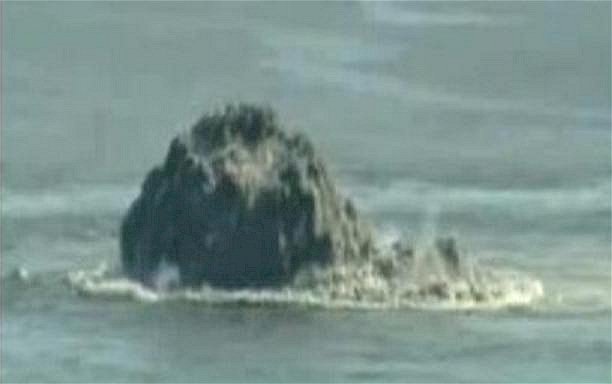
One of last earthquake was 16 km deep slowly is going to surface ..
1111502 09/11/2011 12:33:04 27.7713 -18.0478 16 2.7 mbLg NW FRONTERA.IHI
1111502 09/11/2011 12:33:04 27.7713 -18.0478 16 2.7 mbLg NW FRONTERA.IHI
Update from
earthquake-report
Update 09/22 – 18:00 UTC:
Pevolca has closed the beaches of Puerto Naos and Tacorón because of the risk of toxic gases emitted by the volcano. The decision has been taken after that a technician of IGN was mildly intoxicated while taking samples in the area on Tuesday. All other imposed measures remain unchanged. (ER = this is simply a precautionary measure – the activity of the jacuzzi s and the erupted material was never so high than yesterday. It was unwise of the technician to walk along the beach without a gas mask)
Update 09/22 – 18:00 UTC:
Pevolca has closed the beaches of Puerto Naos and Tacorón because of the risk of toxic gases emitted by the volcano. The decision has been taken after that a technician of IGN was mildly intoxicated while taking samples in the area on Tuesday. All other imposed measures remain unchanged. (ER = this is simply a precautionary measure – the activity of the jacuzzi s and the erupted material was never so high than yesterday. It was unwise of the technician to walk along the beach without a gas mask)
Update from elhierronews (Twittered)
Here we go again: It seems the silence of yesterday and this morning is over. Now IGN counts many earthquakes with max a magnitude 3.5 this evening.
We also see a slow increase in tremors/vibrations. This could be due to moving magma (underground)
Here we go again: It seems the silence of yesterday and this morning is over. Now IGN counts many earthquakes with max a magnitude 3.5 this evening.
We also see a slow increase in tremors/vibrations. This could be due to moving magma (underground)
Update from
earthquake-report
This one was last night
Data Update 11/11 – 00:58 UTC:
- a magnitude 4.6 earthquake happened in the El Golfo bay at 00:20 November 11. The depth was 21 km. This is one of the strongest earthquakes on El Hierro so far.
The earthquake was felt as a light to moderate shaking. If confirmed at 4.6 by IGN, the Los Roquillos tunnel maybe closed again. The epicenter of the earthquake was in the coastal El Golfo bay area.
This one was last night
Data Update 11/11 – 00:58 UTC:
- a magnitude 4.6 earthquake happened in the El Golfo bay at 00:20 November 11. The depth was 21 km. This is one of the strongest earthquakes on El Hierro so far.
The earthquake was felt as a light to moderate shaking. If confirmed at 4.6 by IGN, the Los Roquillos tunnel maybe closed again. The epicenter of the earthquake was in the coastal El Golfo bay area.
Latest update from canariesnews
11/11/2011 @ 09:01 – Scientists are preparing for a new eruption. After a period of calm there was a 4.6 degree earthquake this morning at 00:20. This was located to the north-west of El Hierro. This is the strongest quake to hit the island so far. Scientists claim that data points towards a new eruption off the coast of Frontera, to the north-west of the island as this is where all the lastest earthquakes are being detected. So far today there have been 23 earthquakes over 1.5 degrees on the island, three of these have been felt by the islands population.
11/11/2011 @ 09:01 – Scientists are preparing for a new eruption. After a period of calm there was a 4.6 degree earthquake this morning at 00:20. This was located to the north-west of El Hierro. This is the strongest quake to hit the island so far. Scientists claim that data points towards a new eruption off the coast of Frontera, to the north-west of the island as this is where all the lastest earthquakes are being detected. So far today there have been 23 earthquakes over 1.5 degrees on the island, three of these have been felt by the islands population.
reply to post by Tzavros
Hope you've got plenty of caffeine in for the week end TZ?
Looks like it could be an interesting one!
Rainbows
Jane
Hope you've got plenty of caffeine in for the week end TZ?
Looks like it could be an interesting one!
Rainbows
Jane
Latest update
11/11/2011 @ 14:23 – The director of the National Geographic Institute has said that they are expecting a possible double eruption to the north of El Hierro both underwater and on land, according to the latest data available to them. For this to happen, more powerful earthquakes are needed to allow the magma to the surface.
11/11/2011 @ 14:23 – The director of the National Geographic Institute has said that they are expecting a possible double eruption to the north of El Hierro both underwater and on land, according to the latest data available to them. For this to happen, more powerful earthquakes are needed to allow the magma to the surface.
2 questions to whoever can answer:
1- Has this been recorded happinening before?
2-What are the toxic gases if any other then CO2?
thanks in advance
1- Has this been recorded happinening before?
2-What are the toxic gases if any other then CO2?
thanks in advance
reply to post by Ophiuchus 13
Hi, I will reply when I have got back home unless someone comes in and answers the question.
There is a lot of information on earthquake-report Also I am another member are emailed or twittered very regularly with updates from scientists and locals. angelchemuel has direct contact with the local Joke so she well might come in to talk to you before me..
Hi, I will reply when I have got back home unless someone comes in and answers the question.
There is a lot of information on earthquake-report Also I am another member are emailed or twittered very regularly with updates from scientists and locals. angelchemuel has direct contact with the local Joke so she well might come in to talk to you before me..
Thanks for the updates Tzavros.
There was just a report on the local news mentioning the gases and fishing boats are forbidden to sail close to the area. But i didn't seen everything.
I will check next hour when they repeat the news and let you know.
these are the latest articles on El Hierro from rtve.es
Live stream www.rtve.es...
There was just a report on the local news mentioning the gases and fishing boats are forbidden to sail close to the area. But i didn't seen everything.
I will check next hour when they repeat the news and let you know.
these are the latest articles on El Hierro from rtve.es
Live stream www.rtve.es...
edit on 11-11-2011 by intergalactic fire because: (no reason given)
reply to post by Ophiuchus 13
Yes they happened only greatly increase the amount of, earthquakes are every days more and more shallow so very possibly soon start submarine eruptions close to Frontera ..
CO2 levels in the building are very large island. If last week's non-tip technicians stood at 1,200 tonnes of carbon dioxide emissions per day, a figure 3.5 times higher than normal on the island, the latest data collected on the day on Wednesday threw a rate higher than the 1,400 tons per day ..
In the south, where the eruption is located in the Sea of Calm, confirmed yesterday the Government of the Canaries after the analysis performed by non-tip, the emission shows a downward trend compared to Sunday. If Sunday in eruptive mouth area, La Restinga, CO2 yielded a rate of 54,160 tonnes per day, on Monday the index fell to 15,446 tons per day and up to 12,718 on Tuesday ..
This rate is obviously well above the ground is clear, because the emission is measured in an eruptive mouth already open, while on the island building at the moment, no eruptive mouth open. The same happened with hydrogen sulfide (H2S), which over the last few days showed a downward trend ..
The surface water pH has also changed, and has gone from a rate of 7.97 to 5.45 surface to five feet deep. "This decrease of three units of PH is that the media is supporting an acid concentration of a hundred thousand times higher than normal."
Above 900 is already considered an abnormal figure ..
Hope you enjoy in view "intergalactic fire", it's beautiful there and pity for these eruptions happened
Panorama of La Restinga to see where was submarine eruptions you can also zoom, image two day old ..
www.ilovesantacruz.es...
Live web cam of La Restinga, direction where was submarine eruptions ..
Don't post link they asked or >please< for it, or be overloaded very soon ..
212.170.244.196...
www.diariodeavisos.com...
lavozdetenerife.com... ro/
Peace ..
Yes they happened only greatly increase the amount of, earthquakes are every days more and more shallow so very possibly soon start submarine eruptions close to Frontera ..
CO2 levels in the building are very large island. If last week's non-tip technicians stood at 1,200 tonnes of carbon dioxide emissions per day, a figure 3.5 times higher than normal on the island, the latest data collected on the day on Wednesday threw a rate higher than the 1,400 tons per day ..
In the south, where the eruption is located in the Sea of Calm, confirmed yesterday the Government of the Canaries after the analysis performed by non-tip, the emission shows a downward trend compared to Sunday. If Sunday in eruptive mouth area, La Restinga, CO2 yielded a rate of 54,160 tonnes per day, on Monday the index fell to 15,446 tons per day and up to 12,718 on Tuesday ..
This rate is obviously well above the ground is clear, because the emission is measured in an eruptive mouth already open, while on the island building at the moment, no eruptive mouth open. The same happened with hydrogen sulfide (H2S), which over the last few days showed a downward trend ..
The surface water pH has also changed, and has gone from a rate of 7.97 to 5.45 surface to five feet deep. "This decrease of three units of PH is that the media is supporting an acid concentration of a hundred thousand times higher than normal."
Above 900 is already considered an abnormal figure ..
Hope you enjoy in view "intergalactic fire", it's beautiful there and pity for these eruptions happened
Panorama of La Restinga to see where was submarine eruptions you can also zoom, image two day old ..
www.ilovesantacruz.es...
Live web cam of La Restinga, direction where was submarine eruptions ..
Don't post link they asked or >please< for it, or be overloaded very soon ..
212.170.244.196...
www.diariodeavisos.com...
lavozdetenerife.com... ro/
Scientists at the Institute of Technology and Renewable Energies (ITER), an agency of the Cabildo Insular de Tenerife and which now form part of volcanological Institute of the Canaries (non-tip), were able to estimate the emission of carbon dioxide (CO2) and sulfur hydrogen (H2S) into the atmosphere by the submarine volcano of El Hierro. The emission of carbon dioxide (CO2) into the atmosphere grew to 54,160 tons a day estimates on Sunday [Day 6], whereas the results of subsequent days yielded estimated emission values of the order of 15,446 [day 7 ] and 12,718 [day 8] tonnes per day.
On the other hand, as to estimates of the emission of hydrogen sulfide (H2S) values were recorded 36, 15 and 12 tonnes per day. These results have been reported by scientists at the non-tip in the direction of the Civil Protection Special Plan for Volcanic Risk in the Canary Islands (PEVOLCA) given the interest they represent for the management of the volcanic crisis of El Hierro. The analysis of the temporal evolution of emissions of carbon dioxide (CO2) and hydrogen sulfide (H2S) reflect a downward trend in their values over this short period of observation. Measurements of carbon dioxide emissions (CO2) and hydrogen sulfide (H2S) have failed to materialize with the support and collaboration of the Helicopter
Service of the Guardia Civil in the Canary Islands to perform these measurements in air mobile position combining the use of optical remote sensing and COSPEC miniDOAS type, in order to estimate the emission of sulfur dioxide (SO2) using multiparameter portable instrument that has infrared and electrochemical sensors that provide insight into the relationships of some of the major components volcanic gases such as CO2 / SO2 and H2S / SO2. Non-tip is an institution demanded unanimously by the Senate (2005), Parliament of the Canary Islands (2006) and House of Representatives (2009) with the aim of contributing to improving and optimizing the management of volcanic risk in Spain.
Peace ..
edit on 11-11-2011 by Dalke07 because: (no reason given)
reply to post by Dalke07
Brilliant report thank you. I was hoping you might come in and share your knowledge. I have only just got home and need coffee.
The new cam is working this time at workingcam and might just take the load this time. Just seen a car go passed so it is live not a still like last time.
Brilliant report thank you. I was hoping you might come in and share your knowledge. I have only just got home and need coffee.
The new cam is working this time at workingcam and might just take the load this time. Just seen a car go passed so it is live not a still like last time.
Events on the eruptions from September- now
www.20minutos.es...
Because of the quake today, which was felt also on other islands, they believe there is risk of new quakes on the north of the island of El Hierro.
www.20minutos.es...
Because of the quake today, which was felt also on other islands, they believe there is risk of new quakes on the north of the island of El Hierro.
Update from
earthquake-report
13 volcanic earthquakes since midnight.
- NO earthquakes stronger than 3.0
- Harmonic tremor is still present with regular powerful bursts
- The lack of powerful earthquakes and the continuing strong harmonic tremor are indicating (on the basis of the recent activity) that a new vent might have been opened at a deeper location, not showing any jacuzzi or serious turbulence. The first eruption period had similarities with the present situation. Recent satellite images would certainly reveal this kind of eruption.
It does look like a new faint activity area is forming, there is a slight stain. New jacuzzi's do take a while to form.
13 volcanic earthquakes since midnight.
- NO earthquakes stronger than 3.0
- Harmonic tremor is still present with regular powerful bursts
- The lack of powerful earthquakes and the continuing strong harmonic tremor are indicating (on the basis of the recent activity) that a new vent might have been opened at a deeper location, not showing any jacuzzi or serious turbulence. The first eruption period had similarities with the present situation. Recent satellite images would certainly reveal this kind of eruption.
It does look like a new faint activity area is forming, there is a slight stain. New jacuzzi's do take a while to form.
update from canariesnews
12/11/2011 @ 16:34 – So far today there have been 19 earthquakes over 1.5 degrees on the island of El Hierro, the majority of them to the north-west of the island off the coast of Frontera where experts predict there will be a second eruption. The largest measured 2.8 degrees and was felt by some of the residents of the island.
I have watched the cams for some of the day and sometimes you can see a shape forming, at others the sea is perfectly flat.
12/11/2011 @ 16:34 – So far today there have been 19 earthquakes over 1.5 degrees on the island of El Hierro, the majority of them to the north-west of the island off the coast of Frontera where experts predict there will be a second eruption. The largest measured 2.8 degrees and was felt by some of the residents of the island.
I have watched the cams for some of the day and sometimes you can see a shape forming, at others the sea is perfectly flat.
Update from
earthquake-report
Data Update 13/11 – 10:38 UTC :
A new stain is reported to be forming approx. or on the location of the former jacuzzi. The new stain is brownish at the inside , green at the ourskirts and a layer of foam at the edge.
people currently in La Restinga are reporting a strong gas smell
Data Update 13/11 – 10:27 UTC :
- 10 (volcanic) earthquakes since midnight. The strongest one being a 2.7 magnitude earthquake.
- The depth varying from 18 to 23 km (only -10 km depth would be a very important new event)
- GPS deformation (the change of the surface because of the pressure of the magma) is relatively unchanged, which is one of the indications (in combination with harmonic tremor) that the eruption is probably still going on.
Data Update 13/11 – 10:38 UTC :
A new stain is reported to be forming approx. or on the location of the former jacuzzi. The new stain is brownish at the inside , green at the ourskirts and a layer of foam at the edge.
people currently in La Restinga are reporting a strong gas smell
Data Update 13/11 – 10:27 UTC :
- 10 (volcanic) earthquakes since midnight. The strongest one being a 2.7 magnitude earthquake.
- The depth varying from 18 to 23 km (only -10 km depth would be a very important new event)
- GPS deformation (the change of the surface because of the pressure of the magma) is relatively unchanged, which is one of the indications (in combination with harmonic tremor) that the eruption is probably still going on.
new topics
-
Barron Trump has prior commitments?
Mainstream News: 2 minutes ago -
Is Taco Bell Satanic?
Education and Media: 3 hours ago -
Scientists Find 7 potential Dyson spheres after Scanning 5 million Objects
Space Exploration: 4 hours ago -
Need help understanding the evolution of WHO as a power structure. Shades of the NWO...?
New World Order: 6 hours ago -
The geography of Eden
Religion, Faith, And Theology: 7 hours ago -
US 'Uniparty' officially throws Christians to the lions...
Conspiracies in Religions: 8 hours ago -
REAL ID now a reality
General Conspiracies: 10 hours ago
top topics
-
Oh, Have I got a Goody for You Guys!!!
General Conspiracies: 17 hours ago, 23 flags -
Former Hamas member goes OFF on ‘low grade’ lefty journalist
US Political Madness: 15 hours ago, 15 flags -
REAL ID now a reality
General Conspiracies: 10 hours ago, 7 flags -
Scientists Find 7 potential Dyson spheres after Scanning 5 million Objects
Space Exploration: 4 hours ago, 5 flags -
'I couldn't cope with Britain anymore': Kurdish man pays smuggler to return him to France
Social Issues and Civil Unrest: 13 hours ago, 4 flags -
US 'Uniparty' officially throws Christians to the lions...
Conspiracies in Religions: 8 hours ago, 3 flags -
Need help understanding the evolution of WHO as a power structure. Shades of the NWO...?
New World Order: 6 hours ago, 2 flags -
An Apple a Day
General Chit Chat: 15 hours ago, 2 flags -
Is Taco Bell Satanic?
Education and Media: 3 hours ago, 2 flags -
The geography of Eden
Religion, Faith, And Theology: 7 hours ago, 1 flags
active topics
-
Barron Trump has prior commitments?
Mainstream News • 0 • : BingoMcGoof -
US 'Uniparty' officially throws Christians to the lions...
Conspiracies in Religions • 17 • : AwakeNotWoke -
Is Taco Bell Satanic?
Education and Media • 14 • : Degradation33 -
Multipal Solar Storms Coming Our Way This Weekend
Fragile Earth • 29 • : Irishhaf -
REAL ID now a reality
General Conspiracies • 26 • : AwakeNotWoke -
Need help understanding the evolution of WHO as a power structure. Shades of the NWO...?
New World Order • 2 • : Lumenari -
ISRAEL to Swap Hostages with HAMAS During a 4 Day Cease Fire - 11.21.2023
Middle East Issues • 66 • : Danvero -
Scientists Find 7 potential Dyson spheres after Scanning 5 million Objects
Space Exploration • 20 • : Zanti Misfit -
Bibi’s Dilemma
Middle East Issues • 134 • : AliceTheSmall -
Biden-Democrats Mostly Ignore Americans Killed-Injured by Terrorists on and since Oct 7th 2023.
Political Ideology • 142 • : WeMustCare