It looks like you're using an Ad Blocker.
Please white-list or disable AboveTopSecret.com in your ad-blocking tool.
Thank you.
Some features of ATS will be disabled while you continue to use an ad-blocker.

What just slammed the Sun?
page: 3share:
reply to post by nuttin4U
Is it possible that the object hit with such force that it caused an explosion on the other side? No sarcassam here.
Is it possible that the object hit with such force that it caused an explosion on the other side? No sarcassam here.
lol wow are some of you really saying OMG THEY EDITED THE FOOTAGE!!!!??!?!
just FYI those are real time Gif's. The gif in question was from OCT 1 - 2. Today is OCT 3rd....of course you won't see the same footage. It's PAST OCT 1- 2.
Geez guys we're trying to deny ignorance here not promote it.
No wonder people think conspiracy theorist are crazy, because half of the preachers of conspiracies out there are just quick to jump the gun on every little thing and give out false info.
just FYI those are real time Gif's. The gif in question was from OCT 1 - 2. Today is OCT 3rd....of course you won't see the same footage. It's PAST OCT 1- 2.
Geez guys we're trying to deny ignorance here not promote it.
No wonder people think conspiracy theorist are crazy, because half of the preachers of conspiracies out there are just quick to jump the gun on every little thing and give out false info.
Originally posted by KaginD
reply to post by nuttin4U
Is it possible that the object hit with such force that it caused an explosion on the other side? No sarcassam here.
Possible: it may not have gone straight through the middle, but scudded through the upper layers of the Sun. Or perhaps it just looks like the CME emerges 180 degrees opposite because of the way the footage plays.
Originally posted by nuttin4U
Questions:
1.) How far is the sun away from us?
2.) How fast does a comet travel?
3.) How long did the comet or whatever that was take to impact the sun?
Answers:
1.) Approximately 93 MILLION miles from earth
2.) 40 miles per second (at it's closest point to the sun) A missle travels 14,000 mph.
3.) 13 seconds
Hypothesis:
BS. It was probably a missle that hit an object, in space...giving the illusion, as if it hit the sun. Correct me if i'm wrong....but the angle the U.F.O. (Unidentified Flying Object) was traveling, and the way the explosion occured, just doesn't make sense. The explosion should have come from the same direction the U.F.O. was traveling....not the opposite side.
Whoa.....slow up.
Where ya going with this?
Please break this down so I can understand.
I understand the math part to a certain degree. It doesn't add up. But I don't understand how you leaped to it being shot down (something I think we're TOTALLY capable of doing, by the way).
I love alternative beliefs!
Go on.........................
Originally posted by KaginD
reply to post by nuttin4U
Is it possible that the object hit with such force that it caused an explosion on the other side? No sarcassam here.
That's a good question and from the spaceweather link it looks like it's a valid question.
The timing of the CME so soon after the comet dove into the sun suggests a link. But what? There is no known mechanism for comets to trigger solar explosions. Before 2011 most solar physicists would have discounted the events of Oct. 1st as pure coincidence--and pure coincidence is still the most likely explanation. Earlier this year, however, the Solar Dynamics Observatory (SDO) watched another sungrazer disintegrate in the sun's atmosphere. On July 5, 2011, the unnamed comet appeared to interact with plasma and magnetic fields in its surroundings as it fell apart. Could a puny comet cause a magnetic instability that might propagate and blossom into a impressive CME? The question is not so crazy as it once seemed to be. spaceweather.com/
OiO
Originally posted by nuttin4U
Questions:
1.) How far is the sun away from us?
2.) How fast does a comet travel?
3.) How long did the comet or whatever that was take to impact the sun?
Answers:
1.) Approximately 93 MILLION miles from earth
2.) 40 miles per second (at it's closest point to the sun) A missle travels 14,000 mph.
3.) 13 seconds
Hypothesis:
BS. It was probably a missle that hit an object, in space...giving the illusion, as if it hit the sun. Correct me if i'm wrong....but the angle the U.F.O. (Unidentified Flying Object) was traveling, and the way the explosion occured, just doesn't make sense. The explosion should have come from the same direction the U.F.O. was traveling....not the opposite side.
So what's your qualification to talk about astrophysics and the behaviour of the Sun to impacts? A 'missile' wouldn't even be visible at that scale, and would've melted before it was even remotely near the sun. It was a comet. These things do happen.
That thing was big, way bigger than Elenin.
My question would be if someone spotted Elenin , why didn't someone spot this thing it was was bigger than Elenin.
Why wasn't this in the news or was it?
My question would be if someone spotted Elenin , why didn't someone spot this thing it was was bigger than Elenin.
Why wasn't this in the news or was it?
edit on 3-10-2011 by googolplex because: (no reason given)
Originally posted by freespirit1
Just found this on:
spaceweather.com...
Thanks my friend

Holy $^i+
I wonder if that did break on through to the other side (The Doors)
That is friggin enormous!!
Missile? Wow. I wonder.
Originally posted by googolplex
That thing was big, way bigger than Eilein.
My questipn would be if someone spotted Eilein , why didn't someone spot this thing it was was bigger than Eilein.
Why was this in the news or was it?
It was spotted, independently by four amateur astronomers. Can anyone actually point me to some photos or footage of this 'Elenin' because that seems to be the only object that no one as actually seen.
Originally posted by googolplex
That thing was big, way bigger than Eilein.
My questipn would be if someone spotted Eilein , why didn't someone spot this thing it was was bigger than Eilein.
Why was this in the news or was it?
Shhh. Go back to your trough and stop questioning authority!!
Originally posted by FlyingSpaghettiMonster
Originally posted by googolplex
That thing was big, way bigger than Eilein.
My questipn would be if someone spotted Eilein , why didn't someone spot this thing it was was bigger than Eilein.
Why was this in the news or was it?
It was spotted, independently by four amateur astronomers. Can anyone actually point me to some photos or footage of this 'Elenin' because that seems to be the only object that no one as actually seen.
And that's another thing...........for an object that supposedly no one has really ever seen, there sure seems to be a lot of data and statistics for this phantom object!
I think that WAS Elenin slamming the Sun in this clip. That's my gut feeling.
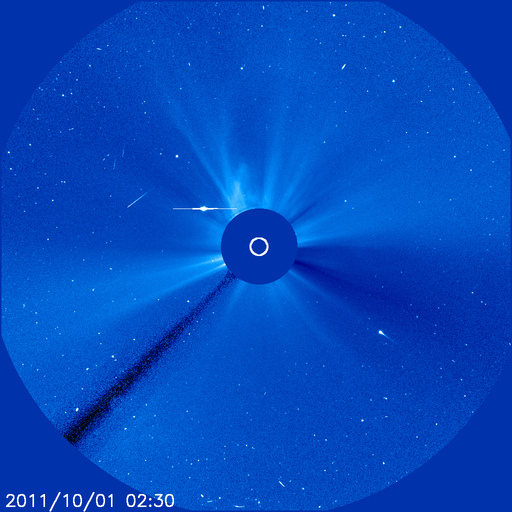
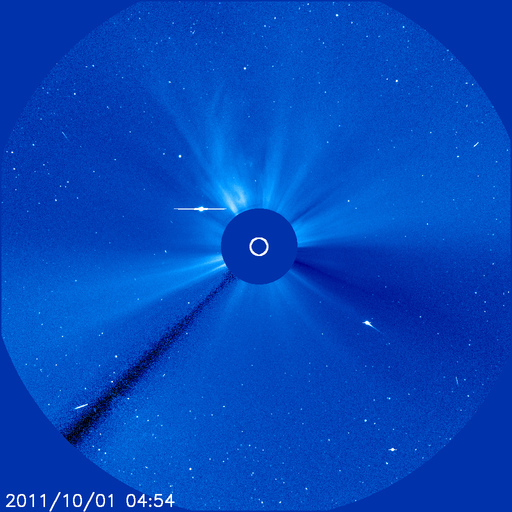
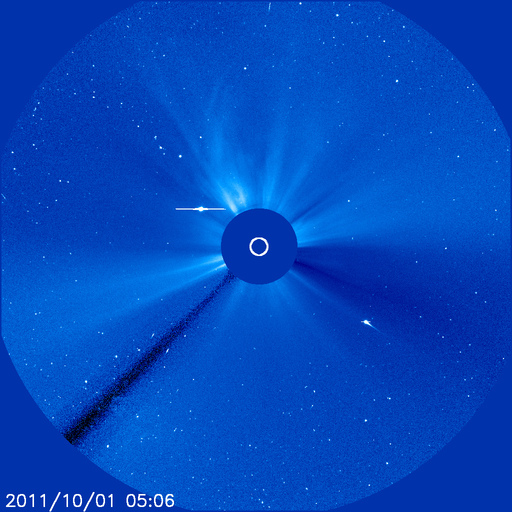
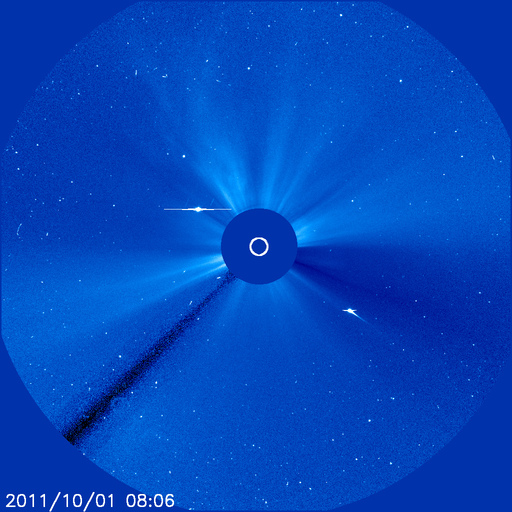
It is a large celestial of sometype. I cannot explain why the tailing end is so thick and bright though. Here are some pics from c3
10-01-230 ORIGINAL SHAPE BEFORE REFLECTION SHAPE CHANGES
10-01-454 LOOK AT BOTTOM BELOW CELESTIAL WHERE DID IT GO IN A 12 MINUTES
10-01-506
10-01-806 CHANGING REFLECTED SHAPE?
10-01-1254 WE HAVE SEEN THIS IMAGE BEFORE IF SOMEONE COULD REPOST?
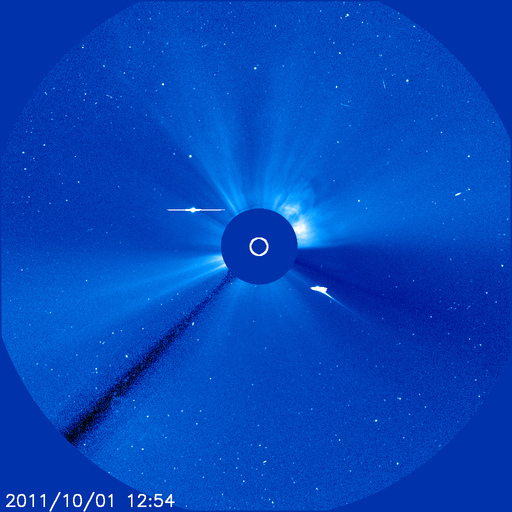
10-01-230 ORIGINAL SHAPE BEFORE REFLECTION SHAPE CHANGES
10-01-454 LOOK AT BOTTOM BELOW CELESTIAL WHERE DID IT GO IN A 12 MINUTES
10-01-506
10-01-806 CHANGING REFLECTED SHAPE?
10-01-1254 WE HAVE SEEN THIS IMAGE BEFORE IF SOMEONE COULD REPOST?
edit on 10/3/11 by Ophiuchus 13 because: (no reason given)
Where is that sunspot everyone was tweeking out over last week? Could that be what exploded? Is there any way to tell where it was when this thing
hit? Note to self, brush up on solar terms. "Stuff" and "things".. I hate using those words haha!
reply to post by Human_Alien
No problem.... new to this site so don't know how to do all of the fancy stuff yet, thanks for embedding that
No problem.... new to this site so don't know how to do all of the fancy stuff yet, thanks for embedding that
I don't usually post on these threads, since, basically, I have no clue what I'm talking about. BUT. WOW! Good Find Human A.......Now, what the
heck is it & was this 'burst' facing away from earth??
Originally posted by FlyingSpaghettiMonster
reply to post by Human_Alien
I meant compared to anything within our solar system.
Yeah, I knew that but wanted to put that up anyway just to make us all feel that much more; less significant
Just kidding.
We all matter. A lot!
But we really are almost microscopic in the larger picture. Our Sun is like a grain of sand.
The whole concept is so vast it can drive a person insane just trying to wrap their heads around the reality of space....and time.
Sorry to get so philosophical on a science thread
Originally posted by j.r.c.b.
I don't usually post on these threads, since, basically, I have no clue what I'm talking about. BUT. WOW! Good Find Human A.......Now, what the heck is it & was this 'burst' facing away from earth??
Thanks
Not sure.
And apparently heading our way!
I am barely awake but have been reading the
posts. Wow, that was some impact - good that
we have it confirmed as a comet now. So should
we expect a CME from this. Seems scientists
are a little perplexed as well.
Spaceweather.com
posts. Wow, that was some impact - good that
we have it confirmed as a comet now. So should
we expect a CME from this. Seems scientists
are a little perplexed as well.
Watch the movie again. The timing of the CME so soon after the comet dove into the sun suggests a link. But what? There is no known mechanism for comets to trigger solar explosions
Spaceweather.com
new topics
-
4/27/24 New Jersey Earthquake
Fragile Earth: 4 hours ago -
Fun with extreme paints
Interesting Websites: 5 hours ago -
CIA is alleged to be operat social media troll frms in Kyiv
ATS Skunk Works: 7 hours ago -
Rainbow : Stargazer
Music: 7 hours ago -
I sleep no more.
Philosophy and Metaphysics: 10 hours ago -
Canada caught red-handed manipulating live weather data and make it warmer
Fragile Earth: 10 hours ago -
Why Files Our Alien Overlords | How We Secretly Serve The Tall Whites
Aliens and UFOs: 11 hours ago
top topics
-
Canada caught red-handed manipulating live weather data and make it warmer
Fragile Earth: 10 hours ago, 16 flags -
Why Files Our Alien Overlords | How We Secretly Serve The Tall Whites
Aliens and UFOs: 11 hours ago, 11 flags -
Curse of King Tuts Tomb Solved
Ancient & Lost Civilizations: 13 hours ago, 9 flags -
CIA is alleged to be operat social media troll frms in Kyiv
ATS Skunk Works: 7 hours ago, 6 flags -
4/27/24 New Jersey Earthquake
Fragile Earth: 4 hours ago, 6 flags -
What allies does Trump have in the world?
ATS Skunk Works: 13 hours ago, 5 flags -
I sleep no more.
Philosophy and Metaphysics: 10 hours ago, 4 flags -
Fun with extreme paints
Interesting Websites: 5 hours ago, 2 flags -
Rainbow : Stargazer
Music: 7 hours ago, 1 flags
active topics
-
Ireland VS Globalists
Social Issues and Civil Unrest • 14 • : covent -
Gov Kristi Noem Shot and Killed "Less Than Worthless Dog" and a 'Smelly Goat
2024 Elections • 92 • : cherokeetroy -
Today I am 8
Members • 21 • : randomuser2034 -
Big Storms
Fragile Earth • 19 • : lilzazz -
George Knapp AMA on DI
Area 51 and other Facilities • 40 • : TheDiscoKing -
I sleep no more.
Philosophy and Metaphysics • 13 • : RAY1990 -
Silent Moments --In Memory of Beloved Member TDDA
Short Stories • 76 • : RAY1990 -
Why Files Our Alien Overlords | How We Secretly Serve The Tall Whites
Aliens and UFOs • 11 • : TheValeyard -
What allies does Trump have in the world?
ATS Skunk Works • 6 • : nugget1 -
CIA is alleged to be operat social media troll frms in Kyiv
ATS Skunk Works • 23 • : theatreboy