It looks like you're using an Ad Blocker.
Please white-list or disable AboveTopSecret.com in your ad-blocking tool.
Thank you.
Some features of ATS will be disabled while you continue to use an ad-blocker.

UEF Background Data
page: 16
share:
This is an open thread for all collaborators on the Voyages of the Penelope and the Yydryl to compile CANONICAL background information for their
races, species, characters, ships, etc.
This is to be used as a reference for writing about the past and major events that have taken place in the background of the story as a whole.
It can also serve as a place for those times you just need to hash out some information but don't want to put it in the main thread.
This is to be used as a reference for writing about the past and major events that have taken place in the background of the story as a whole.
It can also serve as a place for those times you just need to hash out some information but don't want to put it in the main thread.
Saratoga, U.S.S.
United Earth Federation Empathic class medical/research starship, registry number 39115. Lost with all hands around September 2310, presumed destroyed by warships out of Alpha Centauri though that government denies any direct involvement.
The Saratoga responded to a distress call from a dying world a few parsecs from Alpha Centauri as part of a UEF task force. The Saratoga picked up approximately 7,000 refugees and was on her way back to UEF central space when she was destroyed. The actual circumstances surrounding the destruction of the vessel were stamped with a classification by the UEF and the matter was covered up.
[edit on 19-5-2009 by mf_luder]
[edit on 19-5-2009 by mf_luder]
United Earth Federation Empathic class medical/research starship, registry number 39115. Lost with all hands around September 2310, presumed destroyed by warships out of Alpha Centauri though that government denies any direct involvement.
The Saratoga responded to a distress call from a dying world a few parsecs from Alpha Centauri as part of a UEF task force. The Saratoga picked up approximately 7,000 refugees and was on her way back to UEF central space when she was destroyed. The actual circumstances surrounding the destruction of the vessel were stamped with a classification by the UEF and the matter was covered up.
[edit on 19-5-2009 by mf_luder]
[edit on 19-5-2009 by mf_luder]
Synopsis of “The Federation Galactographic Reference” , 7th edition
23 May, 2320
The United Earth Federation, or UEF, is composed galactographically of a roughly spherical volume of space centered on Sol, with a nominal radius of 500 light years, or 153 parsecs. This volume contains 523,598,776 cubic light years (15,090,143 cubic parsecs). Sol itself is located just inside the inner edge of the Orion Spur (also known as the Local Arm) of the Perseus Arm of the Milky Way Galaxy, and is roughly 50 light years (15.3 parsecs) “above” the galactic plane, towards Galactic North. Currently, the closest neighboring star to Sol is Proxima Centauri, the smallest and outermost star in the Alpha Centauri triple system, at 4.25 Light years distance.
The UEF contains 2,094,395 stars, with an average of 0.004 stars per cubic light year. The numeric density of stars thins drastically toward the galactic center, as one encounters the relative void between the spiral arms of the Milky Way Galaxy, and thickens appreciably toward the Galactic Rim in the general direction of Orion. Star spatial density decreases towards both the north and south Galactic poles as one gets farther from Sol, more rapidly towards the north.
In this region of space, Main Sequence stars comprise about 91% of all stars present, followed by White Dwarves at 8% and Giant and Supergiant stars combining to comprise 1%. Main Sequence stars are further subdivided as follows, from dimmest to brightest: Cool, red class M dwarves comprise about 73% of the total, followed by orange class K stars at 14%, yellow class G stars like Sol comprise 9%, green class F at slightly less than 3%, blue class A at 1%, with classes B and O, at the hottest, accounting for far less than 1% combined.
[atsimg]http://files.abovetopsecret.com/images/member/0d0e62741edf.jpg[/atsimg]
Although the huge volume of space claimed by the UEF has not been contested by any of the neighboring political units, it is far from fully explored. In much the same way that parts of the Americas were still unexplored 300 years after colonization of the Americas, Ships of the UEF are still exploring the vast expanse of the Federation, and surprising discoveries are still made. In the 70 years since the Formation of the Federation, there simply has not been enough time or personnel resources to explore more than a fraction of the more than 2 million stars it contains. Nearly all of the stars it contains have been noted and cataloged, but for the majority little to nothing is known as yet of the internal arrangements the systems contain. Nearly 60% of the cataloged stars are estimated to possess planetary systems of one sort or another, and an estimated 10% of those contain planets that are habitable, or can be made habitable with modification to one degree or another, yielding an estimated 125,663 habitable or near habitable planets in the UEF. There are far fewer ‘optimally’ habitable planets, perhaps in the neighborhood of 15,000 total. Despite this seeming limitation, nearly any rock in space can be inhabited given a sufficiently healthy supply line.
[atsimg]http://files.abovetopsecret.com/images/member/8e569880f195.jpg[/atsimg]
Politically, the UEF has Two major neighbors, known in the Federation as the Orion Alliance, formerly known as the Orion Empire, and the Ophiuchi Consortium. Very little of their internal arrangements, affairs, and customs is known, although citizens of both of these entities have been encountered from time to time on the frontiers of Federation space.
The Orion Alliance is located in a densely-starred, resource rich region of the galaxy encompassing the stars and nebulae of the Orion constellation, slightly below the galactic plane, hence the name. Likewise, the Ophiuchi Consortium is located in the direction of the consellation Ophiuchi, as seen from Earth. The Consortium, although possessing far more volume than the UEF, is located in a more thinly starred region of the galaxy due to it’s greater distance above the galactic plane. Because of this, it is believed that the Ophiuchi Consortium has access to fewer resources than the UEF, and far fewer than the Orion Alliance.
Additionally, there are several smaller self-contained political entities bordering Federation space, but again, little is known of them. There are likely to be some of these smaller political units that are yet to be discovered.
Contained wholly within the bounds of UEF space are two Quarantine Zones, one for the Reticulans, and another for the Draconians. Attacks on trade routes around 2240 and the following years by these two hostile races were the stimulus that prompted the formation of the UEF. They have since been defeated and contained within their respective quarantine zones. There have been a few minor incidents when these races have probed the bounds of their Quarantine Zones, but as of 2320, the quarantines have held.
[edit on 2009/5/20 by nenothtu]
23 May, 2320
The United Earth Federation, or UEF, is composed galactographically of a roughly spherical volume of space centered on Sol, with a nominal radius of 500 light years, or 153 parsecs. This volume contains 523,598,776 cubic light years (15,090,143 cubic parsecs). Sol itself is located just inside the inner edge of the Orion Spur (also known as the Local Arm) of the Perseus Arm of the Milky Way Galaxy, and is roughly 50 light years (15.3 parsecs) “above” the galactic plane, towards Galactic North. Currently, the closest neighboring star to Sol is Proxima Centauri, the smallest and outermost star in the Alpha Centauri triple system, at 4.25 Light years distance.
The UEF contains 2,094,395 stars, with an average of 0.004 stars per cubic light year. The numeric density of stars thins drastically toward the galactic center, as one encounters the relative void between the spiral arms of the Milky Way Galaxy, and thickens appreciably toward the Galactic Rim in the general direction of Orion. Star spatial density decreases towards both the north and south Galactic poles as one gets farther from Sol, more rapidly towards the north.
In this region of space, Main Sequence stars comprise about 91% of all stars present, followed by White Dwarves at 8% and Giant and Supergiant stars combining to comprise 1%. Main Sequence stars are further subdivided as follows, from dimmest to brightest: Cool, red class M dwarves comprise about 73% of the total, followed by orange class K stars at 14%, yellow class G stars like Sol comprise 9%, green class F at slightly less than 3%, blue class A at 1%, with classes B and O, at the hottest, accounting for far less than 1% combined.
[atsimg]http://files.abovetopsecret.com/images/member/0d0e62741edf.jpg[/atsimg]
Although the huge volume of space claimed by the UEF has not been contested by any of the neighboring political units, it is far from fully explored. In much the same way that parts of the Americas were still unexplored 300 years after colonization of the Americas, Ships of the UEF are still exploring the vast expanse of the Federation, and surprising discoveries are still made. In the 70 years since the Formation of the Federation, there simply has not been enough time or personnel resources to explore more than a fraction of the more than 2 million stars it contains. Nearly all of the stars it contains have been noted and cataloged, but for the majority little to nothing is known as yet of the internal arrangements the systems contain. Nearly 60% of the cataloged stars are estimated to possess planetary systems of one sort or another, and an estimated 10% of those contain planets that are habitable, or can be made habitable with modification to one degree or another, yielding an estimated 125,663 habitable or near habitable planets in the UEF. There are far fewer ‘optimally’ habitable planets, perhaps in the neighborhood of 15,000 total. Despite this seeming limitation, nearly any rock in space can be inhabited given a sufficiently healthy supply line.
[atsimg]http://files.abovetopsecret.com/images/member/8e569880f195.jpg[/atsimg]
Politically, the UEF has Two major neighbors, known in the Federation as the Orion Alliance, formerly known as the Orion Empire, and the Ophiuchi Consortium. Very little of their internal arrangements, affairs, and customs is known, although citizens of both of these entities have been encountered from time to time on the frontiers of Federation space.
The Orion Alliance is located in a densely-starred, resource rich region of the galaxy encompassing the stars and nebulae of the Orion constellation, slightly below the galactic plane, hence the name. Likewise, the Ophiuchi Consortium is located in the direction of the consellation Ophiuchi, as seen from Earth. The Consortium, although possessing far more volume than the UEF, is located in a more thinly starred region of the galaxy due to it’s greater distance above the galactic plane. Because of this, it is believed that the Ophiuchi Consortium has access to fewer resources than the UEF, and far fewer than the Orion Alliance.
Additionally, there are several smaller self-contained political entities bordering Federation space, but again, little is known of them. There are likely to be some of these smaller political units that are yet to be discovered.
Contained wholly within the bounds of UEF space are two Quarantine Zones, one for the Reticulans, and another for the Draconians. Attacks on trade routes around 2240 and the following years by these two hostile races were the stimulus that prompted the formation of the UEF. They have since been defeated and contained within their respective quarantine zones. There have been a few minor incidents when these races have probed the bounds of their Quarantine Zones, but as of 2320, the quarantines have held.
[edit on 2009/5/20 by nenothtu]
Ventura - Class Heavy Carrier
Class of starship built in the late 2210s, modeled on its predecessor, the Tucson class medium carrier.
The Ventura class ships were intended to be the first in what the UEF expected as a replacement for an 'aging' fleet. The ship design incorporated cutting edge technology from all sectors and employed prototype engines never before tested for full flight status.
Up until the first production run of of a Ventura class ship, the UEF fleet incorporated FTL warp style drives on its vessels. A breakthrough in Quantum Physics by a navigation specialist, Whiterabbit85 led to the development of "wormhole" drives .
The basic specifications for a stock Ventura class are as follows:
Length: 2500 Meters
Width: 680-700 Meters at the widest point
Breadth: 500-650 Meters
Crew: 15,510 personnel
Full specifications for an example of a Ventura class ship can be found at this link:
files.abovetopsecret.com...
As of the year 2320, the following Ventura class Heavy Carriers are in operation within the UEF:
USS Ventura - 117930
USS Penelope - 117931
USS Avenger - 117932
USS Monroe - 117933
USS Yorkshire - 117934
USS Congo - 117935
[edit on 20-5-2009 by mf_luder]
Class of starship built in the late 2210s, modeled on its predecessor, the Tucson class medium carrier.
The Ventura class ships were intended to be the first in what the UEF expected as a replacement for an 'aging' fleet. The ship design incorporated cutting edge technology from all sectors and employed prototype engines never before tested for full flight status.
Up until the first production run of of a Ventura class ship, the UEF fleet incorporated FTL warp style drives on its vessels. A breakthrough in Quantum Physics by a navigation specialist, Whiterabbit85 led to the development of "wormhole" drives .
The basic specifications for a stock Ventura class are as follows:
Length: 2500 Meters
Width: 680-700 Meters at the widest point
Breadth: 500-650 Meters
Crew: 15,510 personnel
Full specifications for an example of a Ventura class ship can be found at this link:
files.abovetopsecret.com...
As of the year 2320, the following Ventura class Heavy Carriers are in operation within the UEF:
USS Ventura - 117930
USS Penelope - 117931
USS Avenger - 117932
USS Monroe - 117933
USS Yorkshire - 117934
USS Congo - 117935
[edit on 20-5-2009 by mf_luder]
Fooks, Gai Dan - Lieutenant
Original Senior navigation officer aboard the USS Penelope . Held the position for three days before being killed by Security Chief Nenothtu who was under mind control influence from an unknown life form.
[edit on 20-5-2009 by mf_luder]
Original Senior navigation officer aboard the USS Penelope . Held the position for three days before being killed by Security Chief Nenothtu who was under mind control influence from an unknown life form.
[edit on 20-5-2009 by mf_luder]
DJMessiah, Doctor, Lieutenant Commander
Original Chief Medical Officer aboard the USS Penelope . Mysteriously vanished after the ship left port and was never heard from again.
Original Chief Medical Officer aboard the USS Penelope . Mysteriously vanished after the ship left port and was never heard from again.
Whiterabbit85, Lieutenant Commander
Original Assistant to the Chief Navigation Officer aboard the USS Penelope . Served during the Nimitz Crisis and requested transfer after arrival back at Lagrange 1 in high Earth orbit.
Was noted for his work on and development of the Wormhole Drive systems used aboard UEF starships.
Original Assistant to the Chief Navigation Officer aboard the USS Penelope . Served during the Nimitz Crisis and requested transfer after arrival back at Lagrange 1 in high Earth orbit.
Was noted for his work on and development of the Wormhole Drive systems used aboard UEF starships.
Nimitz Crisis
Search and Rescue mission initiated by the UEF around January 2320. The USS Nimitz ventured into Alpha Centuarian space and was not heard from for several month. As a shakedown cruise and a test of the ship's abilities, the newly commissioned USS Penelope was sent to investigate.
Upon their arrival in-system, the crew of the Penelope had a hostile encounter with elements of the Alpha Centaurian space forces and what appeared to be a mutinied USS Nimitz . Unfortunately, the Nimitz was destroyed before a full investigation could be launched.
The USS Penelope returned to Earth space to find a war was brewing between the UEF and the Alpha Centaurian government over the results of the encounter between the Penelope and the Nimitz .
Search and Rescue mission initiated by the UEF around January 2320. The USS Nimitz ventured into Alpha Centuarian space and was not heard from for several month. As a shakedown cruise and a test of the ship's abilities, the newly commissioned USS Penelope was sent to investigate.
Upon their arrival in-system, the crew of the Penelope had a hostile encounter with elements of the Alpha Centaurian space forces and what appeared to be a mutinied USS Nimitz . Unfortunately, the Nimitz was destroyed before a full investigation could be launched.
The USS Penelope returned to Earth space to find a war was brewing between the UEF and the Alpha Centaurian government over the results of the encounter between the Penelope and the Nimitz .
Chief Medical Officer
Aboard a UEF ship, the officer charged with responsibility for the health and well-being of the ship's crew. Under certain circumstances the Chief Medical Officer is authorized to certify a ship's Captain as unfit for command.
Aboard a UEF ship, the officer charged with responsibility for the health and well-being of the ship's crew. Under certain circumstances the Chief Medical Officer is authorized to certify a ship's Captain as unfit for command.
Code name/ call sign: "nenothtu"
Birth Name: Cecil Frederick Carpenter
Birth Date: 23 July 2271
Birth Place: Autonomous Republic of Vandalia, American Federal Empire (AFE), Earth, United Earth Federation (UEF)
Current Assignment: Lieutenant Commander, Chief of Security Section, USS Penelope 117931, CPT M.F. Luder, commanding
Nenothtu was born in The Autonomous Republic of Vandalia, one of the reorganized states on the east coast of North America in what was known as the United States, before World War 3 (also known as the "Energy Wars") caused it to reorganize into the AFE in the early 22nd century.
Vandalia is a mountainous area rich in minerals and timber, but economically impoverished due to the wealth from those products being transferred to outside interests. The only other major export of Vandalia is fighting men, who are produced by the boatload in the harsh economic environment. Nenothtu was forged in the crucible of the "Clan Wars" of Vandalia of the late 23rd century, in which extended family groups, or "Clans" were pitted against other extended family groups in a struggle over control of the area's resources. Those wars were fueled, funded, and fostered by the outside interests mentioned above, who had a vested interest in retaining control of the wealth-producing products of the region, and keeping the wealth out of the hands of the locals.
Nenothtu left Vandalia as an already battle-scarred veteran of those wars in 2290, at the age of 19, after his entire family had been wiped out in a series of attacks by the competing Taggart Clan, which didn't survive as a viable entity either. Well, not after neno had hunted down and finished the Taggart survivors, one at a time, over the course of several months. He appeared to be a young man completely devoid of remorse, and dedicated to duty as he perceived it.
After leaving Vandalia, nenothtu gravitated to the major Space Port which had been called Cape Kennedy before the Energy Wars, and had been rechristened as Gammage Interstellar Spaceport upon it's reconstruction in the building boom that followed those wars. By the time neno landed there some 150 years after it's reconstruction, the port had grown into a thriving metropolis centered on the port with all that entailed, the good and the bad. The transition to interstellar flight from purely intrasystem flight after the 2183 revolution in travel occasioned by Plight's development of the "Boundless" really kicked the port into high gear.
Nenothtu established a ruthless and lethal reputation for himself there, and was soon in the employ of a local crime family as an 'enforcer'. The situation suited him, as he had as strong a sense of family as his employers, even if they WERE flatlanders. He had found a place to 'belong', yet still had the nagging feeling of being an Outsider.
Around two years of that was enough for neno. He became dissatisfied with living in the miasmatic flatlands of the AFE, and developed a restlessness to see the rest of the universe. To that end, he signed up with a military-for-hire outfit called "Wilson's Rogue Rangers" and shipped out for adventure among the stars. Some adventure. Most of his time was spent in sheer boredom aboard starships bound from one battlefield to the next, interspersed with the sheer terror of being dropped on to a battlefield where masses of people were trying to KILL him. These battlefields were wholly unlike the Clan Wars of his past for sheer size and destruction. He saw lots of them between 2292 and 2310.
For a brief period around 2296 nenothtu tried to settle down. He met a woman named Margot James on a colony world named "Travis' Rift", and tried to ease himself into a domestic role. It just didn't work. After the birth of a son in early 2297, relations with his common law spouse deteriorated to the point that he was spending more and more time off planet in angry little wars here and there, and not nearly enough time at home in the only angry little war that mattered. For all his stress on "family" it seems that very thing will ever elude him. That situation continued for the next several years until a ship he was on was reported missing and presumed lost in 2310. For all intents and purposes, neno had simply vanished from the universe, leaving Margot to raise their son alone and fatherless on a harsh colony world. It wasn't entirely nenothtu's fault. He was just on the wrong ship at the wrong time.
The starship in question, the "Elysium", was homeward bound after a series of sharp actions in the Black Rock Archepelago when problems had developed, and it had crashed on Khalamzadar. Nearly the entire crew had been killed, and most of the Rangers aboard had died as well. Neno and 9 other Rangers survived the initial crash, and set up a base near the wreckage, hoping for rescue. Over the course of the next 7 years, they battled the elements and wild animals of a jungle planet, dying one by one over time from various causes, until nenothtu was the last survivor of the ill-fated expedition. They spent some time exploring the ruins of a vanished civilization that were present on the planet, but never found a clue as to who the original builders were.
Just months before nenothtu was rescued in 2317, Margot died. Apparently she had never given up hope for his return, and had never had him declared dead. It's rumored that her last words to their by then 20 year old son were "That worthless damn daddy of yours is too mean to die. He'll eventually come home. When he does, you tell him for me that I'll see him in hell." And that's all there is to say about that.
In 2317, an exploratory ship named the "Daedalus" found neno and the remains of the camp on Khalamzadar on a mapping expedition and brought him home. After a few months, the sheer boredom and relative (to Khalamzadar) ease of colonial life got the better of him. Nenothtu made contact with a few gentlemen he had met over the years, seeking off world employment in the only real skill set he had ever known. That led to an appointment in the UEF Services through channels he couldn't even begin to imagine. He and his son left Travis' Rift, and never looked back.
His appointment to the Penelope is rumored to have been occasioned by his file having been left on "someone's" desk.
And that's how he got to where he is today.
An incident aboard Penelope in which nenothtu went into a coma during an encounter with an alien vessel, the "Yydryl", left him somehow "changed" when he emerged from the coma. Voices in his head during the incident told him that his "vibrational level was being raised", and neno attributed that message, and the voices, to hallucination. Neither was. Even nenothtu is unaware of what that change entails.
----------------------------------------------------------------------------------------
Psychological Profile
"Neno probably learned some of the hard lessons on Khala-whatever-that-planet's-called.
Sometimes you gotta do what's wrong to do what's right. "
--- SeekerOfAUTMN
Yeah, he learned some hard lessons on Khalamzadar. But he also learned 'em on Black Rock, Wotan, Ninkidu, and several other battlefield worlds over time.
For neno, this isn't a matter of right or wrong, it's a matter of what's effective, and insures the ship and crew's arrival alive on the other side of the battle, and helps insure against the necessity of future battles, because he really doesn't like fighting, but one does what one is good at.
The more thorough the victory, the less likely a repeat performance in the future.
He doesn't like fighting, because people get killed and things get torn up, and one day, one of those people getting killed is gonna be him. He'll do whatever he feels necessary to push that date with destiny as far into the future as he can, as long as it doesn't endanger the crew of "his" boat.
He feels it's "his" boat, because he's tasked with the safety and security of the Penelope.
I guess it might be a matter of "right" and "wrong", but his perceptions of those concepts don't necessarily agree with what is determined to be "normal".
It's "right" for "his" people aboard Penelope to survive and thrive. That include every man-jack aboard. He tends to feel more responsibility than is actually his.
It's "wrong" for "his" people to be killed or threatened.
He's often harsh and abrasive with those same people he serves because it gets their attention, and helps them to develop their own survival mindset, even if only out of fear of what HE might do to them.
Kind of like what drill sergeants used to do to recruits, he's cruel to be kind.
He's really a pretty simple man, and has pretty simple views, but to some, such as Studious, and perhaps Luder and Badger, those "simple" views may be well nigh incomprehensible.
He DOES have a heart, but he ain't gonna let you see it if he can help it. In his mind that might compromise his combat effectiveness.
His sense of duty, honor, and loyalty is WAY too overdeveloped, but may not always coincide with the common definitions of those concepts.
That's why he didn't mind completely and totally obliterating the NI ships. They were a threat, and had to be dealt with on a permanent basis, so THOSE NI agents would never become a threat again. That's also why he's going to back up Asher just as far as he is humanly able to push it.
Besides, he made a pact of sorts with Asher in the captain's ready room in the NI interview episode. His sense of honor and loyalty won't allow him to back out of it now that Asher's apparently in the grease.
Through thick and thin. That's what Brotherhood is about. If you abandon a brother when he needs you the most, you're a waste of otherwise perfectly good skin in nenothtu's mind.
[edit on 2009/7/8 by nenothtu]
[edit on 2009/7/8 by nenothtu]
Birth Name: Cecil Frederick Carpenter
Birth Date: 23 July 2271
Birth Place: Autonomous Republic of Vandalia, American Federal Empire (AFE), Earth, United Earth Federation (UEF)
Current Assignment: Lieutenant Commander, Chief of Security Section, USS Penelope 117931, CPT M.F. Luder, commanding
Nenothtu was born in The Autonomous Republic of Vandalia, one of the reorganized states on the east coast of North America in what was known as the United States, before World War 3 (also known as the "Energy Wars") caused it to reorganize into the AFE in the early 22nd century.
Vandalia is a mountainous area rich in minerals and timber, but economically impoverished due to the wealth from those products being transferred to outside interests. The only other major export of Vandalia is fighting men, who are produced by the boatload in the harsh economic environment. Nenothtu was forged in the crucible of the "Clan Wars" of Vandalia of the late 23rd century, in which extended family groups, or "Clans" were pitted against other extended family groups in a struggle over control of the area's resources. Those wars were fueled, funded, and fostered by the outside interests mentioned above, who had a vested interest in retaining control of the wealth-producing products of the region, and keeping the wealth out of the hands of the locals.
Nenothtu left Vandalia as an already battle-scarred veteran of those wars in 2290, at the age of 19, after his entire family had been wiped out in a series of attacks by the competing Taggart Clan, which didn't survive as a viable entity either. Well, not after neno had hunted down and finished the Taggart survivors, one at a time, over the course of several months. He appeared to be a young man completely devoid of remorse, and dedicated to duty as he perceived it.
After leaving Vandalia, nenothtu gravitated to the major Space Port which had been called Cape Kennedy before the Energy Wars, and had been rechristened as Gammage Interstellar Spaceport upon it's reconstruction in the building boom that followed those wars. By the time neno landed there some 150 years after it's reconstruction, the port had grown into a thriving metropolis centered on the port with all that entailed, the good and the bad. The transition to interstellar flight from purely intrasystem flight after the 2183 revolution in travel occasioned by Plight's development of the "Boundless" really kicked the port into high gear.
Nenothtu established a ruthless and lethal reputation for himself there, and was soon in the employ of a local crime family as an 'enforcer'. The situation suited him, as he had as strong a sense of family as his employers, even if they WERE flatlanders. He had found a place to 'belong', yet still had the nagging feeling of being an Outsider.
Around two years of that was enough for neno. He became dissatisfied with living in the miasmatic flatlands of the AFE, and developed a restlessness to see the rest of the universe. To that end, he signed up with a military-for-hire outfit called "Wilson's Rogue Rangers" and shipped out for adventure among the stars. Some adventure. Most of his time was spent in sheer boredom aboard starships bound from one battlefield to the next, interspersed with the sheer terror of being dropped on to a battlefield where masses of people were trying to KILL him. These battlefields were wholly unlike the Clan Wars of his past for sheer size and destruction. He saw lots of them between 2292 and 2310.
For a brief period around 2296 nenothtu tried to settle down. He met a woman named Margot James on a colony world named "Travis' Rift", and tried to ease himself into a domestic role. It just didn't work. After the birth of a son in early 2297, relations with his common law spouse deteriorated to the point that he was spending more and more time off planet in angry little wars here and there, and not nearly enough time at home in the only angry little war that mattered. For all his stress on "family" it seems that very thing will ever elude him. That situation continued for the next several years until a ship he was on was reported missing and presumed lost in 2310. For all intents and purposes, neno had simply vanished from the universe, leaving Margot to raise their son alone and fatherless on a harsh colony world. It wasn't entirely nenothtu's fault. He was just on the wrong ship at the wrong time.
The starship in question, the "Elysium", was homeward bound after a series of sharp actions in the Black Rock Archepelago when problems had developed, and it had crashed on Khalamzadar. Nearly the entire crew had been killed, and most of the Rangers aboard had died as well. Neno and 9 other Rangers survived the initial crash, and set up a base near the wreckage, hoping for rescue. Over the course of the next 7 years, they battled the elements and wild animals of a jungle planet, dying one by one over time from various causes, until nenothtu was the last survivor of the ill-fated expedition. They spent some time exploring the ruins of a vanished civilization that were present on the planet, but never found a clue as to who the original builders were.
Just months before nenothtu was rescued in 2317, Margot died. Apparently she had never given up hope for his return, and had never had him declared dead. It's rumored that her last words to their by then 20 year old son were "That worthless damn daddy of yours is too mean to die. He'll eventually come home. When he does, you tell him for me that I'll see him in hell." And that's all there is to say about that.
In 2317, an exploratory ship named the "Daedalus" found neno and the remains of the camp on Khalamzadar on a mapping expedition and brought him home. After a few months, the sheer boredom and relative (to Khalamzadar) ease of colonial life got the better of him. Nenothtu made contact with a few gentlemen he had met over the years, seeking off world employment in the only real skill set he had ever known. That led to an appointment in the UEF Services through channels he couldn't even begin to imagine. He and his son left Travis' Rift, and never looked back.
His appointment to the Penelope is rumored to have been occasioned by his file having been left on "someone's" desk.
And that's how he got to where he is today.
An incident aboard Penelope in which nenothtu went into a coma during an encounter with an alien vessel, the "Yydryl", left him somehow "changed" when he emerged from the coma. Voices in his head during the incident told him that his "vibrational level was being raised", and neno attributed that message, and the voices, to hallucination. Neither was. Even nenothtu is unaware of what that change entails.
----------------------------------------------------------------------------------------
Psychological Profile
"Neno probably learned some of the hard lessons on Khala-whatever-that-planet's-called.
Sometimes you gotta do what's wrong to do what's right. "
--- SeekerOfAUTMN
Yeah, he learned some hard lessons on Khalamzadar. But he also learned 'em on Black Rock, Wotan, Ninkidu, and several other battlefield worlds over time.
For neno, this isn't a matter of right or wrong, it's a matter of what's effective, and insures the ship and crew's arrival alive on the other side of the battle, and helps insure against the necessity of future battles, because he really doesn't like fighting, but one does what one is good at.
The more thorough the victory, the less likely a repeat performance in the future.
He doesn't like fighting, because people get killed and things get torn up, and one day, one of those people getting killed is gonna be him. He'll do whatever he feels necessary to push that date with destiny as far into the future as he can, as long as it doesn't endanger the crew of "his" boat.
He feels it's "his" boat, because he's tasked with the safety and security of the Penelope.
I guess it might be a matter of "right" and "wrong", but his perceptions of those concepts don't necessarily agree with what is determined to be "normal".
It's "right" for "his" people aboard Penelope to survive and thrive. That include every man-jack aboard. He tends to feel more responsibility than is actually his.
It's "wrong" for "his" people to be killed or threatened.
He's often harsh and abrasive with those same people he serves because it gets their attention, and helps them to develop their own survival mindset, even if only out of fear of what HE might do to them.
Kind of like what drill sergeants used to do to recruits, he's cruel to be kind.
He's really a pretty simple man, and has pretty simple views, but to some, such as Studious, and perhaps Luder and Badger, those "simple" views may be well nigh incomprehensible.
He DOES have a heart, but he ain't gonna let you see it if he can help it. In his mind that might compromise his combat effectiveness.
His sense of duty, honor, and loyalty is WAY too overdeveloped, but may not always coincide with the common definitions of those concepts.
That's why he didn't mind completely and totally obliterating the NI ships. They were a threat, and had to be dealt with on a permanent basis, so THOSE NI agents would never become a threat again. That's also why he's going to back up Asher just as far as he is humanly able to push it.
Besides, he made a pact of sorts with Asher in the captain's ready room in the NI interview episode. His sense of honor and loyalty won't allow him to back out of it now that Asher's apparently in the grease.
Through thick and thin. That's what Brotherhood is about. If you abandon a brother when he needs you the most, you're a waste of otherwise perfectly good skin in nenothtu's mind.
[edit on 2009/7/8 by nenothtu]
[edit on 2009/7/8 by nenothtu]
Here are a couple of links for background information:
1) Specs and Procedures for the USS Penelope
files.abovetopsecret.com...
2) Historical background primer for the UEF and Earth.
files.abovetopsecret.com...
Look to see updates to these documents in the near future.
1) Specs and Procedures for the USS Penelope
files.abovetopsecret.com...
2) Historical background primer for the UEF and Earth.
files.abovetopsecret.com...
Look to see updates to these documents in the near future.
Slayer69, Lieutenant Commander
Chief Engineer of the USS Penelope, who took over after the exit of JohnQ. Responsible for saving the lives of the entire crew on more than one occasion, his tactics proving to be invaluable to the crew. Made his departure after dealing with the intense emotional crisis raised by the destruction of Earth by the Opiuchi Consortium.
Currently the Captain of the ship Matilda , her destination and whereabouts unknown.
Chief Engineer of the USS Penelope, who took over after the exit of JohnQ. Responsible for saving the lives of the entire crew on more than one occasion, his tactics proving to be invaluable to the crew. Made his departure after dealing with the intense emotional crisis raised by the destruction of Earth by the Opiuchi Consortium.
Currently the Captain of the ship Matilda , her destination and whereabouts unknown.
Badgerprints, Lieutenant Commander
Wing commander of the on-board starfighter group on the USS Penelope. Badgerprints left as much as he arrived, quickly and without fanfare. His accomplishments while tasked to the Penelope exceed the abilities of previous wing commanders and were critical in the defense of the USS Penelope during a conflict with several NI Battle Ships.
Badgerprints' current whereabouts and status are unknown.
Wing commander of the on-board starfighter group on the USS Penelope. Badgerprints left as much as he arrived, quickly and without fanfare. His accomplishments while tasked to the Penelope exceed the abilities of previous wing commanders and were critical in the defense of the USS Penelope during a conflict with several NI Battle Ships.
Badgerprints' current whereabouts and status are unknown.
Planetary Data Sheet - Khalamzadar IV
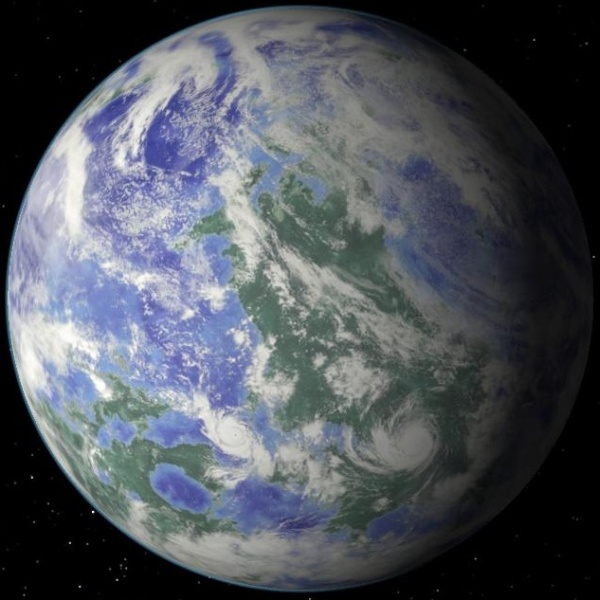
Planet type - Terrestrial
Climate - Warm (N2, O2 - breathable)
Distance from primary star - 1.019 AU (4th orbit from primary)
Mass - 1.393 Earth masses
Surface gravity - 1.12 Earth gees
Surface pressure - 1.866 Earth atmospheres
Surface temperature - 19.7° Celcius/ 67.4° Fahrenheit ( +5.7° C Earth temperature/ +10.2° F Earth temperature)
Normal temperature average (night) -16.3° C; 61.4° F
Normal temperature average (day) - 22.8° C; 73.0° F
Normal temperature range (min - max) - -2.9° C/ 26.8° F; 41.1° C/ 105.9° F
Equatorial radius - 7103.8 Km/ 1.1 Earth radii
Density - 5.55 grams/cc; 1 Earth densities
Eccentricity of orbit - 0.084
Escape Velocity - 12.5 Km/sec
Atmospheric composition - Nitrogen 78%; Oxygen 21.6%; Argon 0.4%; trace: CH4, NH3, H2O, Ne, CO
Axial tilt - 15°
Planetary albedo - 0.43
Length of year - 368.21 Earth days; 599.61 Local days; 1.01 Earth years
Length of day - 14.74 hours
Boiling point of water - 118.3° Celcius; 244.9° Fahrenheit
Hydrosphere percentage - 76.7
Cloud cover percentage - 78.7
Ice cover percentage - 1.2
Geography:
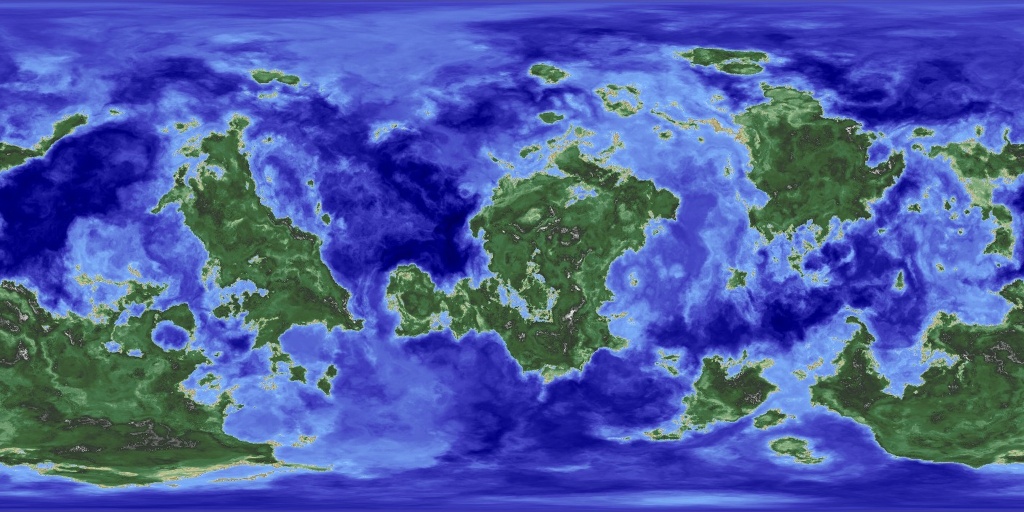
Khalamzadar IV is a warm world, with an atmospheric composition similar to that of Earth, although the atmosphere is a good bit thicker, with nearly twice the atmospheric pressure at sea level compared to that of Earth. The climate is humid and tropical. Clouds cover almost 80% of the sky at any given time, and rain and violent storms are endemic, in part because of the rapid axial spin rate - a "day" locally on Khalamzadar IV amounts to not quite 15 Earth hours long. Since the "year" is 368.21 Earth day long, there are 599.61 local days in a local year. Seasonal variations are less than those found in the temperate regions of Earth, because the axial tilt is more shallow.
Khalamzadar IV has nearly 1.4 times the mass of Earth, at nearly the same density as Earth, making the radius of the Planet some 10% larger than Earth's radius. The mass and radius of the planet combine to make gravity at the surface slightly higher than earth's gravity. A 100 pound woman on Earth would weigh 112 pounds on Khalamzadar IV. The radius also gives Khalamzadar IV 1.21 times the surface area of Earth, of which roughly 77% - just over 3/4 - is covered in water.
Tropical rain forest covers most of the land mass of the planet. The only ice found is at the higher elevations and small patches near the poles, amounting to a coverage of just over 1% of the total surface area. Because of the thick atmosphere and high humidity, there is very little in the way of desert areas, but there are biomes similar to Earth's grasslands found at higher latitudes. Remains of an ancient, presumably extinct civilization dot the planet in several areas in the form of ruins, relics, and deserted cities. many of these have been swallowed and entirely covered and hidden by the riotous growth of the rainforests and coastal lowland swamps. These ruins may be found anywhere under the canopy unexpectedly, and it is unknown what became of the civilization that produced them. On the coasts, they are more readily apparent, usually having some part projecting above the tree canopy.
The planetary rain forest is home to a multitude of species, most notably the "uktena", which is a giant, horned, snake-like predatory animal. It was named after a giant horned serpent of Cherokee legend. The uktena in a Khalamzadar swamp forest:
[atsimg]http://files.abovetopsecret.com/images/member/e466cc02e682.jpg[/atsimg]
Each biome has it's own specific floral and faunal assemblages, with the forests perhaps having the richest diversity of fauna, and the grasslands the poorest diversity of flora. The oceans hold the bulk of the planetary faunal biomass, but the diversity is probably less than that found in the rainforests which cover most of the globe.
In 2310, nenothtu was stranded on this planet after a crash landing of a ship he was traveling on en route from military activity in the Black Rock Archipelago. He remained stranded for seven years, and was the last survivor when he was rescued by the FSS Daedalus, a survey ship charting the previously uncharted system in 2317.
Nenothtu received a marker plaque and a claim for this entire planetary system unexpectedly, which had apparently been filed in the aftermath of his rescue from khalamzadar IV by the captain of the ship which had recued him. The claim citation read, in part:
Claim filed 923021 – 2317 by Captain William Jeffries, Commanding Officer, FSS Daedalus, on behalf of Cecil Frederick Carpenter, A.K.A “nenothtu”, on the basis of seven (7) years continuous possession of, and domicile on, the fourth planet of the below described stellar system, unopposed and uncontested by either natives sentient beings or any other UEF Citizen.
A diligent search having been performed in the UEF Archives for any prior claimants, and such search failing to turn up any prior claims to said system, possession and ownership of the planetary system, together with all increase resulting from same is hereby granted to the above named claimant, pursuant to UEF-GS 14772,229, Section 17a, paragraph (D) effective this date 407228 – 2317.
Harlan G, Radesaljevic, Clerk, UEF Land Office, L5 Administrative Station.
edit on 2012/4/8 by nenothtu because: (no reason given)
Khalamzadar Star Sytem Overview
Relative sizes comparison chart (size is proportional to the square root of the radius, not the absolute size):
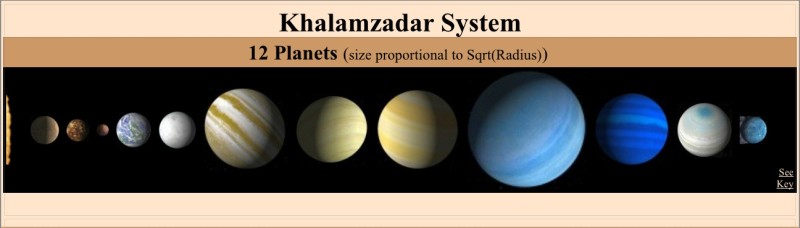
(scroll to see the entire system)
The primary star of the Khalamzadar system is cataloged in the Hipparcos catalog as HIP 84862, the Henry Draper catalog as HD 157214, and the Smithsonian Astrophysical Catalog as SAO 65963. It is also know variously as "72 Her" and "w Her", as well as several other descriptors in various star catalogs.
It is a G0V star 46.997 light years away from Earth. The galactic coordinates of the star are 055.8658 degrees counterclockwise from the galactic center as seen from Earth in the plane of the Milky Way galaxy, and +32.3091 degrees above the galactic plane, as seen from Earth. Viewed from Earth, the star appears in the Hercules constellation.
Khalamzadar has 1.04 times that mass of the Sun, and 1.21 times the luminosity. It is somewhat younger than the sun, at 3.393 billion years old, and has an estimated 5.196 billion years left on the Main Sequence.
The radius of the habitable ecosphere around Khalamzadar ranges from 0.896 astronomical units to 1.588 astronomical units. The optimal distance is 1.1 AU.
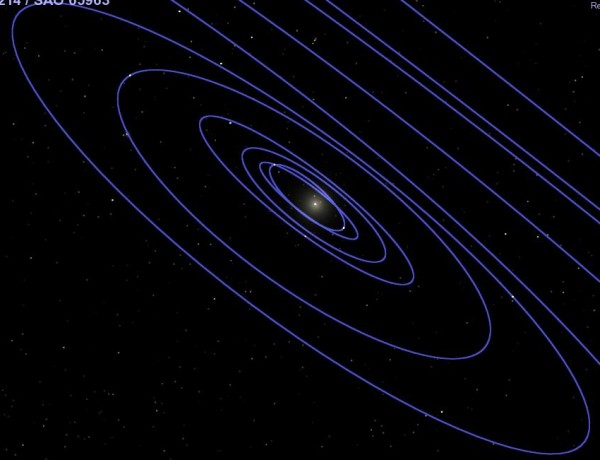
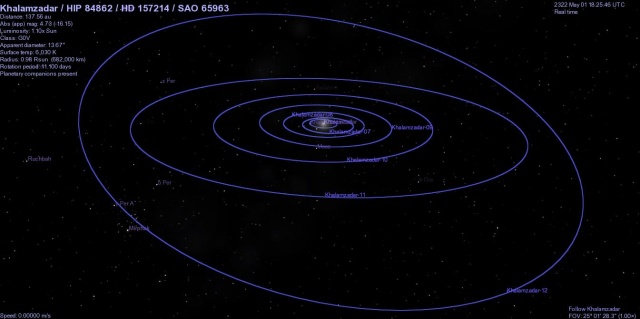
An oblique view of the orbits of the inner planets, showing the orbits of Khalamzadar-01 to Khalamzadar-06 (outermost complete orbit shown):
An overview of the orbits of the outer planets, showing the orbits of Khalamzadar-6 to Khalamzadar-12:
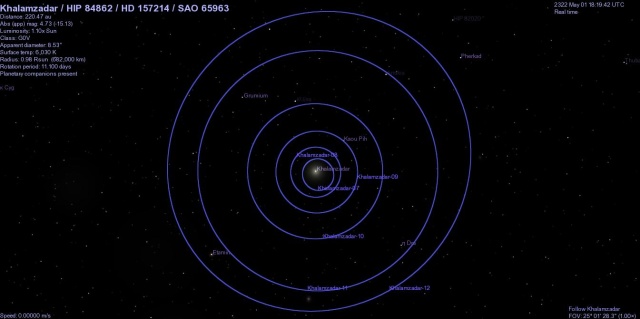
An oblique view of the orbits of the outer planets, showing the orbits of Khalamzadar-5 to Khalamzadar-12:
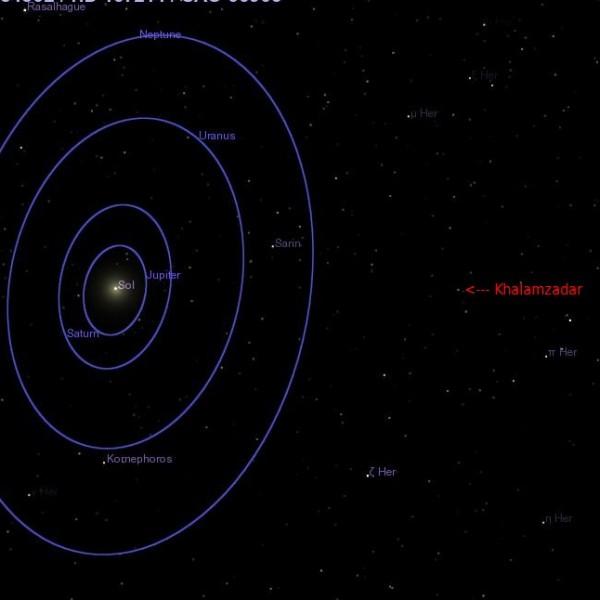
Khalamzadar (labeled in red) as seen from the vicinity of Earth's Sun:
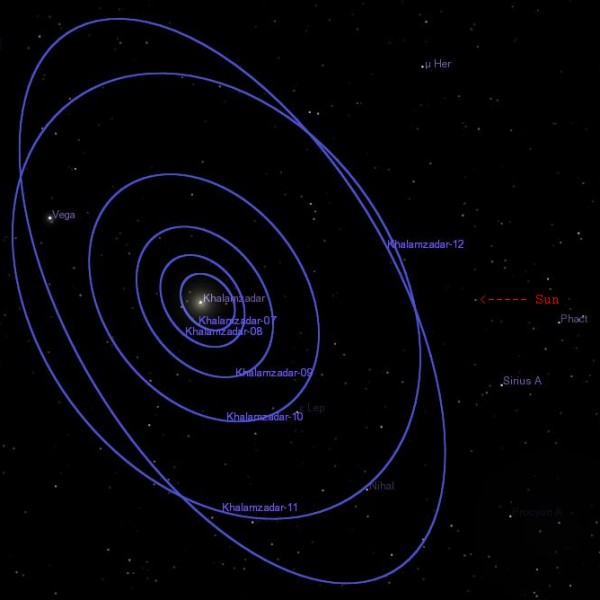
Earth's Sun (labeled in red) as seen from the vicinity of Khalamzadar:
==========================================================
The Planets
There are 12 planets in the Khalamzadar system - 6 rocky planets and 6 gas giants.
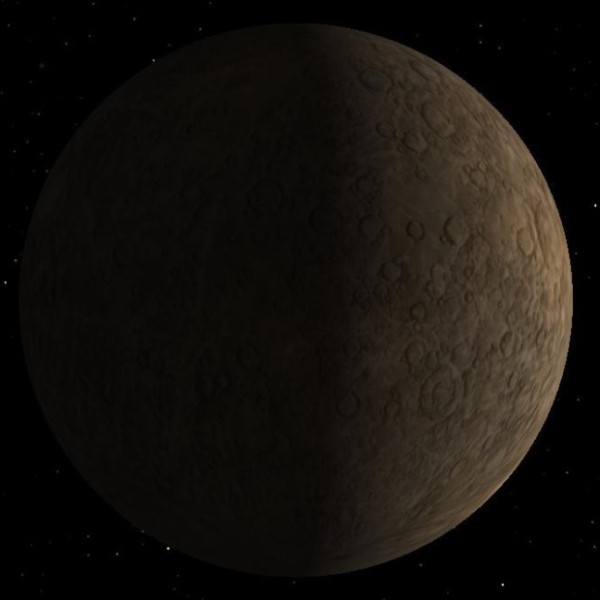
Planet 1 - rocky, 0.365 AU from the star, 0.352 earth masses, 0.710 Earth radii, Temperature 378.7 F /192.6 C, no atmosphere, gravity 0.70 Earth.
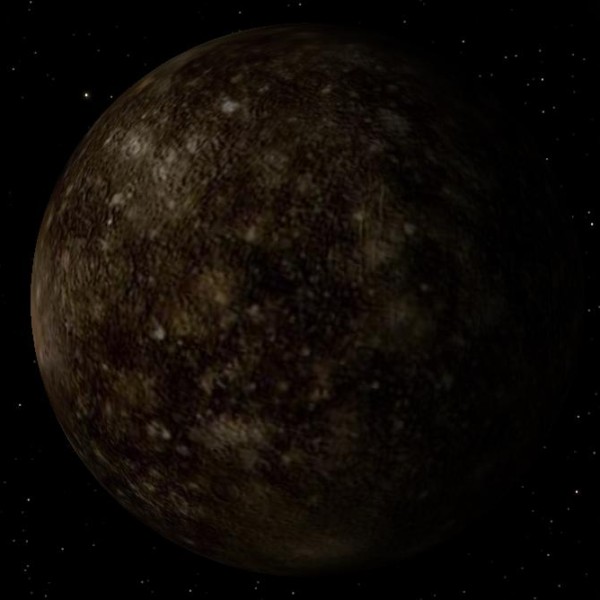
Planet 2 - rocky, 0.465 AU from the star, 0.091 Earth masses, 0.455 Earth radii, temperature 283.3 F / 139.6 C, no atmosphere, gravity 0.44 Earth.
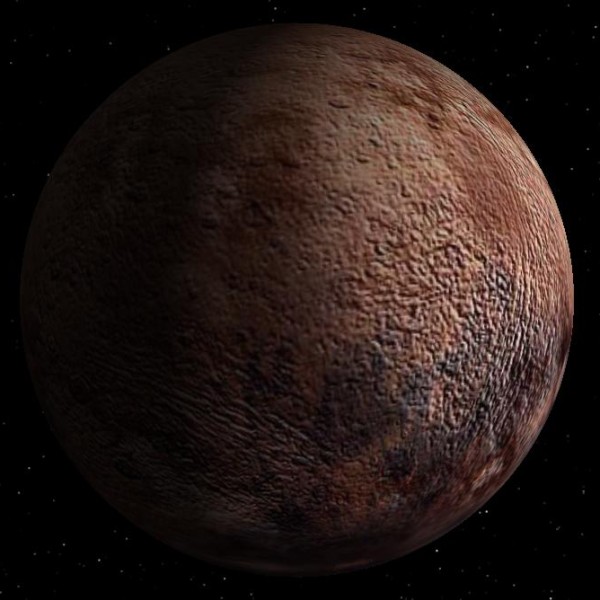
Planet 3 - rocky, 0.676 AU from the star, 0.002 Earth masses, 0.119 Earth radii, temperature 156.8 F / 69.3 C, no atmosphere, gravity 0.11 Earth.
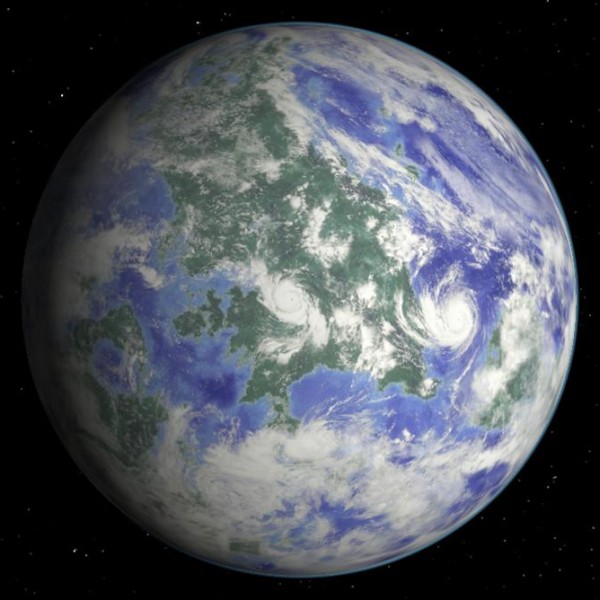
Planet 4 - terrestrial - see "Planetary data Sheet - Khalamzadar-IV" above for details of this planet.

Planet 5 - ice, 1.687 AU from the star, 1.811 Earth masses, 1.212 Earth radii, temperature -96.2 F / -71.2 C, atmospheric pressure 3.153 Earth atmos, composed of H, He, N, O, CH4, NH3, H2O, Ne, gravity 1.23 Earth.
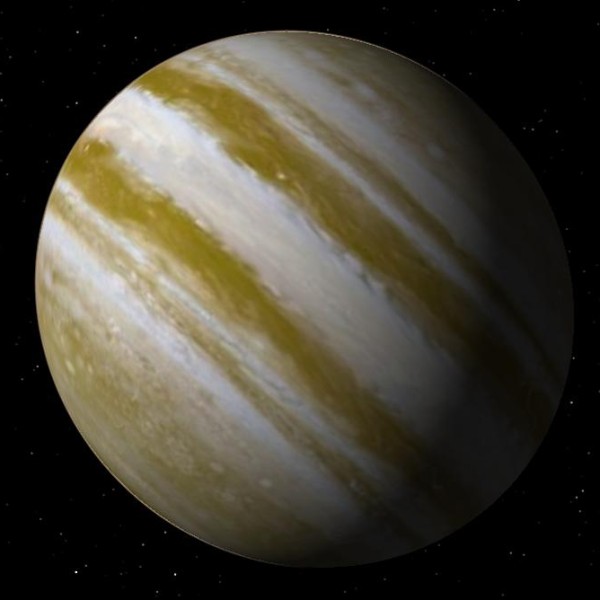
Planet 6 - jovian, 2.591 AU from the star, 77.351 Earth masses, 6.341 Earth radii
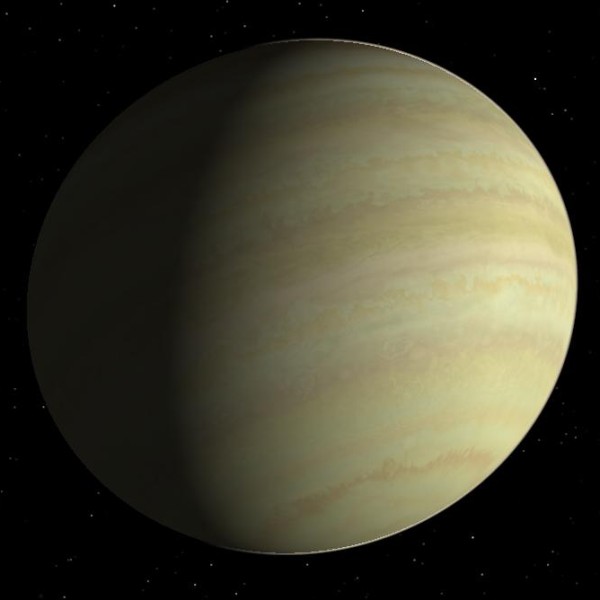
Planet 7 - jovian, 4.917 AU from the star, 23.702 Earth masses, 4.737 Earth radii
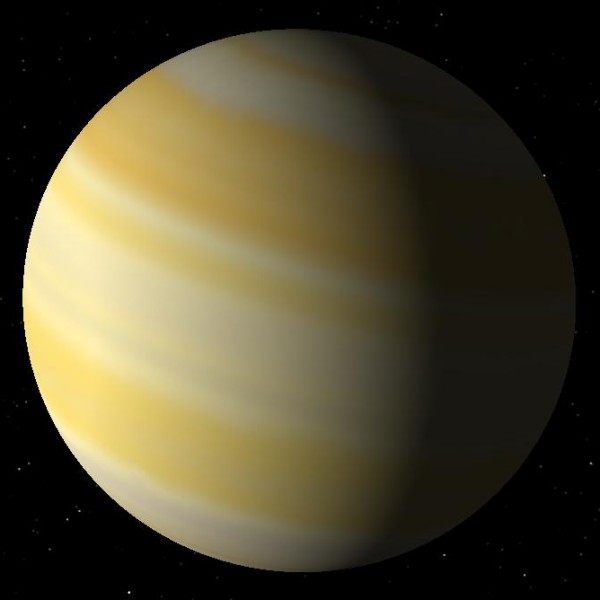
Planet 8 - jovian, 7.688 AU from the star, 48.818 Earth masses, 6.071 Earth radii

Planet 9 - jovian, 12.564 AU from the star, 539.271 Earth masses, 12.744 Earth radii
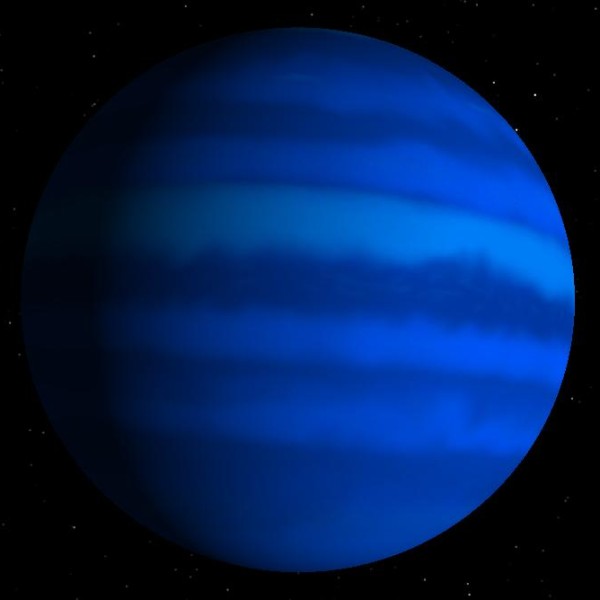
Planet 10 - sub-jovian, 20.738 AU from the star, 17.449 Earth masses, 4.885 Earth radii
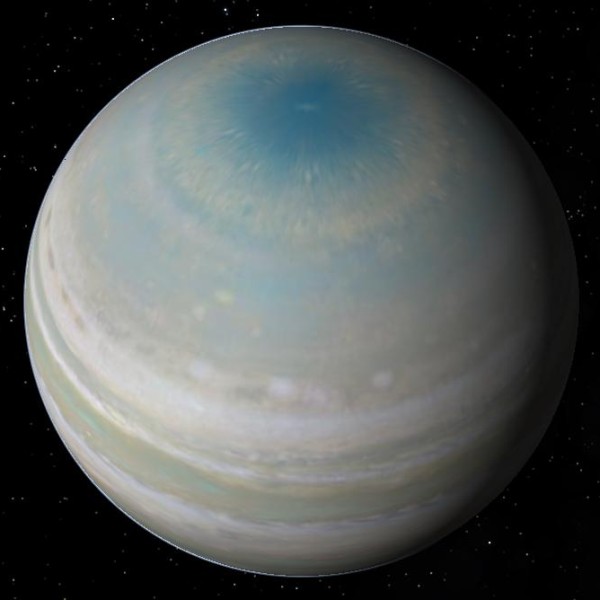
Planet 11 - sub-jovian, 36.903 AU from the star, 2.041 Earth masses, 2.741 Earth radii.
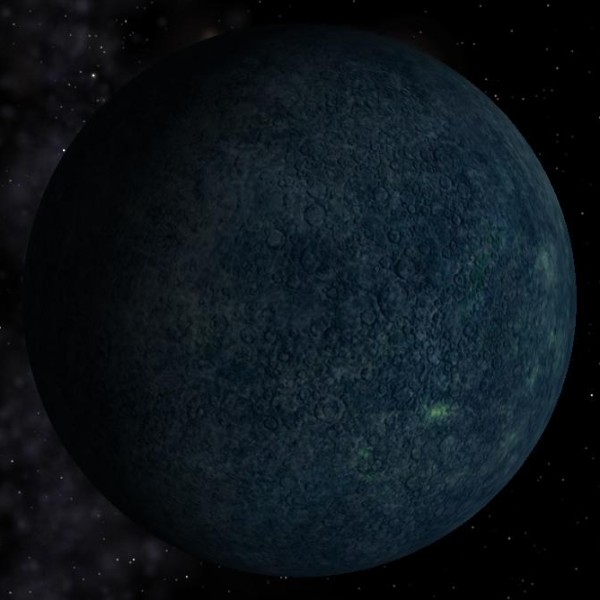
Planet 12 - rocky, 47.488 AU from the star, 0.110 Earth masses, 0.647 Earth radii, temperature -387.6 F / -233.1 C, no atmosphere, gravity 0.26 Earth.
For more details on this star system, see the document "Khalsys - v05a.pdf" on file in the UEF Land Office, Territories Survey Division, UEF HQ, Earth, L5 Administrative Station.
edit on 2013/1/6 by nenothtu because: (no reason given)
new topics
-
A Warning to America: 25 Ways the US is Being Destroyed
New World Order: 1 hours ago -
America's Greatest Ally
General Chit Chat: 2 hours ago -
President BIDEN's FBI Raided Donald Trump's Florida Home for OBAMA-NORTH KOREA Documents.
Political Conspiracies: 7 hours ago -
Maestro Benedetto
Literature: 8 hours ago -
Is AI Better Than the Hollywood Elite?
Movies: 8 hours ago
top topics
-
President BIDEN's FBI Raided Donald Trump's Florida Home for OBAMA-NORTH KOREA Documents.
Political Conspiracies: 7 hours ago, 27 flags -
Weinstein's conviction overturned
Mainstream News: 16 hours ago, 8 flags -
Gaza Terrorists Attack US Humanitarian Pier During Construction
Middle East Issues: 13 hours ago, 8 flags -
Massachusetts Drag Queen Leads Young Kids in Free Palestine Chant
Social Issues and Civil Unrest: 15 hours ago, 7 flags -
Las Vegas UFO Spotting Teen Traumatized by Demon Creature in Backyard
Aliens and UFOs: 12 hours ago, 6 flags -
Meadows, Giuliani Among 11 Indicted in Arizona in Latest 2020 Election Subversion Case
Mainstream News: 15 hours ago, 5 flags -
2024 Pigeon Forge Rod Run - On the Strip (Video made for you)
Automotive Discussion: 13 hours ago, 4 flags -
Is AI Better Than the Hollywood Elite?
Movies: 8 hours ago, 3 flags -
A Warning to America: 25 Ways the US is Being Destroyed
New World Order: 1 hours ago, 3 flags -
Maestro Benedetto
Literature: 8 hours ago, 1 flags
active topics
-
New whistleblower Jason Sands speaks on Twitter Spaces last night.
Aliens and UFOs • 64 • : baablacksheep1 -
HORRIBLE !! Russian Soldier Drinking Own Urine To Survive In Battle
World War Three • 50 • : F2d5thCavv2 -
Russia Ukraine Update Thread - part 3
World War Three • 5732 • : F2d5thCavv2 -
The Acronym Game .. Pt.3
General Chit Chat • 7751 • : F2d5thCavv2 -
Salvador Dali's Moustaches
People • 28 • : zosimov -
Is AI Better Than the Hollywood Elite?
Movies • 17 • : ThePsycheaux -
The best Rice dish i've ever tasted... Kimchi Rice
Food and Cooking • 26 • : lamhaocc -
A Warning to America: 25 Ways the US is Being Destroyed
New World Order • 1 • : 727Sky -
Massachusetts Drag Queen Leads Young Kids in Free Palestine Chant
Social Issues and Civil Unrest • 15 • : tarantulabite1 -
America's Greatest Ally
General Chit Chat • 1 • : BingoMcGoof
6