It looks like you're using an Ad Blocker.
Please white-list or disable AboveTopSecret.com in your ad-blocking tool.
Thank you.
Some features of ATS will be disabled while you continue to use an ad-blocker.

Lunar Sightings Research Images
page: 5share:
Sorry, I should have been more precise in my statement.
Originally posted by sherpa
Are you saying you have never physically seen it being done or that you havn't seen any evidence of it being done.
I don't know about airbrushing photos, I never saw it being done
I have never seen it being done and I never heard about anyone using an airbrush to do that type of job, an airbrush is a clumsy tool for such a precision work.
My sister, who is a photographer and was the one I asked about this, said that she knows a studio photographer that showed her a photo of a man who had his glasses on. Because of it, the photographer had to use the lights in a different way to avoid reflections, and after that he changed all the photo to make it look as if the light was from the normal source, using a very large lens and an extremely sharp pencil to draw directly on the negative, creating a final result that would have been impossible to do with just a photo and common lights.
I have had no involvement with scraping negatives, but back in the early seventies I worked in a commercial art studio and was frequently involved in cleaning up, (spotting), and sometimes enhancing negatives with a special paint, which I can't remember the name of but do remember was coloured brown.
The resulting work was used in final production artwork and was very difficult to tell that this work had been done if it was evident the artwork would be scrapped and redone.
The ignorance of the people that are supposed to know what they are doing or what they are asking for is impressive, most people that do know about TIFFs do not even know that they can use lossless compression and ask for uncompressed TIFFs when they want to scan their documents, even when those people are from universities.
Agreed, one further complication is the native format of the scanners used, with the Lab I used it was jpeg, I did not realise this until after I insisted on being supplied with Tiff scans and being dissapointed with the results, it was only at this point that I asked what the native format was of the scanner they were using and was told jpeg.
So with this in mind I thought it better to accept the jpeg images in case there was any conversion loss from jpeg to tiff, to be honest I am not sure if there is in my particular case but you can see why jpeg is so common.
reply to post by ArMaP
I would not agree with the word "clumsy" the airbrush was used extensively in commercial art studios before the advent of the digital revolution and is still used today as an art form an example of which below:

Source
The results obtained are directly dependent of course on the skill of the artist.
an airbrush is a clumsy tool for such a precision work.
I would not agree with the word "clumsy" the airbrush was used extensively in commercial art studios before the advent of the digital revolution and is still used today as an art form an example of which below:
Source
The results obtained are directly dependent of course on the skill of the artist.
Having given time to further study of AS8-12-2209 in both the JSC version and bookscan I have come to believe they are not the same image.
The reason for this is camera angle and I can demonstrate this with the examples below.
If a rectangle is superimposed over a linear ground feature in this case what seems to be 2 intersecting lines, than the angle between the ground feature and rectangle are clearly different.
Similiarly there is a small crater off to the right of the object which has a lighter area to one side of it again the direction of this lighter material is facing a different angle.
Also there are 3 lighter areas above the object which when you take a line through the approximate centres again presents a different angle to the viewer.
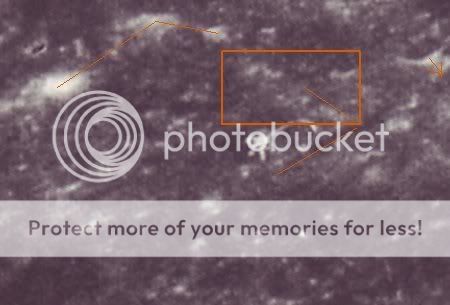
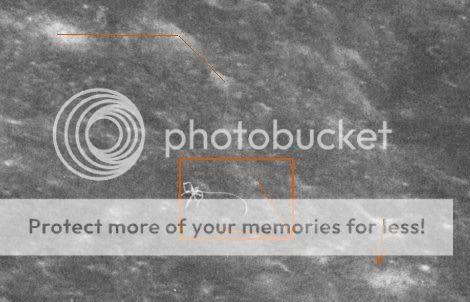
So where is the missing image and will the real AS8-12-2209 stand up please.
The reason for this is camera angle and I can demonstrate this with the examples below.
If a rectangle is superimposed over a linear ground feature in this case what seems to be 2 intersecting lines, than the angle between the ground feature and rectangle are clearly different.
Similiarly there is a small crater off to the right of the object which has a lighter area to one side of it again the direction of this lighter material is facing a different angle.
Also there are 3 lighter areas above the object which when you take a line through the approximate centres again presents a different angle to the viewer.
So where is the missing image and will the real AS8-12-2209 stand up please.
There is a user on Youtbe that has collected al lot of podcasts and videos with people like Hoagland, Steckling, Lear and more
www.youtube.com.... Maybe some questions can be answered by listening to and
watching them. There is one video that really bothered me and that is the 'Moon Secrets Revealed : John Lear & Richard Hoagland'.
www.youtube.com...
Regards
[edit on 30-12-2007 by tangent45]
www.youtube.com...
Regards
[edit on 30-12-2007 by tangent45]
reply to post by sherpa
Hi Sherpa,
Thought #1: A lot of photos back in the day were taken by camera on a copy stand (of the print below).
Thought #2: Some darkroom enlargers have adjustable bases. It was was a common trick to add perspective to a photo that needed it / needed more of it / just thought it would be cooler that way.
Hmmm....
Hi Sherpa,
Thought #1: A lot of photos back in the day were taken by camera on a copy stand (of the print below).
Thought #2: Some darkroom enlargers have adjustable bases. It was was a common trick to add perspective to a photo that needed it / needed more of it / just thought it would be cooler that way.
Hmmm....
Originally posted by lunarSightings
Thanks to Sherpa for tipping me off about a new photo. Here's a crop of some very interesting stuff:
Definitely going in the book!
Your welcome, a crop yes but from what frame ?, it is customary to quote the source when posting images so they can be verified.
Thanks for your post.
Originally posted by sherpa
Originally posted by lunarSightings
Thanks to Sherpa for tipping me off about a new photo. Here's a crop of some very interesting stuff:
Definitely going in the book!
Your welcome, a crop yes but from what frame ?, it is customary to quote the source when posting images so they can be verified.
Thanks for your post.
The photo you referenced back on Page 4
This Photo
reply to post by lunarSightings
Ok, thank you for that.
That would be AS8-12-2209.
Regarding the image enlarger/reducer do you know what it was called ?, I have used something similiar and I thought it was called a Pentagraph or Pentagram any way it was close to a mapograph I believe.
[edit on 30-12-2007 by sherpa]
Ok, thank you for that.
That would be AS8-12-2209.
Regarding the image enlarger/reducer do you know what it was called ?, I have used something similiar and I thought it was called a Pentagraph or Pentagram any way it was close to a mapograph I believe.
[edit on 30-12-2007 by sherpa]
reply to post by sherpa
"... it is customary to quote the source when posting images so they can be verified."
My jury is out on that one - seems most here want to debate the impossibility first, the fact that every method used to bring out the detail is flawed, and third, character calls of quick opinions that we all see what we want to see. Doesn't sound like a body of an investigative team to me. You are one of the few that apparently hasn't conclusively made up their mind before taking the time to a) consider how it 'could be' and, b) taking the time to actually do the research.
"... it is customary to quote the source when posting images so they can be verified."
My jury is out on that one - seems most here want to debate the impossibility first, the fact that every method used to bring out the detail is flawed, and third, character calls of quick opinions that we all see what we want to see. Doesn't sound like a body of an investigative team to me. You are one of the few that apparently hasn't conclusively made up their mind before taking the time to a) consider how it 'could be' and, b) taking the time to actually do the research.
reply to post by ArMaP
"Unless you have two photos of the same area from different angles (and if you have two photos of that area I don't think I have seen them) you can not be sure of the 3D characteristics of anything. "
Sorry - there's pretty much no reason to zoom in any further... This has to be taken as a site plan, not a study on an object. YouTube version above isn't the best, but if you watch if a couple times - keeping your eyes on one area as it rotates through the 3 angles, I think you'll pick up on the non-random, meaningful distribution of the elements in the scene.
"Unless you have two photos of the same area from different angles (and if you have two photos of that area I don't think I have seen them) you can not be sure of the 3D characteristics of anything. "
Sorry - there's pretty much no reason to zoom in any further... This has to be taken as a site plan, not a study on an object. YouTube version above isn't the best, but if you watch if a couple times - keeping your eyes on one area as it rotates through the 3 angles, I think you'll pick up on the non-random, meaningful distribution of the elements in the scene.
reply to post by lunarSightings
Yes I understand there will always be the ones who will not give a damn as to the source because their mind is already made up however for the few of us who are bothered than verification is important.
If you are going to write a book it is something you are going to have to factor in clearly they will not be buying.
For the ones who do then I would suggest plenty of image numbers and references so at least they have a better chance of deciding for themselves, what you have to do is provide the impetus.
Having looked at two previuos examples namely Leonard and Steckling the most glaring mistake was image size but it is difficult to present a good size image in a paperback.
By the way sorry if my "source" post seemed a bit curt.
My jury is out on that one - seems most here want to debate the impossibility first, the fact that every method used to bring out the detail is flawed, and third, character calls of quick opinions that we all see what we want to see. Doesn't sound like a body of an investigative team to me. You are one of the few that apparently hasn't conclusively made up their mind before taking the time to a) consider how it 'could be' and, b) taking the time to actually do the research
Yes I understand there will always be the ones who will not give a damn as to the source because their mind is already made up however for the few of us who are bothered than verification is important.
If you are going to write a book it is something you are going to have to factor in clearly they will not be buying.
For the ones who do then I would suggest plenty of image numbers and references so at least they have a better chance of deciding for themselves, what you have to do is provide the impetus.
Having looked at two previuos examples namely Leonard and Steckling the most glaring mistake was image size but it is difficult to present a good size image in a paperback.
By the way sorry if my "source" post seemed a bit curt.
reply to post by lunarSightings
Are those three different images or are they just the same image rotated?
If the image is the same it is useless to rotate it, we do not get different information from a rotated image.
Are those three different images or are they just the same image rotated?
If the image is the same it is useless to rotate it, we do not get different information from a rotated image.
reply to post by sherpa
Do you have a bigger image from that book scan?
That image is too small to see if the difference between those two images is only because of a rotation or if it has really a different angle.
At the moment, I think it is only rotated.
Do you have a bigger image from that book scan?
That image is too small to see if the difference between those two images is only because of a rotation or if it has really a different angle.
At the moment, I think it is only rotated.
reply to post by ArMaP
Nope that is all I have got as I have not personally had contact with the book I cannot rescan it either.
It seems now we have a matter of opinion mixed in with plausebility and probability.
Yes I can accept the plausebility of the image being rotated while in the copy process but was it probable ?, again what do you believe.
Without going through an experimental process with a copy stand this cannot be proven definatively.
I have come to the conclusion that this is not such an important point and will leave it at that.
I think I need a coffee
Nope that is all I have got as I have not personally had contact with the book I cannot rescan it either.
It seems now we have a matter of opinion mixed in with plausebility and probability.
Yes I can accept the plausebility of the image being rotated while in the copy process but was it probable ?, again what do you believe.
Without going through an experimental process with a copy stand this cannot be proven definatively.
I have come to the conclusion that this is not such an important point and will leave it at that.
I think I need a coffee
reply to post by lunarSightings
Absolutely right, surprised ?, so was I however you might like to look at this thread presented by our very own Zorgon interesting stuff.
NASA Admits to Storms and Dust Clouds on the Moon
www.abovetopsecret.com...
I didn't know there were dust storms on the Moon, but I guess there are?
Absolutely right, surprised ?, so was I however you might like to look at this thread presented by our very own Zorgon interesting stuff.
NASA Admits to Storms and Dust Clouds on the Moon
www.abovetopsecret.com...
reply to post by sherpa
I think it is very likely that the image was rotated during the copy or the scanning for the book, the image from the book is the best "candidate" for being in a different position because it was the image that suffered the most media transfers.
I think it is very likely that the image was rotated during the copy or the scanning for the book, the image from the book is the best "candidate" for being in a different position because it was the image that suffered the most media transfers.
Originally posted by ArMaP
reply to post by lunarSightings
Are those three different images or are they just the same image rotated?
If the image is the same it is useless to rotate it, we do not get different information from a rotated image.
Three different angles, same mission. It is a small area up high on a photo.
reply to post by lunarSightings
Sorry I still don't get this one, you have tower and dome in the file name could you put a couple of arrows in there to indicate what you mean.
And I would appreciate a source and file name for the full size image of your other posted images including the one of your avatar.
Thanks.
Sorry I still don't get this one, you have tower and dome in the file name could you put a couple of arrows in there to indicate what you mean.
And I would appreciate a source and file name for the full size image of your other posted images including the one of your avatar.
Thanks.
reply to post by lunarSightings
If you have three photos and a nadir view you can (if you know how to do it) make a 3D model.
If you have three photos and a nadir view you can (if you know how to do it) make a 3D model.
new topics
-
Putin, Russia and the Great Architects of the Universe
ATS Skunk Works: 2 hours ago -
A Warning to America: 25 Ways the US is Being Destroyed
New World Order: 7 hours ago
top topics
-
President BIDEN's FBI Raided Donald Trump's Florida Home for OBAMA-NORTH KOREA Documents.
Political Conspiracies: 13 hours ago, 31 flags -
A Warning to America: 25 Ways the US is Being Destroyed
New World Order: 7 hours ago, 13 flags -
Is AI Better Than the Hollywood Elite?
Movies: 14 hours ago, 4 flags -
Maestro Benedetto
Literature: 14 hours ago, 1 flags -
Putin, Russia and the Great Architects of the Universe
ATS Skunk Works: 2 hours ago, 1 flags
active topics
-
Sol Et Luna - TIME2024
Short Stories • 11 • : Encia22 -
Gaza Terrorists Attack US Humanitarian Pier During Construction
Middle East Issues • 47 • : FlyersFan -
Any one suspicious of fever promotions events, major investor Goldman Sachs card only.
The Gray Area • 11 • : mysterioustranger -
Ode to Artemis
General Chit Chat • 1 • : Encia22 -
A Warning to America: 25 Ways the US is Being Destroyed
New World Order • 15 • : jidnum2 -
Chris Christie Wishes Death Upon Trump and Ramaswamy
Politicians & People • 25 • : RazorV66 -
Skinwalker Ranch and the Mystery 1.6GHz Signal
Aliens and UFOs • 145 • : Ophiuchus1 -
University of Texas Instantly Shuts Down Anti Israel Protests
Education and Media • 273 • : HerbertWest -
Krystalnacht on today's most elite Universities?
Social Issues and Civil Unrest • 6 • : FlyersFan -
Hate makes for strange bedfellows
US Political Madness • 50 • : 19Bones79