It looks like you're using an Ad Blocker.
Please white-list or disable AboveTopSecret.com in your ad-blocking tool.
Thank you.
Some features of ATS will be disabled while you continue to use an ad-blocker.

NuSTAR has Detected a Huge Explosion in the Center of our Galaxy and inbound...
page: 1share:
Something has exploded in the centre of our galaxy and inbound...
Are we entering or crossing the galactic plane? Hope not!
www.nasa.gov...
NASA: The most lucky Space Agency ever....
An "interesting" theory....
Are we entering or crossing the galactic plane? Hope not!
www.nasa.gov...
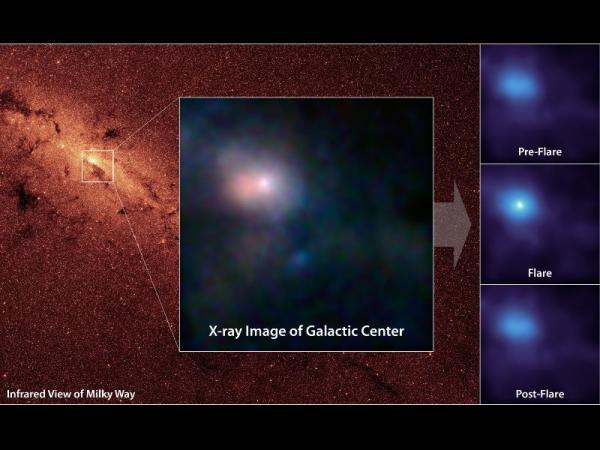
NASA's Nuclear Spectroscopic Telescope Array, or NuSTAR, has captured these first, focused views of the supermassive black hole at the heart of our galaxy in high-energy X-ray light. The background image, taken in infrared light, shows the location of our Milky Way's humongous black hole, called Sagittarius A*, or Sgr A* for short. NuSTAR is the first telescope to be able to focus high-energy X-rays, giving astronomers a new tool for probing extreme objects such as black holes.
In the main image, the brightest white dot is the hottest material located closest to the black hole, and the surrounding pinkish blob is hot gas, likely belonging to a nearby supernova remnant. The time series at right shows a flare caught by NuSTAR over an observing period of two days in July; the middle panel shows the peak of the flare, when the black hole was consuming and heating matter to temperatures up to 180 million degrees Fahrenheit (100 million degrees Celsius).
[...] NuSTAR was lucky to have captured an outburst from the black hole during its observing campaign...
NASA: The most lucky Space Agency ever....
An "interesting" theory....
NASA witnessed an explosion at the centre of our galaxy which must have been travelling at the speed of light for thousands of yrs beccause of the distance from our solar system to where the centre of the galaxy is, and this is recently been observed and i have to say it is terrifying because the speed of light or light which travels at the speed of light, has arrived at an optical device orbiting planet earth, so what you might say, let me try and help you understand this, you will get an EMP pulse off the detonation from a nuclear device before you encounter the blast, it is very difficult for anything molecular or even on the scale of frequency to travel at the speeds of light, now think about that, there is something behind the light that was optically observed from NASA, such as x rays, gamma rays, alpha beta and cosmic particles following at a slightly slower speed than that of light. when this arrives is only a question of speed against distance and forecasting ahead, NASA know when the photos were taken and these observations recorded, they know what speeds particles travel at from such exotic explosions, they know the time to the minute, and i am just going to leave it here because i do not know those specifics, i only know that light will be the first sign of things to come with relation to the speed of light.
edit on 19-12-2012 by Arken because: (no reason given)
Wow. I hope this is what we've been waiting for.
Activate the serpent gate!!!
Activate the serpent gate!!!
Pretty interesting... What effects could this have on earth? I'm no astronomer.
Originally posted by slapjacks
Pretty interesting... What effects could this have on earth? I'm no astronomer.
It depend if you stay on the walk side or right in the middle of the railway when the train arrive....
That picture was at least posted to wiki for Nustar in October.. So pretty pointless..
reply to post by Char-Lee
I think it's like 26000 years, so nothing to worry about really, because I reckon it will take about 13.5 million years for any charged particles to reach us.
Wouldn't it take a long long time to reach us?
I think it's like 26000 years, so nothing to worry about really, because I reckon it will take about 13.5 million years for any charged particles to reach us.
edit on 19-12-2012 by DAZ21 because: (no reason given)
According to the NASA article, this happened back in July. So I am thinking this is nothing to get really worked up about.
But, it is pretty cool. I remember hearing that they will be collecting more data on our galaxy's black hole over the course of the next year or so.
But, it is pretty cool. I remember hearing that they will be collecting more data on our galaxy's black hole over the course of the next year or so.
I was watching discovery or natgeo and they were talking about a gamma ray burst...
I'm curious if that "flare" generated one, if so how long ago and how long till it would hit, and would we have any way if knowing it before it does...
It is curious to day the least..
Grim
I'm curious if that "flare" generated one, if so how long ago and how long till it would hit, and would we have any way if knowing it before it does...
It is curious to day the least..
Grim
Originally posted by Char-Lee
reply to post by Arken
Wouldn't it take a long long time to reach us?
I'm no an astronomer, but if we se now (today) this huge flare in the middle of the galaxy, this means that the explosion is old of several billion years and maybe ir right the angle...
maybe I'm wrong.
Originally posted by Arken
Originally posted by Char-Lee
reply to post by Arken
Wouldn't it take a long long time to reach us?
I'm no an astronomer, but if we se now (today) this huge flare in the middle of the galaxy, this means that the explosion is old of several billion years and maybe ir right the angle...
maybe I'm wrong.
If we are 26.000 (roughly) light years away from the middle of the galaxy, and we see a flash from there, then that flash happened 26.000 years ago, not billions.
reply to post by Arken
Nothing will arrive here from that black hole, apart from those x-rays which have already arrived in July. It's just too far to have any effect on us. The black hole has eaten something, and the x-rays are the "burp". I bet this sort of thing happened many times in the recent past, it's just that we weren't able to detect it before.
Official NuSTAR site, with news and pictures: www.nustar.caltech.edu...
P.S. NuSTAR is smexy. It's part of the NASA Small Explorer satellite program (SMEX).
Nothing will arrive here from that black hole, apart from those x-rays which have already arrived in July. It's just too far to have any effect on us. The black hole has eaten something, and the x-rays are the "burp". I bet this sort of thing happened many times in the recent past, it's just that we weren't able to detect it before.
Official NuSTAR site, with news and pictures: www.nustar.caltech.edu...
P.S. NuSTAR is smexy. It's part of the NASA Small Explorer satellite program (SMEX).
edit on 19-12-2012 by wildespace because: (no reason
given)
How interesting that I came across your post after I had read this...this morning....
Source
For some unknown reason, the black hole at the center of the Milky Way galaxy shoots out an X-ray flare about once a day. These flares last a few hours with the brightness ranging from a few times to nearly one hundred times that of the black hole’s regular output. But back in February 2012, astronomers using the Chandra X-Ray Observatory detected the brightest flare ever observed from the central black hole, also known as Sagittarius A*. The flare, recorded 26,000 light years away, was 150 times brighter than the black hole’s normal luminosity.
What causes these outbursts? Scientists aren’t sure. But Sagittarius A* doesn’t seem to be slowing down, even though as black holes age they should show a decrease in activity.
Source
The timing of this thread could not be more epic.
Truthfully, how many people thought "killshot" when they saw the thread tittle...? SMH I need to take an ATS fast..
Truthfully, how many people thought "killshot" when they saw the thread tittle...? SMH I need to take an ATS fast..
Originally posted by Arken
Originally posted by Char-Lee
reply to post by Arken
Wouldn't it take a long long time to reach us?
I'm no an astronomer, but if we se now (today) this huge flare in the middle of the galaxy, this means that the explosion is old of several billion years and maybe ir right the angle...
maybe I'm wrong.
not that old at all since we are 25,000 light years from the light source, being SagB so this happened roughly 25k years ago. the better question would be how long will it take for the force of the explosion to reach us.
here is an article related to your thread.
Each century, about two massive stars in our own galaxy explode, producing magnificent supernovae. In the Universe at large, a supernova event occurs every second. Astrophysicists at the level of Stephen Hawking believe that these massive explosions may be resonsible for killing off advanced civilization --a major factor perhaps in the "Great Silence" of the Fermi Paradox.
These stellar explosions send fundamental, uncharged particles called neutrinos streaming our way and generate ripples called gravitational waves in the fabric of space-time. Scientists are waiting for the neutrinos and gravitational waves from about 1000 supernovae that have already exploded at distant locations in the Milky Way to reach us. On Earth, large, sensitive neutrino and gravitational-wave detectors have the ability to detect these respective signals, which will provide information about what happens in the core of collapsing massive stars just before they explode.
www.dailygalaxy.com...
highlights mine, interesting theory Stephen put out there and i think very pertinent to our discussion.
The thing you need to know are:-
What are the speeds of Gamma and X-rays.
Like with any explosion you see the light first, then the sound, then shockwave.
So we have seen the light, what arrives next?
What are the speeds of Gamma and X-rays.
Like with any explosion you see the light first, then the sound, then shockwave.
So we have seen the light, what arrives next?
X-rays, gamma rays and visible light are all types of electromagnetic radiation Arken... They all travel at the same speed in a vacum.
edit on
19-12-2012 by Atzil321 because: (no reason given)
reply to post by MasterPainter
Good point will be interesting... If my microwave popcorn starts popping without being in the microwave I guess we will have answer...
Tho in all seriousness it is a good question...
Grim
Good point will be interesting... If my microwave popcorn starts popping without being in the microwave I guess we will have answer...
Tho in all seriousness it is a good question...
Grim
new topics
-
BIDEN Admin Begins Planning For January 2025 Transition to a New President - Today is 4.26.2024.
2024 Elections: 1 hours ago -
Big Storms
Fragile Earth: 3 hours ago -
Where should Trump hold his next rally
2024 Elections: 5 hours ago -
Shocking Number of Voters are Open to Committing Election Fraud
US Political Madness: 6 hours ago -
Gov Kristi Noem Shot and Killed "Less Than Worthless Dog" and a 'Smelly Goat
2024 Elections: 7 hours ago -
Falkville Robot-Man
Aliens and UFOs: 7 hours ago -
James O’Keefe: I have evidence that exposes the CIA, and it’s on camera.
Whistle Blowers and Leaked Documents: 8 hours ago -
Australian PM says the quiet part out loud - "free speech is a threat to democratic dicourse"...?!
New World Order: 8 hours ago -
Ireland VS Globalists
Social Issues and Civil Unrest: 9 hours ago -
Biden "Happy To Debate Trump"
2024 Elections: 9 hours ago
top topics
-
James O’Keefe: I have evidence that exposes the CIA, and it’s on camera.
Whistle Blowers and Leaked Documents: 8 hours ago, 14 flags -
Australian PM says the quiet part out loud - "free speech is a threat to democratic dicourse"...?!
New World Order: 8 hours ago, 13 flags -
Blast from the past: ATS Review Podcast, 2006: With All Three Amigos
Member PODcasts: 12 hours ago, 13 flags -
Biden "Happy To Debate Trump"
2024 Elections: 9 hours ago, 12 flags -
Mike Pinder The Moody Blues R.I.P.
Music: 12 hours ago, 8 flags -
What is the white pill?
Philosophy and Metaphysics: 11 hours ago, 6 flags -
Shocking Number of Voters are Open to Committing Election Fraud
US Political Madness: 6 hours ago, 6 flags -
RAAF airbase in Roswell, New Mexico is on fire
Aliens and UFOs: 10 hours ago, 5 flags -
Ireland VS Globalists
Social Issues and Civil Unrest: 9 hours ago, 5 flags -
Where should Trump hold his next rally
2024 Elections: 5 hours ago, 5 flags
active topics
-
Big Storms
Fragile Earth • 12 • : Lumenari -
Gov Kristi Noem Shot and Killed "Less Than Worthless Dog" and a 'Smelly Goat
2024 Elections • 47 • : cherokeetroy -
BIDEN Admin Begins Planning For January 2025 Transition to a New President - Today is 4.26.2024.
2024 Elections • 8 • : NoCorruptionAllowed -
ALERT - U.S. President JOE BIDEN Examined and Found NOT OF SOUND MIND.
2024 Elections • 65 • : SchrodingersRat -
James O’Keefe: I have evidence that exposes the CIA, and it’s on camera.
Whistle Blowers and Leaked Documents • 13 • : theatreboy -
Where should Trump hold his next rally
2024 Elections • 21 • : Dandandat3 -
RAAF airbase in Roswell, New Mexico is on fire
Aliens and UFOs • 9 • : Degradation33 -
President BIDEN's FBI Raided Donald Trump's Florida Home for OBAMA-NORTH KOREA Documents.
Political Conspiracies • 38 • : SchrodingersRat -
Joe Biden and Donald Trump are both traitors
2024 Elections • 65 • : MrMez -
Mood Music Part VI
Music • 3112 • : underpass61