It looks like you're using an Ad Blocker.
Please white-list or disable AboveTopSecret.com in your ad-blocking tool.
Thank you.
Some features of ATS will be disabled while you continue to use an ad-blocker.

Study shows that people who believe in study results are idiots!
page: 16
share:
 We see a lot of threads around here based on the conclusions of what some
study or another has decreed is the truth about some subject or another. Most often, when we look into the origins of that study, we find that it was
produced of funded by some group with an agenda. While that may not automatically make the study wrong or deceptive, it certainly creates a lot of
questions in the minds of the readers of those studies.
We see a lot of threads around here based on the conclusions of what some
study or another has decreed is the truth about some subject or another. Most often, when we look into the origins of that study, we find that it was
produced of funded by some group with an agenda. While that may not automatically make the study wrong or deceptive, it certainly creates a lot of
questions in the minds of the readers of those studies. Then there's the issue of studies that spend bucket loads of money to tell us something that was already common knowledge. And who can forget all the studies that offer contradictory recommendations on health related issues (eggs are bad for you, they have too much cholesterol/ No they're not, its GOOD cholesterol. ) ?
How is a person to tell which studies are reliable and which ones to ignore when they all seem to come from biased sources or seem to contradict each other?
Study says many studies suck / Research shows we are far too drunk on stupid studies that tell us what research shows
Question No. 1 (please be as specific as possible): Exactly how much of an idiot are you? More to the point: How arrogant and ignorant and out of touch with your body, your heart, your mind, your divine sense of self do you feel you are on a day to day basis? Are you, in short, a moron? How much of a moron? Too much of a moron to actually understand this paragraph? Please check the little box on the right. No, the other right. Thank you.
From what I have gleaned from glancing through a whole slew of recent studies, these are, apparently, the questions we most need answered. These are the questions that plague us and torment us and, oh my God, if we only had the answers to these questions and the many, many other urgent queries like them, such as: Is sunlight necessary? Is breathing compulsory? Is having a dog around sort of nice? If you eat less crap, will you feel better? Sleep: Who cares? Should humans move? God: WTF? — we might just figure out how to live long enough to, you know, accidentally stab ourselves in the eye with a fork and bleed to death.
Which is perhaps an overly snarky way of saying: Many of these studies are getting dangerously inane. And insulting. And actually harmful. Because if you believe many of these deceptive factoids that fill our newspapers and magazines and universities, if you take them as they're meant to be taken, as helpful guidelines for behavior or even as some sort of serious demarcation of human understanding, well, we are doomed indeed.
SF Gate.com
Every study out there seems to have some issues with sampling errors or problems with the methodology in which the information was gathered to the point that somebody, somewhere will cry foul at the results of the study, telling us to ignore it. Often those same people telling us to ignore such and such a study will be promoting a study of their own which came to the exact opposite conclusion.
How are we to tell which studies are reliable and which are biased or even just a load of junk science?
I recently posted a thread about a study that claimed that Public school teachers are overpaid. From the replies that I got in that thread, it proved to me that, yes they are overpaid in some reigons but, in other reigons, they are grossly underpaid as well.
It got me to thinking that maybe the reason we believe in one study over another is because it re-inforces a confirmation bias we already hold. We are more likely to cling to the studies that tell us something that we want to believe in over studies that tell us something that we don't want to believe.
With all of the contradictory and biased studies floating around out there, are we idiots to even listen to any of them anymore? Is there any such thing as an unbiased study, or one that doesn't have some type of methodological errors that could be used to tear it apart?
Why do we tend to believe what the studies tell us? Is it because men in white lab coats tell us so? Are scientists like the new priesthood such that we look to them to pass down truths from on high?
Is there any reason we should even pay attention to the studies anymore since even the "new priesthood" cannot decide on one doctrine for us all to follow?
One of the issues with studies is objectivity. Just how a simple question is worded can influence what the responses will be. This makes it easy to
skew a study and get favorable results towards whatever the surveyor wishes. Even an honest mistake in wording the question can cause skewed results.
Originally posted by jjkenobi
One of the issues with studies is objectivity. Just how a simple question is worded can influence what the responses will be. This makes it easy to skew a study and get favorable results towards whatever the surveyor wishes. Even an honest mistake in wording the question can cause skewed results.
I think your half way right. Studies are used to back up propaganda allot but that does not mean the study is bullet proof. For Example when the Goverment was informing people about Marijuana in the 1940's (made illegal in 1932) they produced a study that showed that it kills brain cells. The details of the study wear not released until the late 1970's. The Government gave monkeys 100 joints a day and fed it to them threw a gas mask for 3hrs a day for a year. Threw a gas mask for 3hrs a day, they could not get oxygen because of smoke blowing in their face for 3hrs a day for a year. Lack of oxygen kills brain cells. Not marijuana. Today that study is not used because it was exposed as junk. Now a whole generation of adults tell their kids it kills your brain cells and the propaganda lives on.
On the other hand, can a study be unbias? Of coarse it can. Just be aware, do not suck in every thing you see. If you find a study thats interesting and it effects you, look into it. Who did that study and most importantly who FUNDED that study. How was that study conducted? Are they trying to hide information about the study?
A alarm should go off any time you see a study connected to a statistics. Most statistics mean nothing. Their are 7billion on this planet. Even if there was a statistic on 3.5billion it would still not be proven correct because you left out half the population. Most statistics only range from 5-300 people. 5-300 people cannot represent 7billion people.
edit on 7-11-2011 by 8ILlBILl8 because: (no reason given)
edit on
7-11-2011 by 8ILlBILl8 because: (no reason given)
edit on 7-11-2011 by 8ILlBILl8 because: (no reason given)
If you ever in your life wanted the definition of irony, read the OP and you will have a clear definition of Irony..
BTW I dont believe what you said because you said I was an idiot, I am not so I cant believe you.. Give me candy and I might reconsider.
BTW I dont believe what you said because you said I was an idiot, I am not so I cant believe you.. Give me candy and I might reconsider.
Studies show that 95% of the statistics in surveys are made up on the spot.
They're just like polls. I can come with a survey or study that proves I'm right...if I took the time, which I don't have.
They're just like polls. I can come with a survey or study that proves I'm right...if I took the time, which I don't have.
Originally posted by TDawgRex
Studies show that 95% of the statistics in surveys are made up on the spot.
"42.7% of all statistics are made up on the spot." -- Steven Wright
"Statistics means never having to say you're certain."
“A statistician can have his head in an oven and his feet in ice, and he will say that on the average he feels fine.”
"Statistics are no substitute for judgment." -- Henry Clay
"Statistics: the mathematical theory of ignorance." -- Morris Kline
"You can not feed the hungry on statistics." -- Heinrich Heine
"In earlier times, they had no statistics, and so they had to fall back on lies". -- Stephen Leacock
Online Math Learning
I don't believe this study.....
Not falling for this one, I am no idiot
Not falling for this one, I am no idiot
Here's a list of ridiculous or misleading studies from 2009:
Bad Science
With studies like these, how can anyone take the words "scientific study" seriously?
The year in nonsense
It’s been a vintage year for dodgy science in government. We saw reports on coc aine that were disappeared, dodgy evidence to justify DNA retention, and some government advisors who estimated the cost of piracy at 10% of GDP, to media applause, and then failed to tell everyone they’d got the figure wrong by 1000%.
A £6m Home Office drugs education study was published with no results, because it was so flawed it couldn’t produce any, we saw MPs being foolish about cervical screening and moon magic, and then when they didn’t like the scientific evidence they got from Professor David Nutt, they sacked him. If politicians want us to take them seriously on the evidence for global warming, they have to show they care about evidence everywhere. It’s only slightly worse in Iraq, where they’ve just spent $32m on 800 sciencey looking dowsing rods to detect bombs.
Elsewhere, alongside the usual barrage of PR reviewed data, we saw that exercise makes you fat, coffee makes you see dead people, and Facebook causes cancer, while housework prevents it, in women. There was industry-standard front page wrongness about vaccines (and the Irish Daily Mail campaigning for the cervical cancer vaccine, while the UK Daily Mail campaigned against it). We saw a man in a coma communicating with a method shown not to help people communicate, hideous distortion of research on rape, the earth’s magnetic field, and much more, although we also found that around half of all academic press releases fail to flag up studies’ flaws.
Bad Science
With studies like these, how can anyone take the words "scientific study" seriously?
I saw the title and dove in. Then I saw the pic with the title about how intercourse increases chance of pregnancy and LOLed I then actually read
the entire original post and agree. I have been thinking this for a while, its one of the reasons I come to ATS. That and I love a good conspiracy.
You got a star from me for making me crack up and for being another "great mind".
You got a star from me for making me crack up and for being another "great mind".
I think you are meant to be confused:
www.naturalnews.com...
There is I am sure a darker side to all this:
www.ucsusa.org...
but maybe I am just paranoid
www.naturalnews.com...
There is I am sure a darker side to all this:
www.ucsusa.org...
but maybe I am just paranoid
reply to post by sapatos
Natural News
WOW!
Either I've been lied to all my life about the dangers of cholesterol or there's something wrong with this newest study. Trying to decide what to believe with all the contradictory studies floating around is enough to make someone's brain explode.
Researchers at the Norwegian University of Science and Technology looked at 52,087 individuals between the ages of 20 and 74. After adjusting for factors like age, smoking and blood pressure, researchers found women with high cholesterol (more than 270 mg/dl) had a 28 percent lower mortality risk than women with low cholesterol (under 193 mg/dl). Risk for heart disease, cardiac arrest and stroke also declined as cholesterol levels rose.
Natural News
WOW!
Either I've been lied to all my life about the dangers of cholesterol or there's something wrong with this newest study. Trying to decide what to believe with all the contradictory studies floating around is enough to make someone's brain explode.
So if I believe I am an idiot, and if I don't believe I am a conspiracy nut??
Quite the conundrum...
Not sure which I would rather be
Quite the conundrum...
Not sure which I would rather be
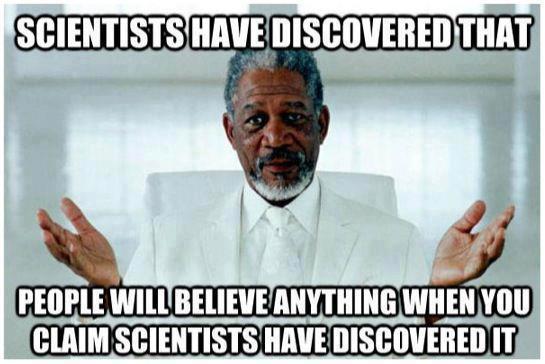
Had to steal this pic for this thread.
It fits perfectly.
It fits perfectly.
Originally posted by IpsissimusMagus
new topics
-
Gaza Genocide Real or Propaganda
Middle East Issues: 46 minutes ago -
Akkabadori: history of tolerant euthanasia
History: 4 hours ago -
Don Trump-Quixote
Political Issues: 6 hours ago -
Paranoia that will tear apart Russia and China
World War Three: 7 hours ago -
SecretKnowledge sez howaryiz all, im back.
Introductions: 10 hours ago
top topics
-
Egypt to join South Africa genocide case at ICJ
Middle East Issues: 12 hours ago, 8 flags -
SecretKnowledge sez howaryiz all, im back.
Introductions: 10 hours ago, 3 flags -
Don Trump-Quixote
Political Issues: 6 hours ago, 3 flags -
Paranoia that will tear apart Russia and China
World War Three: 7 hours ago, 2 flags -
Akkabadori: history of tolerant euthanasia
History: 4 hours ago, 2 flags -
Gaza Genocide Real or Propaganda
Middle East Issues: 46 minutes ago, 2 flags -
Kingdom of the Planet of the Apes
Movies: 15 hours ago, 1 flags
active topics
-
Killings of Palestinian children are soaring in the West Bank.
World War Three • 186 • : Welrus -
Christianity superior to other faiths for very specific reasons. Awaken to true FREEDOM..!!
Conspiracies in Religions • 34 • : DoubleDNH -
Bibi’s Dilemma
Middle East Issues • 287 • : namehere -
Candidate TRUMP Now Has Crazy Judge JUAN MERCHAN After Him - The Stormy Daniels Hush-Money Case.
Political Conspiracies • 1509 • : matafuchs -
Gaza Genocide Real or Propaganda
Middle East Issues • 6 • : BernnieJGato -
Don Trump-Quixote
Political Issues • 7 • : budzprime69 -
Truth Social goes public, be careful not to lose your money
Mainstream News • 135 • : matafuchs -
Trump Record Breaking Campaign Rally 5/11 in New Jersey Draws 100,000 People
2024 Elections • 112 • : CarlLaFong -
Ashley Biden's 'INAPPROPRIATE SHOWERS WITH DADDY' Diary is Real--DOJ
US Political Madness • 138 • : WeMustCare -
"We're All Hamas" Heard at Columbia University Protests
Social Issues and Civil Unrest • 322 • : FlyersFan
6