It looks like you're using an Ad Blocker.
Please white-list or disable AboveTopSecret.com in your ad-blocking tool.
Thank you.
Some features of ATS will be disabled while you continue to use an ad-blocker.

The Big NASA-Military Cover-up On Gravity And Atmosphere On The Moon!
page: 1share:
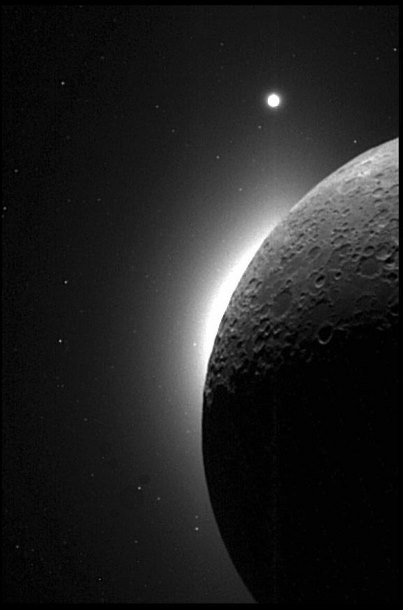
A spectacular picture of the moon taken by the Clementine 1 spacecraft. The haze effect is caused by dust in the lunar atmosphere.
Courtesy: The livingmoon
“...Apollo 8 ... now presently 33,681 [nautical] miles [62,377 km] from the Moon and moving in a Moon related velocity [of] 3,989 feet per second [1,216 m/s]. For the first time, a crew is literally out of this world. At 55 hours, 42 minutes into the mission, this is Apollo Control, Houston."
While I’m a firm believer that we did go to the Moon after all, it wasn’t the Apollo program that was the first to put man on the Moon. Some aspects of the program, probably much of it, were staged and the remainder hidden from the public. It perhaps was a top secret military program that did it. After a little research, I chanced upon an extremely interesting book written by William Brian titled, Moongate: The Suppressed Findings Of The U.S. Space Program. It exposes the greatest cover-up ever perpetrated. The author has compiled evidence from official government publications, NASA photographs and movies, news articles, and books by authorities in various fields.
Checked out various other sources especially the aspect of gravity and the likelihood of an atmosphere on the Moon, this is what turned up.
(In the book) Many aspects of the space program are mathematically and conceptually analyzed to verify the cover-up from a scientific standpoint. Moongate is written for the layman and scientist alike, with mathematical calculations included in the
appendices. Although absolute certainty cannot be given about the details of the cover-up, the evidence demonstrates that either the contentions are true, or portions of the Apollo Moon landings were staged. It seems probable that the landings really occurred; however, the true circumstances surrounding the Apollo missions and related discoveries were carefully suppressed from the public.
William L. Brian II
It is apparent that the military was and is in constant control of the entire NASA space program and much of the NASA-related information is highly classified. The public was only given enough information to convince most that men had landed on the Moon. The majority of details and discoveries regarding the project were carefully suppressed.
I will only touch upon two main aspects concerning gravity and the atmosphere on the Moon. The calculations in the book prove beyond doubt that the gravity on the Moon is not one-sixth, but two-thirds that of Earth! Can the Moon therefore have an atmosphere? Yes it can and does, and needless to say, the implications are mind boggling!
Gravity On The Moon
Orthodox science has always contended that the Moon is a completely airless world. The primary reason has been that the Moon's weak one-sixth gravity would be unable to hold much of an atmosphere. But does it have just one-sixth the gravity of the Earth?
The fundamental law defined by Isaac Newton in 1666 concerning gravity will be shown to be incorrect when applied to planetary bodies. Consequently, the first attempts to explore the Moon with space probes produced unexpected results.
Evidence from the early space probes that Lunar gravitational gradient calculations were possibly flawed:
• The United States and the Soviet Union started to send probes to the Moon in the late fifties. Most of these initial probes met with failure due to a miscalculation of the lunar gravitational gradient.
• The American Ranger space probes were designed to hard land on the Moon. Ranger 3, launched on January 26, 1962, missed its target completely and went into solar orbit. Ranger 4 hit the Moon but did not send back any useful information. Ranger 5 missed the moon by 450 miles and the whole program was put on hold for two years.
• Luna 5, launched on May 9, 1964, crashed at full speed on the Moon, when it was intended to make a soft landing. Luna 6 utterly missed the Moon. Luna 7 crashed on the Moon when it's retro rockets fired too soon, which is a significant detail in relation to where one assumes the Moon's center of gravity to be located in relation to the surface. Miscalculation of the moon's gravitational gradient cannot therefore be ruled out as a reason for the too early start time of Luna 7's landing rocket motor.
• Luna 8 also crashed on the Moon, but Luna 9 was successful, and became the first spacecraft to soft land on the Moon.
Lunar probes from both the United States and the Soviet Union were more successful after this. This cannot most likely be attributed to some sudden advance in the quality of the hardware or telemetry methods of both space programs, whereas it is much more likely to be a result of recalculation of the lunar gravitational gradient.
Newton could not determine accurately the Moon's mass to predict the Moon's force of attraction on other objects. Its mass was later calculated to be about 1/82 of the Earth's. In turn, the Moon's derived mass and the Earth's predicted mass were used to calculate the Moon's surface gravity which came out to be one-sixth of Earth's. Since the Moon is a much smaller body than Earth, it did not seem unreasonable to scientists that it should have a correspondingly smaller surface gravity.
The Neutral Point
This is a ‘point’ where a spacecraft enters the zone of the Moon's gravity. It is the region in space where the Earth's force of attraction equals the Moon's. The average distance to the Moon is approx 239,000 miles, hence based upon Newton's Universal Law Of Gravitation, it places the neutral point about 23,900 miles from the Moon's center. A number of scientists have calculated this as the neutral point using Newton's Gravitation Law and the Moon's mass expressed as 1/83 of the Earth's mass, though some variations were a result of the calculations based on the Earth-Moon distance as well as their masses.

The conventional position of the neutral point between the Earth and
the Moon, as given in the book ‘Principles of Astronautics’, written in 1965, by
Fellow of the British Interplanetary Society, M. Vertregt.
Courtesy: Moongate
In any case, the range of neutral point distances to the Moon's center is between 22,078 and 25,193 miles with the assumption that the Moon has one-sixth of Earth's surface gravity. But do note that these neutral point distances are based upon Newton's Law of Universal Gravitation.
Most of the writers who referenced them were probably unaware of space program findings regarding the neutral point's real location.
Moongate
That said, let’s see where exactly the neutral point should be.
The Neutral Point Discrepency
In reference to Apollo 11, Time magazine gave the following neutral point
information in the July 25, 1969 issue: At a point 43,495 miles from the moon, lunar gravity exerted a force equal to the gravity of the earth, then some 200,000 miles distant.
Was this an error by Time Magazine? Let’s corroborate this a little further.
In the 1969 edition of History of Rocketry & Space Travel by Wernher von Braun and Frederick I. Ordway III, the following statement is made concerning Apollo 11:
The approach to the Moon was so precise that the midcourse correction scheduled for 8:26 a.m. (EDT) on the 19th was canceled. At a distance of 43,495 miles from the Moon, Apollo 11 passed the so-called "neutral" point, beyond which the Lunar gravitational field dominated that of Earth.
Consequently, the spacecraft, which had been gradually losing speed on its long coast away from Earth, now began to accelerate. Note that the precision of the flight was so great that the mid-course correction was not needed. In addition, the neutral point distance is given to the nearest mile and agrees exactly with the value given previously by Time magazine.
Let’s now take a reputable source, the Encyclopedia Britannica that stated the following in the 1973 printing within the topic, "Space Exploration":
The Apollo 11 spacecraft had been in Earth orbit at 118.5 mi. altitude, traveling at 17,427 mph. By firing the rocket motor at the exact moment when the spacecraft was precisely aligned along the proper trajectory, the velocity was increased to 24,200 mph. Because the Earth's gravitational pull continued to act upon the spacecraft during its two and three-quarters day (64 hr.) journey toward the Moon, the spacecraft velocity, with respect to the Earth, dwindled to 2,040 mph at a distance of 39,000 mi. from the Moon.
At this point lunar gravitational attraction became greater than the Earth's and the spacecraft commenced accelerating as it swung toward and around the far side of the Moon, reaching a speed of 5,225 mph. By firing the spacecraft rocket propulsion system the velocity was reduced to 3,680 mph and the spacecraft entered an elliptical orbit about the Moon. Here the distance is 39,000 miles which is still close to the values given by Time magazine and von Braun!
Here’s more corroboration:
In We Reach the Moon, Wilford indicated that the spacecraft entered the lunar sphere of gravitational influence about 38,900 miles from the Moon.
In Footprints on the Moon written in 1969 by the Writers and Editors of the Associated Press, the neutral point is described as follows: Friday, Day Three of the mission, found Apollo 11 at the apex of that long gravitational hill between earth and the moon. At 1:12 p.m. EDT, the nose-to-nose spaceships passed the milestone where the moon's gravity becomes the more important influence. The astronauts were 214,000
miles from earth, only 38,000 miles from their rendezvous with the moon.
The Moon's surface gravity can be calculated with the new figures shown above using the standard inverse-square law technique, where the only aspect of Newton's Law of Gravitation seems valid. Since the Earth's pull equals the Moon's pull at the neutral point, the inverse-square law results in the Moon's surface gravity to be 64 percent of the Earth's surface gravity, not the one-sixth value predicted by Newton's Law of Universal Gravitation!
The publicized period and velocity values are not supportive of a 43,495-mile neutral point distance from the Moon. They support the old neutral point distances and the Moon's weak one-sixth gravity. Therefore, official information is inconsistent and contradictory, indicating a cover-up. The question is why the real neutral point distance leaked out. Did some of the NASA people try to sabotage the cover-up?
Implications
Now if the Moon’s gravity was 2/3rd and NOT 1/6th the Earth’s, then the additional fuel requirements for a landing on the Moon and lift off under the high lunar gravity become horrendous:
• Firstly, the ascent stage would have to weigh 7.2 times the empty weight, or 34,560 pounds.
• Secondly, the fuel required to soft-land the fully loaded ascent stage would increase the Lunar Module's total weight to approximately 250,000 pounds.
Therefore, the LM would be nearly as large as the Titan 2 rocket which weighed 330,000 pounds and was 103 feet tall! But the LM supposedly weighed only 33,200 pounds!
Therefore it would be safe to conclude that if men really landed on the Moon in high lunar gravity conditions, it was not done with rockets! Was there something more than meets the eye here? Was it advanced technology researched by us or reverse engineering of alien technology? And if the Moon has 1/3rd Earth’s gravity, then it is more than likely that it has an atmosphere too! And if it has, it throws the window wide open! Is it therefore a cover-up by the NASA-Military combine?
And what of the astronauts performing on the Moon having a high gravity? Their display of jumping ability wouldn't even come close to anticipated results. Let’s check out some vids to substantiate this.
Evidence Of Gravity On The Moon
Were there any extraordinary feats performed by the astronauts on the Moon having a gravity of just 1/6th that of Earth’s? No. Well, there should have been considering that a 180-pound man would weigh a mere 30 pounds on the Moon!
If an astronaut were to jump vertically in one-sixth gravity with the same effort expended on Earth, the initial velocity would be greater than on Earth. Therefore, the astronaut would reach more than six times higher. Here we see astronauts jump just about one foot, whereas they should have attained a height of at least six feet! There’s not even one pic that shows this! Have a look at this now….
Running
As shown: Slo mo?
Double speed: Actual?
The jump
Now here’s how high the astronaut should have reached on the jump due to 1/6th gravity. Check out the yellow arrows I’ve marked in the frame grab.

The Moon Buggy
Observe the bouncing around of the buggy and the dust trail. Most uncharacteristic of a low gravity Moon environment! Though the commentator insists the vid was taken on Earth, I feel it was taken on the Moon with an atmosphere and 2/3rd Earth’s gravity! Check out the dust trail. With 1/6th gravity, the dust plumes should have gone some 60 feet high and floated off behind for a considerable distance, but they’re less than 10 feet high and hit the surface almost immediately! And dust ‘waves’ produced in the wake of the buggy can only be produced in an environment having an atmosphere!

Notice the height of the dust plume.
Check out the vid here….
in.youtube.com...
An Atmosphere For The Moon
• The Moon buggy had inflatable tires which would have exploded if pre-inflated if there was no atmosphere on the Moon! They had their tires inflated with nitrogen.

This pic shows the Lunar Rover on the Moon, and there on the
rear wheel can be seen the tire valve for inflation!
Courtesy: Apollo Reality
• It would have been impossible to have a water cooled space suit on the Moon, when outside temperature was already at boiling point of water, there would be no where for the heat to dissipate. But water cooled suits are a viable proposition in an environment where atmosphere is present!
• The Puzzle of the Immense Clouds of Water Vapor on the Dry Moon
The few lunar excursions indicated that the moon was a very dry world. One lunar expert said that it was "a million times as dry as the Gobi Desert." The early Apollo missions did not find even the slightest trace of water. But after Apollo 15, NASA experts were stunned when a cloud of water vapor more than 100 square miles in size was detected on the moon's surface.
Embarrassed NASA scientists suggested that two tiny tanks, abandoned on the moon by U.S. astronauts, had somehow ruptured. Huh? Could they have produced a cloud of such magnitude? Nor would the astronauts' urine, which had been dumped into the lunar skies, be an answer.
The water vapor appears to have come from the moon's interior, according to NASA. Mists, clouds and surface changes have allegedly been seen on the moon over the years by astronomers. For instance, six astronomers in the last century have claimed to have seen a mist which obscured details in the floor of the crater Plato. According to many conventional scientists and NASA, clouds on the moon are extremely odd, as the moon's supposed 1/6th gravity could not hold an atmosphere or have any clouds on it at all.
But now you know!!
So why is NASA hiding the facts and not wanting to divulge the truth? The Moon and Mars may have had a civilization (Mars perhaps still does) and disclosing this to the public could result in horrific consequences. And for another, the secret military space program could be using back engineered alien technology to shuttle to and from the Moon as a matter of course. After all, there are exotic resources like titanium and Helium 3/4 that are there for the taking.

Strange structures on the Moon

Here it is in color...


’Tracks’ on the Moon before any known Rover/buggy landed there!
The above images are from: Uncensored NASA Moon Images!
NASA says it will be back on the Moon by 2020, a good 50 years after the last Moon shot. They’re right. As a purely civilian space program, it’s going to take them more than a decade to achieve the technological know-how of the Military space program which has probably been making use of back engineered alien technology to shuttle between Earth and its nearest neighbor as a matter of course! Was the Military-NASA space collaboration terminated after Apollo 17?
Parting Shot!
And here we see an Apollo 17 astronaut making emergency repairs on the buggy’s fender with duct tape (How he did that with his gloves on is debatable!).
Ok. So far, so good. Now check out the pic where the repair has been done. There are foot marks near the fender, BUT WHAT HAPPENED TO THE BUGGY’S TIRE MARKS? How did it get there? Was the buggy placed there by a crane? This has nothing to do with gravity or an atmosphere, but shows the hidden side of what NASA did or did not do.

Courtesy: ApolloReality
”It was Saturday December 9 (1972), and we were in the Moon’s firm hold, only about 38,000 miles out and drawing closer by the moment.”
Eugene Cernan “The Last Man On the Moon,” Copyright 1999 Eugene Cernan and Don Davis.
Cheers!
www.exopolitics.org.uk...
www.thelivingmoon.com...
www.thelivingmoon.com...
home1.gte.net...
www.allbusiness.com...
www.keelynet.com...
apolloreality2.bravehost.com...
[edit on 10-9-2008 by mikesingh]
Just wondering, Do you mean there is MORE gravity on the moon then there is. I mean there IS gravity on the moon that has never been disputed. The
fact there were people walking and not floating off the moon would say there was gravity. I think 17% of Earths gravity to be exact.
Thanks for the work put into your posts though, You do a great job on all of them.
Thanks for the work put into your posts though, You do a great job on all of them.
Originally posted by ShiftTrio
Just wondering, Do you mean there is MORE gravity on the moon then there is.
Hi ST! Yep. As per what we've been told, it's 1/6th gravity of Earth. But as I've shown in the OP it works out to be 2/3rd the gravity of earth or approx +- 66%.
Cheers!
There is gravity on the moon right and the image of the sunlight at the edge of the moon is not due to a atmosphere it is due to a effect similar to
the diamond ring effect which occurs during solar eclipse and that is the light streaming through the valleys in the moon and the spacecraft was in
the correct position to view it.
Originally posted by peacejet
The image of the sunlight at the edge of the moon is not due to a atmosphere it is due to a effect similar to the diamond ring effect which occurs during solar eclipse and that is the light streaming through the valleys in the moon and the spacecraft was in the correct position to view it.
That's because of an atmosphere? Have a look at these two pics of the Moon taken by the Lick observatory a few days apart. The first is pretty clear, but the second seems to be obscured by clouds and haze...
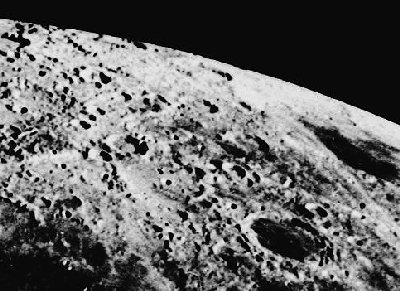
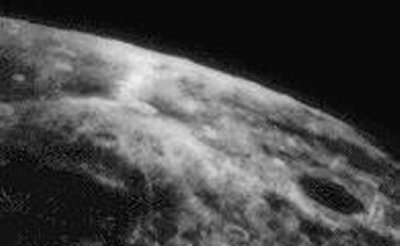
LICKOBSA Lick Observatory, 1946 January 17d 07h 51m UT
Pics courtesy: Thelivingmoon
[edit on 10-9-2008 by mikesingh]
Yes, that might be due to the atmospheric distortion caused by earth how can the atmophere exist on the moon one day and dissapear a few days
later.
reply to post by peacejet
I would say the same way our atmosphere operates...as the jet stream or air current moves, And I would only assume that the currents are less directional on a planet with less gravity and less H2o bodies to affect the atmospheric pressure. I mean only priviledged few would have the need to know knowledge of how a atmosphere of another planet operates. I would guess that some days you could see some type of atmosheric clouds or dust or moisture maybe and other days not....? I see where your coming from Mike..Thats pretty self explanitory and kinda common sense once it's laid out. NASA has done such a great job at blurring and twisting facts so that later as technology evolves they can simply lean on the "knowledge and science at the time" had us believe a certain way.
I would say the same way our atmosphere operates...as the jet stream or air current moves, And I would only assume that the currents are less directional on a planet with less gravity and less H2o bodies to affect the atmospheric pressure. I mean only priviledged few would have the need to know knowledge of how a atmosphere of another planet operates. I would guess that some days you could see some type of atmosheric clouds or dust or moisture maybe and other days not....? I see where your coming from Mike..Thats pretty self explanitory and kinda common sense once it's laid out. NASA has done such a great job at blurring and twisting facts so that later as technology evolves they can simply lean on the "knowledge and science at the time" had us believe a certain way.
Originally posted by peacejet
Yes, that might be due to the atmospheric distortion caused by earth how can the atmophere exist on the moon one day and dissapear a few days later.
That is not atmospheric distortion. Those cameras are about 60 years old, not like they were the best things in the world...
The Moon has no atmosphere. There is no wind, no weather. It can be easily seen by the lack of erosion on the surface of the Moon. The mirrors that are setting a foot above the surface of the Moon would have gathered dust by now since they have been there for decades.
We had instruments on the Moon to measure the gravitation pull as well. Comparing how well they jump on the Moon is fair, but you need to see exactly what it is like to jump on Earth in one of those space suits.
Having water cooled suits in a vacuum does make sense. The side of the suit facing the Sun is hundreds of degrees above freezing, the side away is almost the same, but below freezing. Same concept on the surface of the Moon. Using the same technology on the surface of the Moon and in space, but saying it needs an atmosphere on the Moon to work, means that it needs an atmosphere in space to work as well.
Another great thread Mike - thanks.
I will just put this out there early on and say that it is my opinion that the moon (and Mars for that matter) are so closely linked to man's ancient history and origins that the truth will be hidden and distorted for as long as possible.
All these confusing and seemingly obvious errors are, one agian IMO, carried out to simply muddy the waters so the truth is near impossible to determine even if it is staring you in the face.
And what a great job they've done - all this eveidence and SO MUCH more and yet STILL, none of us really know jack!
I will just put this out there early on and say that it is my opinion that the moon (and Mars for that matter) are so closely linked to man's ancient history and origins that the truth will be hidden and distorted for as long as possible.
All these confusing and seemingly obvious errors are, one agian IMO, carried out to simply muddy the waters so the truth is near impossible to determine even if it is staring you in the face.
And what a great job they've done - all this eveidence and SO MUCH more and yet STILL, none of us really know jack!
Hmm, An interesting theory except when the moon occults a star, there is no distortion as would be expected if the moon had any significant
atmosphere. Also, while it is true that many probes missed the moon, the first Luna 1, got within 5,900 kilometers of the Moon, and the second
actually was able to actually achieve a landing, albeit a hard one (aka as a crash), though this was intentional. The third, Luna 3, took the first
pictures of the far side side of the moon. To have done these undertakings would have required a firm knowledge of the moons gravity. A little closer
look at the early space probes program reveals failures of equipment and rockets as the cause, not a lack of knowledge of the moons gravitational
pull.
Good day to you, sir.
Good day to you, sir.
according to the alleged moon gravity and atmosphere; Since my vert. on earth is 27 inches, If i were on the moon, I would have a more than a 52.38
inch vert. jump. That means if i jumped strait up and did not bend my legs; there would be more than 4 and a half feet between my heels and the
ground. The astronauts aren't getting anywhere close to this in the videos. They're actually not even close to half as high.
Either the videos are fake, the suites are in excess of 300 lbs, the astronauts are in extremely poor shape, OR the data we've been given in regards to the moons atmosphere and gravity is inaccurate.
Either the videos are fake, the suites are in excess of 300 lbs, the astronauts are in extremely poor shape, OR the data we've been given in regards to the moons atmosphere and gravity is inaccurate.
-------------
-------------
Awesome research and post mike. I really appreciate all the work you put into this thread. Have you gotten any scientists to admit it might be true?
I like how you surmise we had help in landing on the moon which was what I had arrived at from my own research. Could it not have been actual 'aliens' that escorted us in their own ship to get there.
Your theory definitely desrves further study, and I think it is time for NASA to come clean on why they have hidden so much from us.
So aliens are real and they may have bases on the Moon and Mars, big deal! At least it's not a big deal to me, since I have seen enough to know we are definitely not alone.
And what if the aliens have requested them to not divulge their existence? I think they would have no choice but to comply. So it works out to possibly be a much bigger cover-up than we could even imagine, but yet most of us have already figured it out, and were ok with the knowledge.
Thanks again and keep up your quest for truth.
-------------
-------------
-------------
Awesome research and post mike. I really appreciate all the work you put into this thread. Have you gotten any scientists to admit it might be true?
I like how you surmise we had help in landing on the moon which was what I had arrived at from my own research. Could it not have been actual 'aliens' that escorted us in their own ship to get there.
Your theory definitely desrves further study, and I think it is time for NASA to come clean on why they have hidden so much from us.
So aliens are real and they may have bases on the Moon and Mars, big deal! At least it's not a big deal to me, since I have seen enough to know we are definitely not alone.
And what if the aliens have requested them to not divulge their existence? I think they would have no choice but to comply. So it works out to possibly be a much bigger cover-up than we could even imagine, but yet most of us have already figured it out, and were ok with the knowledge.
Thanks again and keep up your quest for truth.
-------------
-------------
Originally posted by srsen
And what a great job they've done - all this eveidence and SO MUCH more and yet STILL, none of us really know jack!
No one knows 'Jack' because no one pays attention to what is right under their noses...
[[[Tosses Mike the Torch]]]
Thank you so much for spelling this out for us, once again.
The thing that really baffled me the most, is NASA being the citizens' space program, parting with the military space program.
I can definitely see now where priority does not lie, and how much is actually known, can very well be said to be very little. NASA is a farce. The Military space program has it all.
EDIT typo
[edit on 11-9-2008 by LostNemesis]
The thing that really baffled me the most, is NASA being the citizens' space program, parting with the military space program.
I can definitely see now where priority does not lie, and how much is actually known, can very well be said to be very little. NASA is a farce. The Military space program has it all.
EDIT typo
[edit on 11-9-2008 by LostNemesis]
This is a great presentation with some intriguing facts! I especially like the calculations of the neutral point between the Earth and Moon. The
miscalculated gravity difference would explain why the videos appear to be shot on Earth (though not the parts with the guy floating up before he had
his footing??)
The atmosphere part is doubtful as the one poster brought up with the lack of erosion, but the picture you posted with the clouds does not appear to be due to the camera quality or atmospheric haze on Earth side. The clouds appear contour around the surface of the moon and there is even what looks to be a formation around the crater on the right side.
The atmosphere part is doubtful as the one poster brought up with the lack of erosion, but the picture you posted with the clouds does not appear to be due to the camera quality or atmospheric haze on Earth side. The clouds appear contour around the surface of the moon and there is even what looks to be a formation around the crater on the right side.
Originally posted by zorgon
[[[Tosses Mike the Torch]]]
*Tosses it back and says, "Lead kindly light!!"*
Cheers!
Originally posted by Shadow_Lord
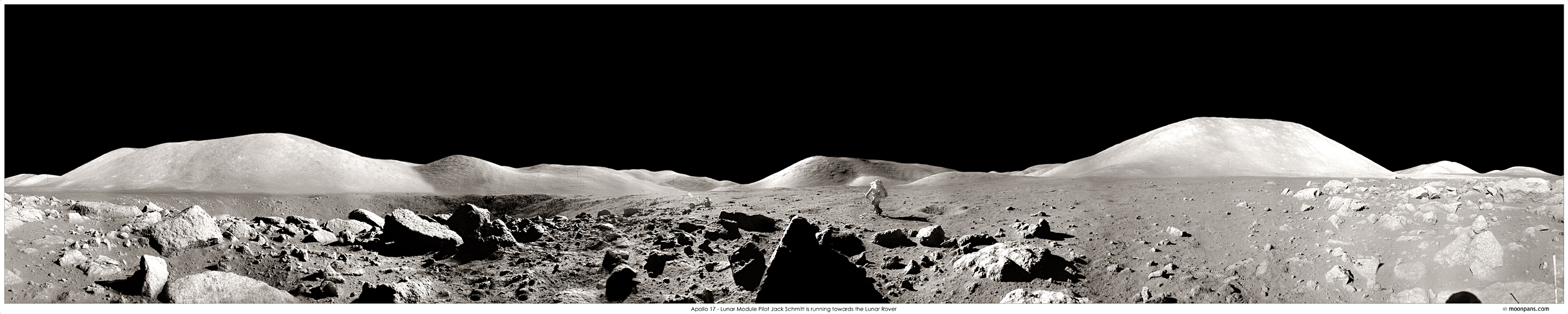
The Moon has no atmosphere. There is no wind, no weather. It can be easily seen by the lack of erosion on the surface of the Moon.
Lack of erosion? Check out the hills in the back ground. They're smooth and rounded, not sharp and rugged, and this can only happen if the Moon has an atmosphere!
Hi Mike - terrific thread, as ever.
I'm interested in what exactly you think is the relationship between the military and NASA. A hell of a lot of time is spent on these boards discussing the idea that NASA themselves are to alrge degree responsible for a cover up and hiding the truth. Is it your belief that the truth is hidden from NASA too?
The series of Luna crashes/misses is particularly interesting here - and is echoed by the large failure rate of probes heading to Mars. Is it that NASA themselves are remotely working on the basis of flawed calculations and knowledge that other military organisations have allowed them to carry on with?
Regardless of the truth behind that first pic - what a stunning image. Sometimes I annoy myself by spending so long looking for discrepancies and diff science that I don't take any time to sit back and say "wow". But that is justa beautiful shot.
Thanks for another fascinating bit of research.
LW
I'm interested in what exactly you think is the relationship between the military and NASA. A hell of a lot of time is spent on these boards discussing the idea that NASA themselves are to alrge degree responsible for a cover up and hiding the truth. Is it your belief that the truth is hidden from NASA too?
The series of Luna crashes/misses is particularly interesting here - and is echoed by the large failure rate of probes heading to Mars. Is it that NASA themselves are remotely working on the basis of flawed calculations and knowledge that other military organisations have allowed them to carry on with?
Regardless of the truth behind that first pic - what a stunning image. Sometimes I annoy myself by spending so long looking for discrepancies and diff science that I don't take any time to sit back and say "wow". But that is justa beautiful shot.
Thanks for another fascinating bit of research.
LW
new topics
-
James O’Keefe: I have evidence that exposes the CIA, and it’s on camera.
Whistle Blowers and Leaked Documents: 32 minutes ago -
Australian PM says the quiet part out loud - "free speech is a threat to democratic dicourse"...?!
New World Order: 1 hours ago -
Ireland VS Globalists
Social Issues and Civil Unrest: 1 hours ago -
Biden "Happy To Debate Trump"
Mainstream News: 2 hours ago -
RAAF airbase in Roswell, New Mexico is on fire
Aliens and UFOs: 2 hours ago -
What is the white pill?
Philosophy and Metaphysics: 3 hours ago -
Mike Pinder The Moody Blues R.I.P.
Music: 4 hours ago -
Putin, Russia and the Great Architects of the Universe
ATS Skunk Works: 7 hours ago
top topics
-
President BIDEN's FBI Raided Donald Trump's Florida Home for OBAMA-NORTH KOREA Documents.
Political Conspiracies: 17 hours ago, 35 flags -
A Warning to America: 25 Ways the US is Being Destroyed
New World Order: 12 hours ago, 20 flags -
Mike Pinder The Moody Blues R.I.P.
Music: 4 hours ago, 7 flags -
Australian PM says the quiet part out loud - "free speech is a threat to democratic dicourse"...?!
New World Order: 1 hours ago, 5 flags -
What is the white pill?
Philosophy and Metaphysics: 3 hours ago, 5 flags -
Biden "Happy To Debate Trump"
Mainstream News: 2 hours ago, 5 flags -
RAAF airbase in Roswell, New Mexico is on fire
Aliens and UFOs: 2 hours ago, 4 flags -
Putin, Russia and the Great Architects of the Universe
ATS Skunk Works: 7 hours ago, 3 flags -
Ireland VS Globalists
Social Issues and Civil Unrest: 1 hours ago, 2 flags -
James O’Keefe: I have evidence that exposes the CIA, and it’s on camera.
Whistle Blowers and Leaked Documents: 32 minutes ago, 1 flags
active topics
-
James O’Keefe: I have evidence that exposes the CIA, and it’s on camera.
Whistle Blowers and Leaked Documents • 6 • : chiefsmom -
University of Texas Instantly Shuts Down Anti Israel Protests
Education and Media • 289 • : KrustyKrab -
Gaza Terrorists Attack US Humanitarian Pier During Construction
Middle East Issues • 85 • : FlyersFan -
Supreme Court Oral Arguments 4.25.2024 - Are PRESIDENTS IMMUNE From Later Being Prosecuted.
Above Politics • 100 • : Vermilion -
Russia Ukraine Update Thread - part 3
World War Three • 5735 • : gortex -
"We're All Hamas" Heard at Columbia University Protests
Social Issues and Civil Unrest • 288 • : FlyersFan -
Biden "Happy To Debate Trump"
Mainstream News • 31 • : theatreboy -
President BIDEN's FBI Raided Donald Trump's Florida Home for OBAMA-NORTH KOREA Documents.
Political Conspiracies • 33 • : theatreboy -
Hate makes for strange bedfellows
US Political Madness • 52 • : YourFaceAgain -
-@TH3WH17ERABB17- -Q- ---TIME TO SHOW THE WORLD--- -Part- --44--
Dissecting Disinformation • 697 • : Thoughtful3