It looks like you're using an Ad Blocker.
Please white-list or disable AboveTopSecret.com in your ad-blocking tool.
Thank you.
Some features of ATS will be disabled while you continue to use an ad-blocker.

The North Side Flyover - Officially Documented, Independently Confirmed
page: 50share:
Originally posted by PplVSNWO
reply to post by jthomas
Apparently, according to the FDR it flew over.
If it flew over where in the world did the FDR come from? Think about that logically, step away from your computer and put away your hatred for the government for a minute.
Now that you're back, do you think that they simply took the FDR from the "flyover" plane and planted it at the scene? Does that sound about right?
Well, then why would they go through such a successful and elaborate "deception" and use the actual "flyover" plane's FDR?
Do you see? You have to keep chasing the never ending spiral of CT after CT that can never hit bottom.
It's much more likely, given the real evidence that the FDR was simply wrong or had been misinterpreted.
Why do you keep coming back to the same tired argument of not having any flyover witnesses? CIT has one that is officially documented and now independently confirmed as seeing the flyover as in the title of this thread.
What about the other "officially documented and now independently confirmed" witnesses who say the plane actually crashed into the Pentagon? Even if you are to say that some were not in a position to see the impact they still saw the plane, but yet none of them, not ONE says the plane flew over.
The CIT's very own witnesses do NOT support any kind of "flyover" once you take the CIT spin out of the equation. Why is it ok to believe portions of the eyewitness statements but not the portions that don't agree with the "flyover" story? Isn't that rather convenient?
To put a CIT style spin on the subject at hand, then this one "flyover" witness absolutely must be suspect since he doesn't agree with their other witnesses. So the testimony must be discarded as false.
So, how many more flyover witnesses does CIT need to satisfy your demands?
For me personally, none will satisfy those demands, since they simply do not exist. Not one single person who saw the incoming plane or impact reports that plane flying over the Pentagon. And no, I do not nor will ever be convinced that every single one of those people were "deceived" into there being an impact.
Not when he uses landmarks as references. He would be very familiar with those, wouldn't you agree?
It's clear that he is a bit confused with his cardinal directions during the interview.
That's pretty ironic coming from you. Wouldn't you agree?
No witness is a computer. They all have perspective issues, make errors, etc.
According to you, that is the entire purpose of the C-130 flying near the Pentagon. To confuse people. Wouldn't you agree?
But timing, altitude, and general location ALL rule out the C-130 as does his specific claim that it was a commercial airliner with jet engines.
Darrell Stafford says the C-130 arrived 30 seconds after impact. That matches up with Roosevelt's recollection pretty well. Wouldn't you agree?
"10 seconds TOPS" is a far cry from 2 or 3 minutes as reported by Tribby and all the ANC witnesses and even the RADES data!
Care to elaborate?
Besides I bet it's doubtful he would have been able to see the C-130 on the RADES flight path from the south loading dock even if he was still outside anyway!
I never said that he did.
Donald Carter does NOT say this.
Darrell Stafford:
he said he thought it was the second plane that went to Pittsburgh
I disagree. He never describes it as a military plane and he associates it with Pennsylvania. I wonder why that is?
He thought it went to the north towards Pennsylvania but that he speculated that the "FIGHTER JETS" that came a bit later seemed to be chasing after him (the C-130).
He NEVER confused the C-130 with a commercial airliner.
See my quote above.
Darrell simply stated that Mr. Carter said it went towards the plane in Pennsylvania not that it WAS "flight 93".
Oh please
You are deliberately twisting their words as a means to spin, confuse, and deny the evidence.
Now admit your mistake like a man or you will be demonstrating your intellectual dishonesty.
Mr. Carter never gave a time for the C-130's arrival after flight 77 hit the Pentagon.
Originally posted by Craig Ranke CIT
You have NOTHING directly supporting the RADES approach of the C-130 before the explosion and now with the ANC witnesses we have a large amount corroborating what we said about O'Brien's statements long ago.
Since a good portion of my previous reply to this part was erased, I'll post it again.
The C-130's approach to the Pentagon is directly supported by the RADES Data, ATC transcripts, the Tribby video, Looney Photographs, and by Lt Col O'Brien himself. ALL of these sources agree.
RADES Data in RED, CIT's path in yellow
ATC Transcripts
Video and Photograph Path combined with RADES path
The Tribby videos and the Looney photographs are already posted in the thread. Partial Statements by Lt Col Steve O'Brien are posted, as well.
Lt Col O'Brien indicated he passed South of the Washington Mall and that he had a "Beautiful View of the Mall". However, CIT has misinterpreted this as passing immediately adjacent to the Mall on the South side. First of all, O'Brien would not have been able to view the Mall from the left cockpit of the C-130 on the CIT predicated path as it would have been virtually UNDER his aircraft. He would have had a clear view on the RADES path. The fact that he flew the RADES depicted path is further verified by the fact that a C-130 would not be able to complete a path joining the CIT depicted path with the video/photographic path because of simple aerodynamics. In other words, the C-130 could not have flown from the CIT depicted path to the RADES/video/photographic path due to time constraints and maneuvering limitations of the aircraft. The same time and maneuvering constraints would also apply to the ANC worker's reported flight path from the NW. The ONLY C-130 path that fits with the video/photograph evidence after the explosion is the RADES flight path prior to the explosion.
For anyone who doubts this information, request CIT to draw their version of a complete path for the C-130 correlating to the video/photograph verified path with timing annotated. They can't because it is impossible.
[edit on 16-8-2008 by Reheat]
Originally posted by Boone 870
Not when he uses landmarks as references. He would be very familiar with those, wouldn't you agree?
It's clear that he is a bit confused with his cardinal directions during the interview.
Yes.
I believe he was suggesting that the plane banked around and did a U-turn headed north by his statement that it went on the "mall entrance side" of the building.
That's pretty ironic coming from you. Wouldn't you agree?
No witness is a computer. They all have perspective issues, make errors, etc.
No not in the least.
We have maintained this from the start.
No witness can give a perfectly accurate exact flight path.
Only the general details that get repeatedly and consistently corroborated should be considered true such as the relatively slow NoC bank as corroborated by multiple people from multiple perspectives (Navy Annex, CITGO, ANC, and Sean Boger at the heliport tower!) yet directly refuted by none.
According to you, that is the entire purpose of the C-130 flying near the Pentagon. To confuse people. Wouldn't you agree?
But timing, altitude, and general location ALL rule out the C-130 as does his specific claim that it was a commercial airliner with jet engines.
Yeah so?
It was never over 50 feet over the south parking lot immediately after the explosion.
The 2nd plane cover story was useful simply as ambiguous confusion AFTER the event in a few relatively obscure subsequent propaganda pieces a few days after the event particularly the ones by Terry Scanlon in local newspaper the Daily Press.
This doesn't diminish the very specific "commercial airliner" and "jet engine" at "50 feet" claim by Roosevelt Roberts immediately after the explosion.
Darrell Stafford says the C-130 arrived 30 seconds after impact. That matches up with Roosevelt's recollection pretty well. Wouldn't you agree?
"10 seconds TOPS" is a far cry from 2 or 3 minutes as reported by Tribby and all the ANC witnesses and even the RADES data!
Absolutely not!
He is explicit in the notion that the explosion happened and a good 30 seconds (count to 30 and feel how long that really is) occurred before he saw it APPROACH from over the cemetery (fatally contradicting the RADES data. Do you believe Stafford saw the C-130?)
Roosevelt describes it as INSTANTLY being 50 feet over the south parking lot (irreconcilable with the C-130 RADES data).
Huge difference.
"10 seconds tops" but he also says "7 steps" which could really be 1 or 2 seconds. The point is he means instantly and Stafford like all the other ANC employees explicitly says this was NOT what the C-130 did.
Care to elaborate?
Besides I bet it's doubtful he would have been able to see the C-130 on the RADES flight path from the south loading dock even if he was still outside anyway!
Not really. I was pretty clear. Re-read it if you don't get it.
I never said that he did.
Donald Carter does NOT say this.
Darrell Stafford:
he said he thought it was the second plane that went to Pittsburgh
The C-130 IS the 2nd plane that went to Pittsburgh!
Didn't you know that?
O'Brien reportedly witnessed the aftermath of both events.
Neither Stafford nor Carter said ANYTHING about the 2nd plane being "flight 93" or a commercial airliner!
Now admit your mistake like a man or your intellectual dishonesty will be revealed.
Do you believe they saw the C-130? Clearly Carter was able to tell the difference between the C-130 and the fighter jets that came in later and seemed to follow it.
If you believe they saw the C-130 how do you account for their 4 time corroborated response of it's approach from the northwest fatally contradicting the RADES data?
I disagree. He never describes it as a military plane and he associates it with Pennsylvania. I wonder why that is?
He thought it went to the north towards Pennsylvania but that he speculated that the "FIGHTER JETS" that came a bit later seemed to be chasing after him (the C-130).
He NEVER confused the C-130 with a commercial airliner.
Could it be because it went towards Pennsylvania where O'Brien reportedly witnessed the aftermath of the Shanksville attack?
Hmmmmm?
Carter was very detailed in regards to the approach and bank away of the C-130 with the fighter jets coming after it both headed north towards Pittsburgh which is exactly what they did.
If you don't think he saw the C-130 then what plane do you think he did see banking north towards Pittsburgh followed by fighter jets a short while after the explosion?
Mr. Carter never gave a time for the C-130's arrival after flight 77 hit the Pentagon.
He said "not seconds", meaning not instantly, it was a bit later but that it approached from the northwest.
He could tell the difference between the C-130 and the "fighter jets" that came later so what do you propose he saw banking north shortly after the event as he describes if not the C-130?
Do you believe the ANC workers saw the C-130?
If so how do you account for their 4 time corroborated response of it's approach from the northwest fatally contradicting the RADES data?
[edit on 16-8-2008 by Craig Ranke CIT]
Originally posted by Craig Ranke CIT
If you believe they saw the C-130 how do you account for their 4 time corroborated response of it's approach from the northwest fatally contradicting the RADES data?
The C-130 DID NOT approach from the NW!
It is only incumbent on CIT (no one else) to explain to the ANC workers why they are mistaken about the approach of the C-130.
You are beginning to look really silly by ignoring video and photographic proof of the C-130 approach.
Your only choice if you continue to disagree with the evidence is to show HOW it is possible for a C-130 to approach from the NW and then be in the position observed in the video and the photographs.
Originally posted by Reheat
The C-130 DID NOT approach from the NW!
Blanket denial does not refute evidence.
It is only incumbent on CIT (no one else) to explain to the ANC workers why they are mistaken about the approach of the C-130.
What?
You're kidding right?
THEY were there!
You were not and I was not.
Why would I tell THEM that what they all indepdently saw (and fits with statements by the pilot himself) is not true?
It is YOU making this claim based on nothing but pure faith in the government so it is incumbent on YOU to go tell them they are wrong about this.
Please video record their responses.
You are beginning to look really silly by ignoring video and photographic proof of the C-130 approach.
You look really silly by suggesting photographs or video from the ground of the plane high in the sky banking AWAY from the scene have anything at all to do with the approach.
Your only choice if you continue to disagree with the evidence is to show HOW it is possible for a C-130 to approach from the NW and then be in the position observed in the video and the photographs.
You can't even prove where the position of the aircraft is in relation to the ground from that video or those images!
It's impossible to tell with any strong degree of accuracy but it doesn't matter anyway because NONE of the images of footage shows it on the approach.
[edit on 16-8-2008 by Craig Ranke CIT]
Originally posted by Craig Ranke CIT
You can't even prove where the position of the aircraft is in relation to the ground from that video or those images!
You are now spewing nonsense. I can tell where it is and so can anyone who matters.
Originally posted by Craig Ranke CIT
It's impossible to tell with any strong degree of accuracy but it doesn't matter anyway because NONE of the images of footage shows it on the approach.
It is duly noted that you avoided the "draw a flight path" challenge. You can't and you won't because you then could not continue the charade on the Internet.
Originally posted by Reheat
Originally posted by Craig Ranke CIT
You can't even prove where the position of the aircraft is in relation to the ground from that video or those images!
You are now spewing nonsense. I can tell where it is and so can anyone who matters.
Prove it.
Prove the exact location of the plane in relation to the ground by using the images and footage or admit you are the one "spewing nonsense".
Simply stating that you "can tell" is not evidence.
The ANC witness accounts corroborating accounts of the northwest approach IS evidence.
[edit on 16-8-2008 by Craig Ranke CIT]
Originally posted by Craig Ranke CIT
The independent evidence proves this is certainly the case (although originating from east of the river) with the decoy jet (see "Flight 77" The White Plane) as guessed by Roosevelt and reported by all the other witnesses we spoke with from Paik, Hubbard, Reyes, Veronica, and Jamal but this is NOT true with the C-130 as reported by ALL the ANC witnesses and is also clear from O'Brien's own statements about his flight path!
Veronica, Reyes and Hubbard do not support your theory at all. You have distorted all of their statements to support a fictitious flight path.
You are egregiously dishonest with Hubbard in particular - you ignore EVERYTHING the woman tells you with the exception that she thought the plane was white, then you fraudulently suggest she has corroborated the "killer jet's" flight path north towards the Sheraton when in fact the woman told you it was headed east towards I395. You purposely didn't point out any of the landmarks she referred to in her testimony because you knew people would clue in STRAIGHT AWAY.
She can't even see the flight path you claim she indicated, because she was inside her house, looking out a window that faced towards the east! The flight path you have plotted that is supposedly corroborated by her account is to the west of her house, heading north.
Veronica puts the plane heading towards I395 and the Pentagon as well. She doesn't indicate anything at all that you attribute to her, other than she though the plane was white.
The same goes for Cindy. The angle and direction of the plane as described by her supports the "official story", but she describes the plane as being white, with black windows.
None of them support that flight path that you have attributed to them and, surprise surprise, you never got them to draw one for you, or confirm the one you doctored.
Hey Craig, when Mrs. Hubbard gave you her witness account of the plane and it's flight path, when confirming with her that you understood her
correctly, why did you ask her this?
Craig Ranke - "So it had to have come from back the 395 area rather than straight up Columbia Pike."
www.thepentacon.com...
If it came from the I395 area would this not put it... south of Citgo?

[edit on 17-8-2008 by discombobulator]
[edit on 17-8-2008 by discombobulator]
Craig Ranke - "So it had to have come from back the 395 area rather than straight up Columbia Pike."
www.thepentacon.com...
If it came from the I395 area would this not put it... south of Citgo?
[edit on 17-8-2008 by discombobulator]
[edit on 17-8-2008 by discombobulator]
Mrs. Hubbard is the REAL killer to your theory, Craig.
What rotten luck for you that she was inside her house and the window she was looking out of faced towards the east.
She cannot possibly see anything remotely at all like what she describes were your fraudulent flight path to be true.
And even IF she had her face pressed right up against the window, squeezing every last inch of view towards the north to see the tail of the plane over the Navy Annex and heading north-east there is no way known to man she'd be left with the impression that the plane had crashed into I395.
The irony of all of this is that Mrs. Hubbard was a previously unknown witness, and YOU FOUND HER!
Read more about Craig and Mrs. Hubbard right here -
s1.zetaboards.com...
frustratingfraud.blogspot.com...
[edit on 17-8-2008 by discombobulator]
What rotten luck for you that she was inside her house and the window she was looking out of faced towards the east.
She cannot possibly see anything remotely at all like what she describes were your fraudulent flight path to be true.
And even IF she had her face pressed right up against the window, squeezing every last inch of view towards the north to see the tail of the plane over the Navy Annex and heading north-east there is no way known to man she'd be left with the impression that the plane had crashed into I395.
The irony of all of this is that Mrs. Hubbard was a previously unknown witness, and YOU FOUND HER!
Read more about Craig and Mrs. Hubbard right here -
s1.zetaboards.com...
frustratingfraud.blogspot.com...
[edit on 17-8-2008 by discombobulator]
reply to post by discombobulator
You are off topic.
But here is your answer.
395 curls around at that point if you show a wider view. The point in my question to Hubbard at the time was whether it was coming generally from the south without regard for exact heading which would be unreasonable to expect her to know since she did not see the approach at all and she was in her house.
But this really has nothing to do with north or south of the citgo since people in the neighborhood there can't see the citgo or the Pentagon at all.
Anyway there is a ton of room for error in the witness flight path.
However there is ZERO room for error in the official flight path and it is irreconcilable with these witnesses particularly Jamal and Chaconas.
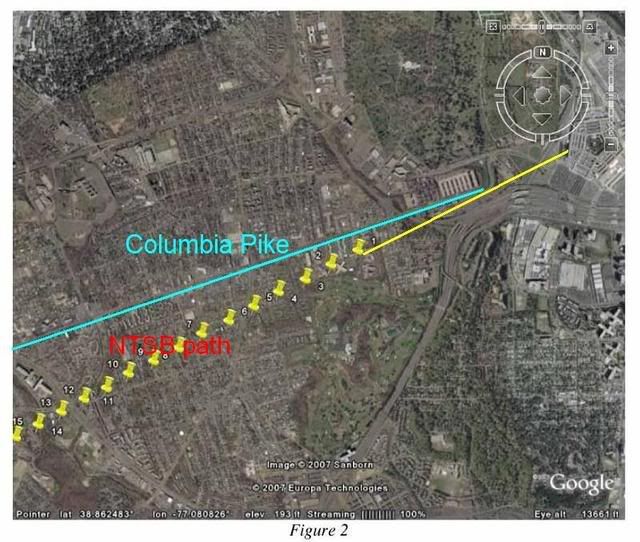
Jamal is the most fatal to the official story of the Arlington neighborhood bunch.
Here is a VERY crude flight path estimate taking all of them into account starting with Steve Chaconas and his east of the river claim:
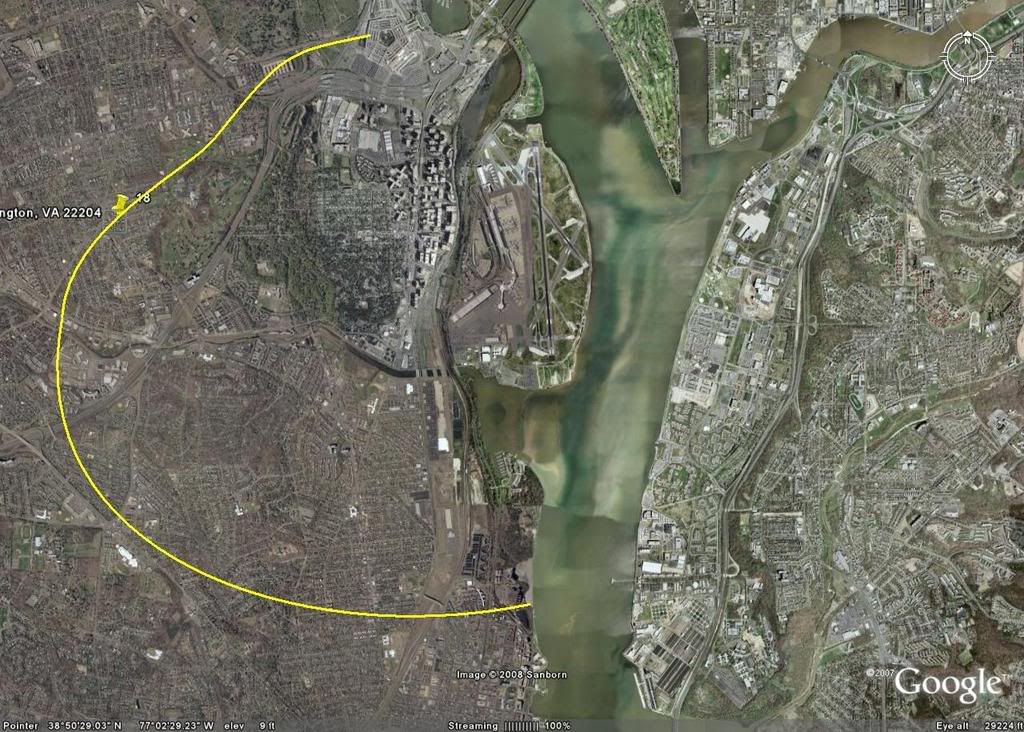
But the final relatively slow north of the citgo bank was clearly more pronounced now that we have the corroborating accounts of the ANC guys, Terry Morin, and Sean Boger.
But yeah....this anomalous loop proving a military deception is now further validated due to William Middleton Sr.'s important account of the plane "circling" before he saw it north of the citgo
Get it now?
You are off topic.
But here is your answer.
395 curls around at that point if you show a wider view. The point in my question to Hubbard at the time was whether it was coming generally from the south without regard for exact heading which would be unreasonable to expect her to know since she did not see the approach at all and she was in her house.
But this really has nothing to do with north or south of the citgo since people in the neighborhood there can't see the citgo or the Pentagon at all.
Anyway there is a ton of room for error in the witness flight path.
However there is ZERO room for error in the official flight path and it is irreconcilable with these witnesses particularly Jamal and Chaconas.
Jamal is the most fatal to the official story of the Arlington neighborhood bunch.
Here is a VERY crude flight path estimate taking all of them into account starting with Steve Chaconas and his east of the river claim:
But the final relatively slow north of the citgo bank was clearly more pronounced now that we have the corroborating accounts of the ANC guys, Terry Morin, and Sean Boger.
But yeah....this anomalous loop proving a military deception is now further validated due to William Middleton Sr.'s important account of the plane "circling" before he saw it north of the citgo
Get it now?
Hubbard has no effect whatsoever on the EoP, ONA, & NoC evidence at all let alone kill our "theory".
What we present is not about "theory".
It is about evidence and Hubbard contradicts none of it.
What we present is not about "theory".
It is about evidence and Hubbard contradicts none of it.
Originally posted by Craig Ranke CIT
reply to post by discombobulator
You are off topic.
But here is your answer.
395 curls around at that point if you show a wider view. The point in my question to Hubbard at the time was whether it was coming generally from the south without regard for exact heading which would be unreasonable to expect her to know since she did not see the approach at all and she was in her house.
How am I off topic when I am responding to YOUR POST where you have attempted to use these names to support your ridiculous theory?
In any case, your response is UTTER NONSENSE.
If your ridiculous flight path were true and Hubbard was indeed pressed up to the window looking to the north the first she would be have been able to see of the AA jet would have been it passing the Sheraton and heading over the Navy Annex in a general west to east direction.
It would have looked like it was heading up Colombia Pike.
But thankfully you cleared that up for us:
Craig Ranke - "So it had to have come from back the 395 area rather than straight up Columbia Pike."
She even thought the plane had crashed into I395 and gave no indication that the plane was heading in any direction but towards I395 relative to her position.
Hubbard is EXACTLY like Terry Morin.
They are both in locations where their known recorded testimonies can only support the "official story".
However in both instances we have to just trust CIT when they claim awareness of additional information that now somehow strangely shifts their stories to support the CIT fabrication...
... because they can't share it.
[edit on 17-8-2008 by discombobulator]
They are both in locations where their known recorded testimonies can only support the "official story".
However in both instances we have to just trust CIT when they claim awareness of additional information that now somehow strangely shifts their stories to support the CIT fabrication...
... because they can't share it.
[edit on 17-8-2008 by discombobulator]
Hey Craig,
Why isn't Roosevelt Roberts Jnr's statement corroborated by Levi Stephens?
He was immediately adjacent to the lane 1 parking area, it would have been directly over his head at one point.
Yet he doesn't report seeing or hearing a second plane moments after impact, does he?
And since Roberts also has the plane heading back to the southwest, in the direction that it apparently came from (assuming I understand what a U-turn is), why is it that none of the witnesses such as Boger, Brooks, Lagasse, Turcios, Paik, etc not see it on the way back out?
Where are all the witnesses on I395 who would have had the awesome sight of the fireball and smoke from the Pentagon and a huge freakin' 757 flying directly towards them 100 feet off the ground?
Why didn't Veronica, Cindy or Mrs. Hubbard mention anything whatsoever about the plane they had only noticed moments before now heading back towards them?
Why do you continually harp about corroboration when NOONE corroborates Roberts story of seeing the flyover jet, over lane 1 of the south Pentagon parking lot, in plain sight of EVERY witness you have used to support this RIDICULOUS FLYOVER theory?
Why isn't Roosevelt Roberts Jnr's statement corroborated by Levi Stephens?
He was immediately adjacent to the lane 1 parking area, it would have been directly over his head at one point.
Yet he doesn't report seeing or hearing a second plane moments after impact, does he?
And since Roberts also has the plane heading back to the southwest, in the direction that it apparently came from (assuming I understand what a U-turn is), why is it that none of the witnesses such as Boger, Brooks, Lagasse, Turcios, Paik, etc not see it on the way back out?
Where are all the witnesses on I395 who would have had the awesome sight of the fireball and smoke from the Pentagon and a huge freakin' 757 flying directly towards them 100 feet off the ground?
Why didn't Veronica, Cindy or Mrs. Hubbard mention anything whatsoever about the plane they had only noticed moments before now heading back towards them?
Why do you continually harp about corroboration when NOONE corroborates Roberts story of seeing the flyover jet, over lane 1 of the south Pentagon parking lot, in plain sight of EVERY witness you have used to support this RIDICULOUS FLYOVER theory?
Originally posted by Griff
Originally posted by SlightlyAbovePar
We do agree the plane wound up in the Pentagon, correct?
Yes. As I've stated before I have spoken personally with a few building engineers (in Arlington/Crystal City) who had a great view of it impacting with the pentagon.
Hey Griff,
Do you think your acquaintances would be interested in an interview by CIT? I would be interested to hear what they have to say.
-TY-
And now for something completely different....
Pentagon View Shed Analysis #1
I'm going to take a look at CIT's claim of a "flyover" from a realistic perspective by showing a View Shed analysis of the topography around the Pentagon to demonstrate the visibility of any aircraft flying over the Pentagon from any location in the area.
This analysis is not needed in any way to refute CIT's claims. Numerous individuals have easily refuted all of CIT's claims (despite angry denials to the contrary) here and on other forums. Reheat has done a masterful job right here. I am doing this because it just further illustrates why CIT refuses to deal with evidence and eyewitness reports.
A View Shed Analysis is a common feature of GIS software and is used to determine the optimal placement and height of transmission antennas intended for television, radio, public utility, microwave, phone, and cell phone usage. It's use is intended for hilly or mountainous areas where topography presents obstructions in direct line-of-sight transmissions, or broadest area coverage, between transmitters and receivers.
I've done a View Shed analysis to illustrate a fundamental problem CIT has with its claims that a "flyover" took place - but no such "flyover" has ever been reported.
CIT claims that one eyewitness, one Roosevelt Roberts, stated that he saw a jet fly over the Pentagon and then took a route to the left over the Potomac River, flying south of The Mall. This is the only eyewitness CIT has ever presented to a so-called "flyover" after persistent requests for eyewitnesses for a long time.
CIT now claims that this sole, apparent eyewitness, "proves" that a "flyover" took place in a planned, calculated deception by the "government" to deceive people into believing a passenger jet, American Airlines flight 77, a Boeing 757, hit the Pentagon.
CIT has stated, for the record, that interviews with 13 other "eyewitnesses" have demonstrated conclusively that AA77 flew on the "north side of the Citgo gas station rather than the south side as the government has claimed," thereby flying a route to the Pentagon that, if it had crashed into the Pentagon, would have produced damage entirely inconsistent with the observed damage. (Not insignificantly, each of CIT's 13 eyewitnesses were in a position to see an aircraft approach the Pentagon.)
Therefore, CIT concludes, the observed jet could not have flown into the Pentagon but, consistent with the statements of 14 "eyewitnesses" CIT found, the jet must have flown over the Pentagon to land in parts unknown. Furthermore, CIT claims, a deliberate deception was planned so that, as the jet began its flyover, a pre-planted bomb in the Pentagon, at the intersection of the flight path of the jet, was detonated producing both an explosion and smoke that obscured the view of the 13 apparent eyewitnesses CIT relies on for its claim that a flyover took place.
I have confined my study to the claim that a "flyover" could have taken place without there being eyewitnesses anywhere on the far side of the Pentagon whose views would never have been obscured by the explosion and subsequent smoke column.
Craig Ranke and Aldo Marquis, sole members of CIT, the "Citizens Investigation Team," have declared individually and separately that no other eyewitnesses to a "flyover" are required. They put their sole trust in 13 eyewitnesses whom they readily acknowledge whose views of an actual flyover would have been obscured by the "explosion" and resultant smoke column at the Pentagon. There remains the one eyewitness, Roosevelt Roberts, on whom CIT's entire claim that a "flyover" took place rests.
The observation comes immediately to mind that if a flyover took place whose flight path would take the jet over and within view of a densely populated geographic area as it flew away from the Pentagon - and the explosion that took place - including heavily-travelled freeways and bridges, should there not be eyewitness reports from a wide geographic area on the other side of the Pentagon in which no topographical obstructions existed? CIT has been asked that question repeatedly and the response has either been that those eyewitnesses are not needed or, "do your own investigation."
The topography around Washington includes obvious obstructions of buildings, trees, overpasses, etc., which are not included in this first run. Obviously, a person standing behind trees or buildings obstructing the view toward the Pentagon, or looking in a different direction altogether, isn't going to witness a plane over the Pentagon as an explosion takes place there. That changes, of course, as the plane moves forward, climbs, and turns.
What is the probability that a such "flyover" could take place in a densely populated metropolis, with many drivers on various roads and bridges around the Pentagon, a spectacular explosion and smoke alerting numerous motorists, and unrefuted testimony that a jet was seen approaching and crashing into the Pentagon at high speed?
I am not in a position to calculate such a probability, but I am in a position to define the extent of the geographic area in which a plane over the Pentagon could have been easily seen.
In this view, I have deliberately limited the range to the jet to two miles, a reasonable distance in which an aircraft the size of a 757 would draw attention moving away from the Pentagon after an explosion. Of course, the jet can been easily at a further distance away.
This instantaneous view places the jet at 100 feet above ground level (not above the building itself) over the central courtyard of the Pentagon. The yellow-shaded area shows the geographic areas up to two miles away from that jet in which a person whose eyesight is five feet above the ground could see that jet, given the observation limitations of structures and vegetation outlined above. Any person within the two-mile range not shaded yellow would be unable to see a jet 100 feet above the ground over the Pentagon courtyard. As one can see, these are very few. It should be obvious as the jet moves forward, and climbs, on a flight path away from the Pentagon, the geographical area at a two-mile range expands, opportunity for it to be observed increases, and the number of potential eyewitnesses increases.
It should also be obvious how the potential for drivers on the freeways and bridges, whose positions are changing and whose attention is necessarily on their surroundings, are in an excellent position to see a jet fly away from the Pentagon, many of whom would see the jet in a direct line of sight to the fireball rising from the Pentagon.
Yet there are no such reports.
This View Shed analysis illustrates the tremendous problem CIT has in facing the probability that many numbers of eyewitnesses would most certainly have seen a flyover take place from a large geographic area and that no such reports have ever surfaced. It also illustrates why CIT refuses to look for any such eyewitnesses. We can imagine many drivers stuck in freeway traffic seeing the explosion at the Pentagon, immediately followed by a jet flying fast and climbing from the direction of the Pentagon. Some would reasonably think there is a connection - perhaps the aircraft dropped a bomb.
But the big problem for CIT is a very reasonable situation. These people who would have seen a flyover would wonder why there were no subsequent media reports of a flyover. Would not even a handful contact media outlets, each competing with each other for breaking news, and say, "Wait a minute! There was a jet flying away from the Pentagon right after the explosion!"
Furthermore, CIT's reliance on Roosevelt Roberts' description of the jet's turn to the left over the river actually puts CIT in a no-win position of having a jet visible from a large area.
Draw your own conclusions.
Pentagon View Shed Analysis #1
I'm going to take a look at CIT's claim of a "flyover" from a realistic perspective by showing a View Shed analysis of the topography around the Pentagon to demonstrate the visibility of any aircraft flying over the Pentagon from any location in the area.
This analysis is not needed in any way to refute CIT's claims. Numerous individuals have easily refuted all of CIT's claims (despite angry denials to the contrary) here and on other forums. Reheat has done a masterful job right here. I am doing this because it just further illustrates why CIT refuses to deal with evidence and eyewitness reports.
A View Shed Analysis is a common feature of GIS software and is used to determine the optimal placement and height of transmission antennas intended for television, radio, public utility, microwave, phone, and cell phone usage. It's use is intended for hilly or mountainous areas where topography presents obstructions in direct line-of-sight transmissions, or broadest area coverage, between transmitters and receivers.
I've done a View Shed analysis to illustrate a fundamental problem CIT has with its claims that a "flyover" took place - but no such "flyover" has ever been reported.
CIT claims that one eyewitness, one Roosevelt Roberts, stated that he saw a jet fly over the Pentagon and then took a route to the left over the Potomac River, flying south of The Mall. This is the only eyewitness CIT has ever presented to a so-called "flyover" after persistent requests for eyewitnesses for a long time.
CIT now claims that this sole, apparent eyewitness, "proves" that a "flyover" took place in a planned, calculated deception by the "government" to deceive people into believing a passenger jet, American Airlines flight 77, a Boeing 757, hit the Pentagon.
CIT has stated, for the record, that interviews with 13 other "eyewitnesses" have demonstrated conclusively that AA77 flew on the "north side of the Citgo gas station rather than the south side as the government has claimed," thereby flying a route to the Pentagon that, if it had crashed into the Pentagon, would have produced damage entirely inconsistent with the observed damage. (Not insignificantly, each of CIT's 13 eyewitnesses were in a position to see an aircraft approach the Pentagon.)
Therefore, CIT concludes, the observed jet could not have flown into the Pentagon but, consistent with the statements of 14 "eyewitnesses" CIT found, the jet must have flown over the Pentagon to land in parts unknown. Furthermore, CIT claims, a deliberate deception was planned so that, as the jet began its flyover, a pre-planted bomb in the Pentagon, at the intersection of the flight path of the jet, was detonated producing both an explosion and smoke that obscured the view of the 13 apparent eyewitnesses CIT relies on for its claim that a flyover took place.
I have confined my study to the claim that a "flyover" could have taken place without there being eyewitnesses anywhere on the far side of the Pentagon whose views would never have been obscured by the explosion and subsequent smoke column.
Craig Ranke and Aldo Marquis, sole members of CIT, the "Citizens Investigation Team," have declared individually and separately that no other eyewitnesses to a "flyover" are required. They put their sole trust in 13 eyewitnesses whom they readily acknowledge whose views of an actual flyover would have been obscured by the "explosion" and resultant smoke column at the Pentagon. There remains the one eyewitness, Roosevelt Roberts, on whom CIT's entire claim that a "flyover" took place rests.
The observation comes immediately to mind that if a flyover took place whose flight path would take the jet over and within view of a densely populated geographic area as it flew away from the Pentagon - and the explosion that took place - including heavily-travelled freeways and bridges, should there not be eyewitness reports from a wide geographic area on the other side of the Pentagon in which no topographical obstructions existed? CIT has been asked that question repeatedly and the response has either been that those eyewitnesses are not needed or, "do your own investigation."
The topography around Washington includes obvious obstructions of buildings, trees, overpasses, etc., which are not included in this first run. Obviously, a person standing behind trees or buildings obstructing the view toward the Pentagon, or looking in a different direction altogether, isn't going to witness a plane over the Pentagon as an explosion takes place there. That changes, of course, as the plane moves forward, climbs, and turns.
What is the probability that a such "flyover" could take place in a densely populated metropolis, with many drivers on various roads and bridges around the Pentagon, a spectacular explosion and smoke alerting numerous motorists, and unrefuted testimony that a jet was seen approaching and crashing into the Pentagon at high speed?
I am not in a position to calculate such a probability, but I am in a position to define the extent of the geographic area in which a plane over the Pentagon could have been easily seen.
In this view, I have deliberately limited the range to the jet to two miles, a reasonable distance in which an aircraft the size of a 757 would draw attention moving away from the Pentagon after an explosion. Of course, the jet can been easily at a further distance away.
This instantaneous view places the jet at 100 feet above ground level (not above the building itself) over the central courtyard of the Pentagon. The yellow-shaded area shows the geographic areas up to two miles away from that jet in which a person whose eyesight is five feet above the ground could see that jet, given the observation limitations of structures and vegetation outlined above. Any person within the two-mile range not shaded yellow would be unable to see a jet 100 feet above the ground over the Pentagon courtyard. As one can see, these are very few. It should be obvious as the jet moves forward, and climbs, on a flight path away from the Pentagon, the geographical area at a two-mile range expands, opportunity for it to be observed increases, and the number of potential eyewitnesses increases.
It should also be obvious how the potential for drivers on the freeways and bridges, whose positions are changing and whose attention is necessarily on their surroundings, are in an excellent position to see a jet fly away from the Pentagon, many of whom would see the jet in a direct line of sight to the fireball rising from the Pentagon.
Yet there are no such reports.
This View Shed analysis illustrates the tremendous problem CIT has in facing the probability that many numbers of eyewitnesses would most certainly have seen a flyover take place from a large geographic area and that no such reports have ever surfaced. It also illustrates why CIT refuses to look for any such eyewitnesses. We can imagine many drivers stuck in freeway traffic seeing the explosion at the Pentagon, immediately followed by a jet flying fast and climbing from the direction of the Pentagon. Some would reasonably think there is a connection - perhaps the aircraft dropped a bomb.
But the big problem for CIT is a very reasonable situation. These people who would have seen a flyover would wonder why there were no subsequent media reports of a flyover. Would not even a handful contact media outlets, each competing with each other for breaking news, and say, "Wait a minute! There was a jet flying away from the Pentagon right after the explosion!"
Furthermore, CIT's reliance on Roosevelt Roberts' description of the jet's turn to the left over the river actually puts CIT in a no-win position of having a jet visible from a large area.
Draw your own conclusions.
new topics
-
New Bombshell Evidence Strongly Suggests Trump was Set Up in Classified Docs Saga
US Political Madness: 38 minutes ago -
One More Night at the Pig and Blanket (Time 2024)
Short Stories: 3 hours ago -
Expert Says Parents Should Ask Babies Permission to Change Nappies.
General Chit Chat: 4 hours ago -
Hard evidence of a Royal plot on the US....if only i had proof.
ATS Skunk Works: 5 hours ago -
Do you name your cars ?
General Chit Chat: 6 hours ago -
Jim Biden Was in Business with Qatari Officials
US Political Madness: 8 hours ago -
I may have had a talk with Pope Francis about his plans for our nation
The Gray Area: 8 hours ago -
Sleep paralysis and the implantation of some weird Matrix-esque demon creature...
The Gray Area: 10 hours ago -
Say his name
US Political Madness: 10 hours ago -
There is no such thing as moonlight.
General Chit Chat: 11 hours ago
top topics
-
5 probed after 18-year old girl dies as a result of having the COVID jab
Diseases and Pandemics: 12 hours ago, 19 flags -
Say his name
US Political Madness: 10 hours ago, 17 flags -
Jim Biden Was in Business with Qatari Officials
US Political Madness: 8 hours ago, 12 flags -
Official denial
Diseases and Pandemics: 15 hours ago, 11 flags -
Expert Says Parents Should Ask Babies Permission to Change Nappies.
General Chit Chat: 4 hours ago, 10 flags -
Sleep paralysis and the implantation of some weird Matrix-esque demon creature...
The Gray Area: 10 hours ago, 8 flags -
Hamas and Other Islamist Terrorist Groups Announce Support of US Campus Anti-Israel Protests
Education and Media: 16 hours ago, 8 flags -
MEGA - Let's Make Europe Great Again
Other Current Events: 15 hours ago, 7 flags -
I may have had a talk with Pope Francis about his plans for our nation
The Gray Area: 8 hours ago, 6 flags -
Psychotronic Operation Rwanda Who Wants To Be A Refugee?
ATS Skunk Works: 16 hours ago, 6 flags
active topics
-
Gov Kristi Noem Shot and Killed "Less Than Worthless Dog" and a 'Smelly Goat
2024 Elections • 130 • : cherokeetroy -
Jim Biden Was in Business with Qatari Officials
US Political Madness • 56 • : Sookiechacha -
Expert Says Parents Should Ask Babies Permission to Change Nappies.
General Chit Chat • 32 • : randomtangentsrme -
SETI chief says US has no evidence for alien technology. 'And we never have'
Aliens and UFOs • 81 • : anthelion -
University of Texas Instantly Shuts Down Anti Israel Protests
Education and Media • 389 • : HopeForTheFuture -
Sleep paralysis and the implantation of some weird Matrix-esque demon creature...
The Gray Area • 10 • : randomuser2034 -
New Bombshell Evidence Strongly Suggests Trump was Set Up in Classified Docs Saga
US Political Madness • 1 • : RazorV66 -
-@TH3WH17ERABB17- -Q- ---TIME TO SHOW THE WORLD--- -Part- --44--
Dissecting Disinformation • 722 • : Crazierfox -
Say his name
US Political Madness • 33 • : Astrocometus -
There is no such thing as moonlight.
General Chit Chat • 20 • : NoviceStoic4