It looks like you're using an Ad Blocker.
Please white-list or disable AboveTopSecret.com in your ad-blocking tool.
Thank you.
Some features of ATS will be disabled while you continue to use an ad-blocker.

India’s Might On Display! Defense Forces Second To None!!
page: 2share:
I don't support the Iraq war in any form, nor do I support the military for anything other then defense, but even a large detractor to war like
myself can freely admit that America dominated and conquered an entire country in two weeks and have held it for YEARS with only 4000 dead, and even
those are from coward terrorists, not real soldiers. Pakistan or India would be utterly devastated in a very short time if they fought any real army.
Again, I don't support the war, or any war from any country, but you can't be so brainwashed that you can't see the total domination that was
present when America conquered Iraq, both times. To pretend that conquering a foreign country and holding it for as many years as America has, as
unjust as that is, the region should just be allowed to destroy itself so we can move on with only civilized countries left, with only 4000 total dead
is truly far and above in military power and ability then anywhere else on earth. So while I'm sure you hate America, and at least here your free
to, if not in Pakistan, from what I hear from Pakistanis who cant wait to leave there, don't be so brainwashed that you can't admit something is
good or amazing because it's fashionable to hate America, Britain, or whatever other country has it better then yours.
Well, what a surprise that this thread turned into a (snip) arguement.
The amount of inbred hatred displayed just shows how unstable the region is; it's a time bomb just ticking away.
I really expected more from some of the contrubutors to this thread.
[edit on 27-1-2008 by Freeborn]
Mod Edit: removed inappropriate reference
[edit on 27-1-2008 by chissler]
The amount of inbred hatred displayed just shows how unstable the region is; it's a time bomb just ticking away.
I really expected more from some of the contrubutors to this thread.
[edit on 27-1-2008 by Freeborn]
Mod Edit: removed inappropriate reference
[edit on 27-1-2008 by chissler]

Guys, please, the overt posturing stops now.
I would strongly suggest that if you have nothing to constructive to contribute to Mikes topic other than political rhetoric, its better to count to ten/a hundred/one thousand and rethink the need to post at all if you can't do it in a civil manner.
Remember please that Courtesy is Mandatory
I would strongly suggest that if you have nothing to constructive to contribute to Mikes topic other than political rhetoric, its better to count to ten/a hundred/one thousand and rethink the need to post at all if you can't do it in a civil manner.
Remember please that Courtesy is Mandatory
I've never really gotten the idea behind these military parades that seem so common in other countries. I am 38 years old and I've never seen the US
have one of these show and tell parades.
Also, to say that Indias forces are second to none is very misleading (nice way to say that It isnt true) they do have the second largest military in terms of population but they cant project that might more than a few miles a day lol..
I wont even say anything about the US military because hen someone will start in about the 4000 deaths in Iraq, they forget to mention that 90% of those deaths are from the enemy sending a deluded fooll into a mess tent with explosives etc..
[edit on 1/27/2008 by Kr0n0s]
have one of these show and tell parades.
Also, to say that Indias forces are second to none is very misleading (nice way to say that It isnt true) they do have the second largest military in terms of population but they cant project that might more than a few miles a day lol..
I wont even say anything about the US military because hen someone will start in about the 4000 deaths in Iraq, they forget to mention that 90% of those deaths are from the enemy sending a deluded fooll into a mess tent with explosives etc..
[edit on 1/27/2008 by Kr0n0s]
Originally posted by Sky watcher
In a straight up conventional fight India would crush Pakistan. It was only the international community that kept them from doing so. India has a decent sized army for its population however their is no way they can match the United States. We sent 8 million men to fight in WW2 and we could beat that number again if we had too. Not one country would ever want to fight India as the Chinese have figured out however that only means that they can defend themselves against an aggressor. They can not project their whole army like the U.S. can. The U.S. has the largest and most advanced air force and navy. We can muster a massive army if we needed to, Remember we are fighting today with an all volunteer force in a not so popular war. If the U.S. were attacked by a country the sleeping American giant would rise up and smack down any said country. While I and most Americans have no problems with India, I have one request. Would someone tell them to stop calling here and acting like they are American
Right you are..however, The US doesnt need a massive force, with the technologically superior US forces, technology, as well as robots, are replacing US infantry men even right now as we speak!. Just check out FCS, which is an aggressive move to transform the entire US army by 2015 into a technological, 1/3 robotic force.
www.army.mil...
And of course, there is the 2020s which will usher in a whole new area where america will further extend its dominance, and it wont even be close.. The below video is actually a DARPA video that has actual qoutes from various generals and scientist on what the US forces need to be to meet the american empires standards. Quite a scary yet unique video.
video.google.com...
To the OP, I wasnt sure exactly how serious you were or what you meant with the whole "second to none" garbage. The indian military is not in or around Americas level. They are a powerful nation, but to say they are second to none..is idiotic and ignorant.And you have exactly defended it well either..Much of what india has is actually russian, and to a lesser, yet growing degree, american.
[edit on 27-1-2008 by West Coast]
[edit on 27-1-2008 by West Coast]
In response to Kronos post, America has air shows where planes do tricks, I think thats fairly similar, although it isn't cutting edge planes or
generally dangerous maneuvers, more entertainment, but it still keeps there existence in your mind.
Originally posted by kangjia57
Hahaha You make me laugh more than mikesingh.
4000 US soldiers dead and hundreds of tanks toasted in Iraq!!
Just when I thought ignorance couldnt de-evolve any lower...
The US military brought havoc and death and destruction to an inferior Iraqi military, and did so with relative ease. The US also is second to none in regards to logistics. Logistics play a major role in any conflict, and that is another factoid where the US remains supreme.
You also conveniently state the 4000 personal death toll...yet i bet you cant show me a single instance where the US military was outgunned, in a battle. 95% of those deaths are from IEDs, not actual fighting...
Just to help you out, here are a few figures to take into account, the unofficial US military budget for last year was estimated to be more around the $600 billion mark, 70+ billion of that was R&D costs, the US airforce is also second to none, as well as the USN. In comparison...pakistans spends a measly what....3 billion dollars on military expenditure? I dont even know why i took the time to respond to such Neanderthal tactics...but your dead wrong on every count that youve made..
Yes we have seen how good the US is.
Defeated an enemy in Iraq in less then a weak, and destroyed the taliban in even less time, has al queada hiding in caves.....has two newly democratic countrys in Afghanistan and Iraq...I would say all in all a job well done considering the restraints put on the US forces going into this battle...something about avoiding collateral damage at all costs...the US could easily make Iraq, and Afghanistan's into a smoldering piece of glass. In conventional warfare, the US stands second to none, as witnessed in taking out afghanistans and Iraqs militarys.
reply to post by Ruggeder
Yea true and Ive been to a few airshows, theyre a blast. I live on the Bay just a few miles from NAS Corpus Christi and the Angels come here at least once a year.
What I mean though is I've never had to attend a mandatory military parade so that my country can show off their gadgets that WERE cutting edge about 20 years ago and pretend they are their most advanced weaponry all while playing suspenseful Russian opera music that grates my ears.
Yea true and Ive been to a few airshows, theyre a blast. I live on the Bay just a few miles from NAS Corpus Christi and the Angels come here at least once a year.
What I mean though is I've never had to attend a mandatory military parade so that my country can show off their gadgets that WERE cutting edge about 20 years ago and pretend they are their most advanced weaponry all while playing suspenseful Russian opera music that grates my ears.
Originally posted by Kr0n0s
reply to post by Ruggeder
Yea true and Ive been to a few airshows, theyre a blast. I live on the Bay just a few miles from NAS Corpus Christi and the Angels come here at least once a year.
What I mean though is I've never had to attend a mandatory military parade so that my country can show off their gadgets that WERE cutting edge about 20 years ago and pretend they are their most advanced weaponry all while playing suspenseful Russian opera music that grates my ears.
Its a tic for tac. India while strong militarily, isnt even the strongest military in the region, China and Russia would have something to say about that. In all honesty Isreal is a more capable force. But india has come along ways. for that I commend them. The OP has sure stirred up a hornets nest (which I think was his intentions) with his chest thumping nationlistic comments. Nothings wrong with that. However, we know whats truth.
[edit on 27-1-2008 by West Coast]
reply to post by mikesingh
If this were 1200 BC i would be more inclined to agree with you. However this is the 21st century. A century where who ever has the shiniest weapons wins wars... And I dont think you will find a more veteran savvy armed force who has combat experience other than the United states military. China has the largest military numerically speaking... Numbers really dont mean much these days, have you seen the weapons we have?
What a load of twaddle! Every conflict has its differences...The indians arnt facing the same kinda of # the americans have and are facing. And many US troops have had to stay longer, if you would have done your research you would have known that.
[edit on 27-1-2008 by West Coast]
Excessive Quoting – Please Review This Link
[edit on 29-1-2008 by Jbird]
If this were 1200 BC i would be more inclined to agree with you. However this is the 21st century. A century where who ever has the shiniest weapons wins wars... And I dont think you will find a more veteran savvy armed force who has combat experience other than the United states military. China has the largest military numerically speaking... Numbers really dont mean much these days, have you seen the weapons we have?
(Tenure of US troops in Iraq is just 1 year, after which it is considered too taxing mentally and physically to operate effectively).
What a load of twaddle! Every conflict has its differences...The indians arnt facing the same kinda of # the americans have and are facing. And many US troops have had to stay longer, if you would have done your research you would have known that.
[edit on 27-1-2008 by West Coast]
Excessive Quoting – Please Review This Link
[edit on 29-1-2008 by Jbird]
Originally posted by kangjia57
Reply to Sky watcher
4000 US soldiers dead and hundreds of tanks toasted in Iraq!!
Yes we have seen how good the US is.
4000 US soldiers dead and another 500,000 Iraqis dead, two islamic nations taken from the grips of Islamists savagery. Osama Bin Laden dead or probably close to dying in a cave somewhere. Great Islamic hero saddam hussien caught like a rat. Pakistan in the pits with no international support Even the "custodians of the two holy mosques" in Saudi ARabia were so scared that they asked American troops to guard Mecca during Desert Storm because they knew Saudi soldiers were useless.
Islamists, a bane on this world, east or west.
[edit on 28-1-2008 by IAF101]
With hats that cool it doesn't matter how they fight. LOL.
Seriously, they are rather nattily attired. As to their abilities on the battlefield, let's really hope we don't find out. With China and/or Pakistan as their most likely advisary, correct me if I'm wrong, the poo has really hit the fan if they start duking it out. Nuclear weapons, anyone?
Seriously, they are rather nattily attired. As to their abilities on the battlefield, let's really hope we don't find out. With China and/or Pakistan as their most likely advisary, correct me if I'm wrong, the poo has really hit the fan if they start duking it out. Nuclear weapons, anyone?
Originally posted by Ruggeder
Pakistan or India would be utterly devastated in a very short time if they fought any real army.
In all fairness, Pakistan and India have "real" armies that are better if not as good as any other army around the world. They both have massive experience in combat and have both fought brutal and bloody struggles along side the best of them. Their military traditions are also on par with most western militaries given that the Indian and pakistani armies both belonged to the British who used them to a large extent in Europe, Africa and Asia. So you cant discount them as not having fought any "real army".
In all practical terms Saddam Husseins army would not have stood a chance against the pakistanis or the Indians in a conventional war.
Originally posted by West Coast
If this were 1200 BC i would be more inclined to agree with you. However this is the 21st century. A century where who ever has the shiniest weapons wins wars... And I dont think you will find a more veteran savvy armed force who has combat experience other than the United states military. China has the largest military numerically speaking... Numbers really dont mean much these days, have you seen the weapons we have?
Easy there son...
Are we forgetting Vietnam? Afghanistan? etc
The one who is more determined always wins wars. That is a proven fact. Shiny toys only will take you half the way, in the end it comes down to blood guts battle where great personal courage and sacrifice will win wars.
No doubt the US Military is phenomenally powerful force on this planet but we dont win because of all the toys we have, we win because the US soldier is the best and most dedicated.
Originally posted by andy1033
Do they hold these parades all the time, or just started this year?
This whole parade thing is what countries that are influenced or supported the Soviet Union do. Even the Egyptians and some Middle eastern countries have this kind of parade. Moscow was especially designed to accomodate large vehicles and to host parades. The Chinese parade and the Soviet parade are very similar in the way the units are arranged, the marching and etc. The Pakistani and Indian military have more of a British structure to them.
Originally posted by IAF101
Easy there son...
Are we forgetting Vietnam? Afghanistan? etc
The one who is more determined always wins wars. That is a proven fact. Shiny toys only will take you half the way, in the end it comes down to blood guts battle where great personal courage and sacrifice will win wars.
No doubt the US Military is phenomenally powerful force on this planet but we dont win because of all the toys we have, we win because the US soldier is the best and most dedicated.
I agree whole heartedly. But if we were to measure based off of pure numbers, then the soviets would have had the "better" military during the cold war...They also had alot more man power then we did, they outnumbered us numerically in literally ever category accept in air power and naval power. Anyways, im getting off topic here just a bit. I agree, US soldiers are trained damned well, but it does help to have those neato toys that they have when it comes down to it....it definitely doesnt hurt!
Originally posted by IAF101
This whole parade thing is what countries that are influenced or supported the Soviet Union do.
That's not entirely true.
Military Parades are also a tradition in many Latin American countries - traditions that date back to their respective indepence days.
Here is Mexico for example:

Reply to mikesingh
Oh boy! Is the Pakistani Army a rag tag circus or what?? You bet it is!
Yes I agree, that’s why just a few hundred mujahideen in Kashmir are taking care of well trained uniformed 1.5 million Indian soldiers.
And you compare it with the US Army?????
Yes the ‘rag tags’ have done quite a job Banging out the US military in Iraq.
Reply to West Coast
You also conveniently state the 4000 personal death toll...yet i bet you cant show me a single instance where the US military was outgunned, in a battle. 95% of those deaths are from IEDs, not actual fighting...
More than 100 US soldiers dead and hundreds injured when they entered a town called Falluja in Iraq. Yes they were outgunned big time and than they decided to air strike the hell outa it.
Remember the Israel/Lebanon war?
Now that wasn’t IEDs.That was 80 merkavas toasted by anti-tank rockets.
Israel was too busy bombing buildings killing civilians while the Israeli army was getting hammered at the borders.
Reply to IAF101
4000 US soldiers dead and another 500,000 Iraqis dead, two islamic nations taken from the grips of Islamists savagery
Yes 500,000 civilians dead. Well done, the US has provided Real democracy for both nations.
Karzai is still crying because he knows once the coalition troops leave. The Taliban will take over within no time.
No doubt the US Military is phenomenally powerful force on this planet but we dont win because of all the toys we have, we win because the US soldier is the best and most dedicated.
We have seen what a US soldiers does once the ‘shiny toy’ is taken away. They sit down and start crying for help as if their mums have left them in the middle of nowhere.
For example:Somalia Mogadishu,if it wasn’t for the Pakistani peace keepers to come and save the US soldiers, they all woulda been slaughtered alive.
Oh boy! Is the Pakistani Army a rag tag circus or what?? You bet it is!
Yes I agree, that’s why just a few hundred mujahideen in Kashmir are taking care of well trained uniformed 1.5 million Indian soldiers.
And you compare it with the US Army?????
Yes the ‘rag tags’ have done quite a job Banging out the US military in Iraq.
Reply to West Coast
You also conveniently state the 4000 personal death toll...yet i bet you cant show me a single instance where the US military was outgunned, in a battle. 95% of those deaths are from IEDs, not actual fighting...
More than 100 US soldiers dead and hundreds injured when they entered a town called Falluja in Iraq. Yes they were outgunned big time and than they decided to air strike the hell outa it.
Remember the Israel/Lebanon war?
Now that wasn’t IEDs.That was 80 merkavas toasted by anti-tank rockets.
Israel was too busy bombing buildings killing civilians while the Israeli army was getting hammered at the borders.
Reply to IAF101
4000 US soldiers dead and another 500,000 Iraqis dead, two islamic nations taken from the grips of Islamists savagery
Yes 500,000 civilians dead. Well done, the US has provided Real democracy for both nations.
Karzai is still crying because he knows once the coalition troops leave. The Taliban will take over within no time.
No doubt the US Military is phenomenally powerful force on this planet but we dont win because of all the toys we have, we win because the US soldier is the best and most dedicated.
We have seen what a US soldiers does once the ‘shiny toy’ is taken away. They sit down and start crying for help as if their mums have left them in the middle of nowhere.
For example:Somalia Mogadishu,if it wasn’t for the Pakistani peace keepers to come and save the US soldiers, they all woulda been slaughtered alive.
Originally posted by West Coast
What a load of twaddle! Every conflict has its differences...The indians arnt facing the same kinda of # the americans have and are facing. And many US troops have had to stay longer, if you would have done your research you would have known that.
Oh boy! What a superb piece of garbage you’ve spewed!! It seems you know nuts about the armed forces of the world. Home work? Man! I've served in the army, Special Forces, for the last 32 years and you are trying to tell me that I haven't researched? Lol! I’ve trained not only US officers in India at the War College but also officers from 18 other countries. So I think I know what the heck I'm talking about!
Now to put things in proper perspective, the Indian army has 50 years of experience of Counter Insurgency operations and Low Intensity Conflicts (LICO) in the Jungles of the North East as well as the Kashmir Valley. US troops including officers are regularly trained by the Indian Amy at their Training establishments in Counter terrorist and counter insurgency operations, apart from ops in varied terrain including high altitudes. Indian troops man posts 22,000 feet high in extremely inhospitable terrain and have been there for 25 years.
Talk of experience. Has any other Army got this? And about Iraq, some have mentioned that US forces took it in three days!! But they’re still at it, suffering mounting casualties because of poor strategic planning and that means a lack of higher direction of war. Counter terrorist ops is a different ball game altogether where force multipliers are of little consequence and high tech gizmos can do little. These type of ops are a great force leveler.
Yes, considering the force multipliers that the US army has, I agree that they’re the best in a conventional scenario. But the question here is man for man. And that is the crux. Without those hi tech toys, it would be tough going for the US Army.
And let’s get one thing straight. The days of conventional warfare are almost over. It is either a nuclear scenario that one has to contend with, the probability of which is next to zilch, or counter insurgency/guerilla warfare. Those high tech gizmos are of little use. The days of rolling juggernauts across the plains of Eastern Europe with massive force consisting of armored and mechanized formations and combat groups with close air support are gone. What you may just have as an adversary in a conventional scenario is one of the poor third world countries like Iraq which had and has a rag tag circus and not a professional army saddled with antique equipment and lack of training. So taking Iraq in a week was no big deal!
Unfortunately, US doctrines haven’t changed much since the end of the Cold War. It’s high time they concentrate more on unconventional warfare instead, which is the war of today. Thankfully they’ve made a start and are now being trained by Indian forces. And needless to say, the Indians are learning the use and deployment of high tech weaponry from the Americans too, for mutual benifit!
Forty Indian soldiers in jungle camouflage descend on a mock village in the central O'ahu mountains, hunting for insurgents. American officers watch for lessons they can apply when leading their own soldiers through the same course on a U.S. Army training ground.
The troops are on the island for the biggest joint drills the Indian and U.S. armies have had to date, the latest sign of growing military relations between the two nuclear powers. Analysts say the United States is eager to deepen military ties with India to learn some of the counterinsurgency methods India's military has cultivated during its long battle against separatists in Kashmir.
There's also a U.S. desire to use India to balance China's growing power and influence, said Itty Abraham, research fellow with the Washington, D.C., office of Hawai'i's East-West Center.
"From the government's point of view, India has become, though people in Washington won't admit it so openly — it's not a nice thing to say — America's counterweight to China," said Abraham.
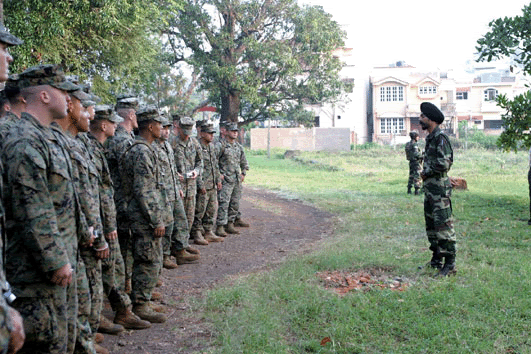
An Indian officer with Alpha Co., 21st Battalion, The Punjab Regiment, helps Marines with Echo Co., Battalion Landing Team 2/4 familiarize themselves with the various ranges and courses they'll be participating in.
Official USMC Photo by Cpl Thomas J. Grove

It’s time for a break!!
Camaraderie between the Indian and American Forces.
Courtesy: Corbs
And training the British Forces too…..
Himalayan Warrior, a joint UK-India exercise comprising specialist high altitude training, will be held in the Ladakh region 17 September-11 October including a period of acclimatization. This is a unique opportunity to share best practice between elite soldiers of both British and Indian Armed Forces.
This specialist environmental training is the culmination of three years interaction between the Royal Marine (RM) mountain leaders and the Indian Army High Altitude Warfare School. Emphasis will be given to survival and infantry skills in order to improve their ability to operate above 5000 metres. The RM welcomed the opportunity to train alongside the Indian Army in one of the most challenging environments in the world that will test their specialist high altitude and mountain leadership skills.
The Indian airborne forces who are taking part in this Exercise ‘HIMALAYAN WARRIOR’, are especially trained high altitude warfare troops capable of operating independently in varied snow-bound mountainous regions. They are well equipped and experienced for conduct of all types of operations in all environments.
More later! But remember, we’re all in it together against a common enemy – Terrorism!!
Cheers!
Refs:
the.honoluluadvertiser.com...
www.india-defence.com...
[edit on 28-1-2008 by mikesingh]
new topics
-
America's Greatest Ally
General Chit Chat: 3 minutes ago -
President BIDEN's FBI Raided Donald Trump's Florida Home for OBAMA-NORTH KOREA Documents.
Political Conspiracies: 5 hours ago -
Maestro Benedetto
Literature: 6 hours ago -
Is AI Better Than the Hollywood Elite?
Movies: 6 hours ago -
Las Vegas UFO Spotting Teen Traumatized by Demon Creature in Backyard
Aliens and UFOs: 10 hours ago -
2024 Pigeon Forge Rod Run - On the Strip (Video made for you)
Automotive Discussion: 11 hours ago -
Gaza Terrorists Attack US Humanitarian Pier During Construction
Middle East Issues: 11 hours ago
top topics
-
President BIDEN's FBI Raided Donald Trump's Florida Home for OBAMA-NORTH KOREA Documents.
Political Conspiracies: 5 hours ago, 26 flags -
Krystalnacht on today's most elite Universities?
Social Issues and Civil Unrest: 16 hours ago, 9 flags -
Gaza Terrorists Attack US Humanitarian Pier During Construction
Middle East Issues: 11 hours ago, 8 flags -
Supreme Court Oral Arguments 4.25.2024 - Are PRESIDENTS IMMUNE From Later Being Prosecuted.
Above Politics: 16 hours ago, 8 flags -
Weinstein's conviction overturned
Mainstream News: 14 hours ago, 8 flags -
Massachusetts Drag Queen Leads Young Kids in Free Palestine Chant
Social Issues and Civil Unrest: 13 hours ago, 7 flags -
Las Vegas UFO Spotting Teen Traumatized by Demon Creature in Backyard
Aliens and UFOs: 10 hours ago, 6 flags -
Meadows, Giuliani Among 11 Indicted in Arizona in Latest 2020 Election Subversion Case
Mainstream News: 13 hours ago, 5 flags -
2024 Pigeon Forge Rod Run - On the Strip (Video made for you)
Automotive Discussion: 11 hours ago, 4 flags -
Is AI Better Than the Hollywood Elite?
Movies: 6 hours ago, 3 flags
active topics
-
Is AI Better Than the Hollywood Elite?
Movies • 15 • : 5thHead -
America's Greatest Ally
General Chit Chat • 0 • : 19Bones79 -
President BIDEN's FBI Raided Donald Trump's Florida Home for OBAMA-NORTH KOREA Documents.
Political Conspiracies • 17 • : BingoMcGoof -
Gaza Terrorists Attack US Humanitarian Pier During Construction
Middle East Issues • 29 • : 19Bones79 -
Supreme Court Oral Arguments 4.25.2024 - Are PRESIDENTS IMMUNE From Later Being Prosecuted.
Above Politics • 90 • : Lumenari -
Las Vegas UFO Spotting Teen Traumatized by Demon Creature in Backyard
Aliens and UFOs • 12 • : KrustyKrab -
SHORT STORY WRITERS CONTEST -- April 2024 -- TIME -- TIME2024
Short Stories • 23 • : DontTreadOnMe -
Truth Social goes public, be careful not to lose your money
Mainstream News • 130 • : Astyanax -
Hate makes for strange bedfellows
US Political Madness • 47 • : 19Bones79 -
-@TH3WH17ERABB17- -Q- ---TIME TO SHOW THE WORLD--- -Part- --44--
Dissecting Disinformation • 689 • : daskakik