It looks like you're using an Ad Blocker.
Please white-list or disable AboveTopSecret.com in your ad-blocking tool.
Thank you.
Some features of ATS will be disabled while you continue to use an ad-blocker.

NASA Admits to Storms and Dust Clouds on the Moon
page: 2share:
Originally posted by MrPenny
David O. Darling is not NASA. He is, what, an amateur astronomer?
Brilliant observation as usual... Shows how much you pay attention here...
You completely ignore the fact that Science@NASA uses the term "dust storms" and THEY obviously think enough of David's work to link to his site from theirs ( as well as MUFON so you cab get a NASA paper...)
Your insults are getting old.
No problem... won't bug ya any more... I will just find more stuff to fill the thread with...
Originally posted by syrinx high priest
lol, let me know when these "storms" involve water
The water is in a frozen 100 square kilometer lake 50 feet deep (thick) at the south pole... everyone knows this... don't you guys ever get out and do ANY research yourself?
:shk:
wow,,i remember a talk between john Lear and richard hoagland where they disagreed on this point, richard insisted there is no atmosphere,,or is it
extensive mining going on there,,,i find it disgraceful that a scientific body like NASA IS EATING ITS WORDS,, why dont they come clean on this..thank
you
[edit on 9-12-2007 by Iraqi_Fighter_Pilot]
[edit on 9-12-2007 by Iraqi_Fighter_Pilot]
A little info on lunar temperature variations which surely can't be disputed:
That's a sufficient temperature range to cover the evaporation/sublimation/freezing limits of many elements & compounds we could expect to find on the lunar surface so energetic changes between night & day are to be expected. It still doesn't suggest that hang gliding from a crater rim is likely to be a safe activity to attempt, well not to most of us at least
Temperatures on the Lunar surface vary widely on location. Although beyond the first few centimeters of the regolith the temperature is a nearly constant -35 C (at a depth of 1 meter), the surface is influenced widely by the day-night cycle. The average temperature on the surface is about 40-45 C lower than it is just below the surface. In the day, the temperature of the Moon averages 107 C, although it rises as high as 123 C. The night cools the surface to an average of -153 C, or -233 C in the permanently shaded south polar basin. A typical non-polar minimum temperature is -181 C (at the Apollo 15 site). The Lunar temperature increases about 280 C from just before dawn to Lunar noon. Average temperature also changes about 6 C betwen aphelion and perihelion.
That's a sufficient temperature range to cover the evaporation/sublimation/freezing limits of many elements & compounds we could expect to find on the lunar surface so energetic changes between night & day are to be expected. It still doesn't suggest that hang gliding from a crater rim is likely to be a safe activity to attempt, well not to most of us at least
Just a small question of no real importance except to me. Does anyone know where to find a cargo manifest for lunar missions?
The reason I ask, is with energetic dust, on whatever scale, it would seem like a spray bottle of Windex and a few cleaning rags might have been taken along. After all, there would need to be a way to keep the visors clean enough to see out of. ( It's not like they could use a sleeve the way the rest of us midwesterners do on a sumer day when our sunglasses get dirty. )
The reason I ask, is with energetic dust, on whatever scale, it would seem like a spray bottle of Windex and a few cleaning rags might have been taken along. After all, there would need to be a way to keep the visors clean enough to see out of. ( It's not like they could use a sleeve the way the rest of us midwesterners do on a sumer day when our sunglasses get dirty. )
reply to post by NGC2736
I think you should ask a subject matter expert of space exploration about that. He would probably have the answers to what they brought along on a space exploration
edit: typos
[edit on 9-12-2007 by tep200377]
I think you should ask a subject matter expert of space exploration about that. He would probably have the answers to what they brought along on a space exploration
edit: typos
[edit on 9-12-2007 by tep200377]
reply to post by tep200377
I will. I just thought that someone here, with all their extensive files on NASA, might have it handy.
Now that I think about it, there ought to be a lot a person could learn from a better look at the type of things taken along on a mission. A form of "space archeology", you might say. A way to understand the conditions they expected to meet.
I will. I just thought that someone here, with all their extensive files on NASA, might have it handy.
Now that I think about it, there ought to be a lot a person could learn from a better look at the type of things taken along on a mission. A form of "space archeology", you might say. A way to understand the conditions they expected to meet.
reply to post by NGC2736
They did take cleaning supplies with them, like feather dusters and rags. But let me tell you, it was a dismal failure. Removing the dust managed to scratch everything, and on the spacesuits it only rubbed in, not off. All seals eventually became so compromised as to be useless. Several more Lunar walks would have put the crew in serious danger by compromising the seals of the airlock and suits.
This has really been a problem for a long time, and is the main reason most large projects and missions were abandoned, either on the drawing board or deployment. New designs include such revolutionary concepts as local electrostatic repulsion of dust and spacesuits that the wearer can step out of into an airlock, while the suit remains outside.
But once again, the southern region promises friendlier dust free "weather" than the rest of the Moon, thus becoming the choice real estate for development.
They did take cleaning supplies with them, like feather dusters and rags. But let me tell you, it was a dismal failure. Removing the dust managed to scratch everything, and on the spacesuits it only rubbed in, not off. All seals eventually became so compromised as to be useless. Several more Lunar walks would have put the crew in serious danger by compromising the seals of the airlock and suits.
This has really been a problem for a long time, and is the main reason most large projects and missions were abandoned, either on the drawing board or deployment. New designs include such revolutionary concepts as local electrostatic repulsion of dust and spacesuits that the wearer can step out of into an airlock, while the suit remains outside.
But once again, the southern region promises friendlier dust free "weather" than the rest of the Moon, thus becoming the choice real estate for development.
The water is in a frozen 100 square kilometer lake 50 feet deep (thick) at the south pole... everyone knows this... don't you guys ever get out and do ANY research yourself?
Not quite.
Hydrogen has been detected, whether it's in the form if water ice is still unknown. It could be in the form of something like Portland cement.
It's still an unknown. That's why Lunar Prospector and Smart-1 were crashed where they were in an attempt to stir it up and get a spectrographic peek at it.
Until some robots get there and do some digging, we may not know for sure. Perhaps Japan & China will conduct similar experiments when the spacecraft reach the end of their mission lives and can be dropped into the right place.
Dusty Plasma Group
Appears to be doing some interesting research into the "tens of centimeters" high swarms of charged lunar dust. Scroll down to "Dust Charging in Sheaths"
Originally posted by MrPenny
But never, have I attained this level of 'stretch'.....
Hey MrPenny, you've been around for a while, what brought you here initially? I am asking because you just seem to hang around attempting to find the first available opportunity to get your digs in.
The good doctor BS is a different story. His excuse is ignorance, for example n another thread he just told me ballistic trajectories (what I call attributes of the atmosphere) of charged particles on the Moon's surface is without merit. I personally think the subject matter is more appropriate for this thread anyway.
I suspect his claims of expertise is without merit. How can anyone study the paths of charged particles in a medium with as much significant effort as he says he did and still not have heard of ballistics?
And the rest is just downhill. Charged particles cannot bounce on a surface of like charge, and seeing other parts of time is pure fantasy and fiction. I could go on and on, but at least he uses a meritorious scale of judgment, whereupon your prejudice is throughly unfounded.
So what are you doing here?
reply to post by NGC2736
Look at page 22 www.hq.nasa.gov...
Not exactly what you where looking for, but anyways ..
Look at page 22 www.hq.nasa.gov...
Not exactly what you where looking for, but anyways ..
reply to post by NGC2736
I believe Zorgon has this on thelivingmoon website. Check in the Arneson files...that is the most likely place for it.
He may only have the STS logs, however...i cannot directly recall and must run to work now (so cannot look).
I believe Zorgon has this on thelivingmoon website. Check in the Arneson files...that is the most likely place for it.
He may only have the STS logs, however...i cannot directly recall and must run to work now (so cannot look).
Originally posted by MrPenny
Nothing in your post was particularly germane to the discussion.
Regardless, thank you for the contribution.
Happy Holidays!!
Where is your proof/documentation of your point.
All you do is shout at zorgon as far as i can see.
While zorgon tries to provide some content to his statements.
If you demand more of him you should start givinfg a good example yourself and provide some proof/documentation, or you are nothing more than a waste of time.
Interesting topic, Zorgon, thanks!
There appears to be a bit of concern with the effects of lunar dust kicked up by the exhaust gases of chemically propelled lunar spacecraft, according to the following, somewhat "fluffy" article:
I mentioned the above article as being "fluffy" due to a couple of issues.
First, according to a short article from the Lunar and Planetary Institute, the distance from the lunar module to Surveyor III was more along the lines of 160 meters, (actually it was ~163 meters) still a good distance, but certainly less than the "about 200" meters as stated in the article.
Second, the article simply states, "There is no atmosphere to slow tiny particles."
Which isn't quite true, since it's been established that there is an atmosphere of a tenuous nature, at the very least:
Nevertheless, and the "fluffiness" of the article aside, perhaps this "scouring" effect of high velocity dust could be a valid concern for operations on the moon, which was the main point of this post.
Heck, even the abrasive effect of the dust held aloft by an electrostatic effect should be of concern for any lunar operations.
Warning: Begging your indulgence, the following will digress progressively further off-topic, proceed at your own risk.
Having read the article, my interest piqued, I did a search for more info and images of the event described and came up with the following pics and a couple of further points of interest.
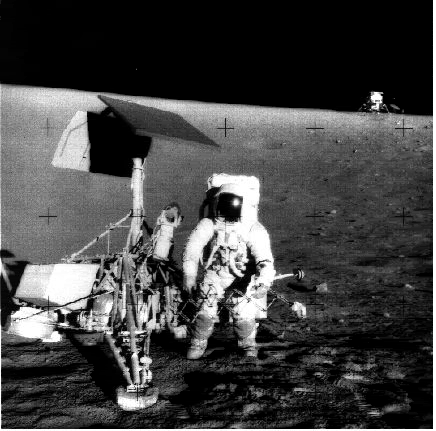
Source | Johnson Space Center | Experiment Operations During Apollo EVAs | Experiment: Surveyor 3 retrieval
Possible allusion to atmospheric oxygen(?):
I'm just an artist, does anyone know where the "low temperature oxygen plasma" effects were generated, or indeed what this even means?
Does this have something to do with the lunar atmosphere?
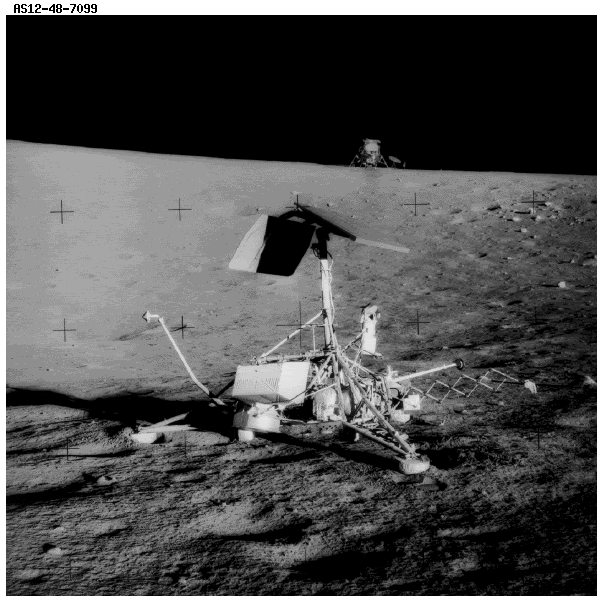
Source | Lunar and Planetary Institute | Apollo 12 Mission | Science Experiments - Surveyor III Analysis
Concerning life surviving the harsh conditions of space:
Additional resources:
A fascinating design study of Space Settlements held at Stanford University and Ames Research Center in the summer of 1975:
Table of contents: Space Settlements: A Design Study
An entire page of links to sites concerned with space settlement issues:
Space Settlements: Spreading life throughout the solar system
We now return you to your regularly scheduled topic:
"NASA Admits to Storms and Dust Clouds on the Moon"
Thank you
[edit on 9-12-2007 by goosdawg]
There appears to be a bit of concern with the effects of lunar dust kicked up by the exhaust gases of chemically propelled lunar spacecraft, according to the following, somewhat "fluffy" article:
Source | MoonDaily | Watch Out For Flying Moondust
Here on Earth, no one pays much heed to dust or sand blasted out by a rocket launch because "atmospheric drag rapidly slows the lightweight particles so they fall harmlessly to the ground a few meters from the blast," he explains. But on the Moon? "There is no atmosphere to slow tiny particles." Small grit can travel enormous distances at high speeds, scouring everything in its path.
This isn't just theory. In November 1969, the Apollo 12 Lunar Module (LM, pronounced "lem") landed about 200 meters from Surveyor 3, a robotic probe that had landed on the Moon in April 1967. The Apollo 12 astronauts walked over to Surveyor 3 to photograph it and to retrieve some pieces for return to Earth. Right away, they noticed that most of Surveyor 3, which at launch was pristine white, had darkened to brown--a result of two-and-a-half years' exposure to extreme lunar conditions.
But the side of Surveyor 3 facing the LM had been sandblasted back to white. In fact, "every bolt, cable, or bracket blocking the spray of fine grit from Apollo 12 left permanent shadows etched onto Surveyor," Metzger says. From examining the returned artifacts, scientists later calculated the sandblasting resulted primarily from finest dust particles only 1 to 10 micrometers (0.00004 to 0.0004 inch) across.
The scoured surfaces were also pocked with hundreds of microscopic impact craters ranging from 30 to 60 micrometers (0.001 to 0.002 inch) across caused by particles of about the same size traveling at high speeds. Moreover, fine grit had been driven into tiny cracks and crevices, including inside Surveyor's camera.
This evidence concerns Metzger because in a future lunar outpost, high-speed fine grit could scour the reflective coating off thermal control blankets, roughen the surfaces of windows and other optics, compromise the surfaces of solar panels, and penetrate connectors or other mechanisms on digging machines or spacesuits, causing friction and even mechanical failure. Well, why not just land far enough away that speeding sand and dust ceases to be a problem?
Answer: You can run, but you can't hide. Dust particles accelerated by a rocket's exhaust could theoretically travel all the way around the Moon!
Metzger's team has analyzed how the impact craters formed on Surveyor 3 and finds that the particles must have been traveling at least 400 to 1,000 meters per second. "In fact, they may have been traveling as fast as the exhaust gases of the lunar lander-that is, at 1 or 2 kilometers per second."
Particles speeding horizontally at 1.7 kilometers per second will travel literally halfway around the Moon. Boost that speed to 2 kilometers per second, and the projectiles can completely circle the Moon. If no mountains got in the way, grit accelerated by a rocket landing could zip entirely around the Moon "and land back at the rocket's feet," says Metzger.
I mentioned the above article as being "fluffy" due to a couple of issues.
First, according to a short article from the Lunar and Planetary Institute, the distance from the lunar module to Surveyor III was more along the lines of 160 meters, (actually it was ~163 meters) still a good distance, but certainly less than the "about 200" meters as stated in the article.
Second, the article simply states, "There is no atmosphere to slow tiny particles."
Which isn't quite true, since it's been established that there is an atmosphere of a tenuous nature, at the very least:
Space Settlements: A Design Study | APPENDIX J | IMPACT UPON LUNAR ATMOSPHERE
The present lunar atmosphere, arising from natural sources with a total rate less than 0.010 kg/s, has a mass of less than 10^4 kg and surface number densities less than 10^7 /cm^3.
Nevertheless, and the "fluffiness" of the article aside, perhaps this "scouring" effect of high velocity dust could be a valid concern for operations on the moon, which was the main point of this post.
Heck, even the abrasive effect of the dust held aloft by an electrostatic effect should be of concern for any lunar operations.
Warning: Begging your indulgence, the following will digress progressively further off-topic, proceed at your own risk.
Having read the article, my interest piqued, I did a search for more info and images of the event described and came up with the following pics and a couple of further points of interest.
Source | Johnson Space Center | Experiment Operations During Apollo EVAs | Experiment: Surveyor 3 retrieval
Possible allusion to atmospheric oxygen(?):
Source | Johnson Space Center | Experiment Operations During Apollo EVAs | Experiment: Surveyor 3 retrieval
After a 30 month exposure of Surveyor 3 on the surface, the A-12 crew inspected the spacecraft and retrieved key parts from it for further analysis on Earth...sort of an LDEF of the Moon. The effects of the A-12 LM blast ejecta, micrometeroid effects on electronics (TV camera), cables, metal structure, mirrors, etc., analysis of the sampler scoop, effect of a low temperature oxygen plasma on the coatings, induced radioactivity, and microbe survival in the lunar environment, were a few of the studies conducted.
Emphasis mine
I'm just an artist, does anyone know where the "low temperature oxygen plasma" effects were generated, or indeed what this even means?
Does this have something to do with the lunar atmosphere?
Source | Lunar and Planetary Institute | Apollo 12 Mission | Science Experiments - Surveyor III Analysis
Concerning life surviving the harsh conditions of space:
Source | Lunar and Planetary Institute | Apollo 12 Mission | Science Experiments - Surveyor III Analysis
A particularly important aspect of the Surveyor 3 analysis was the search for living material on the spacecraft. Surveyor was not sterilized prior to launch, and scientists wanted to know if terrestrial microorganisms had survived for two and a half years in space. One research group found a small amount of the bacteria Streptococcus mitis in a piece of foam from inside the TV camera. They believed that these bacteria had survived in this location since before launch.
Emphasis mine
Additional resources:
A fascinating design study of Space Settlements held at Stanford University and Ames Research Center in the summer of 1975:
Table of contents: Space Settlements: A Design Study
An entire page of links to sites concerned with space settlement issues:
Space Settlements: Spreading life throughout the solar system
We now return you to your regularly scheduled topic:
"NASA Admits to Storms and Dust Clouds on the Moon"
Thank you
[edit on 9-12-2007 by goosdawg]
Does this have something to do with the lunar atmosphere?
More to do with the space environment and solar plasma as a whole, I suspect.
Particularly the oxidizing effects of orbital atomic oxygen on spacecraft materials of which little was known in Surveyors time.
Dusty Plasma Effects on Surfaces in Space(.pfd file)
Further reading about simulating space plasma for LEO applications
Is atomic oxygen bad for my spaceship?
Nice links goosdawg,
Thanks
Heck, even the abrasive effect of the dust held aloft by an electrostatic effect should be of concern for any lunar operations.
Exactly why a type of Lawn Mower on the Moon makes so much sense.
Sintering of landing pads and berms is a major point of interest right now for lunar development.
reply to post by SpaceMax
Ah, I see!
Thanks to your links, I now know the difference between plasma etching and plasma cleaning!
Not to mention, the importance of determining the effects of atomic oxygen on a wide variety of materials in space, particularly in LEO, and why that should be of such paramount concern to systems engineers.
Nice links, backat'cha!
And, again, thanks!
Ah, I see!
Thanks to your links, I now know the difference between plasma etching and plasma cleaning!
Not to mention, the importance of determining the effects of atomic oxygen on a wide variety of materials in space, particularly in LEO, and why that should be of such paramount concern to systems engineers.
Nice links, backat'cha!
And, again, thanks!
Originally posted by NGC2736
Just a small question of no real importance except to me. Does anyone know where to find a cargo manifest for lunar missions?
The reason I ask, is with energetic dust, on whatever scale, it would seem like a spray bottle of Windex and a few cleaning rags might have been taken along. After all, there would need to be a way to keep the visors clean enough to see out of. ( It's not like they could use a sleeve the way the rest of us midwesterners do on a sumer day when our sunglasses get dirty. )
Ah! A Quest! No I haven't found one yet[nor looked]
While I am digging around for that does anyone have any idea about the space suits on Apollo missions? I have heard it said they left them on the Moon, but have not had time to check on that one.
Any help would be appreciated... and NASA sources would be acceptable
Originally posted by SpaceMax
Not quite.
Hydrogen has been detected, whether it's in the form if water ice is still unknown.
Hmmm funny I seem to recall a different story... but hey what do I know...
This was released in Dec 2006...
U.S. Department of Defense
Office of the Assistant Secretary of Defense (Public Affairs)
News Transcript
Presenter: Dr. Dwight Duston, Assistant Deputy for Technology, Ballistic Missile Defense Organization;
DoD News Briefing
Tuesday, December 3, 1996 - 1:45 p.m.
Subject: Discovery of Ice on the Moon
Dr. Dwight Duston, Assistant Deputy for Technology, Ballistic Missile Defense Organization;
Dr. Paul Spudis, Lunar and Planetary Institute, Rice University;
Dr. Stewart Nozette, Lawrence Livermore Laboratory;
Col. Pedro Rustan, USAF, Director, Small Satellite Program, National Reconnaissance Office;
Christopher L. Lichtenberg, Head, RF Active System Section, Naval Research Laboratory; and
Col. Richard Bridges, USA, director, Defense Information, OASD(PA).
Q: What do you think this would look like if you could go right down and see it? Would you see a fairly large pond here, other ponds all over the place, some ice in crevices and rocks?
A: You would probably see... First of all you wouldn't see anything because you'd be in the dark. But if you had a flashlight and you illuminated the surface, you would see a surface that looked not unlike any place else on the moon, but if you were to dig down into that and pull it up, you would find that there would be ice crystals contained in the interstices between the dust grains. So it's not a sheet or a pond. It's not an ice rink on the moon. It's basically ice mixed into the dirt.
Q: What's the presumptive volume of it then, and how did you discern that?
A: As I mentioned, what we can tell from looking at the radar return is roughly the area that is covered by this. Assuming it reflects ice like ice on Mercury -- making that assumption. That's been well looked at. Then in order to see this back scatter effect, this roadside reflector effect; it's estimated that we have to see some number of wavelengths of our radar into the ice. In reviewing the paper, several of the reviewers posited we probably need to see somewhere between 50 and 100 wavelengths. So our wavelength is about six inches. So at the thickest case, it's roughly 50 feet.
Q: That translates to what in volume?
A: We were very conservative in the press release, but if you take basically 100 square kilometers by roughly 50 feet, you get a volume of something like a quarter of a cubic mile, I think it's on that order. It's a considerable amount, but it's not a huge glacier or anything like that.
Q: Can you compare that with something you know?
A: It's a lake. A small lake.
www.defenselink.mil...
new topics
-
Liberal Democrats to Table a Motion of No Confidence in the government Tomorrow
Regional Politics: 51 minutes ago -
Time Traveler Caught on Camera?
Paranormal Studies: 1 hours ago -
Trump legal cases are falling apart at break neck speeds
US Political Madness: 1 hours ago -
We are screwed
Global Meltdown: 1 hours ago -
Medvedev: “No one can hide, a global catastrophe is coming”
World War Three: 2 hours ago -
Russians And Americans At Same Airbase In Niger But Not Sharing Restrooms
World War Three: 5 hours ago -
US Air Force Secretary Kendall flies in cockpit of plane controlled by AI
Aircraft Projects: 10 hours ago -
Messages of Hope – Unity through AI
Dreams & Predictions: 10 hours ago -
Happy Cinco de mayo.
General Chit Chat: 11 hours ago
top topics
-
We are screwed
Global Meltdown: 1 hours ago, 8 flags -
Trump legal cases are falling apart at break neck speeds
US Political Madness: 1 hours ago, 7 flags -
The BEAST System of Revelation has been awoken and has assumed control, at least since COVID.
New World Order: 15 hours ago, 6 flags -
Time Traveler Caught on Camera?
Paranormal Studies: 1 hours ago, 3 flags -
Medvedev: “No one can hide, a global catastrophe is coming”
World War Three: 2 hours ago, 3 flags -
Messages of Hope – Unity through AI
Dreams & Predictions: 10 hours ago, 3 flags -
Russians And Americans At Same Airbase In Niger But Not Sharing Restrooms
World War Three: 5 hours ago, 2 flags -
Happy Cinco de mayo.
General Chit Chat: 11 hours ago, 2 flags -
US Air Force Secretary Kendall flies in cockpit of plane controlled by AI
Aircraft Projects: 10 hours ago, 1 flags -
Liberal Democrats to Table a Motion of No Confidence in the government Tomorrow
Regional Politics: 51 minutes ago, 1 flags
active topics
-
Trump legal cases are falling apart at break neck speeds
US Political Madness • 9 • : JadedGhost -
Alien language: If we met extraterrestrials, could we talk to them?
Aliens and UFOs • 79 • : introufo2 -
Leading Surgeon from Al-Shifa Hospital Dies in Israeli Custody
Middle East Issues • 68 • : cherokeetroy -
Medvedev: “No one can hide, a global catastrophe is coming”
World War Three • 24 • : Kenzo -
Modern Mind Control
General Conspiracies • 40 • : IndieA -
Zionists of ATS assemble
Political Issues • 181 • : cherokeetroy -
We are screwed
Global Meltdown • 3 • : Boogerpicker -
Time Traveler Caught on Camera?
Paranormal Studies • 5 • : KKLOCO -
HOUSE VOTES 320-91 TO BAN CHRISTIAN BELIEFS IN AMERICA
Political Issues • 66 • : Terpene -
Candidate TRUMP Now Has Crazy Judge JUAN MERCHAN After Him - The Stormy Daniels Hush-Money Case.
Political Conspiracies • 1212 • : RazorV66