It looks like you're using an Ad Blocker.
Please white-list or disable AboveTopSecret.com in your ad-blocking tool.
Thank you.
Some features of ATS will be disabled while you continue to use an ad-blocker.

Huge Alien Spaceships Orbiting The Sun??
page: 2share:
i must admit that the first pic well... looks .... like some sort of artificially (man ?) made object
but couldn't the second one be a comet , an asteroid strafing the sun's corona or chromosphere hence creating a tail which looks like a long cylindrical object ? Does it make sense ?
but couldn't the second one be a comet , an asteroid strafing the sun's corona or chromosphere hence creating a tail which looks like a long cylindrical object ? Does it make sense ?
Great pics FiFtEeN.
I specially liked the last two. What in the name of Jupiter is that huge translucent 'tunnel' with eddies? Could it be the wake of a giant spaceship or, as NASA would say, a CCD glitch??
[edit on 29-9-2006 by mikesingh]
I specially liked the last two. What in the name of Jupiter is that huge translucent 'tunnel' with eddies? Could it be the wake of a giant spaceship or, as NASA would say, a CCD glitch??
[edit on 29-9-2006 by mikesingh]
Great pictures fifteen... a good solid piece of 'no UFO's NASA??!!' ...
what evers happening out there, NASA has the soho to keep an eye out at the very least.... but like all ways their keeping it shut tight to stop us all from panic... lol i for onr would love to know what it is thats going on out there!
what evers happening out there, NASA has the soho to keep an eye out at the very least.... but like all ways their keeping it shut tight to stop us all from panic... lol i for onr would love to know what it is thats going on out there!
Nice pictures.
I'm not really that brainy lol but what is CCD's?
There is something out there........ just somewere
[edit on 29-9-2006 by Spacedeck]
I'm not really that brainy lol but what is CCD's?
There is something out there........ just somewere
[edit on 29-9-2006 by Spacedeck]
Originally posted by Spacedeck
Nice pictures.
I'm not really that brainy lol but what is CCD's?
A CCD (charge-coupled device) is an image sensor, consisting of an integrated circuit containing an array of linked, or coupled, capacitors sensitive to light.
Now does that make sense to you?? If so, then do you wanna know how the darn thing works? Here..
If no, then uncork a beer and enjoy the sun!!
mikesingh, how certain are you these photo's are real?
if this is true then that thing has to be almost the size of earth..
nice pics thx for them
if this is true then that thing has to be almost the size of earth..
nice pics thx for them
Originally posted by mikesingh
Originally posted by Spacedeck
Nice pictures.
I'm not really that brainy lol but what is CCD's?
A CCD (charge-coupled device) is an image sensor, consisting of an integrated circuit containing an array of linked, or coupled, capacitors sensitive to light.
Now does that make sense to you?? If so, then do you wanna know how the darn thing works? Here..
If no, then uncork a beer and enjoy the sun!!
LoL.
Think I'm going to read thatl ink
Cheers
Originally posted by mikesingh
After an excellent discussion with you guys on my previous thread, Alien Objects Orbiting Saturn's Rings?? where many of you had posted some fantastic pictures and posts, I thought it was time to show you some mind-boggling images of HUGE 'unidentified spaceships' orbiting the sun! And it does resemble the starship, 'Enterprise' from Star Trek'!! (But thousands of times bigger!!)
I must give full credit to Lizz Edwards of I Wonder Productions who has pored over the photographs taken by SOHO/LASCO for over a year and come out with some incredible images of these gigantic objects. There are two types of ‘space ships’ here.
I leave it to you to decide whether they are orbiting rocks, asteroids, space junk, Mercury, Venus or whatever. As for me, I have an open mind but tend to veer to the conclusion that they are artificial and controlled by very advanced intelligences. If it’s true then all I can say is, ‘WOW’!!!
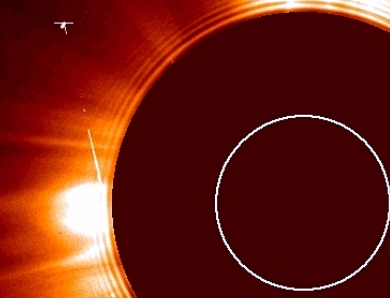
Lower Left (See arrow) and a slightly enlarged pic with the object at Upper left.

Enlargements of the object with colored filters.

Another enlargement. The shape is clearly visible.

This cylindrical object, thousands of miles long,
seems to be burning up. A malfunction?
(Check out Alien Objects Orbiting Saturn's Rings?? for more details on this cylindrical object).
The Sun Cruiser.
Courtesy: Lizz Edwards
I Wonder Productions
[edit on 27-9-2006 by mikesingh]


Looks like the Klingon ship in Star Trek 4 to me, the one when Kirk and crew go back in time and picks up some whales !!!!
Originally posted by selfless
mikesingh, how certain are you these photo's are real?
if this is true then that thing has to be almost the size of earth..
nice pics thx for them
Yeah, these are genuine SOHO/LASCO photographs.
And as I mentioned earlier, these objects are huge. Some possibly the size of the Earth!! Intriguingly they seem to be of similar class to the objects found orbiting the rings of Saturn. Here..
nice threads mike, good pics and sources on saturn objects and sun objects, good read, and it's nice to see a thread with less bickering although
there was some it was minimal and swift :0
I've seen the last picture posted by FiFtEeN before, except when I last read it it was thought to be an unknown planet, but this makes much more
sense.
The objects in the pictures have to be ingelligently made. There is no way they're not. I don't really know what to say in this thread except that this might just be the proof we've been looking for..
The objects in the pictures have to be ingelligently made. There is no way they're not. I don't really know what to say in this thread except that this might just be the proof we've been looking for..
Aaaaaahhhh.....guys...I hate to tell you but....I knew I've seen the first picture somewhere...Pretty nice looking space ship with a central bulge
and a ring...just like Saturn...
Sorry to spoil the fun.
NASA's Solar and Heliospheric Observatory, known as SOHO (sohowww.nascom.nasa.gov...), keeps close watch on the Sun. SOHO images show Saturn on the left moving toward the Sun, which is shielded from view but represented by a white circle in the image center
Cassini - Huygens site
Sorry to spoil the fun.
There is NO WAY that the object in the first picture is Saturn. It's way too large, especially if you consider the distance that saturn is. Saturn
should just be a blip like everything else.
So NASA just used a picture with an UFO on the Cassini Huygens site to illustrate why they loose contact with the probe for a few days....hmmm...I
think not!
This topic title jogged my memory. I have to search through my many books but if I recall correctly one of Earth's original astronomers noted seeing
an object cross the sun's disc a few hundred years ago.
I think that these are commonly known as 'sun cruisers' and can frequent and easily found whilst searching through the SOHO image captures archive.
My bro who is interested in astronomy found out about them and emailed whoever (NASA or someone) who said they were planets. He then looked to see
where the different planets were in relation to the earth and suns position on the given time/day of the SOHO pics and soon found out that they
were infact mostly planets. I'm not convinced however that they are all planets as there are sometimes massive amounts of different types of
anomalies found on anyone of these pictures, but don't know how to find the planets positions at the time of the photos. Maybe someone could do
this?
Evidence of some sun cruisers being planets.
SOHO images
Here is the very latest SOHO "LASCO C3"? image.

Spot the anomalies in this latest animated gif (you'll lose count)
[edit on 29-9-2006 by Xeros]
Evidence of some sun cruisers being planets.
SOHO images
Here is the very latest SOHO "LASCO C3"? image.
Spot the anomalies in this latest animated gif (you'll lose count)
[edit on 29-9-2006 by Xeros]
OK, guys. Here's some more mind boggling stuff from Lizz Edwards. Saturn? Mars? Venus? I think there's something out there which is beyond
comprehension! I don't believe for a moment that all these photographs have CCD glitches - a fairly common 'explanation' given by NASA etc.


The same object enhanced with different colored filters.
The same object enhanced with different colored filters.
But... you're editing those images. You're editing them until you find something you're happy with. Yes, it looks like a UFO... but that's not the
original image. Instead of zooming in and reducing quality and parsing colour filters, take a look at the original image. You can't make a good guess
on a manipulated image as to what the original looked like.
By increasing the pixel count... where do the extra pixels come from? They come from the program trying to find a happy medium between surrounding pixels that'll fit in with the image. So in effect, you're putting in pixels that never existed. Zoom in with a program that doesn't distort pixels, such as paint (bad example, but it shows individual pixels).
...Because unless you doctored the image afterwards, or the physical photo itself degrades, a photograph won't change itself years down the track. If this person meant 15 years, and this glitch still occurs, I would like to ask the person if they have any experience in CCD photography in space, and what they would like to suggest to remove the glitches in a very unpredictable environment.
FiFtEeN: I had a gander at those pics, and this is what I have to say.
1. I think it's quite cool, actually. Looks like a moth in space. Could very well be a glitch, but there's no size reference as to how big it is. It could be one metre from the camera and be a sort of space-moth thing, or it could be lightyears away and be totally immense.
2. Could be a glitch. We don't know what caused that to happen, so it makes no sense to speculate and form a conclusion on limited knowledge.
3. Looks to me to be consistent with that horizontal bleeding.
4. Probably the same as above, just on a more drastic level.
5. Nothing out of the ordinary there.
6. It's obvious in the top left corner that it's bled horizontally. To what the big thing down the bottom is, no idea.
7. Same picture as before.
8. Same image again? But that "ace of spades" looks cool. No idea what that is.
9. I'm assuming you mean that large column of flare (I assume) down the bottom. That looks bloody cool, but I wouldn't discount it more than something such as too much light intensity. There's circles within it overlapping, how cool.
10. I can't see anything?
Those are just my opinions of what I've read about NASA's explanations. I agree that there's something other than us out there, but many of these photos are pure speculation on something many people know next to nothing about, including myself... I can't in my right mind say any of them are spaceships or whatnot. I hope I offered the other side of the coin.
I have to say it... but I wish people would stop manipulating and doctoring images in order to prove something. These "filters" don't enhance the image. They destroy it's original integrity, and you have a new image - something you can't possibly base off the original unless you knew exactly what the image was before hand - which is not in this case.
It's the same as me, trying to BS my way through a university essay: more obscure than is needed, overinflated size, and anything I want it to be.
By mikesingh
Ecto, that was fairly simple. I just re-adjusted the size of the pic by increasing the pixel count. That's it!
By increasing the pixel count... where do the extra pixels come from? They come from the program trying to find a happy medium between surrounding pixels that'll fit in with the image. So in effect, you're putting in pixels that never existed. Zoom in with a program that doesn't distort pixels, such as paint (bad example, but it shows individual pixels).
By mikesingh
According to Lizz Edwards: "I am still amazed that NASA says that this is a CCD glitch.
After 15 months of examining these films how can a glitch be so constant?"
...Because unless you doctored the image afterwards, or the physical photo itself degrades, a photograph won't change itself years down the track. If this person meant 15 years, and this glitch still occurs, I would like to ask the person if they have any experience in CCD photography in space, and what they would like to suggest to remove the glitches in a very unpredictable environment.
FiFtEeN: I had a gander at those pics, and this is what I have to say.
1. I think it's quite cool, actually. Looks like a moth in space. Could very well be a glitch, but there's no size reference as to how big it is. It could be one metre from the camera and be a sort of space-moth thing, or it could be lightyears away and be totally immense.
2. Could be a glitch. We don't know what caused that to happen, so it makes no sense to speculate and form a conclusion on limited knowledge.
3. Looks to me to be consistent with that horizontal bleeding.
4. Probably the same as above, just on a more drastic level.
5. Nothing out of the ordinary there.
6. It's obvious in the top left corner that it's bled horizontally. To what the big thing down the bottom is, no idea.
7. Same picture as before.
8. Same image again? But that "ace of spades" looks cool. No idea what that is.
9. I'm assuming you mean that large column of flare (I assume) down the bottom. That looks bloody cool, but I wouldn't discount it more than something such as too much light intensity. There's circles within it overlapping, how cool.
10. I can't see anything?
Those are just my opinions of what I've read about NASA's explanations. I agree that there's something other than us out there, but many of these photos are pure speculation on something many people know next to nothing about, including myself... I can't in my right mind say any of them are spaceships or whatnot. I hope I offered the other side of the coin.
I have to say it... but I wish people would stop manipulating and doctoring images in order to prove something. These "filters" don't enhance the image. They destroy it's original integrity, and you have a new image - something you can't possibly base off the original unless you knew exactly what the image was before hand - which is not in this case.
It's the same as me, trying to BS my way through a university essay: more obscure than is needed, overinflated size, and anything I want it to be.
Originally posted by Xar Ke Zeth
I have to say it... but I wish people would stop manipulating and doctoring images in order to prove something. These "filters" don't enhance the image. They destroy it's original integrity, and you have a new image - something you can't possibly base off the original unless you knew exactly what the image was before hand - which is not in this case.
It's the same as me, trying to BS my way through a university essay: more obscure than is needed, overinflated size, and anything I want it to be.
OK, Xar, I gotta hand it to you. Good argument there!
But hell, what else can be done to arrive at a logical conclusion? Just leave the pics as they are? In other words, should you be satisfied with 'what you guess is what you see'? Shouldn't one go a step further to try and get nearer the 'truth'?
Of course, I'm not implying fudging photographs!! But doing something to get closer to solving the enigma? Is there any other way? Or should we just sit back and enjoy the SOHO pics suffixed with NASA/JPL's 'explanations' for the anomalies?
new topics
-
Where should Trump hold his next rally
2024 Elections: 2 hours ago -
Shocking Number of Voters are Open to Committing Election Fraud
US Political Madness: 2 hours ago -
Gov Kristi Noem Shot and Killed "Less Than Worthless Dog" and a 'Smelly Goat
2024 Elections: 3 hours ago -
Falkville Robot-Man
Aliens and UFOs: 3 hours ago -
James O’Keefe: I have evidence that exposes the CIA, and it’s on camera.
Whistle Blowers and Leaked Documents: 4 hours ago -
Australian PM says the quiet part out loud - "free speech is a threat to democratic dicourse"...?!
New World Order: 5 hours ago -
Ireland VS Globalists
Social Issues and Civil Unrest: 5 hours ago -
Biden "Happy To Debate Trump"
2024 Elections: 6 hours ago -
RAAF airbase in Roswell, New Mexico is on fire
Aliens and UFOs: 6 hours ago -
What is the white pill?
Philosophy and Metaphysics: 8 hours ago
top topics
-
A Warning to America: 25 Ways the US is Being Destroyed
New World Order: 16 hours ago, 21 flags -
James O’Keefe: I have evidence that exposes the CIA, and it’s on camera.
Whistle Blowers and Leaked Documents: 4 hours ago, 12 flags -
Blast from the past: ATS Review Podcast, 2006: With All Three Amigos
Member PODcasts: 8 hours ago, 12 flags -
Australian PM says the quiet part out loud - "free speech is a threat to democratic dicourse"...?!
New World Order: 5 hours ago, 10 flags -
Biden "Happy To Debate Trump"
2024 Elections: 6 hours ago, 10 flags -
Mike Pinder The Moody Blues R.I.P.
Music: 8 hours ago, 8 flags -
Ireland VS Globalists
Social Issues and Civil Unrest: 5 hours ago, 5 flags -
RAAF airbase in Roswell, New Mexico is on fire
Aliens and UFOs: 6 hours ago, 5 flags -
What is the white pill?
Philosophy and Metaphysics: 8 hours ago, 5 flags -
Putin, Russia and the Great Architects of the Universe
ATS Skunk Works: 11 hours ago, 4 flags
active topics
-
Candidate TRUMP Now Has Crazy Judge JUAN MERCHAN After Him - The Stormy Daniels Hush-Money Case.
Political Conspiracies • 815 • : Annee -
Where should Trump hold his next rally
2024 Elections • 10 • : EmmanuelGoldstein -
President BIDEN's FBI Raided Donald Trump's Florida Home for OBAMA-NORTH KOREA Documents.
Political Conspiracies • 35 • : Threadbarer -
University of Texas Instantly Shuts Down Anti Israel Protests
Education and Media • 309 • : cherokeetroy -
Remember These Attacks When President Trump 2.0 Retribution-Justice Commences.
2024 Elections • 58 • : WeMustCare -
2024 Pigeon Forge Rod Run - On the Strip (Video made for you)
Automotive Discussion • 8 • : WhitewaterSquirrel -
Gov Kristi Noem Shot and Killed "Less Than Worthless Dog" and a 'Smelly Goat
2024 Elections • 28 • : cherokeetroy -
Shocking Number of Voters are Open to Committing Election Fraud
US Political Madness • 5 • : AwakeNotWoke -
The Acronym Game .. Pt.3
General Chit Chat • 7756 • : bally001 -
RAAF airbase in Roswell, New Mexico is on fire
Aliens and UFOs • 8 • : Skinnerbot