It looks like you're using an Ad Blocker.
Please white-list or disable AboveTopSecret.com in your ad-blocking tool.
Thank you.
Some features of ATS will be disabled while you continue to use an ad-blocker.

Mysterious ‘Tracks’ On Mars And The Moon!
page: 1share:
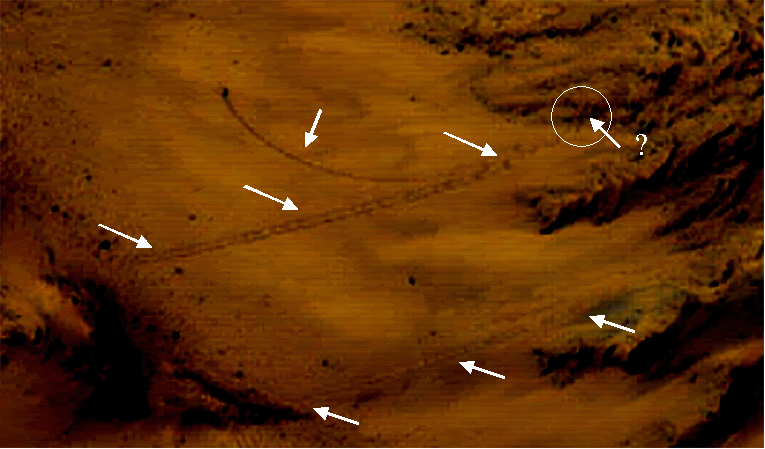
Compare what look like ‘tracks’ on Mars as well as the Moon. The Mars image is the Mojave crater in the Xanthe Terra region. The Moon Image is
within the crater Vitello, (Lunar Orbiter 5, frame 168-H2).
The first two images are from mars, with the second enlarged and brightness and contrast adjusted. The B/W images are from the Moon. Both 'track treads' seem to be exact copies! What are they? Boulders rolling down? But both seem to be going uphill at some stage! And the one on the top in the Mars image is a near perfect arc! Also note a ramp like structure towards the right where the track begins (Or ends?) which I've marked with a circle.
Can anyone venture a guess as to how these could have formed? And the similarity on both the Moon as well as Mars? Are the same geological processes at work on different cosmic bodies? Or does the answer lie somewhere else?
 i118.photobucket.com..." border=0>
Highlighted portion of HiRISE Image PSP_001415_1875
@mikesingh
Enlargement of the area showing the ‘tracks’
Notice the marks which are identical to the ones Zorgon showed in John Lears Moon thread of boulders going uphill!! (See image below)
And the Moon image....
Courtesy: Landoflegends
You can read more about the Moon tracks here..
Did I say that aliens made them? No! But then the mystery remains and the plot thickens!!!
Cheers!
Original image: Moon
Original image: Mars
The first two images are from mars, with the second enlarged and brightness and contrast adjusted. The B/W images are from the Moon. Both 'track treads' seem to be exact copies! What are they? Boulders rolling down? But both seem to be going uphill at some stage! And the one on the top in the Mars image is a near perfect arc! Also note a ramp like structure towards the right where the track begins (Or ends?) which I've marked with a circle.
Can anyone venture a guess as to how these could have formed? And the similarity on both the Moon as well as Mars? Are the same geological processes at work on different cosmic bodies? Or does the answer lie somewhere else?
Highlighted portion of HiRISE Image PSP_001415_1875
@mikesingh
Enlargement of the area showing the ‘tracks’
Notice the marks which are identical to the ones Zorgon showed in John Lears Moon thread of boulders going uphill!! (See image below)
And the Moon image....

Courtesy: Landoflegends
You can read more about the Moon tracks here..
Did I say that aliens made them? No! But then the mystery remains and the plot thickens!!!
Cheers!
Original image: Moon
Original image: Mars
one question before I read the rest. How can you say the tracks are going up or down? they might just all be going down
Just a question.
Very interesting images.
Reminds me of the rocks on earth that seem to move around (old story)
About the bright reflection isn't it common that even stuff like rocks can reflect like that in places where light isn't hindered by a thick atmosphere like ours?
I'm downing the big original images atm.. will take a look tonight I think
[edit]in light of trying to refrain from quick conclusions, that long shadow on your moon crop does not necessarily mean it's a high object depending how low on the horizon the sun is. my cats have shadows i'd estimate 1 m at sunset and they are 20 cm high I haven't compared it at all to other shadows yet so again.. i'm just writing what came to mind glancing at your post. To be honest i always have a hard time with the moon shots, bad quailty camera's? I don't know.. find it hard to make sense of them even without possible anomalies.. the marsian ones are always great though.[/edit]
[edit]Ok think I found your boulder/long shadow and track on the moon. I've downloaded the highest res image of your link but that area's is almost just pixels. did you soften it? and rotated? cuz mine isn't showing the same direction as yours... seems identical though. Ah well I got to go. Will check back when i'm back home again[/edit]
last edit before I go..just noticed.. either the "rock" isn't the origin of the shadow or that shadow magicly goes into the opposite direction of all the other shadows in my image?? really weird.
Like I said most lunar photo's don't make much sense to me. Have a hard time seeing a landscape in them at all so the direction I think the light is coming from might be all wrong but here:
the arrows show the direction of the light / shadows.
What I mean with having a hard time with the old black and white lunar pics is. I have a hard time discerning elevations and depressions.
might just be seeing things.. staring at the screen too long..
really off now
[edit on 2-4-2007 by David2012]
[edit on 2-4-2007 by David2012]
Just a question.
Very interesting images.
Reminds me of the rocks on earth that seem to move around (old story)
About the bright reflection isn't it common that even stuff like rocks can reflect like that in places where light isn't hindered by a thick atmosphere like ours?
I'm downing the big original images atm.. will take a look tonight I think
[edit]in light of trying to refrain from quick conclusions, that long shadow on your moon crop does not necessarily mean it's a high object depending how low on the horizon the sun is. my cats have shadows i'd estimate 1 m at sunset and they are 20 cm high I haven't compared it at all to other shadows yet so again.. i'm just writing what came to mind glancing at your post. To be honest i always have a hard time with the moon shots, bad quailty camera's? I don't know.. find it hard to make sense of them even without possible anomalies.. the marsian ones are always great though.[/edit]
[edit]Ok think I found your boulder/long shadow and track on the moon. I've downloaded the highest res image of your link but that area's is almost just pixels. did you soften it? and rotated? cuz mine isn't showing the same direction as yours... seems identical though. Ah well I got to go. Will check back when i'm back home again[/edit]
last edit before I go..just noticed.. either the "rock" isn't the origin of the shadow or that shadow magicly goes into the opposite direction of all the other shadows in my image?? really weird.
Like I said most lunar photo's don't make much sense to me. Have a hard time seeing a landscape in them at all so the direction I think the light is coming from might be all wrong but here:
the arrows show the direction of the light / shadows.
What I mean with having a hard time with the old black and white lunar pics is. I have a hard time discerning elevations and depressions.
might just be seeing things.. staring at the screen too long..
really off now
[edit on 2-4-2007 by David2012]
[edit on 2-4-2007 by David2012]
Originally posted by David2012
Reminds me of the rocks on earth that seem to move around (old story)
Ah, the sliding rocks of Racetrack Playa in Death Valley.
The major difference being that the Racetrack Playa phenomenon is dependent on atmospheric conditions (precipitation and strong winds)... That's according to the "best theories" that Science has to offer, anyway. After many decades of study, researchers still don't know what forces are at work at Racetrack Playa — nobody has ever seen the rocks move. But move they do.
On the moon, of course, the lack of atmosphere precludes any such convenient meteorological explanations. While Mars does have something of an arid atmosphere, as well as sizable dust storms, it would seem to me that any winds strong enough to move boulders around would also wipe clean any tracks. So, the comparison to Racetrack Playa doesn't quite stand up — but, then, we don't actually know what creates the Racetrack Playa phenomenon, either.
I'd be interested to know more about the actual topography in these Moon and Mars landscapes — long-distance telephoto doesn't always provide a fair representation of topographical subtilties; for all we know, we're looking at moderately steep inclines. Without leaping to the conclusion that ET is roving around up there, the only forces that might naturally move large boulders around and leave tracks on Mars or the Moon would be gravity, seismic disturbances, and meteoritic impacts.
So, if these photos show anything at all, I wonder if we're seeing the tracks of boulders tumbling downhill, or large ejecta from a meteor impact nearby?
— Doc Velocity
Originally posted by Doc Velocity
Originally posted by David2012
Reminds me of the rocks on earth that seem to move around (old story)
Ah, the sliding rocks of Racetrack Playa in Death Valley.
The major difference being that the Racetrack Playa phenomenon is dependent on atmospheric conditions (precipitation and strong winds)... That's according to the "best theories" that Science has to offer, anyway.
I know, I was just reminded of them, didn't say it worked the same way and never offered it as a serious comparison to this in the slightest sense (obviously without the dynamics that are working on this planet)
they still are strange though, but let's stick to mike's topic
we can always open a thread about the playa rocks
A rock sititng on a ledge and maybe not in the most stable of positions could be sent on a roll by a small tremor, also rocks tumble along the shape of the terrain in curves all the time, depending on the shape of the terrain and the shape and imperfections of the rock itself will make it deviate from a strict straight line.
Personally I don't find these pics all that strange.. the shadow inconsistency is likely just me. I have a really hard time discerning elevations from depressions on those "crappy" moon shots.
My quest is more trying to find out what lead mikey to believe these images are odd
[edit on 2-4-2007 by David2012]
Originally posted by David2012
either the "rock" isn't the origin of the shadow or that shadow magicly goes into the opposite direction of all the other shadows in my image?? ...Have a hard time seeing a landscape in them at all so the direction I think the light is coming from might be all wrong but here:
the arrows show the direction of the light / shadows.
Your light source in this photo is roughly the lower center, not the upper center. This image shows typically cratered lunar surface, with at least one prominent formation (center) protruding above the surface. Granted, that's a pretty tall formation relative to the rest of the landscape, but nothing that can't be naturally explained.
Especially in this photo, if the right side of the photo is uphill and the left side is downhill, it's not so difficult to visualize a good-sized boulder rolling downhill and leaving that trail. Just requires a little tremor to jar it loose, and gravity does the rest.
— Doc Velocity
[edit on 4/2/2007 by Doc Velocity]
thanks for clarifying the direction of the light.. doesn't help me discern elevations and depressions better on old moon shots though
to me it looks like the shadows are all going towards where you say the light source is except the long one.
But I know that's because I find it hard to discern between elevations and depressions on these lunar images.
[edit on 2-4-2007 by David2012]
to me it looks like the shadows are all going towards where you say the light source is except the long one.
But I know that's because I find it hard to discern between elevations and depressions on these lunar images.
[edit on 2-4-2007 by David2012]
Originally posted by David2012
My quest is more trying to find out what lead mikey to believe these images are odd
OK, David. So here's why I find the images so odd!
1. The tracks themselves. Must have been pretty recent as otherwise they would have been obliterated by Mars' frequent dust storms.
2. The object at the end of the arc and the near perfect arc itself. How could this be a natural phenomenon? How can a boulder 'roll down' in this manner?
3. This boulder has moved uphill, towards higher ground of the re-entrant. What is the object? It seems to have moved under its own power, as its no way that this could have happened naturally.
4. The 'treads' of the other two tracks are the same as those found on the Moon. And these too are going uphill toward the darker brown area towards the left. If the treads are similar, then it follows that a similar object has moved on both cosmic bodies. And against the force of gravity!
5. The 'ramp' which I've circled. It leads on to the track. Looks pretty suspicious. What does it add up to?
6. So is there more than a natural explanation to this phenomena? Could they be some sort of intelligently controlled objects? That's what we need to find out!!
Cheers!
Originally posted by mikesingh
So is there more than a natural explanation to this phenomena? Could they be some sort of intelligently controlled objects? That's what we need to find out!!
Well, don't be so quick to dismiss natural explanations. Before I jumped to the conclusion of ET rovers, I'd first want to examine photographs of all the landscape surrounding the suspect photo and the "tracks"... Because my first thought would be to locate a fresh impact crater nearby, from which meteoritic ejecta may have rained down and tumbled across the surface, creating the apparent tracks.
And, yes, this energetic delivery could account for arcs and "uphill" tracks, if that's what they are.
— Doc Velocity
[edit on 4/2/2007 by Doc Velocity]
Originally posted by Doc Velocity
... Because my first thought would be to locate a fresh impact crater nearby, from which meteoritic ejecta may have rained down and tumbled across the surface, creating the apparent tracks.
And, yes, this energetic delivery could account for arcs and "uphill" tracks, if that's what they are.
— Doc Velocity
Right on Doc! Lets look for that elusive fresh impact crater. But you'll not find it 'cause it ain't there!! And then, only a three-rock ejecta?? Funny meteorite! Where have all the other 'ejecta rocks' been tossed?
And oh yeah, I didn't know that ejecta rocks produce some amazing near perfect arcs when flung away after a violent impact from ground zero!! The theory of ballistics has really taken a hit here!! Considering that arc, produced by the meteorite ejecta as you claim, try and calculate the impact site by extrapolation and see where you land up! - The fifth dimension!!
Cheers!
[edit on 3-4-2007 by mikesingh]
Originally posted by David2012
one question before I read the rest. How can you say the tracks are going up or down? they might just all be going down
Just a question.
If you would read the rest at my site and study the topography of the tracks on the moon, you would understand its up as it climbs out of the dark crater floor and onto the lit hill...
Reminds me of the rocks on earth that seem to move around (old story)
Those rocks in Death Valley move across the floor of the lake bed in a smooth track... and no one yet knows how or why, nor has actually observed it..
Moving Rocks of Death Valley
Originally posted by mikesingh
Right on Doc! Lets look for that elusive fresh impact crater. But you'll not find it 'cause it ain't there!!
Well, where are the other photos covering the landscape all around your suspect photo? I'd like to see photos of a good 800 mile radius all around the "tracks"... Do those photos exist? Are we supposed to just take your word that a fresh impact crater isn't there?
Originally posted by mikesingh
And then, only a three-rock ejecta?? Funny meteorite! Where have all the other 'ejecta rocks' been tossed?
Well, again, let's see a much larger area of the landscape. Perhaps there are other "tracks" radiating away from an impact, and perhaps what you're showing us is just one of the remote splatters from such an impact.
Originally posted by mikesingh
And oh yeah, I didn't know that ejecta rocks produce some amazing near perfect arcs when flung away after a violent impact from ground zero!! The theory of ballistics has really taken a hit here!!
Not really. Say a good-sized chunk of meteor splatters off of an impact, comes back down a kilometer or so away, and goes tumbling across the landscape — where a fragment of it breaks away and starts tumbling on its own trajectory, perhaps following a shallow depression in the surface. It could describe an arc quite easily.
I mean, what I'm proposing is entirely reasonable, I don't understand your hysterical incredulity. I mean, you're going to guffaw at the meteoritic ejecta theory (although we know that meteors strike Mars and the Moon, producing all sorts of cratering and ejecta patterns).
Take a look at this:
Fresh Martian Meteor Impact & Ejecta Pattern

A fresh meteor impact crater in southeast Arabia Terra acquired in August 2003. The crater is inferred to be young because it still has a finely-detailed pattern of rays associated with its ejecta. These rays formed in a dusty mantle that covers the other craters and rocky terrain at this locale. The crater is young enough that there has not been sufficient time for new dust to cover the rays, or for winds to erase them. The small dark dots associated with the crater are boulders. The boulders were ejected by the impact event. [NASA/JPL/MSSS]
As you can see from this photo of a "fresh" impact crater on Mars in 2003, there is very little of the ejecta pattern that is straight as an arrow. Debris is ejected in all directions, and the radiating spokes are seldom straight — look, they even curve and arc away from the main impact.
Why would you find my theory so laughable, when you're the one leaping straight for the completely unsubstantiated ET explanation?
— Doc Velocity
Originally posted by Doc Velocity
Especially in this photo, if the right side of the photo is uphill and the left side is downhill, it's not so difficult to visualize a good-sized boulder rolling downhill and leaving that trail. Just requires a little tremor to jar it loose, and gravity does the rest.
Except that the lighter colored left side is the central peak and the darker right side is the crater floor as I have clearly shown including a topographical map...
Ergo its going uphill
Besides no one has yet explained to me how it goes up and down over a ridge and through a dip without once changing the "length of stride" shown in the even and symetrical track
Originally posted by zorgon
Except that the lighter colored left side is the central peak and the darker right side is the crater floor as I have clearly shown including a topographical map... Ergo its going uphill Besides no one has yet explained to me how it goes up and down over a ridge and through a dip without once changing the "length of stride" shown in the even and symetrical track
I'm not seeing a symmetrical track — I see a criss-cross wobbling track, which I have seen before in boulder-strewn mountain country where a large and elongated boulder "walks" down a steep slope. It doesn't goes straight down like a bowling ball, it actually wobbles from one side to the other on the way down, almost as if taking alternating steps or walking. That's exactly what these Moon tracks look like to me.
— Doc Velocity
[edit on 4/3/2007 by Doc Velocity]
Jees! The next cold war unfolds!
And Doc, I don't remember saying these tracks could have been made only by ETs!! That was only one of many suggestions. We need to keep all options open, don't we?
Cheers!
[edit on 3-4-2007 by mikesingh]
And Doc, I don't remember saying these tracks could have been made only by ETs!! That was only one of many suggestions. We need to keep all options open, don't we?
Cheers!
[edit on 3-4-2007 by mikesingh]
Originally posted by mikesingh
Jees! The next cold war unfolds!
And Doc, I don't remember saying these tracks could have been made only by ETs!! That was only one of many suggestions. We need to keep all options open, don't we?
No war unfolding. I just offered a natural explanation, and you had some kind of laughing fit. Using your own words, we should keep all options open, so I fail to see why the ejecta theory is so laughable.
Okay, I was being sarcastic with the ET rover remark, but you did express a desire to lunge straight for non-natural explanations, before first even examining the natural explanations. All I'm saying is slow down, exhaust the natural explanations before you start leaping to non-natural conclusions.
— Doc Velocity
Can someone provide a 'scale' for what is in the photos? Are these 'tracks' measured in feet, yards, or miles?
Originally posted by MrPenny
Can someone provide a 'scale' for what is in the photos? Are these 'tracks' measured in feet, yards, or miles?
Working on that... the main image did not provide scale data as they usually do but that image was posted in context with the possibility of Rain on Mars creating those flow patterns
I will track it down... and I sent emails to my contacts within to see what they say
But here is the Big Picture... it is a composite of three Malin strips that are normally about 3 kilometers wide... the highlighted area is in the center strip near the bottom... so the width of the clip first posted by Mike should be around 3 kilometers so the length of the track is about a kilometer or so
[based on the dimensions of the other Malin images) I will track it down... need to know if they are the same size as the Lunar ones...
BTW there is a second track parallel to the first but not as well defined, maybe older?
[edit on 3-4-2007 by zorgon]
Breaking News.... Must see Video
NASA shows absolute proof of Alien activity on Mars...
www.maasdigital.com...
NASA shows absolute proof of Alien activity on Mars...
www.maasdigital.com...
Originally posted by zorgon
NASA shows absolute proof of Alien activity on Mars...
Help me with this zorgon.....
That's a really cool video animation of the rover on Mars, but I don't see your point of it being 'absolute proof'. Heck our rover is alien to Mars by definition.
Originally posted by MrPenny
That's a really cool video animation of the rover on Mars, but I don't see your point of it being 'absolute proof'. Heck our rover is alien to Mars by definition.
LOL not bad Mr Penny... may be hope for you yet...
Precisely the point the Rover is alien to MARS... but I confess... it was a dramatic way to introduce the cool video... and a shameless ploy to get the thread back to the top of the list..
Problem is there are too many Mars threads so attention is spread thin, unlike the moon thread LOL
Here is another cool video from that site Its a trailer for a Disney/ Lockheed Martin collaboration of an IMAX film
disney.go.com...
But hey at least these clips both sides of the fence can enjoy
new topics
-
'I couldn't cope with Britain anymore': Kurdish man pays smuggler to return him to France
Social Issues and Civil Unrest: 1 hours ago -
Former Hamas member goes OFF on ‘low grade’ lefty journalist
US Political Madness: 4 hours ago -
An Apple a Day
General Chit Chat: 4 hours ago -
Oh, Have I got a Goody for You Guys!!!
General Conspiracies: 5 hours ago -
Woman In Her 60s Stabbed To Death In London Street By Thief Who Tried To Steal Her Bag.
Social Issues and Civil Unrest: 7 hours ago -
"The Fool" - A short video featuring a harmonica-playing guy blasted by a UFO
Aliens and UFOs: 10 hours ago
top topics
-
Oh, Have I got a Goody for You Guys!!!
General Conspiracies: 5 hours ago, 13 flags -
Multipal Solar Storms Coming Our Way This Weekend
Fragile Earth: 15 hours ago, 10 flags -
Former Hamas member goes OFF on ‘low grade’ lefty journalist
US Political Madness: 4 hours ago, 9 flags -
US food sources declining becoming non edible .
Social Issues and Civil Unrest: 17 hours ago, 7 flags -
Woman In Her 60s Stabbed To Death In London Street By Thief Who Tried To Steal Her Bag.
Social Issues and Civil Unrest: 7 hours ago, 5 flags -
Lemon-aid and lime-aid
General Chit Chat: 15 hours ago, 3 flags -
Kirkpatrick vs Fugal - Skinwalker ranch briefing.
Aliens and UFOs: 14 hours ago, 2 flags -
An Apple a Day
General Chit Chat: 4 hours ago, 1 flags -
"The Fool" - A short video featuring a harmonica-playing guy blasted by a UFO
Aliens and UFOs: 10 hours ago, 0 flags -
'I couldn't cope with Britain anymore': Kurdish man pays smuggler to return him to France
Social Issues and Civil Unrest: 1 hours ago, 0 flags
active topics
-
Woman In Her 60s Stabbed To Death In London Street By Thief Who Tried To Steal Her Bag.
Social Issues and Civil Unrest • 24 • : derfreebie -
Pfizer agrees to settle over 10,000 Zantac lawsuits after cancer causing substance found in drug
Medical Issues & Conspiracies • 17 • : DragonGod77 -
Oh, Have I got a Goody for You Guys!!!
General Conspiracies • 39 • : rickymouse -
Breaking--Hamas Accepts New Cease Fire
Middle East Issues • 314 • : Xtrozero -
NASA Black Hole Visualization - Go Beyond the Brink
Space Exploration • 12 • : DragonGod77 -
Candidate TRUMP Now Has Crazy Judge JUAN MERCHAN After Him - The Stormy Daniels Hush-Money Case.
Political Conspiracies • 1466 • : xuenchen -
-@TH3WH17ERABB17- -Q- ---TIME TO SHOW THE WORLD--- -Part- --44--
Dissecting Disinformation • 917 • : Thoughtful3 -
Bibi’s Dilemma
Middle East Issues • 116 • : Xtrozero -
'I couldn't cope with Britain anymore': Kurdish man pays smuggler to return him to France
Social Issues and Civil Unrest • 1 • : burritocat -
Former Hamas member goes OFF on ‘low grade’ lefty journalist
US Political Madness • 5 • : Boogerpicker