It looks like you're using an Ad Blocker.
Please white-list or disable AboveTopSecret.com in your ad-blocking tool.
Thank you.
Some features of ATS will be disabled while you continue to use an ad-blocker.

I'm fairly new to electronics... And Need help building a LED tuning device
page: 10
share:
Hello. I'm trying to build some kind of a "inversed antenna". If I pass an electrical current into a wire, and this electrical current has a
frequency, whose wavelenght would be, for example, one centimeter, and the wire lenght is one centimeter too, will this wire resonate? And will it
stop resonating once any other electrical frequency passes through it? By "resonate", I mean vibrational movement, if course. I'm basically trying
to build a tuner which would lit up diferent LEDs depending on the electrical signal's frequencies. When the proper wire would resonnate it would
connect the LED to hot and fire up the right LED depending on the frequency.
reply to post by swan001
I am not familiar with any device that would use a current to make a wire vibrate at a given frequency to power an LED.
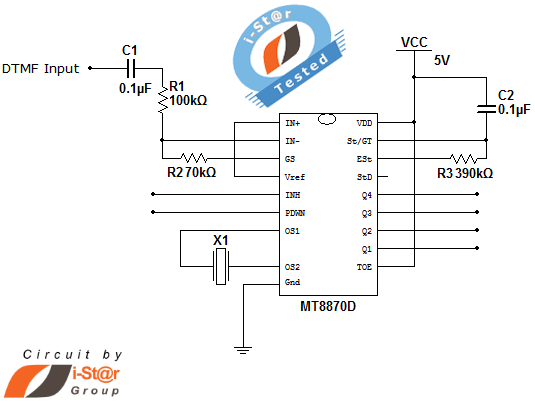
But, I think a DTMF (Dual Tone Multi-Frequency) board may produce your desired outcome.
DTMF (Dual Tone Multi Frequency) decoder Circuit schematic using M8870
I am not familiar with any device that would use a current to make a wire vibrate at a given frequency to power an LED.
But, I think a DTMF (Dual Tone Multi-Frequency) board may produce your desired outcome.
DTMF (Dual Tone Multi Frequency) decoder Circuit schematic using M8870


**
Can wires (at the right length) mechanically vibrate at specific electrical frequencies, or not? That's really my principal question.
**
Can wires (at the right length) mechanically vibrate at specific electrical frequencies, or not? That's really my principal question.
**
edit on 23-3-2013 by swan001 because: (no reason given)
reply to post by beezzer
Hm, only resistors. It's easy to build a resistor. Thanks, it might help - I need to check them out first.
EDIT: Hm, they're not frequency indicators, they are voltage indicators.
Well, at least you provided me with an easy voltage indicators schematics in case I need one.
Hm, only resistors. It's easy to build a resistor. Thanks, it might help - I need to check them out first.
EDIT: Hm, they're not frequency indicators, they are voltage indicators.
Well, at least you provided me with an easy voltage indicators schematics in case I need one.
edit on 23-3-2013 by swan001 because: (no
reason given)
Originally posted by swan001
**
Can wires (at the right length) mechanically vibrate at specific electrical frequencies, or not? That's really my principal question.
**edit on 23-3-2013 by swan001 because: (no reason given)
I'd say no. Not in any way you could accurately measure. The reason?
Copper is a good conductor of electricity at any frequency. There is not the resistance in the copper to generate mechanical movement from the frequency generated.
reply to post by swan001
I agree with beezzer,...But!
You may be able to get similar results with something that oscillates at different frequencies.
Like a tattoo gun, I think it might be doable to rig up something that will cause LEDs to light up when the tattoo gun reaches predetermined speeds or frequencies.
Not sure if that would still suit your needs though.
I agree with beezzer,...But!
You may be able to get similar results with something that oscillates at different frequencies.
Like a tattoo gun, I think it might be doable to rig up something that will cause LEDs to light up when the tattoo gun reaches predetermined speeds or frequencies.
Not sure if that would still suit your needs though.
edit on 23-3-2013 by watchitburn because: (no reason given)
I have a few pointers, being well seasoned in Analog circuitry and Learning the Digital Realm currently.
Easiest, cheapest way to figure out the resonant Frequency of a circuit, Wire, Antenna or other Component is with a DIP Meter. Dial the Meter in until it drops out,That's your resonant Frequency. There are other ways of achieving this, but not without using High Dollar Test equipment that will be unavailable to you.
When i read your post i was thinking you were talking RF Resonance, but when i re-read it i caught on to what you were talking about.
As far as i know with my knowledge of Electronics and physics, it would require a high current and high load over a length of wire to get it to move. ie, Jumper cables while jumping a large Diesel for instance. The High Load and Current draw sometimes will make cables move. But this would be unattainable if your case, reason being the length and obviously the gauge of wire and Power supply required.
Hope I could help.
Easiest, cheapest way to figure out the resonant Frequency of a circuit, Wire, Antenna or other Component is with a DIP Meter. Dial the Meter in until it drops out,That's your resonant Frequency. There are other ways of achieving this, but not without using High Dollar Test equipment that will be unavailable to you.
When i read your post i was thinking you were talking RF Resonance, but when i re-read it i caught on to what you were talking about.
As far as i know with my knowledge of Electronics and physics, it would require a high current and high load over a length of wire to get it to move. ie, Jumper cables while jumping a large Diesel for instance. The High Load and Current draw sometimes will make cables move. But this would be unattainable if your case, reason being the length and obviously the gauge of wire and Power supply required.
Hope I could help.
This might not help at all but I've coded a software guitar tuner for a university project a number of years ago (i.e you played the guitar into a
microphone connected to a PC and it would tell you the note and if it was sharp or flat) and it involves quite a bit of mathematical processing of the
signal using Fourier transforms
The signal from a guitar string contains a lot of sub harmonics that have to be separated out
The signal from a guitar string contains a lot of sub harmonics that have to be separated out
edit on 23/3/13 by davespanners because: (no reason given)
edit on 23/3/13 by davespanners because: (no reason given)
reply to post by swan001
I don't know if this would help or not, but you may want to consider investigating...
A current carrying wire will have a force exerted on it in the presence of a magnetic field. The current in the wire generates a magnetic field around the wire, so placing a fixed magnet will produce the same effect as putting 2 magnets together (when magnets repel each other for instance).
If you could somehow have a fixed magnet along your strings then as you put current in the wire there will be a force exerted on it. If you apply the current periodically the string will "vibrate".
Wiki on Magnetic Force
I don't know if this would help or not, but you may want to consider investigating...
A current carrying wire will have a force exerted on it in the presence of a magnetic field. The current in the wire generates a magnetic field around the wire, so placing a fixed magnet will produce the same effect as putting 2 magnets together (when magnets repel each other for instance).
If you could somehow have a fixed magnet along your strings then as you put current in the wire there will be a force exerted on it. If you apply the current periodically the string will "vibrate".
Wiki on Magnetic Force
edit on 3/23/2013 by xenthuin because: Missed a word
reply to post by xenthuin
Yeah... That could work! Especially if I twist the wire into a coil, like they do inside a loudspeaker. Great idea, mate!
But this wire would start vibrating at any frequencies, right? I'd need a way to discriminate the frequency. Do you reckon the wire length itself could do that?
Yeah... That could work! Especially if I twist the wire into a coil, like they do inside a loudspeaker. Great idea, mate!
But this wire would start vibrating at any frequencies, right? I'd need a way to discriminate the frequency. Do you reckon the wire length itself could do that?
reply to post by davespanners
Whew, there's alot of maths in that link! I'm really bad in maths. Great link nevertheless... Fourier is inevitable once one tries to study frequencies.
Whew, there's alot of maths in that link! I'm really bad in maths. Great link nevertheless... Fourier is inevitable once one tries to study frequencies.
Originally posted by watchitburn
Like a tattoo gun, I think it might be doable to rig up something that will cause LEDs to light up when the tattoo gun reaches predetermined speeds or frequencies.
Hm, and how does that works, in tattoo guns?
Originally posted by Pegasus2000
As far as i know with my knowledge of Electronics and physics, it would require a high current and high load over a length of wire to get it to move. ie, Jumper cables while jumping a large Diesel for instance. The High Load and Current draw sometimes will make cables move. But this would be unattainable if your case, reason being the length and obviously the gauge of wire and Power supply required.
Hm, no I'm thinking about only a dozen of volts. Maybe 9, maybe 21.
reply to post by swan001
Don't let me dissuade you, but I think a straight conductor would be easier to deal with than a coil. In a coil I think you'd have to have the magnetic field of the permanent magnetic oriented down the length of the wire and you would need to have it skewed to one side of the string or another. It would have to be down the length of the coil to provide a force perpendicular to the length if the string (like when you pluck a string). It would have to be skewed to one side of the string to prevent the cancellation of forces acting on the left and right side if the coil.
In a straight conductor, the fixed magnetic field can be applied perpendicularly to the wire (vertically) while the current goes down the length of the string. The force will then always be perpendicular to the length of the string. The higher the fixed magnetic field, the higher the current, the longer the length of the wire that sits in the magnetic field, and the more perpendicular the current flow is to the magentic field, the more force you'll get.
As for the frequency... Yes, the string would move at whatever the input current frequency is. If you want to measure the natural frequency of the string, you could inject just a single current pulse and let the string ring. Basically, just simulate a pluck.
I know it's not quite what you're after, but hopefully it's still helpful!
Don't let me dissuade you, but I think a straight conductor would be easier to deal with than a coil. In a coil I think you'd have to have the magnetic field of the permanent magnetic oriented down the length of the wire and you would need to have it skewed to one side of the string or another. It would have to be down the length of the coil to provide a force perpendicular to the length if the string (like when you pluck a string). It would have to be skewed to one side of the string to prevent the cancellation of forces acting on the left and right side if the coil.
In a straight conductor, the fixed magnetic field can be applied perpendicularly to the wire (vertically) while the current goes down the length of the string. The force will then always be perpendicular to the length of the string. The higher the fixed magnetic field, the higher the current, the longer the length of the wire that sits in the magnetic field, and the more perpendicular the current flow is to the magentic field, the more force you'll get.
As for the frequency... Yes, the string would move at whatever the input current frequency is. If you want to measure the natural frequency of the string, you could inject just a single current pulse and let the string ring. Basically, just simulate a pluck.
I know it's not quite what you're after, but hopefully it's still helpful!
new topics
-
James O’Keefe: I have evidence that exposes the CIA, and it’s on camera.
Whistle Blowers and Leaked Documents: 11 minutes ago -
Australian PM says the quiet part out loud - "free speech is a threat to democratic dicourse"...?!
New World Order: 56 minutes ago -
Ireland VS Globalists
Social Issues and Civil Unrest: 1 hours ago -
Biden "Happy To Debate Trump"
Mainstream News: 1 hours ago -
RAAF airbase in Roswell, New Mexico is on fire
Aliens and UFOs: 2 hours ago -
What is the white pill?
Philosophy and Metaphysics: 3 hours ago -
Mike Pinder The Moody Blues R.I.P.
Music: 4 hours ago -
Putin, Russia and the Great Architects of the Universe
ATS Skunk Works: 7 hours ago -
A Warning to America: 25 Ways the US is Being Destroyed
New World Order: 11 hours ago
top topics
-
President BIDEN's FBI Raided Donald Trump's Florida Home for OBAMA-NORTH KOREA Documents.
Political Conspiracies: 17 hours ago, 35 flags -
A Warning to America: 25 Ways the US is Being Destroyed
New World Order: 11 hours ago, 20 flags -
Mike Pinder The Moody Blues R.I.P.
Music: 4 hours ago, 7 flags -
What is the white pill?
Philosophy and Metaphysics: 3 hours ago, 5 flags -
Biden "Happy To Debate Trump"
Mainstream News: 1 hours ago, 5 flags -
Australian PM says the quiet part out loud - "free speech is a threat to democratic dicourse"...?!
New World Order: 56 minutes ago, 4 flags -
RAAF airbase in Roswell, New Mexico is on fire
Aliens and UFOs: 2 hours ago, 4 flags -
Putin, Russia and the Great Architects of the Universe
ATS Skunk Works: 7 hours ago, 3 flags -
Ireland VS Globalists
Social Issues and Civil Unrest: 1 hours ago, 2 flags -
James O’Keefe: I have evidence that exposes the CIA, and it’s on camera.
Whistle Blowers and Leaked Documents: 11 minutes ago, 1 flags
active topics
-
Gaza Terrorists Attack US Humanitarian Pier During Construction
Middle East Issues • 82 • : YourFaceAgain -
Biden "Happy To Debate Trump"
Mainstream News • 30 • : Lazy88 -
James O’Keefe: I have evidence that exposes the CIA, and it’s on camera.
Whistle Blowers and Leaked Documents • 1 • : CriticalStinker -
Hate makes for strange bedfellows
US Political Madness • 52 • : YourFaceAgain -
-@TH3WH17ERABB17- -Q- ---TIME TO SHOW THE WORLD--- -Part- --44--
Dissecting Disinformation • 697 • : Thoughtful3 -
So this is what Hamas considers 'freedom fighting' ...
War On Terrorism • 265 • : YourFaceAgain -
University of Texas Instantly Shuts Down Anti Israel Protests
Education and Media • 284 • : cherokeetroy -
Supreme Court Oral Arguments 4.25.2024 - Are PRESIDENTS IMMUNE From Later Being Prosecuted.
Above Politics • 96 • : xuenchen -
Ireland VS Globalists
Social Issues and Civil Unrest • 6 • : TimBurr -
President BIDEN's FBI Raided Donald Trump's Florida Home for OBAMA-NORTH KOREA Documents.
Political Conspiracies • 32 • : network dude
0