It looks like you're using an Ad Blocker.
Please white-list or disable AboveTopSecret.com in your ad-blocking tool.
Thank you.
Some features of ATS will be disabled while you continue to use an ad-blocker.

Crete UFO Image Captured - What Is It?
page: 1share:
Crete UFO Image
We were contacted via email a few weeks ago by a photographer in Germany who was recently in Greece on holiday. While that does sound pretty mundane, the image file she attached to her email was anything but, at least to my "not professionally trained in digital imaging" eyes, it was the best "UFO" image I've had emailed to me in years.
As I'm sure you can imagine, we get lots of UFO images sent to us here at AboveTopSecret.com via email. I always give those a bit more credence because the person sending them is obviously not trying to get massive attention for their image like they would if they simply posted it here in the ATS "Aliens and UFOs" Forum for the world to see.That typically means we're not dealing with a hoaxer looking to crank up awareness in the hope of a payday.
That said, these images usually end up being fairly obvious birds, bugs, planes, etc.. upon basic examination by our crew, that, or, they're lonely lights in a dark sky that could be anything.
Not this one.
When I first looked at it I was intrigued by it's strange "VW Beetle Spaceship" appearance and couldn't easily say what it was. After several email exchanges with photographer, I felt like this was not someone trying to hoax us, as a matter of fact she has been totally forthright and cooperative as you'll see in the ensuing posts that contain the analysis of the image.
We decided to send it to Jeff Ritzmann for further analysis and expert's opinion on what it might be, and possibly more importantly, what he believes it is not.
That's all we can do with images, ask the professionals in the field of digital imagery to give us their best opinion. If they can't say with confidence what it then is we bring to you, the AboveTopSecret.com membership. One of you may have seen something they/we missed, you may have seen or photographed something similar, and, best of all, we get your theories as to what it may be.
What follows is Jeff's report, it his professional opinion of what the object is not. He plainly states that he can't say what the object is, and he doesn't try to fill in the blanks with conjecture, he offers a theory as to why he thinks these objects appear in some photographs but that's about it.
Finally, I can tell you that I had a friend who is pretty high up in the law enforcement computer forensics field State Bureau of Investigations level) run the "UFO" shot through a very specialized piece of software not available to the public. This software determines, to the level accepted in a court of law for a criminal trial, whether an image has been tampered with, this one has not, according to that software.
So, please read Jeff's exhaustive analysis and let us know what you think of this image, this is what the AboveTopSecret "Aliens and UFOs" Forum is all about.
To get you started, here's the report of the circumstances surrounding the shot straight from the photographer:
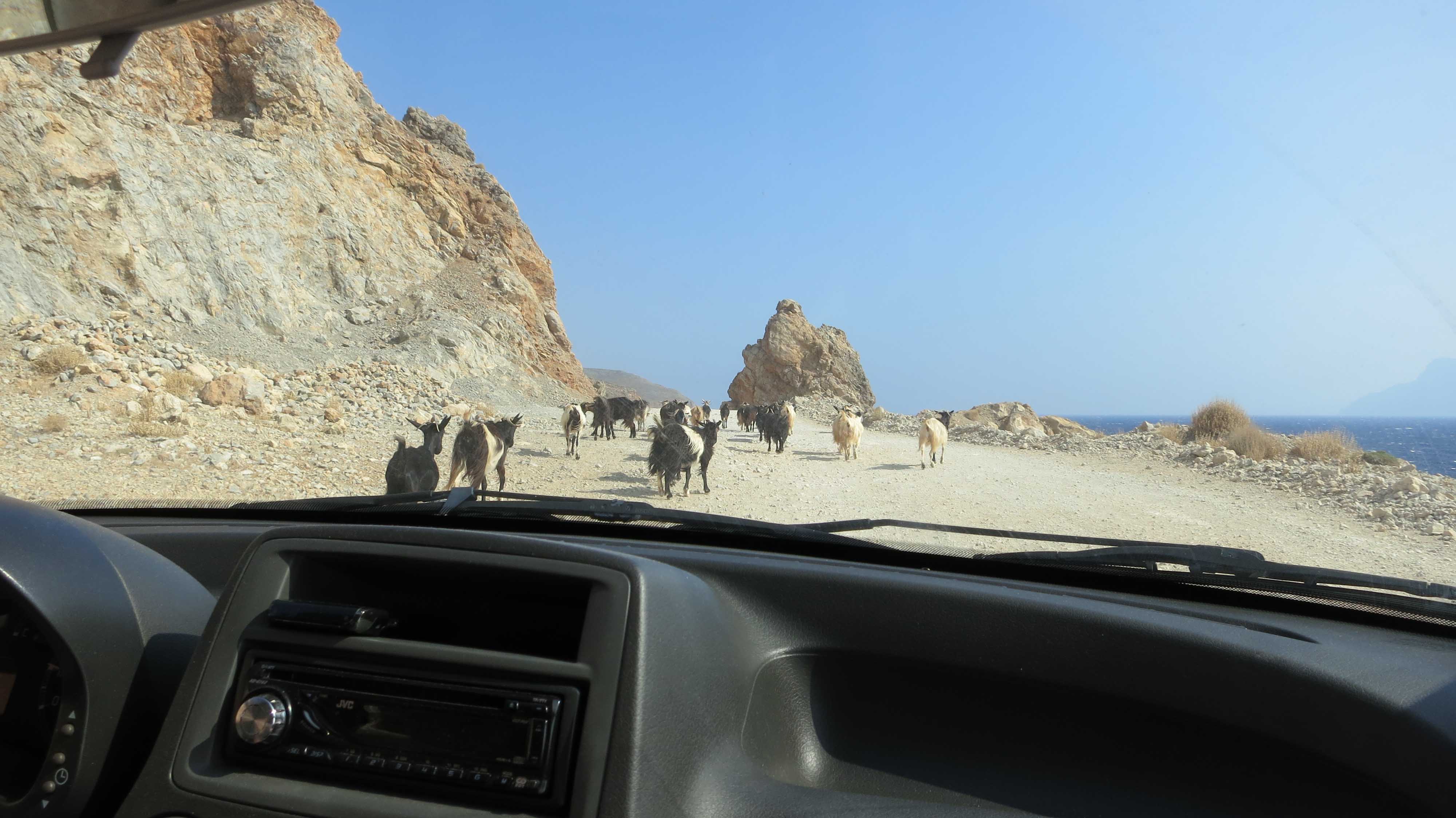
"On August 19 of this year (2012) my husband and I were driving towards a very beautiful beach called Balos beach, Gramvousa in Crete where we were on a holiday break. We were driving on a long dirt road to get to the beach and because of all the holes and humps in the road we're driving really slow. At some point during this half hour drive a hurt of goats were on the road, sort of walking with us so I started taking pictures of the situation. I took some shots leaning out of my opened window and shot the pictures with my reflection in the mirror, the goats walking with us and the spectacular view. At some point I got out of the car and took some more shots.
One and a half hour later, when we finally arrived on the beach after a long climb down hill it was very, very windy, almost stormy so we decided to hide in one of the beach-cafeteria's and we scrolled through the shots on our camera to see what I photographed. This is when we first noticed there was something in the sky on just one of the shots I took. We zoomed in on our camera screen and could not believe what we saw, such a strange shape. We immediately started discussing possibilities to define what it could be, but had no idea.
We didn't notice anything was in the sky when I took the shot. We didn't experience anything strange. It was a warm, sunny day, but there was a strong wind out of the Northeast. There was no sound."
ENJOY!
Springer...
I finally had the time to find this thread after I heard about Jeff Ritzmann's passing a couple weeks ago... I "bumped" it in his honor and in deep gratitude for all he did for so many people searching for the truth.
edit on 4-17-2021 by Springer because: (no reason given)
Jeff Ritzmann's Report pg.1:
Synopsis:
Submitted to me (Jeff Ritzmann) by Mark Allin of www.abovetopsecret.com on August 29th at 4:37pmET, via email. I was sent low resolution photos of the Unidentified Object (UO) in question, in enlargements and cropped, and a low resolution shot of the entire frame in question "IMG_3137" from the camera of witness "SHOOTER".
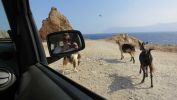
I asked for direct from camera shots, both of the UO shot and the previous and preceding photos. "SHOOTER" was completely open and forthcoming with the full gambit of her camera's files, and never once delayed nor made excuses for not providing every requirement I asked for. Mark Allin put me in direct contact with "SHOOTER" through email on August 31st at 5pmET.
"SHOOTER" related that she was on a vacation trip with her husband, and they were driving in a remote area of Greece. While slowing down to photograph some goats, in one photo only out of multiples, she captured a single image of an unknown object in the sky. "SHOOTER" did not see the object at the time of photographing the scene, and has related to me she noticed nothing whatsoever unusual during this time. The weather was quite windy, spotted with clouds, yet relatively clear, with a temperature of approximately 86 degrees. The object appears in no other photo, including the one preceding it which was taken 5 seconds earlier than the UO shot. The next frame shot after the UO photo was some minutes later and obviously at another vantage point from the "goat series".
See fig. EXIF_UO.jpg
which indicates that the image is un-tampered with by way of image editing programs. I see no obvious evidence that the
EXIF data has been altered.
Object and Characteristics
The object at cursory glance with no processing appears to be a lopsided disc. A partially domed left side which quickly slopes convexly to the right, terminating in a relatively sharp point. Once the object is taken into a LAB color mode, (separating the image into a "lightness", and "A channel" and a "B channel") channel A was run through an auto levels filter in Photoshop CS3. This greatly sharpens contrast and gives the viewer deeper information into the makeup of the photo through channel specific data.
See: fig. LAB.jpg

which shows the object cropped with these procedures executed. Of note is that the UO is not lopsided, but is comprised of an even dome top. Overlaying a symmetrical arc on the object shows the object does indeed have symmetry.
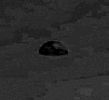 (fig. LAB_arc.jpg)
Also of note is the underside "edge" of the domed object, which appears to have a definitive edge and a seemingly flat or convex underside (with some sort of structural protuberances which will be addressed later in this report)
Overall, the object does exhibit atmospheric haze one would expect to see in a solid object of some distance away - note the existing weather and atmospheric effects in the rest of the photo. The UO appears for all intent and purposes to this examiner as highly reflective, and "chrome-like", as it appears to be reflecting it's surrounding environment. However, the darkest areas are effected by atmospheric haze which soften this "chromic" effect. While the reflective quality seems quite prominent, it would be even more so without the hazing environmental effects of distance.
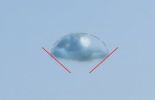 Fig UO1.jpg
Shows the common symmetry of the UO itself. Each outer edge shows a flat area, angled on each side. Each side's angle holds symmetry with it's opposite edge. In other words, the angular elements are mirror images of each other. I cannot ascribe this to coincidence or "happy accident", and it does seem to be structure rather than some asperous random blob. The "dome" top also shows symmetry and evenness equal to it's angular counterparts on the outer left and right edges.
The angle of reflection and highlight on the UO match sun location at the time of shooting. This is not only evidenced by the light and shadow of stationary objects, but in this case it's extremely helpful to have shadows cast by goats in the foreground. The object shows all the appropriate hallmarks of an object reflecting light off a domed surface in the correct places. It also exhibits the correct shadows and lowlight reflections for an object of high reflectivity.
Without the ability to travel to the location and do specific measurements of stationary objects to compare with focal lengths and other triangulation points, I cannot determine the distance of the object. However, it's level of atmospheric haze indicates to me it is of some distance away and of substantial size (perhaps even the legendary 40ft diameter is not out of the question).
Continued:
Synopsis:
Submitted to me (Jeff Ritzmann) by Mark Allin of www.abovetopsecret.com on August 29th at 4:37pmET, via email. I was sent low resolution photos of the Unidentified Object (UO) in question, in enlargements and cropped, and a low resolution shot of the entire frame in question "IMG_3137" from the camera of witness "SHOOTER".
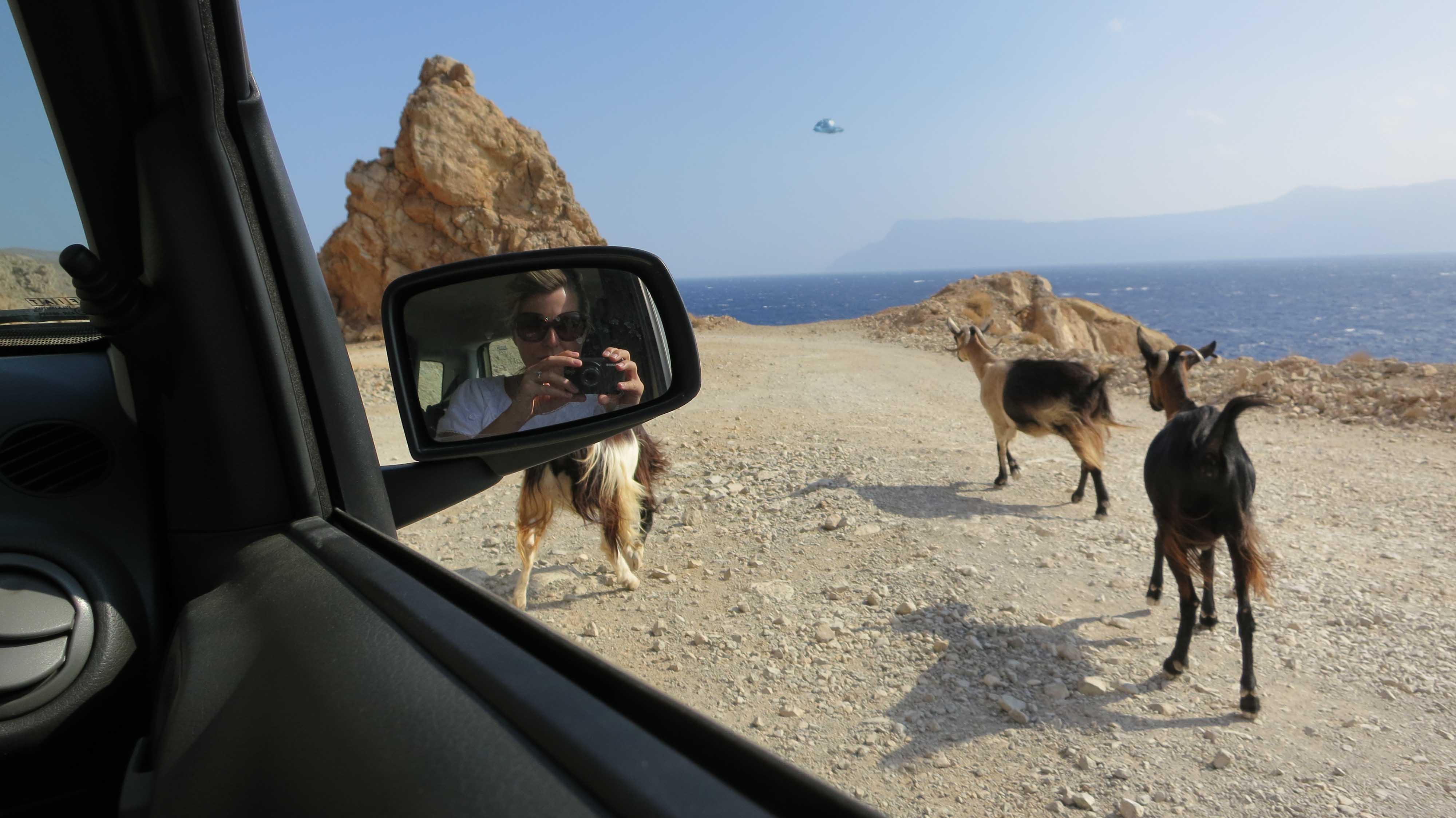
I asked for direct from camera shots, both of the UO shot and the previous and preceding photos. "SHOOTER" was completely open and forthcoming with the full gambit of her camera's files, and never once delayed nor made excuses for not providing every requirement I asked for. Mark Allin put me in direct contact with "SHOOTER" through email on August 31st at 5pmET.
"SHOOTER" related that she was on a vacation trip with her husband, and they were driving in a remote area of Greece. While slowing down to photograph some goats, in one photo only out of multiples, she captured a single image of an unknown object in the sky. "SHOOTER" did not see the object at the time of photographing the scene, and has related to me she noticed nothing whatsoever unusual during this time. The weather was quite windy, spotted with clouds, yet relatively clear, with a temperature of approximately 86 degrees. The object appears in no other photo, including the one preceding it which was taken 5 seconds earlier than the UO shot. The next frame shot after the UO photo was some minutes later and obviously at another vantage point from the "goat series".
See fig. EXIF_UO.jpg
which indicates that the image is un-tampered with by way of image editing programs. I see no obvious evidence that the
EXIF data has been altered. Object and Characteristics
The object at cursory glance with no processing appears to be a lopsided disc. A partially domed left side which quickly slopes convexly to the right, terminating in a relatively sharp point. Once the object is taken into a LAB color mode, (separating the image into a "lightness", and "A channel" and a "B channel") channel A was run through an auto levels filter in Photoshop CS3. This greatly sharpens contrast and gives the viewer deeper information into the makeup of the photo through channel specific data.
See: fig. LAB.jpg
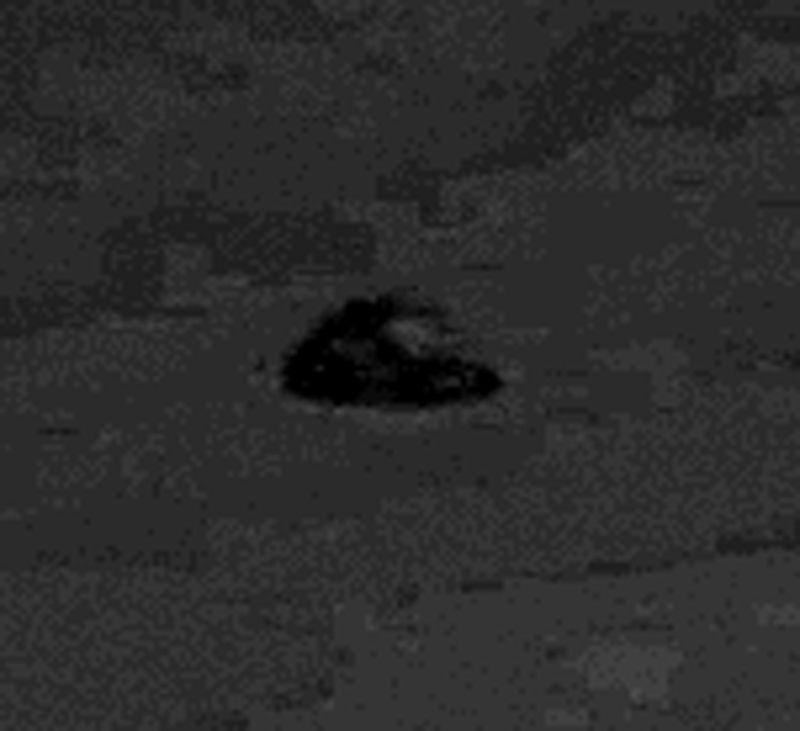
which shows the object cropped with these procedures executed. Of note is that the UO is not lopsided, but is comprised of an even dome top. Overlaying a symmetrical arc on the object shows the object does indeed have symmetry.
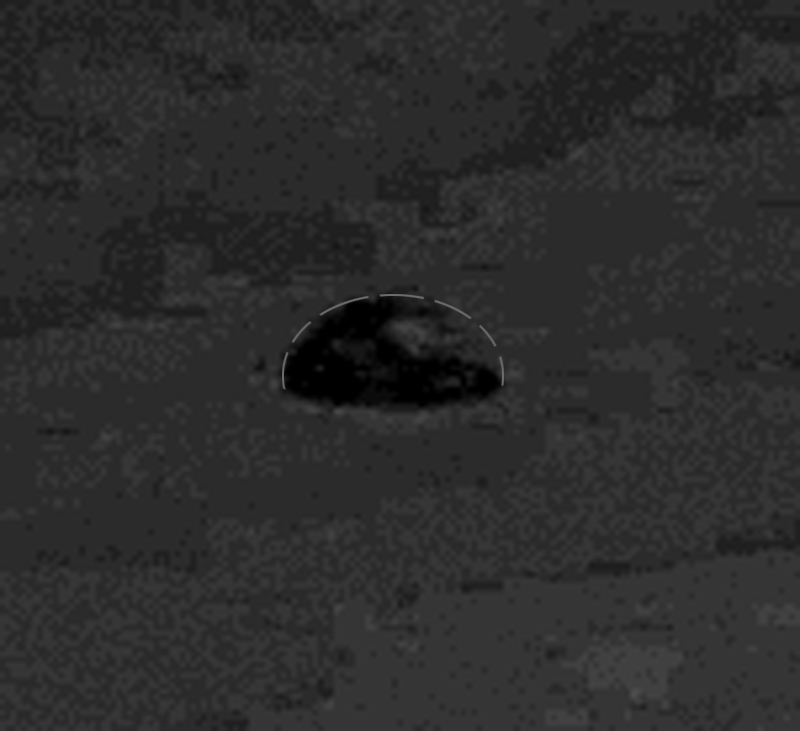 (fig. LAB_arc.jpg)
 Also of note is the underside "edge" of the domed object, which appears to have a definitive edge and a seemingly flat or convex underside (with some sort of structural protuberances which will be addressed later in this report)
Overall, the object does exhibit atmospheric haze one would expect to see in a solid object of some distance away - note the existing weather and atmospheric effects in the rest of the photo. The UO appears for all intent and purposes to this examiner as highly reflective, and "chrome-like", as it appears to be reflecting it's surrounding environment. However, the darkest areas are effected by atmospheric haze which soften this "chromic" effect. While the reflective quality seems quite prominent, it would be even more so without the hazing environmental effects of distance.
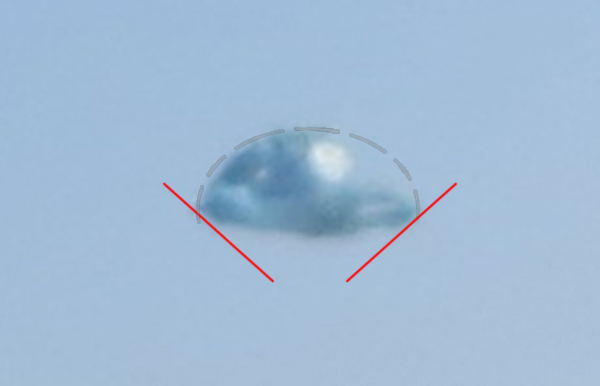 Fig UO1.jpg
 Shows the common symmetry of the UO itself. Each outer edge shows a flat area, angled on each side. Each side's angle holds symmetry with it's opposite edge. In other words, the angular elements are mirror images of each other. I cannot ascribe this to coincidence or "happy accident", and it does seem to be structure rather than some asperous random blob. The "dome" top also shows symmetry and evenness equal to it's angular counterparts on the outer left and right edges.
The angle of reflection and highlight on the UO match sun location at the time of shooting. This is not only evidenced by the light and shadow of stationary objects, but in this case it's extremely helpful to have shadows cast by goats in the foreground. The object shows all the appropriate hallmarks of an object reflecting light off a domed surface in the correct places. It also exhibits the correct shadows and lowlight reflections for an object of high reflectivity.
Without the ability to travel to the location and do specific measurements of stationary objects to compare with focal lengths and other triangulation points, I cannot determine the distance of the object. However, it's level of atmospheric haze indicates to me it is of some distance away and of substantial size (perhaps even the legendary 40ft diameter is not out of the question).
Continued:
Jeff Ritzmann's Report pg.2
The 2 darker distinct reflections on the left side dome indicate that we are possibly seeing reflections of the 2 small rock formations seen in the UO photo "IMG3137"
and "IMG3134"
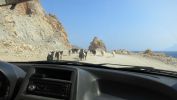 .
.
I again cannot confirm this with certainty, but it is a plausible assumption based on the environment and reflective quality of the object in question.
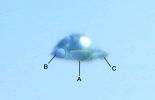
There do appear to be protuberances on the UO (fig. UO_pts.jpg)
 .
.
One is slightly right of center on the underside of the object and rather dark compared to the rest of the UO, labeled "A" in the UO dissection image (fig UO_pts.jpg)
.
This protuberance appears to be tucked into the underside of the UO possibly indicating a concave underside. It is among the darkest areas of the isolated UO image. "B" is seen at the left edge of the UO towards the bottom "lip" of the bottom edge. This appears to be outside the underside, and spherical in shape. It is relaying it's own reflections, including sun and shadow irrespective of the main structure of the UO. (I should make note that many UFO reports have detailed spherical objects of high reflectivity, which surround a larger object and then negate it's visibility - almost acting as "cloaking agents" of some sort, although this is only conjecture by anyone's standard - as we have no idea of the purpose, only the observed effects. I cannot say with any certainty that this spherical object is a separate UO off of our main object in question, as the quality is simply not giving enough information in that respect). "C" is far more elusive and the hardest protuberance to see as it exists as a stretched spheroid version of protuberance "B". It too seems to have it's own set of reflective marks of sun and shadow. I again, cannot determine if these are separate objects from the main UO in question. Readers can make their own assumptions as to what they are, I only account that there are indeed protuberances off the main body that have definitive shape and form / light and shadow of their own.
Photo Composition
The composition of the shot does appear to be a candid shot one would expect leaning slightly from a seated position in an automotive vehicle, window rolled down, and photographing scenery.
Of note here more than the composition, are the horizon lines in comparison to the UO's structure points (which we detailed in the "Object and Characteristics" portion of this report), and the camera's own visible orientation. We are in an extremely valuable position with this photo in my opinion: we can clearly see the shooter, and her camera in the UO photograph. For me, I have not in 26 years of examining UFO visual data come across such a perfect situation in this respect, and it has afforded me some very interesting data in this case.
Referring back to Fig UO1.jpg,
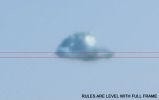
we again note the angles of symmetry present in the UO's sides. Looking exclusively at the UO and not the rest of the photo, the question became are these angles aligned in any special way. If we refer to the top of the left side angle, to the top of the right side angle - they are perfectly level with the frame of the photo itself. These consistencies, are best viewed in Fig. lvl_UO.jpg
 ,
,
whereby rules are implemented in Photoshop CS3 from the top ruler area. These lines are in perfect alignment with the edges of the photo itself. They are 100% level with the photo frame. So, as you might see, is our UO's features.
However, marking he UO's level nature against the actual horizon, shows that the camera was tilted, and therefore there is an "unlevel" horizon. This is not unusual for any photo, as the camera is of course reliant on the user to level the picture. We have a level in the photo UO with an unlevel horizon. In this case we are afforded the unique opportunity of having the camera shooting the photo, in the photo itself. Not surprisingly, the camera shows absolute level in the photo (it's shooting the picture so it would have to be so). see Fig lvl_all.jpg
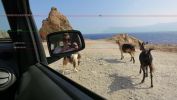
The UO is on par with the level of the camera, but not the horizon of the earth.
Highlights and Dismissed Possible Explanations
The opportunity to examine UFO photos is often one this examiner does not often relish. It is often intellectually insulting, as most are demonstrable fakes and hoaxes perpetrated for reasons known only to the hoaxer themselves. In my 26 years of applying my trained skill set of digital and analog imaging to the UFO field's visual data - I have found very few compelling photos. I find this to be one of the most interesting - I have not only been asked by Mr. Allin to examine for abovetopsecret.com - but one of the more confounding photos of my UFO field involvement.
Continued:
The 2 darker distinct reflections on the left side dome indicate that we are possibly seeing reflections of the 2 small rock formations seen in the UO photo "IMG3137"
and "IMG3134"
 .
. I again cannot confirm this with certainty, but it is a plausible assumption based on the environment and reflective quality of the object in question.
There do appear to be protuberances on the UO (fig. UO_pts.jpg)
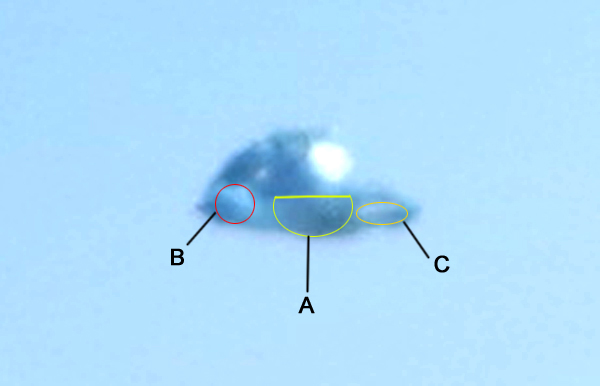 .
. One is slightly right of center on the underside of the object and rather dark compared to the rest of the UO, labeled "A" in the UO dissection image (fig UO_pts.jpg)
. This protuberance appears to be tucked into the underside of the UO possibly indicating a concave underside. It is among the darkest areas of the isolated UO image. "B" is seen at the left edge of the UO towards the bottom "lip" of the bottom edge. This appears to be outside the underside, and spherical in shape. It is relaying it's own reflections, including sun and shadow irrespective of the main structure of the UO. (I should make note that many UFO reports have detailed spherical objects of high reflectivity, which surround a larger object and then negate it's visibility - almost acting as "cloaking agents" of some sort, although this is only conjecture by anyone's standard - as we have no idea of the purpose, only the observed effects. I cannot say with any certainty that this spherical object is a separate UO off of our main object in question, as the quality is simply not giving enough information in that respect). "C" is far more elusive and the hardest protuberance to see as it exists as a stretched spheroid version of protuberance "B". It too seems to have it's own set of reflective marks of sun and shadow. I again, cannot determine if these are separate objects from the main UO in question. Readers can make their own assumptions as to what they are, I only account that there are indeed protuberances off the main body that have definitive shape and form / light and shadow of their own.
Photo Composition
The composition of the shot does appear to be a candid shot one would expect leaning slightly from a seated position in an automotive vehicle, window rolled down, and photographing scenery.
Of note here more than the composition, are the horizon lines in comparison to the UO's structure points (which we detailed in the "Object and Characteristics" portion of this report), and the camera's own visible orientation. We are in an extremely valuable position with this photo in my opinion: we can clearly see the shooter, and her camera in the UO photograph. For me, I have not in 26 years of examining UFO visual data come across such a perfect situation in this respect, and it has afforded me some very interesting data in this case.
Referring back to Fig UO1.jpg,
we again note the angles of symmetry present in the UO's sides. Looking exclusively at the UO and not the rest of the photo, the question became are these angles aligned in any special way. If we refer to the top of the left side angle, to the top of the right side angle - they are perfectly level with the frame of the photo itself. These consistencies, are best viewed in Fig. lvl_UO.jpg
 ,
, whereby rules are implemented in Photoshop CS3 from the top ruler area. These lines are in perfect alignment with the edges of the photo itself. They are 100% level with the photo frame. So, as you might see, is our UO's features.
However, marking he UO's level nature against the actual horizon, shows that the camera was tilted, and therefore there is an "unlevel" horizon. This is not unusual for any photo, as the camera is of course reliant on the user to level the picture. We have a level in the photo UO with an unlevel horizon. In this case we are afforded the unique opportunity of having the camera shooting the photo, in the photo itself. Not surprisingly, the camera shows absolute level in the photo (it's shooting the picture so it would have to be so). see Fig lvl_all.jpg
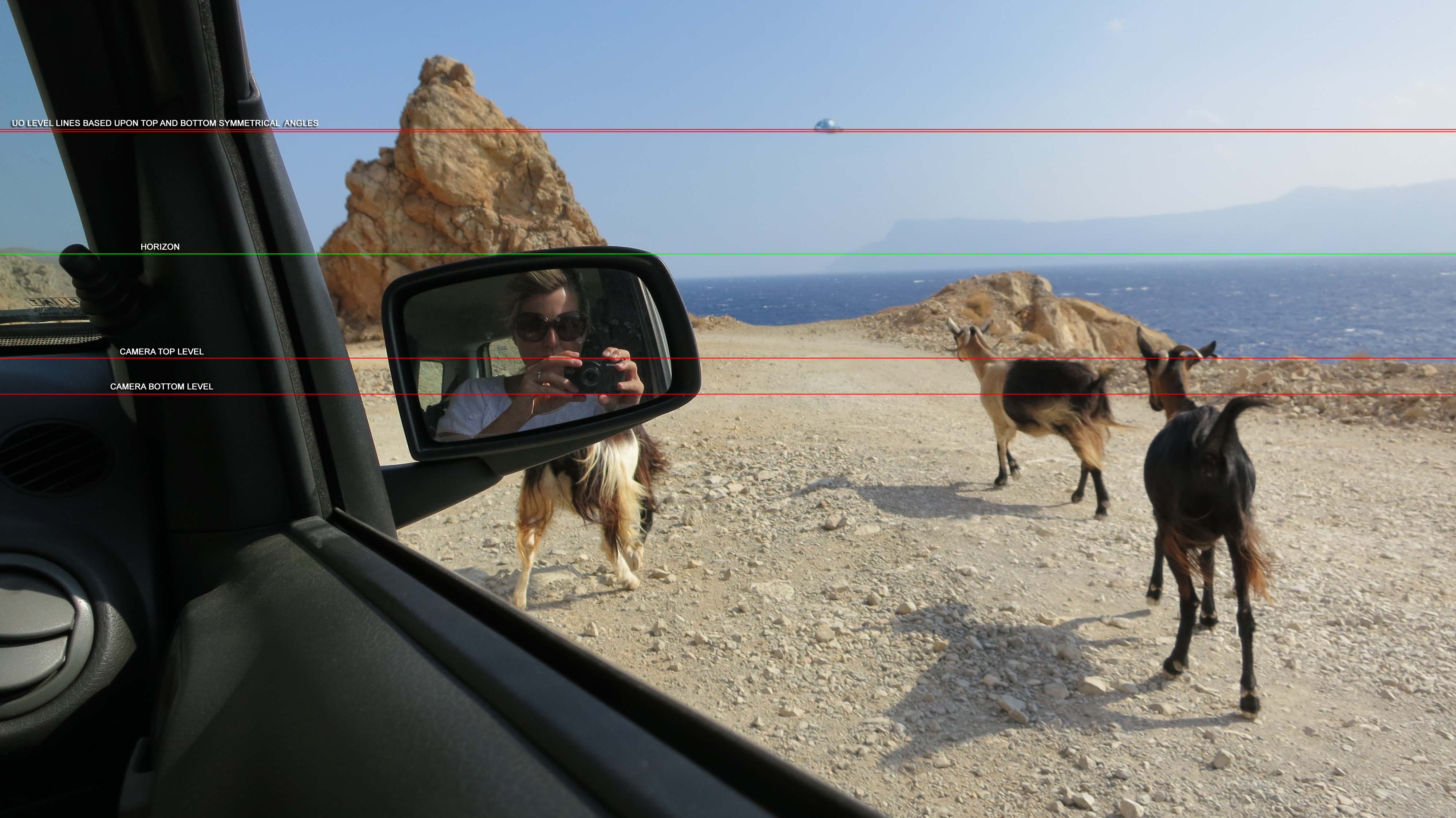
The UO is on par with the level of the camera, but not the horizon of the earth.
Highlights and Dismissed Possible Explanations
The opportunity to examine UFO photos is often one this examiner does not often relish. It is often intellectually insulting, as most are demonstrable fakes and hoaxes perpetrated for reasons known only to the hoaxer themselves. In my 26 years of applying my trained skill set of digital and analog imaging to the UFO field's visual data - I have found very few compelling photos. I find this to be one of the most interesting - I have not only been asked by Mr. Allin to examine for abovetopsecret.com - but one of the more confounding photos of my UFO field involvement.
Continued:
Jeff Ritzmann's Report pg.3
Some items I would like to highlight in examining this photo which are extremely interesting:
a) "SHOOTER" has been nothing but forthright and accommodating in providing every piece of data I requested. She has not made any suspicious excuses, nor has she concealed one very interesting aspect of her life: she is a professional, and very artistic photographer. Her work is shown in prominent upscale galleries and she seems to be very well seated in her long standing professional career. She has nothing to gain and everything to lose by presenting a UFO photo for public view. She made no hesitation to ask me how I could figure out that she had not "photoshopped" this UFO into the picture, nor that she was versed in computer image editing. She made the comment to me that she didn't think anyone would believe her based upon what she does for her livelihood. That an evidence provider would make such statements is not the hallmark of a hoaxer, but one of someone being extremely forthright in genuine curiosity about what she captured on media.
b) The photo exhibits:
-atmospheric distance haze consistent with the rest of the photo which indicates an object of some distance from the shooter
-channel specific data relating to the UO - one cannot overemphasize this point
-appropriate lighting, and shadows consistent with the rest of the photo
-accurate focus in relation to stationary objects
-clean and unfettered EXIF data, and files obtained directly from the camera
-correct pixelation across the image
c)The horizon is out of level with the UO and camera, which match. Ordinarily this is one of the evident issues with a photographic hoax. Rarely does the garden variety hoaxer take the time to make sure his objects are level with the photo's horizon orientation. Composition is not on his/her mind, composite quality is. However in this case we have data that shows the object is very likely not a composite photo, nor a typical hoax. Channel specific data as shown in this case, would be far too much to ascribe to an easy composite hoax, nor a 3d modeling re-render with UO elements added. It would also be near impossible to do effectively and have channel specific data as subtle and unseen as this. This is far and away past what someone would go through to fake a simple photo in my opinion.
Examples of assumed natural or misidentification explanations for the UO and reasons for dismissal:
1) Water or other debris on the lens / lens chip or fracture
- photo taken just seconds before shows no debris of any kind, nor do any of the subsequent photos after
-water droplet would not show correct alignment of the sun's highlight per a 3 dimensional external object
-object is in consistent focus w/ the rest of the shot
2) Camera defect
-No defects in any other photos, no evidence of aberrations in the image caused by bad write to chip or typical known glitch.
3) Physical object blowing in wind
-Object would have to be of extremely significant size
-Object displays symmetry, and structure not consistent with random blowing debris
-Witness relayed that this was an amazingly remote area, which involved lengthy drive on non-paved roads. Populace ratio to trash seems unlikely.
-absolutely no discernible movement blur whatsoever.
4) Weather Phenomena
-Object in photo is not attributable to any known weather anomaly.
5) Planetary body
-Daylight photo
6) Thrown object (hoax)
-Object again shows symmetry, and clarity which would be unlikely with a small thrown object
-Object displays distance hazing inconsistent with a small object in close proximity.
-Focus of object not consistent with small thrown object
7) Digital Composite (hoax)
-Object shows channel specific data not visible in the combined channel, or "normal" viewing mode. Such data is more visible in LAB color mode in the A channel with simple "auto level adjust" operation in photoshop.
-No evidence of composite edge, or poor alpha channel mask.
-Pixels of image seem consistent throughout.
8) Aviary Explanation
-Object does not resemble a bird in any way whatsoever
-While birds can appear to have highlights, they do not reflect the light per this object, nor have reflective properties
I cannot identify or explain the UO in the photo. Of importance to mention is that I am not familiar with every sort of high level and undoubtedly secretive aerial projects employed by any government, military, or private contractor and therefore cannot rule this out. I do find it unlikely, for the horizon alignment issue alone.
Continued:
Some items I would like to highlight in examining this photo which are extremely interesting:
a) "SHOOTER" has been nothing but forthright and accommodating in providing every piece of data I requested. She has not made any suspicious excuses, nor has she concealed one very interesting aspect of her life: she is a professional, and very artistic photographer. Her work is shown in prominent upscale galleries and she seems to be very well seated in her long standing professional career. She has nothing to gain and everything to lose by presenting a UFO photo for public view. She made no hesitation to ask me how I could figure out that she had not "photoshopped" this UFO into the picture, nor that she was versed in computer image editing. She made the comment to me that she didn't think anyone would believe her based upon what she does for her livelihood. That an evidence provider would make such statements is not the hallmark of a hoaxer, but one of someone being extremely forthright in genuine curiosity about what she captured on media.
b) The photo exhibits:
-atmospheric distance haze consistent with the rest of the photo which indicates an object of some distance from the shooter
-channel specific data relating to the UO - one cannot overemphasize this point
-appropriate lighting, and shadows consistent with the rest of the photo
-accurate focus in relation to stationary objects
-clean and unfettered EXIF data, and files obtained directly from the camera
-correct pixelation across the image
c)The horizon is out of level with the UO and camera, which match. Ordinarily this is one of the evident issues with a photographic hoax. Rarely does the garden variety hoaxer take the time to make sure his objects are level with the photo's horizon orientation. Composition is not on his/her mind, composite quality is. However in this case we have data that shows the object is very likely not a composite photo, nor a typical hoax. Channel specific data as shown in this case, would be far too much to ascribe to an easy composite hoax, nor a 3d modeling re-render with UO elements added. It would also be near impossible to do effectively and have channel specific data as subtle and unseen as this. This is far and away past what someone would go through to fake a simple photo in my opinion.
Examples of assumed natural or misidentification explanations for the UO and reasons for dismissal:
1) Water or other debris on the lens / lens chip or fracture
- photo taken just seconds before shows no debris of any kind, nor do any of the subsequent photos after
-water droplet would not show correct alignment of the sun's highlight per a 3 dimensional external object
-object is in consistent focus w/ the rest of the shot
2) Camera defect
-No defects in any other photos, no evidence of aberrations in the image caused by bad write to chip or typical known glitch.
3) Physical object blowing in wind
-Object would have to be of extremely significant size
-Object displays symmetry, and structure not consistent with random blowing debris
-Witness relayed that this was an amazingly remote area, which involved lengthy drive on non-paved roads. Populace ratio to trash seems unlikely.
-absolutely no discernible movement blur whatsoever.
4) Weather Phenomena
-Object in photo is not attributable to any known weather anomaly.
5) Planetary body
-Daylight photo
6) Thrown object (hoax)
-Object again shows symmetry, and clarity which would be unlikely with a small thrown object
-Object displays distance hazing inconsistent with a small object in close proximity.
-Focus of object not consistent with small thrown object
7) Digital Composite (hoax)
-Object shows channel specific data not visible in the combined channel, or "normal" viewing mode. Such data is more visible in LAB color mode in the A channel with simple "auto level adjust" operation in photoshop.
-No evidence of composite edge, or poor alpha channel mask.
-Pixels of image seem consistent throughout.
8) Aviary Explanation
-Object does not resemble a bird in any way whatsoever
-While birds can appear to have highlights, they do not reflect the light per this object, nor have reflective properties
I cannot identify or explain the UO in the photo. Of importance to mention is that I am not familiar with every sort of high level and undoubtedly secretive aerial projects employed by any government, military, or private contractor and therefore cannot rule this out. I do find it unlikely, for the horizon alignment issue alone.
Continued:
Jeff Ritzmann's Report pg.4
Final Thoughts and Conclusion
I have, to the best of my ability, tried to find the explanation of this photo as something other than an unknown object. Despite my efforts, it has withstood a battery of tests that ordinarily would expose a flaw, or provide an answer of some sort.
As mentioned, we are in a unique position here - contact with a willing shooter who is a professional photographer, willing to provide any and all datasets, and has been extremely forthright and honest despite some of my more unusual questions which are not the typical "form submission" of a UFO case.
I have, over the course of the past 2+ decades of involvement with this field, come across few if any photos that I feel demonstrate the aspects of this phenomena (that, unfortunately, many will not talk about) better than this single shot. I believe this photo to be of high import, and extremely valuable in perhaps redirecting or reforming the currently held notions of what the UFO phenomena represents - although this is asking for much to bear on a single photo. I have always held the notion that the true article can be banged on with a hammer and do just fine, while the plethora of fakes and hoaxes fall apart under scrutiny. I feel this photo represents the genuine article for many reasons, but the main focus here to be discussed is the horizon/camera alignment.
In short, the UO is in alignment with the camera, not the horizon. This object, in my opinion, has aligned itself to the witnesses camera. As many who have seriously studied the UFO phenomena will know, it often tends to "self negate" by casting doubt upon itself. I have called this the "paranormal escape hatch" - and it exists from the enigmatic ghost evidence to the UFO phenomena. Much of the UFO interested public is largely convinced of "nuts and bolts" craft originating in some extraterrestrial, highly exotic culture. A photo such as this, with it's tailored, and very personal self negating display, does not fit the extraterrestrial hypothesis (ETH) of a physical "craft". It seems to point to something much more strange, much more complex, and far more interesting. In no way do I remove the ETH as a possibility for some UFO sightings - it cannot be fully removed from the table. However, much of what we refer to in this field about UFOs does not fit that hypothesis nor data when closely examined.
I would call such a sighting as the one being examined here, a "manifestation" of what we'd expect a "flying saucer" to be. The shooter has related to me that she does consider the "alien" possibility, and it is fully within the realm of her paradigm. She has also referred to the photo in this manner: "Could this be my long desired UFO moment?" "SHOOTER" said she mentioned to her accompanying husband that the clouds in the area during the drive (and during this shot) looked like "spaceships". She has made mention also that she desired a paranormal experience, yet was afraid of one at the same time.
"SHOOTER" it should be mentioned, is not just any photographer - but a highly talented and well regarded artist using the medium of photography. It would be my assessment after looking into her career, that she is well known, successful, and is not - if I may be so bold to say - hurting in the financial venue of her life. She clearly, more so than nearly anyone else I have met as a witness - has nothing to gain by bringing forth a UFO photograph, real or faked. That she is an artist, is very compelling to me, as many experiencers of paranormal events are creative people.
I have examined "SHOOTER's" artwork, and although I cannot make any conclusions about her personal experiences - her art contains several interesting items and consistencies: large or misshapen heads, large or exotic eyes shot in ultra closeup, and many of her photos contain elements of what we in this study would call "alien" features. A quick perusal of her Facebook page shows she has or had an interest in owls - owls being something very closely associated in visitation cases. Is "SHOOTER" an experiencer of visitation? In discussion with her, I do not get the sense that she feels she has had any kind of experience whatsoever. I simply find her art, and fixation on owls interesting to mention here in the context of the phenomenon.
To get to the end of this report, including my current line of thought will require me to explain - not what paranormal events are - but what surrounds them. Mr. George Hansen has written an extraordinary book entitled "The Trickster and the Paranormal". In discussions with Mr. Hansen, he noted to me that what surrounds paranormal events is essentially "anti-structure" or liminal states.
Continued:
Final Thoughts and Conclusion
I have, to the best of my ability, tried to find the explanation of this photo as something other than an unknown object. Despite my efforts, it has withstood a battery of tests that ordinarily would expose a flaw, or provide an answer of some sort.
As mentioned, we are in a unique position here - contact with a willing shooter who is a professional photographer, willing to provide any and all datasets, and has been extremely forthright and honest despite some of my more unusual questions which are not the typical "form submission" of a UFO case.
I have, over the course of the past 2+ decades of involvement with this field, come across few if any photos that I feel demonstrate the aspects of this phenomena (that, unfortunately, many will not talk about) better than this single shot. I believe this photo to be of high import, and extremely valuable in perhaps redirecting or reforming the currently held notions of what the UFO phenomena represents - although this is asking for much to bear on a single photo. I have always held the notion that the true article can be banged on with a hammer and do just fine, while the plethora of fakes and hoaxes fall apart under scrutiny. I feel this photo represents the genuine article for many reasons, but the main focus here to be discussed is the horizon/camera alignment.
In short, the UO is in alignment with the camera, not the horizon. This object, in my opinion, has aligned itself to the witnesses camera. As many who have seriously studied the UFO phenomena will know, it often tends to "self negate" by casting doubt upon itself. I have called this the "paranormal escape hatch" - and it exists from the enigmatic ghost evidence to the UFO phenomena. Much of the UFO interested public is largely convinced of "nuts and bolts" craft originating in some extraterrestrial, highly exotic culture. A photo such as this, with it's tailored, and very personal self negating display, does not fit the extraterrestrial hypothesis (ETH) of a physical "craft". It seems to point to something much more strange, much more complex, and far more interesting. In no way do I remove the ETH as a possibility for some UFO sightings - it cannot be fully removed from the table. However, much of what we refer to in this field about UFOs does not fit that hypothesis nor data when closely examined.
I would call such a sighting as the one being examined here, a "manifestation" of what we'd expect a "flying saucer" to be. The shooter has related to me that she does consider the "alien" possibility, and it is fully within the realm of her paradigm. She has also referred to the photo in this manner: "Could this be my long desired UFO moment?" "SHOOTER" said she mentioned to her accompanying husband that the clouds in the area during the drive (and during this shot) looked like "spaceships". She has made mention also that she desired a paranormal experience, yet was afraid of one at the same time.
"SHOOTER" it should be mentioned, is not just any photographer - but a highly talented and well regarded artist using the medium of photography. It would be my assessment after looking into her career, that she is well known, successful, and is not - if I may be so bold to say - hurting in the financial venue of her life. She clearly, more so than nearly anyone else I have met as a witness - has nothing to gain by bringing forth a UFO photograph, real or faked. That she is an artist, is very compelling to me, as many experiencers of paranormal events are creative people.
I have examined "SHOOTER's" artwork, and although I cannot make any conclusions about her personal experiences - her art contains several interesting items and consistencies: large or misshapen heads, large or exotic eyes shot in ultra closeup, and many of her photos contain elements of what we in this study would call "alien" features. A quick perusal of her Facebook page shows she has or had an interest in owls - owls being something very closely associated in visitation cases. Is "SHOOTER" an experiencer of visitation? In discussion with her, I do not get the sense that she feels she has had any kind of experience whatsoever. I simply find her art, and fixation on owls interesting to mention here in the context of the phenomenon.
To get to the end of this report, including my current line of thought will require me to explain - not what paranormal events are - but what surrounds them. Mr. George Hansen has written an extraordinary book entitled "The Trickster and the Paranormal". In discussions with Mr. Hansen, he noted to me that what surrounds paranormal events is essentially "anti-structure" or liminal states.
Continued:
Jeff Ritzmann's Report pg.5
Anti-structure refers to:
-being out of normal routine
-in a strange place unfamiliar to you
-in the process of a great life change, i.e. divorce, breakup, moving residence, loss of loved one, etc.
-engaging in societal taboos, i.e. promiscuity, extra marital affairs, use of recreational drugs, occult practices, etc...
There are many others, but for the sake of brevity, let's table that aspect there.
Another common trait that surrounds paranormal events? Marginality, or marginal people. By marginal, we are not necessarily referring to someone's character, but how they could be perceived outwardly by society at large. "SHOOTER" is an artist - and although highly regarded, successful and immensely talented, artists are often considered "flakey", "weird" or apart from society. Speaking as a lifelong professional artist myself, artistic people tend to see life and surroundings in a different way then non-creatives. This immediately can put one at odds with common societal views.
As this aspect applies to this case? "SHOOTER" is an artist, versed also in digital media, who actually asked me at one point:
"how can you tell I did not make this UFO on my computer.....? I'm just very curious to know that, especially because I'm a computer artist. People told me no one would believe this shot because of my profession."
"SHOOTER" has inadvertently stumbled onto the marginal aspect of her own situation. That "no one would believe" her due in part to her profession, is part and parcel in my opinion to why she's gotten an amazing photo of an unknown object. Self negation. Escape hatch. In effect the phenomenon may be saying "Yes I'm here, but who do you think will believe you?" It should be noted that "SHOOTER" mentioned the computer generated notion before I ever did - and I have not come by any hoaxer who's ever been so bold as to ask such a question to the examiner looking at their visual evidence.
It should be noted that "SHOOTER" was on vacation, and therefore out of routine - an aspect of anti-structure. "SHOOTER" was also in an unfamiliar, remote, area. Another anti-structural element.
In my estimation, "SHOOTER" herself and her situation at the time of shooting, fits well into the profile of what surrounds a paranormal event. The UO also fits well into the self negation by aligning itself with her camera and not the environment (horizon).
So what did "SHOOTER" get in this photo? As George Hansen would say - this is not a productive question to ask. We simply do not know (despite what popular UFO mavens will sell the public) what the phenomenon represents. What do these anti-structural and marginal/liminal states imply in paranormal events? Again, I do not know. It is, however, one of the most compelling items in serious study of the paranormal. I encourage everyone to read Mr. Hansen's book "The Trickster and the Paranormal" for more information.
I am in no way compensated by Mr. Hansen for mentioning his book here. I have however found that Mr. Hansen is an astute researcher and highly intelligent investigator on these matters. Since putting anti-structural and marginality / liminal state questions into practice, both in past and current cases - I am yet to find a good case that doesn't fully support the contentions only glazed over here in these final paragraphs. These characteristics require further study and I must warn the reader there is no condensed explanation to understand fully the implications of such consistencies.
The notion of what surrounds paranormal events, its self negating behavior, and why it has been diluted and ignored in large part by the paranormal studies is a complex question on which a very thick book could be written.
In my opinion, the aspects within this case and accompanying photo will make it difficult for the "UFO field" to ignore or regulate to "outlier" data - the more complex, confounding and bizarre consistencies of data within the UFO question. Thus, I suspect some will be threatened by such data when it does not fit into their preconceived notions of what the phenomena represents, or what they have sold the public - and will likely be dismissed by UFO mavens, their "fans" and ETH enthusiasts alike.
In closing, we have a great witness willing to offer any and all data we asked for without delay. We have a confounding photo, which I have spent more hours on than I care to admit to. In the UFO study, to examine visual data is a doubled edged sword - these days the ability to fake visual evidence is reaching ever closer to our limits of detecting them.
Continued:
Anti-structure refers to:
-being out of normal routine
-in a strange place unfamiliar to you
-in the process of a great life change, i.e. divorce, breakup, moving residence, loss of loved one, etc.
-engaging in societal taboos, i.e. promiscuity, extra marital affairs, use of recreational drugs, occult practices, etc...
There are many others, but for the sake of brevity, let's table that aspect there.
Another common trait that surrounds paranormal events? Marginality, or marginal people. By marginal, we are not necessarily referring to someone's character, but how they could be perceived outwardly by society at large. "SHOOTER" is an artist - and although highly regarded, successful and immensely talented, artists are often considered "flakey", "weird" or apart from society. Speaking as a lifelong professional artist myself, artistic people tend to see life and surroundings in a different way then non-creatives. This immediately can put one at odds with common societal views.
As this aspect applies to this case? "SHOOTER" is an artist, versed also in digital media, who actually asked me at one point:
"how can you tell I did not make this UFO on my computer.....? I'm just very curious to know that, especially because I'm a computer artist. People told me no one would believe this shot because of my profession."
"SHOOTER" has inadvertently stumbled onto the marginal aspect of her own situation. That "no one would believe" her due in part to her profession, is part and parcel in my opinion to why she's gotten an amazing photo of an unknown object. Self negation. Escape hatch. In effect the phenomenon may be saying "Yes I'm here, but who do you think will believe you?" It should be noted that "SHOOTER" mentioned the computer generated notion before I ever did - and I have not come by any hoaxer who's ever been so bold as to ask such a question to the examiner looking at their visual evidence.
It should be noted that "SHOOTER" was on vacation, and therefore out of routine - an aspect of anti-structure. "SHOOTER" was also in an unfamiliar, remote, area. Another anti-structural element.
In my estimation, "SHOOTER" herself and her situation at the time of shooting, fits well into the profile of what surrounds a paranormal event. The UO also fits well into the self negation by aligning itself with her camera and not the environment (horizon).
So what did "SHOOTER" get in this photo? As George Hansen would say - this is not a productive question to ask. We simply do not know (despite what popular UFO mavens will sell the public) what the phenomenon represents. What do these anti-structural and marginal/liminal states imply in paranormal events? Again, I do not know. It is, however, one of the most compelling items in serious study of the paranormal. I encourage everyone to read Mr. Hansen's book "The Trickster and the Paranormal" for more information.
I am in no way compensated by Mr. Hansen for mentioning his book here. I have however found that Mr. Hansen is an astute researcher and highly intelligent investigator on these matters. Since putting anti-structural and marginality / liminal state questions into practice, both in past and current cases - I am yet to find a good case that doesn't fully support the contentions only glazed over here in these final paragraphs. These characteristics require further study and I must warn the reader there is no condensed explanation to understand fully the implications of such consistencies.
The notion of what surrounds paranormal events, its self negating behavior, and why it has been diluted and ignored in large part by the paranormal studies is a complex question on which a very thick book could be written.
In my opinion, the aspects within this case and accompanying photo will make it difficult for the "UFO field" to ignore or regulate to "outlier" data - the more complex, confounding and bizarre consistencies of data within the UFO question. Thus, I suspect some will be threatened by such data when it does not fit into their preconceived notions of what the phenomena represents, or what they have sold the public - and will likely be dismissed by UFO mavens, their "fans" and ETH enthusiasts alike.
In closing, we have a great witness willing to offer any and all data we asked for without delay. We have a confounding photo, which I have spent more hours on than I care to admit to. In the UFO study, to examine visual data is a doubled edged sword - these days the ability to fake visual evidence is reaching ever closer to our limits of detecting them.
Continued:
Jeff Ritzmann's Report pg.6
To engage a photo is to try and disprove it. Solve the photo, and there's no anomaly. You move on. If success in this area is to find the unknown, then your "success" is the utter failure to explain the unknown object in the sky. Your success, is the failure to explain. To that end, I fail to be able to explain this photo as anything other than a highly compelling depiction of we mean when we say "the UFO phenomenon". It remains to be seen, as in any unknown UFO visual data case, if the photo stands the test of time and further evolving techniques and technology.
As of this date, in the technical sense I cannot explain the object in the photo by any rational means, and it does appear to be an unknown object in the sky of considerable distance and size. What is seen, is truly there and present in the photo in my educated opinion. I must urge the reader not to "bet the farm" so to speak on any visual data - it does not tell us what the object is, what it is made of, what if anything is inside, nor where it came from. Visual data is extremely limited in the information it can provide.
As a researcher of this phenomena, I believe the possibility exists that "SHOOTER" was not given this sighting by chance, but that she was ensconced in those rare alignments that constitute a paranormal experience. Was the UO there? Clearly something is interacting with the very physical camera and causing the visage of the flying saucer. Is it "real" in the same definition that we apply to cars, tables and buildings? Who is to say. This too, defies explanation.
Jeff Ritzmann
Thursday, September 27th, 2012
It should be noted, that no visual data examination is ever "case closed", and is an ongoing process that can often run into years if an adequate explanation is not found. At the same turn, none may ever be reached, and the UO stands as an unknown. As new technology becomes available, and new data comes to light, new information can be garnered. There is no schedule for this sort of development. I urge the reader to view this paper as a preliminary result, but not a final one by any means.
At the time of the writing of this addendum, October 5th, 2012 at 12:35pmET - no adequate explanation has been found for the object in the photo. It is important to continue to explore possibilities without relentless self serving desire for an answer of any kind.
With the permission of "SHOOTER" and in the spirit of the scientific process that much of "UFOlogy" touts but rarely puts into practice, I will be submitting this photo and all relevant data to high level imaging analysts for peer review and further insights as to possible answers - and all results will be made public here at abovetopsecret.com as they become available.
*********************************************************************************************************************************
Thanks to Jeff Ritzmann for the wonderful work and genuine dedication to this field of the unknown, unusual, and often times just plain weird.
Springer...
To engage a photo is to try and disprove it. Solve the photo, and there's no anomaly. You move on. If success in this area is to find the unknown, then your "success" is the utter failure to explain the unknown object in the sky. Your success, is the failure to explain. To that end, I fail to be able to explain this photo as anything other than a highly compelling depiction of we mean when we say "the UFO phenomenon". It remains to be seen, as in any unknown UFO visual data case, if the photo stands the test of time and further evolving techniques and technology.
As of this date, in the technical sense I cannot explain the object in the photo by any rational means, and it does appear to be an unknown object in the sky of considerable distance and size. What is seen, is truly there and present in the photo in my educated opinion. I must urge the reader not to "bet the farm" so to speak on any visual data - it does not tell us what the object is, what it is made of, what if anything is inside, nor where it came from. Visual data is extremely limited in the information it can provide.
As a researcher of this phenomena, I believe the possibility exists that "SHOOTER" was not given this sighting by chance, but that she was ensconced in those rare alignments that constitute a paranormal experience. Was the UO there? Clearly something is interacting with the very physical camera and causing the visage of the flying saucer. Is it "real" in the same definition that we apply to cars, tables and buildings? Who is to say. This too, defies explanation.
Jeff Ritzmann
Thursday, September 27th, 2012
It should be noted, that no visual data examination is ever "case closed", and is an ongoing process that can often run into years if an adequate explanation is not found. At the same turn, none may ever be reached, and the UO stands as an unknown. As new technology becomes available, and new data comes to light, new information can be garnered. There is no schedule for this sort of development. I urge the reader to view this paper as a preliminary result, but not a final one by any means.
At the time of the writing of this addendum, October 5th, 2012 at 12:35pmET - no adequate explanation has been found for the object in the photo. It is important to continue to explore possibilities without relentless self serving desire for an answer of any kind.
With the permission of "SHOOTER" and in the spirit of the scientific process that much of "UFOlogy" touts but rarely puts into practice, I will be submitting this photo and all relevant data to high level imaging analysts for peer review and further insights as to possible answers - and all results will be made public here at abovetopsecret.com as they become available.
*********************************************************************************************************************************
Thanks to Jeff Ritzmann for the wonderful work and genuine dedication to this field of the unknown, unusual, and often times just plain weird.
Springer...
edit on 10-5-2012 by Springer because: Addendum added
Extremely curious! Very awesome write up by Mr. Ritzmann. Can't wait to hear the show, this should be very interesting.
Very interesting,to say the least.
Will they be doing a pod cast of the show?
Unfortunately I will be asleep by then.
Will they be doing a pod cast of the show?
Unfortunately I will be asleep by then.
This is going to be a great show tonight, best to you both, I will be listening.
An amazing analysis, and an amazing picture to say the least.
The "photographer did not see the object while taking the picture" always raises a flag for me.
Mr. Ritzman believes it shows characteristics of being a distant object because of haze effects. I don't see it. As seen by near field objects (like the rear view mirror) being in sharp focus and the EXIF data, the automatic focus has selected something at a distance of 0.58m (probably the rear view mirror) from the camera. The rock outcrops are assuredly out of focus. He says there is no evidence of motion blur but with a shutter speed of 1/1,244 second this is not surprising.
While it's not possible to say exactly what the object is, it appears to me that it is close to the camera and relatively small. I don't really understand how Mr. Ritzman can come to the conclusion that if it were a wind blown object it would have to be of "extremely significant size".
If someone wants to place some sort of metaphysical explanation on the object (it knew its picture was being taken) that's fine. For me it seems to be something close to the camera, either blowing or flying past, which looks odd.
Mr. Ritzman believes it shows characteristics of being a distant object because of haze effects. I don't see it. As seen by near field objects (like the rear view mirror) being in sharp focus and the EXIF data, the automatic focus has selected something at a distance of 0.58m (probably the rear view mirror) from the camera. The rock outcrops are assuredly out of focus. He says there is no evidence of motion blur but with a shutter speed of 1/1,244 second this is not surprising.
While it's not possible to say exactly what the object is, it appears to me that it is close to the camera and relatively small. I don't really understand how Mr. Ritzman can come to the conclusion that if it were a wind blown object it would have to be of "extremely significant size".
If someone wants to place some sort of metaphysical explanation on the object (it knew its picture was being taken) that's fine. For me it seems to be something close to the camera, either blowing or flying past, which looks odd.
edit on 9/30/2012 by Phage because: (no reason given)
ok ..
THAT in case anyone didn't know IS
A UFO.. seriously .. gotta be the best picture I've ever seen since the 1950's~!
Springer.........sir.. you really out did yourself this time..
thx you~! I'm at work but I'll definitely be reading this all night long (12hours worth)
NOTE: 17 replies and 3 comments .. I guess pictures really are worth a 1000 words
THAT in case anyone didn't know IS
A UFO.. seriously .. gotta be the best picture I've ever seen since the 1950's~!
Springer.........sir.. you really out did yourself this time..
thx you~! I'm at work but I'll definitely be reading this all night long (12hours worth)
NOTE: 17 replies and 3 comments .. I guess pictures really are worth a 1000 words
reply to post by Phage
This is something we've been seeing a lot of actually .. . and not just UFO's .. the big thread where the kid took the picture at Christmas time didn't see anything either .. but afterwards, caught something in frame that he didn't see..
My big question is: are digital camera's able to pick up ALL the spectrum of light that the eye can't see? If so, I think we have our answer. If not......then is there s/w manipulation in the camera of film it self.
photographer did not see the object while taking the picture" always raises a flag for me.
This is something we've been seeing a lot of actually .. . and not just UFO's .. the big thread where the kid took the picture at Christmas time didn't see anything either .. but afterwards, caught something in frame that he didn't see..
My big question is: are digital camera's able to pick up ALL the spectrum of light that the eye can't see? If so, I think we have our answer. If not......then is there s/w manipulation in the camera of film it self.
In the second picture what is the trail of smoke on the right hand side? IMG3134
Windshield wiper line?
Windshield wiper line?
edit on 30-9-2012 by WildWorld because: (no reason given)
edit on 30-9-2012 by WildWorld because: (no reason given)
reply to post by Springer
Pretty intriguing. I wonder if there is anything distinctive about this objects shape that might indicate an underwater craft? Like a rudder? It appeared in 5 seconds so it likely vanished in 5 seconds. It is close to the water so I wonder if it came and went from there?
Well ...I guess never mind on this question:
Can you see variation in the photo when special effects are used, or any clue at all to indicate direction?
Pretty intriguing. I wonder if there is anything distinctive about this objects shape that might indicate an underwater craft? Like a rudder? It appeared in 5 seconds so it likely vanished in 5 seconds. It is close to the water so I wonder if it came and went from there?
Well ...I guess never mind on this question:
Can you see variation in the photo when special effects are used, or any clue at all to indicate direction?
-absolutely no discernible movement blur whatsoever.
edit on 30-9-2012 by newcovenant because: (no reason given)
reply to post by Springer
Springer.... I have a friend lives on Crete who is pretty handy with a camera them self. If you'd like me to contact him and ask him to investigate a little further on your behalf then drop me a PM.
Springer.... I have a friend lives on Crete who is pretty handy with a camera them self. If you'd like me to contact him and ask him to investigate a little further on your behalf then drop me a PM.
This is the MOTHER of a well written and examined phenomena in order to be presented here at ATS.
This is the first time I see something very different from what we are used to seeing and it is quite intriguing to say the least.
Thanks to all the participants in this investigation! A job well done!
This is the first time I see something very different from what we are used to seeing and it is quite intriguing to say the least.
Thanks to all the participants in this investigation! A job well done!
new topics
-
BIDEN Admin Begins Planning For January 2025 Transition to a New President - Today is 4.26.2024.
2024 Elections: 7 hours ago -
Big Storms
Fragile Earth: 9 hours ago -
Where should Trump hold his next rally
2024 Elections: 11 hours ago
top topics
-
James O’Keefe: I have evidence that exposes the CIA, and it’s on camera.
Whistle Blowers and Leaked Documents: 14 hours ago, 17 flags -
Australian PM says the quiet part out loud - "free speech is a threat to democratic dicourse"...?!
New World Order: 15 hours ago, 15 flags -
Biden "Happy To Debate Trump"
2024 Elections: 16 hours ago, 14 flags -
Ireland VS Globalists
Social Issues and Civil Unrest: 15 hours ago, 11 flags -
BIDEN Admin Begins Planning For January 2025 Transition to a New President - Today is 4.26.2024.
2024 Elections: 7 hours ago, 9 flags -
Big Storms
Fragile Earth: 9 hours ago, 8 flags -
Shocking Number of Voters are Open to Committing Election Fraud
US Political Madness: 12 hours ago, 7 flags -
What is the white pill?
Philosophy and Metaphysics: 17 hours ago, 6 flags -
Gov Kristi Noem Shot and Killed "Less Than Worthless Dog" and a 'Smelly Goat
2024 Elections: 13 hours ago, 5 flags -
Where should Trump hold his next rally
2024 Elections: 11 hours ago, 5 flags
active topics
-
Definitive 9.11 Pentagon EVIDENCE.
9/11 Conspiracies • 429 • : Lazy88 -
University of Texas Instantly Shuts Down Anti Israel Protests
Education and Media • 320 • : burritocat -
Man possibly killed by werewolf in Texas
Cryptozoology • 28 • : RustyShack78 -
Most Compelling Loch Ness Monster Pictures Defy Explanation
Cryptozoology • 60 • : RustyShack78 -
Hate makes for strange bedfellows
US Political Madness • 54 • : Terpene -
A Warning to America: 25 Ways the US is Being Destroyed
New World Order • 30 • : glen200376 -
Eclipse picture taken by my son from the NH-ME border - Cool!
General Chit Chat • 26 • : EyeoftheHurricane -
-@TH3WH17ERABB17- -Q- ---TIME TO SHOW THE WORLD--- -Part- --44--
Dissecting Disinformation • 705 • : cherokeetroy -
Falkville Robot-Man
Aliens and UFOs • 10 • : billxam1 -
Gov Kristi Noem Shot and Killed "Less Than Worthless Dog" and a 'Smelly Goat
2024 Elections • 64 • : cherokeetroy