It looks like you're using an Ad Blocker.
Please white-list or disable AboveTopSecret.com in your ad-blocking tool.
Thank you.
Some features of ATS will be disabled while you continue to use an ad-blocker.

Ants: What The Hell Are These Things, Anyway? Ant-Rant, Ant-Facts and Ant-Lore
page: 6share:
Just my 2 useless cents:
I've seen ants in my dreams repeatedly. They weren't your ordinary little bugs thought. They were horse sized and golden in color. They were the most succesfull sentient biological entitity in our galaxy spanning thousands of planets.
I know it's all a dream but reading somet of the stuff here about our ants kinda gives me creeps.
I've seen ants in my dreams repeatedly. They weren't your ordinary little bugs thought. They were horse sized and golden in color. They were the most succesfull sentient biological entitity in our galaxy spanning thousands of planets.
I know it's all a dream but reading somet of the stuff here about our ants kinda gives me creeps.
Great thread! The small black ants I have in my garden took up residents in my compost bin, the small amount of waste food I put in the bin seems to
keep them happy, my war is against slugs and snails, the little ***** ignore everything else and just eat what I plant, so path ways and verges are
laced with those little blue pellets........
I thoroughly enjoyed this post. I have always been fascinated by ants and I can watch them for hours going about their daily grind. In terms of them
invading the cat's or dog's food, I find that putting their food bowls into a larger bowl filled with some water helps keep the little guys at bay.
This post was fantastic! I forgot what a pest ants can be - living on the second floor for the past eight years I don't have them in the house
anymore. I remember that movie of the ants taking over the world from when I was a kid (good ole channel 56 and its B movies). It thoroughly freaked
me out as a six year old. Thanks for the post as it reminds me that I forgot to get my annual termite inspection last month. Hope I didn't just void
the warranty...doh!
There is one you forgot to mention that can be found here in the southeastern part of the US, especially here in SC, and that's the "Cow Ant" AKA
"Velvet Ant"
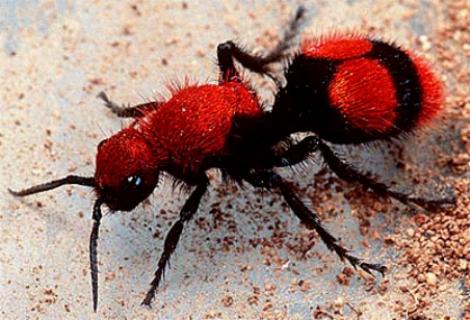
Of course technically they are part of the Wasp family and not Ants, but that is what they look like, one HUGE ant that can take down a cow. Here's a link on them:
Mutillidae
Don't bother stepping on them. They just get ticked off about it and shake it off. The good news is that they tend to be loners when out and about, and can be seen very easily due to the bright red / orange parts of them when they are crawling along the ground.
Fire Ants are the bane here however, and they used to come into our house all the time. Due to the sting they give, this was even worse than finding some other ant in the house.
However, I discovered something that keeps them at bay all year long. A product called "Over and Out!" ant killer, made by Garden Tech. A bag of it costs about $20 but treats 10,000 square feet. You put it in a broadcaster and just run it over your yard in the spring. The first year I used it, our fire ant problem all but went away. Instead of finding hundreds of new ant mounds after a good rain, I'm lucky to see only 1 or 2.
And I know it works as one year I didn't get around to it, and they came back in force!
Of course technically they are part of the Wasp family and not Ants, but that is what they look like, one HUGE ant that can take down a cow. Here's a link on them:
Mutillidae
Don't bother stepping on them. They just get ticked off about it and shake it off. The good news is that they tend to be loners when out and about, and can be seen very easily due to the bright red / orange parts of them when they are crawling along the ground.
Fire Ants are the bane here however, and they used to come into our house all the time. Due to the sting they give, this was even worse than finding some other ant in the house.
However, I discovered something that keeps them at bay all year long. A product called "Over and Out!" ant killer, made by Garden Tech. A bag of it costs about $20 but treats 10,000 square feet. You put it in a broadcaster and just run it over your yard in the spring. The first year I used it, our fire ant problem all but went away. Instead of finding hundreds of new ant mounds after a good rain, I'm lucky to see only 1 or 2.
And I know it works as one year I didn't get around to it, and they came back in force!
My wife and I have little black ant problems from time to time. We never have any other problems with bugs, not spiders or roaches or weavels or
anything... We double and tripple ziplock everything in our cupboards and are super careful when we eat and or prepare food and yet they will still
invade. One of the most amazing things is how every single exterminator company wants to put you on a month to month payment plan as if yer buying a
car in order for them to properly take care of the issue. They said, "well we need to put you on a month to month thing so that we can come out when
the ants come back in a couple months" I'm thinking, if the ants are gonna come back right away what use is the service anyway? The companies do not
want you calling them only once a year or once every other year so they purposely use a product that they know will have them back in a couple months
re-baiting.. They wanna drill holes in your walls and then will not fill or paint them back to normal... Its a joke really.
I am please to report to the ATS community that we found the answer to this severe problem totally by accident.... In a word its 'Advion' Ant Gel w/ Plunger from Dupont (go #24) only on amazon as you cannot seem to get it anywhere else. Only 8 bucks!!! I read that zoo's use it! Its a liquid gel tube thats sort of like a syrup. You can use one tube for 30 to 50 applications as you only need a pea sized dot per bait. You will not need much because it does not dry out so one little application has tons of ants feeding on it till its completely gone... Hundreds of testimonies like mine prove its awesome at getting rid of the problem. Its clear and I recommend cutting little 1 inch squares of plastic of any type to put where you want the bait. This stuff is like crack to ants and for at least 3-5 days they will feast like its the last feast they will ever have!!!!!!!!!... HA AND IT IS!!!! We would only would get a few ants from time to time when they would invade but it was disturbing to see once we put the advion bait out that the trail was a half an inch wide and SOLID with these black ants coming out of a electrical outlet! This went on for 4 long days as you have to let them bring the food back to the queen and larvae and now.... Not one single ant!!! You can put sugar cubes out and not one single ant... We tried everything, Max Force which is used by exterminators, Hot Shot, Raid, etc etc etc... Nothing worked... But this stuff is a miracle and I have to say the only one we found that worked....
Just thought I would share this incase someone with in ant problem comes on looking for tips.
P.S. its supposed to be pet friendly but I would keep it in areas where the pets cannot get to it.
P.S. P.S. also treat the outside with ant pellets they also sell a good brand on amazon. One seller sells two gels and the pellets together. Outdoor stuff is 8 Oz Advance 375a Granular Ant Bait KIT1040.
P.S. P.S. P.S. I have no affiliation with Dupont, Amazon or this product or anyone who sells this product but after YEARS of reading online and trying EVERYTHING from powders to baits and gels and sprays and this company and that company we finally came upon an economical way to kill this lil pests!
Hope this helps someone.
I am please to report to the ATS community that we found the answer to this severe problem totally by accident.... In a word its 'Advion' Ant Gel w/ Plunger from Dupont (go #24) only on amazon as you cannot seem to get it anywhere else. Only 8 bucks!!! I read that zoo's use it! Its a liquid gel tube thats sort of like a syrup. You can use one tube for 30 to 50 applications as you only need a pea sized dot per bait. You will not need much because it does not dry out so one little application has tons of ants feeding on it till its completely gone... Hundreds of testimonies like mine prove its awesome at getting rid of the problem. Its clear and I recommend cutting little 1 inch squares of plastic of any type to put where you want the bait. This stuff is like crack to ants and for at least 3-5 days they will feast like its the last feast they will ever have!!!!!!!!!... HA AND IT IS!!!! We would only would get a few ants from time to time when they would invade but it was disturbing to see once we put the advion bait out that the trail was a half an inch wide and SOLID with these black ants coming out of a electrical outlet! This went on for 4 long days as you have to let them bring the food back to the queen and larvae and now.... Not one single ant!!! You can put sugar cubes out and not one single ant... We tried everything, Max Force which is used by exterminators, Hot Shot, Raid, etc etc etc... Nothing worked... But this stuff is a miracle and I have to say the only one we found that worked....
Just thought I would share this incase someone with in ant problem comes on looking for tips.
P.S. its supposed to be pet friendly but I would keep it in areas where the pets cannot get to it.
P.S. P.S. also treat the outside with ant pellets they also sell a good brand on amazon. One seller sells two gels and the pellets together. Outdoor stuff is 8 Oz Advance 375a Granular Ant Bait KIT1040.
P.S. P.S. P.S. I have no affiliation with Dupont, Amazon or this product or anyone who sells this product but after YEARS of reading online and trying EVERYTHING from powders to baits and gels and sprays and this company and that company we finally came upon an economical way to kill this lil pests!
Hope this helps someone.
edit on 8/19/2012 by YAHUWAH SAVES because: (no reason given)
Great thread. I find it humbling when humans can't outsmart "dumb" creatures.
I like to use insects for my own devices whenever I can. The red fire ants stay in the yard and never come in the house. Maybe because I give them food. My cats leave me their kills and I throw the carcasses on the red ant hills. I've got large black/red ants in my garden. I was afraid they were damaging my plants so I watched them. A few were carrying seeds etc but then I saw several carrying army cutworms, my dreaded enemy. These ants are now my garden watch dogs and I leave them alone.
Little black ants were getting into the cat's food. A poster on my thread about humane bug removal mentioned baby powder works good on ants. It messes with their navigation or something but doesn't kill them. I sprinkled a bit around the cat's bowl. After a couple weeks no more ants. I cleaned up the powder and they still haven't returned. I sprinkle a little on door thresholds and around the window sill in the kitchen. I get a nice smell of baby powder when the wind blows and no ants.
My hummingbird feeder was a toughie. The thing dripped so the ants found it. They swarmed the deck under the feeder and soon found a way up and were getting inside. The baby powder worked on the deck. Despite the temptation of sugar water the powder really keeps the ants away. I constructed an ant guard filled with water that sits on top of the feeders. No more contaminated sugar water.
A fellow arrowhead hunter friend of mine checks red ant hills for native american beads, she's found several. The ants bring them to the surface. The best use of ants imo was in the movie Apocalypto, the mom used ants to suture her son's wound. Not sure if that would work with the variety of ants I have but I've cataloged it away just in case.
I like to use insects for my own devices whenever I can. The red fire ants stay in the yard and never come in the house. Maybe because I give them food. My cats leave me their kills and I throw the carcasses on the red ant hills. I've got large black/red ants in my garden. I was afraid they were damaging my plants so I watched them. A few were carrying seeds etc but then I saw several carrying army cutworms, my dreaded enemy. These ants are now my garden watch dogs and I leave them alone.
Little black ants were getting into the cat's food. A poster on my thread about humane bug removal mentioned baby powder works good on ants. It messes with their navigation or something but doesn't kill them. I sprinkled a bit around the cat's bowl. After a couple weeks no more ants. I cleaned up the powder and they still haven't returned. I sprinkle a little on door thresholds and around the window sill in the kitchen. I get a nice smell of baby powder when the wind blows and no ants.
My hummingbird feeder was a toughie. The thing dripped so the ants found it. They swarmed the deck under the feeder and soon found a way up and were getting inside. The baby powder worked on the deck. Despite the temptation of sugar water the powder really keeps the ants away. I constructed an ant guard filled with water that sits on top of the feeders. No more contaminated sugar water.
A fellow arrowhead hunter friend of mine checks red ant hills for native american beads, she's found several. The ants bring them to the surface. The best use of ants imo was in the movie Apocalypto, the mom used ants to suture her son's wound. Not sure if that would work with the variety of ants I have but I've cataloged it away just in case.
reply to post by Xoanon
An absolutely great post!!
I grew up in an area with the very benign black ants. You could let them crawl all over you and they did no harm; good gentle cousins. But then we moved to the "the South". Egads! Being a child of allergic nature it was quite a difficult thing to have to share space with the fire ants. Thankfully they did not come inside very often; so we were able to stake out our own perimeters. But woe to the one who trespasses. If they came into the house death was a certainty. If I wandered outside into their territory an ER visit almost ineveitable.
I now live in TX where we have the little red fire ants, and the tiny crazy raspberries as well along with the other numerous little ant critters. We also have a large breed of red ant that are mostly peaceful, but if you trouble them and get bitten be ready for several days worth of burning pain at the site where you were bitten. Thank God they don't swarm.
Most of the ants don't bother me. We keep them out of the house with diotomaceous earth and boric acid spread along the baseboards and entry points. It works very well. We have numerous pets and so much pet food about in the house, both in bowls and stored in bins and as yet, (eight years) have not had any serious incursion by the ant hordes.
The ant situation outdoors is a different thing all together. We live by a river and before the drought our yard was a veritable fire ant paradise. And since, as I mentioned, we have many pets this was always a concern. We used a three fold attack for the colonies there. (we tried asking them to leave, as was the polite thing to do, we even explained to them that it was in their best interest, but you know how they can be) We first treated the the entire yard with a water spray containing nematodes. This is suppose to work well for ants and fleas. If new colonies sprang up we shoveled them open and poured in DE. It acts like tiny peices of broken glass when the ants ingest it. Not pretty, but we did warn them. Then, if there was a colony that couldn't be eradicated by non toxic means we would treat that one with toxic ant bait. Eventually our yard was nearly ant and flea free, with little or no collateral damage.
In tha past few years, with the drought the fire ants have retreated deep underground so we do not know how big their colonies may be, or if they have survived unseen. Only rain will tell. The raspberry ants though have not slowed down much. And as long as they don't come into the house I don't have much of a problem with them. We treat the outdoor pet areas with DE and they seem to stay away except for a few intrepid scouts that generally do not make it far after hiking through the DE. I have also been told that the crazy ants will kill a fire ant colony, simply overwhelm them by force of numbers. I don't know if that is true, but I will give them the benefit of the doubt.
A few years ago in the county next to us a research group released a fly/wasp, can't remember which, which lay their eggs on the fire ants which then carry the larvae back to the colony, eventually destroying it. This flying critter is one of the natural preditors of the ant in its original territlry. It is difficult to tell how this is working; as I stated, the drought has pushed the ants underground. But I worry. I can not recall a single time when man has tried to second guess mother nature that turned out well; keeping our fingers crossed.
Anyway, thanks again for the great post.
An absolutely great post!!
I grew up in an area with the very benign black ants. You could let them crawl all over you and they did no harm; good gentle cousins. But then we moved to the "the South". Egads! Being a child of allergic nature it was quite a difficult thing to have to share space with the fire ants. Thankfully they did not come inside very often; so we were able to stake out our own perimeters. But woe to the one who trespasses. If they came into the house death was a certainty. If I wandered outside into their territory an ER visit almost ineveitable.
I now live in TX where we have the little red fire ants, and the tiny crazy raspberries as well along with the other numerous little ant critters. We also have a large breed of red ant that are mostly peaceful, but if you trouble them and get bitten be ready for several days worth of burning pain at the site where you were bitten. Thank God they don't swarm.
Most of the ants don't bother me. We keep them out of the house with diotomaceous earth and boric acid spread along the baseboards and entry points. It works very well. We have numerous pets and so much pet food about in the house, both in bowls and stored in bins and as yet, (eight years) have not had any serious incursion by the ant hordes.
The ant situation outdoors is a different thing all together. We live by a river and before the drought our yard was a veritable fire ant paradise. And since, as I mentioned, we have many pets this was always a concern. We used a three fold attack for the colonies there. (we tried asking them to leave, as was the polite thing to do, we even explained to them that it was in their best interest, but you know how they can be) We first treated the the entire yard with a water spray containing nematodes. This is suppose to work well for ants and fleas. If new colonies sprang up we shoveled them open and poured in DE. It acts like tiny peices of broken glass when the ants ingest it. Not pretty, but we did warn them. Then, if there was a colony that couldn't be eradicated by non toxic means we would treat that one with toxic ant bait. Eventually our yard was nearly ant and flea free, with little or no collateral damage.
In tha past few years, with the drought the fire ants have retreated deep underground so we do not know how big their colonies may be, or if they have survived unseen. Only rain will tell. The raspberry ants though have not slowed down much. And as long as they don't come into the house I don't have much of a problem with them. We treat the outdoor pet areas with DE and they seem to stay away except for a few intrepid scouts that generally do not make it far after hiking through the DE. I have also been told that the crazy ants will kill a fire ant colony, simply overwhelm them by force of numbers. I don't know if that is true, but I will give them the benefit of the doubt.
A few years ago in the county next to us a research group released a fly/wasp, can't remember which, which lay their eggs on the fire ants which then carry the larvae back to the colony, eventually destroying it. This flying critter is one of the natural preditors of the ant in its original territlry. It is difficult to tell how this is working; as I stated, the drought has pushed the ants underground. But I worry. I can not recall a single time when man has tried to second guess mother nature that turned out well; keeping our fingers crossed.
Anyway, thanks again for the great post.
edit on 19-8-2012 by jaguarsky because: sp
Originally posted by Morningglory
Great thread. I find it humbling when humans can't outsmart "dumb" creatures.
The best use of ants imo was in the movie Apocalypto, the mom used ants to suture her son's wound. Not sure if that would work with the variety of ants I have but I've cataloged it away just in case.
I forgot all about this! Here is more info:
South west Florida, ants can kill you, fire ants.
But a new weapon has come to be effective, GRITS.
Yes, just GRITS. Pour it on nest they take it in and repeat, then they are gone.
Someone said it explodes them when they eat it, don't know but it works and I hate chemical treatments.
But a new weapon has come to be effective, GRITS.
Yes, just GRITS. Pour it on nest they take it in and repeat, then they are gone.
Someone said it explodes them when they eat it, don't know but it works and I hate chemical treatments.
i-cias.com...
en.wikipedia.org...
Ants are fascinating creatures, even the Lord bestowed a unique place upon them.
en.wikipedia.org...
Ants are fascinating creatures, even the Lord bestowed a unique place upon them.
Remember the indiana jones, crystal skull ant scene, that one freaks me out.
Also an ant raft:
Also an ant raft:
Originally posted by Xoanon
Weird Scenes Inside The Kitchen: My own anty antecdotes
The kitchen is the front line of the war that these ants wage for my food. I have seen a lot of ant-death in there. It is much, I suppose like 2nd generation WWI warfare; what with the 409 and the other chemicals, also the fact that other than the chemicals the chief means by which these ants die is mechanical trauma. There is also lots of death by water.
I loved this! Reminds me of something I wrote years ago:
What if ants were assassins
and spiders were spies
would the sugar bowl become
the new battleground?
Would cobwebs be broadcasting
To foreign governments and would
Picnics take on a whole new meaning?
The spiders in my house reproduce like rabbits
They lurk in corners that no bachelor thinks
To dust, they try to snare me as I leave in the
Morning, sticky strands tickling my nose.
The ants used to come in long supply lines
And I would strafe them from above with a spray
that I was sure did more damage to me than
To them, as they scattered and ran for cover
Besides I thought this was termed gas warfare
And was banned or perhaps in this war the rules
Of engagement are somewhat different.
Now the ants come singly, their tactics
Are now one of stealth, hit and run, as they carry
Off their plundered items. But what if they were assassins,
How would I cope then?
No less than the Creator teaches us through the Vision Bringers and their scriptures. the creator also "teaches us through the wildlife of the Earth"
Job 35:11
"Religion is nice, but even without all that divine revelatory hullabaloo, the Creator left us enough information in the earth about how to live in balance. If we did not have the Torah, we could have learned everything we needed to know from the animals." Babylonian Talmud, Eruvin roob
Both above from Daily Kabbalah Wisdom from the Tree of Life compiled by Gershon Winkler, pages 41-42.
The world of bugs proves to be endlessly interesting, from anatomy to society....
Anyone who is interested in the violent world of the tiny, check out the book Micro by Michael Crichton, where a team of scientists gets shrunk down to one inch tall and has to survive in a Hawaiian rain forest. Crichton, famous for ER on television and Jurassic Park, always provides plenty of scientific fact.
It's always seemed possible to me that high intelligence could develop in a bug-like species. Considering their survival abilities, you could argue it already has in some ways...
I don't think I'd be adverse to reincarnating as a bug a few million times in the context of an infinite life cycle.
"Religion is nice, but even without all that divine revelatory hullabaloo, the Creator left us enough information in the earth about how to live in balance. If we did not have the Torah, we could have learned everything we needed to know from the animals." Babylonian Talmud, Eruvin roob
Both above from Daily Kabbalah Wisdom from the Tree of Life compiled by Gershon Winkler, pages 41-42.
The world of bugs proves to be endlessly interesting, from anatomy to society....
Anyone who is interested in the violent world of the tiny, check out the book Micro by Michael Crichton, where a team of scientists gets shrunk down to one inch tall and has to survive in a Hawaiian rain forest. Crichton, famous for ER on television and Jurassic Park, always provides plenty of scientific fact.
edit on 19-8-2012 by PatrickGarrow17 because: (no reason given)
It's always seemed possible to me that high intelligence could develop in a bug-like species. Considering their survival abilities, you could argue it already has in some ways...
I don't think I'd be adverse to reincarnating as a bug a few million times in the context of an infinite life cycle.
edit on 19-8-2012 by
PatrickGarrow17 because: (no reason given)
Hey great post Ants are really little amazing bugs, I use to watch them all the time as a kid lol.. and I even kept a little ant farm i made my
self!! lol.. they are one tracked minded little beasts.. but it does seem to me they do indeed "care" about there fellow ants .. I too like one of
the other posters said have seen them carry away there fallen comrades.. I got many lil stories about ants but.. great read one of the best posts iv
seen on here in a very long time.
Well done
Well done
reply to post by warpcrafter
Actually, spiders are the good guys. Without spiders, our world would be over run with insects....
Actually, spiders are the good guys. Without spiders, our world would be over run with insects....
edit on 19-8-2012 by 0zzymand0s because: (no
reason given)
And as if them crawling around weren't enough, here are the jumping variety.
0:35 is amazing!
0:35 is amazing!
reply to post by Xoanon
Thank-you for providing such an interesting read. The similarities between ants and humans are quite peculiar, and I feel that this effect is enhanced because we pay so little attention to them on the whole. When you begin to see something you previously regarded with little significance in a whole new way, the mind starts to boggle.
A few years ago, during the summer, we had a little ant invasion. They travelled a good distance to congregate under the hi-fi stand, never breaking formation. When we pulled it out we discovered a stray strawberry bonbon that looked to be partially dissolved, though I don't know if ants actually do that. The sheer effort they put in to getting at it made me feel awkward when I participated in killing them. Killing anything makes me feel bad, but seeing things so tiny work with incredible persistence for so small a gain made me feel unusually sympathetic.
I quite like ants on the whole, I've always thought they're funny little creatures. We could certainly learn a thing or two from them about working together.
reply to post by Eidolon23
Thank-you, too, for the link. It made for a chilling read. The whole thing reminds me of an episode of The X-Files.
Thank-you for providing such an interesting read. The similarities between ants and humans are quite peculiar, and I feel that this effect is enhanced because we pay so little attention to them on the whole. When you begin to see something you previously regarded with little significance in a whole new way, the mind starts to boggle.
A few years ago, during the summer, we had a little ant invasion. They travelled a good distance to congregate under the hi-fi stand, never breaking formation. When we pulled it out we discovered a stray strawberry bonbon that looked to be partially dissolved, though I don't know if ants actually do that. The sheer effort they put in to getting at it made me feel awkward when I participated in killing them. Killing anything makes me feel bad, but seeing things so tiny work with incredible persistence for so small a gain made me feel unusually sympathetic.
I quite like ants on the whole, I've always thought they're funny little creatures. We could certainly learn a thing or two from them about working together.
reply to post by Eidolon23
Thank-you, too, for the link. It made for a chilling read. The whole thing reminds me of an episode of The X-Files.
new topics
-
Is Taco Bell Satanic?
Education and Media: 1 hours ago -
Scientists Find 7 potential Dyson spheres after Scanning 5 million Objects
Space Exploration: 2 hours ago -
Need help understanding the evolution of WHO as a power structure. Shades of the NWO...?
New World Order: 4 hours ago -
The geography of Eden
Religion, Faith, And Theology: 5 hours ago -
US 'Uniparty' officially throws Christians to the lions...
Conspiracies in Religions: 6 hours ago -
REAL ID now a reality
General Conspiracies: 8 hours ago -
'I couldn't cope with Britain anymore': Kurdish man pays smuggler to return him to France
Social Issues and Civil Unrest: 10 hours ago
top topics
-
Oh, Have I got a Goody for You Guys!!!
General Conspiracies: 15 hours ago, 20 flags -
Former Hamas member goes OFF on ‘low grade’ lefty journalist
US Political Madness: 13 hours ago, 14 flags -
Woman In Her 60s Stabbed To Death In London Street By Thief Who Tried To Steal Her Bag.
Social Issues and Civil Unrest: 17 hours ago, 8 flags -
REAL ID now a reality
General Conspiracies: 8 hours ago, 6 flags -
'I couldn't cope with Britain anymore': Kurdish man pays smuggler to return him to France
Social Issues and Civil Unrest: 10 hours ago, 4 flags -
Scientists Find 7 potential Dyson spheres after Scanning 5 million Objects
Space Exploration: 2 hours ago, 3 flags -
An Apple a Day
General Chit Chat: 13 hours ago, 2 flags -
US 'Uniparty' officially throws Christians to the lions...
Conspiracies in Religions: 6 hours ago, 2 flags -
The geography of Eden
Religion, Faith, And Theology: 5 hours ago, 1 flags -
Need help understanding the evolution of WHO as a power structure. Shades of the NWO...?
New World Order: 4 hours ago, 1 flags
active topics
-
Scientists Find 7 potential Dyson spheres after Scanning 5 million Objects
Space Exploration • 17 • : BeyondKnowledge3 -
Is Taco Bell Satanic?
Education and Media • 9 • : Caver78 -
Mood Music Part VI
Music • 3168 • : lilzazz -
Multipal Solar Storms Coming Our Way This Weekend
Fragile Earth • 24 • : NorthOS -
-@TH3WH17ERABB17- -Q- ---TIME TO SHOW THE WORLD--- -Part- --44--
Dissecting Disinformation • 937 • : daskakik -
REAL ID now a reality
General Conspiracies • 23 • : Euronymous2625 -
Candidate TRUMP Now Has Crazy Judge JUAN MERCHAN After Him - The Stormy Daniels Hush-Money Case.
Political Conspiracies • 1479 • : matafuchs -
Oh, Have I got a Goody for You Guys!!!
General Conspiracies • 55 • : boatguy12 -
Kirkpatrick vs Fugal - Skinwalker ranch briefing.
Aliens and UFOs • 29 • : network dude -
Need help understanding the evolution of WHO as a power structure. Shades of the NWO...?
New World Order • 1 • : NorthOS