It looks like you're using an Ad Blocker.
Please white-list or disable AboveTopSecret.com in your ad-blocking tool.
Thank you.
Some features of ATS will be disabled while you continue to use an ad-blocker.

Substantial Air Superiorty build up in Middle East, F-22s and F-15s.
page: 1share:
www.wired.com...
While I have known about F-22s deployed to the Gulf region, the article also states that 20 F-15s from the Mass. Air National Guard's 104th wing are at an undisclosed base in the region. On top of that the active duty 18th Wing, home based in Japan (guess they aren't worried about N,Korea?) have also deployed; the 18th's aircraft have been updated with new radar.
This is the first substantial air superiority deployment to the gulf since the 2003 invasion of Iraq. Most combat deployments of the USAF in the region have been attack aircraft and bombers to attack targets on the ground. It now appears they are prepared to fight in the air....which means Iran.....
Throw the aircraft carriers' aircraft in, and all the other deployments it is seriously looking like someone expects something to happen. We have moved alot of hardware (which means spent money) around the area.
I don't worry to much when they Navy moves around, they are designed to do that. But when home based USAF or US Army troops start moving, I start to wonder.
While I have known about F-22s deployed to the Gulf region, the article also states that 20 F-15s from the Mass. Air National Guard's 104th wing are at an undisclosed base in the region. On top of that the active duty 18th Wing, home based in Japan (guess they aren't worried about N,Korea?) have also deployed; the 18th's aircraft have been updated with new radar.
This is the first substantial air superiority deployment to the gulf since the 2003 invasion of Iraq. Most combat deployments of the USAF in the region have been attack aircraft and bombers to attack targets on the ground. It now appears they are prepared to fight in the air....which means Iran.....
Throw the aircraft carriers' aircraft in, and all the other deployments it is seriously looking like someone expects something to happen. We have moved alot of hardware (which means spent money) around the area.
I don't worry to much when they Navy moves around, they are designed to do that. But when home based USAF or US Army troops start moving, I start to wonder.
edit on 11-5-2012 by SrWingCommander because: grammer, content
First the special forces currently doing drills in the middle east will "liberate" syria, install puppet leader. Then, onwards to Iran. If the bill
that states the US will aid Israel gets passed, its false flag to Israel then onward to Iran. From their, its anybody guess.
Originally posted by AaronWilson
First the special forces currently doing drills in the middle east will "liberate" syria, install puppet leader. Then, onwards to Iran.
That exercise, Eager Lion, has nothing to do with Syria, nor is it the first time that the exercise has been held. It is a long running, annual exercise.
reply to post by AaronWilson
What you said was rather tame compared to some of the comments said in the thread about said exercise!
What you said was rather tame compared to some of the comments said in the thread about said exercise!
reply to post by SrWingCommander
I thought the F-22s were grounded due to the fact the pilots will not fly them
Due to oxygen life support problems
This however could be a figment of my imagination
So feel free to correct me if indeed i got that wrong
Cran
While I have known about F-22s deployed to the Gulf region
I thought the F-22s were grounded due to the fact the pilots will not fly them
Due to oxygen life support problems
This however could be a figment of my imagination
So feel free to correct me if indeed i got that wrong
Cran
Originally posted by stumason
Originally posted by AaronWilson
First the special forces currently doing drills in the middle east will "liberate" syria, install puppet leader. Then, onwards to Iran.
That exercise, Eager Lion, has nothing to do with Syria, nor is it the first time that the exercise has been held. It is a long running, annual exercise.
So how many times has this Eager event been held? You make it seem as if this has been happening annually for years. Well how many years? I am quite curious.
reply to post by emberscott
This years Eager Lion has been 3 years in the planning. Another was held last year, again after some years in the planning..
www.centcom.mil...
I know two years would probably have some saying "it's not annual", but it has to start somewhere.
This years Eager Lion has been 3 years in the planning. Another was held last year, again after some years in the planning..
www.centcom.mil...
I know two years would probably have some saying "it's not annual", but it has to start somewhere.
reply to post by cranspace
I don't know of there present flight status. They have been grounded off and on due to the oxygen system and some other issues but I think they are currently flying again.
Also, if you are on a combat deployment, a "grounding" order (depedning on how its' written) might not effect any aircraft that are deployed in or near combat zones.
I find the better part of two wings of F-15C's being deployed as (if not more) significant as the F-22s. Your looking at probable 40-60+ US F-15Cs alone in theater. That's on top of the carrier air wings.
I don't know of there present flight status. They have been grounded off and on due to the oxygen system and some other issues but I think they are currently flying again.
Also, if you are on a combat deployment, a "grounding" order (depedning on how its' written) might not effect any aircraft that are deployed in or near combat zones.
I find the better part of two wings of F-15C's being deployed as (if not more) significant as the F-22s. Your looking at probable 40-60+ US F-15Cs alone in theater. That's on top of the carrier air wings.
edit on 11-5-2012 by SrWingCommander because: grammer
edit on
11-5-2012 by SrWingCommander because: spelling
gaaah America stop #ing with Iran and lying about it!. Let them develop free energy devices and anti-gravity if they want too.
I don't care if Mr Rockefeller's oil monopoly is at stake he can piss off and chill in the FEMA camps with his buddies forever!
I don't care if Mr Rockefeller's oil monopoly is at stake he can piss off and chill in the FEMA camps with his buddies forever!
edit on
11-5-2012 by Mandrakerealmz because: (no reason given)
Originally posted by SrWingCommander
reply to post by cranspace
I find the better part of two wings of F-15C's being deployed as (if not more) significant as the F-22s. Your looking at probable 40-60+ US F-15Cs alone in theater. That's on top of the carrier air wings.
I agree that the deployment of 3 F-15C combat wings is noteworthy (unlike a good bit of the reactionary tripe that gets tossed around here regarding military deployments.)
For anyone who doesn't know, the single seat F-15C is a pure fighter plane "not a pound for air to ground" while the newer 2 seat F-15E is configured for dual role ground/air function.The F-15C is also the worlds most successful fighter aircraft with a combat record of over 100 air to air kills without a single air to air loss.
Of note as well is that the Raptors that have been deployed are all recently upgraded to the block 3.1 standard with a ground attack capability.
Superficially, I would take a large deployment of air superiority specialized aircraft in the area as a demonstration of political will in response to Iranian threats to interfere with international shipping in the Straits of Hormuz if stronger sanctions are enforced, however this seems disproportionately overkill.
The 2 carrier task forces currently on station in the Persian Gulf are easily capable of controlling the straits in addition to the Royal Saudi Air Force, which is formidable in its own right.
I honestly don't think there is an air defence network in the world that could substantially impede a force of 60+ Eagles and 20 Raptors from operating at will for at least a short time
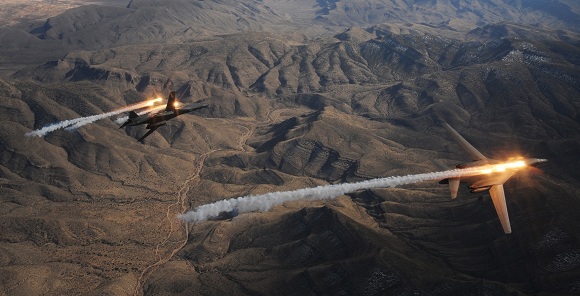
Remembering that a strike on Iran would be a large combined arms effort, any strategic assets would be based outside the Middle East, my guess is that Diego Garcia will be a good bet for B-1 spotting in the near future.
There has been a lot of talk on the Internet recently that the USAF has been taking the possibility of having to project overwhelming power against a integrated, determined air defence over a long distance very seriously.
‘Operation Chimichanga’ Tests Pentagon’s Stealth Strike Force
The first sign of the coming U.S. air raid was when the enemy radar and air-defense missile sites began exploding. The strikers were Air Force F-22 Raptor stealth fighters, flying unseen and faster than the speed of sound, 50,000 feet over the battlefield. Having emptied their weapons bays of super-accurate, 250-pound Small Diameter Bombs, the Raptors turned to engage enemy jet fighters rising in defense of their battered allies on the ground.
That’s when all hell broke loose. As the Raptors smashed the enemy jets with Amraam and Sidewinder missiles, nimble Air Force F-16s swooped in to reinforce the F-22s, launching their own air-to-air missiles and firing guns to add to the aerial carnage.
With enemy defenses collapsing, B-1 bombers struck. Several of the 150-ton, swing-wing warplanes, having flown 10 hours from their base in South Dakota, launched radar-evading Jassm cruise missiles that slammed into ground targets, pulverizing them with their 2,000-pound warheads. Its weapons expended, the strike force streaked away. Behind it, the enemy’s planes and ground forces lay in smoking ruin.
The devastating air strike on April 4 involved real warplanes launching a mix of real and computer-simulated weapons at mock targets scattered across the U.S. military’s vast Joint Pacific Alaska Range Complex near Fort Yukon, a tiny former fur trading post, population 583. “Operation Chimichanga,” as the exercise was reportedly designated, was the first-ever test of a new Air Force long-range strike team combining upgraded Lockheed Martin F-22s and Boeing B-1s carrying the latest air-launched munitions, along with old-school fighters, tankers and radar planes for support.
edit on 11-5-2012 by Drunkenparrot because: (no reason given)
The unity goverment in Isreal could well mean a strike is imminent.
the US airforce may be the backcatcher for the isrealis,but i dont think they would be used in an initial strike unless the situation were radically altered....
I imagine isrealis F 15s(sold to them at scrap prices by none other than rabbi dov zackheim of 9/11 fame..)..
Are probaly every bit the planes we have....given that they have refuelling capability now (courtesy of US) as well as AWACs same same....they will likely be the first to go in.....along with cruise missiles from their subs too.....
the US airforce may be the backcatcher for the isrealis,but i dont think they would be used in an initial strike unless the situation were radically altered....
I imagine isrealis F 15s(sold to them at scrap prices by none other than rabbi dov zackheim of 9/11 fame..)..
Are probaly every bit the planes we have....given that they have refuelling capability now (courtesy of US) as well as AWACs same same....they will likely be the first to go in.....along with cruise missiles from their subs too.....
if anything that we know about obama, is that he keeps his cards very close to the chest.
the alleged osama hit came out of no where. the msm is very pro obama, so they won't scrutinize his every move.
then there was the afghan trip. also out of nowhere.
obama likes to operate when everyone least expects it. when its the quietest and calmest, obama strikes.
the alleged osama hit came out of no where. the msm is very pro obama, so they won't scrutinize his every move.
then there was the afghan trip. also out of nowhere.
obama likes to operate when everyone least expects it. when its the quietest and calmest, obama strikes.
Originally posted by cranspace
reply to post by SrWingCommander
I thought the F-22s were grounded due to the fact the pilots will not fly them
Due to oxygen life support problems
This however could be a figment of my imagination
So feel free to correct me if indeed i got that wrong
Cran
I thought the issue with the raptor was that pilots could be killed when they eject? I dunno either. Sounds like a rumor mill to me. Anybody else?
Edit: Whoops, my bad. Seems you are right. I'll try to remember to check next time...
www.google.com...
edit on 12-5-2012 by intrptr
because: whoops...
So if we are there where are the Russians and the Chinese?
If they are there who is looking out for us here that pay for all this BS?
If they are there who is looking out for us here that pay for all this BS?
Even if Iran is defeated militarily the fallout will be much much worse. Can you imagine 9/11 x 10 happening here as a response. Have we not learned
that we cannot just go around attacking countries without blow-back and collateral damage?
If we do go to war with Iran (highly unlikely) and there are 9/11 style repercussions, I am going to direct you to this EXACT post here to tell you 'told you so' Plus I highly suspect that people will use that defensive attack as an excuse to hate on Islam and Iranians.
If we do go to war with Iran (highly unlikely) and there are 9/11 style repercussions, I am going to direct you to this EXACT post here to tell you 'told you so' Plus I highly suspect that people will use that defensive attack as an excuse to hate on Islam and Iranians.
Originally posted by stirling
The unity goverment in Isreal could well mean a strike is imminent.
the US airforce may be the backcatcher for the isrealis,but i dont think they would be used in an initial strike unless the situation were radically altered....
I imagine isrealis F 15s(sold to them at scrap prices by none other than rabbi dov zackheim of 9/11 fame..)..
Are probaly every bit the planes we have....given that they have refuelling capability now (courtesy of US) as well as AWACs same same....they will likely be the first to go in.....along with cruise missiles from their subs too.....
This is a tough one but it is no secret that U.S./Israeli relations have cooled under the Obama administration.
While Benjamin Netanyahu has been using some very aggressive phrasing in his public dialogues regarding Iran's alleged nuclear ambitions, it also seems clear that he does not have the overwhelming domestic support that similar IAF ventures have enjoyed in the past.
I believe it is worth consideration that this is an election year for the U.S. and any substantial conflict involving Iran is almost guaranteed to force an abrupt increase in fuel prices which is historically detrimental to the incumbent administration.
President Obama's recent comments on post election flexibility of U.S. defence policy to Dmitry Medvedev seem to make it clear that Obama would prefer to maintain the status quo until after November and then I believe any major policy decisions are likely to be conciliatory. There is only moderate support from the right and almost none from the left to act more decisively regarding Iran, the american public are tired of war and not particularly upset with Iranian nuclear ambitions.
Undeniably the presence of these aircraft is calculated be taken as a threat by the Iranian leadership however it is not inconceivable that the intent is twofold.
Although I dont see any realistic scenario involving actual hostilities between USAF and IAF forces, I could see the deployment of an substantial air superiority force to the region for the purpose of encouraging the IAF to take pause before trying to repeat something like 1981's Operation Babylon strike on Iraq's nuclear program.
I understand this is wild speculation but the idea is worth consideration, imho.
I thought the F-22s that were being deployed were block 3.0 models, not 3.1? The earlier variations before 3.1 do not have an air-to-ground
capability.
Originally posted by johnthejedi24
I thought the F-22s that were being deployed were block 3.0 models, not 3.1? The earlier variations before 3.1 do not have an air-to-ground capability.
You are correct.
They are a single flight of block 3.0 aircraft of the Holloman AFB based 7th Fighter Squadron, not the upgraded 3.1 models of Elmendorf AFB's 525th Fighter Squadron as I mistakenly cited above.
Good catch
The six F-22 Raptors currently at Al Dhafra, UAE, belong to the 49th Fighter Wing, based at Holloman AFB, New Mexico...
...They are all Block 3.0 (or Block 30) examples meaning that neither of them has received the latest upgrade (Block 3.1) that has brought the capability to find and engage ground targets using the Synthetic Aperture Radar mapping and eight GBU-39 SDBs (Small Diameter Bombs) to the troubled stealthy fighter.
Exclusive: What nobody else will tell you about the U.S. F-22 stealth fighters deployed near Iran
new topics
-
A Warning to America: 25 Ways the US is Being Destroyed
New World Order: 14 minutes ago -
America's Greatest Ally
General Chit Chat: 59 minutes ago -
President BIDEN's FBI Raided Donald Trump's Florida Home for OBAMA-NORTH KOREA Documents.
Political Conspiracies: 6 hours ago -
Maestro Benedetto
Literature: 7 hours ago -
Is AI Better Than the Hollywood Elite?
Movies: 7 hours ago -
Las Vegas UFO Spotting Teen Traumatized by Demon Creature in Backyard
Aliens and UFOs: 11 hours ago -
2024 Pigeon Forge Rod Run - On the Strip (Video made for you)
Automotive Discussion: 11 hours ago
top topics
-
President BIDEN's FBI Raided Donald Trump's Florida Home for OBAMA-NORTH KOREA Documents.
Political Conspiracies: 6 hours ago, 26 flags -
Krystalnacht on today's most elite Universities?
Social Issues and Civil Unrest: 17 hours ago, 9 flags -
Gaza Terrorists Attack US Humanitarian Pier During Construction
Middle East Issues: 12 hours ago, 8 flags -
Supreme Court Oral Arguments 4.25.2024 - Are PRESIDENTS IMMUNE From Later Being Prosecuted.
Above Politics: 17 hours ago, 8 flags -
Weinstein's conviction overturned
Mainstream News: 15 hours ago, 8 flags -
Massachusetts Drag Queen Leads Young Kids in Free Palestine Chant
Social Issues and Civil Unrest: 14 hours ago, 7 flags -
Las Vegas UFO Spotting Teen Traumatized by Demon Creature in Backyard
Aliens and UFOs: 11 hours ago, 6 flags -
Meadows, Giuliani Among 11 Indicted in Arizona in Latest 2020 Election Subversion Case
Mainstream News: 14 hours ago, 5 flags -
2024 Pigeon Forge Rod Run - On the Strip (Video made for you)
Automotive Discussion: 11 hours ago, 4 flags -
Is AI Better Than the Hollywood Elite?
Movies: 7 hours ago, 3 flags
active topics
-
Massachusetts Drag Queen Leads Young Kids in Free Palestine Chant
Social Issues and Civil Unrest • 15 • : tarantulabite1 -
A Warning to America: 25 Ways the US is Being Destroyed
New World Order • 0 • : charlest2 -
America's Greatest Ally
General Chit Chat • 1 • : BingoMcGoof -
How ageing is" immune deficiency"
Medical Issues & Conspiracies • 35 • : annonentity -
HORRIBLE !! Russian Soldier Drinking Own Urine To Survive In Battle
World War Three • 49 • : Freeborn -
Gaza Terrorists Attack US Humanitarian Pier During Construction
Middle East Issues • 30 • : Asher47 -
Electrical tricks for saving money
Education and Media • 8 • : anned1 -
Is AI Better Than the Hollywood Elite?
Movies • 16 • : 5thHead -
Hate makes for strange bedfellows
US Political Madness • 48 • : Terpene -
President BIDEN's FBI Raided Donald Trump's Florida Home for OBAMA-NORTH KOREA Documents.
Political Conspiracies • 17 • : BingoMcGoof