It looks like you're using an Ad Blocker.
Please white-list or disable AboveTopSecret.com in your ad-blocking tool.
Thank you.
Some features of ATS will be disabled while you continue to use an ad-blocker.

Family Solanaceae: The World's Most Successful Plants. Food, Medicine and Witchcraft
page: 1share:
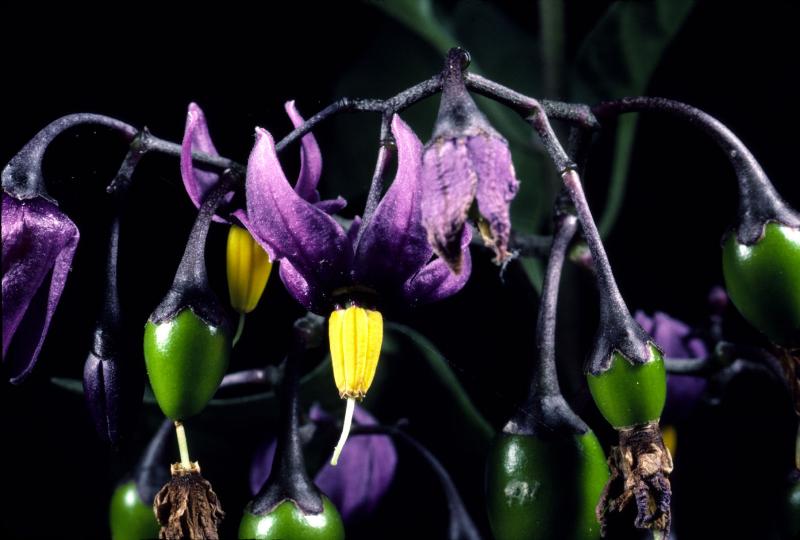
Hello ATS and Happy Weekend!,
It is raining cats and dogs here in Southern California and so it's time for rainy day activities. I want to share with you all today my love for one particular family of plants, Solanaceae or The Deadly Nightshade family they are arguably the most succesful family of plants on the planet, next to maybe corn, and I am hoping that you will be, like me, stunned by their usefulness, adaptability and stunning success in the world of living organisms.
What does it mean to be a successful plant? In the world of evolutionary biology success means adaptation. So the fundamental conditions for success for any organism will be measured by its abiltiy to adapt. But having been a plant lover my whole life, and having studied them both academically and as a humble observer in the garden, I have come to have some of my own notions about what it means to be a very successful plant species and I hope that when you see the stunning scope of Family Solanacae and it's Sub-Family, Solanoideae, that you will see that these plants do indeed exemplify, and instruct us, in what it means to be a succesful plant or organism of any kind.
I would like to cover three areas of interest wherein these plants have found the most success; Food, Medicine and Eurpoean/Central Asian/North American Witchcraft. And, of course, we will handle tobacco all on its own.
Food:
Tomatillos and Tomatoes: Solanum lycopersicum.
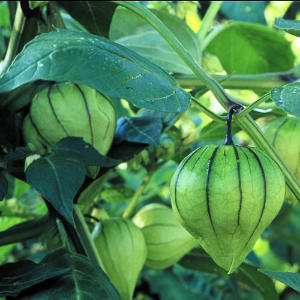
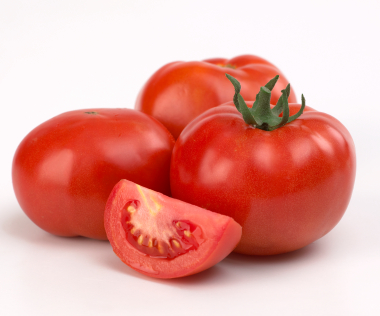
The tomato is native to South America. Genetic evidence shows the progenitors of tomatoes were herbaceous green plants with small green fruit and a center of diversity in the highlands of Peru.One species, Solanum lycopersicum, was transported to Mexico, where it was grown and consumed by Mesoamerican civilizations. The exact date of domestication is not known.
The first domesticated tomato may have been a little yellow fruit, similar in size to a cherry tomato, grown by the Aztecs of Central Mexico. Spanish explorer Cortés may have been the first to transfer the small yellow tomato to Europe after he captured the Aztec city of Tenochtítlan, now Mexico City, in 1521, although Christopher Columbus, a Genoese working for the Spanish monarchy, may have taken them back as early as 1493.
The earliest discussion of the tomato in European literature appeared in an herbal written in 1544 by Pietro Andrea Mattioli, an Italian physician and botanist, who named it pomo d’oro, or "golden apple".
en.wikipedia.org...
Potatoes: Solanum tuberosum.
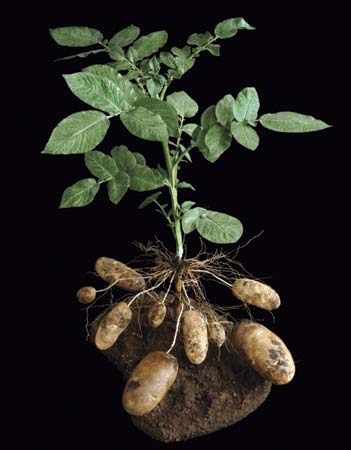
In the region of the Andes, there are some other closely related cultivated potato species. Potatoes were first introduced outside the Andes region four centuries ago, and have become an integral part of much of the world's cuisine. It is the world's fourth-largest food crop, following rice, wheat, and maize.
Following the Spanish conquest of the Inca Empire, the Spanish introduced the potato to Europe in the second half of the 16th century. The staple was subsequently conveyed by European mariners to territories and ports throughout the world. The potato was slow to be adopted by distrustful European farmers, but soon enough it became an important food staple and field crop that played a major role in the European 19th century population boom.
en.wikipedia.org...
Eggplant or Aubergine: Solanum melongena.
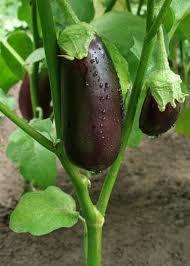
The plant is native to the Indian subcontinent. It has been cultivated in southern and eastern Asia since prehistory, but appears to have become known to the Western world no earlier than ca. 1500. The first known written record of the plant is found in Qí mín yào shù, an ancient Chinese agricultural treatise completed in 544.
The numerous Arabic and North African names for it, along with the lack of the ancient Greek and Roman names, indicate it was introduced throughout the Mediterranean area by the Arabs in the early Middle Ages. The scientific name Solanum melongena is derived from a 16th century Arabic term for one variety.
en.wikipedia.org...
Chili Peppers: Solanum capsicum. *Unbelievably successful!*
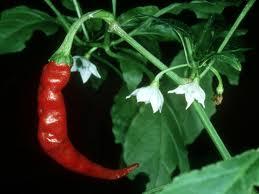
Chili peppers have been a part of the human diet in the Americas since at least 7500 BC. There is archaeological evidence at sites located in southwestern Ecuador that chili peppers were domesticated more than 6000 years ago, and is one of the first cultivated crops in the Central and South Americas that is self-pollinating.
Christopher Columbus was one of the first Europeans to encounter them (in the Caribbean), and called them "peppers" because they, like black and white pepper of the Piper genus known in Europe, have a spicy hot taste unlike other foodstuffs. Upon their introduction into Europe chilis were grown as botanical curiosities in the gardens of Spanish and Portuguese monasteries. But the monks experimented with the chilis' culinary potential and discovered that their pungency offered a substitute for black peppercorns, which at the time were so costly that they were used as legal currency in some countries.
Chilies were cultivated around the globe after Columbus. Diego Álvarez Chanca, a physician on Columbus' second voyage to the West Indies in 1493, brought the first chili peppers to Spain, and first wrote about their medicinal effects in 1494.
From Mexico, at the time the Spanish colony that controlled commerce with Asia, chili peppers spread rapidly into the Philippines and then to India, China, Indonesia, Korea and Japan. They were incorporated into the local cuisines.
en.wikipedia.org...
Gooseberries and Huckleberries: Dessert!
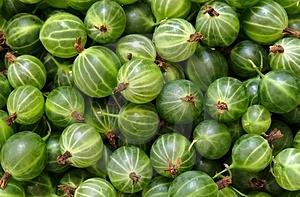
Good lord! look at the way that those plants were dragged to the ends of the earth. That is the meaning of success; that organisms find a niche that allows them to be spread and cultivated. We have so many wonderful culinary varieties of all of these solanaceous food plants. I know that we all enjoy some and probably all of these in our diets.
What could define more, the meaning of success for a plant, than to have its seeds lovingly carried across the earth to be excitedly planted and harvested. It is such a beautiful co-mingling of evolutionary growth for both plant and person.
continued....
Medicine
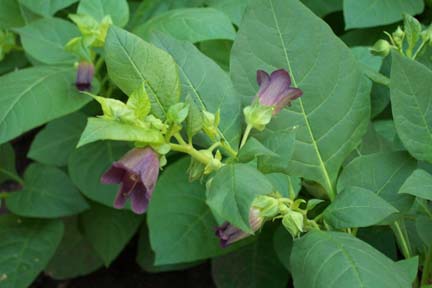
Deadly Nightshade? You may have asked? Well, yes, in the sense that if one were to ingest too much of certain members of this plant family, in certain preparations, it would, indeed, prove deadly.
Aside from being good eating, the main thing that the Solanaceae family is known for is the group useful chemicals that the plants yield up when prepared properly. The most famous of them are known as the Belladonna Alkaloids.
Belladonna is another name for the Nightshade plant or Atropa belladonna. I am sure we have all heard the story of ladies and opera divas using Belladonna drops to dilate their pupils so that they would seem more attractive. here is the group of chemicals that are found in belladonna that have been put to use by Medicine...
The Tropane Alkaloids
The tropane alkaloids have been used in conjunction with opiates for anesthesia since antiquity.All are anticholinergic, which is to say that they inhibit the neurotransmitter choline and so inhibit the parasympathetic nervous system. that means that in poisoning doses the smooth muscles can become paralyzed. Not very pleasant when you consider that at those same doses, these alkaloids cause extreme hallucinations; not nice when one is paralyzed.Please realize that all of this information is given in the spirit of learning and insight; partying with belladonna alkaloids is probably one of the single most unpleasant and possibly deadly things that one can engage in.
Atropine:
Interesting quote from WikiPedia:
Hyoscyamine:
This is the really hallucinogenic one, and we will return to it in the Witchcraft section. This alkaloid also makes the deadly nightshades very successful in the world, as Hyoscyamine is still widely used in medicine for all sorts of bowel disorders and as an aid to increasing the analgesia achieved by other drugs.
en.wikipedia.org...
Scopolamine:
maybe some of you have worn a 'Scop-patch'? Scopalamine is our friend for sure. This is the mtion sickness and anti-nausea drug. It is also hella-hallucinogenic in the wrong doses but we have found a way to befriend this alkoloid and put it to use for us.
So once more we get some more insight in to what it means to be the world's most successful family of plants. By forming a relationship with mankind, Family Solanaceae becomes even more successful, as human beings seek out ways to improve cultivation. It is a win win situation.
When you think about it, it makes these plants and others like them nearly equal partners, in a way, on this trip through the universe on spaceship earth.
And now, the fun part. lets look at the way that this family of plants has insinuated itself in to our culture and society in the form of witchcraft and folklore.
Deadly Nightshade? You may have asked? Well, yes, in the sense that if one were to ingest too much of certain members of this plant family, in certain preparations, it would, indeed, prove deadly.
Aside from being good eating, the main thing that the Solanaceae family is known for is the group useful chemicals that the plants yield up when prepared properly. The most famous of them are known as the Belladonna Alkaloids.
Belladonna is another name for the Nightshade plant or Atropa belladonna. I am sure we have all heard the story of ladies and opera divas using Belladonna drops to dilate their pupils so that they would seem more attractive. here is the group of chemicals that are found in belladonna that have been put to use by Medicine...
The Tropane Alkaloids
The tropane alkaloids have been used in conjunction with opiates for anesthesia since antiquity.All are anticholinergic, which is to say that they inhibit the neurotransmitter choline and so inhibit the parasympathetic nervous system. that means that in poisoning doses the smooth muscles can become paralyzed. Not very pleasant when you consider that at those same doses, these alkaloids cause extreme hallucinations; not nice when one is paralyzed.Please realize that all of this information is given in the spirit of learning and insight; partying with belladonna alkaloids is probably one of the single most unpleasant and possibly deadly things that one can engage in.
Atropine:
Interesting quote from WikiPedia:
"A common mnemonic used to describe the physiologic manifestations of atropine overdose is: as per Jon Blinkey "hot as a hare, blind as a bat, dry as a bone, red as a beet, and mad as a hatter".
en.wikipedia.org...
Hyoscyamine:
This is the really hallucinogenic one, and we will return to it in the Witchcraft section. This alkaloid also makes the deadly nightshades very successful in the world, as Hyoscyamine is still widely used in medicine for all sorts of bowel disorders and as an aid to increasing the analgesia achieved by other drugs.
en.wikipedia.org...
Scopolamine:
maybe some of you have worn a 'Scop-patch'? Scopalamine is our friend for sure. This is the mtion sickness and anti-nausea drug. It is also hella-hallucinogenic in the wrong doses but we have found a way to befriend this alkoloid and put it to use for us.
Other medical uses:
Scopolamine has been used in the past to treat addiction to drugs such as heroin and coc aine. The patient was given frequent doses of scopolamine until they were delirious. This treatment was maintained for 2 to 3 days after which they were treated with pilocarpine. After recovering from this they were said to have lost the acute craving to the drug to which they were addicted
Scopolamine causes memory impairments to a similar degree as diazepam. In October 2006, researchers at the US National Institute of Mental Health found that scopolamine reduced symptoms of depression within a few days, and the improvement lasted for at least a week after switching to a placebo.
Intravenously administered scopolamine has been found to be effective against major depressive disorder. A phase II clinical trial of its efficacy against both major depressive disorder and depression due to bipolar disorder when administered via transdermal patches is scheduled to finish in September 2011.
Due to its effectiveness against sea-sickness it has become commonly used by scuba divers. Scopolamine has been tested as a topical treatment for Aquagenic pruritus and was shown in several cases to be effective.
en.wikipedia.org...
So once more we get some more insight in to what it means to be the world's most successful family of plants. By forming a relationship with mankind, Family Solanaceae becomes even more successful, as human beings seek out ways to improve cultivation. It is a win win situation.
When you think about it, it makes these plants and others like them nearly equal partners, in a way, on this trip through the universe on spaceship earth.
And now, the fun part. lets look at the way that this family of plants has insinuated itself in to our culture and society in the form of witchcraft and folklore.
oh boy :3 im hungry now!
oh yea you becha the chili's are successful!
Chili Peppers: Solanum capsicum. *Unbelievably successful!*
wait... Solanum??? THE ZOMBIE VIRUS COMES FROM CHILI PEPPERS!??!?!
Oh Noes.... get the windows barricaded!!! lol!
oh yea you becha the chili's are successful!
Chili Peppers: Solanum capsicum. *Unbelievably successful!*
wait... Solanum??? THE ZOMBIE VIRUS COMES FROM CHILI PEPPERS!??!?!
Oh Noes.... get the windows barricaded!!! lol!
edit on 17-3-2012 by SoymilkAlaska because: (no reason given)
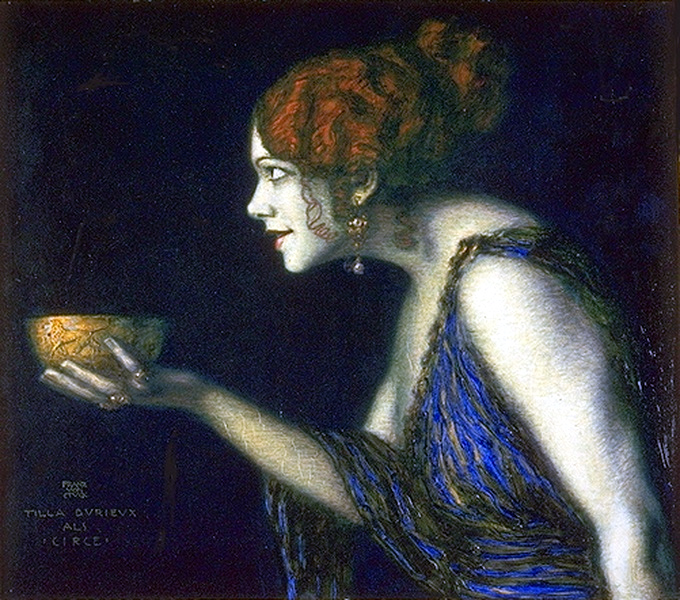
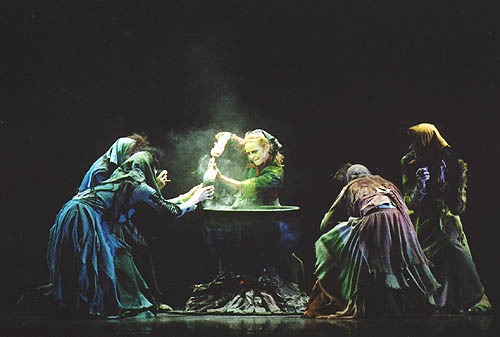
Circe representing the witch brigade. That's probably Dwale in the little bowl.
Dwale:
n. Error; delusion.
n. A sleeping-potion; a soporific.
n. The deadly nightshade, Atropa Belladonna, which possesses stupefying or poisonous properties.
n. In heraldry, a sable or black color.
To mutter deliriously.
Wiktionary
n. a sleeping-potion, especially one made from belladonna
n. belladonna itself, deadly nightshade; or some other soporific plant
GNU Webster's 1913
n. The deadly nightshade (Atropa Belladonna), having stupefying qualities.
n. The tincture sable or black when blazoned according to the fantastic system in which plants are substituted for the tinctures.
n. A sleeping potion; an opiate.
Dwale, the medieval ruphynol. A recipe from a 12th century manuscript:
“How to make a drink that men call dwale to make a man sleep whilst men cut him: take three spoonfuls of the gall [bile] (!) of a barrow swine [boar] for a man, and for a woman of a gilt [sow], three spoonfuls of hemlock juice, three spoonfuls of wild neep [bryony], three spoonfuls of lettuce, three spoonfuls of pape [opium], three spoonfuls of henbane, and three spoonfuls of eysyl [vinegar], and mix them all together and boil them a little and put them in a glass vessel well stopped and put thereof three spoonfuls into a potel of good wine and mix it well together.
“When it is needed, let him that shall be cut sit against a good fire and make him drink thereof until he fall asleep and then you may safely cut him, and when you have done your cure and will have him awake, take vinegar and salt and wash well his temples and his cheekbones and he shall awake immediately.”
www.ncbi.nlm.nih.gov...
You can barely taste the bile, I bet.
edit on 17-3-2012 by Eidolon23 because: Recipe add.
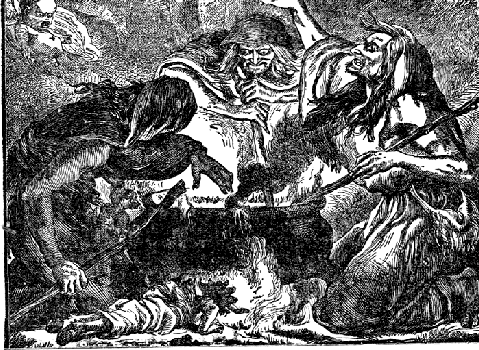
Witchcraft and Folklore
This really deserves a thread all unto itself, and I hope to bring you all one specifically on Mandrake in the near future. but for now, let's look at the Family Solanacae and Witchcraft; as I promised, some from Europe some from North America and a little lore from Central Asia, who knows, maybe the Urals too.
I am sure you have all heard mention of these; but did you know that they were all realted to tomatoes and potatos and tobacco?
Henbane: Hyoscyamus niger
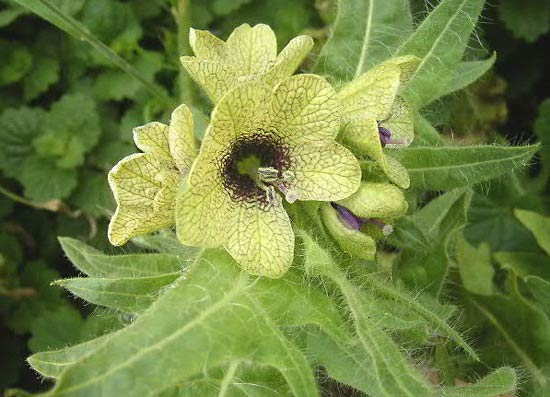
Henbane is very, very rich in Hyoscyamine, as you may have guessed. It is extraordinarily hallucinogenic and is the ingrediant par excellence of the 'flying potions' reported in European witchcraft. One of my favorite scholars and writers, Anthropologist Paul Devereux has written a very good article on the subject...
I paraphrase...
"One of the key elements of “witch lore” was that witches were able to fly on broomsticks, rods or other implements to their sabbats and other night-time gatherings in the wilderness beyond the pale of the town or village. “Flying ointments” were often used, either smeared on the person’s body or flying implements.
The people who became identified as “witches” by the Church were in actuality simply the continuation of an ancient tradition of “night travellers.” In northern Europe they were called qveldriga, “night rider,” or myrkrida, “rider in the dark.”
Medieval “witches” sometimes rubbed themselves with goose grease, perhaps enriched with hallucinogenic herbs, as a symbolic gesture of supernatural flight. Duerr remarks that the night flights were known as “grease flights” [Witch applying ointment] and the night travellers themselves called “grease birds” or “lard wings.” All this was the vestige of archaic spirit-flight symbolism invested in the goose, as expressed in the iconography of Siberian shamans"
As cited in the same article.
Researcher Nigel Jackson has noted:
"Celtic iconography from the Dauphine shows the goddess Epona riding upon a goose in flight. The high calls of the migrant geese on winter nights were poetically perceived as the baying of the spectral hounds by folk in the north of Europe and are closely linked with the flight of the Wild Hunt in Celtic and Germanic regions. "
dailygrail.com...
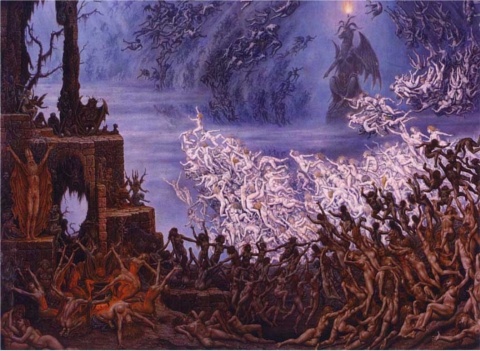
Mandrake. Mandragora officinarum.
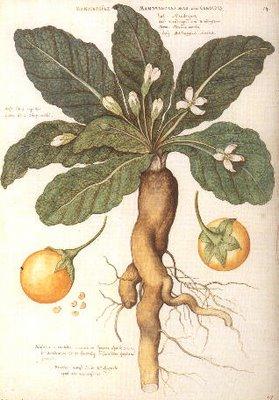
This is one of my favorite plants in the world. One of the things that I find interesting is that it has a folklore of its own in Central Asia and the middle East as well as Europe. In Islamic countries and in Central Asia, that mandrake or mandragora had been in development for hundreds of years as a medicine, especially as an anesthetic.
The Mandrake as well as the opium plant were the subjects of intense alchemical research and our brothers in the east made a great deal of progress decocting the medicinal essences of the mandrake in to useful tools for healing.
Ibn Beithor, the Arab herbalist, refers to the mandrake as 'The Devil's Candle', a title suggested by the plant's glistening appearance at night.
This luminosity is accounted for by the presence of numerous glow-worms at rest on the plants's ample leaves. The Moors, for the same reason, call mandrake 'The Lamp of the Elves'.
According to Ibn Beithor, sometimes styled 'the Arab Discorides', King Solomon had a portion of mandrake set in his famous signet ring, and by its power he held dominion over the jinn; further, the learned Arab tells us that
Alexander the Great owed his conquest of the East to the magical power of mandrake, and that it cures numerous maladies, including in its wide range elephantiasis and loss of memory. One Arab name for mandrake
is Abdul Selam, 'servant of health'.
www.whitedragon.org.uk...
continued...
edit on 17-3-2012 by Xoanon because: .
...Like Hemlock, henbane and Deadly Nightshade, mandrake seems to go hand and hand with the European witch cultus. mandrake is also considered to be a
powerful aphrodisiac. coupled with its other more straight forward pharmaceutical properties as a parasympathetic depressant, hallucinogen and
hypnotic, it is not surprising that we would find mandrake in the herbal arsenal of any witch, wherever it is able to grow.
So once again we find this very intriguing solanaceous plant enjoying a long and rich relationship with mankind and some of mankinds best minds.
Genus Datura.Genus Brugmansia.
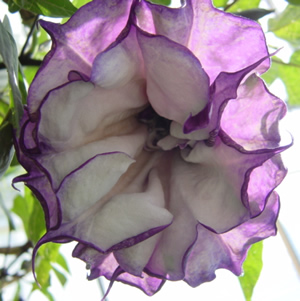
OK. Here is where it gets even more fun. We are going to take a quick look at datura, Castenada and North American Indian shamanism (brief) but what we really want to know about these two fantastic genii is that the species within these tribes of plants cover the globe (nearly) and are very widespread.
They all have the same active ingredients and they all have been impressed in to the use of witchcraft and shamanism for centuries, millennia even. They represent to us once more that Family Solanacae is a very, very special family of plant life that we have a very special relationship with.
Datura is spoken in Carlos Castaneda's books. These novels should all be taken with a fairly large grain of salt but it is still interesting to me that although Don Juan insists that the Datura is a harsh ally, Carlos seems to be chosen by the plant, and vice versa.
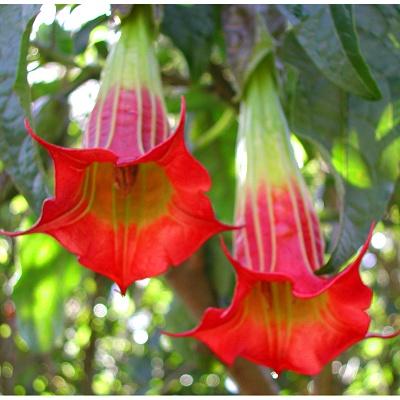
The South American counterpart to the Jimson Weed or Devil's Apple (Datura) is Brugmansias. Same deal here. I would like to just add an anthropologist's account of observing an Peruvian shaman under the influence of some brew of brugmansias...
Fun, huh? It must be worth it to bring back sacred and hidden knowledge to one's people.
So now we may have some more insight in to what it means to be a successful plant. It works both ways, we have benefited greatly from our relationship with all of these fantastic plants in family Solanaceae and they have benefited greatly from their relationship to us. We have helped to take one another very far. I like to think that thinking about plants and other organisms in this way can help us all to become a little more intimate with our connectedness to the web of life on earth. And...the solanaceous plants are just freaking cool.
I have not forgotten tobacco, probably the most successful of the batch. I will post on that as we go. Meanwhile, I hope that you have enjoyed this unusual journey in to the realm of Family Solanaceae. I learned an awful lot putting this together.
Thanks ATS.
X.
So once again we find this very intriguing solanaceous plant enjoying a long and rich relationship with mankind and some of mankinds best minds.
Genus Datura.Genus Brugmansia.
OK. Here is where it gets even more fun. We are going to take a quick look at datura, Castenada and North American Indian shamanism (brief) but what we really want to know about these two fantastic genii is that the species within these tribes of plants cover the globe (nearly) and are very widespread.
They all have the same active ingredients and they all have been impressed in to the use of witchcraft and shamanism for centuries, millennia even. They represent to us once more that Family Solanacae is a very, very special family of plant life that we have a very special relationship with.
Datura is spoken in Carlos Castaneda's books. These novels should all be taken with a fairly large grain of salt but it is still interesting to me that although Don Juan insists that the Datura is a harsh ally, Carlos seems to be chosen by the plant, and vice versa.
"She (Datura) is as powerful as the best of allies, but there is something I personally don't like about her. She distorts men. She gives them a taste of power too soon without fortifying their hearts and makes them domineering and unpredictable. She makes them weak in the middle of their great power."
Don Juan Matos.
The South American counterpart to the Jimson Weed or Devil's Apple (Datura) is Brugmansias. Same deal here. I would like to just add an anthropologist's account of observing an Peruvian shaman under the influence of some brew of brugmansias...
Soon after drinking the Tonga, the man fell into a dull brooding, he stared vacantly at the ground, his mouth was closed firmly, almost convulsively and his nostrils were flared. Cold sweat covered his forehead. He was deathly pale. The jugular veins on his throat were swollen as large as a finger and he was wheezing as his chest rose and sank slowly.
His arms hung down stiffly by his body. Then his eyes misted over and filled with huge tears and his lips twitched convulsively for a brief moment. His carotids were visibly beating, his respiration increased and his extremities twitched and shuddered of their own accord. This condition would have lasted about a quarter of an hour, then all these actions increased in intensity.
His eyes were now dry but had become bright red and rolled about wildly in their sockets and all his facial muscles were horribly distorted. A thick white foam leaked out between his half open lips. The pulses on his forehead and throat were beating too fast to be counted. His breathing was short, extraordinarily fast and did not seem to lift the chest, which was visibly fibrillating. A mass of sticky sweat covered his whole body which continued to be shaken by the most dreadful convulsions.
His limbs were hideously contorted. He alternated between murmuring quietly and incomprehensibly and uttering loud, heart-rending shrieks, howling dully and moaning and groaning.
en.wikipedia.org...
Fun, huh? It must be worth it to bring back sacred and hidden knowledge to one's people.
So now we may have some more insight in to what it means to be a successful plant. It works both ways, we have benefited greatly from our relationship with all of these fantastic plants in family Solanaceae and they have benefited greatly from their relationship to us. We have helped to take one another very far. I like to think that thinking about plants and other organisms in this way can help us all to become a little more intimate with our connectedness to the web of life on earth. And...the solanaceous plants are just freaking cool.
I have not forgotten tobacco, probably the most successful of the batch. I will post on that as we go. Meanwhile, I hope that you have enjoyed this unusual journey in to the realm of Family Solanaceae. I learned an awful lot putting this together.
Thanks ATS.
X.
edit on 17-3-2012 by Xoanon because: .
reply to post by Xoanon
Native Andean Potatoes!
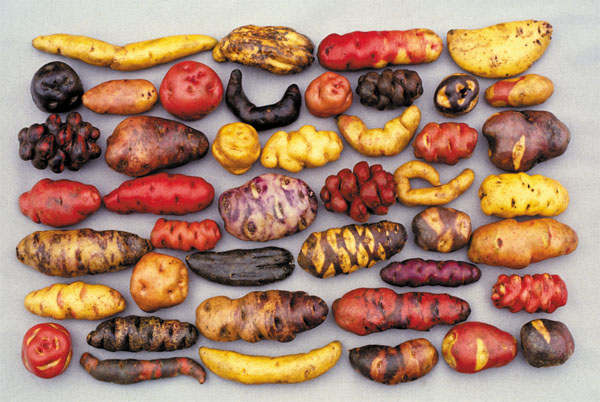
A farmer I worked with once told me that all blight-resistant potatoes must be replaced three generations out by fresh new strains from the Andes, as they lost their resistance very quickly. That if we lost access to the resistant strains grown and bred in that region, we would have to do without potatoes altogether.
I can't imagine a world without potatoes. It does not bear thinking about.
It appears that the potato farmers in those parts really know their stuff. Because, although only a few varieties are in commercial demand, they maintain a crazy diverse stock.
Native Andean Potatoes!
A farmer I worked with once told me that all blight-resistant potatoes must be replaced three generations out by fresh new strains from the Andes, as they lost their resistance very quickly. That if we lost access to the resistant strains grown and bred in that region, we would have to do without potatoes altogether.
I can't imagine a world without potatoes. It does not bear thinking about.
It appears that the potato farmers in those parts really know their stuff. Because, although only a few varieties are in commercial demand, they maintain a crazy diverse stock.
Over 4,000 varieties of native potatoes grow in the Andean highlands of Peru, Boliva, and Ecuador.
Selected over centuries for their taste, texture, shape and color, these potato varieties are very
well adapted to the harsh conditions that prevail in the high Andes, at altitudes ranging from 3,500 to 4,200 meters. Farmers generally produce these native varieties with minimal or no use of agrochemicals.
Diversity is conserved on farms and in communities for subsistence use and as a highly valued heritage. Most of these varieties never see a market; they are traded among highland and lowland communities and given as gifts for weddings and other occasions. The varieties differ from community to community.
It is believed that wild tubers were first domesticated around 8,000 years ago by farmers who lived on the high plains and mountain slopes near Lake Titicaca, which borders modern-day Bolivia and Peru. The tubers grew well in the cold, harsh climate and quickly took root as a centerpiece around which life revolved.
cipotato.org...
edit on 17-3-2012 by Eidolon23 because:
Thanks for the well put together thread with a wealth of information about a plant family!
This was crucial knowledge of the past and I feel that we could all benefit from re-gaining the ignored, if not lost knowledge.
I loves me some potatoes, but I had absolutely no idea there were that many different types. I could eat a different type of potato for years and not try them all it seems.
This was crucial knowledge of the past and I feel that we could all benefit from re-gaining the ignored, if not lost knowledge.
I loves me some potatoes, but I had absolutely no idea there were that many different types. I could eat a different type of potato for years and not try them all it seems.
Originally posted by Eidolon23
reply to post by Xoanon
Native Andean Potatoes!
It appears that the potato farmers in those parts really know their stuff. Because, although only a few varieties are in commercial demand, they maintain a crazy diverse stock.
These are making me so, so hungry. I just want to grab them and start munching.
Thank you for the wonderful posts, Eidolon, the recipe for the cunning philtre is really precious.
X.
edit on 17-3-2012 by Xoanon because: .
reply to post by JizzyMcButter
You are so totally welcome, JizzyMcButter.
I agree. When we are able to see the way that we are intertwined with our world through our commerce with other living things, it makes it feel as though we are all on this ride together. That is some priceless feedback to have, in my opinion. I am personally humbled by how slick the whole solanaceae family is at getting themselves dispersed throughout the world.
Thanks for posting.
X.
You are so totally welcome, JizzyMcButter.
I agree. When we are able to see the way that we are intertwined with our world through our commerce with other living things, it makes it feel as though we are all on this ride together. That is some priceless feedback to have, in my opinion. I am personally humbled by how slick the whole solanaceae family is at getting themselves dispersed throughout the world.
Thanks for posting.
X.
edit on 17-3-2012 by Xoanon because: .
reply to post by Xoanon
F&S
and stars for guest lecturer Eidolon23
i knew that there were many varieties and colors of corn [maize]
but knew naught re potatoes
the blight resistance being lost after 3 generations was new to me too
xoanon, lol as soon as i saw the page i saved just in case it runs afoul of t and c
you mentioned flying ointment and its application
it reminded me of a bit of local lore [P.R.] my grandma once told me [and regret not following up]
here in PR and neighboring islands when a witch flies she "peels her skin off and hides it by hanging it from a tree"
perhaps the local ointment or more probable medicinal bath was pretty strong stuff?
great thread and hopefully it's academic value will outweigh any mention of "power plants"
and will remain here
F&S
and stars for guest lecturer Eidolon23
i knew that there were many varieties and colors of corn [maize]
but knew naught re potatoes
the blight resistance being lost after 3 generations was new to me too
xoanon, lol as soon as i saw the page i saved just in case it runs afoul of t and c
you mentioned flying ointment and its application
it reminded me of a bit of local lore [P.R.] my grandma once told me [and regret not following up]
here in PR and neighboring islands when a witch flies she "peels her skin off and hides it by hanging it from a tree"
perhaps the local ointment or more probable medicinal bath was pretty strong stuff?
great thread and hopefully it's academic value will outweigh any mention of "power plants"
and will remain here
reply to post by DerepentLEstranger
This is a really golden little bit of shared folklore. Thanks for putting that out there, D. Maybe that ointment had a bunch of chilis in it?
The thing that gets me is that the universal object of this whole 'greasing ones self in ointment' routine seemed to be to fly. And it occurs wherever the solanaceous plants grow.
Thanks for the vote of confidence, I guess I will need it. I did not really think of it before posting. I just really sincerely love and get excited about this group of plants. They have been an interest of mine from boyhood. I know that may seem strange but I am one of those that grew up around gardens on both sides of the family and I actually worked in the plant trade, both cultivation and consultation, for a time.
The ways that plants tie in to our societies and culture through folk practices and medicine is an endless source of fascination for me.
I would like to think that anyone that makes their way to ATS is mature enough to understand that it would very likely be fatal to follow through with any ill conceived plans concerning any of these plants, except of course the food which should be consumed in mass quantities.
Unless one has arthritis...
I am going to get to that very soon.
Thank you for being here, D. It is always good to see you.
X.
it reminded me of a bit of local lore [P.R.] my grandma once told me [and regret not following up] here in PR and neighboring islands when a witch flies she "peels her skin off and hides it by hanging it from a tree" perhaps the local ointment or more probable medicinal bath was pretty strong stuff?
This is a really golden little bit of shared folklore. Thanks for putting that out there, D. Maybe that ointment had a bunch of chilis in it?
The thing that gets me is that the universal object of this whole 'greasing ones self in ointment' routine seemed to be to fly. And it occurs wherever the solanaceous plants grow.
great thread and hopefully it's academic value will outweigh any mention of "power plants" and will remain here
Thanks for the vote of confidence, I guess I will need it. I did not really think of it before posting. I just really sincerely love and get excited about this group of plants. They have been an interest of mine from boyhood. I know that may seem strange but I am one of those that grew up around gardens on both sides of the family and I actually worked in the plant trade, both cultivation and consultation, for a time.
The ways that plants tie in to our societies and culture through folk practices and medicine is an endless source of fascination for me.
I would like to think that anyone that makes their way to ATS is mature enough to understand that it would very likely be fatal to follow through with any ill conceived plans concerning any of these plants, except of course the food which should be consumed in mass quantities.
Unless one has arthritis...
I am going to get to that very soon.
Thank you for being here, D. It is always good to see you.
X.
reply to post by Xoanon
ah, perhaps you're not getting it
virgins blood = strawberry jam
Flying= Astral Projection
universality is usually a testament to antiquity
in this case paleolithic, easily
these solanaceous plants especially the ones for flight were definitely
transported and transplanted worldwide by the ancients.
along with the lore behind them.
is there any idea where the family originated?
The thing that gets me is that the universal object of this whole 'greasing ones self in ointment' routine seemed to be to fly. And it occurs wherever the solanaceous plants grow.
ah, perhaps you're not getting it
virgins blood = strawberry jam
Flying= Astral Projection
universality is usually a testament to antiquity
in this case paleolithic, easily
these solanaceous plants especially the ones for flight were definitely
transported and transplanted worldwide by the ancients.
along with the lore behind them.
is there any idea where the family originated?
reply to post by DerepentLEstranger
Tobacco. Genus Nicotiana

Well D,
This is going to have to take us to what is probably the most successful plant amongst these most successful plants: tobacco. We may have to take tobacco in several posts, but as far as reckoning the origins of family Solanaceae, which is difficult, we may as well begin with tobacco.
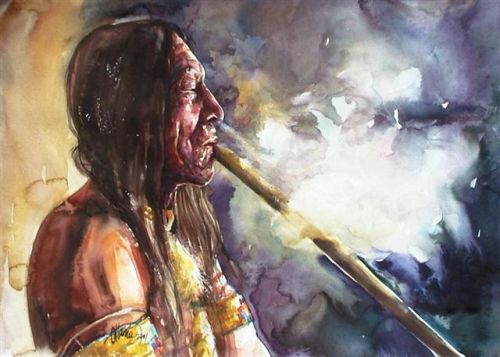
Native North Americans had been cultivating tobacco for hundreds of years before European colonizers arrived. The fact is, that due to polyploidy* and commercial cultivation of ornamental nicotianas, we will never really know the exact origins of all of these solanaceous plants.
Geez, D, as I think about it, and with a fairly cursory inspection of the web with Google, that is a really tough question.
I think it is safe to say that these plants have been with us for 4500 years or so, in other words, as long as there has been antedeluvian mankind.
X.
*Polyploidy:
Roughly, this means that, due to genetic coding issues (mistakes), plants within a group produce more than one set of chromosomes. They can't breed with the group of plants they grew up in, and so become genetically isolated. If they can, and they sometimes are able to, breed, then they will with themselves and a new species occurs. And therefore genetic mutations (adaptations) can occur within isolated geographies of plants, so whole different looking (colors, sexual apparatus) plants can spring up in a giant batch of the same kind of plants.
Tobacco. Genus Nicotiana
Well D,
This is going to have to take us to what is probably the most successful plant amongst these most successful plants: tobacco. We may have to take tobacco in several posts, but as far as reckoning the origins of family Solanaceae, which is difficult, we may as well begin with tobacco.
Native North Americans had been cultivating tobacco for hundreds of years before European colonizers arrived. The fact is, that due to polyploidy* and commercial cultivation of ornamental nicotianas, we will never really know the exact origins of all of these solanaceous plants.
Geez, D, as I think about it, and with a fairly cursory inspection of the web with Google, that is a really tough question.
I think it is safe to say that these plants have been with us for 4500 years or so, in other words, as long as there has been antedeluvian mankind.
X.
*Polyploidy:
Polyploid is a term used to describe cells and organisms containing more than two paired (homologous) sets of chromosomes. Most eukaryotic species are diploid, meaning they have two sets of chromosomes — one set inherited from each parent. However polyploidy is found in some organisms and is especially common in plants.
en.wikipedia.org...
Roughly, this means that, due to genetic coding issues (mistakes), plants within a group produce more than one set of chromosomes. They can't breed with the group of plants they grew up in, and so become genetically isolated. If they can, and they sometimes are able to, breed, then they will with themselves and a new species occurs. And therefore genetic mutations (adaptations) can occur within isolated geographies of plants, so whole different looking (colors, sexual apparatus) plants can spring up in a giant batch of the same kind of plants.
edit on 18-3-2012 by Xoanon because:
really cool thread!!! i am no botanist by a far stretch, but early on when i was studying witchcraft i read about henbane,wolfbane,belladonna,mandrake
and the likes. all this is probably the reason i started growing my own food!
people are always surprised when i tell them that tomatoes are part of the deadly nightshade family! then i tell them to eat the leaves and youl see! lol
peppers are on of my fav. veggies,the hotter the better!!! so healthy for you lots o vitamin c.
perhaps your next post could be about the particular properties of herbs and their magical uses. you seem to be knowlegeable of the plant kingdom. i've learned alot from you friend and for that i thank you!
people are always surprised when i tell them that tomatoes are part of the deadly nightshade family! then i tell them to eat the leaves and youl see! lol
peppers are on of my fav. veggies,the hotter the better!!! so healthy for you lots o vitamin c.
perhaps your next post could be about the particular properties of herbs and their magical uses. you seem to be knowlegeable of the plant kingdom. i've learned alot from you friend and for that i thank you!
Awesome thread. Glad you refreshed my memory on some of these awesome plants in nature
reply to post by Xoanon
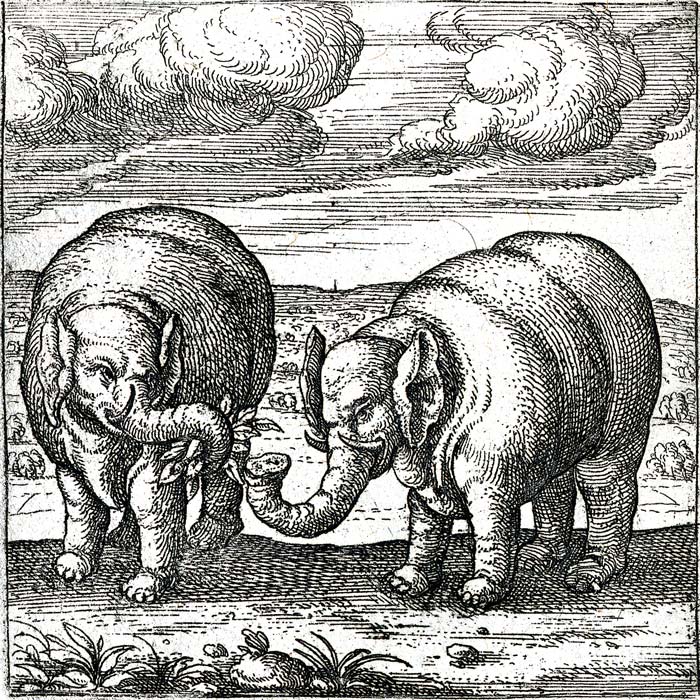
One of my favorite pieces of plant folklore ever concerns the mandrake root and that most chaste of beasts, the elephant. In this illustration, we see an elephant offering a mandrake to its mate.
One of my favorite pieces of plant folklore ever concerns the mandrake root and that most chaste of beasts, the elephant. In this illustration, we see an elephant offering a mandrake to its mate.
They are free of wicked desire for sex; when they wish to produce children, they go to the east near paradise, where a plant called mandrake grows. The female first takes some of the plant, then offers it to the male and persuades him to eat it. Becoming aroused from the action of the plant, they mate and the female immediately conceives. When it is time for her to give birth, for safety from their enemy the serpent (or the dragon) she enters a body of water up to her teats, and there gives birth, while the male stands guard on shore. The young elephant swims until it finds its mother's thighs and suckles from her teats.
...The female elephant seeks a plant called mandrake; when she tastes it she becomes aroused with lust. She offers the plant to the male, who also becomes aroused, and they mate.
spcoll.library.uvic.ca...
edit on 18-3-2012 by Eidolon23 because: (no reason given)
We grow a lot of the nightshades.
Yep, all witches here.
Did you include Datura stramonium?
There flowers are really quite lovely.
We've got mandrakes too. Some are looking like they will bloom this year so we are excited to get fruit, and hence, seeds.
We grow them in long sewer pipe.
Nightshades can inhibit other plant's growth though. They are all magickal, beautiful plants.
The new eggplants put out by Mansanto- not so much. All the bugs eat them and they are ...bleh....
Yep, all witches here.
Did you include Datura stramonium?
There flowers are really quite lovely.
We've got mandrakes too. Some are looking like they will bloom this year so we are excited to get fruit, and hence, seeds.
We grow them in long sewer pipe.
Nightshades can inhibit other plant's growth though. They are all magickal, beautiful plants.
The new eggplants put out by Mansanto- not so much. All the bugs eat them and they are ...bleh....
Hope this link works - love this clip - Hitler and the Mandrake
I just want to post a reply so that I can make sure and read about you have to say about tobacco
Tired of Control Freaks
Tired of Control Freaks
new topics
-
Sleep paralysis and the implantation of some weird Matrix-esque demon creature...
The Gray Area: 1 hours ago -
Say his name
US Political Madness: 1 hours ago -
There is no such thing as moonlight.
Space Exploration: 2 hours ago -
Breaking: 5 probed after 18-year old girl dies as a result of having the COVID jab
Diseases and Pandemics: 3 hours ago -
Official denial
Diseases and Pandemics: 6 hours ago -
MEGA - Let's Make Europe Great Again
Other Current Events: 6 hours ago -
Hamas and Other Islamist Terrorist Groups Announce Support of US Campus Anti-Israel Protests
Education and Media: 7 hours ago -
Psychotronic Operation Rwanda Who Wants To Be A Refugee?
ATS Skunk Works: 7 hours ago
top topics
-
Breaking: 5 probed after 18-year old girl dies as a result of having the COVID jab
Diseases and Pandemics: 3 hours ago, 11 flags -
Psychotronic Operation Rwanda Who Wants To Be A Refugee?
ATS Skunk Works: 7 hours ago, 5 flags -
Hamas and Other Islamist Terrorist Groups Announce Support of US Campus Anti-Israel Protests
Education and Media: 7 hours ago, 5 flags -
Official denial
Diseases and Pandemics: 6 hours ago, 5 flags -
AI phrenology
Science & Technology: 14 hours ago, 4 flags -
There is no such thing as moonlight.
Space Exploration: 2 hours ago, 4 flags -
Say his name
US Political Madness: 1 hours ago, 4 flags -
MEGA - Let's Make Europe Great Again
Other Current Events: 6 hours ago, 3 flags -
Sleep paralysis and the implantation of some weird Matrix-esque demon creature...
The Gray Area: 1 hours ago, 1 flags
active topics
-
There is no such thing as moonlight.
Space Exploration • 11 • : stonerwilliam -
Say his name
US Political Madness • 11 • : Bluntone22 -
Sleep paralysis and the implantation of some weird Matrix-esque demon creature...
The Gray Area • 3 • : Macenroe82 -
Hamas and Other Islamist Terrorist Groups Announce Support of US Campus Anti-Israel Protests
Education and Media • 13 • : FlyersFan -
University of Texas Instantly Shuts Down Anti Israel Protests
Education and Media • 387 • : burritocat -
Hate makes for strange bedfellows
US Political Madness • 63 • : Terpene -
-@TH3WH17ERABB17- -Q- ---TIME TO SHOW THE WORLD--- -Part- --44--
Dissecting Disinformation • 715 • : Thoughtful3 -
MEGA - Let's Make Europe Great Again
Other Current Events • 26 • : stonerwilliam -
Supreme Court Oral Arguments 4.25.2024 - Are PRESIDENTS IMMUNE From Later Being Prosecuted.
Above Politics • 124 • : Sookiechacha -
The theory that COVID-19 originated in China takes a body blow.
Diseases and Pandemics • 55 • : burritocat