It looks like you're using an Ad Blocker.
Please white-list or disable AboveTopSecret.com in your ad-blocking tool.
Thank you.
Some features of ATS will be disabled while you continue to use an ad-blocker.

At last, The "Watergate" Of 9/11 :
page: 14share:
These are the 3 IRS procedure screenshots I took from the Boeing 757's types 200, 300 manuals, with their full and fast align procedures described in
them.
Part 1: files.abovetopsecret.com...
Full Align procedure, approx. 10 minutes, at high latitude approx. 17 minutes :
Part 2: files.abovetopsecret.com...
Fast Align procedure, approx. 30 seconds :
Part 3: files.abovetopsecret.com...
So, fast align could be done very fast by just positioning selectors to ALIGN and then repositioning selectors to NAV. However, greater navigational accuracy was attained by entering the present position.
Can it be that one of the pilots was bored or was in learning mode, and played around with these selector knobs?
Or did they worry that too much drift was accumulated during parking while in the taxi lanes, and therefore did all those fast aligns? It seems a pretty fast method to me, lasting even much shorter than the 30 seconds which stand for it. Click, click, ready.
Now I am gonna re-read your complicated post, to try to comprehend what you were steering at.
I was simply pointing out, that there is hard evidence from that FDR positional data, corrected for accumulated drift, that AAL77 in fact really departed from its original Gate D26.
And may I point out too, that I seem to be the only one in 9/11 forum land up till now, who found that out (assisted of course by the precluding fine work of Jan Zelman, an analytical mind, just as mine).
Not one of you, the professional pilots, dared to confront Balsamo with his misguiding northern departure gate stories. Which he still maintains at his board's main pages.
So, why the condescending tone? Laymen can be having fresh insights, as I proved with the above corrected taxi lanes trajectory for AAL77 departing from Dulles.
Which has in my opinion nothing to do with flying a 757, that's why I can come up with that solution for the nagging PfT Gates confusion.
I did my best to quickly repeat from memory, what I have grasped from all the professional input regarding flying a 757-200. And that in a language which is not mine. Meant for other laymen. Not for pilots. As can be seen, when pilots start talking their trade, we have difficulty to grasp their vocabulary. But a quick view in the Manuals brings us back at pace, most of the time.
I took especially notice of the sentence "" A full alignment must be accomplished when the time from the last full alignment to the completion of the next flight exceeds 18 hours.""
Well, that never happened for AAL77, it flew all the time (years) vice-versa from IAD to LAX and back, arriving back at IAD in the early evening, and departing in the early morning. Never exceeding those 18 hours. Thus, no need for a full align, when I, as a layman, read that Boeing Flight Manual text near the top of my linked to, IRS Part 3.
Because even a very fast align would suffice, since the IRS remembers the evening data, when it is started up again in the morning, after being towed with no electric power on, in the night, around the C and D Concourse building from its northern arrival gate, and down to Gate D26.
But for the sake of clarity, let's make a first full align in the morning. That's thus "the last full alignment". Then we fly 6 hours, land and park at a LAX gate. And depart from LAX f.ex. 4 hours later again. No need for a full align at LAX, no 18 hrs spent there. Arrival at IAD again 6 hrs later, parked at northern gate, power off, towed in the night to D26, power on in the early morning, no 18 hrs spent at IAD, no need for a full align. Etcetera ad infinitum.
I can imagine however the strict airline rule for a full align after each engine and APU start up, but according to the rules description in the Inertial Reference System part of the Boeing 757 Flight Crew Operations Manual, (my linked to Part-3), it was not even necessary.
A fast align with entering present position sufficed, since the 18 hours boundary was never crossed. And at wheels off from the runway, the plane's lat.-long.-position got very fast updated anyway.
See the map of the first minutes after AAL77 departure from Dulles, posted by Balsamo in disguise, a few page back, with the fast drifting together positions, listed in there. You see them come together pretty fast after take off. That means that first in-flight positional update takes little time to correct all drift faults. It's an update, not an in flight alignment, that's possible for civilian planes only after 2002.
Part 1: files.abovetopsecret.com...
Full Align procedure, approx. 10 minutes, at high latitude approx. 17 minutes :
Part 2: files.abovetopsecret.com...
Fast Align procedure, approx. 30 seconds :
Part 3: files.abovetopsecret.com...
So, fast align could be done very fast by just positioning selectors to ALIGN and then repositioning selectors to NAV. However, greater navigational accuracy was attained by entering the present position.
Can it be that one of the pilots was bored or was in learning mode, and played around with these selector knobs?
Or did they worry that too much drift was accumulated during parking while in the taxi lanes, and therefore did all those fast aligns? It seems a pretty fast method to me, lasting even much shorter than the 30 seconds which stand for it. Click, click, ready.
Now I am gonna re-read your complicated post, to try to comprehend what you were steering at.
I was simply pointing out, that there is hard evidence from that FDR positional data, corrected for accumulated drift, that AAL77 in fact really departed from its original Gate D26.
And may I point out too, that I seem to be the only one in 9/11 forum land up till now, who found that out (assisted of course by the precluding fine work of Jan Zelman, an analytical mind, just as mine).
Not one of you, the professional pilots, dared to confront Balsamo with his misguiding northern departure gate stories. Which he still maintains at his board's main pages.
So, why the condescending tone? Laymen can be having fresh insights, as I proved with the above corrected taxi lanes trajectory for AAL77 departing from Dulles.
Which has in my opinion nothing to do with flying a 757, that's why I can come up with that solution for the nagging PfT Gates confusion.
I did my best to quickly repeat from memory, what I have grasped from all the professional input regarding flying a 757-200. And that in a language which is not mine. Meant for other laymen. Not for pilots. As can be seen, when pilots start talking their trade, we have difficulty to grasp their vocabulary. But a quick view in the Manuals brings us back at pace, most of the time.
I took especially notice of the sentence "" A full alignment must be accomplished when the time from the last full alignment to the completion of the next flight exceeds 18 hours.""
Well, that never happened for AAL77, it flew all the time (years) vice-versa from IAD to LAX and back, arriving back at IAD in the early evening, and departing in the early morning. Never exceeding those 18 hours. Thus, no need for a full align, when I, as a layman, read that Boeing Flight Manual text near the top of my linked to, IRS Part 3.
Because even a very fast align would suffice, since the IRS remembers the evening data, when it is started up again in the morning, after being towed with no electric power on, in the night, around the C and D Concourse building from its northern arrival gate, and down to Gate D26.
But for the sake of clarity, let's make a first full align in the morning. That's thus "the last full alignment". Then we fly 6 hours, land and park at a LAX gate. And depart from LAX f.ex. 4 hours later again. No need for a full align at LAX, no 18 hrs spent there. Arrival at IAD again 6 hrs later, parked at northern gate, power off, towed in the night to D26, power on in the early morning, no 18 hrs spent at IAD, no need for a full align. Etcetera ad infinitum.
I can imagine however the strict airline rule for a full align after each engine and APU start up, but according to the rules description in the Inertial Reference System part of the Boeing 757 Flight Crew Operations Manual, (my linked to Part-3), it was not even necessary.
A fast align with entering present position sufficed, since the 18 hours boundary was never crossed. And at wheels off from the runway, the plane's lat.-long.-position got very fast updated anyway.
See the map of the first minutes after AAL77 departure from Dulles, posted by Balsamo in disguise, a few page back, with the fast drifting together positions, listed in there. You see them come together pretty fast after take off. That means that first in-flight positional update takes little time to correct all drift faults. It's an update, not an in flight alignment, that's possible for civilian planes only after 2002.
So what's up, doc?
I read all the posts from a few other professionals in this thread's pages, and they seem to agree with eachother, that a full align is not necessary, since the allowed positional fault margin given for positional errors at big airports like IAD are from 1 to 10 miles wide.
And that's what Balsamo kept bringing forth, that not one pilot would depart with an accumulated fault margin of 3000+ feet. Which is however far within the allowed positional fault margin for IAD (LAX too, btw).
Are you now suddenly agreeing with Balsamo? Who says he can't find evidence of a full align in the FDR at IAD.
""PB : There are no "cockpit positional instruments".
LT : I meant the overhead IRS panel with the three IRS NAV etc. setting knobs above the Pilot seat, as you understood of course. And the same panel above the Flight Officer's seat.
You did understand what I meant, ain't it so? Yep, I am no airliner pilot, so do not talk the "talk". But I have a high-res picture of that 757-200 overhead panel.
""PB : and, as has been repeatedly pointed out, even if there had been a bit of "Map Shift" during the taxi for takeoff, it is irrelevant, back then. The Inertial Nav is not used, nor even referenced, until after takeoff....and it has a chance, then, to receive radio updating. ""
LT : That's pretty much what I have deduced from the other pilots posts, and wrote already much earlier about the same words in my posts. Shortly after wheels off, the IRS positional data get updated very fast by radio signals.
I do like the professional input, do remember we do not talk the talk, have mercy with us.
Our brains are the same as yours, when you accept that, we can still debate at equal level.
And I will still bow for your expertise, while not bowing for authority. That's a small, but significant difference. We learned to trust nobody, peers are our lifeline in our communities.
Probably the same for you, your pilot- and ground personnel colleagues can save your life by given you solid advice, which you perhaps did not know of, before.
De-icing tips seem to be such a niche of old "aces" knowledge.
Which can save the life of the young "guns" and their passengers.
I read all the posts from a few other professionals in this thread's pages, and they seem to agree with eachother, that a full align is not necessary, since the allowed positional fault margin given for positional errors at big airports like IAD are from 1 to 10 miles wide.
And that's what Balsamo kept bringing forth, that not one pilot would depart with an accumulated fault margin of 3000+ feet. Which is however far within the allowed positional fault margin for IAD (LAX too, btw).
Are you now suddenly agreeing with Balsamo? Who says he can't find evidence of a full align in the FDR at IAD.
""PB : There are no "cockpit positional instruments".
LT : I meant the overhead IRS panel with the three IRS NAV etc. setting knobs above the Pilot seat, as you understood of course. And the same panel above the Flight Officer's seat.
You did understand what I meant, ain't it so? Yep, I am no airliner pilot, so do not talk the "talk". But I have a high-res picture of that 757-200 overhead panel.
""PB : and, as has been repeatedly pointed out, even if there had been a bit of "Map Shift" during the taxi for takeoff, it is irrelevant, back then. The Inertial Nav is not used, nor even referenced, until after takeoff....and it has a chance, then, to receive radio updating. ""
LT : That's pretty much what I have deduced from the other pilots posts, and wrote already much earlier about the same words in my posts. Shortly after wheels off, the IRS positional data get updated very fast by radio signals.
I do like the professional input, do remember we do not talk the talk, have mercy with us.
Our brains are the same as yours, when you accept that, we can still debate at equal level.
And I will still bow for your expertise, while not bowing for authority. That's a small, but significant difference. We learned to trust nobody, peers are our lifeline in our communities.
Probably the same for you, your pilot- and ground personnel colleagues can save your life by given you solid advice, which you perhaps did not know of, before.
De-icing tips seem to be such a niche of old "aces" knowledge.
Which can save the life of the young "guns" and their passengers.
reply to post by LaBTop
I do not understand why it is so difficult to explain these misconceptions to you. There are so many, I just selected this one, as example:
Firstly, it is ludicrous to think that the same airplane did "nothing else" but fly from KIAD to KLAX and back for "years".
This is NOT how the real airline industry works!!
Secondly.....I think, by now, I've mentioned this several times before (?). At the end of each flight, the IRUs are completely shut down. Look again at the "biggles" information you posted. The position for the IRU mode selectors....the "OFF" position. This is done at the end of each flight. It is an item on the "Parking Checklist", to verify they have been turned "off". This means that they MUST be fully aligned the next time.
Furthermore, on overnights there is a point, usually, when the entire airplane is powered down. This is perfectly routine. At a base where the airline has its own maintenance personnel, this is left up to them, after they compete any required checks that night, per the maintenance schedules and protocols required. The mechanics then properly complete the power-down.
When the overnight is at a non-maintenance location, then it is the flight crew's responsibility. The thing that may confuse the layperson is, the existence of what's called (in Boeing parlance) the "Ground Service Bus", and the various cabin items that are powered by that source. Usually only lights, interior and exterior and the 115 Volt AC power receptacles, and also any other systems such as the lavatories, etc, all for the convenience of the people who need to service the airplane. None of the cockpit instruments, lights, etc are powered from that bus source.
(Read the "biggles" section on the Electrical System....although, it probably won't make sense, except to other pilots).
Also....second point, is an apparent obsession with IRU/IRS "accuracy" on the ground, during taxi. It just isn't looked at, nor monitored, nor cared about. The IRUs are not habitually "fast aligned" either. One possible exception would be a very, very extended delay after leaving the gate, before takeoff. It is just not something needed to be done.
Also, if American Airlines had the same program versions in their units (these were updated periodically -- they probably did not yet have the 'PEGASUS' update) that I'm familiar with (from that time period), then when you have inserted your takeoff runway into the "DEP / ARR INDEX" page on the CDU, then when the auto-throttles are engaged at the beginning of the takeoff.....the known runway position information is used by the system to update and add to the accuracy, from that point. The process is not instant, but that point is noted, and the system adjusts accordingly, in the ensuing few minutes. Once airborne, and any pilot's navigation system is selected to "NAV", the radio updating begins. If neither pilot has NAV selected, but is in VOR or LOC, then there is no radio updating happening.
That is a concern and consideration (pre-GPS updating days) especially in mountainous terrain areas, and when relying on the IRS solely for navigation --- usually in the arrival phase. It can be evident, though, on the EHSI and we call it "map shift"....when the indicator airplane cursor on the screen doesn't match up with "raw data". "Raw data" is a ground-based navigational directional aid of some sort.
You may wish to further educate yourself (though, tutoring might be in order) by availing of another online resource from "biggles". It is a full explanation of each CDU page, used to interact with the FMCs and IRUs.
HERE
(I linked to the "first" page, after the alignment is done (**), to usually begin entering info.....the "INIT/REF INDEX"page. You can "push" the buttons with our mouse cursor, to simulate interacting with the real "box" in the airplane).
(**) Technically, the very first page that appears, as soon as you turn the IRS mode selector switches to 'NAV', is this page to enter Present Position: POS INIT
>I also see that some people (mostly for the benefit of those who enjoy playing with their home computer simulators) have posted videos explaining much of the IRS procedures on YouTube......<
I do not understand why it is so difficult to explain these misconceptions to you. There are so many, I just selected this one, as example:
Well, that never happened for AAL77, it flew all the time (years) vice-versa from IAD to LAX and back, arriving back at IAD in the early evening, and departing in the early morning. Never exceeding those 18 hours.
Firstly, it is ludicrous to think that the same airplane did "nothing else" but fly from KIAD to KLAX and back for "years".
This is NOT how the real airline industry works!!
Secondly.....I think, by now, I've mentioned this several times before (?). At the end of each flight, the IRUs are completely shut down. Look again at the "biggles" information you posted. The position for the IRU mode selectors....the "OFF" position. This is done at the end of each flight. It is an item on the "Parking Checklist", to verify they have been turned "off". This means that they MUST be fully aligned the next time.
Furthermore, on overnights there is a point, usually, when the entire airplane is powered down. This is perfectly routine. At a base where the airline has its own maintenance personnel, this is left up to them, after they compete any required checks that night, per the maintenance schedules and protocols required. The mechanics then properly complete the power-down.
When the overnight is at a non-maintenance location, then it is the flight crew's responsibility. The thing that may confuse the layperson is, the existence of what's called (in Boeing parlance) the "Ground Service Bus", and the various cabin items that are powered by that source. Usually only lights, interior and exterior and the 115 Volt AC power receptacles, and also any other systems such as the lavatories, etc, all for the convenience of the people who need to service the airplane. None of the cockpit instruments, lights, etc are powered from that bus source.
(Read the "biggles" section on the Electrical System....although, it probably won't make sense, except to other pilots).
Also....second point, is an apparent obsession with IRU/IRS "accuracy" on the ground, during taxi. It just isn't looked at, nor monitored, nor cared about. The IRUs are not habitually "fast aligned" either. One possible exception would be a very, very extended delay after leaving the gate, before takeoff. It is just not something needed to be done.
Also, if American Airlines had the same program versions in their units (these were updated periodically -- they probably did not yet have the 'PEGASUS' update) that I'm familiar with (from that time period), then when you have inserted your takeoff runway into the "DEP / ARR INDEX" page on the CDU, then when the auto-throttles are engaged at the beginning of the takeoff.....the known runway position information is used by the system to update and add to the accuracy, from that point. The process is not instant, but that point is noted, and the system adjusts accordingly, in the ensuing few minutes. Once airborne, and any pilot's navigation system is selected to "NAV", the radio updating begins. If neither pilot has NAV selected, but is in VOR or LOC, then there is no radio updating happening.
That is a concern and consideration (pre-GPS updating days) especially in mountainous terrain areas, and when relying on the IRS solely for navigation --- usually in the arrival phase. It can be evident, though, on the EHSI and we call it "map shift"....when the indicator airplane cursor on the screen doesn't match up with "raw data". "Raw data" is a ground-based navigational directional aid of some sort.
You may wish to further educate yourself (though, tutoring might be in order) by availing of another online resource from "biggles". It is a full explanation of each CDU page, used to interact with the FMCs and IRUs.
HERE
(I linked to the "first" page, after the alignment is done (**), to usually begin entering info.....the "INIT/REF INDEX"page. You can "push" the buttons with our mouse cursor, to simulate interacting with the real "box" in the airplane).
(**) Technically, the very first page that appears, as soon as you turn the IRS mode selector switches to 'NAV', is this page to enter Present Position: POS INIT
>I also see that some people (mostly for the benefit of those who enjoy playing with their home computer simulators) have posted videos explaining much of the IRS procedures on YouTube......<
ProudBird, that's a post I totally understand, and I starred you for it, as I btw have done with others too.
Why do you not understand then, why I ask you repeatedly, if you can address or explain that nervous fast align behavior?
Do you not believe these 7 fast aligns took place?
Because in that case, that plane did NOT depart from gate D26.
Why do you not understand then, why I ask you repeatedly, if you can address or explain that nervous fast align behavior?
Do you not believe these 7 fast aligns took place?
Because in that case, that plane did NOT depart from gate D26.
ProudBird : Also....second point, is an apparent obsession with IRU/IRS "accuracy" on the ground, during taxi. It just isn't looked at, nor monitored, nor cared about. The IRUs are not habitually "fast aligned" either. One possible exception would be a very, very extended delay after leaving the gate, before takeoff. It is just not something needed to be done.
That's an intriguing remark by you, ProudBird.
That FDR showed not my obsession, but the pilots their obsession with positional correctness.
WHY did they do that seven times while taxiing and during halting in between moving down to the runway? There was no ""very, very extended delay after leaving the gate,"" according to my knowledge from the timestamps in the Dulles departure FDR time subframe data. Otherwise, just compare the Concourse -C times mentioned in the FBI interview reports from the usual gate D26 personnel, with the known wheels-off time stamp in the AC reports, all online and referenced in this thread.
I repeat, why would one of those two pilots have performed those obvious 7 fast align procedures when stopped on the taxi lanes, with parking brakes on ? You say its not normal........
One of the pilots can perform that special VERY fast alignment procedure.
When no present position is entered through the CDU, or through the IRS mode selector keyboard, but it is skipped instead, then only two clicks of a selector knob suffice.
He did that by reaching above to his big overhead panel, towards that little IRS Mode Selector panel with the little, red lighted numbers showing display, in its top part.
Since he had already set that panel in a full align procedure via CDU pages, when he had received electrical power to his systems for the first time in the morning, still at the gate D26 position, thus the ALIGN light was off, as can be seen in my Boeing Manual links.
Placed his fingers around one of its three bottom ALLIGN-NAV-ATT selector knobs, --Click--(from NAV to ALIGN), --Click-- (back to NAV), ready).
Read it in my Part 2: files.abovetopsecret.com...
Boeing Manual : Alignment can be accomplished only when the airplane is parked. Alignment stops if an IRU detects motion during alignment. When the motion stops, some units restart the alignment automatically. Other units flash the ALIGN lights until the alignment is manually restarted.
Can either one of this have occurred during taxiing halts, in the cockpit of AAL77?
Alignment is also lost if the selector is moved out of the NAV position.
ProudBird, I have shown you all, the original positional data points extracted from the AAL77 its FDR found in the Pentagon rubble inside. These positional points showed to have been shifted about 3000 feet away from the runways and taxi lanes in that FDR data stream.
Which does not mean that it showed up in the cockpit as a little map as we see here in this forum, it did not.
After they performed their first, full align at the gate D26 area, when electrical power was applied again to the plane by starting the APU and the engines, they saw only red lighted numbers in a small little screen on their overhead display its IRS panel part of it, the longitudinal and latitudinal positions, changing during taxiing and staying constant when parked.
That shift could be seen as plotted by Balsamo on a Google Earth map from Dulles International Airport (I added geometry, to show where the corrections would end up) :
And the same shift could be seen as plotted by Jan Zelman, sharper (red) lines, and I then added my correctional arrival at D15 and departure at D18 (green and blue lines) in his plot, which however still started at the wrong gate D18, instead of the correct gate D26 :
Then Jan Zelman posted a positions-corrected green line taxiing departure trajectory, he shifted the lines to cover all runways and taxi lanes
followed by that plane's wheels.
He now had uncoupled the arrival and departure trajectories in his departure example.
The one below is his original departure trajectory, which started somewhere near Gate D18, but so to see, "inside" the C-Concourse building, instead of on the tarmac.
That little fact should have warned him that his analysis was still not totally correct.
That some essential thing still was missing.
The diagonal other than RW 30 runway portion in the left top portion, shimmering through around all those white gate numbers, is an anomaly from Google Earth. The space under those red dots/gates is a huge concrete and tarmac plane parking and taxiing space, leading to those two small taxi lanes leading southwards :
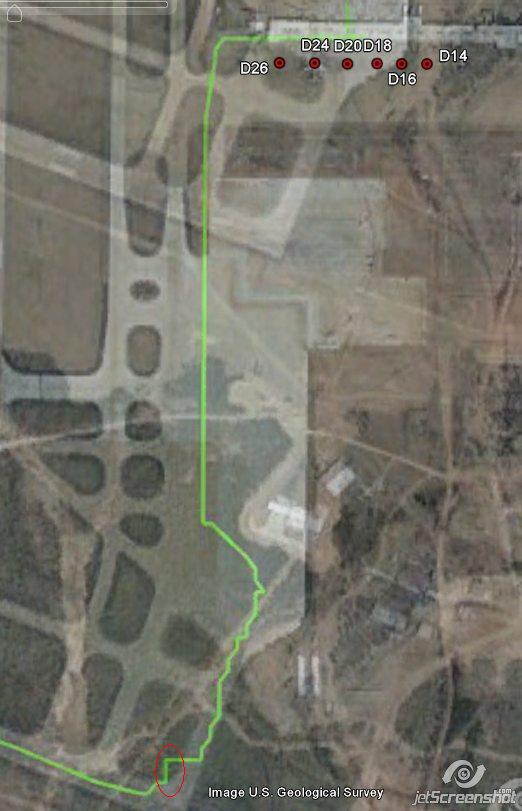
I at last did found all that essential something that was still missing and that Jan did partly mention, but only as the bottom anomaly's red oval nr 5 in his below map, but did not dare to implement its big sudden positional shift-consequence at his PfT threads and posts.
When Jan was doing this for the departure part of Jan's below plotted line, without compensating for the eight 90° sudden positional shifts in that plotted trajectory, it showed a southern departure gate, around gate D18 :
When I was correcting Jan's plots for all eight sudden positional shifts, as can be found in the FDR data by meticulously checking the positional data compared to the times, the whole departure plot is compressed/shifted westwards and southwards, and now started a few meters south of gate D26 and ended right up on Runway 30, while covering all taxi lanes on its way while taxiing towards that runway. Thus showing the real departure trajectory as plotted by me, on that same Dulles map as posted by Jan Zelman :
He now had uncoupled the arrival and departure trajectories in his departure example.
The one below is his original departure trajectory, which started somewhere near Gate D18, but so to see, "inside" the C-Concourse building, instead of on the tarmac.
That little fact should have warned him that his analysis was still not totally correct.
That some essential thing still was missing.
The diagonal other than RW 30 runway portion in the left top portion, shimmering through around all those white gate numbers, is an anomaly from Google Earth. The space under those red dots/gates is a huge concrete and tarmac plane parking and taxiing space, leading to those two small taxi lanes leading southwards :
I at last did found all that essential something that was still missing and that Jan did partly mention, but only as the bottom anomaly's red oval nr 5 in his below map, but did not dare to implement its big sudden positional shift-consequence at his PfT threads and posts.
When Jan was doing this for the departure part of Jan's below plotted line, without compensating for the eight 90° sudden positional shifts in that plotted trajectory, it showed a southern departure gate, around gate D18 :
When I was correcting Jan's plots for all eight sudden positional shifts, as can be found in the FDR data by meticulously checking the positional data compared to the times, the whole departure plot is compressed/shifted westwards and southwards, and now started a few meters south of gate D26 and ended right up on Runway 30, while covering all taxi lanes on its way while taxiing towards that runway. Thus showing the real departure trajectory as plotted by me, on that same Dulles map as posted by Jan Zelman :
Now, you, ProudBird, as the local 757 experienced professional pilot, refrain from answering my above question, up till now. Busy at home or
elsewhere?
When you have time again, I and our readers would like to hear if you agree with my explanation how the FDR data reflects accumulated positional shifting over time, and how we have to compensate their consequences, like I did.
If you don't agree, we expect your solid counter-arguments.
It is however not an analysis which is covered by a 757 pilot's manual, or/and his daily experience, in fact it is more of a mathematical problem which had to be solved, but many layman readers will wait for a professional pilots reaction, before they will accept my explanation how the original plotted raw FDR data must be interpreted, and why it then ends up in the end at Gate D26 at Dulles, and shows the plane departing from its western runway 30.
I know already that my full consequences drift interpretation of Jan Zelman's calculations is right, below you see where it is based on :
The posting members at the PfT forums probably still doubt it.
Like when even a professional business airplane pilot (as Balsamo wrote he is and was) still shows to us, that he does not want to admit, or just plain does not understand that my calculations are right.
And as many PfT members with him, show not to understand.
Or ignore.
Which is a much worse indication of a bad attitude.
Them, and we all too, have a moral duty to unearth at all costs, the real and thus true HISTORY of what happened on that sad day, a life-long duty to all those who died on 9/11, and as the consequence of that day's events, the same duty to the many more who died afterwards in all these new American lead wars. All of them, not only Americans or Europeans, all of these countries their inhabitants too.
Addendum:
Those sudden positional shifts (my orange lines in above drawing), show up in the plot as one longitudinal (horizontal) sudden positional jump, followed by one latitudinal (vertical) sudden positional jump, as can be found in the FDR Dulles data, and seen plotted on the original Jan Zelman map as eight 90° angle-lines with equal length legs. We have to measure the diagonals between each of these two 90° equal length legs each, and remove (subtract) that total distance from the non 90° angled, plotted positions line. In subsequent order, beginning at the Runway 30 position (Jan's red oval with my white 5 beside it).
And then, at wheels off on Runway 30, as above quote, and also my Boeing Manual explains, the systems are getting updated from the Dulles VOR radio signals, it then begins receiving and -recording- from that moment on.
When you have time again, I and our readers would like to hear if you agree with my explanation how the FDR data reflects accumulated positional shifting over time, and how we have to compensate their consequences, like I did.
If you don't agree, we expect your solid counter-arguments.
It is however not an analysis which is covered by a 757 pilot's manual, or/and his daily experience, in fact it is more of a mathematical problem which had to be solved, but many layman readers will wait for a professional pilots reaction, before they will accept my explanation how the original plotted raw FDR data must be interpreted, and why it then ends up in the end at Gate D26 at Dulles, and shows the plane departing from its western runway 30.
I know already that my full consequences drift interpretation of Jan Zelman's calculations is right, below you see where it is based on :
The posting members at the PfT forums probably still doubt it.
Like when even a professional business airplane pilot (as Balsamo wrote he is and was) still shows to us, that he does not want to admit, or just plain does not understand that my calculations are right.
And as many PfT members with him, show not to understand.
Or ignore.
Which is a much worse indication of a bad attitude.
Them, and we all too, have a moral duty to unearth at all costs, the real and thus true HISTORY of what happened on that sad day, a life-long duty to all those who died on 9/11, and as the consequence of that day's events, the same duty to the many more who died afterwards in all these new American lead wars. All of them, not only Americans or Europeans, all of these countries their inhabitants too.
Addendum:
Those sudden positional shifts (my orange lines in above drawing), show up in the plot as one longitudinal (horizontal) sudden positional jump, followed by one latitudinal (vertical) sudden positional jump, as can be found in the FDR Dulles data, and seen plotted on the original Jan Zelman map as eight 90° angle-lines with equal length legs. We have to measure the diagonals between each of these two 90° equal length legs each, and remove (subtract) that total distance from the non 90° angled, plotted positions line. In subsequent order, beginning at the Runway 30 position (Jan's red oval with my white 5 beside it).
ProudBird : Also, if American Airlines had the same program versions in their units (these were updated periodically -- they probably did not yet have the 'PEGASUS' update) that I'm familiar with (from that time period), then when you have inserted your takeoff runway into the "DEP / ARR INDEX" page on the CDU, then when the auto-throttles are engaged at the beginning of the takeoff.....the known runway position information is used by the system to update and add to the accuracy, from that point. The process is not instant, but that point is noted, and the system adjusts accordingly, in the ensuing few minutes. Once airborne, and any pilot's navigation system is selected to "NAV", the radio updating begins. If neither pilot has NAV selected, but is in VOR or LOC, then there is no radio updating happening.
And then, at wheels off on Runway 30, as above quote, and also my Boeing Manual explains, the systems are getting updated from the Dulles VOR radio signals, it then begins receiving and -recording- from that moment on.
This post at page 4, by -PLB- ,shows a very big Dulles map with (both wrong) departure tracks in it, but it shows that huge tarmac and concrete plane
parking much better than in the Jan Zelman plots I used to come to the last, real departure track starting at Gate D26 :
www.abovetopsecret.com...
And this was the plot posted by Jan Zelman at the PfT forums, and used again by Balsamo in disguise, a few pages back (page 12), that shows how fast the radio -UPDATE- procedure works after wheels off :

www.abovetopsecret.com...
And this was the plot posted by Jan Zelman at the PfT forums, and used again by Balsamo in disguise, a few pages back (page 12), that shows how fast the radio -UPDATE- procedure works after wheels off :
This is a post from -PLB- (page 5), he did check the raw FDR data too, he said :
Balsamo (TigerTracks) answered him (partly wrong) :
Note that he meant with "offset" the same type of "3000+ feet" positional shift/drift.
But he stumbles over his own feet when he tries to implement the following "alignment in flight" as coming via GPS updating like in "military aircraft".
No Balsamo, it came through the standard radio updating. No conspiracy here.
But in the last seconds of AAL77 its flight?
See this post of mine in the other thread cross-linked to by me already, for an answer :
www.abovetopsecret.com...
Source : www.pprune.org...
I expect the problem that Balsamo has, is him not willing to understand and accept that the positional information the pilots see on their instruments, is not the same as what is obviously registered (in different format) in the FDR, for later checks.
It looks to me that the FDR slowly accumulates and adds together, all former flights their arrival and departure Lat and Lon positions. Without correcting them for the difference in arrival and departure gate positions, or drift during taxiing and waiting at the holding positions.
Gate position difference and positional drift is a consequence of the usual towing overnight, and happened every time the pilots performed their early morning full align procedure.
The FDR does not register the difference in arrival and departure gate position, only the gate position typed in by the pilots, at every morning's full align and adds that to its data stream from the day before.....that's why you see the jump in position every morning before the full align, since the overnight tow is not registered in the FDR. That jump occurs after electrical power has been applied. And after the full align is ended and saved.
This is obvious, since we can control that behavior in all former flights from flight 77 and flight 93 their FDR's, they were all still in those two recovered FDR's. And both showed for all preceding flights, the same accumulating positional drift during all those former flights.
And a for example 3000+ feet / 914 meters discrepancy with the real gate and runway positions, retained inside the FDR (which data is not shown and used at all by the pilots.! ) does not have any influence on the behavior of the pilots, since they can't see those retained figures, they are not meant to assist the pilots.
Not at all, they are for later reference, if needed to be checked by others than the pilots.
And an experienced FDR specialist will know that, and implement that knowledge in his real time positional plot based on his extracted FDR raw positional data.
The pilots see nothing at all from this FDR its accumulation of raw data.
They perform a full or fast align, and see as a result their Lat and Lon position updated on their IRS screens when moving around after that, until they eventually perform a next fast align when standing too long in a holding area. Fast aligns can only be performed on the ground. It was not possible for a 2001 civilian owned Boeing 757 to align in flight.
Only to use radio signals from all around it, to update its plane's position, quite fast by the way.
To correct an obvious misconception by Balsamo:
The early morning full align is indeed registered in these two FDR's, for every flight it holds data from. It's not always the gate position input, since the tow tractor who pulls the plane from the passenger tube position, sometimes tow them all the way to the rim of the parking and taxiing area, uncouple, and then the pilots performed their full align at that spot tenth of meters away from the gate position.
Only Balsamo's eyes do not seem to register that fact. He keeps insisting that there is no sign of a full align. He's wrong.
Look at the tenth of meters/yards, 90° angled two legged position jump every morning.
See my corrected Zelman map with his not fully corrected green line drawn in it. It can be seen at the very top. As the first 90° green two legged angled line. The diagonal between the end of each Latitudinal and Longitudinal leg depicts the factual positional jump distance, and that distance you have to retract from all the positional data points for the gate departure and taxiing distances up to the runway 30 holding position.
In the bottom of that Zelman map.
And then you arrive every time again, at the proper departure gate, the proper taxi lanes and the proper runway holding position, just before take-off. In case of 9/11, Gate D26 and Runway 30 at KIAD ( International Airport Dulles).
Those FDR-data are getting registered for airline security and post-crash flight data recovery, and can be checked after any flight, if the airline, the NTSB or any other security institution wants to check them.
That's why the pilots do not need to see or check those FDR data on the ground or in flight.
They check the ground-position of their airplane on their HSI map, and if it drifted too much, they perform a fast align. They know that their systems at wheels off automatically begin to quickly align with their real exact position through radio updating signals.
Thus, there's no real need to be exact on the meter while still taxiing. Small positional data errors will be updated fast, after take off.
The FDR is a system for use by the NTSB, or the airline maintenance personnel.
Not for the pilots eyes during taxiing nor in flight. It is locked up in a box in the tail section.
It is connected to all the plane's systems, all signals stream however towards its box, to record the whole flight, and a lot of preceding flights. No interaction needed with the pilots.
They have other means in their cockpit to check and/or input their real position.
When you check the rest of the data from the flight recorder, alignment with the gate does not happen that often. So it looks like that in practice it is not very strict. Or maybe this is just specific to the AA77 data, but I do not have any other data as reference.
When you remove odd movement in the flight path (where the movement is not straight), you end up with a perfect match to gate 26. It looks like drift occurred at those positions. Those positions coincide with the runway holding position markings, which suggests that the plane was not moving when the error occurred.
Balsamo (TigerTracks) answered him (partly wrong) :
"UA93" data is also showing the same type of offset and then alignment in flight. Neither "AA77" nor "UA93" had this capability. But military aircraft do.
Note that he meant with "offset" the same type of "3000+ feet" positional shift/drift.
But he stumbles over his own feet when he tries to implement the following "alignment in flight" as coming via GPS updating like in "military aircraft".
No Balsamo, it came through the standard radio updating. No conspiracy here.
But in the last seconds of AAL77 its flight?
See this post of mine in the other thread cross-linked to by me already, for an answer :
www.abovetopsecret.com...
Source : www.pprune.org...
Since inertial systems accumulate position errors as a function of time, the position information being used by the FMC is slowly accumulating errors. These position errors can be detected by observing the position of the airplane on the HSI map. If an extended ground delay occurs and a significant map error is noticed the IRS should be realigned and present position re-entered [on the ground].
-- those things are so accurate in the 75, 76, 73, and FK100, that we always, always put in the exact gate coordinates on each gate at each airport when preparing to go --
I expect the problem that Balsamo has, is him not willing to understand and accept that the positional information the pilots see on their instruments, is not the same as what is obviously registered (in different format) in the FDR, for later checks.
It looks to me that the FDR slowly accumulates and adds together, all former flights their arrival and departure Lat and Lon positions. Without correcting them for the difference in arrival and departure gate positions, or drift during taxiing and waiting at the holding positions.
Gate position difference and positional drift is a consequence of the usual towing overnight, and happened every time the pilots performed their early morning full align procedure.
The FDR does not register the difference in arrival and departure gate position, only the gate position typed in by the pilots, at every morning's full align and adds that to its data stream from the day before.....that's why you see the jump in position every morning before the full align, since the overnight tow is not registered in the FDR. That jump occurs after electrical power has been applied. And after the full align is ended and saved.
This is obvious, since we can control that behavior in all former flights from flight 77 and flight 93 their FDR's, they were all still in those two recovered FDR's. And both showed for all preceding flights, the same accumulating positional drift during all those former flights.
And a for example 3000+ feet / 914 meters discrepancy with the real gate and runway positions, retained inside the FDR (which data is not shown and used at all by the pilots.! ) does not have any influence on the behavior of the pilots, since they can't see those retained figures, they are not meant to assist the pilots.
Not at all, they are for later reference, if needed to be checked by others than the pilots.
And an experienced FDR specialist will know that, and implement that knowledge in his real time positional plot based on his extracted FDR raw positional data.
The pilots see nothing at all from this FDR its accumulation of raw data.
They perform a full or fast align, and see as a result their Lat and Lon position updated on their IRS screens when moving around after that, until they eventually perform a next fast align when standing too long in a holding area. Fast aligns can only be performed on the ground. It was not possible for a 2001 civilian owned Boeing 757 to align in flight.
Only to use radio signals from all around it, to update its plane's position, quite fast by the way.
To correct an obvious misconception by Balsamo:
The early morning full align is indeed registered in these two FDR's, for every flight it holds data from. It's not always the gate position input, since the tow tractor who pulls the plane from the passenger tube position, sometimes tow them all the way to the rim of the parking and taxiing area, uncouple, and then the pilots performed their full align at that spot tenth of meters away from the gate position.
Only Balsamo's eyes do not seem to register that fact. He keeps insisting that there is no sign of a full align. He's wrong.
Look at the tenth of meters/yards, 90° angled two legged position jump every morning.
See my corrected Zelman map with his not fully corrected green line drawn in it. It can be seen at the very top. As the first 90° green two legged angled line. The diagonal between the end of each Latitudinal and Longitudinal leg depicts the factual positional jump distance, and that distance you have to retract from all the positional data points for the gate departure and taxiing distances up to the runway 30 holding position.
In the bottom of that Zelman map.
And then you arrive every time again, at the proper departure gate, the proper taxi lanes and the proper runway holding position, just before take-off. In case of 9/11, Gate D26 and Runway 30 at KIAD ( International Airport Dulles).
Those FDR-data are getting registered for airline security and post-crash flight data recovery, and can be checked after any flight, if the airline, the NTSB or any other security institution wants to check them.
That's why the pilots do not need to see or check those FDR data on the ground or in flight.
They check the ground-position of their airplane on their HSI map, and if it drifted too much, they perform a fast align. They know that their systems at wheels off automatically begin to quickly align with their real exact position through radio updating signals.
Thus, there's no real need to be exact on the meter while still taxiing. Small positional data errors will be updated fast, after take off.
The FDR is a system for use by the NTSB, or the airline maintenance personnel.
Not for the pilots eyes during taxiing nor in flight. It is locked up in a box in the tail section.
It is connected to all the plane's systems, all signals stream however towards its box, to record the whole flight, and a lot of preceding flights. No interaction needed with the pilots.
They have other means in their cockpit to check and/or input their real position.
On the airport charts pilots use for the airports, each ramp has a precise lat/lon associated with it. This is the position entered by the crews at
the gate at the time of setting up the aircraft ready for the next leg.
Does anyone have any current charts, or better, charts from 9/11/2001, showing positions of the gates at Washington Dulles (KIAD)?
The charts are official documents and updated regularly. They are REQUIRED to be accurate. The gate positions are VERY accurately measured.
I just did a quick Google now, and can't find even current charts showing ramp position and lat/lon for Washington Dulles, however, I found a UK example for London Heathrow that will show you what I am looking for.
www.ead.eurocontrol.int...
Note that for every stand, a lat/lon is associated with it. This is the position entered by the crews into the nav system (the IRS that you posted about above in the case of the 757/767).
Cross-checking the ramp position with the charts will end the argument permanently over which gate the data is for.
Sorry if I mis-read YOUR post, but the alignment situation is this:
* IRS power ON
* IRS FULL ALIGN
* Do stuff here (fly, park, whatever)
* If the time since the last full align is greater than 18 hours, performance of full alignment is REQUIRED before the next takeoff.
Note that if the power is interrupted (IRS goes off or FAULT for example) or the units are switched OFF, ONLY A FULL ALIGNMENT IS POSSIBLE.
The ONLY time you can do a fast align is when the system is already aligned, and you are re-aligning it (NAV -> ALIGN, enter new pos -> NAV).
If you go OFF to NAV or ATT to NAV, you MUST also do a full alignment.
ATTitude mode loses the position data for that IRS, allowing it to be used for attitude information only (to drive the artificial horizon on the PFD).
The time you'd do a fast align is thus:
* Power up the aircraft
* IRS ON
* Enter pos
* IRS full align
* Fly for 2 hours
* Land / park for 30 mins / fast align before pushback
* Fly for 6 hours (no longer than 16 hours 30 mins as it is already 2 hours 30 mins since the last full alignment).
* Land / park for 90 mins / fast align before pushback
* Fly for 3 hours (no longer than 8 hours as it is already 10 hours since the last full alignment).
Does anyone have any current charts, or better, charts from 9/11/2001, showing positions of the gates at Washington Dulles (KIAD)?
The charts are official documents and updated regularly. They are REQUIRED to be accurate. The gate positions are VERY accurately measured.
I just did a quick Google now, and can't find even current charts showing ramp position and lat/lon for Washington Dulles, however, I found a UK example for London Heathrow that will show you what I am looking for.
www.ead.eurocontrol.int...
Note that for every stand, a lat/lon is associated with it. This is the position entered by the crews into the nav system (the IRS that you posted about above in the case of the 757/767).
Cross-checking the ramp position with the charts will end the argument permanently over which gate the data is for.
I took especially notice of the sentence "" A full alignment must be accomplished when the time from the last full alignment to the completion of the next flight exceeds 18 hours.""
Well, that never happened for AAL77, it flew all the time (years) vice-versa from IAD to LAX and back, arriving back at IAD in the early evening, and departing in the early morning. Never exceeding those 18 hours. Thus, no need for a full align, when I, as a layman, read that Boeing Flight Manual text near the top of my linked to, IRS Part 3.
Sorry if I mis-read YOUR post, but the alignment situation is this:
* IRS power ON
* IRS FULL ALIGN
* Do stuff here (fly, park, whatever)
* If the time since the last full align is greater than 18 hours, performance of full alignment is REQUIRED before the next takeoff.
Note that if the power is interrupted (IRS goes off or FAULT for example) or the units are switched OFF, ONLY A FULL ALIGNMENT IS POSSIBLE.
The ONLY time you can do a fast align is when the system is already aligned, and you are re-aligning it (NAV -> ALIGN, enter new pos -> NAV).
If you go OFF to NAV or ATT to NAV, you MUST also do a full alignment.
ATTitude mode loses the position data for that IRS, allowing it to be used for attitude information only (to drive the artificial horizon on the PFD).
The time you'd do a fast align is thus:
* Power up the aircraft
* IRS ON
* Enter pos
* IRS full align
* Fly for 2 hours
* Land / park for 30 mins / fast align before pushback
* Fly for 6 hours (no longer than 16 hours 30 mins as it is already 2 hours 30 mins since the last full alignment).
* Land / park for 90 mins / fast align before pushback
* Fly for 3 hours (no longer than 8 hours as it is already 10 hours since the last full alignment).
edit on 23-12-2011 by mirageofdeceit
because: (no reason given)
I already found out pages ago, that the AA pilots performed a full align after every power switching on and subsequent APU or/and jet engine start.
That was about the only thing Balsamo got right, that the airline ordered every pilot to perform a full align after every engine power-up.
That full align was in first instance not noticed well by me, in Jan Zelman's original drawing, his 90° green lines indicating a full align, above the gate numbers and circles he placed on his map, were a tad bit vague.
So I corrected that mistake by me, in the later corrected drawings made by me, as you can see.
In complicated matters like this gate subject, it helps to think out loud in a forum like this, and get help from like minded souls, to end up in the end with the correct interpretation of what is laid before us.
Mirage, your proposal to find the EXACT coordinates on the Dulles Jeppesen charts or its Gates charts, will not be conclusive, since the plane got towed away from that Gate D26 first, and so to see for a considerable distance, at least 30 to 40 meters or even more. Then the tow tractor driver reported to his colleagues that the pilot started his engines too early, before he had time to disconnect his tow from the plane's front wheel column. And that was abnormal behavior for any pilot, without excusing himself to the tow driver. His colleague told this to the FBI in that interview I already linked to.
So there was a full align as I included in a few of my last drawings, and thus the diagonal position jump of that event has to be subtracted from the green line drawn by Jan Zelman's in his original drawing.
And then you arrive at last at the real departure gate of AA77 on 9/11. Gate D26.
I see Balsamo still keeps his crap up on his homepage, in some of his articles.
His - northern AA77 Gate crap - and his - ACARS messages send after plane crash - crap.
PS : I saw Balsamo banned Scott75 also from his PfT forums, take note, over Balsamo's own ACARS mishap.
He's really making progress with his own clownishness.
Merry Christmas everyone.
That was about the only thing Balsamo got right, that the airline ordered every pilot to perform a full align after every engine power-up.
That full align was in first instance not noticed well by me, in Jan Zelman's original drawing, his 90° green lines indicating a full align, above the gate numbers and circles he placed on his map, were a tad bit vague.
So I corrected that mistake by me, in the later corrected drawings made by me, as you can see.
In complicated matters like this gate subject, it helps to think out loud in a forum like this, and get help from like minded souls, to end up in the end with the correct interpretation of what is laid before us.
Mirage, your proposal to find the EXACT coordinates on the Dulles Jeppesen charts or its Gates charts, will not be conclusive, since the plane got towed away from that Gate D26 first, and so to see for a considerable distance, at least 30 to 40 meters or even more. Then the tow tractor driver reported to his colleagues that the pilot started his engines too early, before he had time to disconnect his tow from the plane's front wheel column. And that was abnormal behavior for any pilot, without excusing himself to the tow driver. His colleague told this to the FBI in that interview I already linked to.
So there was a full align as I included in a few of my last drawings, and thus the diagonal position jump of that event has to be subtracted from the green line drawn by Jan Zelman's in his original drawing.
And then you arrive at last at the real departure gate of AA77 on 9/11. Gate D26.
I see Balsamo still keeps his crap up on his homepage, in some of his articles.
His - northern AA77 Gate crap - and his - ACARS messages send after plane crash - crap.
PS : I saw Balsamo banned Scott75 also from his PfT forums, take note, over Balsamo's own ACARS mishap.
He's really making progress with his own clownishness.
Merry Christmas everyone.
reply to post by LaBTop
I'd like to see what the tug driver actually said, so it can be put into context. Your interpretation doesn't ring true:
It is entirely common and normal to be starting engines even whilst under tow. And, I find it hard to believe that the Captain began the start before receiving verbal acknowledgement from the tug driver. It just isn't done that way, as a matter of discipline and routine.
Now, depending on the circumstances, we can also be under tow or push back without the tug driver or ramp person using a headset and establishing verbal communications. Then, we use established hand signals. Of course, the tug driver cannot be seen from the cockpit, when hooked up. So, at least one other person is the one to be communicating by signals. And of course, they are the "ramp safety" person too. More than one person is always involved in push-backs and tows.
So, it is plausible that, if they used hand signals, the tug driver and ramp person mis-communicated and the signal to the Captain to begin starting might have come from someone other than the tug driver.
Like I said, depends on how they did it that morning.
I'd like to see what the tug driver actually said, so it can be put into context. Your interpretation doesn't ring true:
Then the tow tractor driver reported to his colleagues that the pilot started his engines too early, before he had time to disconnect his tow from the plane's front wheel column.
It is entirely common and normal to be starting engines even whilst under tow. And, I find it hard to believe that the Captain began the start before receiving verbal acknowledgement from the tug driver. It just isn't done that way, as a matter of discipline and routine.
Now, depending on the circumstances, we can also be under tow or push back without the tug driver or ramp person using a headset and establishing verbal communications. Then, we use established hand signals. Of course, the tug driver cannot be seen from the cockpit, when hooked up. So, at least one other person is the one to be communicating by signals. And of course, they are the "ramp safety" person too. More than one person is always involved in push-backs and tows.
So, it is plausible that, if they used hand signals, the tug driver and ramp person mis-communicated and the signal to the Captain to begin starting might have come from someone other than the tug driver.
Like I said, depends on how they did it that morning.
Originally posted by Reheat in page 9 of this thread
Originally posted by LaBTop
PS: your proposal in your signature-link, still is a sharp IMPOSSIBLE to fly, S-shaped maneuver.
I think it is clear from my two proposals, that mine is a long slightly right wing down one.
Ending in level flight over Route 27.
No kidding Sherlock. That was the point of the article.
It should be very obvious to you by now that the aircraft CAN NOT fly from where Paik said it was to over where you think Morin was to pass North of the Citgo, thence to the impact point without an enormously spectacular bank angle at an extremely low altitude that would have awed all who saw it. Once you get that aerodynamically established FACT through your head maybe you'll understand.
Are you still holding on to those words, Reheat?
After I showed you now several times in several pages of this thread, that while using your own linked to easy turn and bank calculator, it is quite easy to fly in a 22.9° bank angle and a turn radius of 3200 meters, from Paik's real observed position of the plane, over Morin's head, over the Y-shaped antenna on the Annex 8th wing roof, passing nearly over the heads of sergeants Brooks and Lagasse just 100 feet northernly of the CITGO stations roof, towards the 4 ANC workers positions and then following that arc back to Route 27 where Riskus saw it cross perpendicular over it, about 100 feet in front of his car, and it flew over the roof of Christine Peterson's car in the HOV Lane in front of the Helipad, and passed the Helipad concrete just a few meters to the right, then impacted.
It is becoming clearer to me by now, that I must not calculate from impact and then back, that's not realistic, since the pilot flew probably not on a set course to that impact point.
He just tried to hit the Pentagon.
Thus, we may assume that your online turn and bank calculator is not of real help anyway, since every steering input from the pilot changes the calculation. Every time.
It will be better to calculate the path from Paik to Morin to the 8th wing its roof as some sort of straight line (and take the whole roof rim as possible aim), and then introduce a downwards arc flown towards the 100 feet north of CITGO point, and then slightly adjust the flight path again to return to Route 27, and after passing that, introduce a very slight left bank move, and then impact follows.
Thus, we can not rely totally on an online turn and bank calculator which is meant to calculate outcomes for a LEVEL flight.
That's in fact using an irrational and illogical tool.
And again, I do not understand where you get your necessary 60° or more excessive bank angles from, at your speeds.
I have shown you now, that a speed varying from 220 to 400 MPH, does not influence the bank angle calculated by me, of 22.9°.
And does also keep the stall speed increase factor at a steady factor of 1.0 .
Are you by any chance all this time, many months already now, relying on your idea that all calculations we lay in front of you, must end in near level flight in front of the 5, then downed light poles, in a path going into the west wall at an angle of 60.25° true north?
Either you, or I are making some enormous perceptional mistake.
Do you even understand that we still do not believe those poles were hit by AA77?
That we believe that the plane crossed Route 27 at the point where Steve Riskus and all the others say they saw it cross it.
Which is definitely not the point where you seem to believe it crossed.
edit on 26/12/11 by LaBTop because: several pages in THIS THREAD :
forgotten to ad link.
Originally posted by ProudBird
reply to post by LaBTop
I'd like to see what the tug driver actually said, so it can be put into context. Your interpretation doesn't ring true:
Then the tow tractor driver reported to his colleagues that the pilot started his engines too early, before he had time to disconnect his tow from the plane's front wheel column.
It is entirely common and normal to be starting engines even whilst under tow. And, I find it hard to believe that the Captain began the start before receiving verbal acknowledgment from the tug driver. It just isn't done that way, as a matter of discipline and routine.
Now, depending on the circumstances, we can also be under tow or push back without the tug driver or ramp person using a headset and establishing verbal communications. Then, we use established hand signals. Of course, the tug driver cannot be seen from the cockpit, when hooked up. So, at least one other person is the one to be communicating by signals. And of course, they are the "ramp safety" person too. More than one person is always involved in push-backs and tows.
So, it is plausible that, if they used hand signals, the tug driver and ramp person mis-communicated and the signal to the Captain to begin starting might have come from someone other than the tug driver.
Like I said, depends on how they did it that morning.
Was in my opening post at page 1.
files.abovetopsecret.com...
reply to post by LaBTop
Well, that statement as I read it, is hearsay.
Second-hand from the interviewee (Michael Mueller) as to to him by Mark Furbish.
There is bound to be a mis-communication going on, and is evident in the narrative. (Perhaps due to the FBI interviewer's unfamiliarity with procedures?? Likely).
Read that part again, in the blue boxed outline. Where Mueller talks about the "salute" before "firing up the engines". That's not how it works.
The salute means "Clear to taxi" or "Clear to depart". The salute then from the Captain is an acknowledgement, and a "You're dismissed" type of message.
We want the guy (usually preferred is to be on the headset) with us for the entire time of the engine start, until WE are ready to leave. The ground crew MUST give a "clearance" to us before we commence the start. It's just how it's done, everyone does it that way, and we have for the history of commercial aviation, I would presume.
We want the ground crew there for the start in case there is a problem at any time....such as a mechanical failure that appears during or after start......and, sometimes THEY will the first ones to alert to a fire or other engine anomaly....the fire warning systems will not alert to every fire location. Admittedly, fires are very rare, but again....this is the overt procedure, with safety in mind foremost.
The communications are, the ground gets the crew's attention. On the headset, they simply say "Ground to cockpit". (That is how it's written in the procedure manuals). We don't have to be strictly formal, but certain key phrases are required. Confirmation of the Parking Brake status for instance. Even though there is a light on the nose gear to indicate to the ground crew when the Brakes are set, we still verify.
Phrase "Parking Brake Set" and "Parking Brake Released" are standard, and procedural. "Clear to start (or "turn", can be said as a variation) Engine Number ____". Et cetera.
(Parking Brake Set confirmation required at the beginning, before chocks are removed from the wheels. "Released" confirmation required before commencing tug movement. Else, the tow-bars will break. "Set" confirmation again at the end of the push-back or tow, so the tow-bar and tug can be disconnected. It's logical, intuitive and easy to comprehend in practice, even as it take all these words to describe).
Here, I hunted on YouTube for you, to illustrate.
Best I could find was this Regional Jet at Air Wisconsin. "Flight 3626". In Philadelphia.
Unfortunately, we only hear the Interphone "hot mics" of the two pilots and the #1 Comm radio on ATC --- Ramp Control --- (and the #2 Comm, which is on the Company frequency)....the Interphone from the tug driver on the headset isn't heard.
Also, this one isn't the best, since I gather they had an inoperative APU (thus, the need for the "cross-bleed" start). SO, you don't see them starting during the push, because they used an external air cart while parked at the gate, and all of that occurred before the video starts. Most jets, it's normal to use the Ext Air for just one engine, then use the other engine(s) as needed, whenever the APU is inop.
If you watch the whole thing you'll see that they need to use the first engine's bleed air in the pneumatics to start the second engine....the function that the APU usually does, when it's not placarded inop.
Notes: The conversations between pilots at times technically "violate" the "sterile rule", but pilots are only Human after all. It is just a fact of life, and to tell the truth only times it is "strictly" observed is when you have a Fed or Check Pilot observing on the Flight Deck. And even the Company CPs are Human too...(and the FAA, oddly enough..lol).
One more note that troubled me specifically about this, is the Capt. asking the F/O how many passengers there were....and the answer was " ....25, I think....or 20 ....."....that's not so good, doesn't put them in a professional light.
Oh well....
But as you see, the "Captain was in a hurry" part of Mueller's FBI statement is subjective, and meaningless. You simply cannot "hurry" the starting procedure.
Found this POV from outside, a Southwest B-737. Engines starting while pushing back. The 737, the right (#2) engine is started first:
Well, that statement as I read it, is hearsay.
Second-hand from the interviewee (Michael Mueller) as to to him by Mark Furbish.
There is bound to be a mis-communication going on, and is evident in the narrative. (Perhaps due to the FBI interviewer's unfamiliarity with procedures?? Likely).
Read that part again, in the blue boxed outline. Where Mueller talks about the "salute" before "firing up the engines". That's not how it works.
The salute means "Clear to taxi" or "Clear to depart". The salute then from the Captain is an acknowledgement, and a "You're dismissed" type of message.
We want the guy (usually preferred is to be on the headset) with us for the entire time of the engine start, until WE are ready to leave. The ground crew MUST give a "clearance" to us before we commence the start. It's just how it's done, everyone does it that way, and we have for the history of commercial aviation, I would presume.
We want the ground crew there for the start in case there is a problem at any time....such as a mechanical failure that appears during or after start......and, sometimes THEY will the first ones to alert to a fire or other engine anomaly....the fire warning systems will not alert to every fire location. Admittedly, fires are very rare, but again....this is the overt procedure, with safety in mind foremost.
The communications are, the ground gets the crew's attention. On the headset, they simply say "Ground to cockpit". (That is how it's written in the procedure manuals). We don't have to be strictly formal, but certain key phrases are required. Confirmation of the Parking Brake status for instance. Even though there is a light on the nose gear to indicate to the ground crew when the Brakes are set, we still verify.
Phrase "Parking Brake Set" and "Parking Brake Released" are standard, and procedural. "Clear to start (or "turn", can be said as a variation) Engine Number ____". Et cetera.
(Parking Brake Set confirmation required at the beginning, before chocks are removed from the wheels. "Released" confirmation required before commencing tug movement. Else, the tow-bars will break. "Set" confirmation again at the end of the push-back or tow, so the tow-bar and tug can be disconnected. It's logical, intuitive and easy to comprehend in practice, even as it take all these words to describe).
Here, I hunted on YouTube for you, to illustrate.
Best I could find was this Regional Jet at Air Wisconsin. "Flight 3626". In Philadelphia.
Unfortunately, we only hear the Interphone "hot mics" of the two pilots and the #1 Comm radio on ATC --- Ramp Control --- (and the #2 Comm, which is on the Company frequency)....the Interphone from the tug driver on the headset isn't heard.
Also, this one isn't the best, since I gather they had an inoperative APU (thus, the need for the "cross-bleed" start). SO, you don't see them starting during the push, because they used an external air cart while parked at the gate, and all of that occurred before the video starts. Most jets, it's normal to use the Ext Air for just one engine, then use the other engine(s) as needed, whenever the APU is inop.
If you watch the whole thing you'll see that they need to use the first engine's bleed air in the pneumatics to start the second engine....the function that the APU usually does, when it's not placarded inop.
Notes: The conversations between pilots at times technically "violate" the "sterile rule", but pilots are only Human after all. It is just a fact of life, and to tell the truth only times it is "strictly" observed is when you have a Fed or Check Pilot observing on the Flight Deck. And even the Company CPs are Human too...(and the FAA, oddly enough..lol).
One more note that troubled me specifically about this, is the Capt. asking the F/O how many passengers there were....and the answer was " ....25, I think....or 20 ....."....that's not so good, doesn't put them in a professional light.
Oh well....
But as you see, the "Captain was in a hurry" part of Mueller's FBI statement is subjective, and meaningless. You simply cannot "hurry" the starting procedure.
Found this POV from outside, a Southwest B-737. Engines starting while pushing back. The 737, the right (#2) engine is started first:
edit on Mon 26 December 2011 by ProudBird because: (no reason given)
Thanks for the extensive explanation, and especially the last video.
There you can clearly see that a tug driver can not push a plane in movement, in a sudden 90° angle around.
As you can see at the end of the video, the front wheel of the plane makes a perfect curve on the concrete of the holding area. And thus also the positional equipment in the cockpit.
And that's what I have tried to explain to all the readers, that the moment you see a 90° angle in the Lat/Lon positions on Jan Zelman's original map, you know that an align has been made.
In this case, in this video, f.ex. a full align at the gate on APU power alone, and then a fast align on jet engine power after the tug was coupled off and removed. That way you see in the FDR a sudden positional shift, expressed in one Latitude shift and one Longitude shift, which shifts are perpendicular on to each other. The diagonal drawn between the endpoints of both shifts depicts the distance the plane moved, and must be subtracted from the in the FDR registered very long list of Lat/Lon values coupled on time stamps.
The pilots in the cockpit however, see nothing abnormal, since their instruments above their heads show a continuously changing row of red figures indicating their Lat/Lon position all the way from Gate to coupling off from the tug.
As I noted before, it seems more and more to me, that these positional shifts were not instigated by pilot inputs, but were an effect of the 2001 IRU system itself.
See the text "Alignment stops when an IRU detects motion during alignment. When the motion stops, some units restart the alignment automatically. Other units flash the ALIGN light until the alignment is manually restarted", in my page 2 screenshot of my Boeing 757's types 200, 300 manuals, that's in my top post of this page 14.
If the pilot was really in a hurry, as the tug driver told his colleague, he could have released the parking brakes too early, or moved the plane too early, and then his F.O. or himself would have quickly done a fast align, to solve that little problem.
It is still unclear to me, why all pilots in all flights have shown this multiple aligns behavior, before take-off.
That's why I opt for an automatic response in the FDR records, unnoticed by the pilots perhaps.
And ProudBird, who is/was a long time 757 pilot for a commercial airline, told us already that for him, these multiple fast aligns were abnormal behavior.
That's why I think it is an internal glitch in the AA planes their FDR's.
I.o.w., I start thinking that the FDR updated its positional data, every time the plane stopped and had the brakes set. But the pilots could not see that happening, it only went on in the "belly" of the computer system that the FDR in principle just is.
That must also be the reason that over time, these huge positional drifts occurred in those FDR's, after many take-offs and landings registered in that FDR. The FDR just accumulated all those positional shifts over a long time. Until perhaps a mechanic at last performed a full reset of the FDR system when the plane was due for its scheduled full overhaul.
There you can clearly see that a tug driver can not push a plane in movement, in a sudden 90° angle around.
As you can see at the end of the video, the front wheel of the plane makes a perfect curve on the concrete of the holding area. And thus also the positional equipment in the cockpit.
And that's what I have tried to explain to all the readers, that the moment you see a 90° angle in the Lat/Lon positions on Jan Zelman's original map, you know that an align has been made.
In this case, in this video, f.ex. a full align at the gate on APU power alone, and then a fast align on jet engine power after the tug was coupled off and removed. That way you see in the FDR a sudden positional shift, expressed in one Latitude shift and one Longitude shift, which shifts are perpendicular on to each other. The diagonal drawn between the endpoints of both shifts depicts the distance the plane moved, and must be subtracted from the in the FDR registered very long list of Lat/Lon values coupled on time stamps.
The pilots in the cockpit however, see nothing abnormal, since their instruments above their heads show a continuously changing row of red figures indicating their Lat/Lon position all the way from Gate to coupling off from the tug.
As I noted before, it seems more and more to me, that these positional shifts were not instigated by pilot inputs, but were an effect of the 2001 IRU system itself.
See the text "Alignment stops when an IRU detects motion during alignment. When the motion stops, some units restart the alignment automatically. Other units flash the ALIGN light until the alignment is manually restarted", in my page 2 screenshot of my Boeing 757's types 200, 300 manuals, that's in my top post of this page 14.
If the pilot was really in a hurry, as the tug driver told his colleague, he could have released the parking brakes too early, or moved the plane too early, and then his F.O. or himself would have quickly done a fast align, to solve that little problem.
It is still unclear to me, why all pilots in all flights have shown this multiple aligns behavior, before take-off.
That's why I opt for an automatic response in the FDR records, unnoticed by the pilots perhaps.
And ProudBird, who is/was a long time 757 pilot for a commercial airline, told us already that for him, these multiple fast aligns were abnormal behavior.
That's why I think it is an internal glitch in the AA planes their FDR's.
I.o.w., I start thinking that the FDR updated its positional data, every time the plane stopped and had the brakes set. But the pilots could not see that happening, it only went on in the "belly" of the computer system that the FDR in principle just is.
That must also be the reason that over time, these huge positional drifts occurred in those FDR's, after many take-offs and landings registered in that FDR. The FDR just accumulated all those positional shifts over a long time. Until perhaps a mechanic at last performed a full reset of the FDR system when the plane was due for its scheduled full overhaul.
edit on 27/12/11 by LaBTop because: (no reason given)
reply to post by LaBTop
Oh dear, oh dear, oh dear....yet again.
NO! Any apparently jagged shifts in those position plots are merely anomalous readings from the system itself, as it acted to drift and self-correct on occasion.
Also, the video of the Southwest jet is only ONE situation. The turning radius can be long and wide, or much shorter and sharper turn.....up to the limits of the nose wheel gear turning angles. They are marked clearly with pained red lines to be seen and used as a guide for the tug driver. There are always differing situations due to the available space on the ramp and traffic congestion present that determine the sharpness of the turn.
IIRC, although the maximum pilot-controlled nose gear angle is 65° either side of center, for pushing the limit is somewhat less to avoid damage at the limit stops.
This PDF shows the various turning radii for a B-757 moving forward under its own power......so, at given angles of nose gear wheel deflection, pushing backwards would be essentially the same:
www.boeing.com...
But of course, one can visit YouTube by following the links on either of those videos above, and see the related videos that show up to peruse as well.
Oh and to add....emphatically no on this:
There is no Earthly reason ever, ever, ever that this would be done! There just simply was no need, nor desire, for a "fast align".
This is the problem.....the lay person over-thinks this, and thus goes "off the rails" in the examination by trying to piece together things that are simply not related in most cases.
The forest, sir. The forest. THAT is what one needs to notice.....the insistence of focusing on minutiae, the tiniest of details of each pine needle or leaf on each tree? That path will lead to madness........
Oh dear, oh dear, oh dear....yet again.
There you can clearly see that a tug driver can not push a plane in movement, in a sudden 90° angle around.
As you can see at the end of the video, the front wheel of the plane makes a perfect curve on the concrete of the holding area. And thus also the positional equipment in the cockpit.
And that's what I have tried to explain to all the readers, that the moment you see a 90° angle in the Lat/Lon positions on Jan Zelman's original map, you know that an align has been made.
NO! Any apparently jagged shifts in those position plots are merely anomalous readings from the system itself, as it acted to drift and self-correct on occasion.
Also, the video of the Southwest jet is only ONE situation. The turning radius can be long and wide, or much shorter and sharper turn.....up to the limits of the nose wheel gear turning angles. They are marked clearly with pained red lines to be seen and used as a guide for the tug driver. There are always differing situations due to the available space on the ramp and traffic congestion present that determine the sharpness of the turn.
IIRC, although the maximum pilot-controlled nose gear angle is 65° either side of center, for pushing the limit is somewhat less to avoid damage at the limit stops.
This PDF shows the various turning radii for a B-757 moving forward under its own power......so, at given angles of nose gear wheel deflection, pushing backwards would be essentially the same:
www.boeing.com...
But of course, one can visit YouTube by following the links on either of those videos above, and see the related videos that show up to peruse as well.
Oh and to add....emphatically no on this:
In this case, in this video, f.ex. a full align at the gate on APU power alone, and then a fast align on jet engine power after the tug was coupled off and removed.
There is no Earthly reason ever, ever, ever that this would be done! There just simply was no need, nor desire, for a "fast align".
This is the problem.....the lay person over-thinks this, and thus goes "off the rails" in the examination by trying to piece together things that are simply not related in most cases.
The forest, sir. The forest. THAT is what one needs to notice.....the insistence of focusing on minutiae, the tiniest of details of each pine needle or leaf on each tree? That path will lead to madness........
edit on Tue 27 December 2011 by ProudBird because: (no reason given)
NO! Any apparently jagged shifts in those position plots are merely anomalous readings from the system itself, as it acted to drift and self-correct on occasion.
Isn't that essentially the same as what I said :
That's why I think it is an internal glitch in the AA planes their FDR's.
I.o.w., I start thinking that the FDR updated its positional data, every time the plane stopped and had the brakes set. But the pilots could not see that happening, it only went on in the "belly" of the computer system that the FDR in principle just is.
If it hadn't been 90° angles expressed in those plots, we would have never known, and all the Balsamo misconceptions about a northernly departure gate at the C-Concourse terminal building would have stood still firm.
Now we know that he is sadly wrong, as he was so many times wrong already in his hunt for 9/11 fame.
The difference between us and him is, that we gladly admit that we are wrong when an opponent PROVES us with hard evidence, that we were wrong.
Balsamo only clings tighter to his mishaps, when PROVEN wrong. He needs professional help. Another, better and more honest and flexible pilot perhaps?
EDIT to add on your edit :
The forest, sir. The forest. THAT is what one needs to notice.....the insistence of focusing on minutiae, the tiniest of details of each pine needle or leaf on each tree? That path will lead to madness........
If I may lead you by example sir.
You perfectly described Charles Darwin up there..... Indeed a dangerous madman... If we may belief some hard core Christians.....
edit on 27/12/11 by LaBTop because: (no reason given)
reply to post by LaBTop
There is a "comparison" (perhaps) to Darwin, here. But, not in the way inferred.
It is an entirely opposite situation. Darwin's brilliance did lie in his keen observation of details.....but, recall that in this aspect he was a "pioneer" of sorts. The work he developed was his own, alone.
AND accounted for by years and years of thought and contemplation.....study, and cataloging......not just a fraction of a second of impression in a single traumatic event, as is the case with Morin (or any of the "other eyewitnesses") on 9/11.
Recall the problem here, for "after-the-fact investigators". (As compared to Darwin). Darwin had all those years, as mentioned and documented. THAT is the essence of science, and the scientific method. Of direct observation and accounting.
By those standards? Not a shred of any scientific method has been implemented in the many and sundry "9/11 conspiracy theories" of the last decade.....
There is a "comparison" (perhaps) to Darwin, here. But, not in the way inferred.
It is an entirely opposite situation. Darwin's brilliance did lie in his keen observation of details.....but, recall that in this aspect he was a "pioneer" of sorts. The work he developed was his own, alone.
AND accounted for by years and years of thought and contemplation.....study, and cataloging......not just a fraction of a second of impression in a single traumatic event, as is the case with Morin (or any of the "other eyewitnesses") on 9/11.
Recall the problem here, for "after-the-fact investigators". (As compared to Darwin). Darwin had all those years, as mentioned and documented. THAT is the essence of science, and the scientific method. Of direct observation and accounting.
By those standards? Not a shred of any scientific method has been implemented in the many and sundry "9/11 conspiracy theories" of the last decade.....
edit on Wed 28 December 2011 by ProudBird because: (no reason given)
All your above lines describe also perfectly all my years of research, contemplating on something no one before me, had noticed.
That the very early seismic evidence put online by Dr Kim from the LDEO seismic institute at Pallisades, N.Y., showed that there was a very abnormal huge seismic energy peak, written on their seismographs, a few seconds before in New York's Manhattan "ground zero" area, any movement at all was registered by video and photo cameras pointed at the WTC 7 building.
A never retracted by NIST, photograph of the first movement registered on video and film, namely the eastern penthouse roof denting, had a to an atomic clock compared time stamp attached, which proved that that huge energy peak showed addition of external energy to the whole WTC 7 global collapse, at least 2 to 3 seconds before that first movement was registered by any camera.
Just use this site's search function, fill in "LaBTop seismic". Many people from this board and other boards have tried to prove me wrong, they all failed. Even NIST tried to introduce a tiny peak in front of that huge peak as a sudden found evidence of a first seismic signal in New York, but that did not change the firm existence of that time stamped photo shot by Mr Cianca and still on the NIST sites. Plus, all seismic research in the same bedrock layers over a hundred years, would suddenly be wrong? Is NIST seriously trying to rebut my research outcome? Not at all.
Such meticulous "Sisyphus" labor is not fitting your 9/11 research threshold ?
And the ACARS messages work done lately by the guys over at Unexplained Mysteries, does that not count as excellent research? Again not fitting your 9/11 research threshold ? Yes, I know it debunks a PfT conspiracy theory. That debunk research is the historical truth, that's all that matters.
And to make something clear to you that you seem to have missed, perhaps at last you will understand that I am not a person you can place in a certain niche of 9/11 research.
I just as enthusiastically applaud research that proves notorious 9/11 conspiracy theories wrong, as well that I applaud parts of 9/11 conspiracy research that prove it right.
There's just one thing that peaks my interest. That's solid research, pro or contra any conspiracy. The historical truth will always prevail in my books.
By the way, you are posting in my thread, where you noticed me changing from a stern wrong departure gate follower, to a stern follower of the big chunk of research already done by a PfT member, Jan Zelman, but where I however were not hindered by any adoration towards a site dictator, and completed Jan's work to the inevitable conclusion that AA77 did not depart from a wrong, even northernly gate, but from the right southern gate, Gate D26 at Dulles Airport.
Again, research not fitting your 9/11 research threshold ?
And do understand, that I am not here to make enemies, nor friends, I want to maintain a neutral stance on the 9/11 subject. That's why I will oppose friends and foes alike, whenever I feel they are mistaken.
And I VERY much appreciate your extensive avionics based explanations, which can only be described by someone like you, with extensive and very long experience with flying big passenger planes for big airlines.
Please proceed in the same manner, I really enjoy it greatly.
But at times we will differ in opinion, and we both hope to convince the other. And that's the natural process, when exercised in good manners and with respect for each other.
I also am sure that when you or me understand that we were wrong in certain details, we will both admit it, and move on to the next subject after admitting it openly here.
Let's wish for the New Year 2012, that everyone will gonna be that honest here.
That the very early seismic evidence put online by Dr Kim from the LDEO seismic institute at Pallisades, N.Y., showed that there was a very abnormal huge seismic energy peak, written on their seismographs, a few seconds before in New York's Manhattan "ground zero" area, any movement at all was registered by video and photo cameras pointed at the WTC 7 building.
A never retracted by NIST, photograph of the first movement registered on video and film, namely the eastern penthouse roof denting, had a to an atomic clock compared time stamp attached, which proved that that huge energy peak showed addition of external energy to the whole WTC 7 global collapse, at least 2 to 3 seconds before that first movement was registered by any camera.
Just use this site's search function, fill in "LaBTop seismic". Many people from this board and other boards have tried to prove me wrong, they all failed. Even NIST tried to introduce a tiny peak in front of that huge peak as a sudden found evidence of a first seismic signal in New York, but that did not change the firm existence of that time stamped photo shot by Mr Cianca and still on the NIST sites. Plus, all seismic research in the same bedrock layers over a hundred years, would suddenly be wrong? Is NIST seriously trying to rebut my research outcome? Not at all.
Such meticulous "Sisyphus" labor is not fitting your 9/11 research threshold ?
And the ACARS messages work done lately by the guys over at Unexplained Mysteries, does that not count as excellent research? Again not fitting your 9/11 research threshold ? Yes, I know it debunks a PfT conspiracy theory. That debunk research is the historical truth, that's all that matters.
And to make something clear to you that you seem to have missed, perhaps at last you will understand that I am not a person you can place in a certain niche of 9/11 research.
I just as enthusiastically applaud research that proves notorious 9/11 conspiracy theories wrong, as well that I applaud parts of 9/11 conspiracy research that prove it right.
There's just one thing that peaks my interest. That's solid research, pro or contra any conspiracy. The historical truth will always prevail in my books.
By the way, you are posting in my thread, where you noticed me changing from a stern wrong departure gate follower, to a stern follower of the big chunk of research already done by a PfT member, Jan Zelman, but where I however were not hindered by any adoration towards a site dictator, and completed Jan's work to the inevitable conclusion that AA77 did not depart from a wrong, even northernly gate, but from the right southern gate, Gate D26 at Dulles Airport.
Again, research not fitting your 9/11 research threshold ?
And do understand, that I am not here to make enemies, nor friends, I want to maintain a neutral stance on the 9/11 subject. That's why I will oppose friends and foes alike, whenever I feel they are mistaken.
And I VERY much appreciate your extensive avionics based explanations, which can only be described by someone like you, with extensive and very long experience with flying big passenger planes for big airlines.
Please proceed in the same manner, I really enjoy it greatly.
But at times we will differ in opinion, and we both hope to convince the other. And that's the natural process, when exercised in good manners and with respect for each other.
I also am sure that when you or me understand that we were wrong in certain details, we will both admit it, and move on to the next subject after admitting it openly here.
Let's wish for the New Year 2012, that everyone will gonna be that honest here.
new topics
-
BIDEN Admin Begins Planning For January 2025 Transition to a New President - Today is 4.26.2024.
2024 Elections: 3 hours ago -
Big Storms
Fragile Earth: 5 hours ago -
Where should Trump hold his next rally
2024 Elections: 7 hours ago -
Shocking Number of Voters are Open to Committing Election Fraud
US Political Madness: 8 hours ago -
Gov Kristi Noem Shot and Killed "Less Than Worthless Dog" and a 'Smelly Goat
2024 Elections: 9 hours ago -
Falkville Robot-Man
Aliens and UFOs: 9 hours ago -
James O’Keefe: I have evidence that exposes the CIA, and it’s on camera.
Whistle Blowers and Leaked Documents: 10 hours ago -
Australian PM says the quiet part out loud - "free speech is a threat to democratic dicourse"...?!
New World Order: 11 hours ago -
Ireland VS Globalists
Social Issues and Civil Unrest: 11 hours ago
top topics
-
James O’Keefe: I have evidence that exposes the CIA, and it’s on camera.
Whistle Blowers and Leaked Documents: 10 hours ago, 17 flags -
Australian PM says the quiet part out loud - "free speech is a threat to democratic dicourse"...?!
New World Order: 11 hours ago, 15 flags -
Blast from the past: ATS Review Podcast, 2006: With All Three Amigos
Member PODcasts: 14 hours ago, 13 flags -
Biden "Happy To Debate Trump"
2024 Elections: 12 hours ago, 13 flags -
Ireland VS Globalists
Social Issues and Civil Unrest: 11 hours ago, 10 flags -
Mike Pinder The Moody Blues R.I.P.
Music: 14 hours ago, 8 flags -
BIDEN Admin Begins Planning For January 2025 Transition to a New President - Today is 4.26.2024.
2024 Elections: 3 hours ago, 7 flags -
What is the white pill?
Philosophy and Metaphysics: 13 hours ago, 6 flags -
Shocking Number of Voters are Open to Committing Election Fraud
US Political Madness: 8 hours ago, 6 flags -
Big Storms
Fragile Earth: 5 hours ago, 6 flags
active topics
-
University of Texas Instantly Shuts Down Anti Israel Protests
Education and Media • 316 • : Schmoe3755 -
Gov Kristi Noem Shot and Killed "Less Than Worthless Dog" and a 'Smelly Goat
2024 Elections • 63 • : GENERAL EYES -
Mood Music Part VI
Music • 3113 • : MRTrismegistus -
BIDEN Admin Begins Planning For January 2025 Transition to a New President - Today is 4.26.2024.
2024 Elections • 20 • : BustedBoomer -
One Flame Throwing Robot Dog for Christmas Please!
Weaponry • 12 • : worldstarcountry -
RAAF airbase in Roswell, New Mexico is on fire
Aliens and UFOs • 13 • : Ophiuchus1 -
President BIDEN's FBI Raided Donald Trump's Florida Home for OBAMA-NORTH KOREA Documents.
Political Conspiracies • 40 • : BingoMcGoof -
Australian PM says the quiet part out loud - "free speech is a threat to democratic dicourse"...?!
New World Order • 7 • : 19Bones79 -
It takes One to Be; Two to Tango; Three to Create.
Philosophy and Metaphysics • 8 • : Compendium -
Big Storms
Fragile Earth • 16 • : rickymouse