It looks like you're using an Ad Blocker.
Please white-list or disable AboveTopSecret.com in your ad-blocking tool.
Thank you.
Some features of ATS will be disabled while you continue to use an ad-blocker.

A Petroleum Engineer's Explanation
page: 8share:
reply to post by Streetwise
Well.... using the nuke is sort of pointless in the current situation for several reasons.
1. The surface layers of the ocean floor are not heavy enough to stop the oil from coming to the surface.
2. You would have to drill a several mile deep tunnel, very close to the original well, deep enough to be within SOLID earth.
3. IF you are drilling THAT DEEP, and THAT CLOSE to the original well, you are already doing the "Bottom Kill" thing anyways...
So, it's sort of redundant.
-Edrick
I do have a question....about the suggestion by Russian petro-engineers to try stopping the outflow by detonating a small nuclear device to seal the well.
Well.... using the nuke is sort of pointless in the current situation for several reasons.
1. The surface layers of the ocean floor are not heavy enough to stop the oil from coming to the surface.
2. You would have to drill a several mile deep tunnel, very close to the original well, deep enough to be within SOLID earth.
3. IF you are drilling THAT DEEP, and THAT CLOSE to the original well, you are already doing the "Bottom Kill" thing anyways...
So, it's sort of redundant.
-Edrick
reply to post by Streetwise
Just got back from the field. I really don't get where they are coming from about blowing it up with a nuclear bomb. I guess it comes from project gas buggy where thay tried to stimulate low permeability gas sands in Colorado to increase production versus using hydraulic fracturing. The result was that the cavern created by the blast actually sealed the wellbore with nuclear glass and shut off or reduced the gas flow. The explosion was at the depth of the producing horizon. Since we would need to get it down to 18,000' with a hole probably 5 times bigger it would work a few years from now, but a smaller hole & pumping mud with the relief wells is infinitely faster and safer. A nuclear blast anywhere but bottomhole I would think would create more problems.
Secondarily, everyone needs to understand that I am not aware of the intermediate casing's burst strength or depth set. Based upon how BP has proceeded, I suspect that the pressures are so high that even if the blowout preventers worked there was a liklihood that the itermediate casing could not contain the pressures. If the itermediate casing bursts the only solution will be the relief wells. The intermediate casing is set when the anticipated pressure to be encountered will require a mud weight that will fracture the exposed borehole. The anticipation about when this is about to occur is estimated by measuring shale densisty, shale resistivity and actual observation of the formation material being circulated out of the hole. If a bunch of shale is coming up that does not look like it was drilled by the bit then you know that the low permeability shale is being blown off the side of the bore hole by high pressure. Hopefully before you encounter a permeable sand that is a higher pressure than the drilling mud you have in the hole, then a "protection string" of pipe is run & cemented. By doing this we can increase the mud weight to create hydrostatic head to offset formation pressure that does not fracture the formation causing all the mud to go sideways into the ground instead of circulating back to the surface.
This casing string is not designed necessarily to withstand the anticipated bottomhole formation pressure at a deeper depth. It is only designed to withstand the hydrostatic pressure of the expected mud weight while drilling. So, if the well was closed in and the top part of the hole is below the "bubble point" then gas will evolve out of the oil just like carbon dioxide out of your Miller Lite. This gas which has densisty less than the oil, will float to the top and continue to build pressure as it displaces the heavier oil reducing the hydrostatic head from the oil column, creating higher & higher pressure at the surface until it finally splits the casing that is containing the flow.
Just got back from the field. I really don't get where they are coming from about blowing it up with a nuclear bomb. I guess it comes from project gas buggy where thay tried to stimulate low permeability gas sands in Colorado to increase production versus using hydraulic fracturing. The result was that the cavern created by the blast actually sealed the wellbore with nuclear glass and shut off or reduced the gas flow. The explosion was at the depth of the producing horizon. Since we would need to get it down to 18,000' with a hole probably 5 times bigger it would work a few years from now, but a smaller hole & pumping mud with the relief wells is infinitely faster and safer. A nuclear blast anywhere but bottomhole I would think would create more problems.
Secondarily, everyone needs to understand that I am not aware of the intermediate casing's burst strength or depth set. Based upon how BP has proceeded, I suspect that the pressures are so high that even if the blowout preventers worked there was a liklihood that the itermediate casing could not contain the pressures. If the itermediate casing bursts the only solution will be the relief wells. The intermediate casing is set when the anticipated pressure to be encountered will require a mud weight that will fracture the exposed borehole. The anticipation about when this is about to occur is estimated by measuring shale densisty, shale resistivity and actual observation of the formation material being circulated out of the hole. If a bunch of shale is coming up that does not look like it was drilled by the bit then you know that the low permeability shale is being blown off the side of the bore hole by high pressure. Hopefully before you encounter a permeable sand that is a higher pressure than the drilling mud you have in the hole, then a "protection string" of pipe is run & cemented. By doing this we can increase the mud weight to create hydrostatic head to offset formation pressure that does not fracture the formation causing all the mud to go sideways into the ground instead of circulating back to the surface.
This casing string is not designed necessarily to withstand the anticipated bottomhole formation pressure at a deeper depth. It is only designed to withstand the hydrostatic pressure of the expected mud weight while drilling. So, if the well was closed in and the top part of the hole is below the "bubble point" then gas will evolve out of the oil just like carbon dioxide out of your Miller Lite. This gas which has densisty less than the oil, will float to the top and continue to build pressure as it displaces the heavier oil reducing the hydrostatic head from the oil column, creating higher & higher pressure at the surface until it finally splits the casing that is containing the flow.
If the casing is not designed to withstand the anticipated bottomhole formation pressure, shouldn't it be?
Originally posted by billyjack
This casing string is not designed necessarily to withstand the anticipated bottomhole formation pressure at a deeper depth. It is only designed to withstand the hydrostatic pressure of the expected mud weight while drilling.
If it's known that gas bubbles can form and lighten the mud column weight and resulting pressure, then a kick can start occurring and isn't the purpose of the BOP to close off and prevent a blowout (hence the name "blowout preventer?) If closing off the BOP can just result in a rupture of the casing because it's not strong enough, then that seems like an inadequate design, right?
[edit on 6-6-2010 by Arbitrageur]
reply to post by Arbitrageur
Remember than when they attempted the "top kill", they were injecting mud through the flow manifold. When we take a "kick" we typically close off the annulus where the flow is coming from and divert the flow through a flow manifold continuing the let the kick flow although in a controlled enviroment. Without going into too much technical detail about drillpipe pressure & annulus pressure, what we try to do is reduce the escape using various smaller diameter chokes to match the rate that we are pumping in kill mud at the bottom of the hole. Although the well may be wanting to flow @ an equivalent bottomhole volume of 100 barrels per minute while we can only pump mud at 10 barrels per minute, we choke it back to keep it from unloading faster than we are replacing with heavier fluid. So even if the blind or shear rams are closed the flow manifold is still open to divert the flow away from the rig floor until it can be ascertained what the shut in pressure may be. Generally, the only casing string designed to handle the reservoir pressure in the production casing and in high pressure wells even this casing is seldom exposed to the reservoir pressure as production is normally done through tubing using an isolation tool(packer) on the end of the tubing that prohibits the reservoir pressure from getting into the tubing/casing annulus.
The larger diameter inetrmediate casing's resistance to burst is limited by the strength of steel. The larger area exposed to pressure creates a larger force for the steel to contain. PI* D* length times the pressure. Just for example API Grade(American Petroleum Institute) P-110 for 9 5/8" casing has a maximum burst pressure of around 10,000 psi, while the same grade 7" can withstand close to 15,000 psi, while 2 7/8" tubing can resist nearly 20,000 psi. Although they may have been able to make special steel mill runs to run tubulars that exceed API specifications, if you stay on top of the operation the existing materials are more than adequate.
Remember than when they attempted the "top kill", they were injecting mud through the flow manifold. When we take a "kick" we typically close off the annulus where the flow is coming from and divert the flow through a flow manifold continuing the let the kick flow although in a controlled enviroment. Without going into too much technical detail about drillpipe pressure & annulus pressure, what we try to do is reduce the escape using various smaller diameter chokes to match the rate that we are pumping in kill mud at the bottom of the hole. Although the well may be wanting to flow @ an equivalent bottomhole volume of 100 barrels per minute while we can only pump mud at 10 barrels per minute, we choke it back to keep it from unloading faster than we are replacing with heavier fluid. So even if the blind or shear rams are closed the flow manifold is still open to divert the flow away from the rig floor until it can be ascertained what the shut in pressure may be. Generally, the only casing string designed to handle the reservoir pressure in the production casing and in high pressure wells even this casing is seldom exposed to the reservoir pressure as production is normally done through tubing using an isolation tool(packer) on the end of the tubing that prohibits the reservoir pressure from getting into the tubing/casing annulus.
The larger diameter inetrmediate casing's resistance to burst is limited by the strength of steel. The larger area exposed to pressure creates a larger force for the steel to contain. PI* D* length times the pressure. Just for example API Grade(American Petroleum Institute) P-110 for 9 5/8" casing has a maximum burst pressure of around 10,000 psi, while the same grade 7" can withstand close to 15,000 psi, while 2 7/8" tubing can resist nearly 20,000 psi. Although they may have been able to make special steel mill runs to run tubulars that exceed API specifications, if you stay on top of the operation the existing materials are more than adequate.
If they have the casing open at the top with nothing in the way, which is currently not the situation, I have an idea that sounds a little far fetched
but it may work.
The idea would be to take drill stem and wrap it with chain, welded to the pipe. Make up a couple of miles of it leaving the ends bare for a few feet so that the turntable and tongs could be used to join it.
Make up the pipe string with the outside diameter of the pipe & chain wrap becoming larger in steps after each 2K ft or so. The engineers could work out how long each size string should be to balance the upward force of the oil coming out of the hole. Load the string down the hole to a depth where the current pipe in the ground could stand the full static pressure, and pump mud into the new pipe. The chain would slow down the flow by friction as the oil gas mix moves along through the chain. This would spread out the kinetic energy of the flow, reducing the flow to a rate that would allow the heavy mud to be pumped in at a rate as high or higher than the oil flow, eventually creating a mud and chain plug with a drill stem in the center.
This sounds simple, but would be difficult to do. It may be easier and more likely to fix the problem than trying to drill a pinpoint shot a couple of miles below the sea bed with the relief wells though.
The idea would be to take drill stem and wrap it with chain, welded to the pipe. Make up a couple of miles of it leaving the ends bare for a few feet so that the turntable and tongs could be used to join it.
Make up the pipe string with the outside diameter of the pipe & chain wrap becoming larger in steps after each 2K ft or so. The engineers could work out how long each size string should be to balance the upward force of the oil coming out of the hole. Load the string down the hole to a depth where the current pipe in the ground could stand the full static pressure, and pump mud into the new pipe. The chain would slow down the flow by friction as the oil gas mix moves along through the chain. This would spread out the kinetic energy of the flow, reducing the flow to a rate that would allow the heavy mud to be pumped in at a rate as high or higher than the oil flow, eventually creating a mud and chain plug with a drill stem in the center.
This sounds simple, but would be difficult to do. It may be easier and more likely to fix the problem than trying to drill a pinpoint shot a couple of miles below the sea bed with the relief wells though.
Originally posted by billyjack
if you stay on top of the operation the existing materials are more than adequate.
Agreed, but as they say, "stuff happens", well I had to reword that a little because of the censor but you get the idea.
If everyone stayed on top of everything all the time like they were supposed to there would never be any "accidents", but by definition, that's what accidents are, cases where for whatever reason, we did NOT stay on top of the operation.
Also the pressures you described for the casing don't sound that far from the bottomhole pressure. Going from 15000 psi casing to 20000 psi casing doesn't sound un-doable.
I don't doubt what you are saying is true but I find it shocking as even after your explanation it sounds like the combination of the casing and the BOP isn't strong enough to prevent the rupture of casing on a well that gets away from them.
And saying that they should be able to stay on top of it, is hardly reassuring. They said that about nuclear power plants too and we still have three mile island.
I don't see how they can justify not making the casing strong enough to withstand emergency pressures, especially when it's just a 25% increase in this case.
[edit on 7-6-2010 by Arbitrageur]
Originally posted by Arbitrageur
Originally posted by billyjack
if you stay on top of the operation the existing materials are more than adequate.
I don't see how they can justify not making the casing strong enough to withstand emergency pressures, especially when it's just a 25% increase in this case.
Engineers don't design for the absolute maximum worst case scenario (because it can't easily be defined in most cases). If they did then the World Trade Center Towers would still be standing. They have to pick design parameters that are within the normal range of possibility and failure modes. Typically when I design a safety system I use two defined sequential failure criteria. If I can easily add a third I will but it's usually just a variation of the two primary failure modes. If you get too complicated with the design you actually increase the probability of failure and it's less safe.
There are two terms used in safety system design that I think are valid here-
PFD- Probability of Failure on Demand
What is the probability that the safety equipment will fail when it's "asked" to perform. A lot of things go into the calc including the historical failure rates and number of layers of protection other than the device. Obviously if something has a high failure rate then the engineer isn't going to waste money on it.
MTBF- Mean Time Between Failures
This is derived from historical failure data for each component used in the system. If MTBF values are low then the device doesn't sell well and it typically disappears from the market.
The current problem did not come about from a single failure. A lot of things had to go wrong to get us where we are today.
Originally posted by Mike6158
Originally posted by Arbitrageur
Originally posted by billyjack
if you stay on top of the operation the existing materials are more than adequate.
I don't see how they can justify not making the casing strong enough to withstand emergency pressures, especially when it's just a 25% increase in this case.
Engineers don't design for the absolute maximum worst case scenario (because it can't easily be defined in most cases).
But you just made my point, it can be defined in this case. The bottomhole pressure isn't some random occurrence, it's a function of depth. There may be an element of noise to it but it's not as unpredictable as you suggest. If it was that unpredictable or hard to define, we'd be having blowouts all the time because they wouldn't know how heavy (actually, how dense) to make the drilling mud, that's the main thing preventing a blowout before the casing is installed.
So the same principles that are used to determine what density to use for the drilling mud needed to contain the bottomhole pressure can be used to determine the casing strength needed to contain the bottom hole pressure.
I'm not sure that's true in most cases that the worst case scenario can't be easily defined as you suggest and it's most certainly not true in this case. Here's a pressure versus depth graph:
pubs.usgs.gov...
[atsimg]http://files.abovetopsecret.com/images/member/dd017f47626a.png[/atsimg]
If you are an engineer you might know what that R squared correlation value of 97% means, it's saying the pressure is 97% predictable versus the depth in this case. Not all wells have a 97% correlation but calculations based on math like this are what's used to determine what a safe drilling mud density is for the depth.
So what you could do is apply plus or minus maybe 5 or 6 standard deviations around data like that and use that for the the worst case. If it's outside of that, then it was too difficult to predict. But chances are, it won't be outside of 6 standard deviations. Maybe one in a million would be on a one-sided statistic like this.
[edit on 7-6-2010 by Arbitrageur]
reply to post by billyjack
So if we are dealing will a pressure coming out of the well of 20,000 psi, they would need tubing capable of resisting a higher pressure. I don't know how the oil industry operates, but most industries require these types of max values to be a certain percentage above what is expected. If you are dealing with 200 psi then you want tubing that can handle at least 250 psi, preferably something rated even higher.
2 7/8" tubing can resist nearly 20,000 psi
So if we are dealing will a pressure coming out of the well of 20,000 psi, they would need tubing capable of resisting a higher pressure. I don't know how the oil industry operates, but most industries require these types of max values to be a certain percentage above what is expected. If you are dealing with 200 psi then you want tubing that can handle at least 250 psi, preferably something rated even higher.
reply to post by Mike6158
How reliable has this concrete casing process been. If I remember right, I read that they have had 17 failures using this technique. At what point is it decided that this process is not reliable enough considering the environmental costs?
How reliable has this concrete casing process been. If I remember right, I read that they have had 17 failures using this technique. At what point is it decided that this process is not reliable enough considering the environmental costs?
emptywheel.firedoglake.com...
"BP Well bore and casing integrity may be blown..."
"Oil and gas are leaking from the seabed surrounding the BP Macondo well in the Gulf of Mexico, Senator Bill Nelson of Florida told Andrea Mitchell today on MSNBC. Nelson, one of the most informed and diligent Congressmen on the BP gulf oil spill issue, has received reports of leaks in the well, located in the Mississippi Canyon sector. This is potentially huge and devastating news."
Say it ain't so...please?
I am hearing stories of dead things washing a shore here in South Texas as well.
[edit on 7-6-2010 by irishchic]
"BP Well bore and casing integrity may be blown..."
"Oil and gas are leaking from the seabed surrounding the BP Macondo well in the Gulf of Mexico, Senator Bill Nelson of Florida told Andrea Mitchell today on MSNBC. Nelson, one of the most informed and diligent Congressmen on the BP gulf oil spill issue, has received reports of leaks in the well, located in the Mississippi Canyon sector. This is potentially huge and devastating news."
Say it ain't so...please?
I am hearing stories of dead things washing a shore here in South Texas as well.
[edit on 7-6-2010 by irishchic]
Originally posted by billyjack
This means that the pressure in the oil reservoir encountered must be nearly 20,000 psi. ((18,000 + 5000) X .86).
billyjack you obviously know more about these operations than the rest of us, however I just wanted to post some corrections from this BP presentation I found in another thread:
www.abovetopsecret.com...
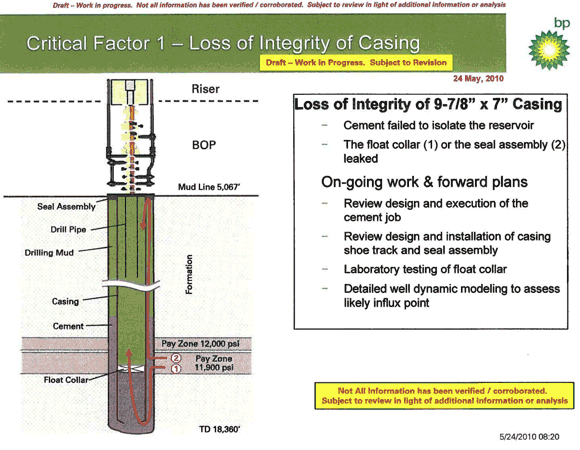
The 5000 feet to the sea floor isn't in addition to the 18000 feet, it's apparently included in the 18000 feet, right? Actually it looks like a total depth of 18,360 feet, right?
And they show the producing formation pressure as 12,000 psi. How accurate that is, I don't know. But that's significant as it puts the formation pressure within the casing limits you mentioned, so the bottomhole pressure should NOT be strong enough to split the casing, unless that 12,000psi is way off.
[edit on 8-6-2010 by Arbitrageur]
reply to post by Arbitrageur
I would say that the greater component of the bottom hole pressure comes from depth. Bottom hole pressure is also determined by the composition of the oil and the temperature in the formation. As the methane (and other volatile components) percentage increases so does the vapor pressure (Pv).
to the last post-
I'm no expert on drilling but it's my understanding that for offshore wells TD is from the floor of the ocean.
[edit on 6/9/2010 by Mike6158]
I would say that the greater component of the bottom hole pressure comes from depth. Bottom hole pressure is also determined by the composition of the oil and the temperature in the formation. As the methane (and other volatile components) percentage increases so does the vapor pressure (Pv).
to the last post-
I'm no expert on drilling but it's my understanding that for offshore wells TD is from the floor of the ocean.
[edit on 6/9/2010 by Mike6158]
Originally posted by Mike6158
reply to post by Arbitrageur
I'm no expert on drilling but it's my understanding that for offshore wells TD is from the floor of the ocean.
Where did you get your understanding from?
I found this:
www.theoildrum.com...
The MC 252 well is located in 5,067 ft of water about 50 miles from the coast of Louisiana. The total depth of the well was 18,360 ft below sea level (13,293 ft below the sea floor).
I suppose that could be wrong but the 12,000 psi formation pressure also points to a shallower depth rather than a deeper depth where the 20,000 psi was calculated.
They also come to an interesting conclusion about the primary cause of the disaster:
The blowout and oil spill on the Deepwater Horizon in the Gulf of Mexico was caused by a flawed well plan that did not include enough cement between the 7-inch production casing and the 9 7/8-inch protection casing. The presumed blowout preventer (BOP) failure is an important but secondary issue.
So it was a flawed plan that didn't use enough cement?
reply to post by Arbitrageur
You are correct, I busted the numbers where the BHP with is closer to 15000 psi. I haven't seen the picture, but was also not aware that the float collar was leaking. This is bizarre since one normally runs a float shoe, a joint or two of casing, then the float collar. Both the float shoe & float collar have check valves to prevent flowback, so again I find it strange that both check valves failed. These valves are very simple devices so I am confused how both failed. It is more likley that the casing would fail before a float valve.
Secondarily, the plot of the pressure gradient curve fit is accurate based upon a saltwater gradient of 9 #/gallon & the 164 psi addition is the intercept with the Y axis for the curve fitting. Depending on where one is in the world this curve will vary slightly. The bottomhole pressure mormally increases with depth using a hydrostatic head between .433 psi/ft(fresh water) to .465 psi/ft(saltwater). However this only projects the normal gradient and doesn't consider the abnormal pressures that are encountered that deviate from the normal gradient. In different areas the change from normal to abnormal prsuures can occur at any depth if the formations have been isolated & then buried whereby the pore pressure(fluid-oil,gas & water) are holding up the compaction from the earth itself.
You are correct, I busted the numbers where the BHP with is closer to 15000 psi. I haven't seen the picture, but was also not aware that the float collar was leaking. This is bizarre since one normally runs a float shoe, a joint or two of casing, then the float collar. Both the float shoe & float collar have check valves to prevent flowback, so again I find it strange that both check valves failed. These valves are very simple devices so I am confused how both failed. It is more likley that the casing would fail before a float valve.
Secondarily, the plot of the pressure gradient curve fit is accurate based upon a saltwater gradient of 9 #/gallon & the 164 psi addition is the intercept with the Y axis for the curve fitting. Depending on where one is in the world this curve will vary slightly. The bottomhole pressure mormally increases with depth using a hydrostatic head between .433 psi/ft(fresh water) to .465 psi/ft(saltwater). However this only projects the normal gradient and doesn't consider the abnormal pressures that are encountered that deviate from the normal gradient. In different areas the change from normal to abnormal prsuures can occur at any depth if the formations have been isolated & then buried whereby the pore pressure(fluid-oil,gas & water) are holding up the compaction from the earth itself.
reply to post by Arbitrageur
Obviously from a really bad source
Where did you get your understanding from?
Obviously from a really bad source
Originally posted by billyjack
reply to post by Arbitrageur
You are correct, I busted the numbers where the BHP with is closer to 15000 psi. I haven't seen the picture, but was also not aware that the float collar was leaking. This is bizarre since one normally runs a float shoe, a joint or two of casing, then the float collar. Both the float shoe & float collar have check valves to prevent flowback, so again I find it strange that both check valves failed. These valves are very simple devices so I am confused how both failed. It is more likley that the casing would fail before a float valve.
Secondarily, the plot of the pressure gradient curve fit is accurate based upon a saltwater gradient of 9 #/gallon & the 164 psi addition is the intercept with the Y axis for the curve fitting. Depending on where one is in the world this curve will vary slightly. The bottomhole pressure mormally increases with depth using a hydrostatic head between .433 psi/ft(fresh water) to .465 psi/ft(saltwater). However this only projects the normal gradient and doesn't consider the abnormal pressures that are encountered that deviate from the normal gradient. In different areas the change from normal to abnormal prsuures can occur at any depth if the formations have been isolated & then buried whereby the pore pressure(fluid-oil,gas & water) are holding up the compaction from the earth itself.
So the composition of the oil doesn't come into play? I have an intimate knowledge of gas processing and that admittedly doesn't translate well to down hole processes but surely there is a difference in the bottom hole pressure of a black oil well vs a wet gas well drilled to the same depth?
Originally posted by Mike6158
So the composition of the oil doesn't come into play? I have an intimate knowledge of gas processing and that admittedly doesn't translate well to down hole processes but surely there is a difference in the bottom hole pressure of a black oil well vs a wet gas well drilled to the same depth?
When you first drill the exploratory well you might not see much difference, why would you?
Whether the formation is oil, gas, or some mixture, it has to support the weight of everything above it and therefore the pressure in the pay zone depends more on the weight of everything above it than what is in the pay zone. It can depend on other factors too like how isolated or interconnected the pay zone is. If it's isolated by impermeable shales or clays, it could be more likely to have abnormal pressures (above or below the linear pressure vs depth graph) due to tectonic forces.
reply to post by Arbitrageur
Ive been thinking about this since I posted. The composition matters but the vapor pressure of the fluid is small compared to the hydrostatic head pressure so it will have minimal contribution to the bottom hole pressure. That changes when the well is produced but for this sub-discussion it's a not a factor.
Ive been thinking about this since I posted. The composition matters but the vapor pressure of the fluid is small compared to the hydrostatic head pressure so it will have minimal contribution to the bottom hole pressure. That changes when the well is produced but for this sub-discussion it's a not a factor.
reply to post by Mike6158
I agree it could make a difference once in production but it's probably not a major factor on the exploratory well.
I agree it could make a difference once in production but it's probably not a major factor on the exploratory well.
new topics
-
What is the white pill?
Philosophy and Metaphysics: 52 minutes ago -
Mike Pinder The Moody Blues R.I.P.
Music: 1 hours ago -
Putin, Russia and the Great Architects of the Universe
ATS Skunk Works: 4 hours ago -
A Warning to America: 25 Ways the US is Being Destroyed
New World Order: 9 hours ago
top topics
-
President BIDEN's FBI Raided Donald Trump's Florida Home for OBAMA-NORTH KOREA Documents.
Political Conspiracies: 14 hours ago, 33 flags -
A Warning to America: 25 Ways the US is Being Destroyed
New World Order: 9 hours ago, 18 flags -
Is AI Better Than the Hollywood Elite?
Movies: 16 hours ago, 4 flags -
Mike Pinder The Moody Blues R.I.P.
Music: 1 hours ago, 4 flags -
What is the white pill?
Philosophy and Metaphysics: 52 minutes ago, 3 flags -
Putin, Russia and the Great Architects of the Universe
ATS Skunk Works: 4 hours ago, 2 flags -
Maestro Benedetto
Literature: 16 hours ago, 1 flags
active topics
-
Mood Music Part VI
Music • 3109 • : TheWoker -
Candidate TRUMP Now Has Crazy Judge JUAN MERCHAN After Him - The Stormy Daniels Hush-Money Case.
Political Conspiracies • 791 • : matafuchs -
Meadows, Giuliani Among 11 Indicted in Arizona in Latest 2020 Election Subversion Case
Mainstream News • 22 • : xuenchen -
President BIDEN's FBI Raided Donald Trump's Florida Home for OBAMA-NORTH KOREA Documents.
Political Conspiracies • 28 • : TzarChasm -
Gaza Terrorists Attack US Humanitarian Pier During Construction
Middle East Issues • 64 • : DBCowboy -
So this is what Hamas considers 'freedom fighting' ...
War On Terrorism • 263 • : ToneD -
What is the white pill?
Philosophy and Metaphysics • 1 • : Astyanax -
A Warning to America: 25 Ways the US is Being Destroyed
New World Order • 21 • : MetalThunder -
Truth Social goes public, be careful not to lose your money
Mainstream News • 133 • : Astyanax -
New whistleblower Jason Sands speaks on Twitter Spaces last night.
Aliens and UFOs • 70 • : baablacksheep1