It looks like you're using an Ad Blocker.
Please white-list or disable AboveTopSecret.com in your ad-blocking tool.
Thank you.
Some features of ATS will be disabled while you continue to use an ad-blocker.

Did Nazis invent the Atomic Bomb?
page: 7share:
Avril Harriman's papers refer to the meeting at Stockholm at end of October 1944 between Abwher agent Edgar Klaus and Soviet Legation member in a
private residence outside Stockholm to hear proposal for separate peace between Russia and Germany.
As for miniature nuclear weapons the ONI document "German Technical Aid to Japan: a Summary" dated June 15 1945 is in the Library at Fort Mead....
As for the ability to create miniature nuclear weapons the concept was described in some detail in a series of wartime patents by Schumann & Trinks which USA copied in the 1950s to create tactical nukes.
You can take a small pellet of fissile Uranium or Plutonium the size of a pea, coat it with a wafer thin coating of Scandium Trittide and then all one has to do is beam a low power dentists X-ray machine at it to cause a nuclear blast the size of ten city blocks.
The Germans knew about this concept and developed Uranium 233 coated with Lithium Deuteride to achieve much the same effect. The colision of Lithium-6 and deuterium under huge pressure (caused by placing it at the heart of a chemical explosive implosion) and high temperatures (again caused by implosion) causes a Deuteron beam emission of neutrons.
The huge flux of neutrons caused by this release imitates the effect of critical mass through highly localised neutron density. The Nazis understood this in 1942.
Thus whilst the Americans laboured long and hard to produce 64 kilograms of HEU for one bomb, the Nazis realised that by a different method they could achieve a nuclear weapon with only 150 grams of U233.
As for miniature nuclear weapons the ONI document "German Technical Aid to Japan: a Summary" dated June 15 1945 is in the Library at Fort Mead....
As for the ability to create miniature nuclear weapons the concept was described in some detail in a series of wartime patents by Schumann & Trinks which USA copied in the 1950s to create tactical nukes.
You can take a small pellet of fissile Uranium or Plutonium the size of a pea, coat it with a wafer thin coating of Scandium Trittide and then all one has to do is beam a low power dentists X-ray machine at it to cause a nuclear blast the size of ten city blocks.
The Germans knew about this concept and developed Uranium 233 coated with Lithium Deuteride to achieve much the same effect. The colision of Lithium-6 and deuterium under huge pressure (caused by placing it at the heart of a chemical explosive implosion) and high temperatures (again caused by implosion) causes a Deuteron beam emission of neutrons.
The huge flux of neutrons caused by this release imitates the effect of critical mass through highly localised neutron density. The Nazis understood this in 1942.
Thus whilst the Americans laboured long and hard to produce 64 kilograms of HEU for one bomb, the Nazis realised that by a different method they could achieve a nuclear weapon with only 150 grams of U233.
edit on 15-11-2012 by sy.gunson because: correcting spelling error
Originally posted by sy.gunson
You can take a small pellet of fissile Uranium or Plutonium the size of a pea, coat it with a wafer thin coating of Scandium Trittide and then all one has to do is beam a low power dentists X-ray machine at it to cause a nuclear blast the size of ten city blocks.
Are you sure you don't mean scandium nitride? There is no such thing as Scandium Trittide.
Unless I am unaware of this new element.
Please advise.
AAC
Originally posted by sy.gunson
Among the delivery systems which Germany had, or were close to fielding in 1944 were:
- He-277 high altitude bombers
- V-2 - with Tabun-B Nerve gas, or tactical nukes
- V-1 - D model with Tabun-B warheads
- Do-217P with tactical nukes
- U-boat towed Lafferentz capsules with V-2 rockets
- Mistel Ar-234 with atomic bombs in fuselage
A "few " problems with that list....
The He-277 was never even flown, and was abandoned
The Germans did not have tactical nukes
no V2 was ever fired from a lafferenz capsule
There was no "Mistel Ar-234", the Mistel programme did not involve the Ar-234, and also the Ar-234 did not have internal stowage of bombs, and again germany did not have nuclear bombs.
There were patents filed during WW2 by Nazi scientists describing workable tactical nukes.
Care to name these patents?
Some people just keep trying to revise history, despite German scientific advances during the war, the allied advances were much better and more advanced.
edit on 15-11-2012 by hellobruce because: (no reason given)
reply to post by sy.gunson
Maybe you are referring to tri·ti·um?
That is a atomic isotope so I assume this is it. Never mind if thats the case.
AAC
Maybe you are referring to tri·ti·um?
That is a atomic isotope so I assume this is it. Never mind if thats the case.
AAC
reply to post by AnAbsoluteCreation
Hydride of Trittium
According to wartime patent applications by Schumann & Trinks in 1943 German Army Ordnance (Heereswaffenamt) used Lithium-6 Deuteride to coat Uranium 233.
Modern miniature nuclear weapons however replicate the method with a hydride of Scandium and Trittium.
Hydride of Trittium
According to wartime patent applications by Schumann & Trinks in 1943 German Army Ordnance (Heereswaffenamt) used Lithium-6 Deuteride to coat Uranium 233.
Modern miniature nuclear weapons however replicate the method with a hydride of Scandium and Trittium.
reply to post by hellobruce
Orders were placed in May 1943. Actually six He-177 A-6 aircraft were converted to He-277 B-5/R2 standard (four 1,750hp DB603G engines) by Reichlin as pre-production prototypes and at least three were known to have flown. Early in conception the He-277 was known as the He-177 A-8.
The He-274 built at Toulouse France was a different but externally similar aircraft with longer span wings for transatlantic bombing missions. This was also designated the He-177 A4.
The He-277 V2 prototype was flown at Vienna-Schwechat 28 February 1944. Mass production was about to start and a large mass of parts were already held when production was cancelled due to the Emergency Fighter Program of 3 July 1944, however Reichlin had eight completed He-277 airframes by this time.
Completed airframes were alocated the following Stammekenzeichen (Stkz) codes:
Prototype Aircraft V-101: NN+QQ (destroyed March 45 Cheb)
Prototype Aircraft V-102: GA+QQ (flown Schwechat Feb 1944)
Prototype Aircraft V-103: NE+OD
Prototype Aircraft V-104: KM+TL (captured Prague Rusnye)
Production aircraft No,A-07: GA+QP
Production aircraft No,A-12: GA+QU
Production aircraft No,A-13: GA+QV
Production aircraft No,A-14: GA+QW
Production aircraft No,A-17 GA+QZ
Stkz codes were only allocated to completed and flying airrframes. Werke numbers were allocated to airframes under construction and Stkz were applied when they joined units or were flown.
I make no claim that the V-2 was fired from a Lafferentz capsule. A 500 ton Lafferentz capsule was trialed behind a U-boat in the Baltic. The Germans realised that the use of Hydrogen Peroxide over such a long voyage was unsatisfactory therefore embarked on development of the A8 version of the V-2 rocket for the capsule using Diesel fuel with Nitric acid to overcome these issues, however that then required a bigger capsule. Three larger capsules were built at Stettin shipyard, but were captured by the Red Army in 1945.
PRO file WO.208/4178 refers to transcripts of secretly recorded conversations by Major General Walter Dornberger during his internment by the British at CSDIC camp 11 where hidden microphones detected his conversations. At Nuremberg the British attempted to prosecute him for War Crimes by citing these recordings and thus the file is found in Nuremberg evidence. In that Dornberger refers to German efforts to arm the V-2 with a nuclear warhead.
Edgar Mayer and Thomas Mehner, Hitler und die ,,Bombe" (Rottenburg: Kopp Verlag, 2002), pp. 110-114, cite the now declassified MAGIC decrypt of a signal from Japan's wartime embassy in Stockholm to Tokyo, in which the writer described a German Uranium "atom smashing" weapon of devastating power which weighed just 5 kilograms: "Stockholm to Tokyo, No. 232.9 December 1944 (War Department), National Archives, RG 457, declassified October 1, 1978.
The Office of Naval Intelligence issued a report before the war with Japan was over citing evidence that Germany had transferred technology in 1944 for a small "atom smashing" bomb, entitled "German Technical Aid to Japan: a Survey" dated June 15 1945.
Allied intelligence reports refer to such a unit Fernkampfflugzeuge 76 aka Kommando Lukesch. Reports from 6 Oct 44 that Arado Ar 234 jet bombers assembled at Kupper bei Sagan, Silesia (codenamed Reichlin 46) Jan 1945 identity confirmed. Activity from Sept 44.
I make no mention of internal bomb stowage: You do.
Given the Japanese refer to a a nuclear weapon with 5 kilogram warhead reported in the Stockholm signal of 12 December 1944, stowage on external bomb racks was perfectly feasible. The aircraft itself was originally conceived as a fast bomber. The Do-217P whilst it had a large bomb bay was capable of dropping large radio guided bombs from 53,000 feet hung from external racks. The He-177 also used external racks therefore the use of external racks does not disqualify the Ar234C being used as a bomber.
Your opinion only.
A "few " problems with that list.... The He-277 was never even flown, and was abandoned
Orders were placed in May 1943. Actually six He-177 A-6 aircraft were converted to He-277 B-5/R2 standard (four 1,750hp DB603G engines) by Reichlin as pre-production prototypes and at least three were known to have flown. Early in conception the He-277 was known as the He-177 A-8.
The He-274 built at Toulouse France was a different but externally similar aircraft with longer span wings for transatlantic bombing missions. This was also designated the He-177 A4.
The He-277 V2 prototype was flown at Vienna-Schwechat 28 February 1944. Mass production was about to start and a large mass of parts were already held when production was cancelled due to the Emergency Fighter Program of 3 July 1944, however Reichlin had eight completed He-277 airframes by this time.
Completed airframes were alocated the following Stammekenzeichen (Stkz) codes:
Prototype Aircraft V-101: NN+QQ (destroyed March 45 Cheb)
Prototype Aircraft V-102: GA+QQ (flown Schwechat Feb 1944)
Prototype Aircraft V-103: NE+OD
Prototype Aircraft V-104: KM+TL (captured Prague Rusnye)
Production aircraft No,A-07: GA+QP
Production aircraft No,A-12: GA+QU
Production aircraft No,A-13: GA+QV
Production aircraft No,A-14: GA+QW
Production aircraft No,A-17 GA+QZ
Stkz codes were only allocated to completed and flying airrframes. Werke numbers were allocated to airframes under construction and Stkz were applied when they joined units or were flown.
The Germans did not have tactical nukes no V2 was ever fired from a lafferenz capsule
I make no claim that the V-2 was fired from a Lafferentz capsule. A 500 ton Lafferentz capsule was trialed behind a U-boat in the Baltic. The Germans realised that the use of Hydrogen Peroxide over such a long voyage was unsatisfactory therefore embarked on development of the A8 version of the V-2 rocket for the capsule using Diesel fuel with Nitric acid to overcome these issues, however that then required a bigger capsule. Three larger capsules were built at Stettin shipyard, but were captured by the Red Army in 1945.
PRO file WO.208/4178 refers to transcripts of secretly recorded conversations by Major General Walter Dornberger during his internment by the British at CSDIC camp 11 where hidden microphones detected his conversations. At Nuremberg the British attempted to prosecute him for War Crimes by citing these recordings and thus the file is found in Nuremberg evidence. In that Dornberger refers to German efforts to arm the V-2 with a nuclear warhead.
Edgar Mayer and Thomas Mehner, Hitler und die ,,Bombe" (Rottenburg: Kopp Verlag, 2002), pp. 110-114, cite the now declassified MAGIC decrypt of a signal from Japan's wartime embassy in Stockholm to Tokyo, in which the writer described a German Uranium "atom smashing" weapon of devastating power which weighed just 5 kilograms: "Stockholm to Tokyo, No. 232.9 December 1944 (War Department), National Archives, RG 457, declassified October 1, 1978.
The Office of Naval Intelligence issued a report before the war with Japan was over citing evidence that Germany had transferred technology in 1944 for a small "atom smashing" bomb, entitled "German Technical Aid to Japan: a Survey" dated June 15 1945.
There was no "Mistel Ar-234", the Mistel programme did not involve the Ar-234, and also the Ar-234 did not have internal stowage of bombs...
Allied intelligence reports refer to such a unit Fernkampfflugzeuge 76 aka Kommando Lukesch. Reports from 6 Oct 44 that Arado Ar 234 jet bombers assembled at Kupper bei Sagan, Silesia (codenamed Reichlin 46) Jan 1945 identity confirmed. Activity from Sept 44.
I make no mention of internal bomb stowage: You do.
Given the Japanese refer to a a nuclear weapon with 5 kilogram warhead reported in the Stockholm signal of 12 December 1944, stowage on external bomb racks was perfectly feasible. The aircraft itself was originally conceived as a fast bomber. The Do-217P whilst it had a large bomb bay was capable of dropping large radio guided bombs from 53,000 feet hung from external racks. The He-177 also used external racks therefore the use of external racks does not disqualify the Ar234C being used as a bomber.
...and again Germany did not have nuclear bombs.
Your opinion only.
reply to post by AnAbsoluteCreation
If you have never heard of Scandium Tritide then perhaps you need to learn more about nuclear weapons or chemistry. Here's a good place for beginners like you to start:
Elements of Fission Weapon Design
If you have never heard of Scandium Tritide then perhaps you need to learn more about nuclear weapons or chemistry. Here's a good place for beginners like you to start:
Elements of Fission Weapon Design
hellobruce
Originally posted by sy.gunson
Among the delivery systems which Germany had, or were close to fielding in 1944 were:
- He-277 high altitude bombers
- V-2 - with Tabun-B Nerve gas, or tactical nukes
- V-1 - D model with Tabun-B warheads
- Do-217P with tactical nukes
- U-boat towed Lafferentz capsules with V-2 rockets
- Mistel Ar-234 with atomic bombs in fuselage
A "few " problems with that list....
The He-277 was never even flown, and was abandoned
He-277 prototypes were tested and flown. These included:
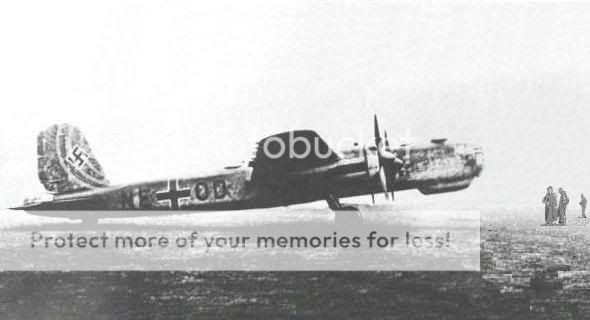
He177 A-08 stkz "DL+AT" (factrory werke no.023) was rebuilt as an He-177 B-0 for testing with the Jumo 222 engine with the stkz code "NE+OD." In a conference at Obersalzburg on 23 March 1943 Hitler gave Heinkel approval to proceed with development of the He-277 and the He-177 B0 prototypes were drafted into flight testing the He-277 concept. In July 1943 rebuilt again as the He-277 V104 with 36m wings intended for the He-177 A7. This particular aircraft was issued the Stammkennzeichen (stkz) "GA+QQ" and was flown.
He-177 B-0 V103 W.Nr.550036 stkz "KM+TL" was converted to a twin tail fin He-277 B-5 V103 and the prototype He-277 was flown.
This aircraft below stkz NE+OD WNr.535550 photographed as an He-177 B-0, V102 conversion, later converted to He-277 V1 was flown and tested with the DB603A engine.
Furthermore sixteen He-177 airframes delivered to Reichlin workshops were also converted to He-277 as pre-production airframes. These included six He-177 A-6/R1 prototypes and one He-177 A-6/R2 prototype with the Rheinmetal Borsig tail turret.
In addition six He-177 A-5 airframes converted to He-177 A-7 aircraft with 36.6m wingspans which were intended to use the 3,600hp coupled DB603 engine (DB613), were instead also converted to He-277 aircraft.
These He-177 A-7 aircraft included:
KM+TN Heinkel He177 A-7 W.Nr.550038 W.Nr.550038 v37 KdE
KM+TY Heinkel He177 A-7 W.Nr.550049 W.Nr.550049 v39 KdE
KM+TL Heinkel He177 A-7 W.Nr.550036 W.Nr.550036 v103 KdE
The following Stammkennzeichen codes (stkz) were allocated to He-277 production aircraft which did fly:
GA+QQ Heinkel He277 V9
GA+QR Heinkel He277 V10
GA+QM Heinkel He277 V26
GA+QX Heinkel He277 V18
I have a list of other He-277 aircraft allocated stkz codes but can't claim whether these also flew.
The Germans did not have tactical nukes
Yes they did have tactical nuclear warheads bassed on boosted fission technology developed between 1941-42 by Otto Haxel and the Schumann-Trinks team. Immediately following WW2 both Sweden and Switzerland began developing their own boosted fission warheads with boosted fission technology which USA itself did not possess until 1956.
In British CSDIC evidence from secretly tape recorded conversations of Gen Major Dornberger in British captivity from 2-7 August 1945 was cited against Dornberger at Nuremberg in an attempt to indict him for the arming of V-2 rockets with tactical nuclear warheads (amongst other things). Some of that evidence still remains classified today.
In December 1944 the Japanese embassy in Stockholm signalled Tokyo describing German use of this 5 kilogram "uranium atom splitting weapon" south of Kursk in June 1942.
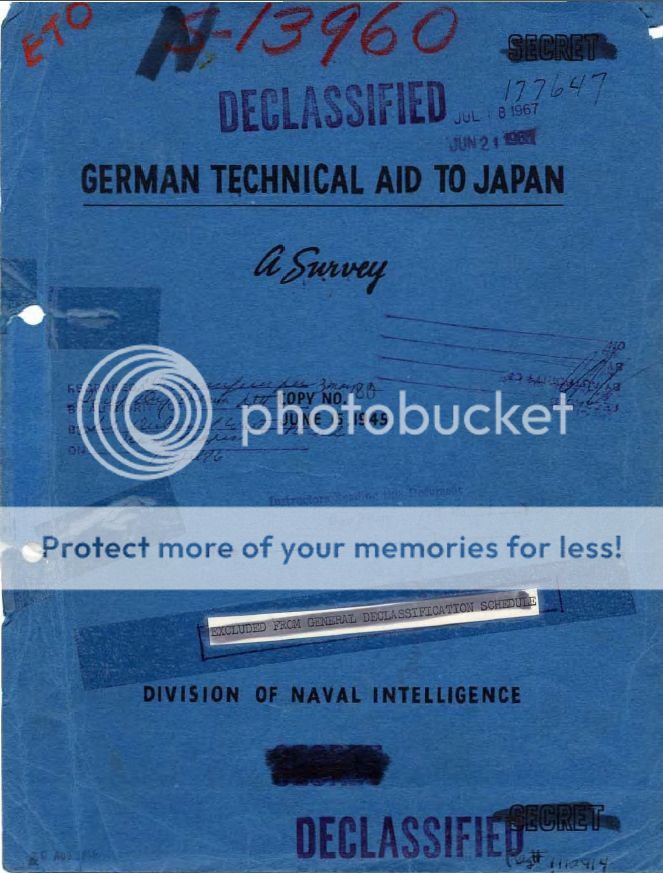
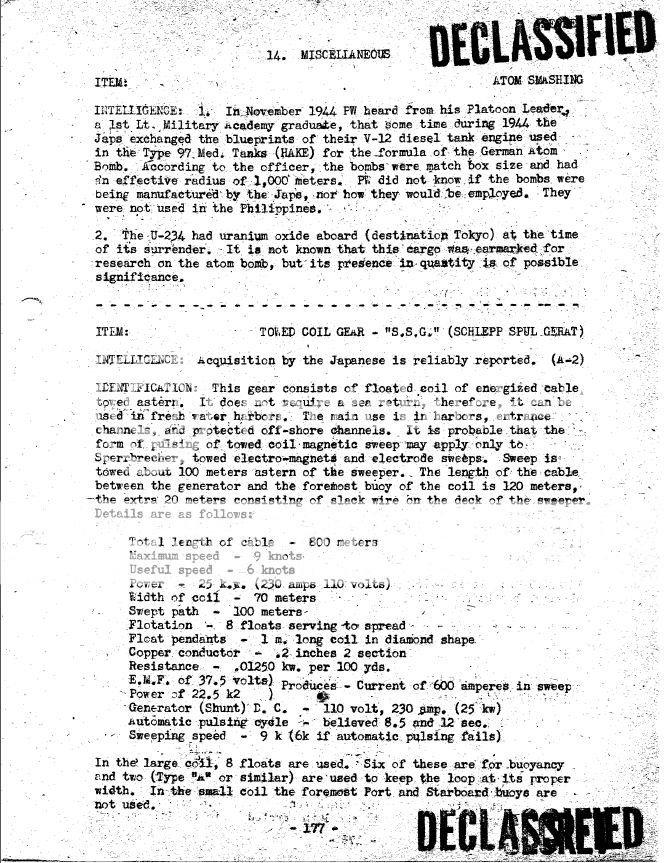
In a US Navy Intelligence report from June 15, 1945 reference is made to German transfer of Atomic bomb technology to japan in 1944 and that the warhead had a radius of 1,000m which is a tactical weapon of roughly 0.87kt.
no V2 was ever fired from a lafferenz capsule
Wernher von Braun when interrogated by the US Naval Technical Mission Europe (NAVTECHMISEU) on 18 may 1945 referred to the testing of V-2 rockets with a Lafferentz capsule in Batlic trials during 1943 with U-1063 known as projekt schwimmweste
There was no "Mistel Ar-234", the Mistel programme did not involve the Ar-234, and also the Ar-234 did not have internal stowage of bombs, and again germany did not have nuclear bombs.[/qoute]
There is no assertion made about internal stowage of bombs. A CSDIC report mentions the use of a transatlantic range "Super V-1" launched from an Ar-234 aircraft piggyback style.
There were patents filed during WW2 by Nazi scientists describing workable tactical nukes.
Care to name these patents?
I refer you to the book Hitlers Bombe, Kalrsch, Rainer 2005, in which excerpts from wartime patents are reproduced courtesy of the Trinks family acrhives (Dr walter trinks' son Professor Hauke Trink) The official historical account holds that all wartime patents disappeared at the end of WW2 however there are strong indications they were confiscated by USA and never acknowledged.
Postwar however and before the method was ever previously disclosed in the media or in scientific journals Schumann reasserted their existence in his postwar patent application for the same method, patent No. 977863; "Procedures for the ignition of thermonuclear reactions by means of convergent detonation compression shocks "
In the periodical “Military engineering monthly magazines"” 1960, P. 8 FF. Hajek (Schumann's postwar alias whilst employed by the French military) explained boosted fission weapons in detail with reference to successful explosion attempts and also discussed shaped-charge cascade ignition of atomic hollow charges arranged against each other.
In 1956 Schuman under the alias H.J. Hajek also published in the magazine of "“explosives"” 5/6 1955, P. 65 FF an article about atomic hollow charges which remains classified.
1943, "Preliminary Report on Enhancement of the Hollow Charge Through Lens Directed Initiation" by Prof. Dr. Erich Schumann and Dr. Gerd Hinrichs, Physics Institute of Berlin University. After Erich Schumann transferred to Atomic weapons research in the office for army weapon ordnance (HWA), in 1940 Dr Walter Trinks rose to Director of the Referats Wa FI b "blowing up physics and hollows charge' (ie Ballistics research). Until the end of war their group of scientists compiled at least forty secret patents around Trinks on the topic of shaped shaped-chargesee.: Erich Schumann, Gerd Hinrichs, provisional report to the report 43/2 on the effect increase with hollow explosives by ignition guidance (lenses); Erich Schumann, over "blowing-up weapons", explosive physics report 44/9, 16.11.1944, by Dr Erich Schumann.
Associated wiuth their research was mathematician Gottfried Guderley, who wrote an article "Strong centre spherical and cylindrical compression shocks in the proximity of the ball center and/or the cylinder axle, in: Magazine for aviation research ("Luftfahrtforschung Vol. 19"), 1942, Bd. 19, Lfg. 9, P. 302-312. This article concerned the use of conical shockwaves used to generate powerful X-ray plasma. After the war
After the war Edward teller father of the H-bomb relied very heavily on Schumann's wartime work. Teller suggested placing a fissile mass in the center of the fusion fuel. The convergent shock wave would compress this to supercriticality upon arriving at the center, making it act as a "spark plug" to ignite the fusion reaction.
edit on 13-3-2014 by sy.gunson because: removing unnecessary duplications
by Hello Bruce:
Some people just keep trying to revise history, despite German scientific advances during the war, the allied advances were much better and more advanced.
In the book: Edward Teller lectures: lasers and inertial fusion energy, by Heinrich Hora, George Hunter Miley pp215-216 it mentions this:
We used them to define the working point in the HIBALL study, a design of a heavy ion driven ICF reactor, which was published in 1983... Spherical implosion for achieving 1500 times fuel compression at pressures of 200 G/bar is the central problem for ICF gas dynamics. In respect of the paper of Gottfreid Guderley on converging shocks, published 1942 in wartime Germany became of particular importance for me
This is direct reference to work in 1942 Germany on Inertial Confinement Fusion ("ICF") by spherical compression, thus it is not historical revision at all but unearthing of actual history as recounted by those who were there. Information which has been suppressed and falsely denied by the fantasists who rewrote conventional history to exclude the truth.
After the war Edward Teller father of the H-bomb relied very heavily on Schumann's wartime work. Teller suggested placing a fissile mass in the center of the fusion fuel. The convergent shock wave would compress this to supercriticality upon arriving at the center, making it act as a "spark plug" to ignite the fusion reaction.
lunarminer
Originally posted by punkinworks09
Yes, the sudden availability of enough U-235 to make a bomb is one of those facts that is hard to ignore. Why was the uranium bomb never tested? The simple answer is that we didn't have enough U-235 to waste on doing a test. If that is so, then obviously we had more plutonium.
It's also possible that was a bluff. What's more powerful in diplomacy? Having nukes and appearing to have a factory capable of pumping them out. Or appearing to be out of the weapons for the time being?
new topics
-
Where should Trump hold his next rally
Politicians & People: 6 minutes ago -
Shocking Number of Voters are Open to Committing Election Fraud
US Political Madness: 50 minutes ago -
Gov Kristi Noem Shot and Killed "Less Than Worthless Dog" and a 'Smelly Goat
2024 Elections: 1 hours ago -
Falkville Robot-Man
Aliens and UFOs: 1 hours ago -
James O’Keefe: I have evidence that exposes the CIA, and it’s on camera.
Whistle Blowers and Leaked Documents: 2 hours ago -
Australian PM says the quiet part out loud - "free speech is a threat to democratic dicourse"...?!
New World Order: 3 hours ago -
Ireland VS Globalists
Social Issues and Civil Unrest: 3 hours ago -
Biden "Happy To Debate Trump"
2024 Elections: 4 hours ago -
RAAF airbase in Roswell, New Mexico is on fire
Aliens and UFOs: 4 hours ago -
What is the white pill?
Philosophy and Metaphysics: 5 hours ago
top topics
-
A Warning to America: 25 Ways the US is Being Destroyed
New World Order: 14 hours ago, 21 flags -
Blast from the past: ATS Review Podcast, 2006: With All Three Amigos
Member PODcasts: 6 hours ago, 11 flags -
Mike Pinder The Moody Blues R.I.P.
Music: 6 hours ago, 8 flags -
Biden "Happy To Debate Trump"
2024 Elections: 4 hours ago, 8 flags -
James O’Keefe: I have evidence that exposes the CIA, and it’s on camera.
Whistle Blowers and Leaked Documents: 2 hours ago, 5 flags -
What is the white pill?
Philosophy and Metaphysics: 5 hours ago, 5 flags -
Australian PM says the quiet part out loud - "free speech is a threat to democratic dicourse"...?!
New World Order: 3 hours ago, 5 flags -
Ireland VS Globalists
Social Issues and Civil Unrest: 3 hours ago, 4 flags -
RAAF airbase in Roswell, New Mexico is on fire
Aliens and UFOs: 4 hours ago, 4 flags -
Putin, Russia and the Great Architects of the Universe
ATS Skunk Works: 9 hours ago, 3 flags
active topics
-
Biden "Happy To Debate Trump"
2024 Elections • 36 • : DontTreadOnMe -
-@TH3WH17ERABB17- -Q- ---TIME TO SHOW THE WORLD--- -Part- --44--
Dissecting Disinformation • 701 • : Thoughtful3 -
This is our Story
General Entertainment • 2 • : ByeByeAmericanPie -
Mike Pinder The Moody Blues R.I.P.
Music • 2 • : DontTreadOnMe -
University of Texas Instantly Shuts Down Anti Israel Protests
Education and Media • 299 • : CriticalStinker -
Where should Trump hold his next rally
Politicians & People • 0 • : charlest2 -
Candidate TRUMP Now Has Crazy Judge JUAN MERCHAN After Him - The Stormy Daniels Hush-Money Case.
Political Conspiracies • 806 • : Annee -
The functionality of boldening and italics is clunky and no post char limit warning?
ATS Freshman's Forum • 14 • : Encia22 -
MULTIPLE SKYMASTER MESSAGES GOING OUT
World War Three • 99 • : cherokeetroy -
Gov Kristi Noem Shot and Killed "Less Than Worthless Dog" and a 'Smelly Goat
2024 Elections • 25 • : FlyersFan