It looks like you're using an Ad Blocker.
Please white-list or disable AboveTopSecret.com in your ad-blocking tool.
Thank you.
Some features of ATS will be disabled while you continue to use an ad-blocker.

The Bunyip Explained?
page: 115
share:
The Bunyip Mystery Explained?
Fooffstarr examines one of Australia's greatest mysteries and discovers that Bunyip sightings could actually been of 3 different creatures...
Australia is a strange place. When the super continent Pangaea broke up millions of years ago, it placed the Australasian region in a unique evolutionary position. Distinctive flora and fauna dot the landscape, having evolved independently from the rest of the world.
Extraordinary creatures, such as the Platypus, have flourished in Australia’s varied climates and ecosystems. It leaves me asking, how strange do these creatures get?
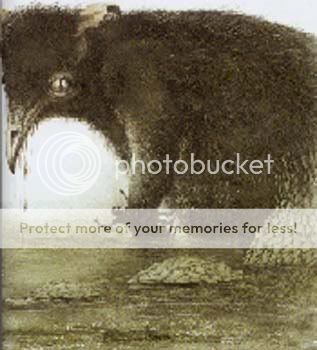
Copyright AmericanMonsters.com
The Aboriginal people, whom it is assumed migrated through Asia and onto the Australian mainland around 40,000 years ago, tell countless stories of creatures currently unknown to science.
One such beast is the Bunyip.
Like the Yowie and other Australian cryptids, the Bunyip was first recognized by Aboriginals. Their description sounds like a strange splicing of a dog, horse and walrus. It was said to have dark fur, facial horns and a bulky physique.
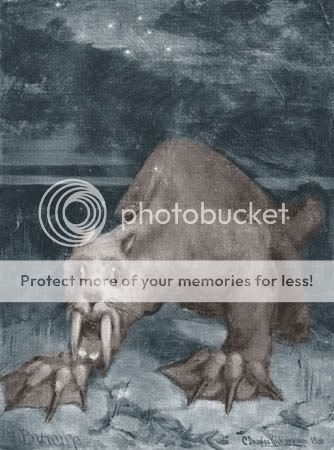
Copyright Wilsonsalmanac.com
At around the size of a cow, the Bunyip was lurked in billabongs and rivers awaiting its next meal and according to Aboriginal legend, that meal was sometimes humans.
The First Fleet arrived in 1788 and began the colonization of eastern coast of Australia. As with the Yowie, reports from the colonists began to hit the Sydney papers of Bunyip encounters.
One such witness was a convict, William Buckley. He states, "In Lake Moodewarri as well as in most of the others inland lakes is a very extraordinary amphibious animal, which the natives call Bunyip. I could never see any part, except the back, which appeared to be covered with feathers of a dusky grey colour. It seemed to be about the size of a full grown calf... I could never learn from any of the natives that they had seen either the head or tail."
In the early 1800s the flood of reported sightings became a trickle. The public had lost some of their interest in Australia’s mysteries. Then in 1846 experts found what they believed to be a Bunyip skull.

Copyright National Library of Australia
The skull was found on the banks of the Murrumbidgee River in New South Wales. The Australian Museum of Sydney took the skull and placed it on display. This discovery sparked a new wave of Bunyip reports and soon after the skull ‘disappeared’ from the museum. Its location remains a mystery.
Once excitement from the skull’s unearthing dissipated, interest in the Bunyip waned. Up until today there have been sporadic sightings and reports, but no evidence has been produced to support the Bunyip’s existence.
With today’s knowledge, however, it is possible to almost wholly explain the Bunyip phenomenon. Although there will be some sightings that remain unexplainable, the vast majority can be accounted for with several theories put forward in the past years.
The first is that what many Aboriginals saw was simply a seal. This matches with the descriptions of the dog-like face, flippers and shiny back. Seals could quite easily find themselves lost in the intricate network of rivers that flow into Australia.

Copyright DanciPrari.com
Aboriginals would be unfamiliar with the animals, and thus relay the tale of them to others. The story would soon be embellished and twisted to create the hairy, cow-sized Bunyip of legend.
Another idea is that Bunyips could have been an extinct species, most likely the Procoptodon or Diprotodon. They were large marsupials which may have lived up to 10,000 years ago. At that stage, the Aboriginals had been on the continent for 30,000 years, so they most likely would have had contact with the creature.
The Diprotodon
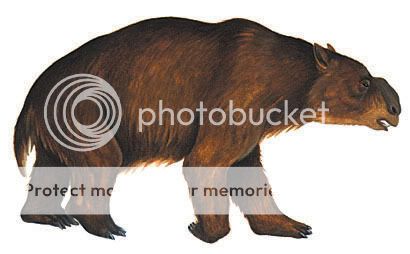
Copyright LostKingdoms.com
There is really no other creature in their Dreaming legends that could match the Procoptodon or Diprotodon.. The Bunyip holds the closest resemblance, possibly a combination of both creatures.
The Procoptodon
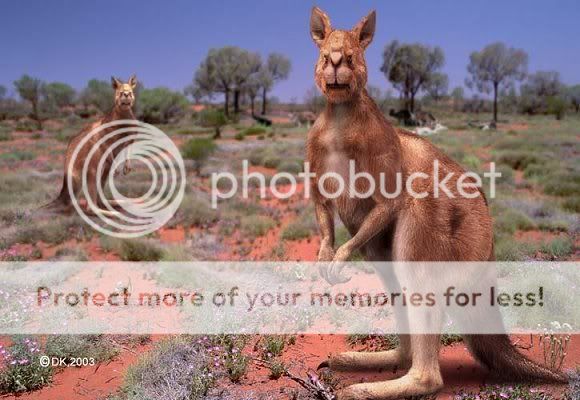
Copyright Prehistoricsillustrated.com
Escaped criminals can also account for some of the colonial-era sightings. A billabong was a safe place to hide from pursuers, and if trouble approached, the suspect could leap into the shallow water and submerge themselves until they were once again alone. Any witnesses to their reemergence would have seen a humanoid covered in mud and water plants, and would most certainly have fled in terror.
So sadly, one of Australia’s greatest mysteries can be logically explained. Until the mysterious skull, which some believe was most likely nothing more than a mutated farm animal, resurfaces, it may never be fully known if anything as bizarre as the Bunyip lurked in the Australian bush.
It is still said, however, that on a calm, quiet night you will hear strange calls coming from many inland billabongs.
Sources and Further Reading
Wikipedia - Bunyip
Cryptozoology.com - Bunyip
Dave's Mythical Creatures
NewAnimal.com - Bunyip
AmericanMonsters.com - Bunyip
Great post!
I have always been interested in Cryptids. But have never looked at the Bunyip much before this.
Great Research S+F
I have always been interested in Cryptids. But have never looked at the Bunyip much before this.
Great Research S+F
reply to post by fooffstarr
I enjoyed your ideas here. Some good information and it's a shame that the thread didn't get more interest, possibly you covered too many
angles in one post? People can't add much more than "Great post!"
After your first illustration, I thought about walruses, but they live around the Arctic and are unlikely to cross the Equator. How about one of these though?

It's the Leopard Seal, they live in the Antarctic and if we're discussing myth and legend, why shouldn't one get lost in the swamps of South Australia once in a while? They grow pretty big and are accountable for a UK diver a couple of years ago. I wouldn't like to be within 100 meters either because they are FAST too.

A shameless )))BUMP((( of a good looking thread
After your first illustration, I thought about walruses, but they live around the Arctic and are unlikely to cross the Equator. How about one of these though?
It's the Leopard Seal, they live in the Antarctic and if we're discussing myth and legend, why shouldn't one get lost in the swamps of South Australia once in a while? They grow pretty big and are accountable for a UK diver a couple of years ago. I wouldn't like to be within 100 meters either because they are FAST too.
Females are generally larger than the males. The bulls are generally 2.5 m (8.2 ft) to 3.2 m (10.5 ft) and weigh between 200 kg (441 lb) and 453.5 kg (1,000 lb), while cows are between 2.4 meters (7.9 feet) and 3.4 meters (11.2 feet) in length and weigh between 225 kg (496 lb) and 591 kg (1,303 lb).
A shameless )))BUMP((( of a good looking thread
Great stuff, s&f +
I'm fascinated by aboriginal folklore..
Now off to see if there are any threads on min-min lights.
I'm fascinated by aboriginal folklore..
Now off to see if there are any threads on min-min lights.
Thanks for the replies
TheOmen
Thanks.
The Bunyip is one of those creatures that is simply written off as legend. Bigfoot, Nessie etc. are at least real to some people, but the Bunyip legend is usually treated in the same category as fairies and unicorns... in other words fantasy.
It was good to find out that at least people thought they were seeing something real.
Kandinsky
Nice post.
The Leopard Seal is a good choice for many of the mis-identifications.
The vast majority of Aboriginal people at the time would not have encountered any form of Seal and one as strange as the Leopard Seal would have certainly caused a stir.
The Walrus is mentioned in many descriptions of the creature, but as you correctly stated, none would have been able to reach Australia.
yizzel
I think the min mins got explained a few years back, not sure. Might just be a false memory. I'll check it out and might make a thread about it if there has been an explanation.
[edit on 25-2-2009 by fooffstarr]
TheOmen
Thanks.
The Bunyip is one of those creatures that is simply written off as legend. Bigfoot, Nessie etc. are at least real to some people, but the Bunyip legend is usually treated in the same category as fairies and unicorns... in other words fantasy.
It was good to find out that at least people thought they were seeing something real.
Kandinsky
Nice post.
The Leopard Seal is a good choice for many of the mis-identifications.
The vast majority of Aboriginal people at the time would not have encountered any form of Seal and one as strange as the Leopard Seal would have certainly caused a stir.
The Walrus is mentioned in many descriptions of the creature, but as you correctly stated, none would have been able to reach Australia.
yizzel
I think the min mins got explained a few years back, not sure. Might just be a false memory. I'll check it out and might make a thread about it if there has been an explanation.
[edit on 25-2-2009 by fooffstarr]
reply to post by fooffstarr
How would they not be familiar with these animals and know them?
They have lived there for 40,000 years !!!!!!
Does that make sense to you?
How would they not be familiar with these animals and know them?
They have lived there for 40,000 years !!!!!!
Does that make sense to you?
reply to post by LucidDreamer85
Which animals are you referring to? The leopard seals? The extinct ones?
Human nature doesn't change. When we see something we can't explain straight away, our minds go into overtime to either push it away or make up something even stranger than what we originally saw.
Seals rarely make it inland in Australia. Even the coastal tribes would not have seen them on a regular basis.
So when one did make it inland and was spotted by an Aboriginal, they were probably terrified and by the time they made it home to tell their family and friends, the creature was twice the size and monstrous in their mind.
As far as the extinct Mega Fauna, yes they would have come in contact with them thousands of years ago. Maybe even hunted them. But all we have to go on is the stories that have survived to this day. And in the Dreaming, there really isn't any stories that tell of these creatures. They do, however, mention the Bunyip, which could easily be the combination of these 2 extinct creatures.
[edit on 1-4-2009 by fooffstarr]
Which animals are you referring to? The leopard seals? The extinct ones?
Human nature doesn't change. When we see something we can't explain straight away, our minds go into overtime to either push it away or make up something even stranger than what we originally saw.
Seals rarely make it inland in Australia. Even the coastal tribes would not have seen them on a regular basis.
So when one did make it inland and was spotted by an Aboriginal, they were probably terrified and by the time they made it home to tell their family and friends, the creature was twice the size and monstrous in their mind.
As far as the extinct Mega Fauna, yes they would have come in contact with them thousands of years ago. Maybe even hunted them. But all we have to go on is the stories that have survived to this day. And in the Dreaming, there really isn't any stories that tell of these creatures. They do, however, mention the Bunyip, which could easily be the combination of these 2 extinct creatures.
[edit on 1-4-2009 by fooffstarr]
The one pic I'm not sure on, is the one that is supposedly a skull, it appears to be more fictional, because why would the skull be green in colour,
surely it would be tarnished from being in a bog, but not coloured like a latex creature.
There ARE pictures (just search Google images), of a skull that was found that DOES look similar to the original bunny with the 'beak' like face, but I'm not taken with the green 'skull'.
On the other hand, I've had relatives from Aus mention similar things to me in the past, my cousins often played in the water when they were kids, and quite often my uncles would take them out to certain lakes and inland water areas, but many of them would be 'forbidden', being the resever of the fabulous creature and they were forbidden to go. My uncle, many many years ago, back before I was interested in crypto topics discussed what I would assume was a sighting but he's no longer with us to question him now I am interested, but he would certainly know what a seal was, and this was at most 20 years ago. It would have been nice to have even an eye witness account from the latter years.
Has your research found any sightings of late? I'd be interested in whether they continue to this day, given the fact that we now have planes and helicopters and more tourists and such walk into the bush on a daily basis than there would be settlers in the olden days.
There ARE pictures (just search Google images), of a skull that was found that DOES look similar to the original bunny with the 'beak' like face, but I'm not taken with the green 'skull'.
On the other hand, I've had relatives from Aus mention similar things to me in the past, my cousins often played in the water when they were kids, and quite often my uncles would take them out to certain lakes and inland water areas, but many of them would be 'forbidden', being the resever of the fabulous creature and they were forbidden to go. My uncle, many many years ago, back before I was interested in crypto topics discussed what I would assume was a sighting but he's no longer with us to question him now I am interested, but he would certainly know what a seal was, and this was at most 20 years ago. It would have been nice to have even an eye witness account from the latter years.
Has your research found any sightings of late? I'd be interested in whether they continue to this day, given the fact that we now have planes and helicopters and more tourists and such walk into the bush on a daily basis than there would be settlers in the olden days.
reply to post by ejsaunders
As far as I know, there hasn't been any credible sightings of a Bunyip for many years.
If it did exist, I'd say it has been pushed to the point of extinction by the ever expanding urban sprawl.
I'm still on the fence about this one though. Maybe it did exist, maybe it didn't.
As far as I know, there hasn't been any credible sightings of a Bunyip for many years.
If it did exist, I'd say it has been pushed to the point of extinction by the ever expanding urban sprawl.
I'm still on the fence about this one though. Maybe it did exist, maybe it didn't.
Personally, I'm of the opinion, that either there are, what science would probably call portals (bit like the show Primeval, but I came up with the
idea after reading some book many many years before), that open into prior ages, OR... that certain animals do not inherently die out in totality,
they survive in small packs that may eventually die out given the lack of breeding and loss of grounds and hence the reason why so few strange
creatures are seen these days - they were merely throw overs from yesteryear that had not completely died out.
The Colecanth (sp? sorry have a dislike for big fish), is a good example, as is the Tazmanian Tiger which has been seen for many years since it supposedly died out.
The lack of what I would assume are its natural habitats to pollution, and human encroachment, would make it likely they died out save for a few isolated animals if they continue to survive.
Still, great thread, and I enjoy research that makes sense, rather than the standard drivel
The Colecanth (sp? sorry have a dislike for big fish), is a good example, as is the Tazmanian Tiger which has been seen for many years since it supposedly died out.
The lack of what I would assume are its natural habitats to pollution, and human encroachment, would make it likely they died out save for a few isolated animals if they continue to survive.
Still, great thread, and I enjoy research that makes sense, rather than the standard drivel
in your OP you mentioned a skull was found that was thought to have been that of a Bunyip, is there any other details surrounding this skull other
than it dissapeared, i would have thought at the time of the finding they would have a pretty good grasp of the fauna in the area.
true it could have been a skull that predated mans settlement on the continent, but i still find the skull an interesting side note.
true it could have been a skull that predated mans settlement on the continent, but i still find the skull an interesting side note.
reply to post by Demandred
A great article about the skull, as well as images of it are here:
A great article about the skull, as well as images of it are here:
In 1846 an unusual skull was retrieved from the banks of the Murrumbidgee River in New South Wales. In the first flush of excitement several experts declared that it was the skull of something unknown to science. In July 1847 the so-called ‘bunyip skull’ was put on exhibition in the Australian Museum (then located at the Supreme Court House, Sydney) for two days.
Visitors flocked to see it and the Sydney Morning Herald, 1847 reported that it prompted a spate of bunyip stories:
… almost everyone became immediately aware that he had heard ‘strange sounds’ from the lagoons at night, or had seen ‘something black’ in the water.
Sydney’s leading naturalist, William Macleay, examined the skull and compared it with an even stranger one: a skull with only one eye-socket—a veritable cyclops!
Scientific knowledge and common sense prevailed, however, when Macleay concluded that both skulls were freaks of nature and did not represent a new species. The Australian Medical Journal warned that claims of ‘bunyip skulls’ could only be seen as an ‘ostentatious display of our ignorance and credulity’.
Gradually the debate calmed down although one final mystery remains—what became of the so-called bunyip skull. It disappeared and has never been sighted since!
Source
reply to post by fooffstarr
Hiya Fooffstarr, another shameless bump of a good thread (it's a shame all the images are now 'external links')
I found an illustration of the famous Bunyip skull, although no vet, it looks very unlike a horse's skull....
[atsimg]http://files.abovetopsecret.com/images/member/8b4952e0b716.jpg[/atsimg]
As you mention in the OP, possibly it was a diprotodon? I like the idea of this one simply because it's very 2 Million Years BC!...
[atsimg]http://files.abovetopsecret.com/images/member/9da73bed75f2.jpeg[/atsimg]
Bunyip - Legendary Creature
I wonder if the terrible nocturnal howls were from rare incidents of kangaroos drowning in pools? Maybe a kangaroo briefly surviving a croc attack? It would explain sounds of splashing and howls. As a kid, me and my brother were woken one night by weird, anguished howling over in the fields and woods nearby. Never forgotten it and never found an explanation. Having heard that sound, I can understand clearly how a mythology can arise to explain similar noises. I can imagine a tribal wiseman being asked what the sound is? Human nature kicks in, unable to explain and not wishing to seem unknowledgeable, he goes on to state (matter of factly)..."Errr...it's a bunyip, stupid! Everyone knows that!"
[edit on 16-5-2009 by Kandinsky]
I found an illustration of the famous Bunyip skull, although no vet, it looks very unlike a horse's skull....
[atsimg]http://files.abovetopsecret.com/images/member/8b4952e0b716.jpg[/atsimg]
As you mention in the OP, possibly it was a diprotodon? I like the idea of this one simply because it's very 2 Million Years BC!...
[atsimg]http://files.abovetopsecret.com/images/member/9da73bed75f2.jpeg[/atsimg]
Bunyip - Legendary Creature
I wonder if the terrible nocturnal howls were from rare incidents of kangaroos drowning in pools? Maybe a kangaroo briefly surviving a croc attack? It would explain sounds of splashing and howls. As a kid, me and my brother were woken one night by weird, anguished howling over in the fields and woods nearby. Never forgotten it and never found an explanation. Having heard that sound, I can understand clearly how a mythology can arise to explain similar noises. I can imagine a tribal wiseman being asked what the sound is? Human nature kicks in, unable to explain and not wishing to seem unknowledgeable, he goes on to state (matter of factly)..."Errr...it's a bunyip, stupid! Everyone knows that!"
[edit on 16-5-2009 by Kandinsky]
reply to post by Kandinsky
Cheers for the support.
I keep meaning to work on a new thread similar to the 3 in my signature, but time has been a highly valued commodity lately.
Yeah, that sketch of the skull is in the link I provided above too.
They compared it to the head of a horse (or more specifically a foal) and the 2 images linked in my post above yours are firstly, the skull of a foal, and the artists impression of what the Bunyip skull looked like.
I can see the similarities to the Diprotodon, but it is missing several key features such as the curving front teeth and raised nose-like bridge on top. They may have broken off, but without the original skull we will never know.
Cheers for the support.
I keep meaning to work on a new thread similar to the 3 in my signature, but time has been a highly valued commodity lately.
Yeah, that sketch of the skull is in the link I provided above too.
They compared it to the head of a horse (or more specifically a foal) and the 2 images linked in my post above yours are firstly, the skull of a foal, and the artists impression of what the Bunyip skull looked like.
I can see the similarities to the Diprotodon, but it is missing several key features such as the curving front teeth and raised nose-like bridge on top. They may have broken off, but without the original skull we will never know.
reply to post by fooffstarr
Hi mate. Interesting thread!
Wondering if you've ever heard any aboriginal tales of "The Mook".
I friend of mine (Aboriginal), told me a few stories about encounters that he had heard about. These encounters were in darkness in the bush; so it could just account for aboriginal superstition. The Mook; as told to me, is their version of the "Boogy-man".
I've got another really wild and creepy story; if you're interested- about the Mook.
Rex Gilroy- a man whom I was lucky enough to meet when I was a boy; is a most interesting man. His knowlegde of Australian Cryptozoology is exceptional (among other things). He has written quite a few books on uniquely Australian encounters- Yowie, Hawkesbury Monster, UFO's and Bunyip. Just a heads-up; if you didnt know.
Cheers.
Hi mate. Interesting thread!
Wondering if you've ever heard any aboriginal tales of "The Mook".
I friend of mine (Aboriginal), told me a few stories about encounters that he had heard about. These encounters were in darkness in the bush; so it could just account for aboriginal superstition. The Mook; as told to me, is their version of the "Boogy-man".
I've got another really wild and creepy story; if you're interested- about the Mook.
Rex Gilroy- a man whom I was lucky enough to meet when I was a boy; is a most interesting man. His knowlegde of Australian Cryptozoology is exceptional (among other things). He has written quite a few books on uniquely Australian encounters- Yowie, Hawkesbury Monster, UFO's and Bunyip. Just a heads-up; if you didnt know.
Cheers.
reply to post by KRISKALI777
Yeah, I know Rex.
His website and Dean Harrison's website were both integral in my learning about the Yowie and Bunyip.
Rex is a bit eccentric but lately the evidence he has been finding regarding the big cats in rural NSW has been excellent. The nightly news and A Current Affair have aired segments on some of the stuff he has found.
Please share all the stories you have. Since this topic is about the Bunyip, though, perhaps you could start an entirely new topic about 'The Mook'. I'm sure many ATSers would be as interested as we are.
Yeah, I know Rex.
His website and Dean Harrison's website were both integral in my learning about the Yowie and Bunyip.
Rex is a bit eccentric but lately the evidence he has been finding regarding the big cats in rural NSW has been excellent. The nightly news and A Current Affair have aired segments on some of the stuff he has found.
Please share all the stories you have. Since this topic is about the Bunyip, though, perhaps you could start an entirely new topic about 'The Mook'. I'm sure many ATSers would be as interested as we are.
reply to post by fooffstarr
Thanks but you may have to mate!
You see, when ever I have tried to start a thread on ATS, I take time to write my opening, get external links etc- and then I always get the same bloody message; THERE ARE ALREADY SIMILAR THREADS TO THIS TOPIC ON THE DISCUSSION BOARD......BLAH BLAH.
Give me a break
This board has more stories and threads about SWINE FLU, they should possibly change ATS to; SFD (Swine flu dribble).
I tell you this story though.......
Late one night, a truckdriver, on his usual run from Sydney to Tamworth, had woken from his sheduled rest. He slept in his truck, and after a cup of coffee, sat with his logbook in-hand up-dating his particulars. His truck was idling, the wind slowly moved the trees as black shapes on the dimmley lightened, moon-less skyline. It was warm, the windows in the truck were down- to let in the slight breeze.
Just then, the driver felt a shift in his load. He had been hauling cattle to the abbatoir; they had suddenly all at once shifted to one side of the trailer, which they would do as if spooked by something.
Enquiring, the driver looked in his driver side rear mirror; he was amazed and shocked to see a black shape hanging-off the side of the trailer.
Seeing this and in panic the driver sped-off hoping to shake whatever it was, from the vehicle.
He drove no-stop for 4 hours, and pulled up at a huge well-lit Round-a-bout on entry into the city of Tamworth. He jumped out of the cab, ran 100 or so metres (pinch-bar in hand), turned to look at the truck to see if this "black-shape", was still on the trailer. He could not see it- but was deeply shaken.
Thanks but you may have to mate!
You see, when ever I have tried to start a thread on ATS, I take time to write my opening, get external links etc- and then I always get the same bloody message; THERE ARE ALREADY SIMILAR THREADS TO THIS TOPIC ON THE DISCUSSION BOARD......BLAH BLAH.
Give me a break
This board has more stories and threads about SWINE FLU, they should possibly change ATS to; SFD (Swine flu dribble).
I tell you this story though.......
Late one night, a truckdriver, on his usual run from Sydney to Tamworth, had woken from his sheduled rest. He slept in his truck, and after a cup of coffee, sat with his logbook in-hand up-dating his particulars. His truck was idling, the wind slowly moved the trees as black shapes on the dimmley lightened, moon-less skyline. It was warm, the windows in the truck were down- to let in the slight breeze.
Just then, the driver felt a shift in his load. He had been hauling cattle to the abbatoir; they had suddenly all at once shifted to one side of the trailer, which they would do as if spooked by something.
Enquiring, the driver looked in his driver side rear mirror; he was amazed and shocked to see a black shape hanging-off the side of the trailer.
Seeing this and in panic the driver sped-off hoping to shake whatever it was, from the vehicle.
He drove no-stop for 4 hours, and pulled up at a huge well-lit Round-a-bout on entry into the city of Tamworth. He jumped out of the cab, ran 100 or so metres (pinch-bar in hand), turned to look at the truck to see if this "black-shape", was still on the trailer. He could not see it- but was deeply shaken.
Flag and star for taking the time to create this post! Very interesting read! Hope to read more into it later on!
Originally posted by KRISKALI777
Late one night, a truckdriver, on his usual run from Sydney to Tamworth, had woken from his sheduled rest. He slept in his truck, and after a cup of coffee, sat with his logbook in-hand up-dating his particulars. His truck was idling, the wind slowly moved the trees as black shapes on the dimmley lightened, moon-less skyline. It was warm, the windows in the truck were down- to let in the slight breeze.
Just then, the driver felt a shift in his load. He had been hauling cattle to the abbatoir; they had suddenly all at once shifted to one side of the trailer, which they would do as if spooked by something.
Enquiring, the driver looked in his driver side rear mirror; he was amazed and shocked to see a black shape hanging-off the side of the trailer.
Seeing this and in panic the driver sped-off hoping to shake whatever it was, from the vehicle.
He drove no-stop for 4 hours, and pulled up at a huge well-lit Round-a-bout on entry into the city of Tamworth. He jumped out of the cab, ran 100 or so metres (pinch-bar in hand), turned to look at the truck to see if this "black-shape", was still on the trailer. He could not see it- but was deeply shaken.
Interesting story. Thanks for posting.
Umm, I don't want to sound rude but Australian truck drivers are notorious for substance abuse on long trips to stay away. Was this particular driver clean, do you know?
As far as the creature itself goes, I've heard similar stories of pitch black or pure white forms that seem attracted to vehicles. My Grandmother had an experience with a white one in the 50s. The legend is that it was the ghost of an Aboriginal woman who had died in the area, but once again there is that Aboriginal connection.
Who knows. That is one thing about Australia that hasn't changed in 200 years; the mystery of the place.
reply to post by fooffstarr
LMFAO
Thats cool Foof; but I am led to believe that this person was a sober family man; and of a quiet demeanour.
There are many other stories of the Mook; which are most probably better gleaned from the Aboriginal people.
The black shape on the truck may be attributed to large feral cats, or the other larger cat mysteries that we are familiar with!
Umm, I don't want to sound rude but Australian truck drivers are notorious for substance abuse on long trips to stay away. Was this particular driver clean, do you know?
LMFAO
Thats cool Foof; but I am led to believe that this person was a sober family man; and of a quiet demeanour.
There are many other stories of the Mook; which are most probably better gleaned from the Aboriginal people.
The black shape on the truck may be attributed to large feral cats, or the other larger cat mysteries that we are familiar with!
new topics
-
American-Jewish Journalist says that Israel is committing war crimes in Gaza
Education and Media: 5 minutes ago -
The Dark Pyramid of Alaska and the Why Files take on the subject
Whistle Blowers and Leaked Documents: 1 hours ago -
Israeli strikes on southern Gaza city of Rafah kill 22, mostly children, as US advances aid package
Middle East Issues: 8 hours ago
top topics
-
Leading Surgeon from Al-Shifa Hospital Dies in Israeli Custody
Middle East Issues: 16 hours ago, 8 flags -
The Vaccine Injured
Medical Issues & Conspiracies: 13 hours ago, 4 flags -
Really Unexplained
Paranormal Studies: 13 hours ago, 4 flags -
Israeli strikes on southern Gaza city of Rafah kill 22, mostly children, as US advances aid package
Middle East Issues: 8 hours ago, 4 flags -
The Dark Pyramid of Alaska and the Why Files take on the subject
Whistle Blowers and Leaked Documents: 1 hours ago, 3 flags -
American-Jewish Journalist says that Israel is committing war crimes in Gaza
Education and Media: 5 minutes ago, 0 flags
active topics
-
The Vaccine Injured
Medical Issues & Conspiracies • 13 • : Zanti Misfit -
American-Jewish Journalist says that Israel is committing war crimes in Gaza
Education and Media • 1 • : Tresky -
Really Unexplained
Paranormal Studies • 29 • : StudioNada -
For Votes - President BIDEN Opens ObamaCare Health Ins to Illegal Aliens Eff Nov 1st 2024.
2024 Elections • 24 • : SteamyAmerican -
New Bombshell Evidence Strongly Suggests Trump was Set Up in Classified Docs Saga
US Political Madness • 65 • : Zanti Misfit -
Israeli strikes on southern Gaza city of Rafah kill 22, mostly children, as US advances aid package
Middle East Issues • 93 • : Dalamax -
Leading Surgeon from Al-Shifa Hospital Dies in Israeli Custody
Middle East Issues • 46 • : DronesandUFOs -
-@TH3WH17ERABB17- -Q- ---TIME TO SHOW THE WORLD--- -Part- --44--
Dissecting Disinformation • 804 • : cherokeetroy -
Candidate TRUMP Now Has Crazy Judge JUAN MERCHAN After Him - The Stormy Daniels Hush-Money Case.
Political Conspiracies • 1186 • : fringeofthefringe -
Lawsuit Seeks to ‘Ban the Jab’ in Florida
Diseases and Pandemics • 38 • : VariedcodeSole
15