It looks like you're using an Ad Blocker.
Please white-list or disable AboveTopSecret.com in your ad-blocking tool.
Thank you.
Some features of ATS will be disabled while you continue to use an ad-blocker.

New Drone, similar to the C2C one
page: 28share:
Here is my 25 minute stab at using the model from the original thread. A fake fly-over series taken from a "camera phone"...lol. Notice how I
reversed the image to make the letters on the store backwards as these are fake...
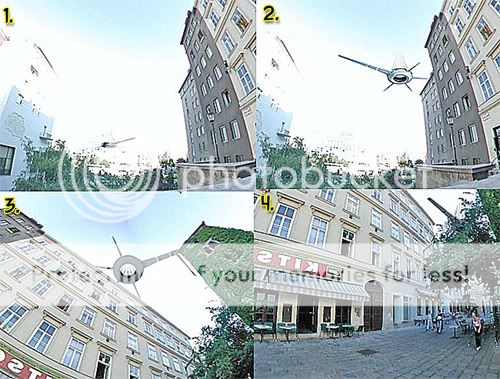
LOOKS LIKE BULLET TIME
According to the OTHER forum they have evidence that Chad and Rajman have the same IP address!! Waiting for more info....
According to the OTHER forum they have evidence that Chad and Rajman have the same IP address!! Waiting for more info....
Originally posted by CthulhuRising
LOOKS LIKE BULLET TIME
According to the OTHER forum they have evidence that Chad and Rajman have the same IP address!! Waiting for more info....
Well that seems llike it would be great info to get over to this fourm, as not all of the user at this fourm go to the other fourm, could you please give us a link mabye or a quote of what they have found out?
Originally posted by 1nL1ghtened
It is interesting that with the exception of the last post , all of these objects are reported to derive in or near central/northern California. I submit a quick reference map I made to give a little perspective on the distances between sightings and the relative proximity.
I submit this just for the sake of debate not to prove an one particular point. I found myself wondering just where in California these "sightings" were taking place and thought it prudent to post my findings as to the geographical positions of these three particular "sightings".
It is quite plausible to ascertain that other people in this triangular area between the red circles, given the apparent slow moving and low altitude behavior of theses "alleged" craft would have also witnessed these events.
The mere fact that three (separate?) groups of people have recorded these "drones" in separate locations could lend some credence the pictures OR further discredit them if any correlation between the three groups can be made or if it can be determined that a single person or group is responsible for them thus validating the perpetration of a hoax.
As with all these theories any scenario is possible considering the vast amount of variables, just thought I would toss up my finds on "sighting locations" being I don't think this has been covered or even explored.
Hope your hungry, more food for thought.....

This is what I was referring to in a prievous post (read the bold underlined text). I have been leaning towards this fiasco as a hoax and in the true spirit of getting to the truth I have always retained an open mind.
From: Springer
I would also suggest you read the posts in this thread, back in the early pages, that explain the facts.
The suggestion to you was not for myself, as I have read each and every post on this thread and the one before it. I do not throw my posts in "willie nillie" just to make an obscure or rhetorical point. My suggestion was for you
to summarize your findings in one post (which you have basically done since then on latter posts) just for those who are "academically challenged"
and are possibly having trouble deciding based on all the evidence.
[edit on 30-5-2007 by 1nL1ghtened]
Originally posted by CthulhuRising
LOOKS LIKE BULLET TIME
According to the OTHER forum they have evidence that Chad and Rajman have the same IP address!! Waiting for more info....
Hopefully "Bren/Lucianarchy/admin" will spill the beans and come with the IP address if he has it. I assume he's got Raj's address from an email header? If so it will be a simple matter of emailing Lex and asking him if it matches the "Chad's" IP address. Lex still may not confirm that but it's certainly worth a shot.
1nL1ghtened I see now what you meant.
Springer...
So here's the story from the boys at OM... It would seem that "Rajman" contacted Admin via email saying he would participate on the board, but he
never did appear. So I believe they used the email headers from this and compared with Chad's from C2C..With this result..Still not 100% conclusive
BUT good enough for me...Just toooo coincidental..or not..dang the story continues
[edit on 30/5/07 by CthulhuRising]
admin edit: Removed content at the request of OM moderator.
[edit on 5-31-2007 by Springer]
[edit on 30/5/07 by CthulhuRising]
admin edit: Removed content at the request of OM moderator.
[edit on 5-31-2007 by Springer]
The first three sets of numbers match but not the fourth set.
Could this then just be a coincidence?
GOTCHA! The first three sets being similar means this is likely a Class C network. A Class C network has 254 distinct addresses, from 1 to 254 (0 and 255 are not used. 0 plus 255 = 256, 2 to the 8th power) GUARANTEED that it's this net is owned by the same entity. Net address blocks are typically owned in Class C chunks, though now that addresses are getting scarce, you can be assigned a subset. They COULD be sub-netted, but this is unlikely. Each computer in a network has its own complete address, thus on a single class C you could have
198.187.135.1 gateway router
198.187.135.2 Color Printer
198.187.135.3 Jim's PC
198.187.135.4 Mike's PC
198.187.135.5 Fileserver #1
198.187.135.254 last of series
The DNS system would be set up to route any of the numbers 2-254 through the "dot one" router out to the Internet.
I used to manage a dozen Class C nets for where I worked. Each building had its own Class C. The large buildings were running out of addresses by the time I left because everything from copy machines to printers, telephones, everything had its own IP address.
If you've got the first three, you can look up the network in a variety of sources and see who it belongs to. That would settle whether this is owned by a utility, qwest, for example, that COULD assign addresses in subnets, or whether the entire Class C was owned by a single entity.
So, whoever has the numbers, just look it up! Like here. Just type in the Ip in dotted decimal format: 198.187.135.1 It will say who owns it, what the range is, etc. It should be easy to tell if both IPs are owned by the same entity. And if it's something like: Industrial Light and magic, well....
[edit on 30-5-2007 by schuyler]
Here is the new video from Kris (saladfingers) of the Drone.
I find this one the best of all. The link:
www.youtube.com...
I find this one the best of all. The link:
www.youtube.com...
damn.....so theres no coming invasion...but i dug foxholes and set nests...damn....ive got alot of explaining to do....well....maybe next time right?
If the 2 IP’s are in the same subnet (first 3 numbers match) it’s highly likely they are from at least the same ISP. You could find out what ISP
owns those 2 numbers via DNSstuff.com. If both numbers are owned by the same ISP it would not be a far stretch to assume both uploads originated in
the same area code for dial up or within 5 miles for DSL.
It appears the similarity came from 2 yahoo email accounts in the same geographic area. So NO smaking gun as yet it would seem. This avenue is still
being investigated by those with the IP addresses but with the ecception of all those that believe these to be CGI the story continues...I
Personally I'm back to waiting for the video with a dodgy back story to come out or a new set of pictures with multiple witness accounts..
CTH
Personally I'm back to waiting for the video with a dodgy back story to come out or a new set of pictures with multiple witness accounts..
CTH
Originally posted by free_spirit
Here is the new video from Kris (saladfingers) of the Drone.
I find this one the best of all. The link:
www.youtube.com...
I don't know anything about CGI, but damn that's cool looking! I'm in awe of this skill.
man i have to say, real or not all you guys should be proud of each other for really putting alot of effort and research into this. i have never seen
so much real time work being voluntarily done by so many people. keep up the good job guys! *HOPES ITS REAL* lol
ok guys this is from the other forum that raj supposedly posted. and admins, if this is not ok for me to post this let me know, i don't want to walk
on anybody's feet here. this is what he said.
admin edit: Pasted content removed at the request of OM Forum admin.
*afterthought* i'm starting to feel as if he is starting to try to hard. i feel that he is trying to tell us exactly what we want to hear.... anybody else get this feeling?
[edit on 30-5-2007 by Jeffery2102]
[edit on 5-31-2007 by Springer]
admin edit: Pasted content removed at the request of OM Forum admin.
*afterthought* i'm starting to feel as if he is starting to try to hard. i feel that he is trying to tell us exactly what we want to hear.... anybody else get this feeling?
[edit on 30-5-2007 by Jeffery2102]
[edit on 5-31-2007 by Springer]
Speaking of Chad, I'm not surprised someone else has seen this thing, but I had no idea pictures of this thing were already floating around the web. The differences between what we have seen, however, are fascinating to me. Also of interest is the lettering on his "craft", which is obviously the same as mine.
Might just be nitpicking, but to me the bold section is a bit of a give away. Possibly just an oversight, but it does sound like he regards the craft as 'his', as in he created it.
And it isn't that obvious about the writing being the same. It would, however, be obvious to him if he had made both sets of photos himself thanks to CGI though.
Probably stretching it, but meh. Worth a shot.
[edit on 30-5-2007 by fooffstarr]
[edit on 30-5-2007 by fooffstarr]
Now, does everyone STILL think this is a photoshop masterpiece?
Yup! Pretty obvious actually. I won't go into all the reasons, but the ersatz Japanese Katakana writing pretty much blows the wind out of the alien idea and the photoshop explanation from previous posts is damned convincing.
F-Dog
Yup! Pretty obvious actually. I won't go into all the reasons, but the ersatz Japanese Katakana writing pretty much blows the wind out of the alien idea and the photoshop explanation from previous posts is damned convincing.
F-Dog
Wow...
I've never seen one like that before...
And right out in the open during the day!
I looked at the photos and found that the only difference between them is that the new one has this weird attachment on the back of the ring with little spikes on it.
That's a real good photo.
I've never seen one like that before...
And right out in the open during the day!
I looked at the photos and found that the only difference between them is that the new one has this weird attachment on the back of the ring with little spikes on it.
That's a real good photo.
As promised earlier, here are six images for your consideration. I reworked my earlier model and will make it available if desired. The images are
rendered in Mental Ray using an HDRI background. Texture is painted and aged. I have much "crisper" images available in png and tif format. Due to
size, I will make them available as a download if requested.
For the record: While I think that the original images are cg, I cannot nor do I wish to "prove" anything. I did this purely for my own reasons. This project was intended for my own personal use as a study, nothing more.
Please take the following into consideration when examining them:
1: I have left out certain details in my model on purpose.
2: I chose a unique texture scheme for the same reasons.
3: The images are jpegs and been retouched in Photoshop (balance, color and levels - auto).
Please judge them on the criteria you imposed upon the originals, ignoring the fact that you know these images to be cg. Does it look real, are the lighting and shadows correct for the location, etc.


For the record: While I think that the original images are cg, I cannot nor do I wish to "prove" anything. I did this purely for my own reasons. This project was intended for my own personal use as a study, nothing more.
Please take the following into consideration when examining them:
1: I have left out certain details in my model on purpose.
2: I chose a unique texture scheme for the same reasons.
3: The images are jpegs and been retouched in Photoshop (balance, color and levels - auto).
Please judge them on the criteria you imposed upon the originals, ignoring the fact that you know these images to be cg. Does it look real, are the lighting and shadows correct for the location, etc.
new topics
-
BIDEN Admin Begins Planning For January 2025 Transition to a New President - Today is 4.26.2024.
2024 Elections: 9 minutes ago -
Big Storms
Fragile Earth: 1 hours ago -
Where should Trump hold his next rally
2024 Elections: 4 hours ago -
Shocking Number of Voters are Open to Committing Election Fraud
US Political Madness: 5 hours ago -
Gov Kristi Noem Shot and Killed "Less Than Worthless Dog" and a 'Smelly Goat
2024 Elections: 5 hours ago -
Falkville Robot-Man
Aliens and UFOs: 6 hours ago -
James O’Keefe: I have evidence that exposes the CIA, and it’s on camera.
Whistle Blowers and Leaked Documents: 6 hours ago -
Australian PM says the quiet part out loud - "free speech is a threat to democratic dicourse"...?!
New World Order: 7 hours ago -
Ireland VS Globalists
Social Issues and Civil Unrest: 8 hours ago -
Biden "Happy To Debate Trump"
2024 Elections: 8 hours ago
top topics
-
James O’Keefe: I have evidence that exposes the CIA, and it’s on camera.
Whistle Blowers and Leaked Documents: 6 hours ago, 13 flags -
Blast from the past: ATS Review Podcast, 2006: With All Three Amigos
Member PODcasts: 10 hours ago, 13 flags -
Australian PM says the quiet part out loud - "free speech is a threat to democratic dicourse"...?!
New World Order: 7 hours ago, 12 flags -
Biden "Happy To Debate Trump"
2024 Elections: 8 hours ago, 12 flags -
Mike Pinder The Moody Blues R.I.P.
Music: 10 hours ago, 8 flags -
What is the white pill?
Philosophy and Metaphysics: 10 hours ago, 6 flags -
Shocking Number of Voters are Open to Committing Election Fraud
US Political Madness: 5 hours ago, 6 flags -
RAAF airbase in Roswell, New Mexico is on fire
Aliens and UFOs: 8 hours ago, 5 flags -
Ireland VS Globalists
Social Issues and Civil Unrest: 8 hours ago, 5 flags -
Where should Trump hold his next rally
2024 Elections: 4 hours ago, 4 flags
active topics
-
BIDEN Admin Begins Planning For January 2025 Transition to a New President - Today is 4.26.2024.
2024 Elections • 2 • : NoCorruptionAllowed -
Gov Kristi Noem Shot and Killed "Less Than Worthless Dog" and a 'Smelly Goat
2024 Elections • 38 • : cherokeetroy -
Falkville Robot-Man
Aliens and UFOs • 7 • : KKLOCO -
Big Storms
Fragile Earth • 9 • : nerbot -
"We're All Hamas" Heard at Columbia University Protests
Social Issues and Civil Unrest • 294 • : TheWoker -
Where should Trump hold his next rally
2024 Elections • 15 • : Zanti Misfit -
Gaza Terrorists Attack US Humanitarian Pier During Construction
Middle East Issues • 89 • : AlongCameaSpider -
Post A Funny (T&C Friendly) Pic Part IV: The LOL awakens!
General Chit Chat • 7138 • : baddmove -
Ireland VS Globalists
Social Issues and Civil Unrest • 8 • : nugget1 -
Definitive 9.11 Pentagon EVIDENCE.
9/11 Conspiracies • 428 • : Zanti Misfit