It looks like you're using an Ad Blocker.
Please white-list or disable AboveTopSecret.com in your ad-blocking tool.
Thank you.
Some features of ATS will be disabled while you continue to use an ad-blocker.

America's deadliest school massacre; no guns required.
page: 1share:
We keep hearing about how the Sandy Hook massacre was the SECOND WORST in American history but, the news media doesn't really seem that interested in
going into details on what, exactly happened in the worst school massacre or where and when it happened. Maybe its because it doesn't fit into their
anti-gun agenda.
The worst school killing happened way back in the Year of our Lord 1927. 45 souls perished that day, 38 of whom were children. It involved the usual deranged individual that usually carries these things out and shocked the nation, for at least three days, after which the nation carried on with its business.
Slate
Kehoe tried working within the system to fight the tax increase, even joining the school board where he tried to obstruct even the most necessary of spending and running for office but, his reputation preceded him and he was rejected by the voters.
His loss at the polls and impending foreclosure on his home finally caused something in him to crack and he spent months packing the school with explosives in order to have his revenge.
They didn't have the politically crazed 24-7 news media like we have today but the story did make national headlines. The nation mourned the loss with the people of Bath but, didn't dwell on it for overly long or become obsessed with finding a way to "make sure nothing like this happens ever again". Back then people recognized this as an isolated incident and went on with their lives. No legislation was proposed to take away anyone's rights to protect the people from themselves.
Without a news media obsessed with learning every aspect of the killer's life and turning him into an instant celebrity, the event died down naturally over the normal course of time, the town was left alone to mourn their dead, and no copycat events followed.
I guess the moral of this story is; American's REALLY hate it when you raise their taxes.
The worst school killing happened way back in the Year of our Lord 1927. 45 souls perished that day, 38 of whom were children. It involved the usual deranged individual that usually carries these things out and shocked the nation, for at least three days, after which the nation carried on with its business.
“We Still Look at Ourselves as Survivors”: More Than Eighty Years Later, Remembering the Deadliest School Massacre in American History
The recent shootings in Newtown, Conn., have led many people to characterize school violence as a modern affliction, a byproduct of our national obsession with guns and media violence. But the deadliest school-related massacre in American history happened in 1927, at an elementary school in Bath, Mich. A school board member named Andrew Kehoe, upset over a burdensome property tax, wired the building with dynamite and set it off in the morning of May 18. Kehoe’s actions killed 45 people, 38 of whom were children.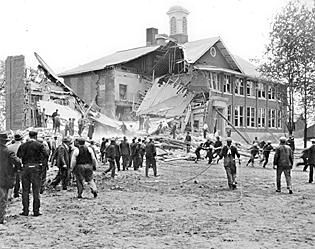
At the time, Bath was a small farm community with under 300 residents. The town had “an elevator, a little drugstore, and you knew everybody within 20 miles,” as one survivor of the attack recalled in 2009. Perhaps its most modern feature was the Bath Consolidated School, which opened its doors in 1922 and brought all the region’s students under one roof. In The Bath School Disaster, published in 1927 and available online here, Kehoe’s neighbor, Monty J. Ellsworth, noted that the consolidated school was markedly superior to the “common country school” that preceded it. It was also more expensive, and the township raised property taxes in order to repay the school’s bonds.
This upset Andrew Kehoe. A local farmer with training as an electrical engineer, he was a severe, stubborn man fond of drastic solutions to small problems; Ellsworth writes that Kehoe once shot a noisy dog and killed his own horse because it was lazy. In an article from May 20, 1927, the New York Times noted that Kehoe “was known through the countryside as a ‘dynamite farmer’. Neighbors detailed how he was continually setting off blasts on his farm, blowing up stumps and rocks.”
Slate
Kehoe tried working within the system to fight the tax increase, even joining the school board where he tried to obstruct even the most necessary of spending and running for office but, his reputation preceded him and he was rejected by the voters.
His loss at the polls and impending foreclosure on his home finally caused something in him to crack and he spent months packing the school with explosives in order to have his revenge.
The school exploded at 8:45 a.m. on May 18. At that point, after killing his wife and destroying his farm, Kehoe hopped inside an explosive-laden truck and drove to the school. Thirty minutes after the initial attack, while conversing with the superintendent, he detonated the truck bomb, killing himself, the superintendent, and a few others. Later, investigators found that a short circuit in Kehoe’s wiring was the only thing that stopped the attack from claiming more lives, as “more than 500 pounds of dynamite and several sacks of gunpowder were found under a portion of the building that remained standing.” If the explosion had gone as planned, Bath’s entire downtown might have been destroyed.
They didn't have the politically crazed 24-7 news media like we have today but the story did make national headlines. The nation mourned the loss with the people of Bath but, didn't dwell on it for overly long or become obsessed with finding a way to "make sure nothing like this happens ever again". Back then people recognized this as an isolated incident and went on with their lives. No legislation was proposed to take away anyone's rights to protect the people from themselves.
But the attention was short-lived. In an interview this summer with the Christian Science Monitor, Arnie Bernstein, author of 2009’s Bath Massacre: America’s First School Bombing, noted that “there wasn't a media frenzy like today. The media came in and left. Three days after it happened, Lindbergh took off and flew to Paris, and that part of it was over.”
Without a news media obsessed with learning every aspect of the killer's life and turning him into an instant celebrity, the event died down naturally over the normal course of time, the town was left alone to mourn their dead, and no copycat events followed.
I guess the moral of this story is; American's REALLY hate it when you raise their taxes.
Thanks for posting this, I had never heard about it.
I think we will start seeing a lot this type of thing if a full on gun ban does get put in place.
It is very cheap and easy to rig up an improvised explosive device.
Lets hope it doesn't come to that.
I think we will start seeing a lot this type of thing if a full on gun ban does get put in place.
It is very cheap and easy to rig up an improvised explosive device.
Lets hope it doesn't come to that.
This will be largely ignored by the anti-gun crowd because it doesn’t further their goals.
I will say it again stop blaming tools and blame the people responsible for using them.
S&F OP
I will say it again stop blaming tools and blame the people responsible for using them.
S&F OP
edit on 23-12-2012 by Grimpachi because: (no reason given)
One doesn't even need a gun
Here is something far more powerful that you can build yourself:
Here is something far more powerful that you can build yourself:
There was a thread here that disappeared into the vast oblivion that I thought made a good point about Sandy Hook incident but didn't get much
attention.
Connecticut already had strict gun laws before this recent incident.
Assault weapons were prohibited PRIOR to this incident...
statutes.laws.com...
Once again prohibition fails, yet people still believe it's the solution.
So the media or prohibition doesn't seem to have an influence either way on preventing these types of incidents. The best way to prevent school shootings in the future is to just ban people from schools.
Or maybe have a well armed population who can defend themselves if necessary.
That's too logical though.
Connecticut already had strict gun laws before this recent incident.
Assault weapons were prohibited PRIOR to this incident...
statutes.laws.com...
Once again prohibition fails, yet people still believe it's the solution.
So the media or prohibition doesn't seem to have an influence either way on preventing these types of incidents. The best way to prevent school shootings in the future is to just ban people from schools.
Or maybe have a well armed population who can defend themselves if necessary.
That's too logical though.
well anyone can build a bomb with some fertilizer and a few other chemicals
but why are guns used 99.9% of the time?
but why are guns used 99.9% of the time?
Ban firearms, and bad guys will just use another tool in their FOREVER AVAILABLE arsenal. Is the "tool" of choice used in that school massacre
mentioned in this thread what you gun-haters wish to see being used? Would that make you feel all warm and fuzzy??
Look folks, criminals will ALWAYS have guns, we NEED to ARM our schools to stop the madness. That is the ONLY SOLUTION that will work in America. PERIOD!!!
Gun haters just want to see a ban on firearms and do not care for a solution because if it were a solution that they wanted, they would NOT be looking for a firearm ban. Its that simple.
Our children need us to stop the bad guys, and a firearm is what is needed to stop the bad guys. America needs to DEMAND that their children's school allow trained and armed staff inside the schools ASAP. We cannot wait any longer, it MUST be done NOW!!! Thats the only REAL SOLUTION folks!!
Americans have the Right to KEEP and BEAR arms, and DAMN IT, that is what it takes to STOP THESE BAD GUYS and their MASSACRES!!!!
Look folks, criminals will ALWAYS have guns, we NEED to ARM our schools to stop the madness. That is the ONLY SOLUTION that will work in America. PERIOD!!!
Gun haters just want to see a ban on firearms and do not care for a solution because if it were a solution that they wanted, they would NOT be looking for a firearm ban. Its that simple.
Our children need us to stop the bad guys, and a firearm is what is needed to stop the bad guys. America needs to DEMAND that their children's school allow trained and armed staff inside the schools ASAP. We cannot wait any longer, it MUST be done NOW!!! Thats the only REAL SOLUTION folks!!
Americans have the Right to KEEP and BEAR arms, and DAMN IT, that is what it takes to STOP THESE BAD GUYS and their MASSACRES!!!!
edit on 23-12-2012 by oper8zhin because: (no reason given)
We should put guards armed with rocket launchers on school rooftops.
The only way to stop a bad guy with a bomb is a good guy with a bomb.
The only way to stop a bad guy with a bomb is a good guy with a bomb.
Originally posted by muse7
We should put guards armed with rocket launchers on school rooftops.
The only way to stop a bad guy with a bomb is a good guy with a bomb.
There was an armed cop on campus in my High school back in 99, armed officers in schools is not such a crazy idea or a new one.
way to jump to illogical rhetoric...
Originally posted by muse7
We should put guards armed with rocket launchers on school rooftops.
The only way to stop a bad guy with a bomb is a good guy with a bomb.
It worked for Afghanistan.
Originally posted by benrl
Originally posted by muse7
We should put guards armed with rocket launchers on school rooftops.
The only way to stop a bad guy with a bomb is a good guy with a bomb.
There was an armed cop on campus in my High school back in 99, armed officers in schools is not such a crazy idea or a new one.
way to jump to illogical rhetoric...
there were also armed guards at columbine and virginia tech.
also...only if someone at fort hood would have had a gun when hassan went on his shooting spree, so many lives would have been saved....
Zzzzz the politicising of these tradegies is getting old.
It's a shame particular groups look to take advantage of dramatic events both new and old for their own ends.
It's a shame particular groups look to take advantage of dramatic events both new and old for their own ends.
Thanks for this thread, OP. It's important to remember that the problem here is homicidal maniacs. Not the tools they choose to do their "work"
with. Although, I must say that gun free zones insure a proper and OSHA approved safe working environment for the modern spree killer. That policy
assures them they'll be free to kill at their leisure....and quit when they run out of ammo or just decide that's it and suicide as we'd all wish
they did before starting.
However, guns sure aren't the problem. Everyone from the Brady Bunch to Michael Moore has had great fun ignorantly showing the Columbine incident as a case of kids, guns and tragedy on steroids. It's worth noting that how it TURNED OUT....That happened to be right. How they planned it? Heck..guns weren't even a big part of it.
99 Improvised Explosive Devices at Columbine High School
It seems to me that killers such as those two have already shown the world what comes after guns....since in that case, guns really were a personal fall back and their own direct defense against being stopped......not the means of maximum death intended. Interesting how facts come to compare with assumptions and impressions, eh?
However, guns sure aren't the problem. Everyone from the Brady Bunch to Michael Moore has had great fun ignorantly showing the Columbine incident as a case of kids, guns and tragedy on steroids. It's worth noting that how it TURNED OUT....That happened to be right. How they planned it? Heck..guns weren't even a big part of it.
99 Improvised Explosive Devices at Columbine High School
It seems to me that killers such as those two have already shown the world what comes after guns....since in that case, guns really were a personal fall back and their own direct defense against being stopped......not the means of maximum death intended. Interesting how facts come to compare with assumptions and impressions, eh?
Originally posted by muse7
Originally posted by benrl
Originally posted by muse7
We should put guards armed with rocket launchers on school rooftops.
The only way to stop a bad guy with a bomb is a good guy with a bomb.
There was an armed cop on campus in my High school back in 99, armed officers in schools is not such a crazy idea or a new one.
way to jump to illogical rhetoric...
there were also armed guards at columbine and virginia tech.
also...only if someone at fort hood would have had a gun when hassan went on his shooting spree, so many lives would have been saved....
You are right about the Fort Hood shooting. People like you assume that soldiers carry guns 24/7. Fact is only the cops have guns on base. Even if you have a license to carry a weapon, you cannot carry it in uniform or at work (as a soldier). Nice try though.
Originally posted by muse7
Originally posted by benrl
Originally posted by muse7
We should put guards armed with rocket launchers on school rooftops.
The only way to stop a bad guy with a bomb is a good guy with a bomb.
There was an armed cop on campus in my High school back in 99, armed officers in schools is not such a crazy idea or a new one.
way to jump to illogical rhetoric...
there were also armed guards at columbine and virginia tech.
also...only if someone at fort hood would have had a gun when hassan went on his shooting spree, so many lives would have been saved....
Nothing is ever 100% in the case of Columbine I am sure it took everyone by surprise and in the case of Fort Hood a place I have served people including soldiers do not walk around with loaded weapons.
The only time live rounds are issued is when you are at a firing range so you are correct it is too bad there wasn’t someone around with a loaded weapon that day.
What is this a pissing contest? Is this in some way to make guns not as much of an issue because of the historical example using explosives you have
listed?
All this demonstrates is that a variety of items can be used to harm others. This is not a vindication for guns...
All this demonstrates is that a variety of items can be used to harm others. This is not a vindication for guns...
Originally posted by Grimpachi
This will be largely ignored by the anti-gun crowd because it doesn’t further their goals.
I will say it again stop blaming tools and blame the people responsible for using them.
S&F OPedit on 23-12-2012 by Grimpachi because: (no reason given)
How is this relevant to the modern discussion around guns. Your attitude is laughable as you presume that the manitude of death toll has any bearing on the severity of this event and the means in which it was conducted.
You just sound like another pro gun advocate grasping at straws.
For the record, I am pro gun, but not pro ignorance
1927 with weapons that were available to the public a mass school massacre would have been hard to pull off. Explosives of course are always an
option that require a great deal more planning and ability than most of our modern nut cases are capable of. Used to take some brains and ability to
pull something like this off. So much easier now any idiot could will a friend or relative that does not secure their weapons can do it.
Originally posted by MrSpad
1927 with weapons that were available to the public a mass school massacre would have been hard to pull off. Explosives of course are always an option that require a great deal more planning and ability than most of our modern nut cases are capable of. Used to take some brains and ability to pull something like this off. So much easier now any idiot could will a friend or relative that does not secure their weapons can do it.
I'm not sure what you mean on that? I did a little looking because it didn't sound quite right...and came up with this. The first couple are ads from the early 1900's to show the general mood about guns. Radically different, to be sure...and availability wasn't an issue. You could mail order them back then.

(1904 Vintage)
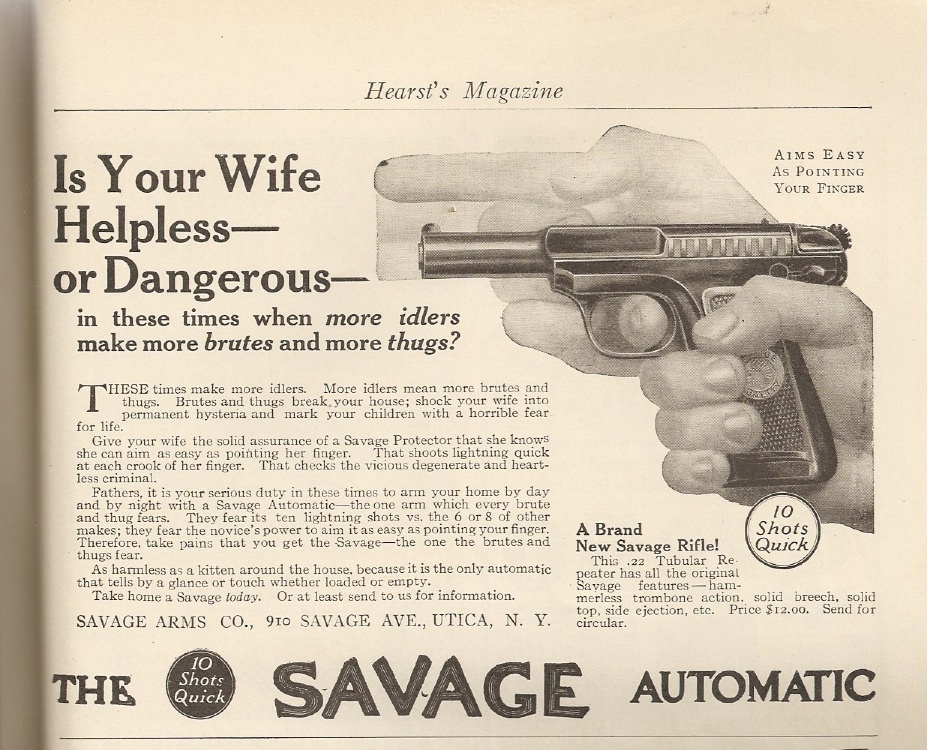
(1914 Vintage)
Now a handgun or .22 rifle does not a massacre make, to be sure...so I checked out the specs and details for availability on the Assault Rifle of it's time and the 1920's and 1930's version of a "Street Sweeper".
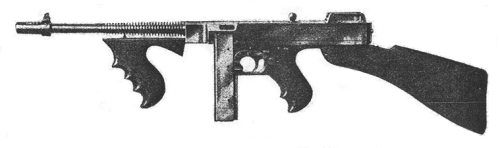
(1921AC Thompson Sub-Machine Gun)
The Thompson has a history of Massacre as it happens. It was the weapon of choice for the St Valentines Day Massacre in 1929, Chicago. It started design in 1917 and entered production in 1921. It was available for sale to the public as well as supplied to the Military and became iconic for the era as the "Chicago Piano" among other nicknames it picked up during it's civilian criminal use.
I think the difference isn't in weapons...as 1920's America had full auto weapons available as easily as a BB gun ..if you could meet the price tag ( $200 Avg Price for the weapon and $20 for the magazine in 1921 when it hit markets). I think it's morality and values. In 1920's America I don't think it even crossed people's minds outside of those fit for an asylum, to take a firearm and proceed to wantonly murder children. That seems a rather recent thing to become anything but exceptionally rare, IMO.
new topics
-
President BIDEN's FBI Raided Donald Trump's Florida Home for OBAMA-NORTH KOREA Documents.
Political Conspiracies: 3 hours ago -
Maestro Benedetto
Literature: 5 hours ago -
Is AI Better Than the Hollywood Elite?
Movies: 5 hours ago -
Las Vegas UFO Spotting Teen Traumatized by Demon Creature in Backyard
Aliens and UFOs: 8 hours ago -
2024 Pigeon Forge Rod Run - On the Strip (Video made for you)
Automotive Discussion: 9 hours ago -
Gaza Terrorists Attack US Humanitarian Pier During Construction
Middle East Issues: 9 hours ago -
The functionality of boldening and italics is clunky and no post char limit warning?
ATS Freshman's Forum: 11 hours ago -
Meadows, Giuliani Among 11 Indicted in Arizona in Latest 2020 Election Subversion Case
Mainstream News: 11 hours ago -
Massachusetts Drag Queen Leads Young Kids in Free Palestine Chant
Social Issues and Civil Unrest: 11 hours ago
top topics
-
President BIDEN's FBI Raided Donald Trump's Florida Home for OBAMA-NORTH KOREA Documents.
Political Conspiracies: 3 hours ago, 24 flags -
Krystalnacht on today's most elite Universities?
Social Issues and Civil Unrest: 14 hours ago, 9 flags -
University of Texas Instantly Shuts Down Anti Israel Protests
Education and Media: 17 hours ago, 8 flags -
Weinstein's conviction overturned
Mainstream News: 13 hours ago, 8 flags -
Supreme Court Oral Arguments 4.25.2024 - Are PRESIDENTS IMMUNE From Later Being Prosecuted.
Above Politics: 14 hours ago, 8 flags -
Massachusetts Drag Queen Leads Young Kids in Free Palestine Chant
Social Issues and Civil Unrest: 11 hours ago, 7 flags -
Gaza Terrorists Attack US Humanitarian Pier During Construction
Middle East Issues: 9 hours ago, 7 flags -
Las Vegas UFO Spotting Teen Traumatized by Demon Creature in Backyard
Aliens and UFOs: 8 hours ago, 6 flags -
Meadows, Giuliani Among 11 Indicted in Arizona in Latest 2020 Election Subversion Case
Mainstream News: 11 hours ago, 5 flags -
2024 Pigeon Forge Rod Run - On the Strip (Video made for you)
Automotive Discussion: 9 hours ago, 4 flags
active topics
-
President BIDEN's FBI Raided Donald Trump's Florida Home for OBAMA-NORTH KOREA Documents.
Political Conspiracies • 14 • : WeMustCare -
Hate makes for strange bedfellows
US Political Madness • 47 • : 19Bones79 -
-@TH3WH17ERABB17- -Q- ---TIME TO SHOW THE WORLD--- -Part- --44--
Dissecting Disinformation • 689 • : daskakik -
University of Texas Instantly Shuts Down Anti Israel Protests
Education and Media • 265 • : Astrocometus -
Gaza Terrorists Attack US Humanitarian Pier During Construction
Middle East Issues • 27 • : ToneD -
Reason of the Existence
The Gray Area • 21 • : BingoMcGoof -
Supreme Court Oral Arguments 4.25.2024 - Are PRESIDENTS IMMUNE From Later Being Prosecuted.
Above Politics • 85 • : Sookiechacha -
Chris Christie Wishes Death Upon Trump and Ramaswamy
Politicians & People • 24 • : nugget1 -
New whistleblower Jason Sands speaks on Twitter Spaces last night.
Aliens and UFOs • 63 • : pianopraze -
SETI chief says US has no evidence for alien technology. 'And we never have'
Aliens and UFOs • 74 • : Justoneman