It looks like you're using an Ad Blocker.
Please white-list or disable AboveTopSecret.com in your ad-blocking tool.
Thank you.
Some features of ATS will be disabled while you continue to use an ad-blocker.

Graham Hancock Answering Ancient Mysteries
page: 3share:
Originally posted by Dragoon01
reply to post by Harte
Birch was referring to the marking after the cartouche. He had not seen that style of markings prior. He was well familiar with the markings within the cartouche.
I disagree. The name known for Khufu at the time did contain the Ra disk, as Scott has shown in his "Who was Khufu" thread, the disk - containing cartouche being taken from one of the king's lists that had been found prior to Vyse finding these chambers.
At least, that's the way I seem to recall it.
Obviously, I could be wrong.
At any rate, I linked Sitchin's book. You can see for yourself in it that Sitchin fabricated the cartouche he shows in that book. The cartouche that Vyse supposedly "mispelled" was the one with the seive in it. According to Sitchin, Vyse "painted on" the Ra disk. Look at a pic of the cartouche. It doesn't contain a Ra disk.
EDIT: Thanks, Hans.
Harte
edit on 1/25/2012 by Harte because: (no reason given)
Harte,
I do not dsagree with you that Sitchin showed that incorrectly and you are right that discredits him. I dont really hinge any belief on his writings per say. He has muddied the waters because he leveled accusations at Vyse and then fudged his "evidence". That being said however it does not clear Vyse of these accusations. It is entirely possible that he faked or at least altered the existing marks. If we look at the other body of work that he participated in we see that quite a lot of the information from that time concerning the pyramids comes from him and his team. If we question that evidence for any reason and it does not hold up then we have to question later evidence that is qualified by it. We have seen that his find in the third pyramid did not really hold up to later study. So back to one of my original points Vyse set the context that later scholars used to measure all findings. It predisposes them to a specific context. An artifact pulled up automatically becomes related to "Khufu" because everything prior to it was related to "Khufu" going back to Vyse. While there is a logic to this method its not really a good way of doing things.
Let me give an analogy. Lets suppose that researchers are digging up the ruins of the United States in 1000 years. The dig up a plastic sign. Its red with a yellow sea shell on it. The suppose that it may have a religious purpose and relates to the worship of sea life. They dig further and uncover pumping devices. They determine these devices must have pumped water and related to the worship of the sea and its life giving waters. Digging further they uncover a building and construct the entire complex as a temple that pumped water from underground storage tanks for the worshipers of sea life. In reality its a Shell gas station but the fact that they first established a context and ran with it clouds the picture. Obviously there is a little more to it than that but you get the picture.
I do not dsagree with you that Sitchin showed that incorrectly and you are right that discredits him. I dont really hinge any belief on his writings per say. He has muddied the waters because he leveled accusations at Vyse and then fudged his "evidence". That being said however it does not clear Vyse of these accusations. It is entirely possible that he faked or at least altered the existing marks. If we look at the other body of work that he participated in we see that quite a lot of the information from that time concerning the pyramids comes from him and his team. If we question that evidence for any reason and it does not hold up then we have to question later evidence that is qualified by it. We have seen that his find in the third pyramid did not really hold up to later study. So back to one of my original points Vyse set the context that later scholars used to measure all findings. It predisposes them to a specific context. An artifact pulled up automatically becomes related to "Khufu" because everything prior to it was related to "Khufu" going back to Vyse. While there is a logic to this method its not really a good way of doing things.
Let me give an analogy. Lets suppose that researchers are digging up the ruins of the United States in 1000 years. The dig up a plastic sign. Its red with a yellow sea shell on it. The suppose that it may have a religious purpose and relates to the worship of sea life. They dig further and uncover pumping devices. They determine these devices must have pumped water and related to the worship of the sea and its life giving waters. Digging further they uncover a building and construct the entire complex as a temple that pumped water from underground storage tanks for the worshipers of sea life. In reality its a Shell gas station but the fact that they first established a context and ran with it clouds the picture. Obviously there is a little more to it than that but you get the picture.
Originally posted by Dragoon01
Harte,
An artifact pulled up automatically becomes related to "Khufu" because everything prior to it was related to "Khufu" going back to Vyse. While there is a logic to this method its not really a good way of doing things.
Vyse didn't create the association of Khufu with the pyramids the ancients did.
Oh Dragoon if you are interested in the over use of religion to explain things in an archaeological context I can suggest the following book, it's an excellent spoof:
Motel of mysteries
edit on 25/1/12 by Hanslune
because: (no reason given)
That looks funny Hans!
Yes there were ancient writers who associated the pyramid with Khufu. Vyse had this in mind when he set out to search. So his findings "confirmed" and set that context. Again the problem is that this "fact" is not necessarily a "fact".
Yes there were ancient writers who associated the pyramid with Khufu. Vyse had this in mind when he set out to search. So his findings "confirmed" and set that context. Again the problem is that this "fact" is not necessarily a "fact".
Originally posted by Dragoon01
Harte,
I do not dsagree with you that Sitchin showed that incorrectly and you are right that discredits him. I dont really hinge any belief on his writings per say. He has muddied the waters because he leveled accusations at Vyse and then fudged his "evidence". That being said however it does not clear Vyse of these accusations. It is entirely possible that he faked or at least altered the existing marks.
Which brings us back to the decision not to believe Hancock regarding his statement that the painted-on glyphs can be seen extending deep into cracks between stones in one of the chambers. So deep that nobody could have painted them on unless they did so before the stones were placed.
Egyptology agrees with this statement. A member of the fringe actually made this statement.
Yet we've decided not to believe it, for whatever reason?
I know Hancock is either a liar or an idiot from reading his "Fingerprints of the Gods" travesty. But I'm inclined to believe a fringer that comes out and says he was wrong about something and Egyptology was right.
Edit: Do you believe in the existence of William the Conqueror? Why? Do you have a photo of him? Couldn't he have been faked?
After all, the only thing we have on him is somebody else's writings. The people in Europe say he existed, just like the people in Egypt said it was Khufu's pyramid.
Harte
edit on 1/25/2012 by Harte because: (no reason given)
Originally posted by Dragoon01
That looks funny Hans!
Recommended
Yes there were ancient writers who associated the pyramid with Khufu. Vyse had this in mind when he set out to search. So his findings "confirmed" and set that context. Again the problem is that this "fact" is not necessarily a "fact".
The grafitti are there and similar were seen else where by Goyon. If you wish to believe Sitchin then so be it.
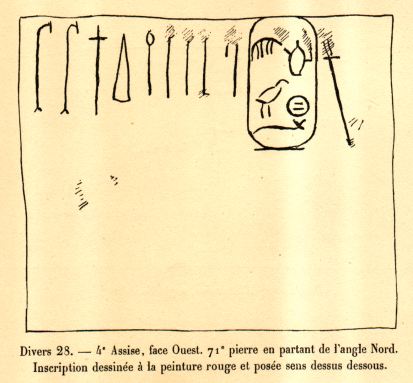
I would suspect that the only way to convince the doubters would be to move a whole lot of rock- however that will probably not happen unless an earthquake provides the chance!
One must ask however why did the ancient writers associate the pyramid with Khufu - they couldn't have seen the grafitti so what other evidence was there?
reply to post by Harte
I am not saying I dont believe Hancock when he says they were painted and behind the joints. I am saying that just because they extend behind a joint does not mean they were not painted after construction. Look at Vyse's drawings they indicate which marks are behind the joints. Only one that shows a cartouche horizontally could not have been the result of paint running down into the joint as it was applied. The vertical cartouche could have been painted on and the wet paint simply ran down into the crack of the joint.
My earlier question about this still stands. If you can see down into a crack to know that the Heiroglyph is behind a joint then how could that preclude someone from painting it after the joint was in place? If it can be seen then someone could use a tool that could reach that area to paint it in? Did this only become visable after Vyse's time? Did Hawass dig out the joint so that it became more visable? I have not seen this talked about in any detail.
Lets assume Hancock and Hawass are correct and the cartouche are behind the joints. Again the cartouche that has the name of "Khufu" is not one of those. Its further up on the wall. The cartouche with the other name for Khufu is the horizontal one behind the joint. Again that leads us to question did Vyse forge the cartouche higher up on the wall? Is this "other name for Khufu" actually his name and not a form of a gods name instead?
I am not saying I dont believe Hancock when he says they were painted and behind the joints. I am saying that just because they extend behind a joint does not mean they were not painted after construction. Look at Vyse's drawings they indicate which marks are behind the joints. Only one that shows a cartouche horizontally could not have been the result of paint running down into the joint as it was applied. The vertical cartouche could have been painted on and the wet paint simply ran down into the crack of the joint.
My earlier question about this still stands. If you can see down into a crack to know that the Heiroglyph is behind a joint then how could that preclude someone from painting it after the joint was in place? If it can be seen then someone could use a tool that could reach that area to paint it in? Did this only become visable after Vyse's time? Did Hawass dig out the joint so that it became more visable? I have not seen this talked about in any detail.
Lets assume Hancock and Hawass are correct and the cartouche are behind the joints. Again the cartouche that has the name of "Khufu" is not one of those. Its further up on the wall. The cartouche with the other name for Khufu is the horizontal one behind the joint. Again that leads us to question did Vyse forge the cartouche higher up on the wall? Is this "other name for Khufu" actually his name and not a form of a gods name instead?
reply to post by Hanslune
Again let me state I do not "believe" Sitchin. I am more of an advanced ancient civilization proponent myself. I believe that the site at Giza existed prior to the Egyptians and that they simple took it over. I believe that the pyramids were in place already although probably in a much smaller configuration. I believe the Egyptians began to try and replicate their forms and once they figured out the techniques they updated the site to their purposes. I am also convinced that the construction is an ancient form of concret and not actual cut stones at least by and large there is cut stone in use but its in addition to the concret.
Again let me state I do not "believe" Sitchin. I am more of an advanced ancient civilization proponent myself. I believe that the site at Giza existed prior to the Egyptians and that they simple took it over. I believe that the pyramids were in place already although probably in a much smaller configuration. I believe the Egyptians began to try and replicate their forms and once they figured out the techniques they updated the site to their purposes. I am also convinced that the construction is an ancient form of concret and not actual cut stones at least by and large there is cut stone in use but its in addition to the concret.
Double post
edit on 25-1-2012 by Dragoon01 because: (no reason given)
reply to post by Dragoon01
Hi Dragoon01,
There are no glyphs of any king between the floor/ceiling blocks in these 'relieving chambers'. There are certainly other hieroglyphs between these blocks but NONE are cartouches. The Khufu cartouche in Campbell's Chamber is in plain sight, daubed with red ochre paint right onto the underside of one of the ceiling gable blocks. Whilst it would have been impossible to paint or even edit any of the glyphs in the cracks between or under blocks, the Khufu cartouche in question is in plain sight and could easily have been tampered with. Not saying it WAS tampered with just that it is easily accessible for such to have occurred.
Graham Hancock's current position on the glyphs in this chamber is as follows:
Regards,
Scott Creighton
Hi Dragoon01,
There are no glyphs of any king between the floor/ceiling blocks in these 'relieving chambers'. There are certainly other hieroglyphs between these blocks but NONE are cartouches. The Khufu cartouche in Campbell's Chamber is in plain sight, daubed with red ochre paint right onto the underside of one of the ceiling gable blocks. Whilst it would have been impossible to paint or even edit any of the glyphs in the cracks between or under blocks, the Khufu cartouche in question is in plain sight and could easily have been tampered with. Not saying it WAS tampered with just that it is easily accessible for such to have occurred.
Graham Hancock's current position on the glyphs in this chamber is as follows:
"In Fingerprints I supported the Vyse forgery theory. Later when I got into the relieving chambers myself and saw that some quarry marks disappear far back into the gaps between the blocks I felt that I must be wrong to support the forgery theory -- because no one could have got a brush into those gaps to carry out the forgery. Therefore the quarry marks must be genuine and must have been put on the blocks before they were put into place in the chamber. Accordingly I retracted the position I had taken in Fingerprints.
It's possible I threw the baby out with the bathwater with that retraction. Unlike the unforgeable quarry marks positioned between the blocks, the Khufu cartouche is in plain view and could easily have been forged by Vyse.
I do not insist it was, I just accept that it could have been, and that some interesting doubts have been raised over its authenticity. I await further evidence one way or the other." - Graham Hancock, 4th April, 2011 (Source)
Regards,
Scott Creighton
Hey Harte, yeah there is the quote I was looking for earlier in the other thread about a 'qualification' of what he stated.
Back peddle
Back peddle
Originally posted by Hanslune
Hey Harte, yeah there is the quote I was looking for earlier in the other thread about a 'qualification' of what he stated.
Back peddle
Hans,
You know I'm not one to stand up for what the fringe claims (understatement of the year) but I don't see it.
Hancock is only staying out of the argument about Vyse's supposed forgery in his post in that thread.
It's our own dear Scott Creighton that's trying to make an argument for Hancock, which Hancock basically repudiates a few posts later by stating:
In Fingerprints I supported the Vyse forgery theory. Later when I got into the relieving chambers myself and saw that some quarry marks disappear far back into the gaps between the blocks I felt that I must be wrong to support the forgery theory -- because no one could have got a brush into those gaps to carry out the forgery. Therefore the quarry marks must be genuine and must have been put on the blocks before they were put into place in the chamber. Accordingly I retracted the position I had taken in Fingerprints.
It's possible I threw the baby out with the bathwater with that retraction. Unlike the unforgeable quarry marks positioned between the blocks, the Khufu cartouche is in plain view and could easily have been forged by Vyse.
I do not insist it was, I just accept that it could have been, and that some interesting doubts have been raised over its authenticity. I await further evidence one way or the other.
Best wishes
Graham
If I were to take the side of any of them, it would be Hancock for coming out more than once and saying the above concerning, at least, the fact that Egyptians built the pyramids.
I understand he talks about it in the preface of the latest edition of "Fingerprints..." too.
The guy's a writer. Quite readable, honestly. I don't disparage him for making money as long as he makes an attempt to be honest (a truly unusual characteristic among fringe writers - J.A. West is another such - he posted in that thread too.)
Now if he'd only disavow the claptrap from VonDaniken that he wrote about in "Fingerprints..." concerning Pakal's tomb at Palenque and the "spaceman" carving on the cover. Oh, and his practically stand-alone belief that Yonaguni isn't natural. J.A. West has stated this fact more than once that I know of. And Robert Schoch as well.
Ah well. I can dream, can't I?
Harte
Originally posted by Dragoon01
reply to post by Harte
I am not saying I dont believe Hancock when he says they were painted and behind the joints. I am saying that just because they extend behind a joint does not mean they were not painted after construction. Look at Vyse's drawings they indicate which marks are behind the joints. Only one that shows a cartouche horizontally could not have been the result of paint running down into the joint as it was applied. The vertical cartouche could have been painted on and the wet paint simply ran down into the crack of the joint.
Hancock and Hawass, and anyone else that's looked, report seeing glyphs between the stones, not paint runs.
Originally posted by Dragoon01My earlier question about this still stands. If you can see down into a crack to know that the Heiroglyph is behind a joint then how could that preclude someone from painting it after the joint was in place? If it can be seen then someone could use a tool that could reach that area to paint it in? Did this only become visable after Vyse's time? Did Hawass dig out the joint so that it became more visable? I have not seen this talked about in any detail.
Some cracks are two inches wide. The chambers, never meant to be occupied at all, are unfinished and not particualarly well-fitted. In fact, they're not really "chambers" and at least one is so low you basically have to crawl in it. If you shine a flashlight into a large crack and see glyphs running back 3 or 4 feet deep, how would you propose that was done? Inside a chamber that was architecturally sealed by megalithic blocks that had to be blown open with gunpowder?
Regarding visibility, Vyse couldn't have seen them. All he had was lamps. You need a good flashlight.
IIRC, it was Hawass who discovered them, though knowing Hawass, it easily could have been someone working under him!
Are you postulating that Vyse went in there with some kind of weird home-made extender paintbrush and proceded to write these glyphs in heiratic script, when in his time it was thought that such script didn't arise until hundreds of years after Khufu was dead?
Do you think Hawass forged them/ Do you actually believe that Hawass would do something like that? Why on Earth would anyone do it in modern times, given that the date of construction (approximate) is a settled issue already in Egyptology, and the only place this argument even takes place is on conspiracy website forums?
Originally posted by Dragoon01
Lets assume Hancock and Hawass are correct and the cartouche are behind the joints. Again the cartouche that has the name of "Khufu" is not one of those. Its further up on the wall. The cartouche with the other name for Khufu is the horizontal one behind the joint. Again that leads us to question did Vyse forge the cartouche higher up on the wall? Is this "other name for Khufu" actually his name and not a form of a gods name instead?
The Khufu glyph, as spelled in the chamber, was unknown in Vyse's time. Even Sitchin makes this point, though he admittedly didn't mean to. That is, he lied about Vyse's claim and tried to back it up with statements from the era showing that the glyph that Sitchin says Vyse should have used was unknown. He assumed you and I and the rest of the world would never find out that the "unknown" spelling was the spelling that Vyse actually reported on.
That seems circuitous in phrasing, but it says it. Vyse supposedly copied Khufu's cartouche from a book on Hieroglyphics that didn't contain the glyph that exists to this day in the chamber. A glyph that the British Museum's expert at the time says he didn't know.
Harte
That there are glyphs on the stones is not a problem for a forgery hypothosis. The only glyhps that are important are the cartouches. If you look at
Vyse's drawing the cartouches are either on open areas or very close to joints. There are no mention of cartouches that are several feet back in two
inch cracks. If a crack is two inches wide then yes a simple long paint brush could be used to paint a cartouche that began on open stone then runs
down into the joint for a few inches. I am not suggesting that Vyse painted marks that are several feet back in cracks. I disagree with your assesment
of Vyse being unable to see into a crack with a simple oil lamp. If he found a crack two inches wide, logic would have taken him to conclude that
another chamber possibly existed beyond it. he would have made every effort to look into that crack.
If Hawass indeed was the man who found these marks way back into a crack then yes I would be suspect of those marks because I do not trust the honesty of Hawass. I would not put anything past him to justify his position. He is in my opinion no better than the most radical fringist.
At this point I have yet to see a photo of a cartouche containing "khufu" that sits a foot or more into a crack.
Every thing I have seen (which may not be all there is) indicates that the cartouches are all accessable on open rock faces. The other marks that I have no problem accepting as original could indeed be all over the place. Their presence does not alter the possibility of an earlier construction of the pyramids.
If Hawass indeed was the man who found these marks way back into a crack then yes I would be suspect of those marks because I do not trust the honesty of Hawass. I would not put anything past him to justify his position. He is in my opinion no better than the most radical fringist.
At this point I have yet to see a photo of a cartouche containing "khufu" that sits a foot or more into a crack.
Every thing I have seen (which may not be all there is) indicates that the cartouches are all accessable on open rock faces. The other marks that I have no problem accepting as original could indeed be all over the place. Their presence does not alter the possibility of an earlier construction of the pyramids.
Originally posted by Dragoon01
That there are glyphs on the stones is not a problem for a forgery hypothosis. The only glyhps that are important are the cartouches.
Only if you're trying to say it's not Khufu's pyramid, and even then, as Hans pointed out, you'll need to explain why the Ancient Egyptians said it was.
AE for the GP is "Khufu's Horizon."
If Hawass indeed was the man who found these marks way back into a crack then yes I would be suspect of those marks because I do not trust the honesty of Hawass. I would not put anything past him to justify his position.
What "position?"
Like I said, his "position" is the same as every other Egyptologist's position, that the GP dates to the 4th Dynasty (what years the dynasty spanned might be subject to some revision, but nothing major) and that the Great Pyramid is Khufu's tomb.
If he forged these things, who was he trying to convince? You?
He wouldn't waste his time nor his job just to ace out a poster on a conspiracy forum.
Harte
reply to post by Harte
An aside
Who first came up with the notion of the Giza pyramid not being tombs and not being built by the Egyptians? I seem to remember some 19th century dude who thought it was Hebrews - was he the first?
Added later
Well I remembered and answered my own question
The first doubter?
An aside
Who first came up with the notion of the Giza pyramid not being tombs and not being built by the Egyptians? I seem to remember some 19th century dude who thought it was Hebrews - was he the first?
Added later
Well I remembered and answered my own question
John Taylor in his work, 'The great pyramid; why was it built: & who built it? (1859). Taylor was also the first to claim the pyramid was divinely inspired, contained a revelation and was built not by the Egyptians, but instead the Hebrews pointing to Biblical passages
Is. 19: 19-20; Job 38: 5-7
Taylor never visited the Pyramid, but the more he studied its structure, the more he became convinced that its architect was not an Egyptian, but an Israelite acting under divine orders. Perhaps it was Noah himself."
The first doubter?
edit on 26/1/12 by Hanslune because: (no reason given)
reply to post by Harte
Well according to one of the sources you guys linked too the AE did not infact call it that, but I guess it depends on what you call ancient. Heroditus was told by preists that they refused to say the name of Khufu because they considered him to be a tyrant.
Read the source you linked to. Its actally painitng a picture that Khufu was a king but may also have been a name associated with a god. The king being named after that god. The inventory stella indicates the pyramids were in place before the reign of the king called Khufu which falls in line with what I have been saying.
Well according to one of the sources you guys linked too the AE did not infact call it that, but I guess it depends on what you call ancient. Heroditus was told by preists that they refused to say the name of Khufu because they considered him to be a tyrant.
Read the source you linked to. Its actally painitng a picture that Khufu was a king but may also have been a name associated with a god. The king being named after that god. The inventory stella indicates the pyramids were in place before the reign of the king called Khufu which falls in line with what I have been saying.
reply to post by Harte
SC: The AE name for the Great Pyramid was actually "Akhet Khufu" which is supposed to translate as 'Khufu's Horizon'. It is believed by Egyptologists that the AE word "Akhet" translates as "horizon". (Akhet, however, also translates as 'Flood' whilst Khufu translates as 'Protect'). Interesting: the Great Pyramid - 'Protect [from the] Flood'.
The interpretation of 'Akhet' meaning 'horizon' is, however, contested by Egyptologists such as Maria Betro who writes:
So, according to Betro, 'Akhet' does not actually mean 'horizon' but rather the 'rising/setting place'.
What is even more curious is that the word 'Khufu' in modern Egyptian-Arabic means - guess what...........?
It means 'horizon' and is written 'oufou'k' (a variant reverse spelling of 'Khufu'). In modern Hebrew the word 'horizon' is written as 'Ofek' (another reverse variant spelling).
So, 'Akhet Khufu' could actually mean the 'rising/setting place [Akhet] on the horizon [Khufu]'.
Seems to me the Egyptologists have perhaps lost something in translation along the way.
Regards,
Scott Creighton
Harte: AE for the GP is "Khufu's Horizon."
SC: The AE name for the Great Pyramid was actually "Akhet Khufu" which is supposed to translate as 'Khufu's Horizon'. It is believed by Egyptologists that the AE word "Akhet" translates as "horizon". (Akhet, however, also translates as 'Flood' whilst Khufu translates as 'Protect'). Interesting: the Great Pyramid - 'Protect [from the] Flood'.
The interpretation of 'Akhet' meaning 'horizon' is, however, contested by Egyptologists such as Maria Betro who writes:
(Emphasis mine).
'Mountain with the Rising Sun'
Ideogram in 3ht, 'horizon'
The sign 3ht, born of the union of the disk and the hieroglyph for mountain, is rather inappropriately translated as 'horizon,' associating it with a modern notion which is foreign to Egyptian thinking.
The sign is a relatively recent creation of Egyptian writing, unknown in the Pyramid Texts, in which the sign that determines the word 3ht is the hieroglyph of a sandy island. The earliest known documentation of the sign is from the Fifth Dynasty, an epoch that saw the official affirmation of the solar cult. Thus the hieroglyph represents the point where the sun appears above the earth at daybreak and where it touches the earth again at sunset. This is the proper meaning of the ideogram, connected to the root 3h, 'to shine'.
The dualistic nature of the sign is made clear by the symbolic portrayal in which two human or mummified figures are placed on the two slopes of the sign. - Maria Carmela Betro, 'Hieroglyphics', page 161.
So, according to Betro, 'Akhet' does not actually mean 'horizon' but rather the 'rising/setting place'.
What is even more curious is that the word 'Khufu' in modern Egyptian-Arabic means - guess what...........?
It means 'horizon' and is written 'oufou'k' (a variant reverse spelling of 'Khufu'). In modern Hebrew the word 'horizon' is written as 'Ofek' (another reverse variant spelling).
So, 'Akhet Khufu' could actually mean the 'rising/setting place [Akhet] on the horizon [Khufu]'.
Seems to me the Egyptologists have perhaps lost something in translation along the way.
Regards,
Scott Creighton
edit on 26/1/2012 by Scott Creighton because: (no reason given)
Originally posted by Scott Creighton
What is even more curious is that the word 'Khufu' in modern Egyptian-Arabic means - guess what...........?
It means 'horizon' and is written 'oufou'k' (a variant reverse spelling of 'Khufu'). In modern Hebrew the word 'horizon' is written as 'Ofek' (another reverse variant spelling).
So, 'Akhet Khufu' could actually mean the 'rising/setting place [Akhet] on the horizon [Khufu]'.
Seems to me the Egyptologists have perhaps lost something in translation along the way.
LEGO linguistics.
"Variant reverse spelling?"
That's a greater stretch than we usually see from you, and we usually see pretty long stretches from you.
You are getting limber!
Harte is a variant re-arranged spelling of Earth.
According to this logic, I'm Gaia.
BTW, the horizon is the place where the sun sets and rises. Not surprising that Egyptologists differ in this, since the concepts are very closely intertwined in that context.
Harte
new topics
-
President BIDEN's FBI Raided Donald Trump's Florida Home for OBAMA-NORTH KOREA Documents.
Political Conspiracies: 1 hours ago -
Maestro Benedetto
Literature: 3 hours ago -
Is AI Better Than the Hollywood Elite?
Movies: 3 hours ago -
Las Vegas UFO Spotting Teen Traumatized by Demon Creature in Backyard
Aliens and UFOs: 6 hours ago -
2024 Pigeon Forge Rod Run - On the Strip (Video made for you)
Automotive Discussion: 7 hours ago -
Gaza Terrorists Attack US Humanitarian Pier During Construction
Middle East Issues: 8 hours ago -
The functionality of boldening and italics is clunky and no post char limit warning?
ATS Freshman's Forum: 9 hours ago -
Meadows, Giuliani Among 11 Indicted in Arizona in Latest 2020 Election Subversion Case
Mainstream News: 9 hours ago -
Massachusetts Drag Queen Leads Young Kids in Free Palestine Chant
Social Issues and Civil Unrest: 10 hours ago -
Weinstein's conviction overturned
Mainstream News: 11 hours ago
top topics
-
President BIDEN's FBI Raided Donald Trump's Florida Home for OBAMA-NORTH KOREA Documents.
Political Conspiracies: 1 hours ago, 13 flags -
Krystalnacht on today's most elite Universities?
Social Issues and Civil Unrest: 13 hours ago, 9 flags -
University of Texas Instantly Shuts Down Anti Israel Protests
Education and Media: 15 hours ago, 8 flags -
Supreme Court Oral Arguments 4.25.2024 - Are PRESIDENTS IMMUNE From Later Being Prosecuted.
Above Politics: 12 hours ago, 8 flags -
Gaza Terrorists Attack US Humanitarian Pier During Construction
Middle East Issues: 8 hours ago, 7 flags -
Weinstein's conviction overturned
Mainstream News: 11 hours ago, 7 flags -
Massachusetts Drag Queen Leads Young Kids in Free Palestine Chant
Social Issues and Civil Unrest: 10 hours ago, 7 flags -
Meadows, Giuliani Among 11 Indicted in Arizona in Latest 2020 Election Subversion Case
Mainstream News: 9 hours ago, 5 flags -
Las Vegas UFO Spotting Teen Traumatized by Demon Creature in Backyard
Aliens and UFOs: 6 hours ago, 4 flags -
2024 Pigeon Forge Rod Run - On the Strip (Video made for you)
Automotive Discussion: 7 hours ago, 3 flags
active topics
-
Is AI Better Than the Hollywood Elite?
Movies • 11 • : rickymouse -
Supreme Court Oral Arguments 4.25.2024 - Are PRESIDENTS IMMUNE From Later Being Prosecuted.
Above Politics • 83 • : Sookiechacha -
President BIDEN's FBI Raided Donald Trump's Florida Home for OBAMA-NORTH KOREA Documents.
Political Conspiracies • 3 • : xuenchen -
Sol Et Luna - TIME2024
Short Stories • 10 • : BrotherKinsMan -
University of Texas Instantly Shuts Down Anti Israel Protests
Education and Media • 263 • : cherokeetroy -
Massachusetts Drag Queen Leads Young Kids in Free Palestine Chant
Social Issues and Civil Unrest • 13 • : ToneD -
Gaza Terrorists Attack US Humanitarian Pier During Construction
Middle East Issues • 26 • : nugget1 -
British TV Presenter Refuses To Use Guest's Preferred Pronouns
Education and Media • 168 • : Annee -
Manly P. Hall says Freemasonry is a religion?
Secret Societies • 22 • : Therealbeverage -
One Flame Throwing Robot Dog for Christmas Please!
Weaponry • 11 • : Therealbeverage