It looks like you're using an Ad Blocker.
Please white-list or disable AboveTopSecret.com in your ad-blocking tool.
Thank you.
Some features of ATS will be disabled while you continue to use an ad-blocker.

Is distance a constant
page: 12
share:
I have a question. Is distance a constant. I picture the universe expanding. The universe has an amount of mass that is constant. As the universe
expands the amount of mass in that volume becomes less per any given area. If it didn't we would have areas of no mass. Does this mean I am
expanding? Is my computer expanding also. If it is then the measurement devise I use would also would also be expanding. Which means that I wouldn't
notice it. This would happen over a very long period of time and I know that It wouldn't be happening as I type this but I use that example to try to
explain my thoughts.
As the universe expands does everything expand? Is it directly porportional to one another? From a subatomic level to the whole universe.
We had the big bang theory where everything was concentrated to a small point then bang the matter flew out everywhere, expanding, the distance between particles increasing. As this expands does it try to even out the areas of less density to reach equilibrium?
Also, If this is true how would it affect the theories of physics. If distance isn't a constant value the speed of light would change.
As the universe expands does everything expand? Is it directly porportional to one another? From a subatomic level to the whole universe.
We had the big bang theory where everything was concentrated to a small point then bang the matter flew out everywhere, expanding, the distance between particles increasing. As this expands does it try to even out the areas of less density to reach equilibrium?
Also, If this is true how would it affect the theories of physics. If distance isn't a constant value the speed of light would change.
I don't have the time to really go into detail, but I will tomorrow, if noone else has.
but simply speaking, if the distance doubles then so will the speed of light, and so will the length of the "ruler" and therefore measurements will still say that speed of light is same.
but simply speaking, if the distance doubles then so will the speed of light, and so will the length of the "ruler" and therefore measurements will still say that speed of light is same.
Distance is a constant...especially for non moving objects. Everytime I have to walk a mile...it is still a mile....
Now to get to the country store for gas...that was 6 miles until it burned down last year and then rebuilt...now it is 6 miles and a tenth. And when I got gas the other day, it was still 6 miles and a tenth.
Now, if you have tires on your truck that are bigger than suggested, then that changes your ro0tations per minute and will change the distance back to 6 miles...
So, if you use the right tires when traveling the universe, distance is a constant...go up one size to get through the mud easier..and then it changes
My advice...stay with the recommended tire size when traveling through space and your distance thinag should be just fine...however, realize the objects traveling to are moving also..so you have to be traveling the same speed or faster to get there
Kind of like the difference between chasing down a horse in your truck vs chasing down a pig in your truck
Now to get to the country store for gas...that was 6 miles until it burned down last year and then rebuilt...now it is 6 miles and a tenth. And when I got gas the other day, it was still 6 miles and a tenth.
Now, if you have tires on your truck that are bigger than suggested, then that changes your ro0tations per minute and will change the distance back to 6 miles...
So, if you use the right tires when traveling the universe, distance is a constant...go up one size to get through the mud easier..and then it changes
My advice...stay with the recommended tire size when traveling through space and your distance thinag should be just fine...however, realize the objects traveling to are moving also..so you have to be traveling the same speed or faster to get there
Kind of like the difference between chasing down a horse in your truck vs chasing down a pig in your truck
reply to post by kaleshchand
So the speed of light, in theory, is infinite, or the potential speed of light. If in 2 million years the distances expands then light would be moving faster than it is now. Or in a different part of the universe where expansion has occured( i don't think the universe expand in perfect sinc) then light would be faster there? Also the distance hasn't doubled just our perception of it, how we measure it.
So the speed of light, in theory, is infinite, or the potential speed of light. If in 2 million years the distances expands then light would be moving faster than it is now. Or in a different part of the universe where expansion has occured( i don't think the universe expand in perfect sinc) then light would be faster there? Also the distance hasn't doubled just our perception of it, how we measure it.
edit on 22-4-2011 by jlafleur02
because: (no reason given)
Originally posted by jlafleur02
Does this mean I am expanding?
Expanding along which dimension?
The one's we can perceive or some other.
Expanding along all dimensions simultaneously? If so where is the distortion, and if no distortion is detected, what is the mechanism that causes uniform expansion.
Plants grow up, clouds expand out, the tide comes in and receeds.
But if you purely refer to the theory of the expanding universe, then maybe consider this. Red shift only suggests that most stars are moving away from us. Not all. Most. So even then, there is not a metric to show that there is either a fundamental expanding of reality or that the bodies in the universe are all moving away from each other uniformly.
Hope that helps.
David Grouchy
edit on 22-4-2011 by davidgrouchy because: (no reason given)
reply to post by jlafleur02
Kaleshchand is mistaken. The real answer is that only intergalactic space is expanding. The space around (and inside) massive objects, such as daisies, chimps, planets and galaxies, is prevented from expanding by the gravitational force exerted by these bodies.
The Wikipedia article on the metric expansion of space is a good source of information on the subject.
Kaleshchand is mistaken. The real answer is that only intergalactic space is expanding. The space around (and inside) massive objects, such as daisies, chimps, planets and galaxies, is prevented from expanding by the gravitational force exerted by these bodies.
The Wikipedia article on the metric expansion of space is a good source of information on the subject.
The expansion as you say happens in many ways and each is different. For the sake of this post I will assume that both the big bang theory, and the
expansion theory both are correct. I am myself on the fence regarding both of them.
As for speed of light, that is a problem onto itself, and I will touch on it at the end of this post.
First the expansion in regards to the big bang, The Big Bang was an explosion so to speak, and as with any explosion all the pieces of matter race away from the center, but clumps of matter do not "explode" any more.
In this regard the distance between planets, stars, galaxies, and so on will slowly increase, but individual planets, your computer screen, you or the ruler will not expand so to speak, and this change is measurable easily.
Now, the expansion in regards to the expansion theory. This states that space itself is expanding. In this sense the individual items are not "racing" away from any center or each other for that matter.
In this regard, it is the space itself that is expanding, that includes the space between atoms, molecules, items, planets, stars, and galaxies will all expand. This expansion should be uniform, but does not need to be. With this kind of expansion you, your pc monitor, the ruler, and everything else will expand, and because the ruler itself is expanding this type of expansion is difficult to measure, and will often seem that there is no expansion.
One way to "measure" this is if the light from a particular source (say a star) is detected at a place where it should not have arrived by traveling at its constant speed.
For example a one year old light is detected 2 light years from its source, that means that the distance between the source and the detected light has expanded.
I hope that was informative enough, and answers your questions.
Now for the thing that is called the so called "constant" speed of light. This is such a thing that even if it changes it will stay the same. If the speed of light were to change it would still stay the same. I will explain.
To calculate the speed of light one needs to know the distance traveled by the light in some time (say a second). Now the SI unit for measuring distance is the Meter. but what is a meter? Its not from one end of a meter stick to another, not fundamentally anyway.
link
Emphasis added, look at the bold part. This defining the meter by the speed of light, and then using the same meter to measure the speed of said light, has us running around in circles. This means that a meter is not really constant, it is only constant as long as speed of light is constant, if speed of light changes, it means that according to definition, the meter will change and speed of light will remain the same.
So if speed of light were to double overnight and the light from the sun then reached us in 4 minutes instead of 8, according to definition, we will say speed of light is still the same, but distance between sun and earth (and everything for that matter) has halved, because really the meter will then be twice as long as it is now.
As for speed of light, that is a problem onto itself, and I will touch on it at the end of this post.
First the expansion in regards to the big bang, The Big Bang was an explosion so to speak, and as with any explosion all the pieces of matter race away from the center, but clumps of matter do not "explode" any more.
In this regard the distance between planets, stars, galaxies, and so on will slowly increase, but individual planets, your computer screen, you or the ruler will not expand so to speak, and this change is measurable easily.
Now, the expansion in regards to the expansion theory. This states that space itself is expanding. In this sense the individual items are not "racing" away from any center or each other for that matter.
In this regard, it is the space itself that is expanding, that includes the space between atoms, molecules, items, planets, stars, and galaxies will all expand. This expansion should be uniform, but does not need to be. With this kind of expansion you, your pc monitor, the ruler, and everything else will expand, and because the ruler itself is expanding this type of expansion is difficult to measure, and will often seem that there is no expansion.
One way to "measure" this is if the light from a particular source (say a star) is detected at a place where it should not have arrived by traveling at its constant speed.
For example a one year old light is detected 2 light years from its source, that means that the distance between the source and the detected light has expanded.
I hope that was informative enough, and answers your questions.
Now for the thing that is called the so called "constant" speed of light. This is such a thing that even if it changes it will stay the same. If the speed of light were to change it would still stay the same. I will explain.
To calculate the speed of light one needs to know the distance traveled by the light in some time (say a second). Now the SI unit for measuring distance is the Meter. but what is a meter? Its not from one end of a meter stick to another, not fundamentally anyway.
The metre (or meter), symbol m, is the base unit of length in the International System of Units (SI). Originally intended to be one ten-millionth of the distance from the Earth's equator to the North Pole (at sea level), its definition has been periodically refined to reflect growing knowledge of metrology.
Since 1983, it is defined as the length of the path travelled by light in vacuum in 1⁄299,792,458 of a second.
link
Emphasis added, look at the bold part. This defining the meter by the speed of light, and then using the same meter to measure the speed of said light, has us running around in circles. This means that a meter is not really constant, it is only constant as long as speed of light is constant, if speed of light changes, it means that according to definition, the meter will change and speed of light will remain the same.
So if speed of light were to double overnight and the light from the sun then reached us in 4 minutes instead of 8, according to definition, we will say speed of light is still the same, but distance between sun and earth (and everything for that matter) has halved, because really the meter will then be twice as long as it is now.
edit on 4/23/2011 by kaleshchand because: (no reason given)
reply to post by Astyanax
There are two types of expansion, that expansion is the big bang expansion, but there is also another expansion. Please read my previous post.
There are two types of expansion, that expansion is the big bang expansion, but there is also another expansion. Please read my previous post.
reply to post by kaleshchand
No, that is incorrect.
Am I being stretched along with the expansion of the universe?
Wouldn't the expansion of space show up inside the solar system in the predicted positions of the planets?
What is the actual evidence that space expands and galaxies stay put?
And one more time, just for luck: metric expansion of space.
In this regard, it is the space itself that is expanding, that includes the space between atoms, molecules, items, planets, stars, and galaxies will all expand.
No, that is incorrect.
Am I being stretched along with the expansion of the universe?
Wouldn't the expansion of space show up inside the solar system in the predicted positions of the planets?
What is the actual evidence that space expands and galaxies stay put?
And one more time, just for luck: metric expansion of space.
reply to post by kaleshchand
Surely you know this is nonsense? The metre has only been defined in these terms since 1983. Earlier, it had other definitions that had nothing to do, directly, with the speed of light.
Anyway, the first estimate of the speed of light (quite an accurate one) was made in the 1600s, and the metre only came into being as a unit of measure in the late 1700s.
Might I suggest a little more research before posting?
This defining the meter by the speed of light, and then using the same meter to measure the speed of said light, has us running around in circles.
Surely you know this is nonsense? The metre has only been defined in these terms since 1983. Earlier, it had other definitions that had nothing to do, directly, with the speed of light.
Anyway, the first estimate of the speed of light (quite an accurate one) was made in the 1600s, and the metre only came into being as a unit of measure in the late 1700s.
Might I suggest a little more research before posting?
Ok I will agree I am wrong for now.
for part of it anyway.
for part of it anyway.
edit on 4/23/2011 by kaleshchand because: (no reason given)
reply to post by kaleshchand
Thank you.
It is the universe that is subject to two types of expansionary force, not space itself.
Space is only subject to the second of these two forces. Inertia has no effect on it.
Thank you.
It is the universe that is subject to two types of expansionary force, not space itself.
The expansion is due partly to inertia (that is, the matter in the universe is separating because it was separating in the past) and partly to a repulsive force of unknown nature, which may be a cosmological constant other theories suggest this could be due to the repulsive gravity model for dark energy. Source
Space is only subject to the second of these two forces. Inertia has no effect on it.
edit on 23/4/11 by Astyanax because: kaleshchand posted in between.
Originally posted by Astyanax
reply to post by kaleshchand
This defining the meter by the speed of light, and then using the same meter to measure the speed of said light, has us running around in circles.
Surely you know this is nonsense? The metre has only been defined in these terms since 1983. Earlier, it had other definitions that had nothing to do, directly, with the speed of light.
Anyway, the first estimate of the speed of light (quite an accurate one) was made in the 1600s, and the metre only came into being as a unit of measure in the late 1700s.
Might I suggest a little more research before posting?
Yes that nonsense I do know, but what I am trying to say is that, that is the way it is defined now, and if by some freak of nature speed of light were to change, we would have to either change the definition of the meter, or the length of the meter would change.
This, really, is a high-level physics question that doesn't really have a firm answer.
It really depends upon what model you subscribe to, and whether we are talking in quantum terns or in relativistic terms.
In pure 'relativity' models, 'space' (also could be called 'distance') is capable of being distorted. This is one of the explanations given for gravitational lensing - that space can have different 'densities' and therefor have a refractive index. It is also speculated that space, can 'move' or expand-and-contract to propel the source of such a phenomena. This is the basis for the "warp" drive concept.
You could also render distance null if you figure that 'time' is somehow slowed by gravity, in which case - a beam of light can only travel so far in a given instance (which is the maximum speed at which information can be sent) - which means that the distance light travels is still the same - time is simply altered.
This is why space is often thought of as space-time - in relativity, the two are intrinsically linked from a macroscopic perspective (space appears more 'dense' around large gravitational bodies - but everything also appears to move slower, there - so the net effect from the perspective of any one entity is that distance is constant).
Again - this is purely theoretical. There are other models out there, most of which deal in terms of unified fields (quantum and relativistic models), that say space is the same density - or has no effective density, and the effects of gravitational lensing are due to the interaction of light and mass - not the interaction of light and space.
It's really not something we can test very well at our techno-industrial capabilities. We would need to be able to reproduce gravitational fields or perform experiments in much more extreme gravitational environments to be able to answer many of these questions. Although it is possible for other discoveries in physics to 'trickle' across and limit the number of possible scenarios - it will not be the 'magic answer' we are looking for.
You would have to look at posts by other members or in physics forums/discussions to look at the question of distance constants in quantum models - and into what more recent studies have found.
It really depends upon what model you subscribe to, and whether we are talking in quantum terns or in relativistic terms.
In pure 'relativity' models, 'space' (also could be called 'distance') is capable of being distorted. This is one of the explanations given for gravitational lensing - that space can have different 'densities' and therefor have a refractive index. It is also speculated that space, can 'move' or expand-and-contract to propel the source of such a phenomena. This is the basis for the "warp" drive concept.
You could also render distance null if you figure that 'time' is somehow slowed by gravity, in which case - a beam of light can only travel so far in a given instance (which is the maximum speed at which information can be sent) - which means that the distance light travels is still the same - time is simply altered.
This is why space is often thought of as space-time - in relativity, the two are intrinsically linked from a macroscopic perspective (space appears more 'dense' around large gravitational bodies - but everything also appears to move slower, there - so the net effect from the perspective of any one entity is that distance is constant).
Again - this is purely theoretical. There are other models out there, most of which deal in terms of unified fields (quantum and relativistic models), that say space is the same density - or has no effective density, and the effects of gravitational lensing are due to the interaction of light and mass - not the interaction of light and space.
It's really not something we can test very well at our techno-industrial capabilities. We would need to be able to reproduce gravitational fields or perform experiments in much more extreme gravitational environments to be able to answer many of these questions. Although it is possible for other discoveries in physics to 'trickle' across and limit the number of possible scenarios - it will not be the 'magic answer' we are looking for.
You would have to look at posts by other members or in physics forums/discussions to look at the question of distance constants in quantum models - and into what more recent studies have found.
reply to post by jlafleur02
Explanation: S&F!
The Hubble constant for universal expansion [of the time/space fabric] in all directions is 70km/s/Mpc.
It is only OBSERVABLE at those scales and here is why.
1 megaParsec = 3.08568025 × 10^22 metres
Divided by 7.000 x 10^4 metres
Equals ... 2.268543540763823471339909570993e-18 metres / 1metre increase / second.
Thats attometres ... which are a billion times smaller than nanometers which is atom sized.
Now there is 3.1536 x10^9 seconds in 100yrs.
Therefor in a 100yr lifetime one would expect to see the local universe expand a full 7.1540789101527936992175388230835e-9 metres [ie 7nanometres].
This is far less than the wavelengths of visible violet light at 400nm.
Now the speed of light is what it takes to travel 1 plancks length in 1 plancks second REGARDLESS of how big a plancks length actually is [yep even if its expanding or contracting] so to balance the equations out the light doesn't change speed but instead it changes FREQUENCY and this is where we get red and blue shifting etc.
Personal Disclosure: No! Distance is not constant at the cosmological scales BUT the change and the rate of that change is so imperceptable as to become irrelevant in everyday life at our 1m 1s 1kg scale of things.
Explanation: S&F!
The Hubble constant for universal expansion [of the time/space fabric] in all directions is 70km/s/Mpc.
It is only OBSERVABLE at those scales and here is why.
1 megaParsec = 3.08568025 × 10^22 metres
Divided by 7.000 x 10^4 metres
Equals ... 2.268543540763823471339909570993e-18 metres / 1metre increase / second.
Thats attometres ... which are a billion times smaller than nanometers which is atom sized.
Now there is 3.1536 x10^9 seconds in 100yrs.
Therefor in a 100yr lifetime one would expect to see the local universe expand a full 7.1540789101527936992175388230835e-9 metres [ie 7nanometres].
This is far less than the wavelengths of visible violet light at 400nm.
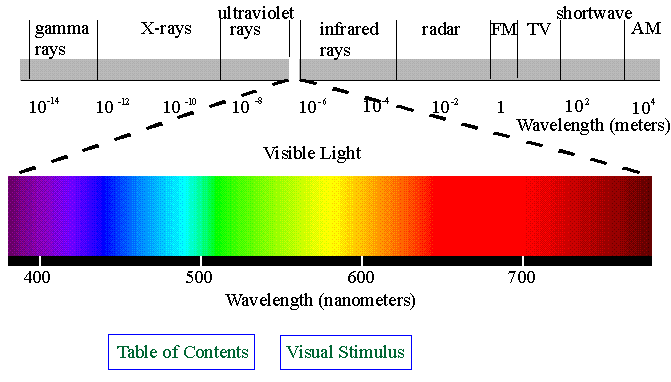
Now the speed of light is what it takes to travel 1 plancks length in 1 plancks second REGARDLESS of how big a plancks length actually is [yep even if its expanding or contracting] so to balance the equations out the light doesn't change speed but instead it changes FREQUENCY and this is where we get red and blue shifting etc.
Personal Disclosure: No! Distance is not constant at the cosmological scales BUT the change and the rate of that change is so imperceptable as to become irrelevant in everyday life at our 1m 1s 1kg scale of things.
After thinking about all the responses, Which are great and I appreciate it, distance would be measured from point a to point b. If the universe is
expanding then the distance would be over an arced line. Does this mean nothing truelly goes in a straight line?
If so then wouldn't the line eventually end in a circle?
Would this mean that no matter where you started from you would eventually end back where you started from?
It seems to me nothing goes on forever and I always thought that the end of the universe going "north" would bring you to the south end, not out forever. Hard to wrap my head around it.
If so then wouldn't the line eventually end in a circle?
Would this mean that no matter where you started from you would eventually end back where you started from?
It seems to me nothing goes on forever and I always thought that the end of the universe going "north" would bring you to the south end, not out forever. Hard to wrap my head around it.
edit on 1-1-2012 by jlafleur02 because: (no reason given)
new topics
-
Putin, Russia and the Great Architects of the Universe
ATS Skunk Works: 2 hours ago -
A Warning to America: 25 Ways the US is Being Destroyed
New World Order: 6 hours ago
top topics
-
President BIDEN's FBI Raided Donald Trump's Florida Home for OBAMA-NORTH KOREA Documents.
Political Conspiracies: 12 hours ago, 29 flags -
A Warning to America: 25 Ways the US is Being Destroyed
New World Order: 6 hours ago, 12 flags -
Las Vegas UFO Spotting Teen Traumatized by Demon Creature in Backyard
Aliens and UFOs: 17 hours ago, 7 flags -
Is AI Better Than the Hollywood Elite?
Movies: 14 hours ago, 3 flags -
Maestro Benedetto
Literature: 14 hours ago, 1 flags -
Putin, Russia and the Great Architects of the Universe
ATS Skunk Works: 2 hours ago, 1 flags
active topics
-
Hate makes for strange bedfellows
US Political Madness • 50 • : 19Bones79 -
Weinstein's conviction overturned
Mainstream News • 28 • : burritocat -
Sunak spinning the sickness figures
Other Current Events • 25 • : Ohanka -
Krystalnacht on today's most elite Universities?
Social Issues and Civil Unrest • 5 • : crayzeed -
University of Texas Instantly Shuts Down Anti Israel Protests
Education and Media • 272 • : burritocat -
Gaza Terrorists Attack US Humanitarian Pier During Construction
Middle East Issues • 40 • : WeMustCare -
Cats Used as Live Bait to Train Ferocious Pitbulls in Illegal NYC Dogfighting
Social Issues and Civil Unrest • 24 • : NoviceStoic4 -
A Warning to America: 25 Ways the US is Being Destroyed
New World Order • 13 • : 2025yuga -
Is AI Better Than the Hollywood Elite?
Movies • 19 • : GENERAL EYES -
ChatGPT Beatles songs about covid and masks
Science & Technology • 24 • : iaylyan
2