It looks like you're using an Ad Blocker.
Please white-list or disable AboveTopSecret.com in your ad-blocking tool.
Thank you.
Some features of ATS will be disabled while you continue to use an ad-blocker.

Three Gorges Dam in China–Largest in World – Serious Problems? Affects the Whole Earth
page: 4share:
If it breaks, tens of millions of Chinese could die, perhaps hundreds of million, but I don't think that i can affect the rotation of the planet or
anything. There simply is not enough momentum.
China needs to stop letting foreign investors do whatever they want lol, might destroy the Earth someday >>.
China needs to stop letting foreign investors do whatever they want lol, might destroy the Earth someday >>.
Originally posted by hstock28
Fascinating thread!
Could you provide a link to the Indian's claims? I would like to read exactly what he had to say.
Thanks for all your hard work.
I forgot to ask about this, too. I was so interested in the Dam info, but I wanted to learn more about this Nature Forum and this Native American's post. I don't know if you are allowed to post a link to another forum here, but maybe you could U2U us.
Thank you
reply to post by hstock28
the Earth site - I go to continually is Earthboppin -
it is all about everything - earthquakes - volcanoes - skywatching - enviromental watching etc.
link here: earthboppin.net...
Then go under the visions/dreams - and see about half way down the post about Walter Cronkite's death - and it questions "who had posted something awhile back.
Anyway - it will then lead you from one spot to another forum - to read the morning's posting before his death from the Indian.
Hope that helps.
Good site - for about Earth stuff.
the Earth site - I go to continually is Earthboppin -
it is all about everything - earthquakes - volcanoes - skywatching - enviromental watching etc.
link here: earthboppin.net...
Then go under the visions/dreams - and see about half way down the post about Walter Cronkite's death - and it questions "who had posted something awhile back.
Anyway - it will then lead you from one spot to another forum - to read the morning's posting before his death from the Indian.
Hope that helps.
Good site - for about Earth stuff.
Everyone please read this prediction relating to the death of Walter Cronkite and the Three Gorges Dam..
It was posted on the June 26th - I read it myself one or maybe two days before Cronkite passed away!
God Like Productions, /forum1/message825776/pg1
If this is not within the rules, please delete it from my post
[edit on 20-7-2009 by blackhatchet]
[edit on 20-7-2009 by blackhatchet]
Thanks, QuestionGall!
Pamie, here is the exact link - in case you have trouble weeding through the forum to find it.
Exact link to Indian's Claims
www.godlikeproductions.com...
--------
I can't seem to get the link to post correctly. If anyone wants the exact link, you can u2u me. Or you can just follow questiongall's instructions to find it for yourself. The text is quite long, else I would quote it here.
[edit on 20-7-2009 by hstock28]
[edit on 20-7-2009 by hstock28]
Pamie, here is the exact link - in case you have trouble weeding through the forum to find it.
Exact link to Indian's Claims
www.godlikeproductions.com...
--------
I can't seem to get the link to post correctly. If anyone wants the exact link, you can u2u me. Or you can just follow questiongall's instructions to find it for yourself. The text is quite long, else I would quote it here.
[edit on 20-7-2009 by hstock28]
[edit on 20-7-2009 by hstock28]
reply to post by blackhatchet
Link not working, can you summarize or post quoted text from the link?
Link not working, can you summarize or post quoted text from the link?
reply to post by grapesofraft
Sure it could – and what’s to stop that from happening as well?
My point is that that thing could have parts of it made from sand and cardboard for all we know. What I do know is that everything does have a breaking point. Sometimes, especially in large complex structures, all it takes is the slightest nudge to cause a chain reaction that brings a catastrophic failure. It has already showed signs of weakening under the pressure already put upon it. More pressure can only bring it closer to failure.
The information that the OP posted leads me to believe that this thing has some serious flaws. It might be an extra inch of rain or perhaps maybe a major earthquake that is required to bring it down. In the end, it doesn’t really matter. From what I’ve read here so far, this thing is a cause for serious concern.
Sure it could – and what’s to stop that from happening as well?
My point is that that thing could have parts of it made from sand and cardboard for all we know. What I do know is that everything does have a breaking point. Sometimes, especially in large complex structures, all it takes is the slightest nudge to cause a chain reaction that brings a catastrophic failure. It has already showed signs of weakening under the pressure already put upon it. More pressure can only bring it closer to failure.
The information that the OP posted leads me to believe that this thing has some serious flaws. It might be an extra inch of rain or perhaps maybe a major earthquake that is required to bring it down. In the end, it doesn’t really matter. From what I’ve read here so far, this thing is a cause for serious concern.
Here is a direct link to information about the "vision"
earthboppin.net...
you will find other info in it too about the dam - visions.
click to see "entire thread - to then be led to another forum (mentioned above) to the Indian's posting that morning.
earthboppin.net...
you will find other info in it too about the dam - visions.
click to see "entire thread - to then be led to another forum (mentioned above) to the Indian's posting that morning.
Originally posted by blackhatchet
Everyone please read this prediction relating to the death of Walter Cronkite and the Three Gorges Dam..
It was posted on the June 26th - I read it myself one or maybe two days before Cronkite passed away!
God Like Productions, /forum1/message825776/pg1
If this is not within the rules, please delete it from my post
[edit on 20-7-2009 by blackhatchet]
[edit on 20-7-2009 by blackhatchet]
This prediction is right on the money with a lot of timing accuracies. WOW!
Ok...this Indian guy is not much of a prophet.
Walter Cronkite was reported to be gravely ill in late June when his prediction was made.
It'll take more to convince me. If the Three Gorges dam busts in the next year I might raise an eyebrow. But even then, he has probably read about the problems facing the dam currently.
Walter Cronkite was reported to be gravely ill in late June when his prediction was made.
It'll take more to convince me. If the Three Gorges dam busts in the next year I might raise an eyebrow. But even then, he has probably read about the problems facing the dam currently.
reply to post by passenger
Here is a link to a pdf fact sheet released by the NPO International Rivers.
internationalrivers.org...
It speaks of the devastating affects that were felt immediately and to the corruption that runs rampant in China that further endangers not only people but the whole of China's environment.
This is a catastrophe waiting to happen...weather the moon, and eclipse or some other arm of mother nature does it... it will happen.
Here is a link to a pdf fact sheet released by the NPO International Rivers.
internationalrivers.org...
It speaks of the devastating affects that were felt immediately and to the corruption that runs rampant in China that further endangers not only people but the whole of China's environment.
This is a catastrophe waiting to happen...weather the moon, and eclipse or some other arm of mother nature does it... it will happen.
reply to post by questioningall
Very interesting thread. I don't think the dam will pop too soon. Interesting things seem to happen during solar max. Personally I feel that Yellowstone is going to put one big scare in us during the height of the solar max.
Also consider this, all those fissures in the ocean floor, magma coming out, the water 800 degrees near the fissures, immense pressure, core breach! Earth becomes an asteroid belt.
Very interesting thread. I don't think the dam will pop too soon. Interesting things seem to happen during solar max. Personally I feel that Yellowstone is going to put one big scare in us during the height of the solar max.
Also consider this, all those fissures in the ocean floor, magma coming out, the water 800 degrees near the fissures, immense pressure, core breach! Earth becomes an asteroid belt.
I'll put it this way: Bad Karma
While the whole world would be effected in one way or another by the dam collapse, the primary recipients of the carnage would be the Chinese.
If it occurs it would be the worst disaster in human history, which would make sense to me. Think of the horrible, horrible Karma the Chinese acquired for what they did to the Tibetans these last 60 years. They did every bad, unspeakable thing in the book to Tibetan monks, lamas, nuns, woman and children.
Frankly, I'd be surprised (based on my belief in how Karma works in this universe) if China didn't suffer some horrendous disaster in the near future because of what they did.
And what of the rest of the world? Well, we didn't try to stop the Chinese, now did we. We deserve what we have coming, too.
While the whole world would be effected in one way or another by the dam collapse, the primary recipients of the carnage would be the Chinese.
If it occurs it would be the worst disaster in human history, which would make sense to me. Think of the horrible, horrible Karma the Chinese acquired for what they did to the Tibetans these last 60 years. They did every bad, unspeakable thing in the book to Tibetan monks, lamas, nuns, woman and children.
Frankly, I'd be surprised (based on my belief in how Karma works in this universe) if China didn't suffer some horrendous disaster in the near future because of what they did.
And what of the rest of the world? Well, we didn't try to stop the Chinese, now did we. We deserve what we have coming, too.
reply to post by questioningall
Frankly my Dear I don't give a Dam, Only joking this is great thread, I usually steer away from those long post, but yours I kept reading and reading and finally saw what you were getting at.
The whole post was very well done and educational.
Some of the posters questioned the solar eclipse factor, is well know fact moon is related to earthquakes, as the moon pulls on ocean it also pulls the land mass and molten materials beneath the surface.
The thing when building things people sometimes over do things, adding more Portland cement would make concrete harder, stronger, but at same time make it brittle, removing any flex that would be needed in such a massive structure. They should have included modifiers, such as latex, acrylics, or even the fiberglass fibers. The thing is these things are to new, and not proven on something of this massive scale.
But any how mistake made, is they made this thing with no give, everytime it moves it breaks.
Someone mentioed repairs fix, this is done deal they are stuck with mistake until it fails.
Frankly my Dear I don't give a Dam, Only joking this is great thread, I usually steer away from those long post, but yours I kept reading and reading and finally saw what you were getting at.
The whole post was very well done and educational.
Some of the posters questioned the solar eclipse factor, is well know fact moon is related to earthquakes, as the moon pulls on ocean it also pulls the land mass and molten materials beneath the surface.
The thing when building things people sometimes over do things, adding more Portland cement would make concrete harder, stronger, but at same time make it brittle, removing any flex that would be needed in such a massive structure. They should have included modifiers, such as latex, acrylics, or even the fiberglass fibers. The thing is these things are to new, and not proven on something of this massive scale.
But any how mistake made, is they made this thing with no give, everytime it moves it breaks.
Someone mentioed repairs fix, this is done deal they are stuck with mistake until it fails.
As usually pseudoscience mixed with real science...
How can something static like a lake make the earth wobble, as other said here, there are bigger lakes elsewhere, and I don't even mention the oceans...
And ... Solar eclipse .. and full moon... we are back in the middle ages
How can something static like a lake make the earth wobble, as other said here, there are bigger lakes elsewhere, and I don't even mention the oceans...
And ... Solar eclipse .. and full moon... we are back in the middle ages
Here is the point...
Both the Sun and the Moon PULL water on Earth towards them.
The closer they are, the greater the pull.
During an eclipse the two forces work together to pull in the same direction just like two guys lined up on a rope pulling in the same direction.
All the water behind the dam will be pulled toward the damn with the combined gravitational force of the Sun and the Moon.
Therefore, the dam could collapse.
Both the Sun and the Moon PULL water on Earth towards them.
The closer they are, the greater the pull.
During an eclipse the two forces work together to pull in the same direction just like two guys lined up on a rope pulling in the same direction.
All the water behind the dam will be pulled toward the damn with the combined gravitational force of the Sun and the Moon.
Therefore, the dam could collapse.
reply to post by SaraThustra
No.
When talking about tides it is important to note that they are not produced so much by the force of gravity but by the gravity gradient. What produces tidal effects is the fact that the force of the moon's gravity on one side of the Earth is greater than the force of its gravity on the opposite side of the earth. This is why high tides occur on opposite sides of the Earth at the same time. The water on the moon side is being pulled more strongly than the earth is being pulled. At the same time, the earth is being pulled more strongly than the water on the side away from the moon. Because the moon is much closer to Earth than the sun and gravity obeys the inverse square law, its gravity gradient is much greater than that of the sun.
www.lhup.edu...
While the sun does affect tides the moon, being much closer, affects the tides a great deal more. But the effects of the sun on the tides can be seen every full and new moon. Because the tidal forces of the sun and moon are aligned at this time the slight effects produced by the sun are added to those of the moon. But the eclipse adds nothing to the effect.
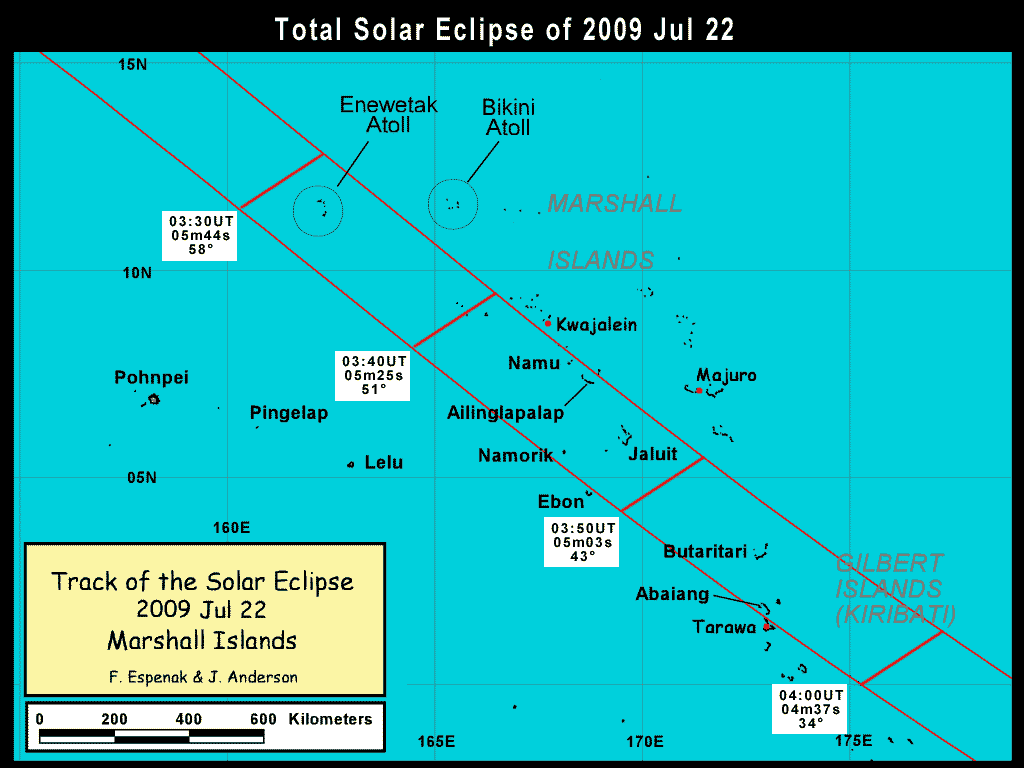
Here is the path of the eclipse over the Marshall Islands.
Here is the tide prediction for Jaluit Atoll.
Jaluit
Jaluit's time zone is UTC+12 so the local time of the eclipse will be at 3:48PM. At the time of the eclipse the tide level will be 3.4 feet. At high tide, which occurs two hours later, the level will be 4 feet. A quick glance shows that there is nothing extreme about this level.
Now let's look at another new moon at Jaluit. In three months, the new moon occurs on October 18th. On that day the high tide will be 4.8 feet. Much higher than the day of the eclipse. The eclipse has no effect.
Some may claim that the tide predictions are wrong. They are not. It is very important to mariners that they are correct. Their accuracy has been validated over many many years, eclipses or no.
Be assured that solar eclipses have no effect on the tides in the ocean or any other body of water. Any more than every full and new moon does anyway.
[edit on 7/20/2009 by Phage]
No.
When talking about tides it is important to note that they are not produced so much by the force of gravity but by the gravity gradient. What produces tidal effects is the fact that the force of the moon's gravity on one side of the Earth is greater than the force of its gravity on the opposite side of the earth. This is why high tides occur on opposite sides of the Earth at the same time. The water on the moon side is being pulled more strongly than the earth is being pulled. At the same time, the earth is being pulled more strongly than the water on the side away from the moon. Because the moon is much closer to Earth than the sun and gravity obeys the inverse square law, its gravity gradient is much greater than that of the sun.
www.lhup.edu...
While the sun does affect tides the moon, being much closer, affects the tides a great deal more. But the effects of the sun on the tides can be seen every full and new moon. Because the tidal forces of the sun and moon are aligned at this time the slight effects produced by the sun are added to those of the moon. But the eclipse adds nothing to the effect.
Here is the path of the eclipse over the Marshall Islands.
Here is the tide prediction for Jaluit Atoll.
Jaluit
Jaluit's time zone is UTC+12 so the local time of the eclipse will be at 3:48PM. At the time of the eclipse the tide level will be 3.4 feet. At high tide, which occurs two hours later, the level will be 4 feet. A quick glance shows that there is nothing extreme about this level.
Now let's look at another new moon at Jaluit. In three months, the new moon occurs on October 18th. On that day the high tide will be 4.8 feet. Much higher than the day of the eclipse. The eclipse has no effect.
Some may claim that the tide predictions are wrong. They are not. It is very important to mariners that they are correct. Their accuracy has been validated over many many years, eclipses or no.
Be assured that solar eclipses have no effect on the tides in the ocean or any other body of water. Any more than every full and new moon does anyway.
[edit on 7/20/2009 by Phage]
Great post, thanks for all the info.
I have read about this dam project and watched shows on it in the past, and it seems that most of the experts think that this was never a very good idea.
I don't know alot about building dams, but from what I understand, the two main considerations are the bedrock under the dam to be built, and the reservoir that will be created by the dam. The Hoover dam was an ideal location for both of these considerations, which is why they chose to build the dam were it was built, and this is considered to be the reason why the project was so successful. The Three Gorges Dam is built on a solid bedrock foundation, but the location for the reservoir was not very well chosen, thus the idea of building this dam in the first place was never very well founded. We have a situation where the Chinese, who have proven themselves to not be very good at building dams, have built the largest dam ever created, in a location that is anything but ideal. Basically, we are looking at a disaster in the making from the beginning.
Here is an article which gives some of the history on China's record when it comes to building dams. It doesn't give a great deal of information on the problems with the reservoir that the dam creates, which is what I understand to be the largest problem, but it does point out several problems.
toxipedia.org...
The project proceeded with numerous problems devloping from the beginning, cracks in the dam pointed out by the op, which is courting disaster on a historical level.
Now, along comes this historical eclipse, as the dam is filling, with all the problems from a poor choice of a location from a reservoir, which have turned out to be far worse than was predicted, or hoped for.
Here is a link which talks about why science is currently studying the effects of solar eclipses on Earths gravity. One thing I do know about is instrumentation. Most people do not realize that gravity changes with location, so that when doing precise weight measurements, local gravity corrections have to be considered. I imagine this has a great deal of effect on determining how solar eclipses effect gravity on Earth. The effect would probably be subtle, but there is good reason to suspect that such a thing does occur.
This link points something out that I think is very important to this thread.
timesofindia.indiatimes.com...
Erratic behavior in the pendulum swing!
Is that symbolic or what?
I have read about this dam project and watched shows on it in the past, and it seems that most of the experts think that this was never a very good idea.
I don't know alot about building dams, but from what I understand, the two main considerations are the bedrock under the dam to be built, and the reservoir that will be created by the dam. The Hoover dam was an ideal location for both of these considerations, which is why they chose to build the dam were it was built, and this is considered to be the reason why the project was so successful. The Three Gorges Dam is built on a solid bedrock foundation, but the location for the reservoir was not very well chosen, thus the idea of building this dam in the first place was never very well founded. We have a situation where the Chinese, who have proven themselves to not be very good at building dams, have built the largest dam ever created, in a location that is anything but ideal. Basically, we are looking at a disaster in the making from the beginning.
Here is an article which gives some of the history on China's record when it comes to building dams. It doesn't give a great deal of information on the problems with the reservoir that the dam creates, which is what I understand to be the largest problem, but it does point out several problems.
toxipedia.org...
The Chinese have a tremendously poor record of dam building. Prior to 1949, only twenty-three large to medium size dams existed in China. Tremendous expansion of dam projects began during the "Great Leap Forward" - Chairman Mao's 1958 plan to springboard China into a viable economic competitor by using China's vast natural and human resources - when over 80,000 dam projects where commenced, including a dam on every one of China's main rivers (Qing, 1998). However by 1973, forty percent of the reservoirs created from that construction were so poorly constructed they were unable to effectively control the flooding. In additional to the reservoir problems, nearly 3,000 dams had completely collapsed. When asked about the history of dam failures of the past, one provincial water manager commented, "The crap from that era (the Great Leap Forward) has not yet been cleaned up" (Qing, 1998). In addition to collapses, nearly one quarter of dams from that era were deemed unsafe and in need of repair, putting hundreds of thousands of lives in jeopardy.
The project proceeded with numerous problems devloping from the beginning, cracks in the dam pointed out by the op, which is courting disaster on a historical level.
Now, along comes this historical eclipse, as the dam is filling, with all the problems from a poor choice of a location from a reservoir, which have turned out to be far worse than was predicted, or hoped for.
Here is a link which talks about why science is currently studying the effects of solar eclipses on Earths gravity. One thing I do know about is instrumentation. Most people do not realize that gravity changes with location, so that when doing precise weight measurements, local gravity corrections have to be considered. I imagine this has a great deal of effect on determining how solar eclipses effect gravity on Earth. The effect would probably be subtle, but there is good reason to suspect that such a thing does occur.
This link points something out that I think is very important to this thread.
timesofindia.indiatimes.com...
The first sign that gravity fluctuates during an eclipse was in 1954, when French economist and physicist Maurice Allais noticed erratic behaviour in a swinging pendulum when an eclipse passed over Paris.
Erratic behavior in the pendulum swing!
Is that symbolic or what?
Originally posted by SaraThustra
Here is the point...
Both the Sun and the Moon PULL water on Earth towards them.
The closer they are, the greater the pull.
During an eclipse the two forces work together to pull in the same direction just like two guys lined up on a rope pulling in the same direction.
All the water behind the dam will be pulled toward the damn with the combined gravitational force of the Sun and the Moon.
Therefore, the dam could collapse.
Every day the sun and the moon pull the water of the lake. Every day. Some times more, some days less. A good rain is more of a danger than the moon's pull.
An eclipse has no effect on gravitational pull. An eclipse is only a shadow.
new topics
-
What is the white pill?
Philosophy and Metaphysics: 1 hours ago -
Mike Pinder The Moody Blues R.I.P.
Music: 1 hours ago -
Putin, Russia and the Great Architects of the Universe
ATS Skunk Works: 4 hours ago -
A Warning to America: 25 Ways the US is Being Destroyed
New World Order: 9 hours ago
top topics
-
President BIDEN's FBI Raided Donald Trump's Florida Home for OBAMA-NORTH KOREA Documents.
Political Conspiracies: 15 hours ago, 33 flags -
A Warning to America: 25 Ways the US is Being Destroyed
New World Order: 9 hours ago, 18 flags -
Is AI Better Than the Hollywood Elite?
Movies: 16 hours ago, 4 flags -
Mike Pinder The Moody Blues R.I.P.
Music: 1 hours ago, 4 flags -
What is the white pill?
Philosophy and Metaphysics: 1 hours ago, 4 flags -
Putin, Russia and the Great Architects of the Universe
ATS Skunk Works: 4 hours ago, 2 flags -
Maestro Benedetto
Literature: 16 hours ago, 1 flags
active topics
-
Gaza Terrorists Attack US Humanitarian Pier During Construction
Middle East Issues • 67 • : FlyersFan -
What is the white pill?
Philosophy and Metaphysics • 4 • : BrotherKinsMan -
Truth Social goes public, be careful not to lose your money
Mainstream News • 134 • : lilzazz -
Starburst galaxy M82 - Webb Vs Hubble
Space Exploration • 6 • : Arbitrageur -
One Flame Throwing Robot Dog for Christmas Please!
Weaponry • 11 • : Therealbeverage -
Ditching physical money
History • 21 • : SprocketUK -
Graham Hancock being proven right all along about ancient humans in America.
Ancient & Lost Civilizations • 106 • : JonnyC555 -
President BIDEN's FBI Raided Donald Trump's Florida Home for OBAMA-NORTH KOREA Documents.
Political Conspiracies • 29 • : MetalThunder -
Putin, Russia and the Great Architects of the Universe
ATS Skunk Works • 17 • : BrotherKinsMan -
Massachusetts Drag Queen Leads Young Kids in Free Palestine Chant
Social Issues and Civil Unrest • 18 • : ToneD