It looks like you're using an Ad Blocker.
Please white-list or disable AboveTopSecret.com in your ad-blocking tool.
Thank you.
Some features of ATS will be disabled while you continue to use an ad-blocker.

Milky Way more massive and spinning more faster
page: 14
share:
This is the most important news in astronomy. Accurate measurements of the speed of the milky way by Mark Reid of the Harvard-Smithsonian indicates
that it is 50% heavier.
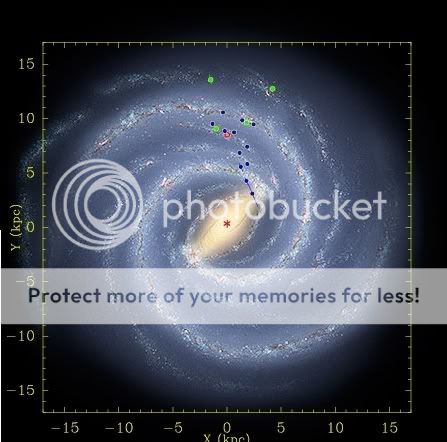
So, the possible implications are that, this increases the chance of collision with the andromeda galaxy, with sure possible destruction of our galaxy.
And how was this accurate measurement done?
The instruments used for this purpose
The capacity of the telescope,
Link:
Milky Way
High-precision measurements of the Milky Way disclose our galaxy is rotating about 100,000 miles per hour faster than previously understood. That increase in speed, said Mark Reid of the Harvard-Smithsonian Center for Astrophysics, increases the Milky Way’s mass by 50 percent.
So, the possible implications are that, this increases the chance of collision with the andromeda galaxy, with sure possible destruction of our galaxy.
The larger mass, in turn, means a greater gravitational pull that increases the likelihood of collisions with the Andromeda galaxy or smaller nearby galaxies. So even though we're faster, we're also heavier and more likely to be annihilated. Bummer!
And how was this accurate measurement done?
Trigonometric parallax was first used in 1838 to measure the first stellar distance. However, with better technology, the accuracy is now about 10,000 times greater.
The instruments used for this purpose
The scientists are using the National Science Foundation’s Very Long Baseline Array (VLBA) radio telescope to remake the map of the Milky Way. Taking advantage of the VLBA’s unparalleled ability to make extremely detailed images, the team is conducting a long-term program to measure distances and motions in our Galaxy.
The capacity of the telescope,
The VLBA is a system of 10 radio-telescope antennas stretching from Hawaii to New England and the Caribbean. It has the best resolving power, of any astronomical tool in the world. The VLBA can routinely produce images hundreds of times more detailed than those produced by the Hubble Space Telescope. The VLBA’s tremendous resolving power, equal to being able to read a newspaper in Los Angeles from the distance of New York, is what permits the astronomers to make precise distance determinations.
Link:
Milky Way
reply to post by peacejet
So if our galaxy is 50% heavier could that mean that the rest of the galaxies in our universe could be heavier as well?
Ans if so doesn't this potentially alter the entire equation of the mass of the universe with regards to the expansion of our universe?
Meaning that dark energy & dark matter might be scrapped as it is no longer necessary to fill in blanks in order to make the equations come together.
So if our galaxy is 50% heavier could that mean that the rest of the galaxies in our universe could be heavier as well?
Ans if so doesn't this potentially alter the entire equation of the mass of the universe with regards to the expansion of our universe?
Meaning that dark energy & dark matter might be scrapped as it is no longer necessary to fill in blanks in order to make the equations come together.
reply to post by MrVertigo
It's easier to measure the rate of rotation and other characteristics of other galaxies than our own.
www.cfa.harvard.edu...
zebu.uoregon.edu...
Of course, estimating the entire mass of the universe requires making some far reaching assumptions.
[edit on 1/5/2009 by Phage]
It's easier to measure the rate of rotation and other characteristics of other galaxies than our own.
“These direct measurements are revising our understanding of the structure and motions of our Galaxy,” Menten said. "Because we’re inside it, it’s difficult for us to determine the Milky Way’s structure. For other galaxies, we can simply look at them and see their structure, but we can’t do this to get an overall image of the Milky Way. We have to deduce its structure by measuring and mapping,” he added.
www.cfa.harvard.edu...
zebu.uoregon.edu...
Of course, estimating the entire mass of the universe requires making some far reaching assumptions.
[edit on 1/5/2009 by Phage]
Originally posted by MrVertigo
reply to post by peacejet
Ans if so doesn't this potentially alter the entire equation of the mass of the universe with regards to the expansion of our universe?
Meaning that dark energy & dark matter might be scrapped as it is no longer necessary to fill in blanks in order to make the equations come together.
Highly unlikely, dark matter and dark energy was introduced to fit the observations that galaxies rotate at the same speed at the edges and at the center. And also, the galaxies are so large and the mass induced gravity is not enough to hold them together and this dark energy is holding them together.
re: So, the possible implications are that, this increases the chance of collision with the andromeda galaxy, with sure possible destruction of our
galaxy.
We won't be destroyed, just absorbed. Just like our galaxy, Sagittarius Minor, is being absorbed by the Milky Way.
We won't be destroyed, just absorbed. Just like our galaxy, Sagittarius Minor, is being absorbed by the Milky Way.
Originally posted by peacejet
with sure possible destruction of our galaxy.
Oh NOES! We all gonna die!
Seriously, a good post. Starred from me.
[edit on Tue Jan 6 2009 by Jbird]
Originally posted by wookiee
We won't be destroyed, just absorbed. Just like our galaxy, Sagittarius Minor, is being absorbed by the Milky Way.
It is Sagittarius Dwarf, and as the name suggests, it is a dwarf galaxy and smaller than the milky way and hence is being absorbed.
And andromeda, though it is large, is similar to our milky way,
Andromeda is the largest galaxy of the Local Group, which consists of the Andromeda Galaxy, the Milky Way Galaxy, the Triangulum Galaxy, and about 30 other smaller galaxies. Although the largest, it may not be the most massive, as recent findings suggest that the Milky Way contains more dark matter and may be the most massive in the grouping.[7] However, recent observations by the Spitzer Space Telescope revealed that M31 contains one trillion (1012) stars, greatly exceeding the number of stars in our own galaxy.[8] 2006 estimates put the mass of the Milky Way to be ~80% of the mass of Andromeda, which is estimated to be 7.1×10¹¹ solar masses.[2]
Link-
en.wikipedia.org...
So, since both the galaxies are equal in mass, a battle of gravity will take place and based on the angle of attack, both the galaxies will either merge together to form a super galaxy(which means total annhilation of the milky way and andromeda) or get deforemed as they zip past each other.
Originally posted by MrVertigo
reply to post by peacejet
Meaning that dark energy & dark matter might be scrapped as it is no longer necessary to fill in blanks in order to make the equations come together.
I was thinking the exact same thing. It makes more sense than having to 'invent' some highly exotic matter to account for holes in a theory. However, you wont see those who's paychecks rely on it being 'real' taking a step backward. They will simply create a new equation that still requires their beloved black gunk.
IRM
The dark matter/energy will not be nullified, because, if this is energy is applicable to our galaxy alone, then we can consider this, but we see this
in all galaxies(whose mass has been accurately measured)and the universe as a whole. So, think of it.
Get out of the way! Galactic collision will happen sooner than
scientists thought
Mod Note: Quote Reference - Please Review This Link.
[edit on Tue Jan 6 2009 by Jbird]
According to their most detailed measurements yet, scientists admitted to having grossly underestimated the mass of the Milky Way, and so the gravitational pull it exerts on our cosmic neighbours, including the giant Andromeda galaxy.
The oversight means that the two galaxies, which are on a cataclysmic collision course, will slam into one another earlier than scientists had previously predicted. When the two galaxies meet, powerful shockwaves will compress interstellar gas clouds within them, triggering a dazzling flourish of newborn stars, in a last heavenly hurrah before the giant wreckage slowly dims and dies out.
The measurements showed that our solar system is hurtling along at 600,000mph, 100,000mph faster than thought. "These measurements are revising our understanding of the structure and motions of our galaxy," said Menten.
The speedier rotation of the galaxy means its mass must be similar to that of Andromeda, around 270bn times the mass of the sun, or 33% greater than earlier calculations have suggested. "No longer will we think of the Milky Way as the little sister of the Andromeda galaxy," said Reid. The research was presented at the annual meeting of the American Astronomical Society in Long Beach, California.
Astronomers believe the crunch to end all crunches could happen around the same time our sun is due to burn up the last of its nuclear fuel, within the next 7bn years. It is highly unlikely that planets and stars will collide. Instead the two galaxies will merge to form a new, large galaxy.
[edit on Tue Jan 6 2009 by Jbird]
As an amateur astronomer I have a few things to say.
It was long believed that andromeda was the largest and most massive galaxy in in our local cluster.
However, recently they've discovered that despite having far few stars than andromeda, the milky was is more massive. I always thought that was interesting.
It's alot more difficult measuring a galaxy from within one
It was long believed that andromeda was the largest and most massive galaxy in in our local cluster.
However, recently they've discovered that despite having far few stars than andromeda, the milky was is more massive. I always thought that was interesting.
It's alot more difficult measuring a galaxy from within one
It's been known for a long time that the Milky Way and Andromeda are on a collision course but since it wont happen for billions of years, don't get
your panties in a twist lol.
I did not read anything that disproves dark matter (maybe I haven't had enough coffee yet). I did see an article recently that said that dark matter may be all over our solar system and around planets. This may explain why gas giants like jupiter seem to emit more heat than they should.
Our ignorance is astounding.
I did not read anything that disproves dark matter (maybe I haven't had enough coffee yet). I did see an article recently that said that dark matter may be all over our solar system and around planets. This may explain why gas giants like jupiter seem to emit more heat than they should.
Our ignorance is astounding.
wow, two glaxies colliding, just imagine the beauty that would come from such process (except for the human kind), fusing together, creating a whole
new galaxy of sheer endless new possibilities. argh I wish I had some kind of spaceship and a "fast-foward" time machine. Oh well, maybe in my next
life.

reply to post by Nicolas Flamel
Recent studies also indicate that odd socks originate from dark matter having swallowed the other half of the pair
Seriously, Dark matter and energy is used as the default answer whenever something is impossible to explain by the conventional models, which is ridiculous as both are, at best, highly theoretical constructs.
Recent studies also indicate that odd socks originate from dark matter having swallowed the other half of the pair
Seriously, Dark matter and energy is used as the default answer whenever something is impossible to explain by the conventional models, which is ridiculous as both are, at best, highly theoretical constructs.
Originally posted by MrVertigo
reply to post by Nicolas Flamel
Recent studies also indicate that odd socks originate from dark matter having swallowed the other half of the pair
Seriously, Dark matter and energy is used as the default answer whenever something is impossible to explain by the conventional models, which is ridiculous as both are, at best, highly theoretical constructs.
LOL, yes you are right, but once we thought the world was flat too...
reply to Nicolas Flamel
Dark energy has nothing to do with jupiters heat. The reason for the heat is because the large size of jupiter compacts gas in the core and starts a mini- fusion reaction, giving off heat, and if jupiter had more mass then, it would ignite entirely and become a second sun.
Dark energy has nothing to do with jupiters heat. The reason for the heat is because the large size of jupiter compacts gas in the core and starts a mini- fusion reaction, giving off heat, and if jupiter had more mass then, it would ignite entirely and become a second sun.
new topics
-
BIDEN Admin Begins Planning For January 2025 Transition to a New President - Today is 4.26.2024.
2024 Elections: 1 hours ago -
Big Storms
Fragile Earth: 3 hours ago -
Where should Trump hold his next rally
2024 Elections: 5 hours ago -
Shocking Number of Voters are Open to Committing Election Fraud
US Political Madness: 6 hours ago -
Gov Kristi Noem Shot and Killed "Less Than Worthless Dog" and a 'Smelly Goat
2024 Elections: 7 hours ago -
Falkville Robot-Man
Aliens and UFOs: 7 hours ago -
James O’Keefe: I have evidence that exposes the CIA, and it’s on camera.
Whistle Blowers and Leaked Documents: 8 hours ago -
Australian PM says the quiet part out loud - "free speech is a threat to democratic dicourse"...?!
New World Order: 9 hours ago -
Ireland VS Globalists
Social Issues and Civil Unrest: 9 hours ago -
Biden "Happy To Debate Trump"
2024 Elections: 10 hours ago
top topics
-
James O’Keefe: I have evidence that exposes the CIA, and it’s on camera.
Whistle Blowers and Leaked Documents: 8 hours ago, 14 flags -
Australian PM says the quiet part out loud - "free speech is a threat to democratic dicourse"...?!
New World Order: 9 hours ago, 13 flags -
Blast from the past: ATS Review Podcast, 2006: With All Three Amigos
Member PODcasts: 12 hours ago, 13 flags -
Biden "Happy To Debate Trump"
2024 Elections: 10 hours ago, 12 flags -
Mike Pinder The Moody Blues R.I.P.
Music: 12 hours ago, 8 flags -
What is the white pill?
Philosophy and Metaphysics: 11 hours ago, 6 flags -
Shocking Number of Voters are Open to Committing Election Fraud
US Political Madness: 6 hours ago, 6 flags -
RAAF airbase in Roswell, New Mexico is on fire
Aliens and UFOs: 10 hours ago, 5 flags -
Ireland VS Globalists
Social Issues and Civil Unrest: 9 hours ago, 5 flags -
Where should Trump hold his next rally
2024 Elections: 5 hours ago, 5 flags
active topics
-
SHORT STORY WRITERS CONTEST -- April 2024 -- TIME -- TIME2024
Short Stories • 26 • : Encia22 -
Gov Kristi Noem Shot and Killed "Less Than Worthless Dog" and a 'Smelly Goat
2024 Elections • 50 • : AwakeNotWoke -
Biden "Happy To Debate Trump"
2024 Elections • 50 • : Lumenari -
Falkville Robot-Man
Aliens and UFOs • 9 • : CosmicFocus -
Big Storms
Fragile Earth • 12 • : Lumenari -
BIDEN Admin Begins Planning For January 2025 Transition to a New President - Today is 4.26.2024.
2024 Elections • 8 • : NoCorruptionAllowed -
ALERT - U.S. President JOE BIDEN Examined and Found NOT OF SOUND MIND.
2024 Elections • 65 • : SchrodingersRat -
James O’Keefe: I have evidence that exposes the CIA, and it’s on camera.
Whistle Blowers and Leaked Documents • 13 • : theatreboy -
Where should Trump hold his next rally
2024 Elections • 21 • : Dandandat3 -
RAAF airbase in Roswell, New Mexico is on fire
Aliens and UFOs • 9 • : Degradation33
4