It looks like you're using an Ad Blocker.
Please white-list or disable AboveTopSecret.com in your ad-blocking tool.
Thank you.
Some features of ATS will be disabled while you continue to use an ad-blocker.

There will be NO Sea Typhoon
page: 1share:
Defence-Aerospace
So thats end of discussion - the UK are buying JSF , although the strong leaning is for the STOVL varient , the option for the full on `C` model for the RN is very much open.
[edit on 8/12/08 by Harlequin]
Q281 ROBERT KEY: Is a marinised Typhoon still an option?
General Sir Kevin O'Donoghue: That is not being looked at, no.
Q282 ROBERT KEY: What discussions have you been having with the French about the possibility of purchasing a French aircraft that could fly on the French aircraft carriers and the British aircraft carriers?
General Sir Kevin O'Donoghue: I have not been having any.
So thats end of discussion - the UK are buying JSF , although the strong leaning is for the STOVL varient , the option for the full on `C` model for the RN is very much open.
[edit on 8/12/08 by Harlequin]
But would the C-variant be able to operate off of thier new carrier? If so then yes it would be otherwise.
Its a shame that they are not considering a naval variant of the EF-2000 :shk: and seems shortsided to me.
However, the costs may simply be too much
Its a shame that they are not considering a naval variant of the EF-2000 :shk: and seems shortsided to me.
However, the costs may simply be too much
Originally posted by FredT
Its a shame that they are not considering a naval variant of the EF-2000 :shk: and seems shortsided to me.
Why is that?
reply to post by FredT
further in that transcript answers your question:
further in that transcript answers your question:
Q290 CHAIRMAN: And the aircraft carriers that we are building would be big enough, would they, to take the carrier version?
Dr Tyler: Yes, absolutely. One of the assumptions on the carrier design was that the carrier's flight deck needed to be of a sufficient length that, should you wish to, you could convert. In fact, the space underneath the flight deck has actually been left in order so that should you wish to in the future fit the catapults and the traps, which sit immediately under the flight deck, you would be able to do that. In fact, there are designs which actually show how that would be fitted in the event that you wanted to change the carrier over to a conventional take-off on the carrier. You might want to do that for any number of reasons; it was not just uncertainty around the JSF programme per se, it was in order to keep that option open
reply to post by Harlequin
Yeah I saw that clip but early on he says a definitive No and we both know the cost of retrofitting a capital ship with such a major change will be hugely expensive to the point it may be better to build a whole new flatop.
Yeah I saw that clip but early on he says a definitive No and we both know the cost of retrofitting a capital ship with such a major change will be hugely expensive to the point it may be better to build a whole new flatop.
reply to post by YourForever
There are a variety of reasons.
It would support and keep active your indistrial base
It would take servicing / tech tranpher objections the USA would have out of the equation.
The F-35 is going to be a great airframe but its a fighter bomber and stealth aside would not be as potent as an EF-2000 naval version fitted with CAPTOR. A mix of the two would be excellent.
There are a variety of reasons.
It would support and keep active your indistrial base
It would take servicing / tech tranpher objections the USA would have out of the equation.
The F-35 is going to be a great airframe but its a fighter bomber and stealth aside would not be as potent as an EF-2000 naval version fitted with CAPTOR. A mix of the two would be excellent.
reply to post by FredT
The new carriers have a full backfit for catobar ops , so refitting them isn`t quite as massive operation as you think - the design is for mag cats using the full flight deck of 260m , whilst the stovl will use the smaller 2 flight lines of 160m
comparison to the nimitz with a flight deck of 330m - and the current invincible with a flight deck of 168m - the new ships will be much bigger *thankfully*
The new carriers have a full backfit for catobar ops , so refitting them isn`t quite as massive operation as you think - the design is for mag cats using the full flight deck of 260m , whilst the stovl will use the smaller 2 flight lines of 160m
comparison to the nimitz with a flight deck of 330m - and the current invincible with a flight deck of 168m - the new ships will be much bigger *thankfully*
I wouldn't go as far to say they are buying JSF, as he makes it clear the decision to buy 3 for Operational Test and Evaluation has not be made yet,
and the decision to buy JSF for service will only be made after 3 years of OT&E.
You could compare it to the UK cancelling TSR-2 in favor of buying F-111 which they then didn't. Of course this time they have the 2 expensive full sized carriers which they haven't got enough harriers to fill (if they can be made to fly that long). Mind you there is talk of the carriers being delayed for another 2 years. Never underestimate the UK Gov for making stupid decisions.
You could compare it to the UK cancelling TSR-2 in favor of buying F-111 which they then didn't. Of course this time they have the 2 expensive full sized carriers which they haven't got enough harriers to fill (if they can be made to fly that long). Mind you there is talk of the carriers being delayed for another 2 years. Never underestimate the UK Gov for making stupid decisions.
I have posted previously that the intention is to build HMS Prince of Wales with CATOBAR installed and HMS Queen Elizabeth with the facility for it to
be added quickly. The reason given for this is to allow USN and French aircraft to land on them as we used to do in the 70's. It also however allows
us a choice of fighter aircraft and I am disappointed that we aren't at least keeping our options open beyond choosing the F-35B, F-35C or nowt.
Of course, playing devils advocate, there is a quite obvious airframe to operate from the carriers, The rafale, it is in capability and design
basically a navalised typhoon. Also we know that its going to work well from the carriers. Wouldnt be too bad to have a two squadrons of these to one
of 35-c/b.
Dreaming of course. I somehow get the feeling I am going to take my future grandkids to an airshow in 2040 and see the Harrier still operating.
Jensy
Dreaming of course. I somehow get the feeling I am going to take my future grandkids to an airshow in 2040 and see the Harrier still operating.
Jensy
In the report it is made pretty clear that the Rafale is not even being considered as an option, neither is the Super Hornet (ohh, shame ) which is
what I was referring to with my last post. You might think that alternatives were at least being looked at.
Originally posted by waynos
In the report it is made pretty clear that the Rafale is not even being considered as an option, neither is the Super Hornet (ohh, shame ) which is what I was referring to with my last post. You might think that alternatives were at least being looked at.
Aside from the grin the F-18's MTOW of 30000 kg is almost 9000 more than the EF-2000 so it may not be a real option anyway?????
Thats actually too bad as the RN could use a dedicated EW aircraft like the Growler.
reply to post by Harlequin
Good to know, I have to admit Non US capital ships is not usually my area of interest.
Good to know, I have to admit Non US capital ships is not usually my area of interest.
reply to post by FredT
The F-35B (like all Lightning versions) will have inherent electronic attack capabilities as well as a host of passive/active ISR features. While not as refined and dedicated as those found on the Growler they will be supplemented by the Lightnings VLO design. The Raptor has shown less distance from a source will greatly enhance capability.
The F-35B (like all Lightning versions) will have inherent electronic attack capabilities as well as a host of passive/active ISR features. While not as refined and dedicated as those found on the Growler they will be supplemented by the Lightnings VLO design. The Raptor has shown less distance from a source will greatly enhance capability.
The UK have `hinted` they will buy 3 - now i can see 2 being `B` variants for the RAF and RN - the mystery - will the third be a C version?
IMO the EF2000 is to, well, 'flimsy' is not he right word, light weight maybe? to be a good carrier aircraft - it's more of a thoroughbred, treat
it nice and you get rewarded.
Carrier based craft have to take punishing landings - the JSF airframe looks like a better option - it's beefier, will take the punishment of carrier landings.
Carrier based craft have to take punishing landings - the JSF airframe looks like a better option - it's beefier, will take the punishment of carrier landings.
Originally posted by Now_Then
IMO the EF2000 is to, well, 'flimsy' is not he right word, light weight maybe? to be a good carrier aircraft - it's more of a thoroughbred, treat it nice and you get rewarded.
Carrier based craft have to take punishing landings - the JSF airframe looks like a better option - it's beefier, will take the punishment of carrier landings.
Do you have any knowledge of the airframe strength of the Eurofighter, because if you dont then your comment is slightly puzzling - looks are nothing.
reply to post by RichardPrice
Well traditionally the air frames that withstand carrier landings are heavier and the landing gear very substantial. It's easier to explain if I get some pics..
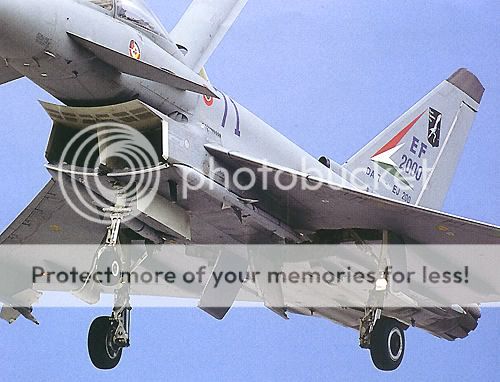
See the way the rear landing gear seems quite light weight. And how it mounts in the wing, quite far out from the body? That IMO would not make for good repeated 'hard' landings such as you get on an aircraft carrier.
compare to the F-18.
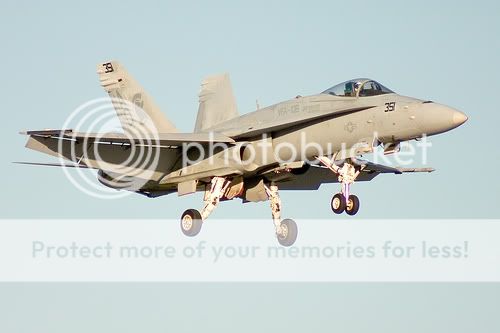
You see the rear undercarriage on the F-18 looks like it's ready to recieve impact... It actually looks like it's going to spring. And the mounting point is very central - where the strongest part of the frame is. Compared to the Euro fighter the F18 is all together a sturdier beast when it comes to landings.
And then you got the F-14 - and that is no lightweight! Look how it looks ready to take a punishing landing.

I don't doubt the EF-2000 would work from a carrier... But in the long run it's not very economical - your trying to get a race horse to pull a cart.
Edit: forgot the f-14 pic
[edit on 10/12/2008 by Now_Then]
Well traditionally the air frames that withstand carrier landings are heavier and the landing gear very substantial. It's easier to explain if I get some pics..
See the way the rear landing gear seems quite light weight. And how it mounts in the wing, quite far out from the body? That IMO would not make for good repeated 'hard' landings such as you get on an aircraft carrier.
compare to the F-18.
You see the rear undercarriage on the F-18 looks like it's ready to recieve impact... It actually looks like it's going to spring. And the mounting point is very central - where the strongest part of the frame is. Compared to the Euro fighter the F18 is all together a sturdier beast when it comes to landings.
And then you got the F-14 - and that is no lightweight! Look how it looks ready to take a punishing landing.
I don't doubt the EF-2000 would work from a carrier... But in the long run it's not very economical - your trying to get a race horse to pull a cart.
Edit: forgot the f-14 pic
[edit on 10/12/2008 by Now_Then]
Originally posted by Now_Then
reply to post by RichardPrice
Well traditionally the air frames that withstand carrier landings are heavier and the landing gear very substantial. It's easier to explain if I get some pics..
*snip*
See the way the rear landing gear seems quite light weight. And how it mounts in the wing, quite far out from the body? That IMO would not make for good repeated 'hard' landings such as you get on an aircraft carrier.
Take a look at the F-4 Phantoms undercart - its as far out on the wing, and looks to be equally built as the Eurofighters.
Also note that the F-4 was 5,000lb heavier than the Eurofighter, the F-14 is about twice the weight of the Eurofighter and the F-18 was adapted from the YF-17 which was originally designed as a conventional aircraft anyway (it went up against the F-16 in the lightweight fighter contest and lost - it was then chosen for the USN fighter and adapted as seen fit).
So if the F-18 can be adapted from a design that was never intended for carrier usage, the Eurofighter certainly can be.
Fred, the carriers are intended to allow USN, USMC and Aeronavale aircraft to operate from them. To me that means the F-18, as well as the F-35 but I
admit that is an assumption.
Now then, Now_Then (sorry couldn't resist ) Looking at your post about undercarriages and sturdiness I was struck by one thought, "BAE Hawk".
This was designed with a very light undercarriage purely for long concrete runways and with no thought whatsoever for carrier ops, but it made the transition to the T-45 successfully enough. By comparison the Typhoon's undercarriage is monolithic, being design, as it was, for rough field operations. I would imagine the changes required to make it carrier compatible would be less challenging than they were when BAe put the Hawk up for the VTX-TS competition?
[edit on 10-12-2008 by waynos]
Now then, Now_Then (sorry couldn't resist ) Looking at your post about undercarriages and sturdiness I was struck by one thought, "BAE Hawk".
This was designed with a very light undercarriage purely for long concrete runways and with no thought whatsoever for carrier ops, but it made the transition to the T-45 successfully enough. By comparison the Typhoon's undercarriage is monolithic, being design, as it was, for rough field operations. I would imagine the changes required to make it carrier compatible would be less challenging than they were when BAe put the Hawk up for the VTX-TS competition?
[edit on 10-12-2008 by waynos]
new topics
-
FBI confirms new leads connected to DNA evidence and cellphone data in disturbing killings of elderl
Breaking Alternative News: 42 minutes ago -
Moyes No Longer Blowing Bubbles
World Sports: 50 minutes ago -
Breaking--Hamas Accepts New Cease Fire
Middle East Issues: 1 hours ago -
Soros, Rockefeller and Pritzker, according to a POLITICO analysis Back Palestinian protests
US Political Madness: 1 hours ago -
Tornado Obliterates Nebraska Building with Furious Anger
Fragile Earth: 1 hours ago -
They say justice is blind.
Religion, Faith, And Theology: 2 hours ago -
Liberal Democrats to Table a Motion of No Confidence in the government Tomorrow
Regional Politics: 3 hours ago -
Time Traveler Caught on Camera?
Paranormal Studies: 4 hours ago -
Trump legal cases are falling apart at break neck speeds
US Political Madness: 4 hours ago -
We are screwed
Global Meltdown: 4 hours ago
top topics
-
Medvedev: “No one can hide, a global catastrophe is coming”
World War Three: 5 hours ago, 14 flags -
Trump legal cases are falling apart at break neck speeds
US Political Madness: 4 hours ago, 14 flags -
We are screwed
Global Meltdown: 4 hours ago, 12 flags -
Time Traveler Caught on Camera?
Paranormal Studies: 4 hours ago, 4 flags -
Soros, Rockefeller and Pritzker, according to a POLITICO analysis Back Palestinian protests
US Political Madness: 1 hours ago, 4 flags -
Messages of Hope – Unity through AI
Dreams & Predictions: 14 hours ago, 3 flags -
Breaking--Hamas Accepts New Cease Fire
Middle East Issues: 1 hours ago, 3 flags -
Liberal Democrats to Table a Motion of No Confidence in the government Tomorrow
Regional Politics: 3 hours ago, 3 flags -
Tornado Obliterates Nebraska Building with Furious Anger
Fragile Earth: 1 hours ago, 2 flags -
Happy Cinco de mayo.
General Chit Chat: 14 hours ago, 2 flags
active topics
-
Candidate TRUMP Now Has Crazy Judge JUAN MERCHAN After Him - The Stormy Daniels Hush-Money Case.
Political Conspiracies • 1223 • : matafuchs -
Moyes No Longer Blowing Bubbles
World Sports • 2 • : theatreboy -
Breaking--Hamas Accepts New Cease Fire
Middle East Issues • 20 • : xuenchen -
Medvedev: “No one can hide, a global catastrophe is coming”
World War Three • 77 • : RussianTroll -
Really Unexplained
General Chit Chat • 155 • : Beesnestbomber -
Soros, Rockefeller and Pritzker, according to a POLITICO analysis Back Palestinian protests
US Political Madness • 5 • : Vermilion -
-@TH3WH17ERABB17- -Q- ---TIME TO SHOW THE WORLD--- -Part- --44--
Dissecting Disinformation • 824 • : Thoughtful3 -
Trump legal cases are falling apart at break neck speeds
US Political Madness • 20 • : network dude -
We are screwed
Global Meltdown • 8 • : BingoMcGoof -
Zionists of ATS assemble
Political Issues • 182 • : Lazy88