It looks like you're using an Ad Blocker.
Please white-list or disable AboveTopSecret.com in your ad-blocking tool.
Thank you.
Some features of ATS will be disabled while you continue to use an ad-blocker.

Round 4. TLomon v Intepid: Divided They Stand?
page: 12
share:
The topic for this debate is "Dividing Iraq into several independent nations would likely improve the peace and stability there".
TLomon will be arguing the pro position and will open the debate.
Intrepid will argue the con position.
Each debater will have one opening statement each. This will be followed by 3 alternating replies each. There will then be one closing statement each and no rebuttal.
There are no limits on the length of posts, but you may only use 1 post per turn.
Editing is strictly forbidden. For reasons of time, mod edits should not be expected except in critical situations
Opening and closing statements must not contain any images and must have no more than 3 references.
Excluding both the opening and closing statements, only two images and no more than 5 references can be included for each post. Each invidual post may contain up to 10 sentences of external source material, totaled from all external sources.
Links to multiple pages within a single domain count as 1 reference but there is a maximum of 3 individual links per reference, then further links from that domain count as a new reference. Excess quotes and excess links will be removed before judging.
The Socratic Debate Rule is in effect. Each debater may ask up to 5 questions in each post, except for in closing statements- no questions are permitted in closing statements. These questions should be clearly labeled as "Question 1, Question 2, etc.
When asked a question, a debater must give a straight forward answer in his next post. Explanations and qualifications to an answer are acceptable, but must be preceeded by a direct answer.
A new time limit policy is in effect
Each debate must post within 24 hours of the timestamp on the last post. If your opponent is late, you may post immediately without waiting for an announcement of turn forfeiture. If you are late, you may post late, unless your opponent has already posted.
Each debater is entitled to one extention of 24 hours. The request should be posted in this thread and is automatically granted- the 24 hour extention begins at the expiration of the previous deadline, not at the time of the extention request.
In the unlikely event that tardiness results in simultaneous posting by both debaters, the late post will be deleted unless it appears in its proper order in the thread.
Judging will be done by a panel of anonymous judges. After each debate is completed it will be locked and the judges will begin making their decision. One of the debate forum moderators will then make a final post announcing the winner.
TLomon will be arguing the pro position and will open the debate.
Intrepid will argue the con position.
Each debater will have one opening statement each. This will be followed by 3 alternating replies each. There will then be one closing statement each and no rebuttal.
There are no limits on the length of posts, but you may only use 1 post per turn.
Editing is strictly forbidden. For reasons of time, mod edits should not be expected except in critical situations
Opening and closing statements must not contain any images and must have no more than 3 references.
Excluding both the opening and closing statements, only two images and no more than 5 references can be included for each post. Each invidual post may contain up to 10 sentences of external source material, totaled from all external sources.
Links to multiple pages within a single domain count as 1 reference but there is a maximum of 3 individual links per reference, then further links from that domain count as a new reference. Excess quotes and excess links will be removed before judging.
The Socratic Debate Rule is in effect. Each debater may ask up to 5 questions in each post, except for in closing statements- no questions are permitted in closing statements. These questions should be clearly labeled as "Question 1, Question 2, etc.
When asked a question, a debater must give a straight forward answer in his next post. Explanations and qualifications to an answer are acceptable, but must be preceeded by a direct answer.
A new time limit policy is in effect
Each debate must post within 24 hours of the timestamp on the last post. If your opponent is late, you may post immediately without waiting for an announcement of turn forfeiture. If you are late, you may post late, unless your opponent has already posted.
Each debater is entitled to one extention of 24 hours. The request should be posted in this thread and is automatically granted- the 24 hour extention begins at the expiration of the previous deadline, not at the time of the extention request.
In the unlikely event that tardiness results in simultaneous posting by both debaters, the late post will be deleted unless it appears in its proper order in the thread.
Judging will be done by a panel of anonymous judges. After each debate is completed it will be locked and the judges will begin making their decision. One of the debate forum moderators will then make a final post announcing the winner.
Hello, my name is Turlo Lomon, aka TLomon, and I will be arguing the pro side of "Dividing Iraq into several independent nations
would likely improve the peace and stability there".
I would like to start off by thanking The Vagabond for taking the time to run this tournament, as well as my opponent, Intrepid, who appears to have had similiar luck with debate tournament as I have. Fear not, my esteemed friend, I won't be letting you win by default.
Iraq: Cultures in Crisis
What exactly is the problem in Iraq? After all, didn't the United States bring democracy to them by removing Saddam Hussein? Yet democracy is precisely what is causing the downfall of the Iraqi people. There are several ethnic groups present in Iraq, which surprisingly enough, vote along ethnic and religious lines. The groups are Sunni, Shia, Kurds, Assyrians, Mandeans, Iraqi Turkmen, Shabaks, Roma, and others I am forgetting to mention.
But it is a democracy! Why shouldn't everyone get along? During the reign of Suddam Hussein, everyone was not treated equally, with discrimination along ethnic and religious groups being the norm. Under democracy, things should be better. Right? Well, reality is proving otherwise. The discrimination has gotten worse, not better. The vote ended up being more like a census of the different ethnic groups then a true accountability for getting the best candidate in office.
Democracy only works when everyone is treated equally under the government. However, when a majority rules, they can impose laws, restrictions, and outright harm against minority groups. This isn't a question of Republican versus Democrat. This is a blood feud, going back to before the region was founded. Some of the extremists are not interested in merely suppressing the opposition, but rather genocide.
It's Started Already, Hasn't It?
Iraq is currently experiencing a civil war. Our own government admits to this. This is all easily proven. Death squads wander the streets. Suicide bombings are commonplace. The death toll has been steadily rising since the United States moved in. Their own militia refuses to serve in areas of different ethnic background, and in some cases abandon their posts entirely. Chaos is everywhere.
The majority is forcing its will on the minority under the guise of democracy. The minority is fighting with their backs to the wall. It is a messy situation that will not be resolved by simply declaring a democracy and allowing things to run their course. The Kurds have even formed their own automonous region with their own military control.
Here is a detailed report on analyzing the current situation there that will shed some light on those who haven't kept up on the subject.
* Stabilizing Iraq: An Assessment of the Security Situation
The report includes a map showing the ethnic distribution in Iraq, which would be key to determining how the country should be broken up.
Seperating the Brawlers
The different cultures already control different regions of Iraq. The north is dominated by the Kurds. The central is dominated by the Sunni. The south is dominated by the Shiite. Meanwhile, the government plan submitted by Shiite representatives would give then control over the Sunni oil fields. This isn't democracy, but rather a majority forcing its view on the minority through shear force. Similar to a school yard bully.
So, how does the conflict get resolved? Separate the groups. Form static borders. Create individual countries. Let them rule themselves, and give their own people celebrate their own traditions and heritage without the oppression forced upon them by other groups.
This Doesn't Sound Simple
I never said this would be easy. It should have been done immediately after unseating Suddam Hussein. Our own government acknowledges this fact. Their own constitution acknowledges this as a possibility. Each of the different groups deserves the same automity granted to the Kurds... by the Kurds.
Statements by President Bush show he seems to lack understanding on what is actually going on in Iraq. He has rejected suggestions of breaking up the country into separate pieces. The evidence will show that there is large support for this idea, including from his own administration.
Questions, or lack there of
At this time I will not ask any questions until I have a chance to read my opponent's views on the subject.
I would like to start off by thanking The Vagabond for taking the time to run this tournament, as well as my opponent, Intrepid, who appears to have had similiar luck with debate tournament as I have. Fear not, my esteemed friend, I won't be letting you win by default.
Iraq: Cultures in Crisis
What exactly is the problem in Iraq? After all, didn't the United States bring democracy to them by removing Saddam Hussein? Yet democracy is precisely what is causing the downfall of the Iraqi people. There are several ethnic groups present in Iraq, which surprisingly enough, vote along ethnic and religious lines. The groups are Sunni, Shia, Kurds, Assyrians, Mandeans, Iraqi Turkmen, Shabaks, Roma, and others I am forgetting to mention.
But it is a democracy! Why shouldn't everyone get along? During the reign of Suddam Hussein, everyone was not treated equally, with discrimination along ethnic and religious groups being the norm. Under democracy, things should be better. Right? Well, reality is proving otherwise. The discrimination has gotten worse, not better. The vote ended up being more like a census of the different ethnic groups then a true accountability for getting the best candidate in office.
Democracy only works when everyone is treated equally under the government. However, when a majority rules, they can impose laws, restrictions, and outright harm against minority groups. This isn't a question of Republican versus Democrat. This is a blood feud, going back to before the region was founded. Some of the extremists are not interested in merely suppressing the opposition, but rather genocide.
It's Started Already, Hasn't It?
Iraq is currently experiencing a civil war. Our own government admits to this. This is all easily proven. Death squads wander the streets. Suicide bombings are commonplace. The death toll has been steadily rising since the United States moved in. Their own militia refuses to serve in areas of different ethnic background, and in some cases abandon their posts entirely. Chaos is everywhere.
The majority is forcing its will on the minority under the guise of democracy. The minority is fighting with their backs to the wall. It is a messy situation that will not be resolved by simply declaring a democracy and allowing things to run their course. The Kurds have even formed their own automonous region with their own military control.
Here is a detailed report on analyzing the current situation there that will shed some light on those who haven't kept up on the subject.
* Stabilizing Iraq: An Assessment of the Security Situation
The report includes a map showing the ethnic distribution in Iraq, which would be key to determining how the country should be broken up.
Seperating the Brawlers
The different cultures already control different regions of Iraq. The north is dominated by the Kurds. The central is dominated by the Sunni. The south is dominated by the Shiite. Meanwhile, the government plan submitted by Shiite representatives would give then control over the Sunni oil fields. This isn't democracy, but rather a majority forcing its view on the minority through shear force. Similar to a school yard bully.
So, how does the conflict get resolved? Separate the groups. Form static borders. Create individual countries. Let them rule themselves, and give their own people celebrate their own traditions and heritage without the oppression forced upon them by other groups.
From The fantasy is over, we must partition Iraq and get out now, Times Online
In much of Iraq everything points to a looming conflict between Shi’ites and Sunnis. To all who know these people, this is an utter tragedy, brought on by the coalition’s continued presence and its failure to establish order. All recent experience of such conflict, whether in Ulster, Palestine, Sudan or Yugoslavia, sees it resolved into population movement and ethnic cleansing. This is now proceeding bloodily in and round Baghdad. It will bring an awful residue of ghost districts, refugee camps, revenge attacks and safe havens.
In Yugoslavia the solution, abetted by western intervention, was partition. In Iraq America began the same process by guaranteeing de facto autonomy to Kurdistan. That logic must now be followed to its conclusion. Partition was always the most likely outcome. This view is at last gaining traction in Washington, advocated by Joe Biden, the Senate foreign relations chairman.
This Doesn't Sound Simple
I never said this would be easy. It should have been done immediately after unseating Suddam Hussein. Our own government acknowledges this fact. Their own constitution acknowledges this as a possibility. Each of the different groups deserves the same automity granted to the Kurds... by the Kurds.
Statements by President Bush show he seems to lack understanding on what is actually going on in Iraq. He has rejected suggestions of breaking up the country into separate pieces. The evidence will show that there is large support for this idea, including from his own administration.
Questions, or lack there of
At this time I will not ask any questions until I have a chance to read my opponent's views on the subject.
Much appreciation to The Vagabond for his efforts in setting up this debate. I also would like to thank TL for it as well. Judging by the avvy's we
have 2 Xmen in the ring. I hope we will entertain as well as doing the subject justice.
The topic:
"Dividing Iraq into several independent nations would likely improve the peace and stability there".
Iraq is a mess now. Well, that's not quite accurate, it's been a mess of a LONG time. The problems that have plagued this nation for millenia are still being manifest today. These include issues mainly of race, economics and religion. These are not easy obstacles to overcome as we have seen, not only here but in various other parts of the world. How do we deal with this? What would improve peace in this country?
Dividing the country into individual states may seem like the way to go. There are several factors that not only contribute to, "Should we do this" but further, "Can we do this"? My position will be not only that we "shouldn't" but also that it is not viable.
I see that my opponent is looking for some hook as to where I'm going with this, I will digress at this time as I was lucky enough to get the rebutal position. The points in my 2 previous paragraphs will become clear in my following posts.
Here we go. What have you got TL?
The topic:
"Dividing Iraq into several independent nations would likely improve the peace and stability there".
Iraq is a mess now. Well, that's not quite accurate, it's been a mess of a LONG time. The problems that have plagued this nation for millenia are still being manifest today. These include issues mainly of race, economics and religion. These are not easy obstacles to overcome as we have seen, not only here but in various other parts of the world. How do we deal with this? What would improve peace in this country?
Dividing the country into individual states may seem like the way to go. There are several factors that not only contribute to, "Should we do this" but further, "Can we do this"? My position will be not only that we "shouldn't" but also that it is not viable.
I see that my opponent is looking for some hook as to where I'm going with this, I will digress at this time as I was lucky enough to get the rebutal position. The points in my 2 previous paragraphs will become clear in my following posts.
Here we go. What have you got TL?
I am a little disappointed my opponent has chosen to not detail his opening position, however that is his choice, and I respect it. After all, he does
have my second favorite X-men as an icon. Now, on to the details of my argument.
A Little History Lesson
Mesopotamia, Sumer, Babylonia... the land that is now Iraq has had a great deal of conflict since our earliest recorded history. Let's fast forward a tad. In the 16th century, what is now Iraq was mostly under the control of the Ottoman Empire. In 1831, after the overthrow of Mamluk regime, they completed their objective. The entirety of Iraq was under their rule.
In 1916, the French and British, with the support of Russia, formed the Sykes-Picot Agreement.
From the beginning, the country was formed out of fighting factions. The agrement allowed Britain to plain a monarchy in Iraq, definied their territories, and completely ignored the local politics of religious and ethnic groups. During their occupation, there was constant rebellion.
* International Boundary Study, Jordan – Syria Boundary
A Foundation of Faults
As I have shown, the foundation of Iraq was a mistake. It was rushed, and no thought was given to the indigineous population of the areas involved.
During the breakup of the Ottoman Empire, other countries were formed in the area, but not granted sovereignty. Kuwait, for example, was formed in 1922, yet was not recognized as independant until 1961. In 1990, they were annexed by Iraq. They were once again independent the following year through the work of the United States and the United Nations. Why? Because they had a unique cultural identity and deserved their own country.
The rest of Iraq's population deserves the same.
The Current Situation
Let's take a look at the document that I introduced in my opening statement.
* Stabilizing Iraq: An Assessment of the Security Situation
Besides detailing a lot of what I have already covered, they include a map showing the breakup of the different ethnicities in Iraq. This map is rather interesting.
As you can see, there is already some very clear areas where borders could be drawn and countries could be formed. My opponent has stated this is not viable, but I disagree. It is extremely realistic, and after a brief transitional phase which would involve some relocations, would immediately cut down on the violence and infighting in the area.
Based on the stories I have read, people in hostile areas would be more then happy to leave if they were given assistance. A mutual compact between the major factions would allow everyone to finally live in relative peace.
It Has Already Started
The Kurdish region in northern Iraq has already formed its own government, its own military, and even its own flag. It is ready to split apart now.
* No retreat by Barzani in flag row
It is an interesting article. Especially about the part of the Kurdish nation suceeding from the rest of Iraq. Why would they do this? They are done with the fighting. The Kurds have been avoiding conflicts when possible, and have already setup to move out on their own.
My opponent says this is not viable. I say it is not only viable, but will be completed within our livetimes. Under the rule of foreign governments, the indigenous population has been forced to live with others of opposing ethnic and religious views. How would allowing them to create their own countries not alleviate this situation?
The Rest of the World
My opponent stated that this is a problem all over the world. I would be foolish not to agree with him. However, how did the situations resolve themselves?
Let's take a look at Czechoslovakia. Due to the growing problems with national tensions, the Parliment took it upon themselves to dissolve the country and form the Czech Republic and Slovakia in 1993. It has been done before. It will be done again.
Question Time
Just one question for my opponent this time.
1) At what point do you feel the Kurdish nation will become a reality?
A Little History Lesson
Mesopotamia, Sumer, Babylonia... the land that is now Iraq has had a great deal of conflict since our earliest recorded history. Let's fast forward a tad. In the 16th century, what is now Iraq was mostly under the control of the Ottoman Empire. In 1831, after the overthrow of Mamluk regime, they completed their objective. The entirety of Iraq was under their rule.
In 1916, the French and British, with the support of Russia, formed the Sykes-Picot Agreement.
The agreement is seen by many as a turning point in Western/Arab relations, creating the animosity that we see today, as the Kurds under Russia, the Shiites under France, and the Sunnis under Britain, broke out into mass regional war, provoking the Treaty of Versailles, which led to WWII."
Dr. Jane Wykowsky, Harvard
From the beginning, the country was formed out of fighting factions. The agrement allowed Britain to plain a monarchy in Iraq, definied their territories, and completely ignored the local politics of religious and ethnic groups. During their occupation, there was constant rebellion.
* International Boundary Study, Jordan – Syria Boundary
A Foundation of Faults
As I have shown, the foundation of Iraq was a mistake. It was rushed, and no thought was given to the indigineous population of the areas involved.
During the breakup of the Ottoman Empire, other countries were formed in the area, but not granted sovereignty. Kuwait, for example, was formed in 1922, yet was not recognized as independant until 1961. In 1990, they were annexed by Iraq. They were once again independent the following year through the work of the United States and the United Nations. Why? Because they had a unique cultural identity and deserved their own country.
The rest of Iraq's population deserves the same.
The Current Situation
Let's take a look at the document that I introduced in my opening statement.
* Stabilizing Iraq: An Assessment of the Security Situation
Besides detailing a lot of what I have already covered, they include a map showing the breakup of the different ethnicities in Iraq. This map is rather interesting.
As you can see, there is already some very clear areas where borders could be drawn and countries could be formed. My opponent has stated this is not viable, but I disagree. It is extremely realistic, and after a brief transitional phase which would involve some relocations, would immediately cut down on the violence and infighting in the area.
Based on the stories I have read, people in hostile areas would be more then happy to leave if they were given assistance. A mutual compact between the major factions would allow everyone to finally live in relative peace.
It Has Already Started
The Kurdish region in northern Iraq has already formed its own government, its own military, and even its own flag. It is ready to split apart now.
* No retreat by Barzani in flag row
It is an interesting article. Especially about the part of the Kurdish nation suceeding from the rest of Iraq. Why would they do this? They are done with the fighting. The Kurds have been avoiding conflicts when possible, and have already setup to move out on their own.
My opponent says this is not viable. I say it is not only viable, but will be completed within our livetimes. Under the rule of foreign governments, the indigenous population has been forced to live with others of opposing ethnic and religious views. How would allowing them to create their own countries not alleviate this situation?
The Rest of the World
My opponent stated that this is a problem all over the world. I would be foolish not to agree with him. However, how did the situations resolve themselves?
Let's take a look at Czechoslovakia. Due to the growing problems with national tensions, the Parliment took it upon themselves to dissolve the country and form the Czech Republic and Slovakia in 1993. It has been done before. It will be done again.
Question Time
Just one question for my opponent this time.
1) At what point do you feel the Kurdish nation will become a reality?
My apologies for not giving my opponent anything to work with but hey, this is a debate and I'm in it to win. Sometimes tactics are an important
aspect of a debate.
The topic:
"Dividing Iraq into several independent nations would likely improve the peace and stability there."
This is a detailed timeline as to what has happened between the Sunni and Shia Muslims, the majority of the people in Iraq:
www.newstatesman.com...
The problems between these to major players has been going on for millenia. It spreads across borders. See Sharia Iran. The Sunni have a 4-1 edge in population. Will individual states remove the sectarian violence? History proves otherwise if you look at the rift between mostly Sunni Iraq and predominently Sharia Iran. What would lead one to believe that all will be well inside Iraq if there are seperate states? It wouldn't. This is about religion, not about boundries. Western thinking doesn't work here.
Next, the Kurds. My opponent proposes that the Kurds are stepping out of Iraq and all is well:
What he forgets is the topic:
"Dividing Iraq into several independent nations would likely improve the peace and stability there."
He doesn't take into account external factors like Iran. Like Turkey:
www.foxnews.com...
The topic: "....likely improve the peace and stability there."
Turkey will NOT tolerate a Kurdish state. They have a formidable army. Does that sound like this will improve peace and stability? Unlikely.
We will also look closer at that map in the future.
My opponent says:
That is a little shortsighted. You are not dealing with serious ethnic and religious differences. It would be more apt to compare this with the breakup of Yugoslavia.
news.bbc.co.uk...
That's history though, right? Uh-uh, from just 2 months ago, when Kosovo declared it's independence:
news.bbc.co.uk...
MORE violence. These to countries are similar. Both had stable strong leaders keeping control, Hussien and Tito. Both countries fell to fighting after they were gone. Is it not reasonable to expect that the same will happen in Iraq that happened in post-Yugoslavia?
Socratic question: 1) At what point do you feel the Kurdish nation will become a reality?
Maybe in our lifetime but it will be fleeting if you consider the stance of Turkey. Remember the topic, seperating the peoples of Iraq will likely improve peace and stability. If there weren't outside forces involve, which also MUST be considered, for peace in Iraq, it would have a better chance but still wouldn't be viable.
I will be pointing to economic and other reasons in further posts.
Mod edit: 4 sentences of quoted external source material have been deleted, from the end, to comply with the rules.
[edit on 20-4-2008 by The Vagabond]
The topic:
"Dividing Iraq into several independent nations would likely improve the peace and stability there."
This is a detailed timeline as to what has happened between the Sunni and Shia Muslims, the majority of the people in Iraq:
Islam divides into two main sects - Sunnis (followers of the Sunna, or traditions: 85-90 per cent) and Shias (followers of the Shiat Ali, or "Party of Ali": 10-15 per cent). Often compared to Catholic-Protestant split in Christianity, but has not been as divisive or bloody - until now.
Background:
656: Twenty-four years after Muhammad's death, a crisis over succession leads to Sunni- Shia rift. Sunnis accept rule of elected caliphs, while Shias recognise only imams, descendants of the Prophet through his daughter Fatima and his cousin and son-in-law Ali.
680: Prophet's grandson Hussein is killed by Sunni forces at Karbala, a martyrdom mourned each year by Shias on the day of Ashura.
www.newstatesman.com...
The problems between these to major players has been going on for millenia. It spreads across borders. See Sharia Iran. The Sunni have a 4-1 edge in population. Will individual states remove the sectarian violence? History proves otherwise if you look at the rift between mostly Sunni Iraq and predominently Sharia Iran. What would lead one to believe that all will be well inside Iraq if there are seperate states? It wouldn't. This is about religion, not about boundries. Western thinking doesn't work here.
Next, the Kurds. My opponent proposes that the Kurds are stepping out of Iraq and all is well:
The Current Situation
Let's take a look at the document that I introduced in my opening statement.
* Stabilizing Iraq: An Assessment of the Security Situation
Besides detailing a lot of what I have already covered, they include a map showing the breakup of the different ethnicities in Iraq. This map is rather interesting.
The Kurdish region in northern Iraq has already formed its own government, its own military, and even its own flag. It is ready to split apart now.
* No retreat by Barzani in flag row
It is an interesting article. Especially about the part of the Kurdish nation suceeding from the rest of Iraq. Why would they do this? They are done with the fighting. The Kurds have been avoiding conflicts when possible, and have already setup to move out on their own.
What he forgets is the topic:
"Dividing Iraq into several independent nations would likely improve the peace and stability there."
He doesn't take into account external factors like Iran. Like Turkey:
ANKARA, Turkey — Turkey's top general said Thursday his army — which has been massing troops on the border with Iraq — was prepared to attack separatist Kurdish guerrillas in a cross-border offensive.
Gen. Yasar Buyukanit said the military was ready and awaiting government orders for an incursion, putting pressure on the government to support an offensive that risks straining ties with the United States and Europe and raising tensions with Iraqi Kurds.
"As soldiers, we are ready," Buyukanit said at an international security conference in Istanbul.
www.foxnews.com...
The topic: "....likely improve the peace and stability there."
Turkey will NOT tolerate a Kurdish state. They have a formidable army. Does that sound like this will improve peace and stability? Unlikely.
We will also look closer at that map in the future.
My opponent says:
Let's take a look at Czechoslovakia. Due to the growing problems with national tensions, the Parliment took it upon themselves to dissolve the country and form the Czech Republic and Slovakia in 1993. It has been done before. It will be done again.
That is a little shortsighted. You are not dealing with serious ethnic and religious differences. It would be more apt to compare this with the breakup of Yugoslavia.
By 1992 the Yugoslav Federation was falling apart. Nationalism had once again replaced communism as the dominant force in the Balkans.
news.bbc.co.uk...
That's history though, right? Uh-uh, from just 2 months ago, when Kosovo declared it's independence:
news.bbc.co.uk...
MORE violence. These to countries are similar. Both had stable strong leaders keeping control, Hussien and Tito. Both countries fell to fighting after they were gone. Is it not reasonable to expect that the same will happen in Iraq that happened in post-Yugoslavia?
Socratic question: 1) At what point do you feel the Kurdish nation will become a reality?
Maybe in our lifetime but it will be fleeting if you consider the stance of Turkey. Remember the topic, seperating the peoples of Iraq will likely improve peace and stability. If there weren't outside forces involve, which also MUST be considered, for peace in Iraq, it would have a better chance but still wouldn't be viable.
I will be pointing to economic and other reasons in further posts.
Mod edit: 4 sentences of quoted external source material have been deleted, from the end, to comply with the rules.
[edit on 20-4-2008 by The Vagabond]
My opponent states that tactics are an important aspect of a debate, because he is in it to win. I believe following the rules of a debate are also
important. Specifically, "Each individual post may contain up to 10 sentences of external source material, totaled from all external sources." I am
confident this will be rectified by the moderators before the judges make their final decisions.
A Little History Lesson, Part II
I find it interesting that my opponent chose to reference an article that is criticized for "a fudamental lack of historical precision" on the article page itself. However, let's analyze what the author is trying to say and put a little more context on it. After all, his time line appears accurate. It is just lacking a clear comparison of events.
The split between the Sunni and the Shia divisions was caused by the issue of succession. To clarify this further, who should lead them. My opponent agrees with this, or at least his reference does. However, he seems to disagree that letting the groups lead themselves is a solution to the problem. If leadership was central to the conflict, why would allowing their own leadership not be a solution?
The Sunni would like to be lead by an elected caliph. The Shia would like to be lead by an imam. Both can have what they desire through the creation of two separate countries. If the fighting is about who leads, this would be a great step toward stopping the fighting that has been going on since 656.
Bosnia is an interesting case to examine. When it originally broke off, there was a lot of fighting. This was due to the mix-match of cultures. In 1995, Ambassador Richard Holbrooke performed further surgery and split the country into two parts, dividing along religious lines. In their regions, they were given full autonomity, and only met together for foreign affairs and national issues.
Let's take a look at the history of Yugoslavia. There was a reason I chose not to use this as a reference. It is clearly a textbook example on how not to do it. The period of course is during the rule of Milošević. Interesting man, Milošević. While ethnic regions were requesting independence, Milošević talked about centralizing government. When the constitutional limit of his term came to an end, he ran for president in another region. When the voters wanted someone else, he refused to give up his office. When Kosovo broke off, he sent in the troops because it gave someone else control of what he felt was his. He was guilty of ordering the murders of political opponents, crimes against humanity, war crimes, and more. My opponent's own sources state this.
Yugoslavia is not an example of breaking up a country along ethnic and religious lines, but rather people breaking away from a mad dictator who hid behind the veil of democracy. Once again, people want the ability to self-rule.
The examples of violence my opponent would like us to jump all over need to be looked at in detail. They were not aimed at Kosovo political targets, but rather the landmarks of foreign countries and organizations that controlled them. They wanted independence. They finally received it. Any symbol of the subjugation they experienced under these foreign powers was a target. This is a minor issue with regards to long term "peace and stability".
Turkey Time
What exactly is going on in Turkey? In the northern portion of Iraq, you have a large Kurdish population. In the south east portion of Turkey you have... a large Kurdish population. So, why all the fighting? Kurdish independence. People will fight for freedom. In this case, it is the Kurdistan Workers' Party (KPP), a terrorist group that is not part of the main Kurdish forces in Iraq, who have been fighting for Kurdish independence in south east Turkey since 1984. They have been responsible for more Kurdish deaths then the Turkey military itself.
It helps when you read news that isn't from last year. Turkey is not opposed to a Kurdistan nation, but rather the constant attacks from a terrorist group originating in the same area. The problem my opponent is suggesting is non-existent.
Breaking up Iraq
To establish a plan for long term peace and stability, the formation of independant countries from the remains of Iraq is quite necessary. Politicians, soldiers, and diplomats all agree on divisions that would minimize violence and maximize peace and stability in the region.
* Central Iraq (Sunni)
* Southern Iraq (Shi'ite)
* Kurdistan (Kurd)
* Bagdad (Autonomous)
Here are some references for your review as well. This idea has been put forth for years, and is finally gaining some ground. More and more believe this will quell the violence in the region. People want to the ability to lead themselves.
* BREAK UP IRAQ NOW!
* Biden's plan splitting up Iraq overwhelmingly passes Senate
* Sunday Forum: Split up Iraq three ways
There is a specific section I believe is significant to this discussion, so I will quote it.
Additional Thoughts
My opponent has already conceeded the point that Kurdistan is a possibility. This completely contradicts his earlier statement that it isn't viable, as he has agrees an independant nation could very well be formed.
That is great. The people of Kurdistan agree as well.
A Little History Lesson, Part II
I find it interesting that my opponent chose to reference an article that is criticized for "a fudamental lack of historical precision" on the article page itself. However, let's analyze what the author is trying to say and put a little more context on it. After all, his time line appears accurate. It is just lacking a clear comparison of events.
The split between the Sunni and the Shia divisions was caused by the issue of succession. To clarify this further, who should lead them. My opponent agrees with this, or at least his reference does. However, he seems to disagree that letting the groups lead themselves is a solution to the problem. If leadership was central to the conflict, why would allowing their own leadership not be a solution?
The Sunni would like to be lead by an elected caliph. The Shia would like to be lead by an imam. Both can have what they desire through the creation of two separate countries. If the fighting is about who leads, this would be a great step toward stopping the fighting that has been going on since 656.
Bosnia is an interesting case to examine. When it originally broke off, there was a lot of fighting. This was due to the mix-match of cultures. In 1995, Ambassador Richard Holbrooke performed further surgery and split the country into two parts, dividing along religious lines. In their regions, they were given full autonomity, and only met together for foreign affairs and national issues.
From Sunday Forum: Split up Iraq three ways
This unusual arrangement was greeted with skepticism in the mid-'90s (mostly because nobody understood exactly what an "entity" was, or how it differed from a "state" or a "province") but it has worked surprisingly well. Even though the country as a whole is still led by an international governor (its sixth since the end of the war), the violence has stopped -- maybe permanently.
Let's take a look at the history of Yugoslavia. There was a reason I chose not to use this as a reference. It is clearly a textbook example on how not to do it. The period of course is during the rule of Milošević. Interesting man, Milošević. While ethnic regions were requesting independence, Milošević talked about centralizing government. When the constitutional limit of his term came to an end, he ran for president in another region. When the voters wanted someone else, he refused to give up his office. When Kosovo broke off, he sent in the troops because it gave someone else control of what he felt was his. He was guilty of ordering the murders of political opponents, crimes against humanity, war crimes, and more. My opponent's own sources state this.
Yugoslavia is not an example of breaking up a country along ethnic and religious lines, but rather people breaking away from a mad dictator who hid behind the veil of democracy. Once again, people want the ability to self-rule.
The examples of violence my opponent would like us to jump all over need to be looked at in detail. They were not aimed at Kosovo political targets, but rather the landmarks of foreign countries and organizations that controlled them. They wanted independence. They finally received it. Any symbol of the subjugation they experienced under these foreign powers was a target. This is a minor issue with regards to long term "peace and stability".
Turkey Time
What exactly is going on in Turkey? In the northern portion of Iraq, you have a large Kurdish population. In the south east portion of Turkey you have... a large Kurdish population. So, why all the fighting? Kurdish independence. People will fight for freedom. In this case, it is the Kurdistan Workers' Party (KPP), a terrorist group that is not part of the main Kurdish forces in Iraq, who have been fighting for Kurdish independence in south east Turkey since 1984. They have been responsible for more Kurdish deaths then the Turkey military itself.
From PKK only problem with N. Iraq, Turkey tells US
During talks with Cheney, Ankara expresses willingness to expand ties with northern Iraq once the region is completely cleared of terrorist elements.
It helps when you read news that isn't from last year. Turkey is not opposed to a Kurdistan nation, but rather the constant attacks from a terrorist group originating in the same area. The problem my opponent is suggesting is non-existent.
Breaking up Iraq
To establish a plan for long term peace and stability, the formation of independant countries from the remains of Iraq is quite necessary. Politicians, soldiers, and diplomats all agree on divisions that would minimize violence and maximize peace and stability in the region.
* Central Iraq (Sunni)
* Southern Iraq (Shi'ite)
* Kurdistan (Kurd)
* Bagdad (Autonomous)
Here are some references for your review as well. This idea has been put forth for years, and is finally gaining some ground. More and more believe this will quell the violence in the region. People want to the ability to lead themselves.
* BREAK UP IRAQ NOW!
* Biden's plan splitting up Iraq overwhelmingly passes Senate
* Sunday Forum: Split up Iraq three ways
There is a specific section I believe is significant to this discussion, so I will quote it.
From Sunday Forum: Split up Iraq three ways
Giving each of Iraq's three main groups control over a specific territory, with limited local power and access to natural resources, might be just the carrot that would coax Iraqis to stabilize their country at the local level.
Additional Thoughts
My opponent has already conceeded the point that Kurdistan is a possibility. This completely contradicts his earlier statement that it isn't viable, as he has agrees an independant nation could very well be formed.
That is great. The people of Kurdistan agree as well.
I'm in Montreal today so I'll have to ask for 24hr extention.
Post in two parts
Rebutal:
Do we not see a corrolation here? You say Milosevic, I say Hussein. Both were removed and both countries remain in turmoil. The link in my last post was referencing violence happening in that region THIS YEAR. Milosevic has been dead for almost 11 years but stability still hasn't been restored to the region. Will this happen in Iraq? No wonder you didn't want to use this example.
Next, the Turkey issue:
What my opponent missed in that link, HIS LINK, was:
Hmm, sounds official? Maybe that diplomat was Micheal Jackson? Hey, we don't know, we can only speculate. We DO know that the US Administration wants Turkey to back off though.
Now to my sources above that say they will invade a Kurdish state, who said that? Gen. Yasar Buyukanit, not some unseen entity. A year old or not, who would you believe?
My opponents other sources:
BREAK UP IRAQ NOW!- NY Times opinion piece. From 2003, if you're keeping track of dates TL.
Biden's plan splitting up Iraq overwhelmingly passes Senate- A CNN blog countering the Bush administration. Is that policy?
Sunday Forum: Split up Iraq three ways- The banner for that page reads- post-gazzette NOW OPINION. Again, policy?
Google can be a good tool if used properly.
I did? I said:
If conceding that it will be short lived and that the violence will not be reduced but compounded, then I guess he got my point.
Pt 2, Iraq's Economy
This is an important aspect of this debate. Who controls the oil? Why? Because whoever controls the oil controls the region.
www.infoplease.com...
Where is this oil?
www.rigzone.com...
Basra being the most prolific producer. Why is this important? The golden rule, he who has the gold makes the rules. So who are we going to give this land to? And if we take it from others are they going to be, "Oh well, I can still farm sand." That is a bet NO ONE would take, given the nature of the people involved here.
Is this starting to look viable to you TL? If it still is, I'll address something of even MORE impact in my next post.
Please keep in mind the topic:
"Dividing Iraq into several independent nations would likely improve the peace and stability there".
Over to you.
Rebutal:
Originally posted by TLomon
Let's take a look at the history of Yugoslavia. There was a reason I chose not to use this as a reference. It is clearly a textbook example on how not to do it. The period of course is during the rule of Milošević. Interesting man, Milošević. While ethnic regions were requesting independence, Milošević talked about centralizing government. When the constitutional limit of his term came to an end, he ran for president in another region. When the voters wanted someone else, he refused to give up his office.
Do we not see a corrolation here? You say Milosevic, I say Hussein. Both were removed and both countries remain in turmoil. The link in my last post was referencing violence happening in that region THIS YEAR. Milosevic has been dead for almost 11 years but stability still hasn't been restored to the region. Will this happen in Iraq? No wonder you didn't want to use this example.
Next, the Turkey issue:
From PKK only problem with N. Iraq, Turkey tells US
During talks with Cheney, Ankara expresses willingness to expand ties with northern Iraq once the region is completely cleared of terrorist elements.
It helps when you read news that isn't from last year. Turkey is not opposed to a Kurdistan nation, but rather the constant attacks from a terrorist group originating in the same area. The problem my opponent is suggesting is non-existent.
What my opponent missed in that link, HIS LINK, was:
We have told him that our sole problem with northern Iraq is the presence of the outlawed Kurdistan Workers' Party (PKK),� the diplomat, who asked not to be named, told the Turkish Daily News.
Hmm, sounds official? Maybe that diplomat was Micheal Jackson? Hey, we don't know, we can only speculate. We DO know that the US Administration wants Turkey to back off though.
Now to my sources above that say they will invade a Kurdish state, who said that? Gen. Yasar Buyukanit, not some unseen entity. A year old or not, who would you believe?
My opponents other sources:
BREAK UP IRAQ NOW!- NY Times opinion piece. From 2003, if you're keeping track of dates TL.
Biden's plan splitting up Iraq overwhelmingly passes Senate- A CNN blog countering the Bush administration. Is that policy?
Sunday Forum: Split up Iraq three ways- The banner for that page reads- post-gazzette NOW OPINION. Again, policy?
Google can be a good tool if used properly.
My opponent has already conceeded the point that Kurdistan is a possibility. This completely contradicts his earlier statement that it isn't viable, as he has agrees an independant nation could very well be formed.
That is great. The people of Kurdistan agree as well.
I did? I said:
Maybe in our lifetime but it will be fleeting if you consider the stance of Turkey. Remember the topic, seperating the peoples of Iraq will likely improve peace and stability.
If conceding that it will be short lived and that the violence will not be reduced but compounded, then I guess he got my point.
Pt 2, Iraq's Economy
This is an important aspect of this debate. Who controls the oil? Why? Because whoever controls the oil controls the region.
The oil industry dominates Iraq's economy, traditionally accounting for nearly 95% of the country's revenues.
www.infoplease.com...
Where is this oil?
"Most of Iraq's oil production comes from the south of Iraq and is exported via the Persian Gulf because of repeated sabotage attacks on facilities in the north," said Mohamed Zine, IHS regional manager for the Middle East.
www.rigzone.com...
Basra being the most prolific producer. Why is this important? The golden rule, he who has the gold makes the rules. So who are we going to give this land to? And if we take it from others are they going to be, "Oh well, I can still farm sand." That is a bet NO ONE would take, given the nature of the people involved here.
Is this starting to look viable to you TL? If it still is, I'll address something of even MORE impact in my next post.
Please keep in mind the topic:
"Dividing Iraq into several independent nations would likely improve the peace and stability there".
Over to you.
As my opponent has so eloquently stated, "this is a debate and I'm in it to win". He seems to forget that there are rules to follow. Let me remind
him of another one.
Point and Counter-Point
Yugoslavia is not an accurate comparison because it was a separation done without the influence of outside forces. People fled a dictator. Bosnia is a more relevant example because it was done with outside input. The country was split up for the mutual benefit of all involved. Sometimes you have to have an outside view to see how to fix things.
It is interesting how my opponent criticizes my sources, yet uses an encyclopedia entry that, although written in 2006, has a bibliography consisting of books only going up to 2003. None of the more recent events are cited. However, it does confirm wealth is there. I never argued that it wasn't.
Although your second newly introduced source exceeds the number you are allowed, I will address it. Did you read the whole thing?
Emphasis mine. Creating that environment is what the goal of everyone should be. As a whole, the economical situation of Iraq is viable. Nothing in these sources contradict this statement. I will address more of this later in my post.
The People Want Change
Abdul Aziz al-Hakim was a leader of a Shiite block. He repeatedly petitioned parliament to realize the inevitable conclusion.
After his assassination in 2003, his son, Ammar al-Hakim took up the mantle of leadership. It is unfortunate that he doesn't follow all of his father's beliefs.
Why are we still denying the right of a people to lead themselves? Separating them into their own countries would allow this. The Bosnia example shows that this can work when done correctly. My opponent submitted this. All he has succeeded in his argument is proving mine. A proper division of the country, granting the people the right to lead themselves, quelled violence, perhaps permanently.
What is Stopping Them?
Sometimes people are too close to the problem. They have personal interests that outweigh the interests of the total people of Iraqi.
An outside disinterested party is needed for resolution. Without the outside party, personal interests outweigh public well-being. This is what happened in Yugoslavia. We shouldn't let it happen her.
What Iraq needs is Richard Holbrooke. Unfortunately, he stopped being an ambassador in 2001. Is another ambassador up to the task? I pray that we find someone with the skill and drive that Holbrooke had. It could go far to end the violence.
How I Would Proceed
Once again, back to Bosnia as an example of how to do it right. The first problem with Iraq is undoing the damage the British did when it was created in the first place. How can we do this peacefully?
Divide the nation into three autonomous countries under a unified republic. Each country should be allowed to run things the way they wish.
* Central Iraq (Sunni)
* Southern Iraq (Shi'ite)
* Kurdistan (Kurd)
The leadership would meet at a central location to discuss national policy and international relation issues.
* Bagdad (Autonomous)
To balance the assets of the nation as a whole, we run into a snag, but it is not unfixable. Kurdistan has oil fields to the north. Southern Iraq has oil fields to the south. However, there are no oil fields in Central Iraq. This can be resolved by giving 20% of oil proceeds to Central Iraq by a mutual agreement of the other two. This percentage would be revised yearly, if needed, based on the population percentage of the Sunni when compared to the other two.
Creating a situation like Bosnia after Richard Holbrooke fixed it would be ideal to the Iraqi people. It worked there. Why wouldn't it work in Iraq? My opponent has not supplied any evidence to suggest that it wouldn't. However, he did put Bosnia forth as an example, and that only shows that it is not only possible, but likely that a proper division would work.
Question Time
My opponent may not like my questions, but they are written around topics that interest me and were introduced by this debate. Mind you, I didn't say they were related to the debate, but they were introduced by it.
1) Why the repeated rule violations? I thought you were an experienced debator (and a moderator as well).
2) Why did you bring up Bosnia? I was originally planning to introduce that on my second rebuttal, but you beat me to it.
3) How is the local food in Montreal? I have never been there, and the culinary delights of travel interest me. (I'll accept a U2U on this one.)
Excluding both the opening and closing statements, only two images and no more than 5 references can be included for each post.
Point and Counter-Point
Yugoslavia is not an accurate comparison because it was a separation done without the influence of outside forces. People fled a dictator. Bosnia is a more relevant example because it was done with outside input. The country was split up for the mutual benefit of all involved. Sometimes you have to have an outside view to see how to fix things.
It is interesting how my opponent criticizes my sources, yet uses an encyclopedia entry that, although written in 2006, has a bibliography consisting of books only going up to 2003. None of the more recent events are cited. However, it does confirm wealth is there. I never argued that it wasn't.
Although your second newly introduced source exceeds the number you are allowed, I will address it. Did you read the whole thing?
From IHS: Iraq's Oil Production Capacity Could Double in Near Term
However, the Iraq Atlas estimates indicate that given a stable political and civil environment, Iraq has the potential to produce four million barrels a day in the near term if necessary investments are made in repairing and modernizing facilities.
Emphasis mine. Creating that environment is what the goal of everyone should be. As a whole, the economical situation of Iraq is viable. Nothing in these sources contradict this statement. I will address more of this later in my post.
The People Want Change
Abdul Aziz al-Hakim was a leader of a Shiite block. He repeatedly petitioned parliament to realize the inevitable conclusion.
From Iraq: Shiite Leader Calls for Federal State
Al-Hakim asserted that, "he who accepts the existence of a Kurdistan region, should accept the existence of regions in… other parts.
After his assassination in 2003, his son, Ammar al-Hakim took up the mantle of leadership. It is unfortunate that he doesn't follow all of his father's beliefs.
Why are we still denying the right of a people to lead themselves? Separating them into their own countries would allow this. The Bosnia example shows that this can work when done correctly. My opponent submitted this. All he has succeeded in his argument is proving mine. A proper division of the country, granting the people the right to lead themselves, quelled violence, perhaps permanently.
From Should we partition Iraq?
"The Iraq we're trying to herd back together," Peters wrote in July 2003, "consists of three distinct nations caged under a single, bloodstained flag."
What is Stopping Them?
Sometimes people are too close to the problem. They have personal interests that outweigh the interests of the total people of Iraqi.
From Shiite push for autonomy endangers Iraq's fragile coalition
Dulaimi warned that it was wrong to debate any proposal that could lead to autonomous regions until after Parliament had the chance to rewrite portions of the Constitution. He was joined by an official from the secular coalition of the former interim prime minister, Ayad Allawi. Some Shiite legislators from the Fadhila Party and the coalition loyal to the rebel cleric Moktada al-Sadr say they are also concerned that Hakim's party is racing ahead too quickly.
An outside disinterested party is needed for resolution. Without the outside party, personal interests outweigh public well-being. This is what happened in Yugoslavia. We shouldn't let it happen her.
What Iraq needs is Richard Holbrooke. Unfortunately, he stopped being an ambassador in 2001. Is another ambassador up to the task? I pray that we find someone with the skill and drive that Holbrooke had. It could go far to end the violence.
How I Would Proceed
Once again, back to Bosnia as an example of how to do it right. The first problem with Iraq is undoing the damage the British did when it was created in the first place. How can we do this peacefully?
Divide the nation into three autonomous countries under a unified republic. Each country should be allowed to run things the way they wish.
* Central Iraq (Sunni)
* Southern Iraq (Shi'ite)
* Kurdistan (Kurd)
The leadership would meet at a central location to discuss national policy and international relation issues.
* Bagdad (Autonomous)
To balance the assets of the nation as a whole, we run into a snag, but it is not unfixable. Kurdistan has oil fields to the north. Southern Iraq has oil fields to the south. However, there are no oil fields in Central Iraq. This can be resolved by giving 20% of oil proceeds to Central Iraq by a mutual agreement of the other two. This percentage would be revised yearly, if needed, based on the population percentage of the Sunni when compared to the other two.
Creating a situation like Bosnia after Richard Holbrooke fixed it would be ideal to the Iraqi people. It worked there. Why wouldn't it work in Iraq? My opponent has not supplied any evidence to suggest that it wouldn't. However, he did put Bosnia forth as an example, and that only shows that it is not only possible, but likely that a proper division would work.
Question Time
My opponent may not like my questions, but they are written around topics that interest me and were introduced by this debate. Mind you, I didn't say they were related to the debate, but they were introduced by it.
1) Why the repeated rule violations? I thought you were an experienced debator (and a moderator as well).
2) Why did you bring up Bosnia? I was originally planning to introduce that on my second rebuttal, but you beat me to it.
3) How is the local food in Montreal? I have never been there, and the culinary delights of travel interest me. (I'll accept a U2U on this one.)
I feel compelled to answer the Socratic questions first:
1) Why the repeated rule violations? I thought you were an experienced debator (and a moderator as well).
The first post with 14 sentences, as opposed to 10, was a legitimate mistake. Fine, I admit it(ignoring the fact that it took 6 opposing sentences to point out the 4, we debating?).
This wasn't:
Maybe my opponent would like to look up in the dictionary what "reference" is.
3 of the references in my last post weren't mine, his. I was just showing them for what they were, irrelevent. Are we going to debate the rules or this topic?
2) Why did you bring up Bosnia? I was originally planning to introduce that on my second rebuttal, but you beat me to it.
I brought up Yugoslavia and what has happened and what continues to happen in that region because it's relevant to what's going on in Iraq. You were going to?
Got it, I think.
3rd question:
3) How is the local food in Montreal? I have never been there, and the culinary delights of travel interest me. (I'll accept a U2U on this one.)
I'm afraid to leave this one alone as I might be charged with a rules violation again. My answer, "What's your point"? And are you going to be serious about this?
Sorry to those that have to read this but are we discussing an issue or pissing in the wind? I admitted 4 extra sentences, the only oops I had, EVEN THOUGH I'M A MODERATOR. Whatever that means is covered. Eauh, needs a shower. I'm not going to play this again.
*Has a shower*
Pt2
Relocation.
Let's look at that map again, a bigger one, so that we can all see:
The topic is that segregating the people of Iraq, seperating them, will bring peace to the region. There are many regions that both Shia and Sunnie see as there own. Who do we move? And HOW? Move the lesser numbers? Might work.
Or we could look at Palistine. They got moved 60 years ago, did that work? Is that finished? Do I need to expand on this? Pretty common knowledge.
People don't want to move from their homes, do you think it's still viable? Or is a second Palistine acceptable?
1 Socratic question(my first btw): Do you think that if the majority Shia get the Promised Land, Basra, oil, the rest of the Iraqi's will just be fine and well with that?
1) Why the repeated rule violations? I thought you were an experienced debator (and a moderator as well).
The first post with 14 sentences, as opposed to 10, was a legitimate mistake. Fine, I admit it(ignoring the fact that it took 6 opposing sentences to point out the 4, we debating?).
This wasn't:
Originally posted by TLomon
As my opponent has so eloquently stated, "this is a debate and I'm in it to win". He seems to forget that there are rules to follow. Let me remind him of another one.
Excluding both the opening and closing statements, only two images and no more than 5 references can be included for each post.
Point and Counter-Point
Maybe my opponent would like to look up in the dictionary what "reference" is.
# noun: the act of referring or consulting (Example: "Reference to an encyclopedia produced the answer")
# noun: the most direct or specific meaning of a word or expression; the class of objects that an expression refers to
# noun: the relation between a word or phrase and the object or idea it refers to (Example: "He argued that reference is a consequence of conditioned reflexes")
3 of the references in my last post weren't mine, his. I was just showing them for what they were, irrelevent. Are we going to debate the rules or this topic?
2) Why did you bring up Bosnia? I was originally planning to introduce that on my second rebuttal, but you beat me to it.
I brought up Yugoslavia and what has happened and what continues to happen in that region because it's relevant to what's going on in Iraq. You were going to?
Let's take a look at the history of Yugoslavia. There was a reason I chose not to use this as a reference. It is clearly a textbook example on how not to do it.
Got it, I think.
3rd question:
3) How is the local food in Montreal? I have never been there, and the culinary delights of travel interest me. (I'll accept a U2U on this one.)
I'm afraid to leave this one alone as I might be charged with a rules violation again. My answer, "What's your point"? And are you going to be serious about this?
Sorry to those that have to read this but are we discussing an issue or pissing in the wind? I admitted 4 extra sentences, the only oops I had, EVEN THOUGH I'M A MODERATOR. Whatever that means is covered. Eauh, needs a shower. I'm not going to play this again.
*Has a shower*
Pt2
Relocation.
Let's look at that map again, a bigger one, so that we can all see:
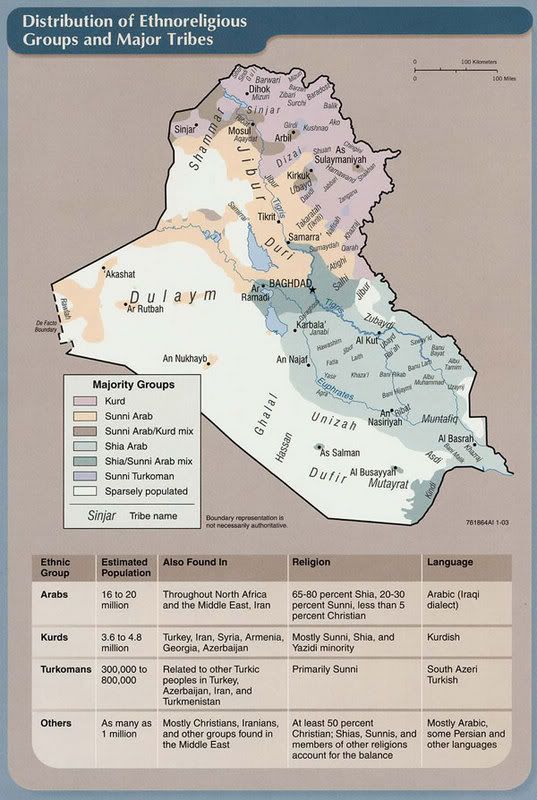
The topic is that segregating the people of Iraq, seperating them, will bring peace to the region. There are many regions that both Shia and Sunnie see as there own. Who do we move? And HOW? Move the lesser numbers? Might work.
Or we could look at Palistine. They got moved 60 years ago, did that work? Is that finished? Do I need to expand on this? Pretty common knowledge.
People don't want to move from their homes, do you think it's still viable? Or is a second Palistine acceptable?
1 Socratic question(my first btw): Do you think that if the majority Shia get the Promised Land, Basra, oil, the rest of the Iraqi's will just be fine and well with that?
The topic of this debate was "Dividing Iraq into several independent nations would likely improve the peace and stability there". I believe I
have clearly shown this to be a viable solution. So, let's review the final summary.
Response to Question
If you simply hand it to them without concern of the rest of the population, then no. However, my proposal on how it is possible would allow this very thing to happen. You have to take all of the people involved into the equation, not just one division. That is the fault that got Iraq into this mess in the first place.
I am not sure why my opponent feels the need to belittle the importance of rules. They are in place for a reason, and should be respected by both parties to create a balanced playing field.
The Founding of Iraq
It may have been intentional, or purely accidental, but the original creation of Iraq was founded on mistakes. The British, French, and Russians used a malformed cookie cutter to carve out a country from the Ottoman Empire. In doing so, they created a region strife with violence and political turmoil. My opponent's own timeline of events in the area shows minimal violence during the Ottoman rule because the people were left alone.
If care was taken to take into account the personal differences of the people, the violence that took place afterwards would have been prevented. Now, we are in a situation were we can rectify the mistake made in history, and finally bring peace and stability to the region.
Bosnia is the Perfect Example
Ambassador Richard Holbrooke was a great diplomatic - perhaps one of the greatest in history. What he did was a work of genius. By dividing a country along its ethnic and religious factions, giving them full autonomy, can have great results.
This shows that such a division is not only possible, but it is extremely viable. Even something as simple as building a wall between neibhorhoods has cut down violence in the area.
People want to lead themselves. Give them that opportunity, and stability will follow. Impose another's rule, and violence will continue. The examples put forth by my opponent have been retracted or inaccurate. Comparing apples to oranges will not prove a point.
History shows the Bosnia example to be true. Why would Iraq be any different?
Economic Viability
The region of Iraq has great potentional wealth. This has been proven historically. My opponent has even supplied the references. It has never been a contention of argument. However, an agreement with all three potentional nations could easily resolve this issue. Three autonomous regions could live in without the violence and political strife that has plagued them for so long. As such, splitting the natural resources of Iraq into three could very well work.
None of the evidence my opponent has put forth contradicts this possibility.
Relocation Problems
My opponent has stated that people don't want to move from their homes. However, he is forgetting that due to the violence all over the country, this has already happened in several, if not most, areas.
People want to feel safe. Safety is part of turning a house into a home. Houses can be built. Homes have to be made through ensuring security to the family living inside it.
The issue of Palestine should be the subject of another debate. The list of problems plaguing that country are just as extensive as Iraq's.
The Proposal
Divide the nation into three autonomous countries under a unified republic. Each country should be allowed to run things the way they wish.
* Central Iraq (Sunni)
* Southern Iraq (Shi'ite)
* Kurdistan (Kurd)
The leadership would meet at a central location to discuss national policy and international relation issues.
* Bagdad (Autonomous)
To balance the assets of the nation as a whole, we run into a snag, but it is not unfixable. Kurdistan has oil fields to the north. Southern Iraq has oil fields to the south. However, there are no oil fields in Central Iraq. This can be resolved by giving 20% of oil proceeds to Central Iraq by a mutual agreement of the other two. This percentage would be revised yearly, if needed, based on the population percentage of the Sunni when compared to the other two.
My opponent has put forth nothing to indicate this wouldn't work to quell violence, and "likely improve the peace and stability there".
Conclusion
People want to lead themselves. Give them that opportunity... all of them... and peace follows. The evidence clearly shows that not only is this viable, it has a strong chance to work.
Response to Question
Do you think that if the majority Shia get the Promised Land, Basra, oil, the rest of the Iraqi's will just be fine and well with that?
If you simply hand it to them without concern of the rest of the population, then no. However, my proposal on how it is possible would allow this very thing to happen. You have to take all of the people involved into the equation, not just one division. That is the fault that got Iraq into this mess in the first place.
I am not sure why my opponent feels the need to belittle the importance of rules. They are in place for a reason, and should be respected by both parties to create a balanced playing field.
The Founding of Iraq
It may have been intentional, or purely accidental, but the original creation of Iraq was founded on mistakes. The British, French, and Russians used a malformed cookie cutter to carve out a country from the Ottoman Empire. In doing so, they created a region strife with violence and political turmoil. My opponent's own timeline of events in the area shows minimal violence during the Ottoman rule because the people were left alone.
If care was taken to take into account the personal differences of the people, the violence that took place afterwards would have been prevented. Now, we are in a situation were we can rectify the mistake made in history, and finally bring peace and stability to the region.
Bosnia is the Perfect Example
Ambassador Richard Holbrooke was a great diplomatic - perhaps one of the greatest in history. What he did was a work of genius. By dividing a country along its ethnic and religious factions, giving them full autonomy, can have great results.
From Sunday Forum: Split up Iraq three ways
This unusual arrangement was greeted with skepticism in the mid-'90s (mostly because nobody understood exactly what an "entity" was, or how it differed from a "state" or a "province") but it has worked surprisingly well. Even though the country as a whole is still led by an international governor (its sixth since the end of the war), the violence has stopped -- maybe permanently.
This shows that such a division is not only possible, but it is extremely viable. Even something as simple as building a wall between neibhorhoods has cut down violence in the area.
People want to lead themselves. Give them that opportunity, and stability will follow. Impose another's rule, and violence will continue. The examples put forth by my opponent have been retracted or inaccurate. Comparing apples to oranges will not prove a point.
History shows the Bosnia example to be true. Why would Iraq be any different?
Economic Viability
The region of Iraq has great potentional wealth. This has been proven historically. My opponent has even supplied the references. It has never been a contention of argument. However, an agreement with all three potentional nations could easily resolve this issue. Three autonomous regions could live in without the violence and political strife that has plagued them for so long. As such, splitting the natural resources of Iraq into three could very well work.
None of the evidence my opponent has put forth contradicts this possibility.
Relocation Problems
My opponent has stated that people don't want to move from their homes. However, he is forgetting that due to the violence all over the country, this has already happened in several, if not most, areas.
From WHO opens conference in Syria on Iraqi refugee health needs
Some 750,000 Iraqis have also fled to Jordan and 200,000 to both Egypt and Lebanon, driven out of Iraq by the turmoil that followed the U.S.-led invasion in 2003 that toppled Saddam Hussein.
People want to feel safe. Safety is part of turning a house into a home. Houses can be built. Homes have to be made through ensuring security to the family living inside it.
The issue of Palestine should be the subject of another debate. The list of problems plaguing that country are just as extensive as Iraq's.
The Proposal
Divide the nation into three autonomous countries under a unified republic. Each country should be allowed to run things the way they wish.
* Central Iraq (Sunni)
* Southern Iraq (Shi'ite)
* Kurdistan (Kurd)
The leadership would meet at a central location to discuss national policy and international relation issues.
* Bagdad (Autonomous)
To balance the assets of the nation as a whole, we run into a snag, but it is not unfixable. Kurdistan has oil fields to the north. Southern Iraq has oil fields to the south. However, there are no oil fields in Central Iraq. This can be resolved by giving 20% of oil proceeds to Central Iraq by a mutual agreement of the other two. This percentage would be revised yearly, if needed, based on the population percentage of the Sunni when compared to the other two.
My opponent has put forth nothing to indicate this wouldn't work to quell violence, and "likely improve the peace and stability there".
Conclusion
People want to lead themselves. Give them that opportunity... all of them... and peace follows. The evidence clearly shows that not only is this viable, it has a strong chance to work.
"Dividing Iraq into several independent nations would likely improve the peace and stability there"
Conclusion
Iraq is a mess and we are responsible for it. We want desperately to find a way to fix this. The question remains, HOW? Seperation and segregation is what is being proposed in this debate. Are we that desperate to thinking that something of this nature would work when it hasn't in the past? Is this a straw we want to grasp.
Noting the historic violence that is inherent to this area, we note that getting anything done with these groups is not an easy endeavor. They have been at each other for millenia. Mistrust is common currency. Let's look at these groups in closing.
I have shown, with valid sources, that a Kurdistan government will not be tolerated by Turkey. The violence would INCREASE, not decrease if this state was allowed to come into being.
Remember, "... likely improve the peace and stability there."
Shia Iran may also be an outside influence but that is merely speculation at this point.
Let us look at the internal factors. My opponent puts forth:
My opponent is showing us rosy pictures while ignoring that this area is FAR from stable. From THIS YEAR:
www.iht.com...
This is not the first example of violence in that region that I have referenced in this debate. "Why would Iraq be any different?" Indeed!
That is very short sighted. Yes many have fled the violence. Would it not be reasonable to say that those that stayed did so because those homes are theirs and they don't want to leave? How would they react to a forcable move? I believe that the Palestine comparison is VERY apt. And my opponent states, "The list of problems plaguing that country are just as extensive as Iraq's." Exactly!
The economics of Iraq are also a massive obstacle. Where 90% of the nations wealth is clustered in a small area in the south, how do you divide this up? My opponent proposes:
So basically he want to put the Shi'ites in a position of power, making the other states "welfare" states. It also puts them in a position to levy sanctions if these states do not do as the Shi'ites wish. Think Palestine again. At the economic whim of another state. How's the peace and stability working there? What reaction would come from such sanctions? Bow to Shi'te rule, even though seperated and become slave or fight. Which option is likely to happen? History tells us that answer and it isn't the "peaceful" one.
Do I have answers to how to create a stable Iraq? Of course not, wish I did. I do know and have shown though that dividing Iraq into segregated states will NOT "... improve peace and stability there"
Thank you.
Conclusion
Iraq is a mess and we are responsible for it. We want desperately to find a way to fix this. The question remains, HOW? Seperation and segregation is what is being proposed in this debate. Are we that desperate to thinking that something of this nature would work when it hasn't in the past? Is this a straw we want to grasp.
Noting the historic violence that is inherent to this area, we note that getting anything done with these groups is not an easy endeavor. They have been at each other for millenia. Mistrust is common currency. Let's look at these groups in closing.
I have shown, with valid sources, that a Kurdistan government will not be tolerated by Turkey. The violence would INCREASE, not decrease if this state was allowed to come into being.
Remember, "... likely improve the peace and stability there."
Shia Iran may also be an outside influence but that is merely speculation at this point.
Let us look at the internal factors. My opponent puts forth:
History shows the Bosnia example to be true. Why would Iraq be any different?
My opponent is showing us rosy pictures while ignoring that this area is FAR from stable. From THIS YEAR:
BANJA LUKA, Bosnia and Herzegovina: The police fired tear gas at Bosnian Serb rioters Tuesday to prevent them from storming the U.S. Consulate during a rally to protest Kosovo's declaration of independence.
www.iht.com...
This is not the first example of violence in that region that I have referenced in this debate. "Why would Iraq be any different?" Indeed!
My opponent has stated that people don't want to move from their homes. However, he is forgetting that due to the violence all over the country, this has already happened in several, if not most, areas.
From WHO opens conference in Syria on Iraqi refugee health needs
Some 750,000 Iraqis have also fled to Jordan and 200,000 to both Egypt and Lebanon, driven out of Iraq by the turmoil that followed the U.S.-led invasion in 2003 that toppled Saddam Hussein.
People want to feel safe. Safety is part of turning a house into a home. Houses can be built. Homes have to be made through ensuring security to the family living inside it.
The issue of Palestine should be the subject of another debate. The list of problems plaguing that country are just as extensive as Iraq's.
That is very short sighted. Yes many have fled the violence. Would it not be reasonable to say that those that stayed did so because those homes are theirs and they don't want to leave? How would they react to a forcable move? I believe that the Palestine comparison is VERY apt. And my opponent states, "The list of problems plaguing that country are just as extensive as Iraq's." Exactly!
The economics of Iraq are also a massive obstacle. Where 90% of the nations wealth is clustered in a small area in the south, how do you divide this up? My opponent proposes:
* Central Iraq (Sunni)
* Southern Iraq (Shi'ite)
* Kurdistan (Kurd)
*snip*
To balance the assets of the nation as a whole, we run into a snag, but it is not unfixable. Kurdistan has oil fields to the north. Southern Iraq has oil fields to the south. However, there are no oil fields in Central Iraq. This can be resolved by giving 20% of oil proceeds to Central Iraq by a mutual agreement of the other two. This percentage would be revised yearly, if needed, based on the population percentage of the Sunni when compared to the other two.
So basically he want to put the Shi'ites in a position of power, making the other states "welfare" states. It also puts them in a position to levy sanctions if these states do not do as the Shi'ites wish. Think Palestine again. At the economic whim of another state. How's the peace and stability working there? What reaction would come from such sanctions? Bow to Shi'te rule, even though seperated and become slave or fight. Which option is likely to happen? History tells us that answer and it isn't the "peaceful" one.
Do I have answers to how to create a stable Iraq? Of course not, wish I did. I do know and have shown though that dividing Iraq into segregated states will NOT "... improve peace and stability there"
Thank you.
The winner is Intrepid, and he will advance to the final round.
Early on it looked like TLomon might pull this one off, especially when Intrepid took the risky gambit of all but skipping his opening to see if he could leave TLomon without a sense of direction.
When Intrepid showed up though things started to change. Intrepid scored big points with the Palestine analogy, he successfully defeated the suggestion that Turkey posed no threat to Kurdistan, and the Yugoslavia argument did stay relevant, though it was contested.
TLomon sort of made a superman out of Holbrooke, lawyered with the rules too much (never a good thing to call somebody on the rules and be wrong), and above all walked straight into the Palestine argument by suggesting economic dependence and a neutral historic capital city.
Ultimately the biggest missing ingredient in the debate was a model of 3 functioning, stable states in place of Iraq. That could have tipped the balance, but there was never really a complete vision of what could be, so I came out pretty sure that peace and stability were unattainable while the division persists.
new topics
-
President BIDEN's FBI Raided Donald Trump's Florida Home for OBAMA-NORTH KOREA Documents.
Political Conspiracies: 41 minutes ago -
Maestro Benedetto
Literature: 2 hours ago -
Is AI Better Than the Hollywood Elite?
Movies: 2 hours ago -
Las Vegas UFO Spotting Teen Traumatized by Demon Creature in Backyard
Aliens and UFOs: 5 hours ago -
2024 Pigeon Forge Rod Run - On the Strip (Video made for you)
Automotive Discussion: 6 hours ago -
Gaza Terrorists Attack US Humanitarian Pier During Construction
Middle East Issues: 7 hours ago -
The functionality of boldening and italics is clunky and no post char limit warning?
ATS Freshman's Forum: 8 hours ago -
Meadows, Giuliani Among 11 Indicted in Arizona in Latest 2020 Election Subversion Case
Mainstream News: 8 hours ago -
Massachusetts Drag Queen Leads Young Kids in Free Palestine Chant
Social Issues and Civil Unrest: 9 hours ago -
Weinstein's conviction overturned
Mainstream News: 10 hours ago
top topics
-
Krystalnacht on today's most elite Universities?
Social Issues and Civil Unrest: 12 hours ago, 9 flags -
University of Texas Instantly Shuts Down Anti Israel Protests
Education and Media: 14 hours ago, 8 flags -
Supreme Court Oral Arguments 4.25.2024 - Are PRESIDENTS IMMUNE From Later Being Prosecuted.
Above Politics: 11 hours ago, 8 flags -
Gaza Terrorists Attack US Humanitarian Pier During Construction
Middle East Issues: 7 hours ago, 7 flags -
Weinstein's conviction overturned
Mainstream News: 10 hours ago, 7 flags -
Massachusetts Drag Queen Leads Young Kids in Free Palestine Chant
Social Issues and Civil Unrest: 9 hours ago, 6 flags -
President BIDEN's FBI Raided Donald Trump's Florida Home for OBAMA-NORTH KOREA Documents.
Political Conspiracies: 41 minutes ago, 5 flags -
Meadows, Giuliani Among 11 Indicted in Arizona in Latest 2020 Election Subversion Case
Mainstream News: 8 hours ago, 5 flags -
Las Vegas UFO Spotting Teen Traumatized by Demon Creature in Backyard
Aliens and UFOs: 5 hours ago, 4 flags -
Chris Christie Wishes Death Upon Trump and Ramaswamy
Politicians & People: 12 hours ago, 2 flags
active topics
-
University of Texas Instantly Shuts Down Anti Israel Protests
Education and Media • 238 • : Xtrozero -
Is AI Better Than the Hollywood Elite?
Movies • 5 • : 5thHead -
New whistleblower Jason Sands speaks on Twitter Spaces last night.
Aliens and UFOs • 62 • : pianopraze -
Alternate Electors vs Fake Electors - What is the Difference.
2024 Elections • 115 • : WeMustCare -
Sunak spinning the sickness figures
Other Current Events • 24 • : NoCorruptionAllowed -
Nearly 70% Of Americans Want Talks To End War In Ukraine
Political Issues • 95 • : Irishhaf -
Meadows, Giuliani Among 11 Indicted in Arizona in Latest 2020 Election Subversion Case
Mainstream News • 14 • : WeMustCare -
HORRIBLE !! Russian Soldier Drinking Own Urine To Survive In Battle
World War Three • 44 • : theshadowknows -
President BIDEN's FBI Raided Donald Trump's Florida Home for OBAMA-NORTH KOREA Documents.
Political Conspiracies • 0 • : WeMustCare -
God's Righteousness is Greater than Our Wrath
Religion, Faith, And Theology • 31 • : glend
2