It looks like you're using an Ad Blocker.
Please white-list or disable AboveTopSecret.com in your ad-blocking tool.
Thank you.
Some features of ATS will be disabled while you continue to use an ad-blocker.

Our Constitution Has Been SUSPENDED...oh, has it now?
page: 4share:
reply to post by donwhite
Executive Order 11110, June 4, 1963.
Wikipedia explains:
Estimated to be $4.3-5 billion
[edit on 2/24/0808 by jackinthebox]
JFK did not “issue silver certificates.”
Executive Order 11110, June 4, 1963.
Wikipedia explains:
The Order was for the Treasury to issue silver certificates against all silver held by the government which did not already have certificates against it.
Estimated to be $4.3-5 billion
[edit on 2/24/0808 by jackinthebox]
reply to post by jackinthebox
Highlights are mine as are my comments in brackets or CAPS.
[edit on 2/25/2008 by donwhite]
Executive Order 11110 was issued by President John F. Kennedy on June 4, 1963.
This executive order allowed the U.S. Secretary of the Treasury to issue silver certificates against silver bullion based on authority delegated by the President to the Secretary under the Thomas Amendment to the Agricultural Adjustment Act.
The Order was for the Treasury to issue silver certificates against all silver held by the government which did not already have certificates against it.
[THIS IS KNOWN AS A HOUSEKEEPING ORDER. It has nothing to do with JFK “fighting” the Federal Reserve System.]
The Order was needed due to the passage of Public Law 88-36 which repealed the Silver Purchase Act and other related monetary measures. One result was that after the repeals, only the President could issue new silver certificates. The Federal Reserve System could replace the certificates, but only in larger denominations. The thrust of the Order returned the authority to issue new silver certificates (and specify denominations) back to the U.S. Treasury. This allowed for the Federal Reserve System to distribute and exchange currency at lower denominations that met the growing economic need. The authoritative basis for the Order was nullified in 1982 with the passage of Public Law 97-258.
The Order was never directly reversed. However, Section 1(j) of Executive Order 10289, which was added by Section 1(a) of Executive Order 11110, was revoked when Ronald Reagan signed Executive Order 12608 in 1987. FINI en.wikipedia.org...
Highlights are mine as are my comments in brackets or CAPS.
[edit on 2/25/2008 by donwhite]
reply to post by donwhite
It is your opinion that this was a "housekeeping" order. The fact remains that over $4billion was slated to be injected into the economy, without going through the Fed. The day after the asassination, the "United States Notes" were called out of circulation. LBJ went on to make many reforms regarding silver, and devaluing our coinage.
Another important fact to point out, is the wording printed on paper currency.
In 1913 for example, currency exhibited the phrase,"United States of America, __ Dollars in Gold Coin," and here's the real important part, "Payable to the Bearer on Demand".
When the Federal Reserve begain issuing "notes" in 1914, the wording changed to, "Secured By United States Certificates Of Indebtedness Or One-Year Gold Notes, Deposited With The Treasurer Of The United States Of America." Technically, one might argue that such paper currency was not Constitutional, since it was not directly redeemable in gold or silver. However, it still bore the phrase, "Will Pay the Bearer on Demand." So from this, it seems you could redeem this paper money, for a certificate that was redeemable in gold. You can see the double-speak behind the trickery of the Federal Reserve Bank. But let us just agree that the note was still legal, since it still had value in gold.
In 1934, the phrase on Federal Reserve Notes was changed to, "This Note Is Legal Tender For All Debts Public And Private And Is Redeemable In Lawful Money At The United States Treasury Or At Any Federal Reserve Bank". Okay, well since gold and silver is the only "lawful money" under the Constitution, the currency still appears to be legal.
Twenty days before the asassination of President John F. Kennedy, the Federal Reserve Bank began issuing notes bearing the new phrase, "This Note Is Legal Tender For All Debts Public And Private", which we are all now so familiar with today. The fact is however, that this "legal tender" is NOT lawful money under the Constitution. It is not redeemable for anything!
I hope this expands your understanding of money.
It is your opinion that this was a "housekeeping" order. The fact remains that over $4billion was slated to be injected into the economy, without going through the Fed. The day after the asassination, the "United States Notes" were called out of circulation. LBJ went on to make many reforms regarding silver, and devaluing our coinage.
Another important fact to point out, is the wording printed on paper currency.
In 1913 for example, currency exhibited the phrase,"United States of America, __ Dollars in Gold Coin," and here's the real important part, "Payable to the Bearer on Demand".
When the Federal Reserve begain issuing "notes" in 1914, the wording changed to, "Secured By United States Certificates Of Indebtedness Or One-Year Gold Notes, Deposited With The Treasurer Of The United States Of America." Technically, one might argue that such paper currency was not Constitutional, since it was not directly redeemable in gold or silver. However, it still bore the phrase, "Will Pay the Bearer on Demand." So from this, it seems you could redeem this paper money, for a certificate that was redeemable in gold. You can see the double-speak behind the trickery of the Federal Reserve Bank. But let us just agree that the note was still legal, since it still had value in gold.
In 1934, the phrase on Federal Reserve Notes was changed to, "This Note Is Legal Tender For All Debts Public And Private And Is Redeemable In Lawful Money At The United States Treasury Or At Any Federal Reserve Bank". Okay, well since gold and silver is the only "lawful money" under the Constitution, the currency still appears to be legal.
Twenty days before the asassination of President John F. Kennedy, the Federal Reserve Bank began issuing notes bearing the new phrase, "This Note Is Legal Tender For All Debts Public And Private", which we are all now so familiar with today. The fact is however, that this "legal tender" is NOT lawful money under the Constitution. It is not redeemable for anything!
I hope this expands your understanding of money.
reply to post by jackinthebox
Jack....its a lost battle already. We are fighting over it and therefore we have already been defeated. NO ONE will understand what is said on this thread as truth because this entire nation has bee indoctrinated to blindly accept what is put in front of them.
ARGUMENTS SHOULD END NOW:
Here is the secret to having any sort of standing in a global economy.....A NATIONAL BANK, A NATIONAL CURRENCY REGULATED BY THAT BANK which in turn is OWNED and OPERATED by the GOVERNEMTN which in turn is OWNED and OPPERATED BY THE PEOPLE.
Guess what? WE HAVE NEITHER!!!!! NO more discussion necessary....we have no national sovereignty because our banks are run by an international central banking system and not by a US banking system.
Forget all that you have been taught in economics class because they do not teach you about true and unabridged freedom on a GLOBAL scale.
The people of this country are in debt to banks just like the governemtn of this country is in debt to a CENTRAL BANKING CARTEL. Profit margins rule supreme and logic, reason, freedom and love are thrown to the curb.
WAKE UP EVERYONE!! We can have a working economy in a global setting but only if our soveriegnty is intact not if our banks are not owned and operated by US.
Jack....its a lost battle already. We are fighting over it and therefore we have already been defeated. NO ONE will understand what is said on this thread as truth because this entire nation has bee indoctrinated to blindly accept what is put in front of them.
ARGUMENTS SHOULD END NOW:
Here is the secret to having any sort of standing in a global economy.....A NATIONAL BANK, A NATIONAL CURRENCY REGULATED BY THAT BANK which in turn is OWNED and OPERATED by the GOVERNEMTN which in turn is OWNED and OPPERATED BY THE PEOPLE.
Guess what? WE HAVE NEITHER!!!!! NO more discussion necessary....we have no national sovereignty because our banks are run by an international central banking system and not by a US banking system.
Forget all that you have been taught in economics class because they do not teach you about true and unabridged freedom on a GLOBAL scale.
The people of this country are in debt to banks just like the governemtn of this country is in debt to a CENTRAL BANKING CARTEL. Profit margins rule supreme and logic, reason, freedom and love are thrown to the curb.
WAKE UP EVERYONE!! We can have a working economy in a global setting but only if our soveriegnty is intact not if our banks are not owned and operated by US.
But tell me...what is so hard to grasp about this national soveriegnty issue? Does anyone understand that labor is directly attached to life and
unconditional freedom through economic wealth? The system has been set up this way in order to make it easily controllable. Couple that with the fact
that when you have entire countries in debt using their own people's sweat and blood as both payment for this debt and stimulus for infrastructure
you have a breeding ground for total control. Whoever controls the way money is made and its flux IS who is in CONTROL OVERALL. Its not about
governments or politics....its about money. How this ties into the overall galactic game is simple.....this system is killing human nature and
manipulates the weaknesses of the human condition for the benefit of the elites. Whether they be alien or purely human, the elites still exist. Lets
stop fighting among each other. Your economics classes are nothing more than indocrinization. NOTHING MORE!!!! dont beleive the hype......man o man,
no one is going to understand this jack. People have to unite and stop dividing themselves. ITS THE ONLY WAY TO SAVE EVERYONE!!!! You know what i
mean?
Ever wonder also why banks are so inherent in our system? Ever ask yourself why we need banks? Or wHY we are reliant upon banks? ITS AN ILLUSION OF
LEGITIMACY that is so strong and programmed into our own consciousness that it becomes real. Just remember that its all just a ride and isnt real. WE
make it real....by fighting, by killing, by separating ourselves from each other, by affiliating ourselves with restrictive political ideals.....its
in our hands to make a difference.
Its not about taking our country back by force because it is already ours collectively. This understanding doesnt mean we should practice nationalism soley....conversely the infered agenda should be the betterment of the ENTIRE HUMAN RACE in order to ensure and perpetuate its continual life and evolution AS A WHOLE. The only way to do this is to be separate but one.....these spiritual ideals tie into our physical realities but we were all told that this way of thinking is only good for "tree huggers" or "pinko commi etc..." What the hell do those words mean anyway? "IM A HUMAN BEING GODDAMMIT AND MY LIFE HAS VALUE!!!"
I dont need governments, religions, or money to validate my existence. That is the lie perpetuated among the human race for thousands and thousands of years.
We are all in the same damn boat and we better start acting like it because if iwas an alien i wouldnt think twice about snuffing out a race that didnt care enough about its own existence to stop fighting among themselves. According to me (as a an alien), we got it wrong. We totally got it wrong and are throwing all sorts of bad karma into the spiritual realm.....HA!!! No wonder this place has been the object of so many intergalactic wars and colonizing. WE ARE THE CENTER OF THE UNIVERSE SO LETS START ACTING LIKE WE CARE!!
Its not about taking our country back by force because it is already ours collectively. This understanding doesnt mean we should practice nationalism soley....conversely the infered agenda should be the betterment of the ENTIRE HUMAN RACE in order to ensure and perpetuate its continual life and evolution AS A WHOLE. The only way to do this is to be separate but one.....these spiritual ideals tie into our physical realities but we were all told that this way of thinking is only good for "tree huggers" or "pinko commi etc..." What the hell do those words mean anyway? "IM A HUMAN BEING GODDAMMIT AND MY LIFE HAS VALUE!!!"
I dont need governments, religions, or money to validate my existence. That is the lie perpetuated among the human race for thousands and thousands of years.
We are all in the same damn boat and we better start acting like it because if iwas an alien i wouldnt think twice about snuffing out a race that didnt care enough about its own existence to stop fighting among themselves. According to me (as a an alien), we got it wrong. We totally got it wrong and are throwing all sorts of bad karma into the spiritual realm.....HA!!! No wonder this place has been the object of so many intergalactic wars and colonizing. WE ARE THE CENTER OF THE UNIVERSE SO LETS START ACTING LIKE WE CARE!!
reply to post by jackinthebox
Yes. It does. But where are you trying to go with this argument? Just as I wrote earlier that the Courts (quite properly) ignore arguments based on the NON sighing of the Ohio state documents of 1803, so also I would too. So what? I'd ask. Even if Ohio was not a state until 1970, what am I or any one to do? Abolish government? Hang myself?
I mean, it makes no difference. it's an historical oddity. Same here arguing over money. We have one kind of money now although before we had many types. Now that gold is touching the $1000 an ounce price, I'm sure a lot of people would like to buy some for $35. If silver is pushing $15, then a genuine silver dollar is worth a lot more melted down, provided you don't get caught melting it down. That can cost you a 5 years "vacation" at Leavenworth at Govt expense.
It's good to learn about our past. Any learning is good. But what can you do with the Federal Reserve argument? Surely no one is saying Alan Greenspan was the 2nd shooter on the grassy knoll? If ink costs money, then the current "This Note Is Legal Tender For All Debts Public And Private" is the shortest and most direct statement of all before it, and therefore, the cheapest to print. That's got to be an advantage.
Seigniorage. The legal profit a government makes between actual cost to print or mint money versus the face value of the money. Like a dollar bill costs 5 cents to make. The government gains 95 cents each time it puts a new bill into circulation. The Mint made $730 million last year on seigniorage.
Under the new rules, it is illegal to melt pennies and nickels. It is also illegal to export the coins for melting. Travelers may legally carry up to $5 in 1- and 5-cent coins out of the USA or ship $100 of the coins abroad "for legitimate coinage and numismatic purposes."
Violators could spend up to five years in prison and pay as much as $10,000 in fines. Plus, the government will confiscate any coins or metal used in melting schemes.
www.usatoday.com...
[edit on 2/25/2008 by donwhite]
It is your opinion that this [XO11110] was a "housekeeping" order . . . . . I hope this expands your understanding of money.
Yes. It does. But where are you trying to go with this argument? Just as I wrote earlier that the Courts (quite properly) ignore arguments based on the NON sighing of the Ohio state documents of 1803, so also I would too. So what? I'd ask. Even if Ohio was not a state until 1970, what am I or any one to do? Abolish government? Hang myself?
I mean, it makes no difference. it's an historical oddity. Same here arguing over money. We have one kind of money now although before we had many types. Now that gold is touching the $1000 an ounce price, I'm sure a lot of people would like to buy some for $35. If silver is pushing $15, then a genuine silver dollar is worth a lot more melted down, provided you don't get caught melting it down. That can cost you a 5 years "vacation" at Leavenworth at Govt expense.
It's good to learn about our past. Any learning is good. But what can you do with the Federal Reserve argument? Surely no one is saying Alan Greenspan was the 2nd shooter on the grassy knoll? If ink costs money, then the current "This Note Is Legal Tender For All Debts Public And Private" is the shortest and most direct statement of all before it, and therefore, the cheapest to print. That's got to be an advantage.
Seigniorage. The legal profit a government makes between actual cost to print or mint money versus the face value of the money. Like a dollar bill costs 5 cents to make. The government gains 95 cents each time it puts a new bill into circulation. The Mint made $730 million last year on seigniorage.
Under the new rules, it is illegal to melt pennies and nickels. It is also illegal to export the coins for melting. Travelers may legally carry up to $5 in 1- and 5-cent coins out of the USA or ship $100 of the coins abroad "for legitimate coinage and numismatic purposes."
Violators could spend up to five years in prison and pay as much as $10,000 in fines. Plus, the government will confiscate any coins or metal used in melting schemes.
www.usatoday.com...
[edit on 2/25/2008 by donwhite]
reply to post by donwhite
I dont think you even understand the purpose of money....if you think you are a free man, stop paying your rent and see what happens. When we realize that we do not own our lives inthis system we realize what exactly is going on. Stop being a slave to economic thought.....debt is killing this world and this country directly.
I dont think you even understand the purpose of money....if you think you are a free man, stop paying your rent and see what happens. When we realize that we do not own our lives inthis system we realize what exactly is going on. Stop being a slave to economic thought.....debt is killing this world and this country directly.
reply to post by donwhite
Are you arguing that the suspension of the US Constitution makes "no difference" that is is merely "an historical oddity"?
How about "redeemable in gold"? If you are arguing that they changed the wording to save ink, then I won't even bother discussing this with you anymore.
The Federal Reserve Bank is not the government! The Fed is a private entity.
Your source states...
Show me.
[edit on 2/25/0808 by jackinthebox]
I mean, it makes no difference. it's an historical oddity
Are you arguing that the suspension of the US Constitution makes "no difference" that is is merely "an historical oddity"?
"This Note Is Legal Tender For All Debts Public And Private" is the shortest and most direct statement of all before it, and therefore, the cheapest to print. That's got to be an advantage.
How about "redeemable in gold"? If you are arguing that they changed the wording to save ink, then I won't even bother discussing this with you anymore.
The legal profit a government makes between actual cost to print or mint money versus the face value of the money. Like a dollar bill costs 5 cents to make. The government gains 95 cents each time it puts a new bill into circulation.
The Federal Reserve Bank is not the government! The Fed is a private entity.
Your source states...
...reappropriation by governments of the right of seigniorage now possessed by private banks. About 95% of new money currently issued takes the form of loans made by private banks to their customers.
The Mint made $730 million last year on seigniorage.
Show me.
[edit on 2/25/0808 by jackinthebox]
reply to post by GUICE2
Well, not paying rent (or the mortgage payment) will get you into homeless status. We are born naked and we will be naked when we are put to rest. The only 2 times in our lives when all men are equal. In between birthing and dying we have to fend for ourselves. Free? Freedom? What's that? A theoretical concept? What's it got to do with my next meal? Or my sleeping provisions for tonight? I think we are being disingenuously tangential or oblique to a fault.
f you think you are a free man, stop paying your rent and see what happens. When we realize that we do not own our lives in this system we realize what exactly is going on. Stop being a slave to economic thought ..... debt is killing this world and this country directly.
Well, not paying rent (or the mortgage payment) will get you into homeless status. We are born naked and we will be naked when we are put to rest. The only 2 times in our lives when all men are equal. In between birthing and dying we have to fend for ourselves. Free? Freedom? What's that? A theoretical concept? What's it got to do with my next meal? Or my sleeping provisions for tonight? I think we are being disingenuously tangential or oblique to a fault.
Originally posted by TheWalkingFox
He was appointed actually as a political compromise, and his party engineered events for him to take power. He ran for office twice and was soundly beaten both times - Hitler was never elected.
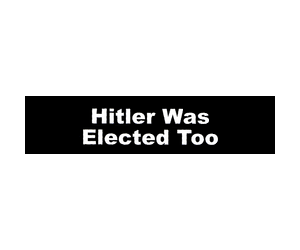
Wow, for some reason, this sounds so very familiar. I really can not quite put My finger on it. Why oh why is this like a sense of deja vu?
~note the sarcasm with cynicism~
History always repeats itself, it's just the details that change. That sure seems like a franchise of a restaurant but with the name of the actual food company and the manager changing but the building stay right there.
Anyone still care to argue that the U.S. Constitution is a valid force of law in the nation today? The OP set out to disprove claims made elsewhere
that the U.S. Constitution has been suspended. I have seen no evidence presented that would lead me to believe that Johnny Utah is accurate in his
opinion.
reply to post by donwhite
There is no argument my friend only your acceptance. You have inherently accepted these facts which are different than those that i have accepted as truth. I AM FREE and part of that freedom includes the understanding of human nature and its condition. Do we need to eat? Of course we do and that is where the discussion ends for that. As far as WHERE your next meal will come from i cannot say, but only in this twisted world where you have to labor for PAPER to exchange for food. In a world of peace.....food is there for everyone to consume because it is obviously understood as more than just a basic human need but a staple to the entirety of humanity. So no more arguments about those issues in a society of peace because people arent concerned with GAINING profit from the weaknesses of others. I do not accept the way it is now but am forced to survive in and around cities and people who do.....but i am a free man because i was born free and still CHOOSE to be free. YOu are too my friend you just have to claim it back even if it is purely a mindset because of our physical surroundings and corrupt environments. Wake up people.....we are still being controlled in every way, even our thought processes. How sick is this world when a man knows that he is not free but does not stand up and fight for it? What is it with this cold comfort everyone is into? It makes me sick....
There is no argument my friend only your acceptance. You have inherently accepted these facts which are different than those that i have accepted as truth. I AM FREE and part of that freedom includes the understanding of human nature and its condition. Do we need to eat? Of course we do and that is where the discussion ends for that. As far as WHERE your next meal will come from i cannot say, but only in this twisted world where you have to labor for PAPER to exchange for food. In a world of peace.....food is there for everyone to consume because it is obviously understood as more than just a basic human need but a staple to the entirety of humanity. So no more arguments about those issues in a society of peace because people arent concerned with GAINING profit from the weaknesses of others. I do not accept the way it is now but am forced to survive in and around cities and people who do.....but i am a free man because i was born free and still CHOOSE to be free. YOu are too my friend you just have to claim it back even if it is purely a mindset because of our physical surroundings and corrupt environments. Wake up people.....we are still being controlled in every way, even our thought processes. How sick is this world when a man knows that he is not free but does not stand up and fight for it? What is it with this cold comfort everyone is into? It makes me sick....
reply to post by jackinthebox
Jack this is a secret that many people have taken to the grave. First of all, we have to assume that the entirety of the supreme court justices understand this fact but STILL practice their responsibilities as judicial reviewers. This has always seemed odd to me but perhaps these lies come into play when a petition such as "the people V the United States" comes along. Maybe they can still practice some sort of checks and balances but not when it comes to true freedom of a monetary system and national bank because that would unravel a huge candy bar of CRAP!
HAhahaha I love metaphors.
Jack this is a secret that many people have taken to the grave. First of all, we have to assume that the entirety of the supreme court justices understand this fact but STILL practice their responsibilities as judicial reviewers. This has always seemed odd to me but perhaps these lies come into play when a petition such as "the people V the United States" comes along. Maybe they can still practice some sort of checks and balances but not when it comes to true freedom of a monetary system and national bank because that would unravel a huge candy bar of CRAP!
HAhahaha I love metaphors.
reply to post by GUICE2
There is nothing wrong with having a dream. But to deny reality is not really a dream as much as it is a nighmare.
To be truly free means no one has anything you want. Only then are your truly free.
The rest of us make bargains.
That to secure these rights, Governments are instituted among Men, deriving their just powers from the consent of the governed . . to institute new Government, laying its foundation on such principles and organizing its powers in such form, as to them shall seem most likely to effect their Safety and Happiness . . that as Free and Independent States, they have full Power to levy War, conclude Peace, contract Alliances, establish Commerce, and to do all other Acts and Things which Independent States may of right do. From The United States Declaration of Independence.
[edit on 2/26/2008 by donwhite]
How sick is this world when a man knows that he is not free but does not stand up and fight for it? What is it with this cold comfort everyone is into?
There is nothing wrong with having a dream. But to deny reality is not really a dream as much as it is a nighmare.
To be truly free means no one has anything you want. Only then are your truly free.
The rest of us make bargains.
That to secure these rights, Governments are instituted among Men, deriving their just powers from the consent of the governed . . to institute new Government, laying its foundation on such principles and organizing its powers in such form, as to them shall seem most likely to effect their Safety and Happiness . . that as Free and Independent States, they have full Power to levy War, conclude Peace, contract Alliances, establish Commerce, and to do all other Acts and Things which Independent States may of right do. From The United States Declaration of Independence.
[edit on 2/26/2008 by donwhite]
reply to post by donwhite
Im not denying reality....i am dealing with a distorted and manipulated version of what should be reality by the elites and bankers of this world.
I understand the social contracts between governments and their people.....ours has been violated so many times that we should have had countless rebellions against the accepted authoritarian truths put before us. Maybe they did happen but all who participated were snuffed out and arrested. Seattle riots sound familiar? Or any demonstration that only ends in disruption and arrests? I am a free man because i was born free into the human race.....no man can take my freedom away. I dont see it as bargaining, i see it as life. If someone needs food and i have it to share then it goes beyond saying that it is my duty to do so. I am free to choose and therefore i am free to live. Our governments shoud embody these ideals for us and protect them.....all they do is protect the agendas of corporate conglomerates so that their profits will inflate. There still is taxation without true representation. So what do the people of a country do when they realize this? Answer that......
Im not denying reality....i am dealing with a distorted and manipulated version of what should be reality by the elites and bankers of this world.
I understand the social contracts between governments and their people.....ours has been violated so many times that we should have had countless rebellions against the accepted authoritarian truths put before us. Maybe they did happen but all who participated were snuffed out and arrested. Seattle riots sound familiar? Or any demonstration that only ends in disruption and arrests? I am a free man because i was born free into the human race.....no man can take my freedom away. I dont see it as bargaining, i see it as life. If someone needs food and i have it to share then it goes beyond saying that it is my duty to do so. I am free to choose and therefore i am free to live. Our governments shoud embody these ideals for us and protect them.....all they do is protect the agendas of corporate conglomerates so that their profits will inflate. There still is taxation without true representation. So what do the people of a country do when they realize this? Answer that......
reply to post by donwhite
You forget one thing when considering governments....we forget how important the coinage of currency is to the sovereignty of a nation.
Labor=money=life.....it is because of this equation that national banks run BY THE GOVERNMENT which is run BY PEOPLE FOR THE PEOPLE are very important to FREEDOM in a global socioeconomic environment. Its not just about having these social contracts because those are governed by both natural common law and the laws of human nature. The problem is that those in charge either dont understand any of those terms or they do understand them and are manipulating their weaknesses for profit. Obviously the latter is correct....i mean just look around you.
You are right....its dangerous to disregard reality. Its even more dangerous to wake up and realize you are in a foreign land where you are being controlled by a silent, hidden force.....and then do nothing about it.
You forget one thing when considering governments....we forget how important the coinage of currency is to the sovereignty of a nation.
Labor=money=life.....it is because of this equation that national banks run BY THE GOVERNMENT which is run BY PEOPLE FOR THE PEOPLE are very important to FREEDOM in a global socioeconomic environment. Its not just about having these social contracts because those are governed by both natural common law and the laws of human nature. The problem is that those in charge either dont understand any of those terms or they do understand them and are manipulating their weaknesses for profit. Obviously the latter is correct....i mean just look around you.
You are right....its dangerous to disregard reality. Its even more dangerous to wake up and realize you are in a foreign land where you are being controlled by a silent, hidden force.....and then do nothing about it.
reply to post by GUICE2
I do not understand the necessity of this singular interest in money. It is very unlikely anyone will be complete unto himself, so “trade” with others is necessary and inextricable way of life. Money is so convenient. Holding gold is a bummer. Although it never deteriorates it never earns interest either. And gold is rather heavy - the heaviest element I believe - so it is hard to transport. And gold in bulk cannot be used for buying or selling without an assay, costly and time consuming.
Globalization is like a great ship with a broken rudder. By slowing first the port screws then the starboard screws we can influence the direction of the ship. But it takes a very long time to alter the course very much.
Utopia. An imaginative human condition. From the Greek, meaning “no place.” There were a number of utopian communities in the US in the 19th century. It started after the Second Great Awakening, 1800-1830. I’m from Kentucky and we still have one, Shaker Village, at Pleasant Hill, Ky. Located near Harrodsburg, about 30 miles from Lexington, Ky. It was abandoned at the end of War 2 - Shakers were celibate - but it is now a restored state historical site and open to the public.
Last Utopia. Israel’s kibbutz. The failure of the Kibbutz movement in Israel has been the final nail in the coffin [of utopianism]. This had been the one twentieth century utopian experiment given sanction by "serious" social science. The Kibbutzniks themselves were fond of joking that more books had been written about the Kibbutz (by anthropologists, sociologists, psychologists and educators) than there were Kibbutzniks.
This is no longer the case. Out of 270 Kibbutzim only about 20 are still prospering. The rest are hanging on by their fingernails and are economic and social basket cases. Indeed, the Kibbutz Movement has only survived the last decade because of a 6 billion-Shekel bailout by the government. www.wfs.org...
[edit on 2/26/2008 by donwhite]
You forget one thing when considering governments .... we forget how important the coinage of currency is to the sovereignty of a nation. Labor=money=life ..... it is because of this equation that national banks run BY THE GOVERNMENT which is run BY PEOPLE FOR THE PEOPLE are very important to FREEDOM in a global socioeconomic environment.
I do not understand the necessity of this singular interest in money. It is very unlikely anyone will be complete unto himself, so “trade” with others is necessary and inextricable way of life. Money is so convenient. Holding gold is a bummer. Although it never deteriorates it never earns interest either. And gold is rather heavy - the heaviest element I believe - so it is hard to transport. And gold in bulk cannot be used for buying or selling without an assay, costly and time consuming.
Globalization is like a great ship with a broken rudder. By slowing first the port screws then the starboard screws we can influence the direction of the ship. But it takes a very long time to alter the course very much.
Utopia. An imaginative human condition. From the Greek, meaning “no place.” There were a number of utopian communities in the US in the 19th century. It started after the Second Great Awakening, 1800-1830. I’m from Kentucky and we still have one, Shaker Village, at Pleasant Hill, Ky. Located near Harrodsburg, about 30 miles from Lexington, Ky. It was abandoned at the end of War 2 - Shakers were celibate - but it is now a restored state historical site and open to the public.
Last Utopia. Israel’s kibbutz. The failure of the Kibbutz movement in Israel has been the final nail in the coffin [of utopianism]. This had been the one twentieth century utopian experiment given sanction by "serious" social science. The Kibbutzniks themselves were fond of joking that more books had been written about the Kibbutz (by anthropologists, sociologists, psychologists and educators) than there were Kibbutzniks.
This is no longer the case. Out of 270 Kibbutzim only about 20 are still prospering. The rest are hanging on by their fingernails and are economic and social basket cases. Indeed, the Kibbutz Movement has only survived the last decade because of a 6 billion-Shekel bailout by the government. www.wfs.org...
[edit on 2/26/2008 by donwhite]
reply to post by donwhite
Why have money at all? Why not understand that it is a tool that is not needed anymore? We have to start thinking and living for other things now dont we? Trade? What trade? If the global agenda is the evolution and wellbeing of the human race then why worry about who has more and gaining wealth. True wealth and success has nothing to do with money and power......the ideals need to change and the muse for society and infrastructure will follow suit. People still need motivation to build infrastructure but it isnt money anymore, its the illusion of a great dream called freedom which is directly contingent upon how many credits you have in the bank. Money=life in our society....and the banks control money. I dont know if i can find simpler terms to convey this message until people finally get that we should stop killing each other over it.
It served its purpose....now leave me be and let me work to help others build infrastructure around them and not soley to earn paper. I need food because i am human and trade wouldnt be necessary if the corporate conglomerates of the world would allow TECHNOLOGY to be used for good.
Every american family can have a hydroponic fresh vegetable garden intheir homes if state and local governments had the determinatin
Why have money at all? Why not understand that it is a tool that is not needed anymore? We have to start thinking and living for other things now dont we? Trade? What trade? If the global agenda is the evolution and wellbeing of the human race then why worry about who has more and gaining wealth. True wealth and success has nothing to do with money and power......the ideals need to change and the muse for society and infrastructure will follow suit. People still need motivation to build infrastructure but it isnt money anymore, its the illusion of a great dream called freedom which is directly contingent upon how many credits you have in the bank. Money=life in our society....and the banks control money. I dont know if i can find simpler terms to convey this message until people finally get that we should stop killing each other over it.
It served its purpose....now leave me be and let me work to help others build infrastructure around them and not soley to earn paper. I need food because i am human and trade wouldnt be necessary if the corporate conglomerates of the world would allow TECHNOLOGY to be used for good.
Every american family can have a hydroponic fresh vegetable garden intheir homes if state and local governments had the determinatin
DonWhite Quote:
The constitution Page 2 article 8 I believe if I remember right says government and government only is to issue money. Hmmmm
Its also says in that same article that only the government can raise and army and security force. Have you heard of a company called Black Water?
The patriot act do you understand what is in the patriot act? Im not going to get in the nitty gritty details but lets just say your right to privacy is thrown out the door.
Ill join you and giving a big baaa baaa cause we are all just sheep.
That to secure these rights, Governments are instituted among Men, deriving their just powers from the consent of the governed . . to institute new Government, laying its foundation on such principles and organizing its powers in such form, as to them shall seem most likely to effect their Safety and Happiness . . that as Free and Independent States, they have full Power to levy War, conclude Peace, contract Alliances, establish Commerce, and to do all other Acts and Things which Independent States may of right do. From The United States Declaration of Independence.
The constitution Page 2 article 8 I believe if I remember right says government and government only is to issue money. Hmmmm
Its also says in that same article that only the government can raise and army and security force. Have you heard of a company called Black Water?
The patriot act do you understand what is in the patriot act? Im not going to get in the nitty gritty details but lets just say your right to privacy is thrown out the door.
Ill join you and giving a big baaa baaa cause we are all just sheep.
new topics
-
Where should Trump hold his next rally
2024 Elections: 1 hours ago -
Shocking Number of Voters are Open to Committing Election Fraud
US Political Madness: 2 hours ago -
Gov Kristi Noem Shot and Killed "Less Than Worthless Dog" and a 'Smelly Goat
2024 Elections: 3 hours ago -
Falkville Robot-Man
Aliens and UFOs: 3 hours ago -
James O’Keefe: I have evidence that exposes the CIA, and it’s on camera.
Whistle Blowers and Leaked Documents: 4 hours ago -
Australian PM says the quiet part out loud - "free speech is a threat to democratic dicourse"...?!
New World Order: 5 hours ago -
Ireland VS Globalists
Social Issues and Civil Unrest: 5 hours ago -
Biden "Happy To Debate Trump"
2024 Elections: 6 hours ago -
RAAF airbase in Roswell, New Mexico is on fire
Aliens and UFOs: 6 hours ago -
What is the white pill?
Philosophy and Metaphysics: 7 hours ago
top topics
-
A Warning to America: 25 Ways the US is Being Destroyed
New World Order: 15 hours ago, 21 flags -
James O’Keefe: I have evidence that exposes the CIA, and it’s on camera.
Whistle Blowers and Leaked Documents: 4 hours ago, 11 flags -
Blast from the past: ATS Review Podcast, 2006: With All Three Amigos
Member PODcasts: 8 hours ago, 11 flags -
Australian PM says the quiet part out loud - "free speech is a threat to democratic dicourse"...?!
New World Order: 5 hours ago, 10 flags -
Biden "Happy To Debate Trump"
2024 Elections: 6 hours ago, 10 flags -
Mike Pinder The Moody Blues R.I.P.
Music: 8 hours ago, 8 flags -
Ireland VS Globalists
Social Issues and Civil Unrest: 5 hours ago, 5 flags -
RAAF airbase in Roswell, New Mexico is on fire
Aliens and UFOs: 6 hours ago, 5 flags -
What is the white pill?
Philosophy and Metaphysics: 7 hours ago, 5 flags -
Putin, Russia and the Great Architects of the Universe
ATS Skunk Works: 11 hours ago, 4 flags
active topics
-
2024 Pigeon Forge Rod Run - On the Strip (Video made for you)
Automotive Discussion • 8 • : WhitewaterSquirrel -
Gov Kristi Noem Shot and Killed "Less Than Worthless Dog" and a 'Smelly Goat
2024 Elections • 28 • : cherokeetroy -
Shocking Number of Voters are Open to Committing Election Fraud
US Political Madness • 5 • : AwakeNotWoke -
President BIDEN's FBI Raided Donald Trump's Florida Home for OBAMA-NORTH KOREA Documents.
Political Conspiracies • 34 • : AwakeNotWoke -
The Acronym Game .. Pt.3
General Chit Chat • 7756 • : bally001 -
RAAF airbase in Roswell, New Mexico is on fire
Aliens and UFOs • 8 • : Skinnerbot -
Putin, Russia and the Great Architects of the Universe
ATS Skunk Works • 27 • : KnowItAllKnowNothin -
Falkville Robot-Man
Aliens and UFOs • 5 • : Ophiuchus1 -
Biden "Happy To Debate Trump"
2024 Elections • 42 • : JadedGhost -
Gold and silver prices....woo hoo
History • 86 • : lilzazz