It looks like you're using an Ad Blocker.
Please white-list or disable AboveTopSecret.com in your ad-blocking tool.
Thank you.
Some features of ATS will be disabled while you continue to use an ad-blocker.

skull on mars
page: 10
share:

I just thought this looked awfully odd, im sure its been posted befor, i tried to do a search but got sql errors
[edit on 4-12-2006 by VoXiSo]
I think its a fake because our mind is designed to reconigze faces in everything.
Originally posted by tomcat ha
I think its a fake because our mind is designed to reconigze faces in everything.
Is that a fact?
Our minds know what is real and what is not. We know what is a libing organism and what is not.
Creativity is all that what makes people see faces in objects.
Originally posted by tomcat ha
I think its a fake because our mind is designed to reconigze faces in everything.
Our minds are most certainly not 'designed' to recognize faces in 'everything' but those minds that did manage to make out the shape of a predator ' in the grass' were more likely to survive than those who could not... I don't know who spread the idea that we are predisposed to seeing human faces in rocks and clouds but i can guess at their motives....
Stellar
I think this picture in particular is just incredible. I know that we tend to see things in all the rocks on Mars but this one is really clear-cut and
doesn't require any interpretive thinking like some of the posts that point out "writing" or "martian machine parts".
very creepy pic indeed....let's do a roadtrip to MARS...who's in?
One could actually start to think that the entire surface of Mars might be littered with skulls, bones, machine parts, glass tunnels and, hey, even
pyramids.
The picture does look like a skull....sort of. But it can also appear to be a wind worn rock formation that just happens to look like a skull. In our eagerness to actually find life and or traces of life on Mars, we are apt to see whatever it is we want to see. In this case, we have a rock that looks like a skull. I once found a potato in my garden that sort of looked like a bulldog. Maybe I subconsciously needed to see a dog and so I did. I ate the potato anyway.
The picture does look like a skull....sort of. But it can also appear to be a wind worn rock formation that just happens to look like a skull. In our eagerness to actually find life and or traces of life on Mars, we are apt to see whatever it is we want to see. In this case, we have a rock that looks like a skull. I once found a potato in my garden that sort of looked like a bulldog. Maybe I subconsciously needed to see a dog and so I did. I ate the potato anyway.
Originally posted by TheRanchMan
Originally posted by tomcat ha
I think its a fake because our mind is designed to reconigze faces in everything.
Is that a fact?
Yes it is a fact. We have a region of our brain that deals with facial recognition. I'm not going to argue whether it was designed or not. But this article talks about how recent findings suggest it is more of a learned trait, rather than innate. Either way, there is a part of our brain that responds to shapes/angles/light/shadows/whatever that may indicate a face is present in the visual field. Recognizing and interpretating facial responses is obviously a very important aspect of social interaction.
ScienceDaily: Brain Article
Our minds know what is real and what is not. We know what is a libing organism and what is not.
Creativity is all that what makes people see faces in objects.
Our mind DECIDES what is real and what is not. When your dreaming the most illogical things can seem normal because your brain determines the structure or parameters of it's reality. When we're awake our brain interprets light waves and pressurized waves of air to create a 'reality' that our conscious can navigate. Your brain's never seen light or heard a sound, it's all electrical signals by the time it gets there. Our brain is quite willing to fill in gaps, like when you only see a hand sticking out of a wall but know that an entire person is standing there. The brain's guessing and assuming greatly increases it's information processing but can sometimes lead you to sense something that's not entirely true. If I could even objectively use the word true or truth in this sense, it's all just perspective anyways.
Your creativity statement is somewhat true. The creative function of the brain can draw associations between objects that may not normally be connected. The personification of the inanimate or even a simple metaphor. Our creativity allows for imperfections and oddities to become beautiful and unique visions. The brain becomes creative enough to accept that while that rock may not exactly look like a face, it shouldn't eliminate it as a possiblity. A computer would have trouble matching an imperfect copy of it's predefined face or drawing the line at the point where something looks too odd to be a face. But our mind allows us to float in the space between what may exist and what doesn't. Is it a skull? Is it a rock? We'll probably never know but it doesn't hurt to think it could.
Okay, previous explorations on mars have not even been able to confirm the lowest level of life on Mars. Not even single celled bacteria... or any
other signs of previous life for the matter... How in God's name is there just going to be skull lying in the middle of no where there?
Either a.) FAKE or b.) a rock that is eerily shaped like a skull.
[edit on 4-12-2006 by k4rupt]
Either a.) FAKE or b.) a rock that is eerily shaped like a skull.
[edit on 4-12-2006 by k4rupt]
Looks more like one of those Roman helmuts to me! I was going to write a thread pointing out all these 'rocks' and 'buildings' that are on the
moon and Mars, but are now all rubble. Its amazing what people can see if they believe hard enough!
Here is a link to one of the originals from the Spirit Rover website.
marsrovers.jpl.nasa.gov...
It's close to the foreground..must be pretty small.
marsrovers.jpl.nasa.gov...
It's close to the foreground..must be pretty small.
Hey George Lucas left a stormtrooper helmet behind when he made the Tatooine scenes for Star Wars. They were made more realistic by filming them on
Mars.
I wonder if this coincides with the announcement about mars that NASA is going to give tomorrow? Very interesting developments.
www.nasa.gov...
Sorry, I forgot to post a link to the thing I was talking about in the last post - excuse me for that.
Sorry, I forgot to post a link to the thing I was talking about in the last post - excuse me for that.
Originally posted by uplander
I wonder if this coincides with the announcement about mars that NASA is going to give tomorrow? Very interesting developments.
I think they are going to announce that they found water on Mars. I have found images from Spirit and Opportunity that shows bugs. Here is the best image I have found so far of a bug:
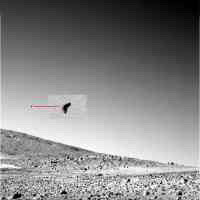
Here is a closeup:
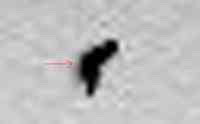
The original image can be found here
Originally posted by Stari
Originally posted by uplander
I wonder if this coincides with the announcement about mars that NASA is going to give tomorrow? Very interesting developments.
I think they are going to announce that they found water on Mars. I have found images from Spirit and Opportunity that shows bugs. Here is the best image I have found so far of a bug:
Here is a closeup:
The original image can be found here
Never seen that, could it bee something on the lense?
Originally posted by Parabol
Yes it is a fact. We have a region of our brain that deals with facial recognition. I'm not going to argue whether it was designed or not.
Wise choice imo.
But this article talks about how recent findings suggest it is more of a learned trait, rather than innate. Either way, there is a part of our brain that responds to shapes/angles/light/shadows/whatever that may indicate a face is present in the visual field. Recognizing and interpreting facial responses is obviously a very important aspect of social interaction.
ScienceDaily: Brain Article
Agreed and there is every advantage to being able to spot the relatively familiar forms( predators, game) against a complex background so it would be surprising not to find such areas/processes somewhere in the human brain.
Our mind DECIDES what is real and what is not. When your dreaming the most illogical things can seem normal because your brain determines the structure or parameters of it's reality. When we're awake our brain interprets light waves and pressurized waves of air to create a 'reality' that our conscious can navigate.
As the editing happens in the subconscious mind, and thus even before the awareness that is the conscious mind, one has to very careful as without conscious deliberate effort you will not enabling your own involvement in hat editing process.
Your brain's never seen light or heard a sound, it's all electrical signals by the time it gets there. Our brain is quite willing to fill in gaps, like when you only see a hand sticking out of a wall but know that an entire person is standing there. The brain's guessing and assuming greatly increases it's information processing but can sometimes lead you to sense something that's not entirely true.
Agreed but the alternatives seems rather problematic in my opinion
If I could even objectively use the word true or truth in this sense, it's all just perspective anyways.
I think that there is a objective reality and that it is in fact independent of perception ( not seeing or acknowledging cars on a road wont prevent you suffering very real consequences) however far astray perception can lead you from that objective truth.
Your creativity statement is somewhat true. The creative function of the brain can draw associations between objects that may not normally be connected. The personification of the inanimate or even a simple metaphor. Our creativity allows for imperfections and oddities to become beautiful and unique visions.
Agreed but all that can be crushed by a conscious effort, as is the science establishment standard, when it runs into observations that contradict current norms. A person who is not open minded ( undecided) might very well subconsciously edit certain conscious possibilities or conclusions out of consideration before there was ever any true evaluation as the subconscious is not only powerful but completely self serving; it's comparable to script and you were not the programmer... Our perception of reality can go as far astray as the environment allows and if the environment or social system is set up to reward certain perceptions over others , however unrealistic or patently false, there is IMO no telling how far away from reality the consensus can be pushed...
The brain becomes creative enough to accept that while that rock may not exactly look like a face, it shouldn't eliminate it as a possiblity.
Well it's unlikely to spot it in the first place as there is no movement; something normally associated with 'faces'. If a person regularly sees faces in rock formations in their back yard they should probably see someone about it...
A computer would have trouble matching an imperfect copy of it's predefined face or drawing the line at the point where something looks too odd to be a face.
I would say this depends mostly on the how restrictive the original parameters where but that a computer can normally identify forms with far greater certainty based on a good data base or specifications.
But our mind allows us to float in the space between what may exist and what doesn't. Is it a skull? Is it a rock? We'll probably never know but it doesn't hurt to think it could.
I would have to slightly disagree and say that some minds allow that as those are the minds that have been allowed to consider such contradictory information without a result or conclusion being immediately required. I would go as far as to say that true genius may have much to do with how large a volume of sometimes contradictory information or observation a mind/brain can store without a conclusion or decision as to what must be true and what must be discarded as false...
Anyways! I enjoyed reading and thinking about your post and while my general agreement may not seem obvious i do agree and hope that my contributions is seen and accepted as such!
Stellar
[edit on 11-12-2006 by StellarX]
new topics
-
BIDEN Admin Begins Planning For January 2025 Transition to a New President - Today is 4.26.2024.
2024 Elections: 3 hours ago -
Big Storms
Fragile Earth: 4 hours ago -
Where should Trump hold his next rally
2024 Elections: 7 hours ago -
Shocking Number of Voters are Open to Committing Election Fraud
US Political Madness: 8 hours ago -
Gov Kristi Noem Shot and Killed "Less Than Worthless Dog" and a 'Smelly Goat
2024 Elections: 8 hours ago -
Falkville Robot-Man
Aliens and UFOs: 9 hours ago -
James O’Keefe: I have evidence that exposes the CIA, and it’s on camera.
Whistle Blowers and Leaked Documents: 9 hours ago -
Australian PM says the quiet part out loud - "free speech is a threat to democratic dicourse"...?!
New World Order: 10 hours ago -
Ireland VS Globalists
Social Issues and Civil Unrest: 11 hours ago -
Biden "Happy To Debate Trump"
2024 Elections: 11 hours ago
top topics
-
James O’Keefe: I have evidence that exposes the CIA, and it’s on camera.
Whistle Blowers and Leaked Documents: 9 hours ago, 17 flags -
Australian PM says the quiet part out loud - "free speech is a threat to democratic dicourse"...?!
New World Order: 10 hours ago, 15 flags -
Blast from the past: ATS Review Podcast, 2006: With All Three Amigos
Member PODcasts: 13 hours ago, 13 flags -
Biden "Happy To Debate Trump"
2024 Elections: 11 hours ago, 13 flags -
Ireland VS Globalists
Social Issues and Civil Unrest: 11 hours ago, 9 flags -
Mike Pinder The Moody Blues R.I.P.
Music: 14 hours ago, 8 flags -
BIDEN Admin Begins Planning For January 2025 Transition to a New President - Today is 4.26.2024.
2024 Elections: 3 hours ago, 7 flags -
What is the white pill?
Philosophy and Metaphysics: 13 hours ago, 6 flags -
Shocking Number of Voters are Open to Committing Election Fraud
US Political Madness: 8 hours ago, 6 flags -
Big Storms
Fragile Earth: 4 hours ago, 6 flags
active topics
-
Australian PM says the quiet part out loud - "free speech is a threat to democratic dicourse"...?!
New World Order • 7 • : 19Bones79 -
It takes One to Be; Two to Tango; Three to Create.
Philosophy and Metaphysics • 8 • : Compendium -
Big Storms
Fragile Earth • 16 • : rickymouse -
James O’Keefe: I have evidence that exposes the CIA, and it’s on camera.
Whistle Blowers and Leaked Documents • 14 • : 19Bones79 -
BIDEN Admin Begins Planning For January 2025 Transition to a New President - Today is 4.26.2024.
2024 Elections • 18 • : rickymouse -
RAAF airbase in Roswell, New Mexico is on fire
Aliens and UFOs • 12 • : pianopraze -
A Warning to America: 25 Ways the US is Being Destroyed
New World Order • 29 • : 19Bones79 -
What is the white pill?
Philosophy and Metaphysics • 22 • : AlexandrosOMegas -
University of Texas Instantly Shuts Down Anti Israel Protests
Education and Media • 315 • : CriticalStinker -
Gov Kristi Noem Shot and Killed "Less Than Worthless Dog" and a 'Smelly Goat
2024 Elections • 58 • : cherokeetroy
0