It looks like you're using an Ad Blocker.
Please white-list or disable AboveTopSecret.com in your ad-blocking tool.
Thank you.
Some features of ATS will be disabled while you continue to use an ad-blocker.

tectonics - it's time we remove this nonsense from our schools
page: 7share:
Do you realize that tectonics does not host a single physical principle that we can find in a physics book? [Not one] There are no mathematical formulations!
The earth's mantle in the numerical model is treated as an irrotational, infinite Prandtl number, anelastic Newtonian fluid within a spherical shell with isothermal, undeformable, traction-free boundaries. Under these conditions the following equations describe the local fluid behavior:
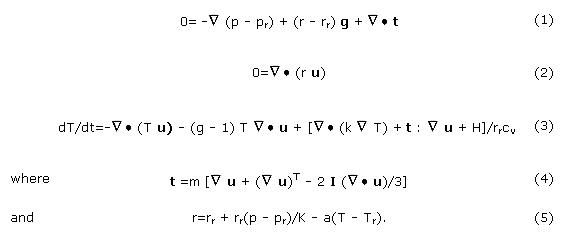
Here p denotes pressure, r density, g gravitational acceleration, t deviatoric stress, u fluid velocity, T absolute temperature, g the Grueneisen parameter, k thermal conductivity, H volume heat production rate, cv specific heat at constant volume, m dynamic shear viscosity, K the isothermal bulk modulus, and a the volume coefficient of thermal expansion. The quantities pr, rr, and Tr are, respectively, the radially varying pressure, density, and temperature of the reference state used for the mantle. I is the identity tensor. The superscript T in (4) denotes the tensor transpose. Equation (1) expresses the conservation of momentum in the infinite Prandtl number limit. In this limit, the deformational term is so large that the inertial terms (as well as the rotational terms) may be completely ignored. The resulting equation (1) then represents the balance among forces arising from pressure gradients, buoyancy, and deformation. Equation (2) expresses the conservation of mass under the anelastic approximation. The anelastic approximation ignores the partial derivative of density with respect to time in the dynamics and thereby eliminates fast local density oscillations. It allows the computational time step to be dictated by the much slower deformational dynamics. Equation (3) expresses the conservation of energy in terms of absolute temperature. It includes effects of transport of heat by the flowing material, compressional heating and expansion cooling, thermal conduction, shear or deformational heating, and local volume (e.g., radiogenic) heating.
The expression for the deviatoric stress given by equation (4) assumes a viscosity m that is dependent on the radial temperature and pressure distribution but independent of the strain rate. The stress therefore is linear with respect to velocity and represents the customary description for the deformation of a Newtonian fluid. This rheological law applies to the type of deformation in solids known as diffusion creep that is believed to occur in the mantle under conditions of extremely small strain rate. Equation (5) represents density variations as linearly proportional to pressure and temperature variations relative to a reference state. The compressible reference state is chosen to match observational data for the earth to a high degree of precision. It includes the density jumps associated with mineralogical phase changes. In the numerical model the set of equations (1)-(5) is solved for each grid point in the computational domain during each time step.
The Morse equation of state [2], derived from an atomic potential model of a crystalline lattice, is employed for the density dependence and given as follows:
p1(r)=[3Ko/(Ko' - 1)] (r/ro)2/3 E (E - 1)
E=exp[ (Ko' - 1) [1 - (r/ro)-1/3] ]
Here ro is the uncompressed zero-temperature density, Ko is the uncompressed zero-temperature isothermal bulk modulus, and Ko' is the derivative of Ko with respect to pressure. These three material parameters specify the pressure-density relationship for a given mineral assemblage. By choosing appropriate values for the upper mantle, the transition zone between 410 and 660 km depth, and the lower mantle, one can match the density profile given by the seismic models quite closely.
Depth variation in the dynamic shear viscosity is modeled using a temperature and pressure dependent relationship of the form
m=mo exp[ -(E* + prV*)/RTr]
www.uga.edu...
www.geodynamics.org:8080...
epswww.unm.edu...
www.coc.ufrj.br...
www.michaelmandeville.com...
www.itis-molinari.mi.it...
I suggest you do your homework :x
Do you realize that tectonics does not host a single physical principle that we can find in a physics book? [Not one] There are no mathematical formulations!
Would something called 'Earthquakes and tectonics' be considered relevant?
I don't know anything about it like I said and I did use Google admit, but I found this straight away.. There's a bunch of formulae and stuff in there and it all looks complicated like what I remember of physics so I think it might be based on physical principles...
www.eri.u-tokyo.ac.jp...
Just to add briefly to QuietSoul's excellent post -- some of you might have noticed the Prandtl Number mentioned. I suspect most of us aren't
familiar with this (well, I wasn't!) and so I looked it up.
This is the "number" that you get when you divide the "shear stress" value of a viscous substance (lava is viscous) by a number produced by dividing the material's heat conductivity by its volumetric heat capacity.
en.wikipedia.org...
This isn't magic or imagination, but it IS rocket science -- or, at least geoscience and engineering. This tells us what happens to things when we have a crust that's relatively cool and a liquid/semiliquid/viscous substance below it that is being moved and shifted by heat and pressure -- what goes on at the boundary layer between the less solid region and the more solid region.
You see it used in some eyeball bending physics and material science papers like this one:
prola.aps.org...
This is the "number" that you get when you divide the "shear stress" value of a viscous substance (lava is viscous) by a number produced by dividing the material's heat conductivity by its volumetric heat capacity.
en.wikipedia.org...
This isn't magic or imagination, but it IS rocket science -- or, at least geoscience and engineering. This tells us what happens to things when we have a crust that's relatively cool and a liquid/semiliquid/viscous substance below it that is being moved and shifted by heat and pressure -- what goes on at the boundary layer between the less solid region and the more solid region.
You see it used in some eyeball bending physics and material science papers like this one:
prola.aps.org...
I find it a little hard to believe that I just watched people I know to be well educated take on a nonsensical poster and his totally rubbish theory.
It's your time to waste and you can certainly use it as you will, but surely you had to know you were in fact wasting your time trying to reason with
him. It's people like him that caused Scientific American to give ATS'ers such a bad rap.
Originally posted by Astronomer70
I find it a little hard to believe that I just watched people I know to be well educated take on a nonsensical poster and his totally rubbish theory. It's your time to waste and you can certainly use it as you will, but surely you had to know you were in fact wasting your time trying to reason with him. It's people like him that caused Scientific American to give ATS'ers such a bad rap.
Hehe, I've been glancing at this post topic for awhile now, and I never really cared to look into to. Today I was bored and decided to see what this guy had to provide and was bamboozled by the first sentence.
Figured I'd throw a bomb in here and end this rubbish
Deny Ignorance and all the jazz.
[edit on 4/28/2006 by QuietSoul]
Originally posted by Astronomer70
I find it a little hard to believe that I just watched people I know to be well educated take on a nonsensical poster and his totally rubbish theory.
Hey man, we've gotta keep the fangs sharp somehow!

Originally posted by whaaa
Im not sure about this but I think beforebc has a biblical
fundamental ax to grind here.
Do we need to protect our children from science or merely just
change public education into a more fundy friendly curriculum?
Instead of becoming defensive as soon as somebody challenges one of your core beliefs how about hearing out what he says... something like deny ignorance? Being judgemental makes you a fundy doesn't it?
IN regards the topic at hand I fully agree with the premise being floated here for several reasons one of which is that WE DON"T know what is at the centre of the earth do we?
Originally posted by denythestatusquo
Originally posted by whaaa
Im not sure about this but I think beforebc has a biblical
fundamental ax to grind here.
Do we need to protect our children from science or merely just
change public education into a more fundy friendly curriculum?
Instead of becoming defensive as soon as somebody challenges one of your core beliefs
Who in the world has a core beleif about the imperceptible movement of plates, the boundaries of which a human normally never even sees, being driven by stuff deeper than any hole any person has ever dug??
Being judgemental makes you a fundy doesn't it?
?
A fundamentalists accepts an idea because they beleive in it. We've all got to make judgements about these sorts of things.
IN regards the topic at hand I fully agree with the premise being floated here for several reasons one of which is that WE DON"T know what is at the centre of the earth do we?
That has nothing to do with it. He was saying that, in effect, if you take a toy boat, and put it in a pot of boiling water, it won't move.
Does a person need to be negative to realize that that's bunk? Would it make a difference if we didn't know if it was water or some other liquid that was boiling?
Nygdan:
"Your sense of sight is nothing more than a remote sensing technique that involves interpolation."
Yes, and that is science as we know it and how we studied it.
"Until someone can come up with an alternative explanation for the observations, then they're the best theories that we have. ...."
Theories, until proven being real, it is what it is, so why discard other teories?
This is not about choosing which team i belong, but to verify the data provided by both sides.
"The same way we can tell that earth is tectonically active, by observing it. There are no plates of crust on the moon. There isn't any crustal movement on mars, etc."
Do we consider tectonically active, something moving in a time frame(could be generations or millions of years) pre-defined by us? Yes we do, and if it is out of our time frame?
"I fail to understand your explanation. The mantle is convecting. The crust is a thin layer on top of it. The crust moves because of this. "
Sorry about this answer, discard it, i was thinking in other thing at that time, i will give you the right answer now:
- "The "convection" comes from what is observed when liquids are heated from beneath. The heated liquid expands a little, becoming slightly less dense than the cooler liquid and thus tends to rise, to float to the surface. Cool liquid rushes in to fill the space that had been occupied by the heated liquid."
- Indeed, decades of research has yet to find any direct, unambiguous evidence of
mantle convection. Is the idea of mantle convection simply a contrivance to make plate tectonics seem to work?
crustas
"Your sense of sight is nothing more than a remote sensing technique that involves interpolation."
Yes, and that is science as we know it and how we studied it.
"Until someone can come up with an alternative explanation for the observations, then they're the best theories that we have. ...."
Theories, until proven being real, it is what it is, so why discard other teories?
This is not about choosing which team i belong, but to verify the data provided by both sides.
"The same way we can tell that earth is tectonically active, by observing it. There are no plates of crust on the moon. There isn't any crustal movement on mars, etc."
Do we consider tectonically active, something moving in a time frame(could be generations or millions of years) pre-defined by us? Yes we do, and if it is out of our time frame?
Because they are thinner(presuming, sea crust), the transfer of heat to water is much bigger than in bigger crust(continental) and therefore the convection cells loose strenght..
"I fail to understand your explanation. The mantle is convecting. The crust is a thin layer on top of it. The crust moves because of this. "
Sorry about this answer, discard it, i was thinking in other thing at that time, i will give you the right answer now:
- "The "convection" comes from what is observed when liquids are heated from beneath. The heated liquid expands a little, becoming slightly less dense than the cooler liquid and thus tends to rise, to float to the surface. Cool liquid rushes in to fill the space that had been occupied by the heated liquid."
- Indeed, decades of research has yet to find any direct, unambiguous evidence of
mantle convection. Is the idea of mantle convection simply a contrivance to make plate tectonics seem to work?
crustas
Originally posted by crustas
Theories, until proven being real, it is what it is, so why discard other teories?
Theories aren't ever "proven real" though. A theory is nothing more than an hypothesis that hasn't been refuted and is widely accepted. No scientific theories have ever been proven. We allways have to distinguish between theories, iow, reject some of them, accept others.
A good way to do that, short of a theory being refuted, is to look at how well the theory explains the observations: how many observations it explains, how simply it explains them, etc.
The Rotational Bending hypothesis, pretending for a moment that it actually makes sense at all, doesn't do a very good job of explaining the data that we do have, certainly not as good of a job as Plate Tectonics; it leaves a heck of a lot of stuff unexplained. Thus, we should, rationally, reject it.
Yes we do, and if it is out of our time frame?
Then its not tectonically active. The moon is not tectonically active, its not seperated into a crust composed of plates that are moving. Mars also isn't currently set up as mobile tectonic plates. Therefore, its not tectonically active.
Indeed, decades of research has yet to find any direct, unambiguous evidence of mantle convection
I suspect that most people wouldn't accept anything other than slicing the earth open like and apple and watching convection at work as "unambiguous" evidence of convection.
All interpretations can be argued, about anything. That doesn't mean that there isn't any thing actually out in the world.
For me this discussion is over. Still, one word, DIG.
Crustas
Crustas
new topics
-
President BIDEN's FBI Raided Donald Trump's Florida Home for OBAMA-NORTH KOREA Documents.
Political Conspiracies: 3 hours ago -
Maestro Benedetto
Literature: 4 hours ago -
Is AI Better Than the Hollywood Elite?
Movies: 4 hours ago -
Las Vegas UFO Spotting Teen Traumatized by Demon Creature in Backyard
Aliens and UFOs: 8 hours ago -
2024 Pigeon Forge Rod Run - On the Strip (Video made for you)
Automotive Discussion: 9 hours ago -
Gaza Terrorists Attack US Humanitarian Pier During Construction
Middle East Issues: 9 hours ago -
The functionality of boldening and italics is clunky and no post char limit warning?
ATS Freshman's Forum: 10 hours ago -
Meadows, Giuliani Among 11 Indicted in Arizona in Latest 2020 Election Subversion Case
Mainstream News: 11 hours ago -
Massachusetts Drag Queen Leads Young Kids in Free Palestine Chant
Social Issues and Civil Unrest: 11 hours ago
top topics
-
President BIDEN's FBI Raided Donald Trump's Florida Home for OBAMA-NORTH KOREA Documents.
Political Conspiracies: 3 hours ago, 23 flags -
Krystalnacht on today's most elite Universities?
Social Issues and Civil Unrest: 14 hours ago, 9 flags -
University of Texas Instantly Shuts Down Anti Israel Protests
Education and Media: 17 hours ago, 8 flags -
Weinstein's conviction overturned
Mainstream News: 12 hours ago, 8 flags -
Supreme Court Oral Arguments 4.25.2024 - Are PRESIDENTS IMMUNE From Later Being Prosecuted.
Above Politics: 14 hours ago, 8 flags -
Massachusetts Drag Queen Leads Young Kids in Free Palestine Chant
Social Issues and Civil Unrest: 11 hours ago, 7 flags -
Gaza Terrorists Attack US Humanitarian Pier During Construction
Middle East Issues: 9 hours ago, 7 flags -
Las Vegas UFO Spotting Teen Traumatized by Demon Creature in Backyard
Aliens and UFOs: 8 hours ago, 6 flags -
Meadows, Giuliani Among 11 Indicted in Arizona in Latest 2020 Election Subversion Case
Mainstream News: 11 hours ago, 5 flags -
2024 Pigeon Forge Rod Run - On the Strip (Video made for you)
Automotive Discussion: 9 hours ago, 4 flags
active topics
-
Gaza Terrorists Attack US Humanitarian Pier During Construction
Middle East Issues • 27 • : ToneD -
-@TH3WH17ERABB17- -Q- ---TIME TO SHOW THE WORLD--- -Part- --44--
Dissecting Disinformation • 688 • : daskakik -
Reason of the Existence
The Gray Area • 21 • : BingoMcGoof -
President BIDEN's FBI Raided Donald Trump's Florida Home for OBAMA-NORTH KOREA Documents.
Political Conspiracies • 10 • : nugget1 -
Supreme Court Oral Arguments 4.25.2024 - Are PRESIDENTS IMMUNE From Later Being Prosecuted.
Above Politics • 85 • : Sookiechacha -
Chris Christie Wishes Death Upon Trump and Ramaswamy
Politicians & People • 24 • : nugget1 -
New whistleblower Jason Sands speaks on Twitter Spaces last night.
Aliens and UFOs • 63 • : pianopraze -
SETI chief says US has no evidence for alien technology. 'And we never have'
Aliens and UFOs • 74 • : Justoneman -
Starburst galaxy M82 - Webb Vs Hubble
Space Exploration • 6 • : Arbitrageur -
University of Texas Instantly Shuts Down Anti Israel Protests
Education and Media • 264 • : stelth2