It looks like you're using an Ad Blocker.
Please white-list or disable AboveTopSecret.com in your ad-blocking tool.
Thank you.
Some features of ATS will be disabled while you continue to use an ad-blocker.

The Chelyabinsk meteor
page: 11
share:
Firstly, I can't believe no one started a thread about this topic on here. It's one for the history books, being the second largest impact event in
recorded history after the Tunguska.
Here's one of the videos of the meteor burning and exploding in the sky:
Lots more videos at LiveLeak: www.liveleak.com...
The estimated size of the object, prior to entering Earth's atmosphere, has been revised upward from 49 feet (15 meters) to 55 feet (17 meters), and its estimated mass has increased from 7,000 to 10,000 tons. Also, the estimate for energy released during the event has increased by 30 kilotons to nearly 500 kilotons of energy released, more than 30 times the Hiroshima explosion. The meteor shone brighter than the Sun.
The trajectory of the Russia meteor was significantly different than the trajectory of the asteroid 2012 DA14, which hours later made its flyby of Earth, making it a completely unrelated object.
www.nasa.gov...
Here's one of the videos of the meteor burning and exploding in the sky:
Lots more videos at LiveLeak: www.liveleak.com...
The estimated size of the object, prior to entering Earth's atmosphere, has been revised upward from 49 feet (15 meters) to 55 feet (17 meters), and its estimated mass has increased from 7,000 to 10,000 tons. Also, the estimate for energy released during the event has increased by 30 kilotons to nearly 500 kilotons of energy released, more than 30 times the Hiroshima explosion. The meteor shone brighter than the Sun.
The trajectory of the Russia meteor was significantly different than the trajectory of the asteroid 2012 DA14, which hours later made its flyby of Earth, making it a completely unrelated object.
www.nasa.gov...
edit on 17-2-2013 by wildespace because: (no reason given)
reply to post by wildespace
I cant believe you've not seen the many threads on ATS about this incident
I cant believe you've not seen the many threads on ATS about this incident
Originally posted by TheBlackDog
reply to post by wildespace
I cant believe you've not seen the many threads on ATS about this incident
Same here ... this is the real conspiracy
Right, I should clarify that there were no threads in Space Exploration forum, where such things are usually posted. Understandably, the conspiracy
side of it can be discussed in the Conspiracy forums, but this is a space-related event.
P.S. I never really visit other forums, aside from Science & Technology. It saves me some sanity.
P.S. I never really visit other forums, aside from Science & Technology. It saves me some sanity.
edit on 17-2-2013 by wildespace because:
(no reason given)
Originally posted by wildespace
Right, I should clarify that there were no threads in Space Exploration forum, where such things are usually posted. Understandably, the conspiracy side of it can be discussed in the Conspiracy forums, but this is a space-related event.
P.S. I never really visit other forums, aside from Science & Technology. It saves me some sanity.edit on 17-2-2013 by wildespace because: (no reason given)
It's because it was breaking news that turned big, and was posted in the Breaking News forum.
However, at a 100 pages it can make for a very long and difficult read, especially with the many off topic posts and bickering that happened in that thread (which got several warnings from mods, including being closed for a while). It took me a couple of hours to read through what had been posted before I was able to make a post myself (I always read through threads completely before posting).
I don't know if your thread will stay open here, but it would be nice to have a shorter thread that is on topic here, where comprehensive points about the event can be discussed, and new evidence or data provided down the road.
reply to post by eriktheawful
Yeah, I don't see any reason why this thread should be locked or removed, as we can discuss the space and science side of this event here.
Wikipedia article with lots more info: en.wikipedia.org...
So, with the estimated size of 17 meters, I wonder how difficult it would be to spot such an object before it hits the atmosphere. I know it's possible because a much smaller object, the famous 2008 TC3, was spotted about 20 hrs before the impact. en.wikipedia.org...
Also, any ideas about the origin of the Chelyabinsk meteor? If I got it right, it came from the opposite direction to the direction asteroids usually orbit in. Or did the Earth "run into" it? It's notable that the meteor's flight was fairly slow and shallow.
Yeah, I don't see any reason why this thread should be locked or removed, as we can discuss the space and science side of this event here.
Wikipedia article with lots more info: en.wikipedia.org...
So, with the estimated size of 17 meters, I wonder how difficult it would be to spot such an object before it hits the atmosphere. I know it's possible because a much smaller object, the famous 2008 TC3, was spotted about 20 hrs before the impact. en.wikipedia.org...
Also, any ideas about the origin of the Chelyabinsk meteor? If I got it right, it came from the opposite direction to the direction asteroids usually orbit in. Or did the Earth "run into" it? It's notable that the meteor's flight was fairly slow and shallow.
edit on 17-2-2013 by wildespace
because: (no reason given)
reply to post by wildespace
Oh it was moving, I think estimates were between 17k to 18k Mph. Very little in our solar system is at rest.
What would help is to find fragments of it so an analysis of it's chemical make up can be determined.
As someone pointed out, declaring both this event and 2012 DA14 unrelated is not really a valid claim. For all we know, it could have been a chuck broken off from 2012 DA14 millions of years ago from an impact from it (things do collide in our solar system, and it's been around long enough to allow for things like that to happen).
Or they can yes, be completely unrelated. The russian event could be an object that was at one time a piece of Ceres for all we know that was blasted from an impact a billion years ago......we just don't know right now (and it's possible to never know).
Oh it was moving, I think estimates were between 17k to 18k Mph. Very little in our solar system is at rest.
What would help is to find fragments of it so an analysis of it's chemical make up can be determined.
As someone pointed out, declaring both this event and 2012 DA14 unrelated is not really a valid claim. For all we know, it could have been a chuck broken off from 2012 DA14 millions of years ago from an impact from it (things do collide in our solar system, and it's been around long enough to allow for things like that to happen).
Or they can yes, be completely unrelated. The russian event could be an object that was at one time a piece of Ceres for all we know that was blasted from an impact a billion years ago......we just don't know right now (and it's possible to never know).
And as I posted over there,
See www.gefsproject.org...
I would also be very interested in eyewitness reports of electrophonic sound PRIOR to the acoustic shock -- that is, during the brightest flaring of the fireball. This is a at-long-last well-established effect of plasma-generated radio noise coupling into near-observer physical objects and creating a hissing or whooshing sound. It occurs simo with the visual flares, seems to come from 'all around' [not from above], has been reported for centuries by some bright fireball witnesses and pooh-poohed by scientists until work by Colin Keay and others established its validity.
See www.gefsproject.org...
Originally posted by wildespace
If I got it right, it came from the opposite direction to the direction asteroids usually orbit in. Or did the Earth "run into" it? It's notable that the meteor's flight was fairly slow and shallow.
With the fireball's velocity being so slow, there is a good chance that the asteroid had to catchup with Earth in order to impact. Objects that slam into the Earth "head on" are usually going too fast to survive down to the kinds of altitudes this one did.
The asteroid's path was roughly east-to-west. Here's a Google Earth view of the path, ending at Lake Chebarkul. Calculated by Stefan Geens using
imagery and shadow angles.
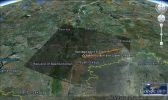
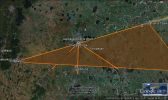
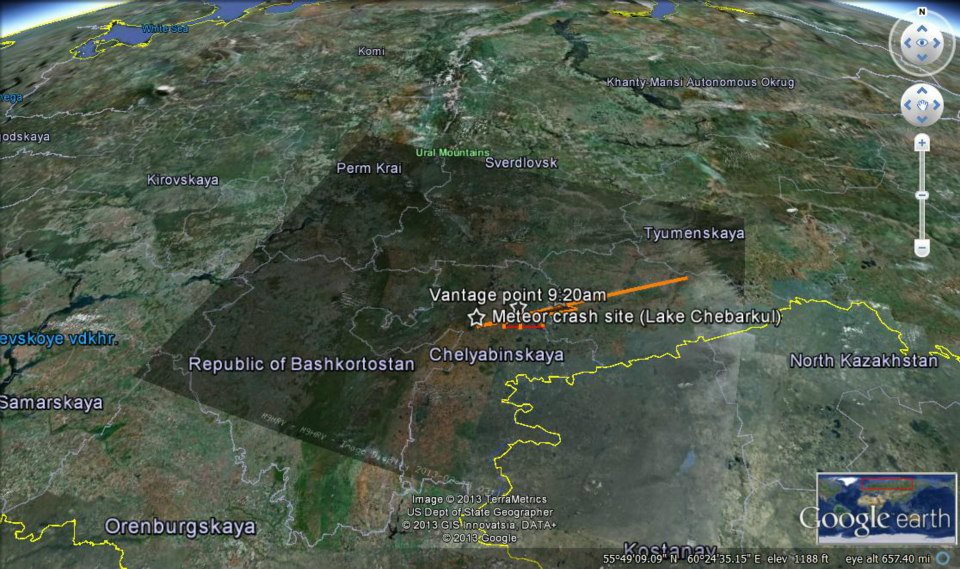
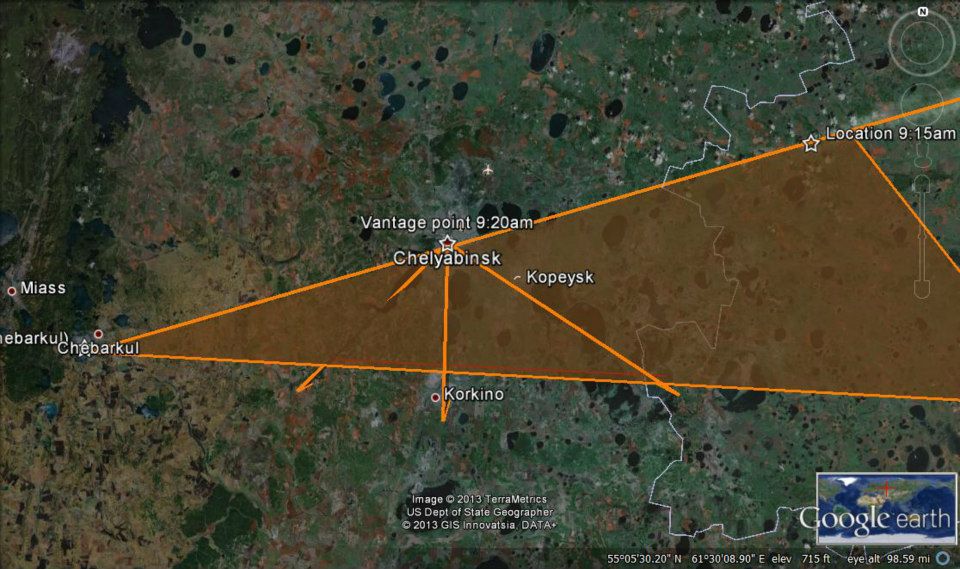
Why wasn't the Russian Meteor detected before it entered the atmosphere?
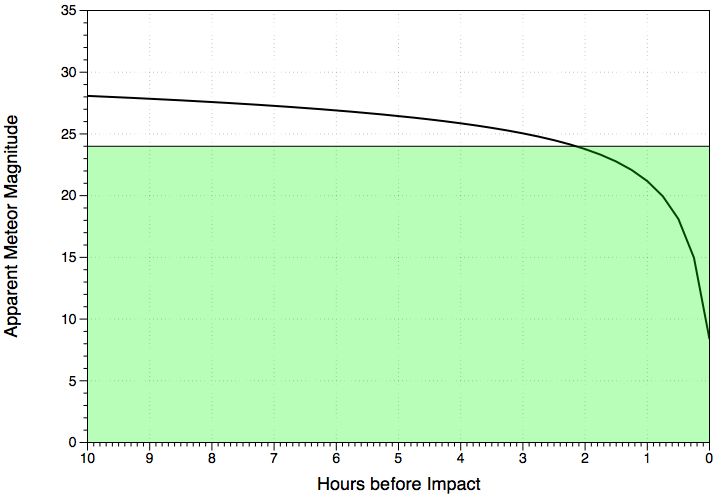
This is the question that keeps cropping up, and it deserves an answer. Images are being posted showing the fragments and they look like ordinary chondrites of asteroidal origin. This material is dark, and not very reflective, which makes it difficult to spot out in outer space, especially if the object is bus or house size.
Astronomers measure brightnesses in magnitudes - the larger, more positive the number, the fainter the object is. The Sun is magnitude -27, the planet Venus -4, the star Vega 0, and the faintest star you can see is about +6. The best asteroid survey telescopes have a magnitude limit of about +24, which is about 16 million times fainter than what you can see with the unaided eye.
We can now use the latest orbit determined by Dave Clark and combine it with the estimated size and reflectivity to figure out when we should have seen the meteoroid in the asteroid survey telescopes. The calculations can be displayed in a graph like this one. Note that, even with very large telescopes, the meteoroid would not have been visible until a mere 2 hours (135,000 km from Earth) before impact - very little time to sound a warning.
Even if we had been looking at the right spot and the right time, there is another problem - the meteoroid would be in the daylit sky, and telescopes cannot see faint objects in the daytime.
Simply put, the meteoroid was too small for the survey telescopes and came at us out of the Sun.
Source: www.facebook.com...
Also -- the white 'smoke' was not a contrail or meteor debris -- it was angry atmospheric ions.
Misinterpreting the 30 km high trail leads to wasted dead-ends.
Compare the meteor with the smaller man-made meteor, shuttle Endeavour back in the 1990s, as seen fireballing across the American southwest.
www.jamesoberg.com...
Misinterpreting the 30 km high trail leads to wasted dead-ends.
Compare the meteor with the smaller man-made meteor, shuttle Endeavour back in the 1990s, as seen fireballing across the American southwest.
www.jamesoberg.com...
And what of this bizarre quote?
www.bbc.co.uk...
Does anyone have info on this conflicting info or is there a thread about it elsewhere? I'm curious!
Russian scientists say the meteor weighed about 10 tonnes before it entered the Earth's atmosphere, travelling at some 30km (19 miles) per second, before breaking apart 30-50km (20-30 miles) above ground.
However, the US space agency Nasa said the meteor was 17m (55ft) wide and weighed 10,000 tonnes before entering the atmosphere, releasing about 500 kilotons of energy. The atomic bomb dropped on Hiroshima in 1945 was 12-15 kilotons.
www.bbc.co.uk...
Does anyone have info on this conflicting info or is there a thread about it elsewhere? I'm curious!
reply to post by markymint
I've checked the Russian Wikipedia article, and it seems that there are very different estimates from the Russian, Canadian, and American scientists. Russians think it weighed 10-100 tonnes and exploded with the force of only a few kilotonnes. The Canadians think it weighed 7000 tonnes, and NASA as you know says 10,000 tonnes, with a 500 kt explosion.
This does seem rather messy. Could any maths and physics buffs here confirm if a rocky object 15-17 meters in diameter can weigh 10,000 tonnes?
P.S. I did some calculations, and for a spherical rocky object with the density of 3000 kg/m^3 and weighing 10 tonnes, the diameter of the object would be just under 2 meteres - too small for such a powerful explosion. NASA's 10,000 tonnes and 17 meters give the density of 3887.4 kg/m^3 which sounds quite reasonable for a rocky body with some iron in it.
I've checked the Russian Wikipedia article, and it seems that there are very different estimates from the Russian, Canadian, and American scientists. Russians think it weighed 10-100 tonnes and exploded with the force of only a few kilotonnes. The Canadians think it weighed 7000 tonnes, and NASA as you know says 10,000 tonnes, with a 500 kt explosion.
This does seem rather messy. Could any maths and physics buffs here confirm if a rocky object 15-17 meters in diameter can weigh 10,000 tonnes?
P.S. I did some calculations, and for a spherical rocky object with the density of 3000 kg/m^3 and weighing 10 tonnes, the diameter of the object would be just under 2 meteres - too small for such a powerful explosion. NASA's 10,000 tonnes and 17 meters give the density of 3887.4 kg/m^3 which sounds quite reasonable for a rocky body with some iron in it.
edit on 21-2-2013 by wildespace because: (no reason given)
new topics
-
Hurt my hip; should I go see a Doctor
General Chit Chat: 40 minutes ago -
Israel attacking Iran again.
Middle East Issues: 1 hours ago -
Michigan school district cancels lesson on gender identity and pronouns after backlash
Education and Media: 1 hours ago -
When an Angel gets his or her wings
Religion, Faith, And Theology: 2 hours ago -
Comparing the theology of Paul and Hebrews
Religion, Faith, And Theology: 3 hours ago -
Pentagon acknowledges secret UFO project, the Kona Blue program | Vargas Reports
Aliens and UFOs: 4 hours ago -
Boston Dynamics say Farewell to Atlas
Science & Technology: 4 hours ago -
I hate dreaming
Rant: 5 hours ago -
Man sets himself on fire outside Donald Trump trial
Mainstream News: 7 hours ago -
Biden says little kids flip him the bird all the time.
Politicians & People: 7 hours ago
top topics
-
The Democrats Take Control the House - Look what happened while you were sleeping
US Political Madness: 7 hours ago, 17 flags -
In an Historic First, In N Out Burger Permanently Closes a Location
Mainstream News: 9 hours ago, 16 flags -
A man of the people
Medical Issues & Conspiracies: 15 hours ago, 10 flags -
Biden says little kids flip him the bird all the time.
Politicians & People: 7 hours ago, 8 flags -
Man sets himself on fire outside Donald Trump trial
Mainstream News: 7 hours ago, 7 flags -
Pentagon acknowledges secret UFO project, the Kona Blue program | Vargas Reports
Aliens and UFOs: 4 hours ago, 6 flags -
Israel attacking Iran again.
Middle East Issues: 1 hours ago, 5 flags -
Michigan school district cancels lesson on gender identity and pronouns after backlash
Education and Media: 1 hours ago, 4 flags -
Boston Dynamics say Farewell to Atlas
Science & Technology: 4 hours ago, 4 flags -
4 plans of US elites to defeat Russia
New World Order: 17 hours ago, 4 flags
active topics
-
Hurt my hip; should I go see a Doctor
General Chit Chat • 5 • : Caver78 -
MULTIPLE SKYMASTER MESSAGES GOING OUT
World War Three • 50 • : cherokeetroy -
Pentagon acknowledges secret UFO project, the Kona Blue program | Vargas Reports
Aliens and UFOs • 7 • : Ophiuchus1 -
-@TH3WH17ERABB17- -Q- ---TIME TO SHOW THE WORLD--- -Part- --44--
Dissecting Disinformation • 549 • : cherokeetroy -
In an Historic First, In N Out Burger Permanently Closes a Location
Mainstream News • 9 • : VariedcodeSole -
When an Angel gets his or her wings
Religion, Faith, And Theology • 1 • : lilzazz -
Israel attacking Iran again.
Middle East Issues • 18 • : BeyondKnowledge3 -
A man of the people
Medical Issues & Conspiracies • 14 • : chr0naut -
British TV Presenter Refuses To Use Guest's Preferred Pronouns
Education and Media • 68 • : ToneD -
MH370 Again....
Disaster Conspiracies • 9 • : WakeUpBeer
1