It looks like you're using an Ad Blocker.
Please white-list or disable AboveTopSecret.com in your ad-blocking tool.
Thank you.
Some features of ATS will be disabled while you continue to use an ad-blocker.

Regarding those who claim freemasons worship lucifer -
page: 2share:
reply to post by OnTheLevel213
I think I am being misunderstood here....Those arguments are argument I disagree with, not my opinion on Masons, but others. I will agree that betterment is (a) main premise, I should have included (a) in the first statment.
I think I am being misunderstood here....Those arguments are argument I disagree with, not my opinion on Masons, but others. I will agree that betterment is (a) main premise, I should have included (a) in the first statment.
edit on 27-1-2013 by ParanoidAmerican because: (no reason
given)
reply to post by EnochWasRight
From your source..
From your source..
Although, unbeknown to him at the time of joining, all his affiliations were with unrecognized and irregular bodies, Crowley’s status as a freemason went largely unquestioned by non-masons throughout his life.
reply to post by EnochWasRight
But no matter how many times you are told the truth, you still seem to ignore it. I guess God doesn't mind if you lie just a little, here and there right? I mean, it's for the greater good right? You might convince a freemason that he is wrong and needs to repent by lying to him, so perhaps God won't mind at all.
You have no integrity.
But no matter how many times you are told the truth, you still seem to ignore it. I guess God doesn't mind if you lie just a little, here and there right? I mean, it's for the greater good right? You might convince a freemason that he is wrong and needs to repent by lying to him, so perhaps God won't mind at all.
You have no integrity.

No lie. He was connected to Masonic ritual, considered himself a Mason and participated with lodges. Recognized or not, that matter is irrelevant.
I don't recognize the Catholic Church as a legitimate church, yet I wouldn't deny someone was a Christian who attends. They adhere to the same
faith as Baptists at the heart of the belief. For Masons, Crowley was as much a Theosophist as the rest of them. The Golden Dawn, Theosophy and the
Rosicrucians are ALL part of the same Mystery Religion. If a Lodge in Mexico claims the same rituals and version of private associations, then they
are the same.
Because the Masons have distanced themselves from a hot potato in no way implies that Crowley was not connected to the garden that grew him. I'm not the one holding the untruth.
Because the Masons have distanced themselves from a hot potato in no way implies that Crowley was not connected to the garden that grew him. I'm not the one holding the untruth.
Originally posted by network dude
reply to post by EnochWasRight
But no matter how many times you are told the truth, you still seem to ignore it. I guess God doesn't mind if you lie just a little, here and there right? I mean, it's for the greater good right? You might convince a freemason that he is wrong and needs to repent by lying to him, so perhaps God won't mind at all.
You have no integrity.
Originally posted by EnochWasRight
He was connected to Masonic ritual, considered himself a Mason and participated with lodges. Recognized or not, that matter is irrelevant.
It is highly relevant.
Any group can start a lodge and claim they are 'Masons', just as Crowely's unrecognized lodge, this does not make them such. If they do not adhere to the Ancient Landmarks and tenets of the Fraternity they will remain justly clandestine and irregular.
Need we start judging all the Christians by Westboro standards?
You getting the point yet?
reply to post by EnochWasRight
Well then, If you are convinced that Crowley represents all of masonry, you will have to accept Jeffrey Dahmer as a representative of Christianity.
source
You can't have it both ways.
Well then, If you are convinced that Crowley represents all of masonry, you will have to accept Jeffrey Dahmer as a representative of Christianity.
Almost all serial killers start quoting one verse after another from the Christian Bible. This shows most serial killers had strong religious upbringing, have been studying the bible for years and were still very Christian religious when they were murdering.
source
You can't have it both ways.
reply to post by EnochWasRight
What does the following suggest?
"Not to be an enthusiast, persecutor or slanderer of religion, neither bending towards avarice, injustice, malice, revenge, nor the envy or contempt of mankind, but giving up every selfish propensity which might injure others."
Farmer or hunter?
What does the following suggest?
"Not to be an enthusiast, persecutor or slanderer of religion, neither bending towards avarice, injustice, malice, revenge, nor the envy or contempt of mankind, but giving up every selfish propensity which might injure others."
Farmer or hunter?
Originally posted by EnochWasRight
Recognized or not, that matter is irrelevant.
Actually it is very relevant and to try and compare us with religion is like comparing apples and oranges.
Originally posted by EnochWasRight
I don't recognize the Catholic Church as a legitimate church, yet I wouldn't deny someone was a Christian who attends.
That's not what you're comparing it to, though. It's not whether you consider a Catholic a Christian*, it's whether you're comfortable letting a Catholic be the spokesperson for and a representative sample of all of Christianity.
They adhere to the same faith as Baptists at the heart of the belief.
*Thing is, Crowley's "Masonic" orders didn't adhere to the Landmarks of Freemasonry. They were not the same "at heart", they just retained a few of the external trappings.
Help me understand. When you say, "Adhere to Ancient Landmarks," how does this apply to the doctrine of exclusive territorial jurisdiction? I
would assume that when you say landmarks, you are really speaking of principles of actions. In this case, we are speaking of a boundary set up
against innovation, much like a river that cannot be moved and blocked. Speaking of Crowley, we are seeing a man who innovates and moves ahead of the
pack. My assumption is that this is the main reason such a Mason would be distanced from the herd. Considering the English Grand Lodge does not
recognize landmarks, how do you define their status?
Which of these 25 Landmarks (linked below) would disqualify Crowley and the lodges he pledged?
According to most masonic constitutions, Crowley would be innocent of all charges by this standard. "Heresy, for instance, is not a masonic crime. Masons are obliged to use the words of the Old Charges, "to that religion in which all men agree, leaving their particular opinions to themselves;" and, therefore, as long as a Mason acknowledges his belief in the existence of one God, a lodge can take no action on his peculiar opinions, however heterodox they may be." Even if he subverts the laws of a state, he can only be "be pitied as an unhappy man."
This next one seems to be broken on ATS regularly by Masons: "... imprudent conversation in relation to Masonry in the presence of uninitiated strangers; refusal to relieve a worthy distressed Brother, if in your power; and all "wrangling, quarreling, back-biting, and slander."
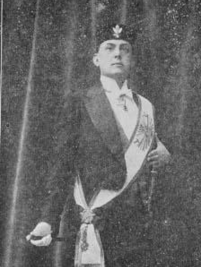
Does this website contradict these landmarks? If not, does it disqualify a Mason from the lodge by conflict with his constitution? Who makes these decisions? I am sorry, but I have questions and seeing Crowley in full Masonic regalia makes me think he may have been one.
Which of these 25 Landmarks (linked below) would disqualify Crowley and the lodges he pledged?
According to most masonic constitutions, Crowley would be innocent of all charges by this standard. "Heresy, for instance, is not a masonic crime. Masons are obliged to use the words of the Old Charges, "to that religion in which all men agree, leaving their particular opinions to themselves;" and, therefore, as long as a Mason acknowledges his belief in the existence of one God, a lodge can take no action on his peculiar opinions, however heterodox they may be." Even if he subverts the laws of a state, he can only be "be pitied as an unhappy man."
This next one seems to be broken on ATS regularly by Masons: "... imprudent conversation in relation to Masonry in the presence of uninitiated strangers; refusal to relieve a worthy distressed Brother, if in your power; and all "wrangling, quarreling, back-biting, and slander."
Does this website contradict these landmarks? If not, does it disqualify a Mason from the lodge by conflict with his constitution? Who makes these decisions? I am sorry, but I have questions and seeing Crowley in full Masonic regalia makes me think he may have been one.
25 Landmarks from An Encyclopaedia of Freemasonry” of 1858:
In the early eighteenth century, English Grand Master George
Payne, in compiling his General Regulations, determined that “[e]very annual Grand-Lodge has
an inherent power and authority to make new Regulations, or to alter these, for the real benefit of
this ancient Fraternity: Provided always that the old Landmarks be carefully preserved . . .”
1. Modes of recognition.
2. The division of symbolic Masonry in three degrees.
3. The legend of the Third Degree being the essence and identity of Freemasonry.
4. Government of the Fraternity by an elected Grand Master.
5-8. The prerogative of the Grand Master a) to preside over every assembly of the Craft, b) to grant dispensation for conferring degrees at irregular times, c) for opening and holding lodges and d) to make Masons at sight.
9. The necessity for masons to congregate in lodges.
10. The Government of a lodge by a Master and two Wardens.
11. The necessity that every lodge should be duly tiled.
12-14. The right of every Mason to a) be represented to all general meetings of the Craft; b) to appeal from a lodge’s decision to Grand Lodge; c) to visit every regular lodge (right of visitation).
15. No unknown visitor to enter a lodge without examination.
16. No lodge to interfere with the business of another lodge, or give degrees to Brethren who are members of other lodges.
17. Every Mason to be amenable to the laws and regulations of the Masonic jurisdiction in which he resides. Non-affiliation, a Masonic offence, does not exempt a Mason from Masonic jurisdiction.
18. A candidate for initiation to be a man -unmutilated, free-born, and of mature age. A woman, a cripple, or a slave, or one born in slavery, is disqualified.
19,20. Belief in a) the existence of God as the Grand Architect of the Universe, and b) resurrection to a future life.
21. The Book of the Law to have a place in every lodge. It is that volume which, by the religion of the country, “is believed to contain the revealed will of the Grand Architect of the Universe”.
22. The equality of all Masons.
23. Secrecy. “If divested of its secret character, it would loose its identity and cease to be Freemasonry”.
24. The foundation of a speculative science upon an operative art, and the symbolic use and explanation of the terms of that art, for the purposes of religious or moral teaching. “The Temple of Solomon was the symbolic cradle of the Institution”.
25. The crowning landmark is that these landmarks can never be changed.
Originally posted by AugustusMasonicus
Originally posted by EnochWasRight
He was connected to Masonic ritual, considered himself a Mason and participated with lodges. Recognized or not, that matter is irrelevant.
It is highly relevant.
Any group can start a lodge and claim they are 'Masons', just as Crowely's unrecognized lodge, this does not make them such. If they do not adhere to the Ancient Landmarks and tenets of the Fraternity they will remain justly clandestine and irregular.
I never said Crowley represents all of Masonry. What I implied is that Theurgy and Theosophy are hallmarks of the Masons, just like baptism is a
hallmark of Baptists. As for Westboro, there are Baptists that are on the fringe. I would remind you of your constitution:
"Heresy, for instance, is not a masonic crime. Masons are obliged to use the words of the Old Charges, "to that religion in which all men agree, leaving their particular opinions to themselves;" and, therefore, as long as a Mason acknowledges his belief in the existence of one God, a lodge can take no action on his peculiar opinions, however heterodox they may be."
Book Fourth, Chapter 1
"Heresy, for instance, is not a masonic crime. Masons are obliged to use the words of the Old Charges, "to that religion in which all men agree, leaving their particular opinions to themselves;" and, therefore, as long as a Mason acknowledges his belief in the existence of one God, a lodge can take no action on his peculiar opinions, however heterodox they may be."
Book Fourth, Chapter 1
Originally posted by network dude
reply to post by EnochWasRight
Well then, If you are convinced that Crowley represents all of masonry, you will have to accept Jeffrey Dahmer as a representative of Christianity.
Almost all serial killers start quoting one verse after another from the Christian Bible. This shows most serial killers had strong religious upbringing, have been studying the bible for years and were still very Christian religious when they were murdering.
source
You can't have it both ways.
reply to post by EnochWasRight
Hey, doesn't Enoch's name translate into 'Initiated' in English? So you are running around with a forerunner of the Masons name as yours, telling masons that they are way off? Doesn't sound right logically...
Hey, doesn't Enoch's name translate into 'Initiated' in English? So you are running around with a forerunner of the Masons name as yours, telling masons that they are way off? Doesn't sound right logically...
edit on 28-1-2013 by VeritasAequitas because: (no reason given)
Originally posted by EnochWasRight
When you say, "Adhere to Ancient Landmarks," how does this apply to the doctrine of exclusive territorial jurisdiction? I would assume that when you say landmarks, you are really speaking of principles of actions. In this case, we are speaking of a boundary set up against innovation, much like a river that cannot be moved and blocked.
The main purpose of the Landmarks in this context is in regards recognition, to be considered Regular certain Landmarks must be observed. Masonic principles, truth, charity, hope, faith, etc are immemorial and as such need no 'innovation'.
Speaking of Crowley, we are seeing a man who innovates and moves ahead of the pack. My assumption is that this is the main reason such a Mason would be distanced from the herd. Considering the English Grand Lodge does not recognize landmarks, how do you define their status?
The United Grand Lodge of England strictly observes one Landmark, the most important and the one that Crowely's lodge of choice failed to uphold:
...a professed belief in TGAOTU is an Ancient Landmark of the Order and the only one specifically defined as
such by the United Grand Lodge of England. Source
This next one seems to be broken on ATS regularly by Masons: "... imprudent conversation in relation to Masonry in the presence of uninitiated strangers; refusal to relieve a worthy distressed Brother, if in your power; and all "wrangling, quarreling, back-biting, and slander."
I see no discussion of portions of the ritual that fall under this category, I have not seen a Brother ask for help and been refused nor have I seen Masons engaging in "wrangling, quarreling, back-biting, and slander".
Does this website contradict these landmarks?
What website?
Who makes these decisions?
Fellow Masons.
I am sorry, but I have questions and seeing Crowley in full Masonic regalia makes me think he may have been one.
If I trotted down to the hopsital and threw on some doctors scrubs would you want me operating on you? If no, why not, I look like a doctor?
edit on 28-1-2013 by AugustusMasonicus because: networkdude has no beer
Originally posted by EnochWasRight
I am sorry, but I have questions and seeing Crowley in full Masonic regalia makes me think he may have been one.
He is wearing OTO regalia. This has also been pointed out to you.
Another lie to further your agenda. But with you crying about being banned and then implying it had something to do with your "knowledge" is just another example of how dishonest you really are.
Integrity=0
Jesus would not be proud of you.
Originally posted by VeritasAequitas
reply to post by EnochWasRight
Hey, doesn't Enoch's name translate into 'Initiated' in English? So you are running around with a forerunner of the Masons name as yours, telling masons that they are way off? Doesn't sound right logically...edit on 28-1-2013 by VeritasAequitas because: (no reason given)
Such irony, I know. Enoch was a builder. We are all builders. The mind IS the builder. Masons have no claim over this title.
reply to post by network dude
Good point; that is indeed OTO regalia, and not Masonic....There is a very big difference...
Good point; that is indeed OTO regalia, and not Masonic....There is a very big difference...
Was the founder of OTO, Karl Kellner, a Freemason? No matter. The roots of the Mystery School come in all forms. One is like the other if the
pursuit is taking knowledge rather than receiving knowledge. If the aim is a conspiracy against the laws (True Landmarks set by God), then Masonic
landmarks are bogus. We are all builders and no oath can take this right away from anyone on the street. Associating with the architect is not
earned. It's HIS decision alone and God can only give. It's his will be done, not "So mote it be." It's do unto others and not do for one's self.
I could go on. It's we the people and not we of the grand lodge. Like it or not, our world reflects the ones who took it. Not for long.
Originally posted by network dude
Originally posted by EnochWasRight
I am sorry, but I have questions and seeing Crowley in full Masonic regalia makes me think he may have been one.
He is wearing OTO regalia. This has also been pointed out to you.
Another lie to further your agenda. But with you crying about being banned and then implying it had something to do with your "knowledge" is just another example of how dishonest you really are.
Integrity=0
Jesus would not be proud of you.
edit on 28-1-2013 by EnochWasRight because: (no reason given)
edit on 28-1-2013 by
EnochWasRight because: (no reason given)
Originally posted by VeritasAequitas
reply to post by network dude
Good point; that is indeed OTO regalia, and not Masonic....There is a very big difference...
Before he wasn't a Mason, he was. We are all builders.
new topics
-
Happy St George's day you bigots!
Breaking Alternative News: 1 hours ago -
TLDR post about ATS and why I love it and hope we all stay together somewhere
General Chit Chat: 2 hours ago -
Hate makes for strange bedfellows
US Political Madness: 4 hours ago -
Who guards the guards
US Political Madness: 7 hours ago -
Has Tesla manipulated data logs to cover up auto pilot crash?
Automotive Discussion: 9 hours ago
top topics
-
Hate makes for strange bedfellows
US Political Madness: 4 hours ago, 14 flags -
whistleblower Captain Bill Uhouse on the Kingman UFO recovery
Aliens and UFOs: 14 hours ago, 11 flags -
Who guards the guards
US Political Madness: 7 hours ago, 10 flags -
1980s Arcade
General Chit Chat: 16 hours ago, 7 flags -
Deadpool and Wolverine
Movies: 17 hours ago, 4 flags -
TLDR post about ATS and why I love it and hope we all stay together somewhere
General Chit Chat: 2 hours ago, 3 flags -
Has Tesla manipulated data logs to cover up auto pilot crash?
Automotive Discussion: 9 hours ago, 2 flags -
Happy St George's day you bigots!
Breaking Alternative News: 1 hours ago, 2 flags
active topics
-
"We're All Hamas" Heard at Columbia University Protests
Social Issues and Civil Unrest • 240 • : TzarChasm -
-@TH3WH17ERABB17- -Q- ---TIME TO SHOW THE WORLD--- -Part- --44--
Dissecting Disinformation • 615 • : daskakik -
Candidate TRUMP Now Has Crazy Judge JUAN MERCHAN After Him - The Stormy Daniels Hush-Money Case.
Political Conspiracies • 718 • : Threadbarer -
whistleblower Captain Bill Uhouse on the Kingman UFO recovery
Aliens and UFOs • 16 • : pianopraze -
1980s Arcade
General Chit Chat • 21 • : chris_stibrany -
Hate makes for strange bedfellows
US Political Madness • 30 • : nugget1 -
Who guards the guards
US Political Madness • 3 • : theatreboy -
TLDR post about ATS and why I love it and hope we all stay together somewhere
General Chit Chat • 5 • : TzarChasm -
A Better Choice I Think
2024 Elections • 31 • : burritocat -
Russia Ukraine Update Thread - part 3
World War Three • 5716 • : Oldcarpy2