It looks like you're using an Ad Blocker.
Please white-list or disable AboveTopSecret.com in your ad-blocking tool.
Thank you.
Some features of ATS will be disabled while you continue to use an ad-blocker.

"2012 A-Z" - A Galaxial Event of Disneyesque Proportion
page: 2share:
Well, I watched the entire video. It's great, if true. But I know next to nothing about how planets actually orbit, so only someone in that field
could verify. I thought most "experts" claimed that the Photon Belt doesn't actually exist? Well, anyway, what do I know? Like I said. It's well
done and explains things well, but since I am ignorant of the scientific facts, he could of told me that marshmallows originally come from the Milky
Way (really).
Originally posted by ziplock9000
What a load of #e. We should make a list of the 21st December tards who believe this stuff and publicly humiliate them on the 22nd.
is that your goal in life, to humiliate other people? may i recommend a good psychologist for you? there are some seriously deranged individuals in this forum, many of which are quite scary.
i enjoyed watching that video and it brings some interesting possibilities as we fly through space orbiting our galactic center all the while our galaxy is orbiting another. i never realized our sun is traveling like a comet, dragging our planets along for the ride.
I also watched the whole thing. Yup. The whole hour+
It resonated with me very strongly. Is it all "true"? No idea. But it was thought provoking and, more importantly to me, moved me on a deep level. Flame away. That's all I've got for ya! :-)
I don't believe 12/21 is the end of the world in a Hollywood sense, but I would not be at all surprised if something happened....
Can anyone give more info on who this guy is? Why did he put the video together?
It resonated with me very strongly. Is it all "true"? No idea. But it was thought provoking and, more importantly to me, moved me on a deep level. Flame away. That's all I've got for ya! :-)
I don't believe 12/21 is the end of the world in a Hollywood sense, but I would not be at all surprised if something happened....
Can anyone give more info on who this guy is? Why did he put the video together?
Originally posted by winterkill
Everything you wanted to know about '2012' but didn't know to ask. Heard of the Photon Belt? Pole Shift? Precession of Equinoxes?
www.youtube.com...
So lets add to the 2012 mayham with this little video, which starts slow but gets good. Have fun.edit on 13-12-2012 by winterkill because: added material
it is over an hour long, but both this video and another i will link are two examples of divergent views of 2012 that are comimng out at the last minute (as it were)
here were the 3 links i was going to OP today or Saturday, but you seem to scan obscure links for info. the way i do....and posted a thread first
www.youtube.com...
Now this 1:44:++ video is great to begin with but then centers on mostly the utterings of 3 presenters- 'authorities' as it were
www.youtube.com...#!
2012 Crossing Over, A New Beginning OFFICIAL FILM [Brave Archer Films®]
THEN THERE IS THIS.... in talking about the 'change that will sweep over the human community how about elephants partially digesting coffee beans to alter the bean's almost harsh taste & mellow the product.... youse might find this report interesting.....
it concerns coffee beans i will never be able to afford, but would be quite willing to try -
even though i am not a coffee drinker for the last 15+ years
www.theepochtimes.com...
happy holidaze
i thought the parts concerning the star Alyceon and our own Suns binary companion Sirius were very provoking
this gives me a new light on just what the Galactic plane more correctly is...instead of the apparent 'crossing' we will view as the dark rift at 11AM on 21-12-12
the 24k year solar dance between Stars is what is causing the sine-wave undulations of our solar system orbit in the Milky Way... i keep learning every day
edit on 14-12-2012 by St Udio because: shrimp belching
Originally posted by SunnyDee
If I could give this more flags I would.
Not often we get such a great video to learn new things from.
Edit to add:
Why do they not teach grade school kids about our solar system orbiting Alcyone or that Alcyone orbits Sirius which orbits the galaxy?
They really have kept us small-minded.edit on 13-12-2012 by SunnyDee because: (no reason given)
Because it's complete nonsense. We do NOT orbit Alcyone, nor does Sirius.
NGCHunter explained it quite well in another thread, so I'll let him do the talking.
www.abovetopsecret.com...
Complete nonsense. Here are some numbers for you. Sirius has a proper motion of 1.2 arcseconds/year in declination and .546 arcseconds per year in right ascension (simbad.u-strasbg.fr... ) (15 km/sec and 6.8 km/sec velocity relative to our solar system respectively). Since we're about 8.6 light years from the Sirius system, and since Sirius A and B have a combined mass of nearly 3 times the sun's mass, the escape velocity from the Sirius system at the distance of our sun is about 0.1 km/sec. In other words, our solar system is traveling many times too fast relative to Sirius to be able to orbit it or be in a trinary configuration with it. Let's crunch the numbers for Alcyone as well just to show you how ridiculous this is. Alcyone is of course part of the Pleiades as well, so let's use the total mass of the Pleiades cluster to see if we're orbiting it. Alcyone has a parallax of about 8.09 milliarcseconds, which corresponds to a distance of about 402 light years. simbad.u-strasbg.fr... It also has a proper motion of about 19.34 milliarcseconds in right ascension and -43.67 milliarcseconds in declination per year. Now at a distance of 402 light years, those 43.67 milliarcseconds/year in declination translate to 805,195,033 kilometers per year or about 25.515 km/second. Now the Pleiades cluster has a total mass of about 740 sun masses (arxiv.org... ), so at a distance of 400 light years, the escape velocity for the entire Pleiades cluster is about 0.227861 km/second. In other words, even just taking into account our proper motion in declination, to say nothing of our total motion relative to Alcyone including in right ascension and radial velocity, we're traveling over 100 times too fast to be orbiting the Pleiades! We are not orbiting the Pleiades, let alone Alcyone, not even close.
Here is a link to Alcyone, you might want to read up on it. Both the star and the Pleiades are only 50 million years old.
Our sun and planet are over 4.5 billion years old.
Care to explain how we're orbiting something that didn't even exist when the sun formed, and who's gravitational effect on us at over 370 light years away is negligable at best?
The fun begin at 20:56..Our ancestors believe our Earth is flat..And now we believe our Solar systems is flat but this video will explain the real
truth about it..
this was a very interesting video, and for a know it all, like we all seem to be on these topics
i did learn a few new things! so thats always a bonus
so in the end after watching the whole thing, I feel some valid points were made in how to look at the events happening.
thanks for the post!
i did learn a few new things! so thats always a bonus
so in the end after watching the whole thing, I feel some valid points were made in how to look at the events happening.
thanks for the post!
Originally posted by eriktheawful
Originally posted by SunnyDee
If I could give this more flags I would.
Not often we get such a great video to learn new things from.
Edit to add:
Why do they not teach grade school kids about our solar system orbiting Alcyone or that Alcyone orbits Sirius which orbits the galaxy?
They really have kept us small-minded.edit on 13-12-2012 by SunnyDee because: (no reason given)
Because it's complete nonsense. We do NOT orbit Alcyone, nor does Sirius.
NGCHunter explained it quite well in another thread, so I'll let him do the talking.
www.abovetopsecret.com...
Complete nonsense. Here are some numbers for you. Sirius has a proper motion of 1.2 arcseconds/year in declination and .546 arcseconds per year in right ascension (simbad.u-strasbg.fr... ) (15 km/sec and 6.8 km/sec velocity relative to our solar system respectively). Since we're about 8.6 light years from the Sirius system, and since Sirius A and B have a combined mass of nearly 3 times the sun's mass, the escape velocity from the Sirius system at the distance of our sun is about 0.1 km/sec. In other words, our solar system is traveling many times too fast relative to Sirius to be able to orbit it or be in a trinary configuration with it. Let's crunch the numbers for Alcyone as well just to show you how ridiculous this is. Alcyone is of course part of the Pleiades as well, so let's use the total mass of the Pleiades cluster to see if we're orbiting it. Alcyone has a parallax of about 8.09 milliarcseconds, which corresponds to a distance of about 402 light years. simbad.u-strasbg.fr... It also has a proper motion of about 19.34 milliarcseconds in right ascension and -43.67 milliarcseconds in declination per year. Now at a distance of 402 light years, those 43.67 milliarcseconds/year in declination translate to 805,195,033 kilometers per year or about 25.515 km/second. Now the Pleiades cluster has a total mass of about 740 sun masses (arxiv.org... ), so at a distance of 400 light years, the escape velocity for the entire Pleiades cluster is about 0.227861 km/second. In other words, even just taking into account our proper motion in declination, to say nothing of our total motion relative to Alcyone including in right ascension and radial velocity, we're traveling over 100 times too fast to be orbiting the Pleiades! We are not orbiting the Pleiades, let alone Alcyone, not even close.
Here is a link to Alcyone, you might want to read up on it. Both the star and the Pleiades are only 50 million years old.
Our sun and planet are over 4.5 billion years old.
Care to explain how we're orbiting something that didn't even exist when the sun formed, and who's gravitational effect on us at over 370 light years away is negligable at best?
I'm quoting this as to have it appear more often in the thread, since people will surely pass right over it as it does not say what they want.
Great video!
All tho my Question is..
Not sure how the mayan calander would come about if we forget who we are everytime we enter a new age?
All tho my Question is..
Not sure how the mayan calander would come about if we forget who we are everytime we enter a new age?
edit on 14-12-2012 by TripleDoubleSingle
because: (no reason given)
Hands down the best part is the sun moving like a comet and we are in tow.
Doesn't matter to me if we are orbiting Alcyone or not.
Theres a ton of speculation in the video but it's fun.
We are certainly orbiting Galactic center.
Also without a doubt the Sun does appear to rise in the center of the milky way galaxy
on Dec 21. Check it on your Star walk app haha.
This presenter isn't a scientist .
It's an Internet radio show. He's too slick to be a guy that wandered into a library.
And the Earth wont stop. But who cares the animation is worth the speculation.
Doesn't matter to me if we are orbiting Alcyone or not.
Theres a ton of speculation in the video but it's fun.
We are certainly orbiting Galactic center.
Also without a doubt the Sun does appear to rise in the center of the milky way galaxy
on Dec 21. Check it on your Star walk app haha.
This presenter isn't a scientist .
It's an Internet radio show. He's too slick to be a guy that wandered into a library.
And the Earth wont stop. But who cares the animation is worth the speculation.
just finished watching the entire video, and i must say, having watched several of the longer 2012 video's geared more towards doom and gloom, this
guy had a more up-beat, here's my theory, take it or leave it no hard feelings approach... which was refreshing. i liked his tone and presentation of
facts.
t minus 7 days, guess we'll find out!
t minus 7 days, guess we'll find out!
Watched the entire video and its just rubbish. All based on biblical prophecies...at the end the commentator/creator of the video puts him self on a
par with Jesus. Just one guys who researched myths that he couldn't really verify but then still elaborates on the unknown myth witch he continually
adds to thus creating an entirely fake fantasy.
Yeah, yeah I guess this is stage one....ridicule.
Yeah, yeah I guess this is stage one....ridicule.
Originally posted by eriktheawful
Originally posted by SunnyDee
If I could give this more flags I would.
Not often we get such a great video to learn new things from.
Edit to add:
Why do they not teach grade school kids about our solar system orbiting Alcyone or that Alcyone orbits Sirius which orbits the galaxy?
They really have kept us small-minded.edit on 13-12-2012 by SunnyDee because: (no reason given)
Because it's complete nonsense. We do NOT orbit Alcyone, nor does Sirius.
NGCHunter explained it quite well in another thread, so I'll let him do the talking.
www.abovetopsecret.com...
Complete nonsense. Here are some numbers for you. Sirius has a proper motion of 1.2 arcseconds/year in declination and .546 arcseconds per year in right ascension (simbad.u-strasbg.fr... ) (15 km/sec and 6.8 km/sec velocity relative to our solar system respectively). Since we're about 8.6 light years from the Sirius system, and since Sirius A and B have a combined mass of nearly 3 times the sun's mass, the escape velocity from the Sirius system at the distance of our sun is about 0.1 km/sec. In other words, our solar system is traveling many times too fast relative to Sirius to be able to orbit it or be in a trinary configuration with it. Let's crunch the numbers for Alcyone as well just to show you how ridiculous this is. Alcyone is of course part of the Pleiades as well, so let's use the total mass of the Pleiades cluster to see if we're orbiting it. Alcyone has a parallax of about 8.09 milliarcseconds, which corresponds to a distance of about 402 light years. simbad.u-strasbg.fr... It also has a proper motion of about 19.34 milliarcseconds in right ascension and -43.67 milliarcseconds in declination per year. Now at a distance of 402 light years, those 43.67 milliarcseconds/year in declination translate to 805,195,033 kilometers per year or about 25.515 km/second. Now the Pleiades cluster has a total mass of about 740 sun masses (arxiv.org... ), so at a distance of 400 light years, the escape velocity for the entire Pleiades cluster is about 0.227861 km/second. In other words, even just taking into account our proper motion in declination, to say nothing of our total motion relative to Alcyone including in right ascension and radial velocity, we're traveling over 100 times too fast to be orbiting the Pleiades! We are not orbiting the Pleiades, let alone Alcyone, not even close.
Here is a link to Alcyone, you might want to read up on it. Both the star and the Pleiades are only 50 million years old.
Our sun and planet are over 4.5 billion years old.
Care to explain how we're orbiting something that didn't even exist when the sun formed, and who's gravitational effect on us at over 370 light years away is negligable at best?
Totally agree, I watched it all and cannot believe so many people are buying the utter nonsense.
Originally posted by SunnyDee
If I could give this more flags I would.
Not often we get such a great video to learn new things from.
Edit to add:
Why do they not teach grade school kids about our solar system orbiting Alcyone or that Alcyone orbits Sirius which orbits the galaxy?
Probably because the solar system does not orbit Alcyone (which is a star far younger than our solar system -- it was "born" only 70 million years ago or so (see Wikipedia) and Alcyone and the Pleiades do not orbit Sirius (which is billions of miles from it... many stars are much closer. Alcyone is a binary (two star) system with two brown dwarfs.)
...and that's why they don't teach that our solar system orbits Alcyone and that Alcyone orbits Sirius.
Originally posted by eriktheawful
Originally posted by SunnyDee
If I could give this more flags I would.
Not often we get such a great video to learn new things from.
Edit to add:
Why do they not teach grade school kids about our solar system orbiting Alcyone or that Alcyone orbits Sirius which orbits the galaxy?
They really have kept us small-minded.edit on 13-12-2012 by SunnyDee because: (no reason given)
Because it's complete nonsense. We do NOT orbit Alcyone, nor does Sirius.
NGCHunter explained it quite well in another thread, so I'll let him do the talking.
www.abovetopsecret.com...
Complete nonsense. Here are some numbers for you. Sirius has a proper motion of 1.2 arcseconds/year in declination and .546 arcseconds per year in right ascension (simbad.u-strasbg.fr... ) (15 km/sec and 6.8 km/sec velocity relative to our solar system respectively). Since we're about 8.6 light years from the Sirius system, and since Sirius A and B have a combined mass of nearly 3 times the sun's mass, the escape velocity from the Sirius system at the distance of our sun is about 0.1 km/sec. In other words, our solar system is traveling many times too fast relative to Sirius to be able to orbit it or be in a trinary configuration with it. Let's crunch the numbers for Alcyone as well just to show you how ridiculous this is. Alcyone is of course part of the Pleiades as well, so let's use the total mass of the Pleiades cluster to see if we're orbiting it. Alcyone has a parallax of about 8.09 milliarcseconds, which corresponds to a distance of about 402 light years. simbad.u-strasbg.fr... It also has a proper motion of about 19.34 milliarcseconds in right ascension and -43.67 milliarcseconds in declination per year. Now at a distance of 402 light years, those 43.67 milliarcseconds/year in declination translate to 805,195,033 kilometers per year or about 25.515 km/second. Now the Pleiades cluster has a total mass of about 740 sun masses (arxiv.org... ), so at a distance of 400 light years, the escape velocity for the entire Pleiades cluster is about 0.227861 km/second. In other words, even just taking into account our proper motion in declination, to say nothing of our total motion relative to Alcyone including in right ascension and radial velocity, we're traveling over 100 times too fast to be orbiting the Pleiades! We are not orbiting the Pleiades, let alone Alcyone, not even close.
Here is a link to Alcyone, you might want to read up on it. Both the star and the Pleiades are only 50 million years old.
Our sun and planet are over 4.5 billion years old.
Care to explain how we're orbiting something that didn't even exist when the sun formed, and who's gravitational effect on us at over 370 light years away is negligable at best?
Well I don't claim to know anything, but I do believe it is a fact that we circle around the 12 constellations every 24,000 years. So there is an orbit there. An orbit within the orbit of the center of the galaxy.
The age of stars is not a perfect science, either, and Alcyone being 10 times larger than our sun, and therefore aging faster, we could be wrong on it's age. imagine.gsfc.nasa.gov...
The galaxy is still quite misunderstood. Here is a great article on the galaxy and everything being a vortex.vacuumsingularity.wordpress.com...
I do not see great evidence on the internet for our solar system circling Alcyone, but that does not mean it's out of the question.
The video had a great section on our solar system and how it's orbit is not flat, and how it oscillates up and down. That is true.
The Mayans are still quite misunderstood, but they did chart the stars and had great knowledge that can not be accounted for. Therefore to speculate about an end to their calendar , (which does NOT say " Dec. 22, 2012 flip calendar over and start again") as nothing of particular importance is naive.
If you have detailed information to the contrary here, please post links.
reply to post by SunnyDee
Three things you might want to review and get at least a basic understanding of:
Orbital Mechanics, Gravitation, and Escape Velocity.
First, the 26,000 year "changing of the constellations" that you're thinking of is called Precession, and it's not an orbit, it's the changing of the orientation of a spinning axis of an object. Specifically, the Earth's rotational axis.
Next, to give you an idea about orbits:
Each planet that orbits our sun does so at a certain velocity. The closer you are to the sun and orbit it, the faster the velocity is. For example:
Mercury Orbital Velocity: 47 km/s
Venus Orbital Velocity: 35 km/s
Earth Orbital Velocity: 29 km/s
Mars Orbital Velocity: 24 km/s
By the time you get to Neptune, it's orbital velocity is: 5.4 km/s
The way orbital mechanics and gravitation works is, the further away you get from another object's gravity well, the less velocity it takes to escape from it. If Neptune were to some how speed up to say Mercury's orbital velocity of 47 km/s, it would leave our solar system, never to orbit the sun again.
Now, our sun is moving at 220 km/s in relation to the center of the Milky Way galaxy. NGChunter showed that at almost 400 light years away from Alcyone, which masses 10 times more than the sun (that gives us what type of gravitational force it is), showed that at this distance from it, any velocity greater than 0.22 km/2 is more than enough to be escape velocity.
In other words, our sun can not orbit Alcyone simply because it's moving too fast to be in orbit around it!
It's called Physics, and it is very well understood. If it were not, then you would not be enjoying things like GPS, weather satellite images, etc, etc. As we'd not be able to put things in orbit.
So I'm sorry, but yes: it's impossible for us to be orbiting that star.
As for the age of the star: it's called Stellar Evolution and Nuclear Fusion, and while yes, it is hard to know the exact age of a star, know both stellar evolution and nuclear fusion, we can still be within the ball park. The site you linked even explains that.
As for our galaxy and understanding it: you linked to an article that talks about black holes. Not our galaxy.
Three things you might want to review and get at least a basic understanding of:
Orbital Mechanics, Gravitation, and Escape Velocity.
First, the 26,000 year "changing of the constellations" that you're thinking of is called Precession, and it's not an orbit, it's the changing of the orientation of a spinning axis of an object. Specifically, the Earth's rotational axis.
Next, to give you an idea about orbits:
Each planet that orbits our sun does so at a certain velocity. The closer you are to the sun and orbit it, the faster the velocity is. For example:
Mercury Orbital Velocity: 47 km/s
Venus Orbital Velocity: 35 km/s
Earth Orbital Velocity: 29 km/s
Mars Orbital Velocity: 24 km/s
By the time you get to Neptune, it's orbital velocity is: 5.4 km/s
The way orbital mechanics and gravitation works is, the further away you get from another object's gravity well, the less velocity it takes to escape from it. If Neptune were to some how speed up to say Mercury's orbital velocity of 47 km/s, it would leave our solar system, never to orbit the sun again.
Now, our sun is moving at 220 km/s in relation to the center of the Milky Way galaxy. NGChunter showed that at almost 400 light years away from Alcyone, which masses 10 times more than the sun (that gives us what type of gravitational force it is), showed that at this distance from it, any velocity greater than 0.22 km/2 is more than enough to be escape velocity.
In other words, our sun can not orbit Alcyone simply because it's moving too fast to be in orbit around it!
It's called Physics, and it is very well understood. If it were not, then you would not be enjoying things like GPS, weather satellite images, etc, etc. As we'd not be able to put things in orbit.
So I'm sorry, but yes: it's impossible for us to be orbiting that star.
As for the age of the star: it's called Stellar Evolution and Nuclear Fusion, and while yes, it is hard to know the exact age of a star, know both stellar evolution and nuclear fusion, we can still be within the ball park. The site you linked even explains that.
As for our galaxy and understanding it: you linked to an article that talks about black holes. Not our galaxy.
Originally posted by SunnyDee
Well I don't claim to know anything, but I do believe it is a fact that we circle around the 12 constellations every 24,000 years. So there is an orbit there. An orbit within the orbit of the center of the galaxy.
Er, no.
I think you're confused about the precession of the equinox
It's due to a slight wobble in the Earth's orbit.
The constellations (including those in the zodic) are coincidental patterns formed by stars of great varying distance from Earth. All those stars moving relative to one another such that the constellations themselves change over eons.
And as for the Sun orbiting a young star hundreds of light years away. Well, even impossible fantasy claims require some evidence ....... If I told you in a clever youtube video that your house was a portal to the 11th dimension and your must sprinkle fairy dust in every doorway at the stroke of midnight, every night for exactly 101 days starting in the 21st December 2012, otherwise a frangeworzle woud eat your children, would believe me and do it?
I've been doing a little research and indeed our sun does NOT orbit Alcyone, that's false.
As to Sirius, there could be a relationship.
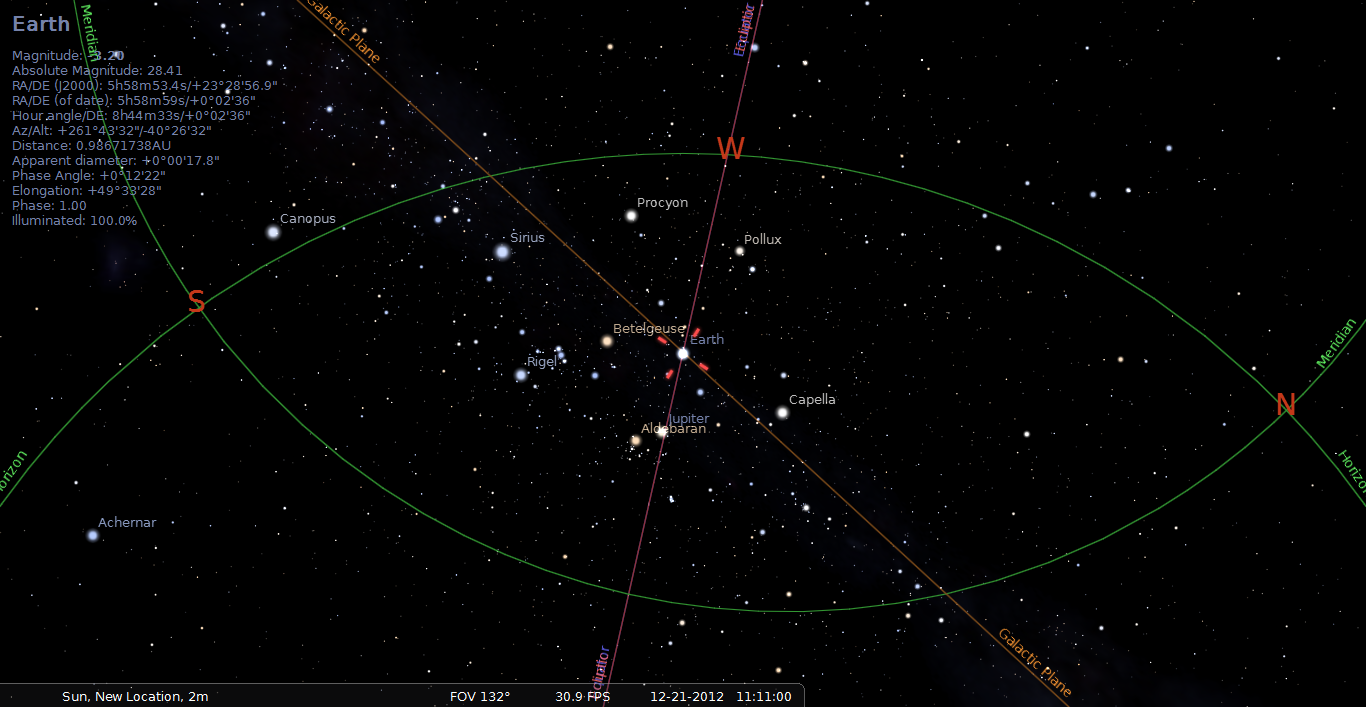
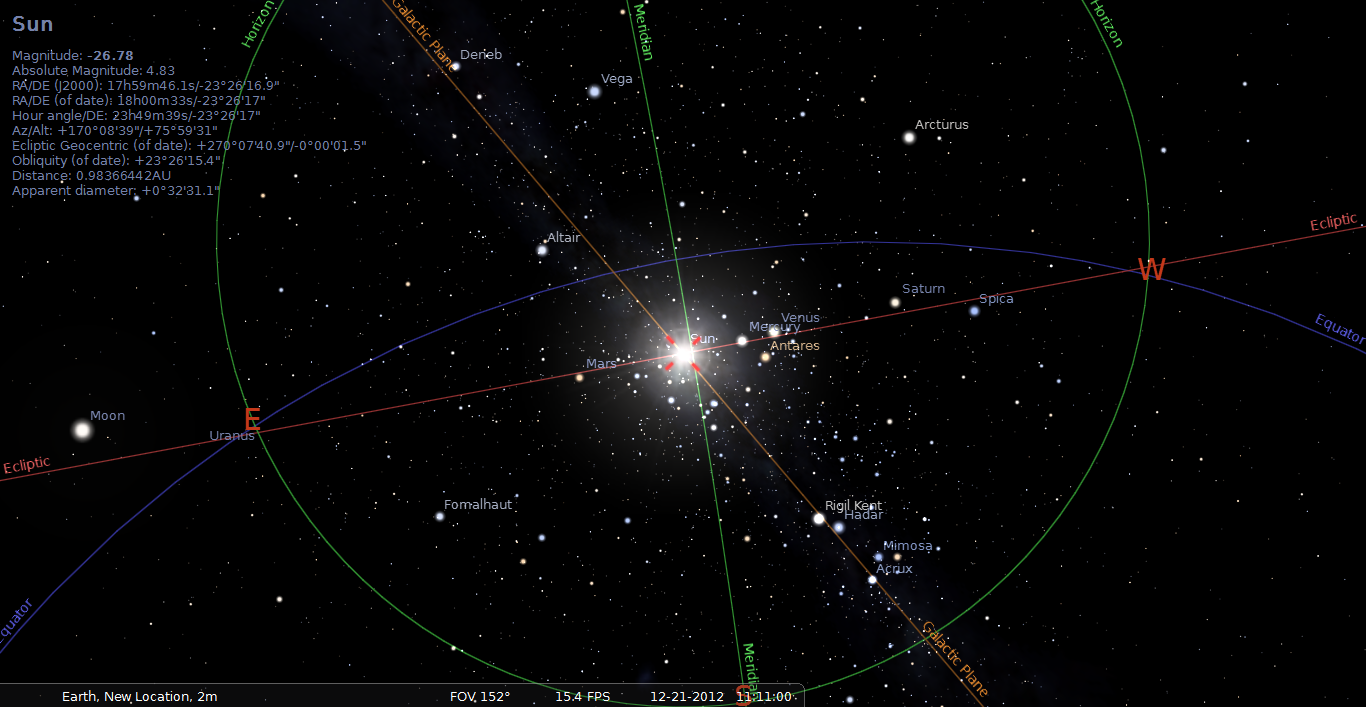
In regards to the solstice intersection with the dark rift and the galactic plane, that is true.
As to Sirius, there could be a relationship.
In regards to the solstice intersection with the dark rift and the galactic plane, that is true.
Originally posted by BrokenAngelWings33
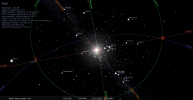
Anyway, here is a picture or 2 that I found interesting to share with you...
From the Sun...see what I see here?
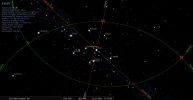
The alignment you were asking for I think...
edit on 14-12-2012 by NewAgeMan because: (no reason given)
new topics
-
Hate makes for strange bedfellows
US Political Madness: 1 hours ago -
Who guards the guards
US Political Madness: 4 hours ago -
Has Tesla manipulated data logs to cover up auto pilot crash?
Automotive Discussion: 6 hours ago -
whistleblower Captain Bill Uhouse on the Kingman UFO recovery
Aliens and UFOs: 11 hours ago
top topics
-
CIA botched its handling of sexual assault allegations, House intel report says
Breaking Alternative News: 16 hours ago, 11 flags -
whistleblower Captain Bill Uhouse on the Kingman UFO recovery
Aliens and UFOs: 11 hours ago, 10 flags -
Hate makes for strange bedfellows
US Political Madness: 1 hours ago, 9 flags -
Who guards the guards
US Political Madness: 4 hours ago, 8 flags -
1980s Arcade
General Chit Chat: 13 hours ago, 5 flags -
Teenager makes chess history becoming the youngest challenger for the world championship crown
Other Current Events: 15 hours ago, 4 flags -
Deadpool and Wolverine
Movies: 14 hours ago, 4 flags -
Has Tesla manipulated data logs to cover up auto pilot crash?
Automotive Discussion: 6 hours ago, 2 flags
active topics
-
Candidate TRUMP Now Has Crazy Judge JUAN MERCHAN After Him - The Stormy Daniels Hush-Money Case.
Political Conspiracies • 684 • : Threadbarer -
Hate makes for strange bedfellows
US Political Madness • 13 • : ImagoDei -
How ageing is" immune deficiency"
Medical Issues & Conspiracies • 27 • : RookQueen2 -
whistleblower Captain Bill Uhouse on the Kingman UFO recovery
Aliens and UFOs • 14 • : alldaylong -
"We're All Hamas" Heard at Columbia University Protests
Social Issues and Civil Unrest • 234 • : KrustyKrab -
IDF Intel Chief Resigns Over Hamas attack
Middle East Issues • 42 • : TheWoker -
Deadpool and Wolverine
Movies • 4 • : FlyersFan -
British TV Presenter Refuses To Use Guest's Preferred Pronouns
Education and Media • 113 • : Consvoli -
Fast Moving Disc Shaped UFO Captured on Camera During Flight from Florida to New York City
Aliens and UFOs • 20 • : MaximusNewmanus -
1980s Arcade
General Chit Chat • 14 • : ATruGod