It looks like you're using an Ad Blocker.
Please white-list or disable AboveTopSecret.com in your ad-blocking tool.
Thank you.
Some features of ATS will be disabled while you continue to use an ad-blocker.

Why don't you believe? (@Non-Believers and Skeptics)
page: 25share:
Originally posted by theabsolutetruth
reply to post by Unidentified_Objective
Do your own research.
Oh I have...I was hoping for an example that has escaped me.
reply to post by Evanzsayz
I never believed in alien abductions until I experienced something, nor UFO until I witnessed those too.
In fact I thought it was a Hollywood style stunt craft, I soon realised it wasn't a stunt craft, it was real.
Sometimes only experience will prove things truly.
I never believed in alien abductions until I experienced something, nor UFO until I witnessed those too.
In fact I thought it was a Hollywood style stunt craft, I soon realised it wasn't a stunt craft, it was real.
Sometimes only experience will prove things truly.
edit on 26-11-2012 by theabsolutetruth because: (no reason given)
Originally posted by AceWombat04
Originally posted by paladinah
People don't believe because they've been brainwashed into thinking they don't want to believe. Look around you - the average man in a more economically developed country is ignorant: they take just about everything in life for granted. This should not be - everyone must have the innovation and intuition for greater understanding of the universe, and yet people seem to be restricted to only what goes on in our failure of a planet. It really is depressing thinking about the amount of people who mock the idea of UFOs and inter-dimensional beingsedit on 26-11-2012 by paladinah because: changed 'an' to 'a'
While I can't speak for everyone, this is not strictly true. No one has convinced me that I don't want to believe. On the contrary, I am not persuaded by the available evidence to believe in spite of the overwhelming desire - even need - to believe. I am actually, on some level, depriving myself of contentment in life by not simply believing.
I used to believe in many things when I was younger. Like many here, I read a veritable library worth of literature on UFOs and the alien abduction phenomenon. I even ended up doing some hands-on research into a family member's experiences. I, too, used to hold the view that skeptics were simply closed minded; that they could not or would not allow themselves to see the larger, less finite reality that I was open to. But this is not necessarily the case.
As I learned more and more over the years, I began to see contradictions, inconsistencies, the possibility of fraud and charlatans, and at times even outright lies on the part of so-called experiencers. I began to see people deluding themselves into believing events would come to pass in connection with their experiences that never did. I began to see a lack of rigor in investigations into such phenomena, and started asking myself hard, uncomfortable, but necessary questions. And I began to search in earnest for real, hard proof of these experiences. I was extremely disillusioned to find that in all but a few exceptional cases, there was none. And even more so, that there were alternative explanations which could entirely account for a great many of the experiences reported.
That was many years ago. Since that time, I have become far more skeptical. But my deep, profound, longing for something like this to truly exist and be experienced, has not diminished. My skepticism exists in spite of that longing. A large part of me will never be fulfilled or happy until something like this is experienced and known to be true, as I suspect is the case for many here. But that is all the more reason for my skepticism. It prevents me from falling into the trap of confirmation bias, assumption, and providing myself with what I so desperately crave but have yet to discover.
In my experience, there are a small number of cases - mostly UFO sightings corroborated by radar and credible witnesses, but some abduction scenarios as well - which cannot be explained or accounted for, except in the most theoretical of ways. I am open minded. I believe it is possible that people have had the encounters they believe they have, or claim to have. And I have even had my own experiences for which I lack explanation. And no, proof does not mean I have to shake hands with an alien, and I do not accuse experiencers of being liars or frauds unless I have proof of that. And, lastly, I do have my own personal spiritual beliefs, if you wish to call them that. I simply delineate between belief and knowledge, i.e. my beliefs could be wrong.
But until I do see what amounts to proof by my standards, I cannot accept on faith, inconclusive photography, and testimony alone that these entities and their technology are visiting our planet (or our dimension, if you're an adherent of the interdimensional hypothesis.) Again, not because I'm brainwashed and don't want to believe. But rather, because I do want to. If you only knew how badly I do, you would not say that skeptics don't want to believe...
Peace.edit on 11/26/2012 by AceWombat04 because: Typos
Bravo!!! excellent post. I could not have summed my feelings up on this matter any better. What you expressed was almost exactly how i feel. I want it to be real as bad as anyone, but i won't delude myself by accepting the evidence thats out there,when most have been proven hoax or had a earthly explanation for them. For the ones that have not been debunked yet, those are what make me a believing skeptic, not just a total non-believer.
It's obvious, because the world is full of liars, at this time.
What EXACTLY did you experienced when you refer to someting ?
Originally posted by theabsolutetruth
reply to post by Evanzsayz
I never believed in alien abductions until I experienced something, nor UFO until I witnessed those too.
In fact I thought it was a Hollywood style stunt craft, I soon realised it wasn't a stunt craft, it was real.
Sometimes only experience will prove things truly.edit on 26-11-2012 by theabsolutetruth because: (no reason given)
I am a firm believer in the ETH based on my own experiences, however I am often labelled as a skeptic simply because I question and dig deeper into
every piece of evidence I see, whether it be witness testimony, video, or documents.
People will often say, "I thought you were a believer?"...well yes, I am, however I don't (or attempt not to) allow my drive to find "Exhibit A" to bias my discernment of evidence.
There is an extravagant abundance of well-produced CGI videos available and I try not to jump headlong down every rabbit hole like the famous bunny in Alice in Wonderland.
People will often say, "I thought you were a believer?"...well yes, I am, however I don't (or attempt not to) allow my drive to find "Exhibit A" to bias my discernment of evidence.
There is an extravagant abundance of well-produced CGI videos available and I try not to jump headlong down every rabbit hole like the famous bunny in Alice in Wonderland.
Originally posted by theabsolutetruth
I am well educated, completely sane, respected, learned individual, free thinking, non herd mentality, feet firmly on the ground, logical realist that has experiences that leads me to believe 100% that extraterrestrial intelligent life exists, statistically the vastness of the universe allows for this reality, as does quantum mechanics and astrophysics to name a few aspects of science.
No intelligent person could ever allow themselves to believe in the existence of alien life with 100 percent certainty. Not until it is PROVEN WITH 100 percent certainty that life outside of earth exist.
Take a look for example at Cern (LHC) and their two teams Atlas and Cms. Their scientists are STILL accumulating more evidence as possible to prove beyond a shadow of a doubt that Boson Higgs field and its subatomic particle are REAL.
Also I don’t understand what astrophysics and quantum physics have in common aside from being separate scientific fields? How quantum mechanics proves that extra-terrestrial beings are visiting our planet?
reply to post by synchronomy
Exactly! I have yet to see ONE video of a real UFO. How can someone videotaping an object thousands of miles away know for certain that what they are videotaping is a UFO and nothing more than a fighter jet or an oil rig. There is no way for anyone to prove anything conclusive about an objects which are moving or hanging thousands of miles away, even if that someone was top expert in their field. What I am trying to say is this ... Photographic evidence are not a good tool to prove alien existence. End of story.
Exactly! I have yet to see ONE video of a real UFO. How can someone videotaping an object thousands of miles away know for certain that what they are videotaping is a UFO and nothing more than a fighter jet or an oil rig. There is no way for anyone to prove anything conclusive about an objects which are moving or hanging thousands of miles away, even if that someone was top expert in their field. What I am trying to say is this ... Photographic evidence are not a good tool to prove alien existence. End of story.
Been following an interesting (sometimes heated) discussion. Felt no real need to chime in until now as the debaters have been articulating their
points quite well.
Thanks to all on both sides of the fence (and upon it) for increasing awareness and dialogue on a subject worthy of the attention given it.
A bit of hypocrisy is emerging, however, from the OP and others, that is disturbing in that it seems to serve only to alienate (pun intended) their objective and contradicts the premise of the argument. In fact, was not this supposed to be a simple inquiry among skeptics as to why they may not believe? Instead, the inquiry has digressed in many cases to an inquisition, with criticism and insult thrown in as a means to ...what end? Why insult the skeptics if you simply wish to learn their reasoning for disbelief?
Like many other respondents, I consider myself an "alien-agnostic". We simply do not yet know the truth. Like many legends, myths, religious figures and other entities, it would be quite intriguing, wonderful even, should their existence, along with EBE's be confirmed. We patiently (or not so patiently) await the "big day".
Until that time, our skepticism should not be ridiculed. Most of us have little interest in ridiculing others simply because they believe. Actually, in my opinion, such belief is a healthy, natural part of the process of getting to the truth. And I welcome believers with open arms.
Yet, I am dismayed that sometimes such belief is so strong that it transcends honesty and undergoes a metamorphosis such that some believers resort to insulting non-believers (or agnostics like me), 'fabricating evidence', attempting to 'indoctrinate' the gullible to increase their numbers, and other nefarious actions. The plethora of hoaky, poorly-devised YouTube videos on phony UFO's and goofy aliens are increasingly flagrant examples of this mentality.
What is so wrong with being skeptical? Some make it sound as if this makes us "enemies" of the believers. We are not! We are simply stating that in our minds we have not yet been presented with evidence that is strong enough to convince us, without a doubt, that aliens exist or that UFOs are of extraterrestrial origin. There may be plenty of circumstantial and truly incredible quantities of anecdotal evidence to lend itself to their existence - but no empirical evidence. You may chide me for insisting that an alien come up to me and shake my hand or land a craft in my backyard before I am convinced - but why are believers so incensed at the idea?
Sure - the governments of the world MAY have evidence of aliens and their ships. I suppose that's possible. But I have not been invited to see such things first-hand for myself.
Yes, indeed, it MAY be possible that some individuals on this Earth have been contacted, perhaps abducted, communicated with telepathically or otherwise. We are not saying these things did NOT happen or that they are impossible, or that such experiencers are lying. It is just that we ourselves have not had the same privilege as yet, and so can not confirm that such things have occurred.
Nor are we suggesting that the myriad examples of UFO sightings and recordings as witnessed by professionals and lay people from all walks of life, over decades, centuries perhaps, even millenia include none that are of alien or extraterrestrial origin. In some cases the events seem overwhelmingly in favor of just such a conclusion. Nevertheless, the general public at least (including every scientific and academic body on the planet), has not a single, bona fide, craft or device that we are able to examine for ourselves.
Surely among the thousands or tens of thousands of sightings, we can expect JUST ONE that we can view up close, let alone touch. Where are they? Why have we not been able to do so? Forget the White House lawn. How about landing a single craft at any University in the world, any crowded public park, or, better yet, in the middle of a big-city freeway intersection at rush hour? Trust me - such an event would instantly turn legions of skeptics and agnostics into believers!
So keep the discussion moving along - and thanks to all who are posting their heart-felt replies and comments. Even with the occasional animosity, it is a worthwhile discourse, and reveals much about the psyche of the conundrum we all face - skeptics and believers alike.
The bottom line is this: We are either alone in the universe or we are not. It is an either/or enigma. The most intriguing thing about it is that regardless of which answer ULTIMATELY PROVES to be true - it will mean profound changes and adjustments to humanity. That day has not yet come.
I just hope I learn which answer is UNDENIABLY correct (to me) before I pass from this Earth...
One day, MAYBE:
Thanks, ALL -Happy Searching...!
Thanks to all on both sides of the fence (and upon it) for increasing awareness and dialogue on a subject worthy of the attention given it.
A bit of hypocrisy is emerging, however, from the OP and others, that is disturbing in that it seems to serve only to alienate (pun intended) their objective and contradicts the premise of the argument. In fact, was not this supposed to be a simple inquiry among skeptics as to why they may not believe? Instead, the inquiry has digressed in many cases to an inquisition, with criticism and insult thrown in as a means to ...what end? Why insult the skeptics if you simply wish to learn their reasoning for disbelief?
Like many other respondents, I consider myself an "alien-agnostic". We simply do not yet know the truth. Like many legends, myths, religious figures and other entities, it would be quite intriguing, wonderful even, should their existence, along with EBE's be confirmed. We patiently (or not so patiently) await the "big day".
Until that time, our skepticism should not be ridiculed. Most of us have little interest in ridiculing others simply because they believe. Actually, in my opinion, such belief is a healthy, natural part of the process of getting to the truth. And I welcome believers with open arms.
Yet, I am dismayed that sometimes such belief is so strong that it transcends honesty and undergoes a metamorphosis such that some believers resort to insulting non-believers (or agnostics like me), 'fabricating evidence', attempting to 'indoctrinate' the gullible to increase their numbers, and other nefarious actions. The plethora of hoaky, poorly-devised YouTube videos on phony UFO's and goofy aliens are increasingly flagrant examples of this mentality.
What is so wrong with being skeptical? Some make it sound as if this makes us "enemies" of the believers. We are not! We are simply stating that in our minds we have not yet been presented with evidence that is strong enough to convince us, without a doubt, that aliens exist or that UFOs are of extraterrestrial origin. There may be plenty of circumstantial and truly incredible quantities of anecdotal evidence to lend itself to their existence - but no empirical evidence. You may chide me for insisting that an alien come up to me and shake my hand or land a craft in my backyard before I am convinced - but why are believers so incensed at the idea?
Sure - the governments of the world MAY have evidence of aliens and their ships. I suppose that's possible. But I have not been invited to see such things first-hand for myself.
Yes, indeed, it MAY be possible that some individuals on this Earth have been contacted, perhaps abducted, communicated with telepathically or otherwise. We are not saying these things did NOT happen or that they are impossible, or that such experiencers are lying. It is just that we ourselves have not had the same privilege as yet, and so can not confirm that such things have occurred.
Nor are we suggesting that the myriad examples of UFO sightings and recordings as witnessed by professionals and lay people from all walks of life, over decades, centuries perhaps, even millenia include none that are of alien or extraterrestrial origin. In some cases the events seem overwhelmingly in favor of just such a conclusion. Nevertheless, the general public at least (including every scientific and academic body on the planet), has not a single, bona fide, craft or device that we are able to examine for ourselves.
Surely among the thousands or tens of thousands of sightings, we can expect JUST ONE that we can view up close, let alone touch. Where are they? Why have we not been able to do so? Forget the White House lawn. How about landing a single craft at any University in the world, any crowded public park, or, better yet, in the middle of a big-city freeway intersection at rush hour? Trust me - such an event would instantly turn legions of skeptics and agnostics into believers!
So keep the discussion moving along - and thanks to all who are posting their heart-felt replies and comments. Even with the occasional animosity, it is a worthwhile discourse, and reveals much about the psyche of the conundrum we all face - skeptics and believers alike.
The bottom line is this: We are either alone in the universe or we are not. It is an either/or enigma. The most intriguing thing about it is that regardless of which answer ULTIMATELY PROVES to be true - it will mean profound changes and adjustments to humanity. That day has not yet come.
I just hope I learn which answer is UNDENIABLY correct (to me) before I pass from this Earth...
One day, MAYBE:

Thanks, ALL -Happy Searching...!
edit on 11/26/2012 by Outrageo because:
Einstein rejected the label atheist, which he associated with certainty regarding God's nonexistence. Einstein stated: "I have repeatedly said that in my opinion the idea of a personal God is a childlike one. You may call me an agnostic, but I do not share the crusading spirit of the professional atheist whose fervor is mostly due to a painful act of liberation from the fetters of religious indoctrination received in youth. I prefer an attitude of humility corresponding to the weakness of our intellectual understanding of nature and of our own being."[1] According to Prince Hubertus, Einstein said, "In view of such harmony in the cosmos which I, with my limited human mind, am able to recognize, there are yet people who say there is no God. But what really makes me angry is that they quote me for the support of such views."[16] Einstein had previously explored the belief that man could not understand the nature of God. In an interview published in 1930 in G. S. Viereck's book Glimpses of the Great, Einstein, in response to a question about whether or not he believed in God, explained:
Your question [about God] is the most difficult in the world. It is not a question I can answer simply with yes or no. I am not an Atheist. I do not know if I can define myself as a Pantheist. The problem involved is too vast for our limited minds. May I not reply with a parable?The human mind, no matter how highly trained, cannot grasp the universe. We are in the position of a little child, entering a huge library whose walls are covered to the ceiling with books in many different tongues. The child knows that someone must have written those books. It does not know who or how. It does not understand the languages in which they are written. The child notes a definite plan in the arrangement of the books, a mysterious order, which it does not comprehend, but only dimly suspects. That, it seems to me, is the attitude of the human mind, even the greatest and most cultured, toward God. We see a universe marvelously arranged, obeying certain laws, but we understand the laws only dimly. Our limited minds cannot grasp the mysterious force that sways the constellations. I am fascinated by Spinoza's Pantheism. I admire even more his contributions to modern thought. Spinoza is the greatest of modern philosophers, because he is the first philosopher who deals with the soul and the body as one, not as two separate things.
en.wikipedia.org...
Underlining is my doing to highlight my point.
We are mere children born upon this great vastness of knowledge.
reply to post by Outrageo
Just wanted to let you know how much I liked your post. Thank you for taking your time to summarize your thought to us.
Just wanted to let you know how much I liked your post. Thank you for taking your time to summarize your thought to us.
What bothers me a lot is the fact that they hence BELIEVERS expect us to believe. Why should anyone be expected to believe in anything in the first
place? I feel offended when I come to think that some shmock who never got his high school diploma is expecting me or you to believe in something and
then is puzzled and even bothered when I am not. Worse, I am being called sheep because apparently I am too blind to see the truth. I am not good
enough to meet aliens because my soul does not resonate with their vibrations. Sounds familial? Take for example those Christians who deem everyone to
hell. If you do not believe in Jesus you are a an abomination to god and therefore your place is in hell. See any similarities here with New Age
religion? Practically everything is if you replaced God with Aliens, heave and hell with different vibrations (low / high).
Originally posted by stanislav
See any similarities here with New Age religion? Practically everything is if you replaced God with Aliens, heave and hell with different vibrations (low / high).
That is because belief that aliens have come and visited, abducted people etc IS just a religion. There is zero evidence for aliens, it is all a faith thing. The op believes in aliens, so everyone else is beneath him.
Originally posted by hellobruce
Originally posted by stanislav
See any similarities here with New Age religion? Practically everything is if you replaced God with Aliens, heave and hell with different vibrations (low / high).
That is because belief that aliens have come and visited, abducted people etc IS just a religion. There is zero evidence for aliens, it is all a faith thing. The op believes in aliens, so everyone else is beneath him.
Well said mate bravo..

Originally posted by theabsolutetruth
reply to post by Unidentified_Objective
Do your own research.
Ha!
Typical answer from a believer.
Ask for evidence and you either get a bunch of pseudo-science Youtube charlatan links, or, an answer similar as above.
When asked for evidence on my own position, I'm more than happy to provide:
The majority of Alien Contact reports and claims can be described and attributed to subject specific personally subjective Psychological Phenomenon experiences.
Such stance is supported by:
The Psychology of Alien Contact and Abduction Claims
The Construction of Space Alien Abduction Memories
The Ordinary Nature of Alien Abduction Memories
Memory Distortion in People Reporting Abduction by Aliens
Transcultural Psychiatry - Sleep Paralysis, Sexual Abuse, and Space Alien Abduction
as well as many other well documented citations, and papers listed in the public domain on the subject.
Further, as supported by above documentation and other studies conducted regarding the phenomenon, the majority of Alien Abduction accounts can be accounted for by Schizotypy and/or Schizotypal Personality Disorder (SPD) as well as several other classifications.
Space aliens are inside your head.
At least that's what the data indicates.
Feel free to read any and/or all of the papers cited. They support each other, and don't come from any one single source.
I challenge any Space Alien believer to provide even half the evidence I've provided.
Of extra note, in these citations, Space Alien encounters can even be replicated predictably in the lab since they're all attributable to Psychological phenomenon.
You may, or may not have seen all this posted before, but, i post the above links often enough as it's important to illustrate the Psycho-Social model that described the majority of Space Alien encounters.
We're human, and all wired essentially the same, so, under certain neuro-chemical conditions it's no surprise many people see the same thing.
Similar neuro-chemical states equal simialr experiences, just like taking an aspirin or any drug has predictable results.
edit on 26-11-2012 by Druscilla because: (no reason given)
reply to post by Druscilla
Given life on Earth and the size of the universe, it is not unreasonable to infer the existence of alien life. Even intelligent alien life seems much more probable than not.
I'd say the probability of alien existence is high enough where I would feel quite comfortable believing it to be fact.
You're right that anecdotal evidence doesn't hold.
But I think it's worth considering that inference and extrapolation are viable techniques in painting one's picture of the universe.
Given life on Earth and the size of the universe, it is not unreasonable to infer the existence of alien life. Even intelligent alien life seems much more probable than not.
I'd say the probability of alien existence is high enough where I would feel quite comfortable believing it to be fact.
You're right that anecdotal evidence doesn't hold.
But I think it's worth considering that inference and extrapolation are viable techniques in painting one's picture of the universe.
Cave man paintings doodling at first then modern man took ideas of thier own then revert
back to the paintings as proof .. it's the catch that seems to sucker in everyone by the charlatans.
back to the paintings as proof .. it's the catch that seems to sucker in everyone by the charlatans.
Originally posted by PatrickGarrow17
reply to post by Druscilla
Given life on Earth and the size of the universe, it is not unreasonable to infer the existence of alien life. Even intelligent alien life seems much more probable than not.
I'd say the probability of alien existence is high enough where I would feel quite comfortable believing it to be fact.
You're right that anecdotal evidence doesn't hold.
But I think it's worth considering that inference and extrapolation are viable techniques in painting one's picture of the universe.
I don't disagree that in a universe with over 500 Billion Galaxies, with each galaxy averaging between 200-700 Billion stars, there is indeed the possibility for BILLIONS of advanced technological civilizations to be extant, thriving and rampant all over the universe.
On the other hand, the Universe is VAST. The very same statistics that give positive indication of probability for life elsewhere is the very same thing that makes it almost impossibly improbable that any single intelligent technologically advanced culture anywhere in the universe at any time frame (important) will encounter any other culture.
Take our galaxy of some 300-500 Billion stars, just our galaxy alone as an example.
If you could travel instantaneously to every single star in just our galaxy, and you stayed at each star for just ONE SECOND, it would take you over 12,000 years to explore the whole of our galaxy. that's just our one little average sized galaxy out of hundreds of billions of other large and small galaxies all over the universe.
If you were to do the same thing as I just illustrated for every single star in the universe, it would take you longer to explore the entire universe than the universe is old many many many times over.
The Universe is VAST.
Thus, sure, there could actually BE a Galaxy from a long time ago Far Far Away where there really are Jedis, Sith, and stormtroopers that can't hit anything in a constant mythical struggle for domination of their galaxy.
the universe, however, is so Vast, we'll likely never know.
Even if we were to accidentally stumble across an area that at one time was inhabited by an alien culture, time is a wonky thing such that they could be long long gone and extinct.
As far as aliens visiting here ... if they even could find us by accident, well, it'd probably be something like this:
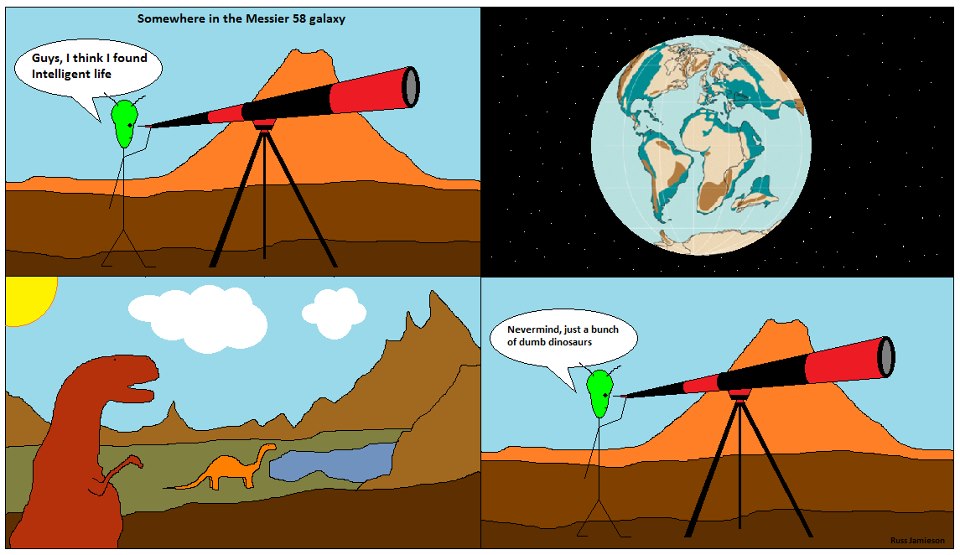
Thus, there's not only space as far as distances to consider, but, there's also very importantly Time as a matter of just the right lucky finite flash of time to actually stumble onto a culture when a culture is alive and active, and at least on such a level that you can actually say "hello".
And for people who claim that our universe is so vast that it is impossible for us to be the only intelligent life in this universe. I have an answer
to your ambiguous question. It's called Fermi paradox. READ IT AND LEARN SOMETHING! After reading it thoroughly you will never ask again why aliens
are not visiting planet earth.
en.wikipedia.org...
en.wikipedia.org...
The basic points of the argument, made by physicists Enrico Fermi and Michael H. Hart, are: The Sun is a young star. There are billions of stars in the galaxy that are billions of years older; Some of these stars likely have Earth-like planets[2] which, if the Earth is typical, may develop intelligent life; Presumably some of these civilizations will develop interstellar travel, as Earth seems likely to do; At any practical pace of interstellar travel, the galaxy can be completely colonized in just a few tens of millions of years. According to this line of thinking, the Earth should have already been colonized, or at least visited. But no convincing evidence of this exists. Furthermore, no confirmed signs of intelligence elsewhere have been spotted, either in our galaxy or the more than 80 billion other galaxies of the observable universe. Hence Fermi's question "Where is everybody?".
edit on 26-11-2012 by stanislav because: (no reason given)
edit on 26-11-2012 by stanislav because: (no reason
given)
new topics
-
That which the "news" never talks about; Truth about election fraud
Mainstream News: 16 minutes ago -
Biden doesnt want the votes of "Death to America" chanters
US Political Madness: 23 minutes ago -
Horizon Post office scandal
Regional Politics: 1 hours ago -
Joe Biden and Donald Trump are both traitors
US Political Madness: 3 hours ago -
I'm new here. Avid conspiracy fan.
Introductions: 3 hours ago -
Denmark's Notre-Dame moment - 17th Century Borsen goes up in Flames
Mainstream News: 4 hours ago
top topics
-
Suspected Iranian agent working for Pentagon while U.S. coordinated defense of Israel
US Political Madness: 12 hours ago, 16 flags -
The Baloney aka BS Detection Kit
Social Issues and Civil Unrest: 12 hours ago, 7 flags -
Denmark's Notre-Dame moment - 17th Century Borsen goes up in Flames
Mainstream News: 4 hours ago, 4 flags -
That which the "news" never talks about; Truth about election fraud
Mainstream News: 16 minutes ago, 4 flags -
How does my computer know
Education and Media: 15 hours ago, 3 flags -
I'm new here. Avid conspiracy fan.
Introductions: 3 hours ago, 3 flags -
Joe Biden and Donald Trump are both traitors
US Political Madness: 3 hours ago, 2 flags -
Horizon Post office scandal
Regional Politics: 1 hours ago, 1 flags -
Biden doesnt want the votes of "Death to America" chanters
US Political Madness: 23 minutes ago, 0 flags
active topics
-
Abortions in first 12 weeks should be legalised in Germany, commission says
Medical Issues & Conspiracies • 18 • : Consvoli -
That which the "news" never talks about; Truth about election fraud
Mainstream News • 1 • : watchitburn -
Joe Biden and Donald Trump are both traitors
US Political Madness • 34 • : andy06shake -
Biden doesnt want the votes of "Death to America" chanters
US Political Madness • 1 • : Disgusted123 -
Candidate TRUMP Now Has Crazy Judge JUAN MERCHAN After Him - The Stormy Daniels Hush-Money Case.
Political Conspiracies • 239 • : matafuchs -
How does my computer know
Education and Media • 18 • : MrGashler -
It has begun... Iran begins attack on Israel, launches tons of drones towards the country
World War Three • 746 • : CriticalStinker -
Truth Social goes public, be careful not to lose your money
Mainstream News • 114 • : matafuchs -
NYAG Letitia James Prepares to Begin Seizing TRUMP Assets Even Though There Was No Crime.
Above Politics • 285 • : matafuchs -
Anti-Israel Protesters in CHICAGO Chant 'Death to Israel and 'Death to America'
Social Issues and Civil Unrest • 43 • : ARM19688