It looks like you're using an Ad Blocker.
Please white-list or disable AboveTopSecret.com in your ad-blocking tool.
Thank you.
Some features of ATS will be disabled while you continue to use an ad-blocker.

Earth's Clouds Are Getting Lower
page: 1share:
Greetings, ATS!
Last week I was listening to NPR and they had an interesting story about the clouds covering our planet. According to the reporter, the average height of clouds has been getting lower over the past few years.
That was the extent of the story, so I did a little digging. Here's what I've found:
Science Daily
Scientists have only recently (past decade) begun to study this phenomenon, so its premature to make long-term predictions.
If the clouds are indeed lowering, what effect can we expect?
So if we combine this information with the information about the solar hibernation, does it indicate a higher possiblilty for a cooling trend in the future?
Last week I was listening to NPR and they had an interesting story about the clouds covering our planet. According to the reporter, the average height of clouds has been getting lower over the past few years.
That was the extent of the story, so I did a little digging. Here's what I've found:
Science Daily
The study, published recently in the journal Geophysical Research Letters, revealed an overall trend of decreasing cloud height. Global average cloud height declined by around one percent over the decade, or by around 100 to 130 feet (30 to 40 meters). Most of the reduction was due to fewer clouds occurring at very high altitudes.
Scientists have only recently (past decade) begun to study this phenomenon, so its premature to make long-term predictions.
If the clouds are indeed lowering, what effect can we expect?
A consistent reduction in cloud height would allow Earth to cool to space more efficiently, reducing the surface temperature of the planet and potentially slowing the effects of global warming. This may represent a "negative feedback" mechanism -- a change caused by global warming that works to counteract it. "We don't know exactly what causes the cloud heights to lower," says Davies. "But it must be due to a change in the circulation patterns that give rise to cloud formation at high altitude."
So if we combine this information with the information about the solar hibernation, does it indicate a higher possiblilty for a cooling trend in the future?
Originally posted by smyleegrl
If the clouds are indeed lowering, what effect can we expect?
...Fog?
Just teasing mate, I was on a plane this week and thought that looking down onto clouds was certainly an empowering feeling. Can't say for sure if they're getting lower or not, it seemed about like normal to me.
I would say, if true, then it would speed up the rate of warming and could account for some of the higher temps around. Nice find....S&F
Guess is would also depend on the density and actual coverage in the sky though.
Guess is would also depend on the density and actual coverage in the sky though.
edit on 9/24/12 by Vasa Croe because: (no reason
given)
reply to post by Vasa Croe
Apparently it will do the opposite, and make things cooler. Kinda is an oxymoron, which is what startled me. I always thought that clouds held the warmth in, so it's confusing.
Apparently it will do the opposite, and make things cooler. Kinda is an oxymoron, which is what startled me. I always thought that clouds held the warmth in, so it's confusing.
reply to post by smyleegrl
Clouds help to insulate the Earth - thicker clouds will keep more heat in the boundary layer. The article is suggesting a decrease in mean global cloud height (thickness) has been observed which effectively reduces the thickness of Earth's insulation. A cooling effect is the result of this.
Source
These feedback mechanisms seem to oscillate. 'Global warming' = warmer seas and more evaporation which leads to thicker clouds. More heat is trapped so there is more evaporation and clouds get thicker. Eventually they reach a critical point where the cloud albedo is so high that more sunlight is reflected than reaches the Earth's surface and we start to see a cooling effect. This leads to a decrease in the rate of water evaporation and we observe lowering cloud heights. As more sunlight starts to reach the surface the process starts over (more evaporation and increasing cloud thickness).
The amount of ice at the poles and high latitudes also plays an important role in global warming / cooling with similar feedback mechanisms regarding surface albedo and ice melt.
Clouds help to insulate the Earth - thicker clouds will keep more heat in the boundary layer. The article is suggesting a decrease in mean global cloud height (thickness) has been observed which effectively reduces the thickness of Earth's insulation. A cooling effect is the result of this.
...satellite data show that cloud optical thickness actually increases with increasing temperature. Whether the net effect is warming or cooling depends on details such as the type and altitude of the cloud; details that are difficult to represent in climate models.
Source
These feedback mechanisms seem to oscillate. 'Global warming' = warmer seas and more evaporation which leads to thicker clouds. More heat is trapped so there is more evaporation and clouds get thicker. Eventually they reach a critical point where the cloud albedo is so high that more sunlight is reflected than reaches the Earth's surface and we start to see a cooling effect. This leads to a decrease in the rate of water evaporation and we observe lowering cloud heights. As more sunlight starts to reach the surface the process starts over (more evaporation and increasing cloud thickness).
The amount of ice at the poles and high latitudes also plays an important role in global warming / cooling with similar feedback mechanisms regarding surface albedo and ice melt.
edit on 24/9/2012 by Fazza! because: (no reason given)
LINK
The study of clouds, where they occur, and their characteristics, play a key role in the understanding of climate change. Low, thick clouds primarily reflect solar radiation and cool the surface of the Earth. High, thin clouds primarily transmit incoming solar radiation; at the same time, they trap some of the outgoing infrared radiation emitted by the Earth and radiate it back downward, thereby warming the surface of the Earth. Whether a given cloud will heat or cool the surface depends on several factors, including the cloud's altitude, its size, and the make-up of the particles that form the cloud. The balance between the cooling and warming actions of clouds is very close although, overall, averaging the effects of all the clouds around the globe, cooling predominates.
pretty good description at link, as well as diagrams. Lowers clouds do lower temp. Thanks for sharing S&F from me
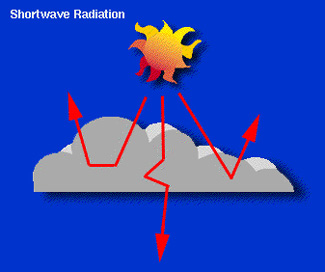
The shortwave rays from the Sun are scattered in a cloud. Many of the rays return to space. The resulting "cloud albedo forcing," taken by itself, tends to cause a cooling of the Earth.
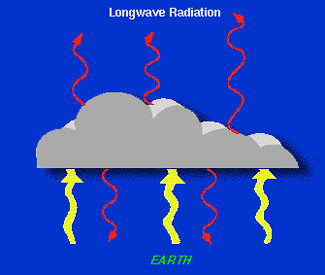
Longwave rays emitted by the Earth are absorbed and reemitted by a cloud, with some rays going to the surface. Thicker arrows indicate more energy. The resulting "cloud greenhouse forcing," taken by itself, tends to cause a warming of the Earth.
It would appear the planet is taking care of itself, no surprise there.
edit on 24-9-2012 by DIRTYDONKEY because: (no reason
given)
edit on 24-9-2012 by DIRTYDONKEY because: get it right
The whole climate thing is gonna blow up soon, it seems. We are getting unprecedented droughts in SE Europe.
I personaly believe the cause to be the ever increasing air traffic. The more airplanes leave exhaust particles, the more moisture gathers on them, disperses with winds, and less natural - rain making clouds can be formed. The same with the average height of clouds, the water particles are still there, but are dispersed unnaturaly and thus reduce cloud height.
If you are not traveling inter-continental, travel on ground! Cheap airplane tickets will be the ruin of us all.
I personaly believe the cause to be the ever increasing air traffic. The more airplanes leave exhaust particles, the more moisture gathers on them, disperses with winds, and less natural - rain making clouds can be formed. The same with the average height of clouds, the water particles are still there, but are dispersed unnaturaly and thus reduce cloud height.
If you are not traveling inter-continental, travel on ground! Cheap airplane tickets will be the ruin of us all.
I hope this is not due to atmosphere shrinkage. There was a lot of info about this in 2010... but can't find anything current.
Some articles about Atmosphere Shrinkage
And if it's true, could solar winds be the cause?
Link
Some articles about Atmosphere Shrinkage
And if it's true, could solar winds be the cause?
Solar wind controls nonthermal escape of planetary atmospheric volatiles, regardless of the strength of planetary magnetic fields.
Link
reply to post by badnickname
But wouldn't the water molecules still be in the atmosphere? so they would still be able to reform into natural clouds. Or where do you suppose they go? Just hanging on to the exhaust and gone forever?
But wouldn't the water molecules still be in the atmosphere? so they would still be able to reform into natural clouds. Or where do you suppose they go? Just hanging on to the exhaust and gone forever?
i dunno. according to this article cloud height can do different things depending on the variables. you can't just say "lower clouds mean
cooling" because that doesn't factor in anything else. i don't trust that lower clouds will cause cooling. we all know that a cloudy night
will retain warmth better than a clear night.
scroll down to the "clouds" section:
earthobservatory.nasa.gov...
scroll down to the "clouds" section:
earthobservatory.nasa.gov...
I think the clouds are lowering because the van allen radiation belt is coming down.
That will be fun when all that radiation is on the ground (this is why the gubbamints are building underground bases)
That will be fun when all that radiation is on the ground (this is why the gubbamints are building underground bases)
Here's a thread about an article from this past February talking about NASA's statement regarding the lower cloud tops.
www.abovetopsecret.com...
It seems this situation is being brought into the spotlight again and reinforced for some reason.
It seems this situation is being brought into the spotlight again and reinforced for some reason.
Originally posted by badnickname
The whole climate thing is gonna blow up soon, it seems. We are getting unprecedented droughts in SE Europe.
I personaly believe the cause to be the ever increasing air traffic. The more airplanes leave exhaust particles, the more moisture gathers on them, disperses with winds, and less natural - rain making clouds can be formed. The same with the average height of clouds, the water particles are still there, but are dispersed unnaturaly and thus reduce cloud height.
If you are not traveling inter-continental, travel on ground! Cheap airplane tickets will be the ruin of us all.
That's an interesting concept. I've heard my "better half" say almost the same thing. He also has a theory about the rapid heating of the atmosphere being affected by all of the things we keep sending into space and low orbit- everything from spaceships to satellites. He told me he thinks punching all these holes in the atmosphere are letting in more and more radiation from the sun which speeds the heating process. Who knows? Not I fore sure.
I did read somewhere that so many airplanes flying around nowdays is having a heating affect. I wish I remembered where I read it, but it's been awhile.
Originally posted by new_here
I hope this is not due to atmosphere shrinkage.
This is something I've been noticing every now and then for the last 40 - 50 years, but haven't mentioned to too many people because they might find it too off-the-wall. But I have noticed both together - that the clouds are getting slightly lower, and that when you see those beautiful pictures of the atmosphere from space, the band has become narrower since the 1960s. Obviously, it's necessary to compare pictures taken from similar angles and distances away. Cause - I don't know but all these theories are interesting.
Originally posted by Anthony2
Originally posted by new_here
I hope this is not due to atmosphere shrinkage.
This is something I've been noticing every now and then for the last 40 - 50 years, but haven't mentioned to too many people because they might find it too off-the-wall. But I have noticed both together - that the clouds are getting slightly lower, and that when you see those beautiful pictures of the atmosphere from space, the band has become narrower since the 1960s. Obviously, it's necessary to compare pictures taken from similar angles and distances away. Cause - I don't know but all these theories are interesting.
I think this is exactly why they may be focusing on fukushima and other nuclear plants. If natural background radiation spikes they will have bought enough time distracting us with nukes, and by the time we figure it out they'll have the doors locked...
I keep having dreams about rocks hitting the ground. They were exploding meteorites. I'm thinking if this is true about the atmosphere, then, it would be easier for space rocks to make it down to earth..
"The sky is falling.. The sky is falling!"
hehe
Isn't funny, contrails cool the planet, on 911 when they stopped air traffic the temp actually rose.
And now the clouds are lowering for us...
Wow, sure funny how things are happening that combat global warming in someway... yep... sure funny how thats happening.
Not like anyone can manipulate weather or anything...
And now the clouds are lowering for us...
Wow, sure funny how things are happening that combat global warming in someway... yep... sure funny how thats happening.
Not like anyone can manipulate weather or anything...
If the clouds are indeed lowering, what effect can we expect?
The thing is, the study didn't exactly find that clouds are "lowering".
www.sciencedaily.com...
Most of the reduction was due to fewer clouds occurring at very high altitudes.
Fewer high altitude clouds means a lower average cloud top height. That is what the study found.
The conclusion from the actual article:
Ten years is unfortunately too short a span for any definitive conclusion, as the linear trend in global cloud height of -44 +/- 22 m over the last decade is partly influenced by the La Niña event, and may prove ephemeral.
www.worldclimatereport.com...
Interesting chart there showing that the apparent trend was quite strongly influenced by La Nina. There is not enough data to indicate any trend at all but it does add another factor to demonstrate how complex the Earth's climate system is.
reply to post by Afterthought
The article in the OP is from February.
It seems this situation is being brought into the spotlight again and reinforced for some reason.
The article in the OP is from February.
reply to post by benrl
Who says contrails cools the planet?
No. The temperature did not actually rise when air traffic was stopped after the attacks. What one study found was that the diurnal temperature change became greater. The study found that contrails sort of stabilize the day/night change in temperature by an average of 1º, keeping it a bit warmer at night and a bit cooler during the day. No net warming or cooling effect was indicated by the study but it does reinforce other studies showing that contrails have a net warming effect.
Isn't funny, contrails cool the planet, on 911 when they stopped air traffic the temp actually rose.
Who says contrails cools the planet?
No. The temperature did not actually rise when air traffic was stopped after the attacks. What one study found was that the diurnal temperature change became greater. The study found that contrails sort of stabilize the day/night change in temperature by an average of 1º, keeping it a bit warmer at night and a bit cooler during the day. No net warming or cooling effect was indicated by the study but it does reinforce other studies showing that contrails have a net warming effect.
edit on 9/24/2012 by Phage because: (no reason given)
new topics
-
Former Labour minister Frank Field dies aged 81
People: 15 minutes ago -
SETI chief says US has no evidence for alien technology. 'And we never have'
Aliens and UFOs: 1 hours ago -
This is our Story
General Entertainment: 4 hours ago -
President BIDEN Vows to Make Americans Pay More Federal Taxes in 2025 - Political Suicide.
2024 Elections: 6 hours ago -
Ode to Artemis
General Chit Chat: 7 hours ago -
Ditching physical money
History: 11 hours ago -
One Flame Throwing Robot Dog for Christmas Please!
Weaponry: 11 hours ago -
Don't take advantage of people just because it seems easy it will backfire
Rant: 11 hours ago
top topics
-
University student disciplined after saying veganism is wrong and gender fluidity is stupid
Education and Media: 15 hours ago, 14 flags -
President BIDEN Vows to Make Americans Pay More Federal Taxes in 2025 - Political Suicide.
2024 Elections: 6 hours ago, 10 flags -
One Flame Throwing Robot Dog for Christmas Please!
Weaponry: 11 hours ago, 6 flags -
Should Biden Replace Harris With AOC On the 2024 Democrat Ticket?
2024 Elections: 12 hours ago, 6 flags -
Don't take advantage of people just because it seems easy it will backfire
Rant: 11 hours ago, 4 flags -
Ditching physical money
History: 11 hours ago, 4 flags -
SETI chief says US has no evidence for alien technology. 'And we never have'
Aliens and UFOs: 1 hours ago, 3 flags -
God lived as a Devil Dog.
Short Stories: 16 hours ago, 3 flags -
Ode to Artemis
General Chit Chat: 7 hours ago, 2 flags -
VirginOfGrand says hello
Introductions: 12 hours ago, 2 flags
active topics
-
The Superstition of Full Moons Filling Hospitals Turns Out To Be True!
Medical Issues & Conspiracies • 24 • : angelchemuel -
SETI chief says US has no evidence for alien technology. 'And we never have'
Aliens and UFOs • 13 • : andy06shake -
"We're All Hamas" Heard at Columbia University Protests
Social Issues and Civil Unrest • 266 • : KrustyKrab -
Former Labour minister Frank Field dies aged 81
People • 1 • : angelchemuel -
Russia Ukraine Update Thread - part 3
World War Three • 5720 • : Freeborn -
University student disciplined after saying veganism is wrong and gender fluidity is stupid
Education and Media • 32 • : BedevereTheWise -
So this is what Hamas considers 'freedom fighting' ...
War On Terrorism • 227 • : HopeForTheFuture -
Remember These Attacks When President Trump 2.0 Retribution-Justice Commences.
2024 Elections • 51 • : Justoneman -
British TV Presenter Refuses To Use Guest's Preferred Pronouns
Education and Media • 131 • : FlyersFan -
Spectrophilia - Women Who Have Had Affairs With Ghosts Say Spooks Are Better Lovers Than Real Men
Paranormal Studies • 30 • : FlyersFan