It looks like you're using an Ad Blocker.
Please white-list or disable AboveTopSecret.com in your ad-blocking tool.
Thank you.
Some features of ATS will be disabled while you continue to use an ad-blocker.

Ancient Stone Shaping and Setting
page: 1share:
When I view the ancient design and construction of stone buildings and walls whether it be the temples of South America to the walls of ancient Egypt
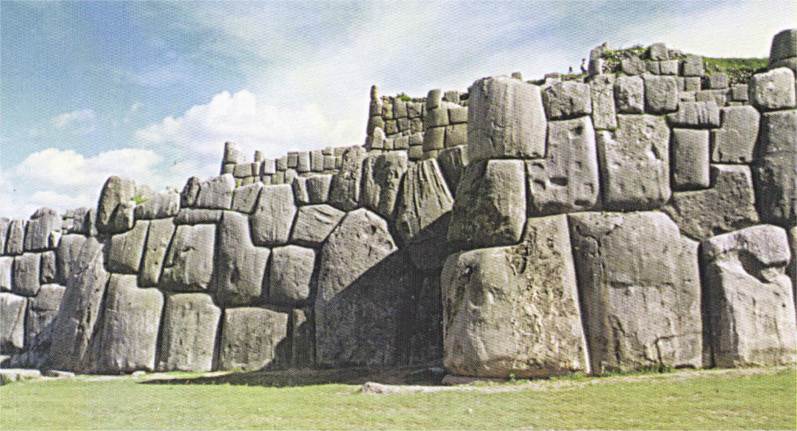
and Greece, I'm awestruck at the complexity of how the multi faceted stone seems to just "melt" together. Even more bewildering is the sheer size
and weight that many of these pieces of stone happen to be. Most of all, as somebody who works with stone for a living, I understand just how time
consuming and painstakingly awkward it is to be measuring, chipping, placing and removing SMALL blocks of stone in order to get this particular effect
for a wall. But these enormous pieces of stone have been made to perfectly fit, not just in a stacked uniform fashion (which is difficult enough), but
in what appears to be a completely random manner. It's one thing to say "But they had excellent mathematicians and engineers", but even with
"spot-on" measurements, there is still a large amount of fine tuning that needs to be done in order to get this effect. This involves placing,
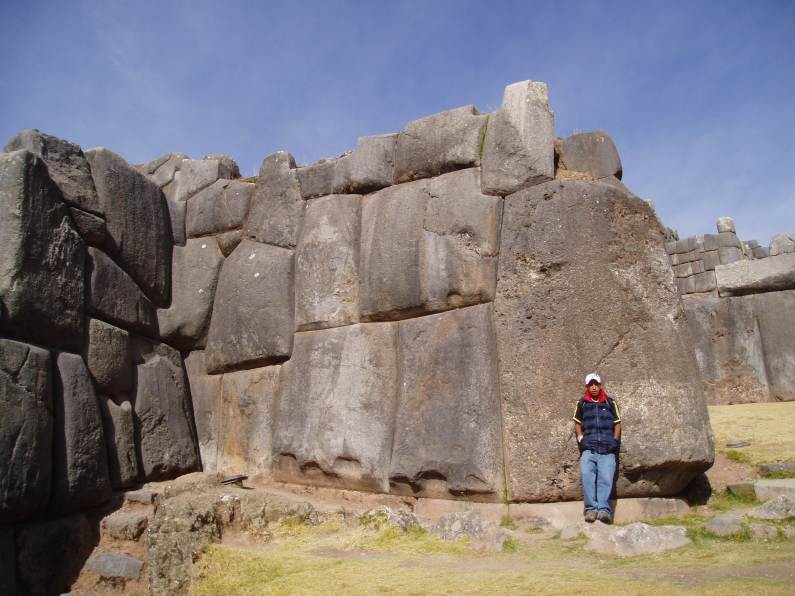
removing and trimming each piece of stone (often many times over), and with pieces that weigh anywhere from 20 to 200 tons on average, this truly is
extraordinary. I simply cannot fathom this being done with 200 ton blocks. Some pieces can even weigh in excess of 500
tons!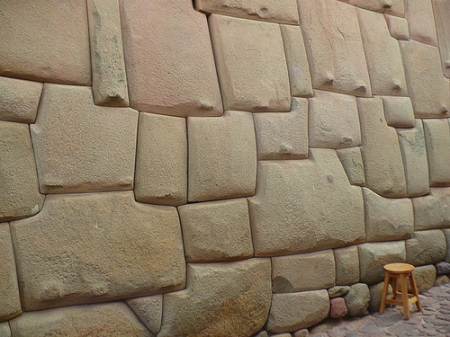
The argument that this was all achieved with lots of man power, levers and pulleys in order to cut, transport and lift these pieces into place, I disagree with. Sure, maybe for smaller pieces and more so in later times, what makes more sense to me is that this was accomplished using the lost or mostly forgotten techniques of stone softening and acoustic levitation. There is already several threads made on these two subjects, but I would like to combine the two methods and reinforce that this would be the only logical way to build structures this massive and complex.
Stone softening in South America would be achieved by combining the extract of several rare plants that have natural acidic qualities, the Pito or Pitu, the Kechuca and a possible third plant known as Punco-Punco. The exact process and quantities used are still a mystery. Scientists have been able to partially reproduce the method of dissolving the stone but are unable to reform the slurry back to original hardness and name Acetic acid, Oxalic acid and Citric acid as being the main constituents. The Egyptians have also been mentioned as to having been able to dissolve the Limestone used in the Pyramids construction completely, then reform this into concrete like blocks. Additives such as kaolin (clay), salt and lime make the finished product and it still very much appears to be natural Limestone, but unlike any other Limestone known. Only under electron microscope can this be determined.
Acoustic levitation is also a very real process, although somewhat new to modern science, it is now well known that sound vibrations can have a physical effect on objects under the right circumstances.
I believe that this was used to manipulate the massive stones used in the construction of many ancient structures, possibly by the use of musical instruments or even chants.
(continued next post)
Source
Inca stonework is famous for its large stones (some over 100 tons), which are fitted so precisely that "a knife cannot be inserted into the joints." An aura of mystery has always hung about the great "walls" at Saqsaywaman and Ollantaytambo (spellings vary). How could the Incas have quarried, dressed, transported, and lifted such huge stones? As usual with such remarkable ancient structures, the overzealous have proposed antigravity devices, stone-softening agents, and similar wild notions. In truth, as J. Protzen relates in the subject article, Inca stonemasonry was surprisingly unsophisticated and yet efficient, although some mysteries remain.
Protzen has spent many months in Inca country experimenting with different methods of shaping and fitting the same kinds of stones used by the Incas. He found that quarrying and dressing the stones were not problems at all using the stone hammers found in abundance in the area. Even the precision-fitting of stones was a relatively simple matter. The concave depressions into which new stones were fit were pounded out by trial and error until a snug fit was achieved. Protzen's first-hand experience is impressive and convincing. Certainly he required no radical solutions.
The problems that Protzen was not able to solve to his satisfaction involved the transportation and handling of the large stones. The fitting process necessitated the repeated lowering and raising of the stone being fitted, with trial-and-error pounding in between. He does not know just how 100-ton stones were manipulated during this stage. To transport the stones from the quarries, some as far as 35 kilometers distant, the Incas built special access roads and ramps. Many of the stones were dragged over gravel-covered roads, as evidenced by their polished surfaces. The largest stone at Ollantaytambo weighs about 140,000 kilograms. It could have been pulled up a ramp with a force of about 120,000 kilograms. Such a feat would have required some 2,400 men. Getting the men was no problem, but where did they all stand? The ramps were only 8 meters wide at most. A minor problem perhaps, but still unsolved. Further, the stones used at Saqsaywaman were fine-dressed at the Rumiqolqa quarry and show no signs of dragging. Protzen does not know how they were transported 35 kilometers.
The argument that this was all achieved with lots of man power, levers and pulleys in order to cut, transport and lift these pieces into place, I disagree with. Sure, maybe for smaller pieces and more so in later times, what makes more sense to me is that this was accomplished using the lost or mostly forgotten techniques of stone softening and acoustic levitation. There is already several threads made on these two subjects, but I would like to combine the two methods and reinforce that this would be the only logical way to build structures this massive and complex.
Source
In an interview in 1983, Jorge A. Lira, a Catholic priest who was an expert in Andean folklore, said that he had rediscovered the ancient method of softening stone. According to a pre-Columbian legend the gods had given the Indians two gifts to enable them to build colossal architectural works such as Sacsayhuaman and Machu Picchu. The gifts were two plants with amazing properties. One of them was the coca plant, whose leaves enabled the workers to sustain the tremendous effort required. The other was a plant which, when mixed with other ingredients, turned hard stone into a malleable paste. Padre Lira said he had spent 14 years studying the legend and finally succeeded in identifying the plant in question, which he called ‘jotcha’. He carried out several experiments and, although he managed to soften solid rock, he could not reharden it, and therefore considered his experiments a failure.
Stone softening in South America would be achieved by combining the extract of several rare plants that have natural acidic qualities, the Pito or Pitu, the Kechuca and a possible third plant known as Punco-Punco. The exact process and quantities used are still a mystery. Scientists have been able to partially reproduce the method of dissolving the stone but are unable to reform the slurry back to original hardness and name Acetic acid, Oxalic acid and Citric acid as being the main constituents. The Egyptians have also been mentioned as to having been able to dissolve the Limestone used in the Pyramids construction completely, then reform this into concrete like blocks. Additives such as kaolin (clay), salt and lime make the finished product and it still very much appears to be natural Limestone, but unlike any other Limestone known. Only under electron microscope can this be determined.
Acoustic levitation is also a very real process, although somewhat new to modern science, it is now well known that sound vibrations can have a physical effect on objects under the right circumstances.
Source
The idea that something so intangible can lift objects can seem unbelievable, but it's a real phenomenon. Acoustic levitation takes advantage of the properties of sound to cause solids, liquids and heavy gases to float. The process can take place in normal or reduced gravity. In other words, sound can levitate objects on Earth or in gas-filled enclosures in space.
I believe that this was used to manipulate the massive stones used in the construction of many ancient structures, possibly by the use of musical instruments or even chants.
(continued next post)
(continued)
To me, it appears that certain environmental conditions as well as specific notes would affect stone more profoundly, according to their resonant frequencies. Although there is some speculation as to the validity of this claim, I would like to list it as being possible......keeping an open mind:
Consider the patterns and design of pyramids and chambers:
(continued next post)
Source
Detailed accounts written by Spanish chroniclers of the sixteenth century emphasize the importance of music and dance in Inka celebrations and festivals. They describe musical instruments such as flutes and panpipes made of bone, reed, and fired clay, shell trumpets called pututos, ceramic whistles, ocarinas, trumpets, and drums, as well as rattles made with a variety of materials. These objects are sometimes portrayed as delicate instruments played with solemnity and virtuosity, sometimes as instruments generating meaningless sounds during pagan or diabolic rituals. The Inkas and their predecessors used music to communicate with the ancestors, heal the sick, and bury the dead. Music followed them in war and pilgrimages, perhaps providing them with supernatural power.
To me, it appears that certain environmental conditions as well as specific notes would affect stone more profoundly, according to their resonant frequencies. Although there is some speculation as to the validity of this claim, I would like to list it as being possible......keeping an open mind:
Source
The second case involved an Austrian named Linauer, who stated that while at a remote monastery in northern Tibet during the 1930s, he had witnessed the demonstration of two curious sound instruments which could induce weightlessness in stone blocks. The first was an extremely large gong, 3.5 metres in diameter, composed of a central circular area of very soft gold, followed by a ring of pure iron, and finally a ring of extremely hard brass. When struck, it produced an extremely low dumph which ceased almost immediately. The second instrument was also composed of three different metals; it had a half-oval shape like a mussel shell, and measured 2 metres long and 1 metre wide, with strings stretched longitudinally over its hollow surface. Linauer was told that it emitted an inaudible resonance wave when the gong was struck. The two devices were used in conjunction with a pair of large screens, positioned so as to form a triangular configuration with them. When the gong was struck with a large club to produce a series of brief, low-frequency sounds, a monk was able to lift a heavy stone block with just one hand. Linauer was informed that this was how their ancestors had built protective walls around Tibet, and that such devices could also disintegrate physical matter.
Consider the patterns and design of pyramids and chambers:
Enigmatic finds from ancient megalithic sites, temples and pyramids around the world provide an emphatic answer to the glaring question of how these same megaliths were erected. At each of these monumental sites archaeologists are unable to find any basic stone carving tools, nor any recognizable tools that may have been used in their transportation and building phases. This inconsistency points to one solution only: the giant stones were levitated using advanced acoustic resonance technologies.
Deep heartbeat booming emanating from the Giza pyramids resounded loudly at various bands of resonant focal points throughout the world network, based on the quadratic function [ zn+1 = zn2 ]. The distance from Giza to the Irish sacred sites of Newgrange, Knowth and Dowth is 10.0% of the Earth's mean circumference distance (of 24,892 miles). Stonehenge, England lies at the 9.0% distance from Giza, while the sacred stone temples of Machu Picchu, Peru and subterranean caverns of La Maná, Ecuador sit exactly along the 30.0% distance from Giza. Mexico's Teotihuacan pyramid complex and the Nazca Lines of Peru sit along the 30.9% distance corresponding to Fibonacci #138. These perfect distance relationships reveal a systematic global alignment.
Source
Both the piezoelectric properties and the perfectly formed concavities of the large, ancient stone basins confirm their utility as precision instruments for acoustic levitation, and their cultural context informs us that water was being levitated. This conclusion is also directly supported by the cosmology of the ancient stepped-pyramid-building cultures of the Maya and Aztec, who speak very clearly in the Pyramid of Fire Codex about the separation of terrestrial and celestial waters - referring to the resonant solar infrasound separation of pure protium from the low-resonance isotopes of deuterium and tritium: Chalchiuhtlicue, Goddess of Terrestrial Waters, of that which flows, runs, surges, forward and down... Chalchiuhtlicue fills the gourd of pulque so that man may forget... Tláloc, God of Celestial Water... god of the mist that ascends from the valleys at dawn... Tláloc is the return of vapor that strains to rise, is the return of time that strains to remember.
(continued next post)
Has anyone ever thought that the stones could have been cut or sanded down to fit as they were drug across the ground or some kind of grinding source
during transportation and then just placed where they fit necessarily?
(continued)
In conclusion, I beleive that most of the construction was done with minimal hands on labor, using acoustic levitation to raise the stone, stone softening compound pasted on each piece of stone, then gently lowered into place and finally wiped or scraped to create a seamless join.
As a final note, an example of this type of work in my opinion, is the Bahubali (Sanskrit) or Gomateshwara statue located in Shravanabelagola, Karnataka, India. At first glance this 60 foot, 80 ton (estimate) statue doesn't seem all that remarkable compared to many other statues around the world, until you learn that it is carved from a single block of granite, and extremely well detailed and highly polished.LINK
In conclusion, I beleive that most of the construction was done with minimal hands on labor, using acoustic levitation to raise the stone, stone softening compound pasted on each piece of stone, then gently lowered into place and finally wiped or scraped to create a seamless join.
As a final note, an example of this type of work in my opinion, is the Bahubali (Sanskrit) or Gomateshwara statue located in Shravanabelagola, Karnataka, India. At first glance this 60 foot, 80 ton (estimate) statue doesn't seem all that remarkable compared to many other statues around the world, until you learn that it is carved from a single block of granite, and extremely well detailed and highly polished.LINK
reply to post by ATSGrunt
Thanks for waiting bud. Yeah.........all that's been considered, pretty low brow if you ask me.

Thanks for waiting bud. Yeah.........all that's been considered, pretty low brow if you ask me.
edit on 5/7/12 by Stonesplitter because: (no reason given)
Nice thread. I have always thought acoustic levitation was involved, and that the blocks looked "formed" somehow. It just really seems weird that
we haven't been able to rediscover the secrets. Thanks for the links!
reply to post by Templeton
Cheers mate. I've tried to form an opinion based on the little facts we have these days, but you'll find that most of this way of thinking generally Isn't accepted into the mainstream yet. I also avoided using any specific cultures or dates for this reason.
Cheers mate. I've tried to form an opinion based on the little facts we have these days, but you'll find that most of this way of thinking generally Isn't accepted into the mainstream yet. I also avoided using any specific cultures or dates for this reason.
Source This here goes to show that some people like to think they've proven something.........even when It's blatantly false.
The blocks from Kachiqhata had to be brought down the steep slope from the quarry, lowered down a vertical canyon wall, and then transported across the river and up to their present position. In 1996 a group of archaeologists tried to demonstrate how it was done with a 1-ton block. This relatively puny stone slipped its ropes on the way downhill from the quarry and rolled down to the river. The team managed to drag it over the cobbles at the bottom of the shallow river, but then abandoned it in the water, declaring that they had now proved how the blocks were transported.
Originally posted by ATSGrunt
Has anyone ever thought that the stones could have been cut or sanded down to fit as they were drug across the ground or some kind of grinding source during transportation and then just placed where they fit necessarily?
You can rule out that theory since most of the stones have more than 4 angles.
reply to post by Stonesplitter
Fascinating topic and S&F for you for providing great info. and images. This thread makes me want to experiment with stone softening. It kinda reminds me of a science experiment I did as a kid where you place a chicken bone in a glass of vinegar for a week or two and it turns the hard bone into a rubbery, flexible bone.
The acoustic levitation of objects is equally interesting. I had kidney stones a few decades ago and they used ultrasonic sound waves to break up the stone stuck in my uterer(?) to make it easier to pass. They had me in a tub of water and I woke up while they were blasting the stone with ultrasonic sound waves. I didn't feel any pain from it, just heard a loud clacking sound every few seconds.
Anyways, thanks for the insightful thread. It really piqued my interest.
Fascinating topic and S&F for you for providing great info. and images. This thread makes me want to experiment with stone softening. It kinda reminds me of a science experiment I did as a kid where you place a chicken bone in a glass of vinegar for a week or two and it turns the hard bone into a rubbery, flexible bone.
The acoustic levitation of objects is equally interesting. I had kidney stones a few decades ago and they used ultrasonic sound waves to break up the stone stuck in my uterer(?) to make it easier to pass. They had me in a tub of water and I woke up while they were blasting the stone with ultrasonic sound waves. I didn't feel any pain from it, just heard a loud clacking sound every few seconds.
Anyways, thanks for the insightful thread. It really piqued my interest.
Originally posted by Stonesplitter
(continued)
In conclusion, I beleive that most of the construction was done with minimal hands on labor, using acoustic levitation to raise the stone, stone softening compound pasted on each piece of stone, then gently lowered into place and finally wiped or scraped to create a seamless join.
As a final note, an example of this type of work in my opinion, is the Bahubali (Sanskrit) or Gomateshwara statue located in Shravanabelagola, Karnataka, India. At first glance this 60 foot, 80 ton (estimate) statue doesn't seem all that remarkable compared to many other statues around the world, until you learn that it is carved from a single block of granite, and extremely well detailed and highly polished.LINK
Some time ago we were discussing this in another thread, we covered Lira's theory and possible secret formulas to soften rocks, as you mentioned. Like it or not, levitation is still the best explanation. Today, with all the resources we have, nobody have been able yet to built similar structures.
Also I would like to add, most of these structures were built before the Incas, they just used them. It's well known that when the spaniards asked locals who built those structures, they answer "They were already there".
I have a passion for Inca's and Pre-Columbian Cultures, as you can see in my profile, for that reason I thank you for this thread. Some of the info you presented is new for me and will spend some analysing it later.
reply to post by Evildead
Much appreciated mate.
I think with the direction the world is heading in general that more and more ancient techniques of work and living practices will begin to come in to play. People seem to be realizing that nature and spiritual aspects go hand in hand, and fast living and industrialized machinery go against the grain of things. There's still so much to learn, even when it comes to medicine, nature has more to offer than Big Pharma.
Much appreciated mate.
I think with the direction the world is heading in general that more and more ancient techniques of work and living practices will begin to come in to play. People seem to be realizing that nature and spiritual aspects go hand in hand, and fast living and industrialized machinery go against the grain of things. There's still so much to learn, even when it comes to medicine, nature has more to offer than Big Pharma.
Originally posted by Trueman
Also I would like to add, most of these structures were built before the Incas, they just used them. It's well known that when the spaniards asked locals who built those structures, they answer "They were already there".
Absolutely:
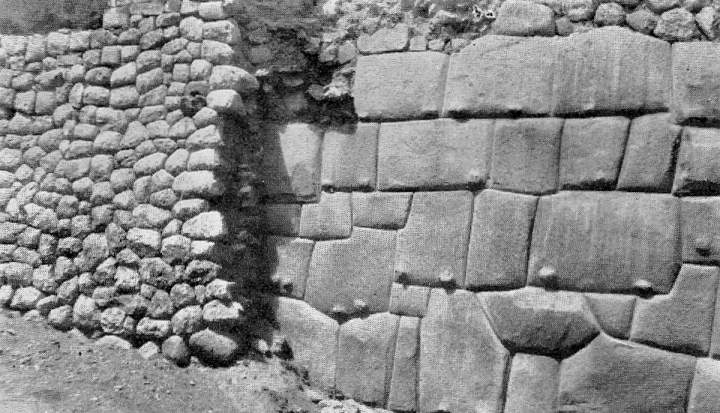
I've read quite a bit about ancient Chinese and even white bearded men making their way into these parts eons back. I just hope that these places don't get further ruined or covered up in order to hide some ancient truths.
Thanks for the reply mate
Interesting thread. Great effort. S&F
Though personally, I think this masonry is quite easily the work of man and can be proven thus....
Things we can rule out
1 Levitation to transport the stones. This is pretty obvious as we can see the lever points of the sides of the larger stones. The smaller stones don't require lever points as a/several wedge/s could be hammered straight between the blocks due to the chamfer cut into the edges of the stones.
If the beings building this structure had the ability to levitate blocks in order to transport them from the quarry, then why need pry/lever points to fit the stone?
2. Superior stone cutting techniques. This again is a no brainer as we can see evidence of hand cutting in the stones themselves.
3. Advanced mathematics. This may not seem so obvious to some as the sheer splendor of the entire structure is breathtaking but the evidence is in plain sight. If you look at the blocks that comprise the structure, no two blocks are alike thus negating the notion that hard-and-fast plans were used.
How could humans have got the stone blocks to fit together with such precision?
Easy. When shaped for the stones final resting place, the masons only have to shape two sides of the block to get a perfect fit. There are many ways to make the surfaces mating to other blocks identical to their mate but the easiest I know of is mud.
Yep. Mud.
You smear one side of one block with a thin layer of mud and then you bring the two blocks together. The block that did not get the mud treatment will have a mud footprint of the other stone. This footprint marks exactly where the mason needs to cut next. This process is repeated until the stones fit together perfectly.
Though personally, I think this masonry is quite easily the work of man and can be proven thus....
Things we can rule out
1 Levitation to transport the stones. This is pretty obvious as we can see the lever points of the sides of the larger stones. The smaller stones don't require lever points as a/several wedge/s could be hammered straight between the blocks due to the chamfer cut into the edges of the stones.
If the beings building this structure had the ability to levitate blocks in order to transport them from the quarry, then why need pry/lever points to fit the stone?
2. Superior stone cutting techniques. This again is a no brainer as we can see evidence of hand cutting in the stones themselves.
3. Advanced mathematics. This may not seem so obvious to some as the sheer splendor of the entire structure is breathtaking but the evidence is in plain sight. If you look at the blocks that comprise the structure, no two blocks are alike thus negating the notion that hard-and-fast plans were used.
How could humans have got the stone blocks to fit together with such precision?
Easy. When shaped for the stones final resting place, the masons only have to shape two sides of the block to get a perfect fit. There are many ways to make the surfaces mating to other blocks identical to their mate but the easiest I know of is mud.
Yep. Mud.
You smear one side of one block with a thin layer of mud and then you bring the two blocks together. The block that did not get the mud treatment will have a mud footprint of the other stone. This footprint marks exactly where the mason needs to cut next. This process is repeated until the stones fit together perfectly.
reply to post by OccamAssassin
See, the biggest problem I have with what you say is that being I work with stone, and other masons on a daily basis, and even now in modern times, nobody is prepared to work in this fashion including using excavators (which even a drag line excavator can only hold a maximum of 350 to 400 tons) as it would be too damn dangerous. The stone (in the first few pictures) is clearly not machined, and multi cuts such as these to get a perfect fit are practically impossible with stone of that size and weight. If you work with stone (walling in particular) you would understand that stone that size would not "hang" for very long on ropes or vine.
Honestly, I've talked with these guys about this stuff, and they cringe at the thought of it.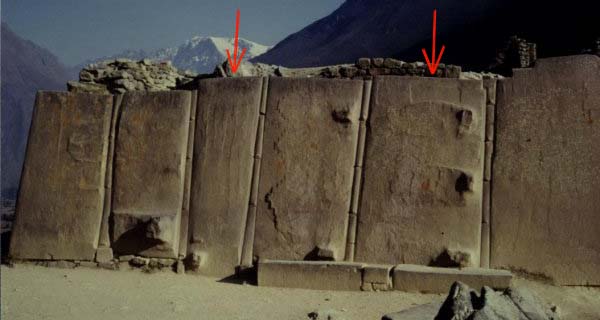
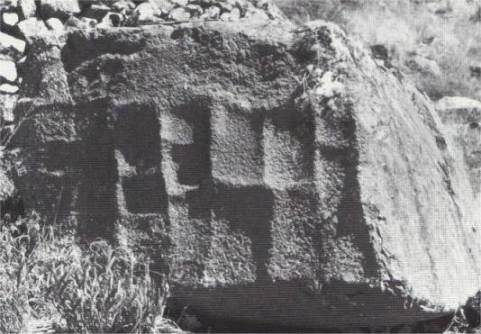
These marks are not tool marks, they look more like how wet mortar would look if being scraped.
He also points out that, unlike the blocks from Kachiqhata, the blocks quarried at the Rumiqolqa quarry were fine-dressed at the quarry but show no drag marks at all; he has no idea how the dressed blocks were transported.
Many stones in ‘Inca’ walls have strange protuberances or bosses, of several shapes and sizes, which appear to mar the beauty of the masonry. They are generally found on the lower part of blocks that have been fitted. It is commonly assumed that they were used in handling the blocks, perhaps by attaching ropes to them or applying levers against them. Blocks at the quarries tend to have large protuberances whereas blocks that have been fitted, or are found lying around at Inca construction sites, or were abandoned along the route from the quarry have much smaller protuberances. The latter could not have had ropes tied to them; what’s more, the positioning of the protuberances seems rather random. Since they were clearly not needed for transportation or for handling the blocks at the building sites, and were not always removed once the blocks were in place, they may have had some symbolic function. Similar protuberances can be seen on blocks in the Osireion temple at Abydos, Egypt, and on some of the granite casing stones used on the lower part of the Third (‘Menkaure’) Pyramid at Giza.
Protzen draws attention to certain blocks with saw cuts and drilled holes, pointing out that no Inca tools have yet been found that are capable of making them.
See, the biggest problem I have with what you say is that being I work with stone, and other masons on a daily basis, and even now in modern times, nobody is prepared to work in this fashion including using excavators (which even a drag line excavator can only hold a maximum of 350 to 400 tons) as it would be too damn dangerous. The stone (in the first few pictures) is clearly not machined, and multi cuts such as these to get a perfect fit are practically impossible with stone of that size and weight. If you work with stone (walling in particular) you would understand that stone that size would not "hang" for very long on ropes or vine.
Source
The historical truth, as related by the Ynca Amautas, who were the wise philosophers and doctors in the time of their idolatry, is that more than twenty thousand Indians dragged the stone with stout cables. They proceeded with great difficulty, as the road was very rough, and passed up and down many steep mountains. Half the people hauled upon the cables in front, while the other half held on behind ... In one of these steep places (where, through carelessness, they were not all hauling with equal force) the weight of the stone overcame the force of those who held it, and it slipped down the hill, killing three or four thousand Indians who were guiding it. Notwithstanding this disaster, they raised it up, and brought it to the place where it now lies.
Honestly, I've talked with these guys about this stuff, and they cringe at the thought of it.
These marks are not tool marks, they look more like how wet mortar would look if being scraped.
edit on 5/7/12 by Stonesplitter because:
(no reason given)
I was reading about the theory that casing stones (and perhaps others) of the Great Pyramid are actually cast concrete. Joseph Davidovits proposed
this idea 20 years ago, and recently several American scientists have been researching the theory by performing electron microscope analysis to
allegedly prove that many of the sampled stones cannot be naturally occurring solid stone. This theory would explain how large blocks could be given
improbably precise connective geometry, since it is trivial to produce curves and very flat planes using casting.
Do you have any data to prove that the 'carved' blocks you have shown are definitely 100% solid rock? You have included some interesting quotes about 'liquid rock'. Liquid rock sounds quite a lot like concrete to me. Could these blocks you have shown be polished geopolymer concrete? Could the plants you are talking about be some kind of agent for the concrete?
en.wikipedia.org... - Joseph_Davidovits
www.nytimes.com... - Did the Great Pyramids builders use concrete?
web.mit.edu... - Gathering 'concrete' evidence MIT class explores controversial pyramid theory with scale model
www.materials.drexel.edu...
Scanning electron microscopy micrographs and elemental maps of bulk of Lauer sample showing (a) secondary and (b) backscattered images; the rest of the images represent elemental maps of Ca, Na, Si, and S.
www.livescience.com...
Do you have any data to prove that the 'carved' blocks you have shown are definitely 100% solid rock? You have included some interesting quotes about 'liquid rock'. Liquid rock sounds quite a lot like concrete to me. Could these blocks you have shown be polished geopolymer concrete? Could the plants you are talking about be some kind of agent for the concrete?
en.wikipedia.org... - Joseph_Davidovits
www.nytimes.com... - Did the Great Pyramids builders use concrete?
web.mit.edu... - Gathering 'concrete' evidence MIT class explores controversial pyramid theory with scale model
www.materials.drexel.edu...
Scanning electron microscopy micrographs and elemental maps of bulk of Lauer sample showing (a) secondary and (b) backscattered images; the rest of the images represent elemental maps of Ca, Na, Si, and S.

www.livescience.com...
A year and a half later, after extensive scanning electron microscope observations and other testing, Barsoum and his research group finally began to draw some conclusions about the pyramids. They found that the tiniest structures within the inner and outer casing stones were indeed consistent with a reconstituted limestone. The cement binding the limestone aggregate was either silicon dioxide (the building block of quartz) or a calcium and magnesium-rich silicate mineral.
The stones also had a high water content — unusual for the normally dry, natural limestone found on the Giza plateau — and the cementing phases, in both the inner and outer casing stones, were amorphous, in other words, their atoms were not arranged in a regular and periodic array. Sedimentary rocks such as limestone are seldom, if ever, amorphous.
The sample chemistries the researchers found do not exist anywhere in nature. "Therefore," Barsoum said, "it's very improbable that the outer and inner casing stones that we examined were chiseled from a natural limestone block."edit on 5-7-2012 by yampa because: (no reason given)
reply to post by yampa
There's no confirmed or hard evidence for much of this, as it goes too far back in history and I think a lot of it is dismissed by mainstream science. There was I believe a question about whether these (South American) stones were formed in a sack or other form work, but there is no evidence for this either (no fibers/wood chips).
The Egyptian blocks used a very soft Limestone which was soaked in water for some time, and was apparently dissolved before adding the clay/salt/lime, which would probably account for the large amount of water. Mortar is predominantly made from a high percentage of kilned lime with clay additives. The acids used were from plants (2 in particular) that grew in rock crevices high in the Andes, and acids have a negative effect on mortar and some soft stone.
Overall, It's pretty hard to determine "facts" in this situation mainly a hypothesis or theory based on a whole lot of inconsistencies in our regular "school history". I believe a lot of this type thinking gets shot down pretty quick and even when discoveries are made, things such as ooparts happen to wind up "missing" more often than not.
Thanks for the interesting questions mate.
There's no confirmed or hard evidence for much of this, as it goes too far back in history and I think a lot of it is dismissed by mainstream science. There was I believe a question about whether these (South American) stones were formed in a sack or other form work, but there is no evidence for this either (no fibers/wood chips).
The Egyptian blocks used a very soft Limestone which was soaked in water for some time, and was apparently dissolved before adding the clay/salt/lime, which would probably account for the large amount of water. Mortar is predominantly made from a high percentage of kilned lime with clay additives. The acids used were from plants (2 in particular) that grew in rock crevices high in the Andes, and acids have a negative effect on mortar and some soft stone.
Source
A 2006 study by materials engineer Michel Barsoum and his colleagues supported Davidovits’ claims that some of the blocks used in the pyramids were made from a limestone-based form of concrete. Using scanning and transmission electron microscopy, they found that pyramid samples had mineral ratios that did not exist in any known limestone sources.14 However, that didn’t stop the head of Egypt’s Antiquities Department, Zahi Hawass, from dismissing the hypothesis as ‘plain stupid, idiotic and insulting’.
Overall, It's pretty hard to determine "facts" in this situation mainly a hypothesis or theory based on a whole lot of inconsistencies in our regular "school history". I believe a lot of this type thinking gets shot down pretty quick and even when discoveries are made, things such as ooparts happen to wind up "missing" more often than not.
Thanks for the interesting questions mate.
Originally posted by Stonesplitter
(continued)
In conclusion, I beleive that most of the construction was done with minimal hands on labor, using acoustic levitation to raise the stone, stone softening compound pasted on each piece of stone, then gently lowered into place and finally wiped or scraped to create a seamless join.
As a final note, an example of this type of work in my opinion, is the Bahubali (Sanskrit) or Gomateshwara statue located in Shravanabelagola, Karnataka, India. At first glance this 60 foot, 80 ton (estimate) statue doesn't seem all that remarkable compared to many other statues around the world, until you learn that it is carved from a single block of granite, and extremely well detailed and highly polished.:
now... just what techniques did the poet, sculptor use to create the statue?
were stone softners or stone levitation used back then in 978AD when he created the giant statue..
surely records were kept for the 15 year project
i bet that time comsuming labor was involved...chipping/denting & blowing away the dust to make the contours and bas relief ornaments. then polishing by hand with various gritty stone mixed with water
the ancients had plenty of time to do their tasks, besides it was all a devouted work for the gods, even those walls were sacred, thus all the workers were motivated to do their best...unlike todays monument builder crews that do it mostly for the paycheck
industry & desire to do something for a highr cause can make the mundane, labor intensive projects appear to be more than what they are...supervised work projects with no help from supernatural forces like levitation or realigning the molecular structure of granite blocks for a desired period of time...
reply to post by St Udio
Like a lot of Indian mythology, you generally get a spiritual or symbolic story that "explains" how certain actions or events take place. That doesn't mean this HAD to be mysteriously built, but Chavundaraya was a Brahmin. India really is an interesting place as far as spirituality is concerned and having been there and understanding quite a bit about their history, as well as a keen interest in Vedic teachings, I don't think that this piece would have been "hammered and craned". Even if it was slowly and meticulously chipped and polished due to, say Nishkamakarma (work without attachment) I believe it would have been lifted through Bhajan or Dharshan (song or prayer). Sounds odd, I know, but India really is a mystical place and you can't grasp their way of life until you understand the way they live, and here in the west, we THINK we know it all..............couldn't be further from the truth.
Like a lot of Indian mythology, you generally get a spiritual or symbolic story that "explains" how certain actions or events take place. That doesn't mean this HAD to be mysteriously built, but Chavundaraya was a Brahmin. India really is an interesting place as far as spirituality is concerned and having been there and understanding quite a bit about their history, as well as a keen interest in Vedic teachings, I don't think that this piece would have been "hammered and craned". Even if it was slowly and meticulously chipped and polished due to, say Nishkamakarma (work without attachment) I believe it would have been lifted through Bhajan or Dharshan (song or prayer). Sounds odd, I know, but India really is a mystical place and you can't grasp their way of life until you understand the way they live, and here in the west, we THINK we know it all..............couldn't be further from the truth.
new topics
-
God's Righteousness is Greater than Our Wrath
Religion, Faith, And Theology: 15 minutes ago -
Electrical tricks for saving money
Education and Media: 3 hours ago -
VP's Secret Service agent brawls with other agents at Andrews
Mainstream News: 4 hours ago -
Sunak spinning the sickness figures
Other Current Events: 5 hours ago -
Nearly 70% Of Americans Want Talks To End War In Ukraine
Political Issues: 5 hours ago -
Late Night with the Devil - a really good unusual modern horror film.
Movies: 7 hours ago -
Cats Used as Live Bait to Train Ferocious Pitbulls in Illegal NYC Dogfighting
Social Issues and Civil Unrest: 8 hours ago -
The Good News According to Jesus - Episode 1
Religion, Faith, And Theology: 10 hours ago
top topics
-
Florida man's trip overseas ends in shock over $143,000 T-Mobile phone bill
Social Issues and Civil Unrest: 15 hours ago, 8 flags -
Cats Used as Live Bait to Train Ferocious Pitbulls in Illegal NYC Dogfighting
Social Issues and Civil Unrest: 8 hours ago, 8 flags -
VP's Secret Service agent brawls with other agents at Andrews
Mainstream News: 4 hours ago, 8 flags -
Former Labour minister Frank Field dies aged 81
People: 17 hours ago, 4 flags -
Bobiverse
Fantasy & Science Fiction: 15 hours ago, 3 flags -
HORRIBLE !! Russian Soldier Drinking Own Urine To Survive In Battle
World War Three: 12 hours ago, 3 flags -
Electrical tricks for saving money
Education and Media: 3 hours ago, 3 flags -
Nearly 70% Of Americans Want Talks To End War In Ukraine
Political Issues: 5 hours ago, 3 flags -
Sunak spinning the sickness figures
Other Current Events: 5 hours ago, 3 flags -
Late Night with the Devil - a really good unusual modern horror film.
Movies: 7 hours ago, 2 flags
active topics
-
VP's Secret Service agent brawls with other agents at Andrews
Mainstream News • 32 • : ThatSmellsStrange -
The Reality of the Laser
Military Projects • 46 • : Zaphod58 -
God's Righteousness is Greater than Our Wrath
Religion, Faith, And Theology • 0 • : randomuser2034 -
President BIDEN Vows to Make Americans Pay More Federal Taxes in 2025 - Political Suicide.
2024 Elections • 136 • : ImagoDei -
Electrical tricks for saving money
Education and Media • 3 • : Mike72 -
TLDR post about ATS and why I love it and hope we all stay together somewhere
General Chit Chat • 10 • : theshadowknows -
Why to avoid TikTok
Education and Media • 20 • : 5thHead -
How ageing is" immune deficiency"
Medical Issues & Conspiracies • 32 • : annonentity -
-@TH3WH17ERABB17- -Q- ---TIME TO SHOW THE WORLD--- -Part- --44--
Dissecting Disinformation • 657 • : daskakik -
HORRIBLE !! Russian Soldier Drinking Own Urine To Survive In Battle
World War Three • 30 • : DaRAGE