It looks like you're using an Ad Blocker.
Please white-list or disable AboveTopSecret.com in your ad-blocking tool.
Thank you.
Some features of ATS will be disabled while you continue to use an ad-blocker.

Scientist Finds Hidden Portals in Earth’s Magnetic Field
page: 1share:
Scientist Finds Hidden Portals in Earth’s Magnetic Field
According to NASA, Jack Scudder—a researcher at the University of Iowa—has found "hidden portals on Earth's magnetic field [that] open and close dozens of times each day." Some of them are open for long periods of time.
Scudder says that these portals "create an uninterrupted path leading from our own planet to the sun's atmosphere 93 million miles away."
Called X-points or electron diffusion regions, they are located "a few tens of thousands of kilometers from Earth. The portals are created through a process of magnetic reconnection in which lines of magnetic force from both celestial bodies mingle and criss-cross through space. The criss-crossing creates these x-points.
The portals are "invisible, unstable and elusive," opening and closing without any warning. When they open, however, they are capable of transporting energetic particles at high speed from the Sun's atmosphere's to Earth's, causing geomagnetic storms.
Can someone who knows how this discovery will benefit us please explain, if I have read this right (probably not ) is it saying that these portals are like wormholes transporting particles, because when I think of a portal I think of stepping through one side and exiting some where else? What is making them open and close, can we do anything with this discovery, some people have said we might be able to predict the flow of particles so we can move satellites out of the way in high solar activity, is this it, i got really excited when I first read the title thinking that something or someone might be coming through them! I no expert at all someone explain
They are sending craft to study them in 2014
NASA is getting ready such a spacecraft in their Magnetospheric Multiscale Mission. A whole squadron of them: four ships that will be deployed around Earth and "surround the portals to observe how they work." The spacecraft will launch in 2014.
Source
reply to post by DeyTookErJeobs
No. Nothing like wormholes. They are more like pipelines through which charged particles from the Sun enter the Earth's magnetosphere.
The discovery is a few years old.
science.nasa.gov...
No. Nothing like wormholes. They are more like pipelines through which charged particles from the Sun enter the Earth's magnetosphere.
The discovery is a few years old.
science.nasa.gov...
If NASA is going to that much trouble then they must be very, very interesting and potentially important to science. NASA does not simply pour
millions of dollars toward something that doesn't interest the government and the only things the government are usually interested in are staying a
government and weapons..... so........
Sounds like ultra focused points in the atmosphere from our sun that create holes allowing more energy to pass through deeper into our atmosphere.
This has probably been happening throughout history and is just now coming to "light."
Interesting find nonetheless.
Interesting find nonetheless.
Originally posted by Raivan31
If NASA is going to that much trouble then they must be very, very interesting and potentially important to science. NASA does not simply pour millions of dollars toward something that doesn't interest the government and the only things the government are usually interested in are staying a government and weapons..... so........
Or they are curious about how our planet works and hope that some day we will have enough understanding of our planet to do off the wall things, such as create abundant solar energy.
Not all people in power are bad. There are about 4 good ones...
edit on 7/4/2012 by forall2see because: (no reason given)
reply to post by Phage
So we wont be seeing little green men come through them Only joking thanks for clearing that up for me!
So we wont be seeing little green men come through them Only joking thanks for clearing that up for me!
Originally posted by forall2see
Originally posted by Raivan31
If NASA is going to that much trouble then they must be very, very interesting and potentially important to science. NASA does not simply pour millions of dollars toward something that doesn't interest the government and the only things the government are usually interested in are staying a government and weapons..... so........
Or they are curious about how our planet works and hope that some day we will have enough understanding of our planet to do off the wall things, such as create abundant solar energy.
Not all people in power are bad. There are about 4 good ones...edit on 7/4/2012 by forall2see because: (no reason given)
Well yeah, but most of the benign scientific discovery achieved by NASA has been incedental to the actual objective of any given mission... The entire space race was just a apendage-size contest between the U.S.A and soviet Russia (as an example)
My point is not to suggest that some evil conspiracy is afoot (perish the thought ) but that the implications of this discovery must be pretty damned important if they are prepared to put four spacecraft up there at once.
When was the last time NASA put that much equipment up there?
The money involved must be staggering and the people who hold the purse strings are not gonna release that much moola unless they are certain to get something back.
Science = discovery, knowledge.
Investors = profit.
edit on 4-7-2012 by Raivan31 because: (no reason given)
Originally posted by Raivan31
My point is not to suggest that some evil conspiracy is afoot (perish the thought ) but that the implications of this discovery must be pretty damned important if they are prepared to put four spacecraft up there at once.
When was the last time NASA put that much equipment up there?
Well, yes the implications are pretty big if it helps scientists much better understand how the Sun affects the ionosphere. The properties of ionosphere at a given time have a major effect on long-range radio comms and how it's done.
edit on 4-7-2012 by XeroOne because: (no reason
given)
reply to post by Raivan31
$683 million. The only "investors" are us.
mms.gsfc.nasa.gov...
Not much to be gained. Except learning about things that have the potential to have a huge impact on our technologically dependent society.
$683 million. The only "investors" are us.
By observing magnetic reconnection in nature, MMS provides access to predictive knowledge of a universal process that is the final governor of space weather, affecting modern technological systems such as communications networks, GPS navigation, and electrical power grids. MMS will establish knowledge, methods and technologies applicable to future space weather missions and the future growth and development of space weather forecasting.
mms.gsfc.nasa.gov...
Not much to be gained. Except learning about things that have the potential to have a huge impact on our technologically dependent society.
edit on 7/4/2012 by Phage because: (no reason given)
reply to post by DeyTookErJeobs
I wonder if these "portals" could have any link to the Native American and other peoples feelings of "Energy" spots on the planet. Could it be something one could feel if you were in the area of our end of the sun/earth portal.
A little more reading and I realize the smaller portals are still several thousand miles across so no that would not make sense.
Very interesting that it happens every 8 mins.
I wonder if these "portals" could have any link to the Native American and other peoples feelings of "Energy" spots on the planet. Could it be something one could feel if you were in the area of our end of the sun/earth portal.
A little more reading and I realize the smaller portals are still several thousand miles across so no that would not make sense.
Very interesting that it happens every 8 mins.
edit on 4-7-2012 by Char-Lee because: (no reason given)
As soon as an honest Physicist starts analyzing this they will realize another source for the heating of the earth the IPCC did not take into account.
It will be ppbbbtttt there goes the story and the research money's will dry up. It will be as if nothing ever happened. In fact, I am surprised NASA
released this data. Maybe, there are some elements inside of NASA who do love the truth after all, wherever it takes us.
reply to post by Char-Lee
I found it interesting that they opened every 8 minutes, the time it takes light from the sun to reach Earth, so many coincidences!
I found it interesting that they opened every 8 minutes, the time it takes light from the sun to reach Earth, so many coincidences!
Originally posted by forall2see
Originally posted by Raivan31
If NASA is going to that much trouble then they must be very, very interesting and potentially important to science. NASA does not simply pour millions of dollars toward something that doesn't interest the government and the only things the government are usually interested in are staying a government and weapons..... so........
Or they are curious about how our planet works and hope that some day we will have enough understanding of our planet to do off the wall things, such as create abundant solar energy.
Not all people in power are bad. There are about 4 good ones...edit on 7/4/2012 by forall2see because: (no reason given)
There are about 4 good ones LEFT I figure you were trying to say?
I'm 100% convinced they have tech beyond the average person's imagination. Even if they didn't, I'm not that gullible to believe multi-billion investments have still not lead to anything other than "oh well, we need fossil fuels because there's just no good replacement yet!!!", just like cancer research... "we just can't find a cure!!! "
Also, I think "we have discovered...!!" should always be taken with a grain of salt, I'm sure they discovered it, the real question is, when did they really discover it? This might just as well be old information to keep the public satisfied, in a way like "look people, we're doing good things with that money you give us!". People would start asking questions if nothing ever was discovered, however, nothing major can be discovered either.
I believe there is free energy technology, and for you shills who are undoubtedly going to attempt to ridicule me, I have just ONE question;
Where is the world and the people in it when free energy devices are made public?
I'll answer it myself; FREEDOM. Free electricity? -> No more bills, for anything! You pump your own water, or water is supplied for free everywhere in the world. Heavy equipment that needs lots of power are only expensive to be bought, communities would thrive beyond imagination, people who were up to it would have unlimited potential as near everything would become free. Crime? No more need for it, everything can be automated, people who are too lazy to work can stay in bed all day, nobody gives a sh*t because people who want to be productive can do so.
When there are no bills to pay, people can grow food for a living, or teach, or invent, or study, ... Nearly everything we know today leads back to money, which would be easy to eliminate once we'd have free energy.
(but of course, some people love owning all that precious money so they would never release such technology And the people who discover it themselves? Have been and will always be silenced, enough evidence for that)
edit on 4/7/12 by ThisIsNotReality because: (no reason
given)
reply to post by ThisIsNotReality
History teaches us it doesn't quite work like that in the real world. Engineers built power stations that run on fossil fuels, and people are bitching about that damaging in the environment. Engineers tried replacing that with nuclear power, but people are bitching about the waste, despite it being generally less damaging than fossil fuels. Engineers then moved on to wind power, but people are bitching about a few turbines spoiling the scenery. Mate, we're not ready for 'free energy'.
Also, who's going to pay for the installation and maintenance of the 'free energy' grid? Or do you reckon it'll be run by voluntary staff?
History teaches us it doesn't quite work like that in the real world. Engineers built power stations that run on fossil fuels, and people are bitching about that damaging in the environment. Engineers tried replacing that with nuclear power, but people are bitching about the waste, despite it being generally less damaging than fossil fuels. Engineers then moved on to wind power, but people are bitching about a few turbines spoiling the scenery. Mate, we're not ready for 'free energy'.
Also, who's going to pay for the installation and maintenance of the 'free energy' grid? Or do you reckon it'll be run by voluntary staff?
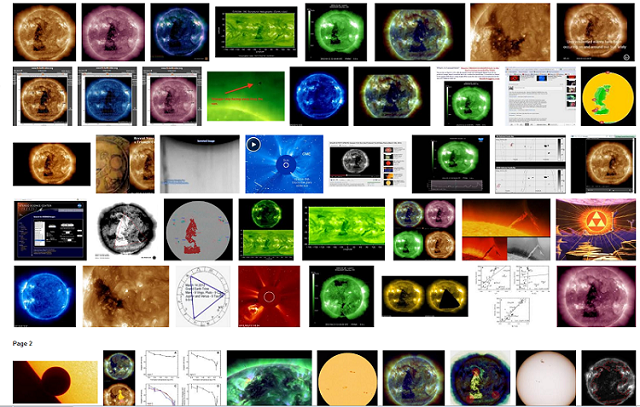
Maybe they are connected/have something to do with (please excuse my high-level scientific terminology) this little portal on the Sun that keeps
popping up in the shape of a little triangle that is only the surface area of 34 Jupiters..........but it's probably nothing........
reply to post by DeyTookErJeobs
This is not new at all. They reported this same thing in Time Magazine back when I actually read that trash. That would have been the mid to late 90's.
There are basically toroidal shaped "tunnels" that connect our outer magnetosphere to the suns outer surface magnetically. During this connection huge amounts of charged particles can bombard our magnetosphere.
Who decided to run this as some new discovery? What, NASA gets all its shuttles mothballed and now has to regurgitate the good old days to justify funding?
This is not new at all. They reported this same thing in Time Magazine back when I actually read that trash. That would have been the mid to late 90's.
There are basically toroidal shaped "tunnels" that connect our outer magnetosphere to the suns outer surface magnetically. During this connection huge amounts of charged particles can bombard our magnetosphere.
Who decided to run this as some new discovery? What, NASA gets all its shuttles mothballed and now has to regurgitate the good old days to justify funding?
Originally posted by Phage
reply to post by Raivan31
$683 million. The only "investors" are us.
By observing magnetic reconnection in nature, MMS provides access to predictive knowledge of a universal process that is the final governor of space weather, affecting modern technological systems such as communications networks, GPS navigation, and electrical power grids. MMS will establish knowledge, methods and technologies applicable to future space weather missions and the future growth and development of space weather forecasting.
mms.gsfc.nasa.gov...
Not much to be gained. Except learning about things that have the potential to have a huge impact on our technologically dependent society.
edit on 7/4/2012 by Phage because: (no reason given)
Information is the most potent weapon. Many scientist work towards only a tiny piece of the puzzle. And only the people funding know the true nature of it.
reply to post by bigfatfurrytexan
Here is a link to a story from 2006 talking about these 'portals': www.theregister.co.uk...
And it seems that it was Aurélie Marchaudon of the Université d'Orléans that confirmed the data gathered from the happenstance.
And i'll be damned if it hasn't been claimed (as of 2004) to have been known about "for many years."
Not knocking the OP. I am knocking either the media or NASA for regurgitating old news and attributing a legitimate scientific discovery to the wrong person.
Here is a link to a story from 2006 talking about these 'portals': www.theregister.co.uk...
And it seems that it was Aurélie Marchaudon of the Université d'Orléans that confirmed the data gathered from the happenstance.
And i'll be damned if it hasn't been claimed (as of 2004) to have been known about "for many years."
What happened was that a series of so-called magnetic flux tubes swept past the satellites again and again. These tubes are channels created by the merging of the Earth and Sun's magnetic fields.
One end of the tube is connected to Earth, and the other to the full force of the solar wind, and so they allow solar particles to penetrate the normally protective magnetosphere. When this happens, physicists say there has been a Flux Transfer Event. It is also known as magnetic reconnection.
The phenomenon has been known to exist for many years, but what is interesting about the day in May 2004, is that the same location underwent magnetic reconnection several times. And the satellites were there to watch it.
The data from the five spacecraft enabled scientists in France, led by Aurélie Marchaudon of the Université d'Orléans, to triangulate the location of the magnetic reconnection region, and to deduce its size.
They found that the reconnection site was on the daylight west side of the Earth's magnetic shield and was around 25000 kilometres across.
Later, Jean Berchem of the University of California Los Angeles (UCLA) and his team, conducted computer simulations that confirmed the observational data.
Not knocking the OP. I am knocking either the media or NASA for regurgitating old news and attributing a legitimate scientific discovery to the wrong person.
edit on 4-7-2012 by bigfatfurrytexan because: (no reason given)
new topics
-
When an Angel gets his or her wings
Conspiracies in Religions: 17 minutes ago -
Comparing the theology of Paul and Hebrews
Religion, Faith, And Theology: 1 hours ago -
Pentagon acknowledges secret UFO project, the Kona Blue program | Vargas Reports
Aliens and UFOs: 2 hours ago -
Boston Dynamics say Farewell to Atlas
Science & Technology: 2 hours ago -
I hate dreaming
Rant: 2 hours ago -
Man sets himself on fire outside Donald Trump trial
Mainstream News: 4 hours ago -
Biden says little kids flip him the bird all the time.
2024 Elections: 4 hours ago -
The Democrats Take Control the House - Look what happened while you were sleeping
US Political Madness: 5 hours ago -
Sheetz facing racial discrimination lawsuit for considering criminal history in hiring
Social Issues and Civil Unrest: 5 hours ago -
In an Historic First, In N Out Burger Permanently Closes a Location
Mainstream News: 7 hours ago
top topics
-
In an Historic First, In N Out Burger Permanently Closes a Location
Mainstream News: 7 hours ago, 14 flags -
The Democrats Take Control the House - Look what happened while you were sleeping
US Political Madness: 5 hours ago, 12 flags -
A man of the people
Medical Issues & Conspiracies: 12 hours ago, 8 flags -
Man sets himself on fire outside Donald Trump trial
Mainstream News: 4 hours ago, 7 flags -
Biden says little kids flip him the bird all the time.
2024 Elections: 4 hours ago, 7 flags -
Pentagon acknowledges secret UFO project, the Kona Blue program | Vargas Reports
Aliens and UFOs: 2 hours ago, 4 flags -
4 plans of US elites to defeat Russia
New World Order: 14 hours ago, 4 flags -
Sheetz facing racial discrimination lawsuit for considering criminal history in hiring
Social Issues and Civil Unrest: 5 hours ago, 3 flags -
Are you ready for the return of Jesus Christ? Have you been cleansed by His blood?
Religion, Faith, And Theology: 10 hours ago, 3 flags -
MH370 Again....
Disaster Conspiracies: 8 hours ago, 2 flags
active topics
-
The Democrats Take Control the House - Look what happened while you were sleeping
US Political Madness • 53 • : Mahogani -
Candidate TRUMP Now Has Crazy Judge JUAN MERCHAN After Him - The Stormy Daniels Hush-Money Case.
Political Conspiracies • 401 • : WeMustCare -
So I saw about 30 UFOs in formation last night.
Aliens and UFOs • 36 • : Arbitrageur -
Thousands Of Young Ukrainian Men Trying To Flee The Country To Avoid Conscription And The War
Other Current Events • 48 • : Consvoli -
12 jurors selected in Trump criminal trial
US Political Madness • 110 • : DontTreadOnMe -
A man of the people
Medical Issues & Conspiracies • 10 • : Astrocometus -
Election Year 2024 - Interesting Election-Related Tidbits as They Happen.
2024 Elections • 65 • : Threadbarer -
When an Angel gets his or her wings
Conspiracies in Religions • 0 • : BrotherKinsMan -
-@TH3WH17ERABB17- -Q- ---TIME TO SHOW THE WORLD--- -Part- --44--
Dissecting Disinformation • 545 • : cherokeetroy -
Man sets himself on fire outside Donald Trump trial
Mainstream News • 31 • : watchitburn