It looks like you're using an Ad Blocker.
Please white-list or disable AboveTopSecret.com in your ad-blocking tool.
Thank you.
Some features of ATS will be disabled while you continue to use an ad-blocker.

Man Eats Uranium, Drinks and Swims In Reactor Water, Ignites Plutonium In His Bare Hand
page: 2share:
reply to post by AnarchoCapitalist
very interesting story.
i don't believe it.
well... i do believe he did this but he is (as another member proposed) a droid or he's pretty sick (or dead) by now. or he has a really strong mind.
also... not that wikipedia is a great resource for truthful information, but i do find it a bit odd that i couldn't find a wiki page for this guy.
very interesting story.
i don't believe it.
well... i do believe he did this but he is (as another member proposed) a droid or he's pretty sick (or dead) by now. or he has a really strong mind.
also... not that wikipedia is a great resource for truthful information, but i do find it a bit odd that i couldn't find a wiki page for this guy.
reply to post by AnarchoCapitalist
That's not the point is it. The point is that nuclear radiation is very harmful. A large area around the Chernobyl meltdown was completely destroyed, all life was devastated, including trees and plants. It took multiple years to start showing signs of life again. Fukushima will be the same, if not worse.
Nuclear reactors can be designed to be safe, effective, and small.
See U.S. nuclear fleet.
There is no reason for a Chernobyl, or any other disaster, to occur if the reactors are designed correctly.
That's not the point is it. The point is that nuclear radiation is very harmful. A large area around the Chernobyl meltdown was completely destroyed, all life was devastated, including trees and plants. It took multiple years to start showing signs of life again. Fukushima will be the same, if not worse.
Due to genetic diversity I expect there are some people with a higher tolerance to radioactive material compared to others, but there have been more
than enough people cooked and deformed by this stuff to clearly indicate it is dangerous.
www.fourwinds10.net...
So no degrees?
Oh he was just paid to call people and buying it.
So you can call a sales person on the telephone a expert scientist who you can base all your medical needs on.
Martin: You sound plenty smart to me.
Winsor: I’ve been on a rough road.
Martin: How do I spell your first name?
Winsor: G-a-l-e-n. Galen was the first
Greek physician. He was the one who first
mapped out the blood system and the lymphatic
system. So, the doctor who delivered me in
1926 said: “This kid’s name is Galen” and I’ve
been Galen ever since.
Martin: Should I put any specific
credentials after your name?
Winsor: Oh, I did things like work on a
Ph.D. in soil chemistry, at the University of
Wisconsin, and never finished it, under Dr.
Emil Truog.
I’m an expert in plutonium chemistry. I
was “Mister Plutonium” for the General
Electric Company.
But no—you don’t put any fancy letters
after my name.
Martin: That’s fine with me. I understand
that philosophy.
Winsor: I’m a plutonium chemist. I
learned it through the school of hard knocks.
There’s not a university in the country that
would even recognize the work that I’ve done.
Martin: It’s been a pleasure talking with
you, and I appreciate your taking the time to
share so many little known points about the
electrical generation industry.
So no degrees?
Winsor: Well, yeah. And you know
what? I used to be the uranium ore buying
manager for General Electric, at Naturita,
Colorado, 25 years ago. My business was to
buy uranium “yellow-cake” from the miners.
[Editor’s note: Yellow-cake is a processed
oxide of uranium, U3O8, extracted and
concentrated from uranium ore. It is used as
the raw material for commercial nuclear
products, especially fuel elements in nuclear
reactors.] Do you know how much of that
yellow-cake we needed?
Oh he was just paid to call people and buying it.
So you can call a sales person on the telephone a expert scientist who you can base all your medical needs on.
edit on 27-6-2012 by
JBA2848 because: (no reason given)
To insinuate that radioactivity from nuclear waste, fallout, production, material....is harmless......is absurdity of the highest form.
All one has to do is Google photos of the MUTANT children born from survivors of the Chernobyl disaster. Or those from the fallout from Japan and Nagasaki. Or adults and children affected by depleted uranium in war torn countries.
Hell, cigarettes were smoked on television and promoted as non harmful....BEFORE millions died from them and they studied the real effects.
A diet of soda and Big Macs was 'normal' too at one point, I remember in the 80s we were told it was a 'healhty alternative' to dinner. Hell Burger King or McDonalds were the places to take your kids after school for "dinner", and whole families went.
Point being, there will always be someone who comes along to play down the dangers
OR
Over hype the benign.
There's an A-HOLE in every crowd.
All one has to do is Google photos of the MUTANT children born from survivors of the Chernobyl disaster. Or those from the fallout from Japan and Nagasaki. Or adults and children affected by depleted uranium in war torn countries.
Hell, cigarettes were smoked on television and promoted as non harmful....BEFORE millions died from them and they studied the real effects.
A diet of soda and Big Macs was 'normal' too at one point, I remember in the 80s we were told it was a 'healhty alternative' to dinner. Hell Burger King or McDonalds were the places to take your kids after school for "dinner", and whole families went.
Point being, there will always be someone who comes along to play down the dangers
OR
Over hype the benign.
There's an A-HOLE in every crowd.
edit on 27-6-2012 by PaxVeritas because: (no reason given)
edit on 27-6-2012 by PaxVeritas because: (no reason given)
hes dead now, apparently
from an old PDF file mentioning his claims, lasp.colorado.edu/~randall/3500/lectures/20080916_6.pdf
it links to a dead source www.tri-cityherald.com...
heres his gravestone: www.usgwarchives.net...
and apparently he graduated from brigham young university?
www.e-yearbook.com...
that might explain a few things.... or maybe it begs more questions?
still cant find out anything on HOW he died.. but he lived to 2008. and died at 82 years old.
Galen Hulet Winsor, 82, of West Richland, died July 19 in West Richland. He was born in Morgan, Utah, and lived in the Tri-City area since 1950. He was a retired chemist for General Electric.
from an old PDF file mentioning his claims, lasp.colorado.edu/~randall/3500/lectures/20080916_6.pdf
it links to a dead source www.tri-cityherald.com...
heres his gravestone: www.usgwarchives.net...
and apparently he graduated from brigham young university?
www.e-yearbook.com...
that might explain a few things.... or maybe it begs more questions?
still cant find out anything on HOW he died.. but he lived to 2008. and died at 82 years old.
edit on 27-6-2012 by BohemianBrim because: (no reason given)
Winsor: I spent 2-½ years on the lecture
tour for American Opinion Speakers Bureau in
1984-86, and what I said was: “My least
favorite person is the one who says ‘I do not
know, and I do not care.’ ”
American Opinion Speakers Bureau is a part of the John Birch Society.
One of the founding members was Fred Koch, founder of Koch Industries, one of the largest private corporations in America.
Originally posted by BohemianBrim
hes dead now, apparently
Galen Hulet Winsor, 82, of West Richland, died July 19 in West Richland. He was born in Morgan, Utah, and lived in the Tri-City area since 1950. He was a retired chemist for General Electric.
from an old PDF file mentioning his claims, lasp.colorado.edu/~randall/3500/lectures/20080916_6.pdf
it links to a dead source www.tri-cityherald.com...
heres his gravestone: www.usgwarchives.net...
and apparently he graduated from brigham young university?
www.e-yearbook.com...
that might explain a few things.... or maybe it begs more questions?
still cant find out anything on HOW he died.. but he lived to 2008. and died at 82 years old.
edit on 27-6-2012 by BohemianBrim because: (no reason given)
Doesn't look like his years of eating uranium, swimming in reactor pools, or irradiating his house did much to him if that is the case. He beat the average life expectancy at least.
Originally posted by ChaoticOrder
reply to post by AnarchoCapitalist
Nuclear reactors can be designed to be safe, effective, and small.
See U.S. nuclear fleet.
There is no reason for a Chernobyl, or any other disaster, to occur if the reactors are designed correctly.
That's not the point is it. The point is that nuclear radiation is very harmful. A large area around the Chernobyl meltdown was completely destroyed, all life was devastated, including trees and plants. It took multiple years to start showing signs of life again. Fukushima will be the same, if not worse.
Actually, that's a myth. The wildlife around Chernobyl has exploded and has wildly exceeded forecast expectations.
It would seem that civilisation was a much greater threat to the indigenous flora and fauna than a massive radiation leak.
Wildlife thriving after Chernobyl’s nuclear disaster – study
When dangerously high levels of radiation spewed from the Chernobyl nuclear plant in 1986 after an explosion in one of the reactors the effects were devastating.
Not only was the accident responsible for the deaths of thousands of people in the following years, scientists also feared the worst for Chernobyl’s surrounding wildlife.
But ground-breaking research conducted by two UK universities has revealed the effects of the nuclear disaster may not have been as harmful on wildlife as previously thought.
The study has been shedding light on the real impact of radiation on birds living in Chernobyl’s exclusion zone – and it shows they have been thriving without humans.
Experts believe the results in Chernobyl could also apply to wildlife at Fukushima in Japan following last year's tsunami and subsequent nuclear crisis.
In Dead Zone of Chernobyl, Animal Kingdom Thrives
In the months since the Japanese tsunami, we’ve heard a lot about Chernobyl as a worst-case example: here’s how bad Fukushima could have been. Now PBS’s “Nature” offers another vision: Chernobyl as a best-case demonstration that life abides despite the human race’s efforts to eradicate it. As long as the life in question isn’t ours, that is.
Studies on wildlife status in the Exclusion Zone
The Exclusion Zone around the Chernobyl nuclear power station is reportedly a haven for wildlife.
As humans were evacuated from the area 25 years ago, existing animal populations multiplied and rare species not seen for centuries have returned or have been reintroduced, for example lynx, wild boar, wolf, Eurasian brown bear, European bison, Przewalski's horse, and eagle owl.
Birds even nest inside the cracked concrete sarcophagus shielding in the shattered remains of Reactor 4. The Exclusion Zone is so lush with wildlife and greenery that in 2007 the Ukrainian government designated it a wildlife sanctuary, and at 488.7 km2 it is one of the largest wildlife sanctuaries in Europe.
Edit to add:
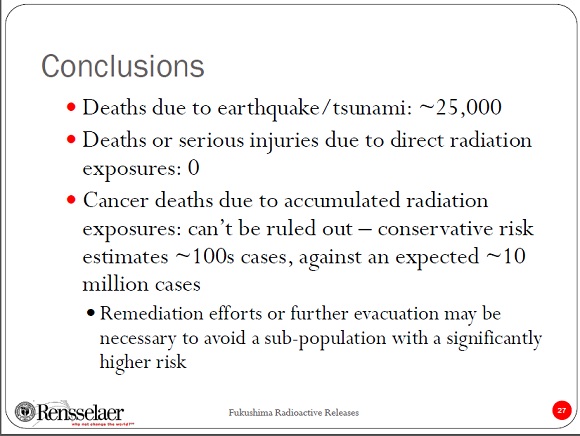
Peter F. Caracappa, Ph.D., CHP
Rensselaer Polytechnic Institute
ANS Annual Meeting
Special Session: The Accident at Fukushima Daiichi—
Preliminary Investigations
June 28, 2011
edit on 27-6-2012 by Drunkenparrot because: added content
Originally posted by AnarchoCapitalist
Originally posted by MrUncreated
Really? I have one word for you: Chernobyl.
I don't care if you can eat it or swim in it. If a meltdown can cause an incident like that, keep it the hell away from me, please.
Nuclear reactors can be designed to be safe, effective, and small.
See U.S. nuclear fleet.
There is no reason for a Chernobyl, or any other disaster, to occur if the reactors are designed correctly.
I agree in part, with the last sentence.
They boil water! Nuclear reactors boil water to make steam, to turn turbines, to make electricity. Just like coal.
If Fukushima or Chernobyl were another steam source how many would be dead/dying as a result today?
So yes "There is no reason for a Chernobyl, or any other disaster, to occur " Then we have this, "if the reactors are designed correctly". Well, they were designed correctly, or so they thought at the time. Now we are learning that what we knew (or thought we knew) 50-60-70 yrs ago might not be 100% correct
reply to post by Drunkenparrot
Actually no it's not a myth, I've seen original video footage of what the area was like shortly after the accident. It was a complete waste land. But yes, it has grown back into a nice lush garden of flora and fauna. But all areas where humans abandon show the same thing. The facts are the initial meltdown caused a great deal of damage and killed many people. Just because it eventually grew back doesn't make it much better.
Actually, that's a myth. The wildlife around Chernobyl has exploded and has wildly exceeded forecast expectations.
Actually no it's not a myth, I've seen original video footage of what the area was like shortly after the accident. It was a complete waste land. But yes, it has grown back into a nice lush garden of flora and fauna. But all areas where humans abandon show the same thing. The facts are the initial meltdown caused a great deal of damage and killed many people. Just because it eventually grew back doesn't make it much better.
After the disaster, four square kilometers of pine forest directly downwind of the reactor turned reddish-brown and died, earning the name of the "Red Forest".[104] Some animals in the worst-hit areas also died or stopped reproducing. Most domestic animals were removed from the exclusion zone, but horses left on an island in the Pripyat River 6 km (4 mi) from the power plant died when their thyroid glands were destroyed by radiation doses of 150–200 Sv.[105]
Chernobyl disaster
Originally posted by Dookie Master
I am EXTREMELY skeptical about this one. He handled fissile material with his own hands and he lived? I just don't know if this is possible. All of the material mentioned is known to be extremely dangerous to DNA; it actually destroys it. But, there is this guy:
en.wikipedia.org...
It's very possible to handle fissile materials with your own hands if they are treated properly chemically, because well purified such materials have low spontaneous radiation rates. In 1945 they brought the halves of the Trinity device in the backseat of a car with somebody holding on to the suitcase.
Plutonium and Uranium dust is quite toxic, but solid metal lumps of it? I'd pick it up with a ordinary rubber glove and not worry.
Waste which has been recently in a fission reactor (like say fallout from a bomb---which is just a very very fast fission reactor) is of course much more dangerous and I'd stay away.
Originally posted by ChaoticOrder
reply to post by Drunkenparrot
Actually, that's a myth. The wildlife around Chernobyl has exploded and has wildly exceeded forecast expectations.
Actually no it's not a myth, I've seen original video footage of what the area was like shortly after the accident. It was a complete waste land. But yes, it has grown back into a nice lush garden of flora and fauna. But all areas where humans abandon show the same thing. The facts are the initial meltdown caused a great deal of damage and killed many people. Just because it eventually grew back doesn't make it much better.
After the disaster, four square kilometers of pine forest directly downwind of the reactor turned reddish-brown and died, earning the name of the "Red Forest".[104] Some animals in the worst-hit areas also died or stopped reproducing. Most domestic animals were removed from the exclusion zone, but horses left on an island in the Pripyat River 6 km (4 mi) from the power plant died when their thyroid glands were destroyed by radiation doses of 150–200 Sv.[105]
Chernobyl disaster
You seem to have accidentally edited out the last sentence of your source that affirms your previous post, where you said
was incorrect.
all life was devastated, including trees and plants. It took multiple years to start showing signs of life again.
Allow me to post the paragraph in its entirety without your accidental omission...
After the disaster, four square kilometers of pine forest directly downwind of the reactor turned reddish-brown and died, earning the name of the "Red Forest".Some animals in the worst-hit areas also died or stopped reproducing. Most domestic animals were removed from the exclusion zone, but horses left on an island in the Pripyat River 6 km (4 mi) from the power plant died when their thyroid glands were destroyed by radiation doses of 150–200 Sv. Some cattle on the same island died and those that survived were stunted because of thyroid damage. The next generation appeared to be normal.
Chernobyl disaster/Flora and fauna
If you cant dazzle them with brilliance, baffle them with cow manure.
edit on 28-6-2012 by Drunkenparrot because: syntax
Originally posted by BohemianBrim
hes dead now, apparently
Galen Hulet Winsor, 82, of West Richland, died July 19 in West Richland. He was born in Morgan, Utah, and lived in the Tri-City area since 1950. He was a retired chemist for General Electric.
from an old PDF file mentioning his claims, lasp.colorado.edu/~randall/3500/lectures/20080916_6.pdf
it links to a dead source www.tri-cityherald.com...
heres his gravestone: www.usgwarchives.net...
and apparently he graduated from brigham young university?
www.e-yearbook.com...
that might explain a few things.... or maybe it begs more questions?
still cant find out anything on HOW he died.. but he lived to 2008. and died at 82 years old.
edit on 27-6-2012 by BohemianBrim because: (no reason given)
So he lived to 82 yrs old..
eating and swimming in this stuff .. !
Originally posted by Drunkenparrot
If you cant dazzle them with brilliance, baffle them with cow manure.edit on 28-6-2012 by Drunkenparrot because: syntax
Drunkenparrot, your last line applies to yourself too.
Your posting leaves suspicion to any observer. Slanted to pro nuclear position a bit aren't you?
Originally posted by rjetarh
Originally posted by Drunkenparrot
If you cant dazzle them with brilliance, baffle them with cow manure.edit on 28-6-2012 by Drunkenparrot because: syntax
Drunkenparrot, your last line applies to yourself too.
Your posting leaves suspicion to any observer. Slanted to pro nuclear position a bit aren't you?
I posted the sources I used to support my position that the wildlife throughout the Chernobyl disaster area has thrived beyond all expectations and the ecological doomsday feared by some never materialised.
If you can find fault with or refute the information I posted please, lets here it? (sources too please as I have been thoughtful enough to provide mine)
Nature has an incredible ability to repair itself, one that mankind continually underestimates.
How you can make a pro or con nuclear statement from that is beyond me, however please debate the facts and not others politics.
I fail to see how that compares with providing an unsourced incorrect opinion as fact or disingenuously editing a source to make it appear that it supports a position it doesn't.
Care to enlighten me?
Originally posted by MrUncreated
Really? I have one word for you: Chernobyl.
I don't care if you can eat it or swim in it. If a meltdown can cause an incident like that, keep it the hell away from me, please.
no offense, but how much do you know exactly and for sure, and from first hand experience about chernobyl?
reply to post by Drunkenparrot
Note that they are talking about the cattle which survived. Cattle can generally live for up to 20 to 25 years. The latency time for radiation-induced solid cancers, such as thyroid cancer, is about 10 years. They probably lived "several years" before dying... several could mean 2 years or it could mean 10. I didn't know the exact figure off the top of my head so I said several. Not to mention cattle are still dying from thyroid damage and they are still dealing with useless, irradiated boar meat to this day. But I was also talking about the plant life when I made that statement. Overall, it did take several years for the ecosystem to really recover and get back to how it was before the disaster.
edit: and here's an article that talks about this issue:
Once again... the fact that the recovery time for plants and animals is fairly quick does not detract from the initial devastation caused by the radiation. And even if the plants and animals can handle it after a while, that's only because they spent several years adapting to the radiation. It would still be highly dangerous to send Humans into a contaminated zone even decades after the initial event. You would need to let several generations of Humans adapt to the radiation before it would become a safe living environment for those people.
Some cattle on the same island died and those that survived were stunted because of thyroid damage. The next generation appeared to be normal.
Note that they are talking about the cattle which survived. Cattle can generally live for up to 20 to 25 years. The latency time for radiation-induced solid cancers, such as thyroid cancer, is about 10 years. They probably lived "several years" before dying... several could mean 2 years or it could mean 10. I didn't know the exact figure off the top of my head so I said several. Not to mention cattle are still dying from thyroid damage and they are still dealing with useless, irradiated boar meat to this day. But I was also talking about the plant life when I made that statement. Overall, it did take several years for the ecosystem to really recover and get back to how it was before the disaster.
edit: and here's an article that talks about this issue:
Plants and animals living in the 30-km exclusion zone received the highest level of radiation. Since radionucleotides migrate very slowly in soil, the radiation level in this region remains high.
The Chernobyl accident took place during the growing season. It took only two weeks for the conifers to suffer significant damage from exposure. Initially many trees suffered sever damage to reproductive tissue.
Within three years of the accident, the trees had regained their reproductive functions. The forests have begun to thrive.
Chernobyl Disaster's Agricultural and Environmental Impact
Once again... the fact that the recovery time for plants and animals is fairly quick does not detract from the initial devastation caused by the radiation. And even if the plants and animals can handle it after a while, that's only because they spent several years adapting to the radiation. It would still be highly dangerous to send Humans into a contaminated zone even decades after the initial event. You would need to let several generations of Humans adapt to the radiation before it would become a safe living environment for those people.
edit on 28/6/2012 by
ChaoticOrder because: (no reason given)
new topics
-
Weinstein's conviction overturned
Mainstream News: 1 hours ago -
Supreme Court Oral Arguments 4.25.2024 - Are PRESIDENTS IMMUNE From Later Being Prosecuted.
Above Politics: 2 hours ago -
Krystalnacht on today's most elite Universities?
Social Issues and Civil Unrest: 2 hours ago -
Chris Christie Wishes Death Upon Trump and Ramaswamy
Politicians & People: 3 hours ago -
University of Texas Instantly Shuts Down Anti Israel Protests
Education and Media: 5 hours ago -
Any one suspicious of fever promotions events, major investor Goldman Sachs card only.
The Gray Area: 7 hours ago -
God's Righteousness is Greater than Our Wrath
Religion, Faith, And Theology: 11 hours ago
top topics
-
VP's Secret Service agent brawls with other agents at Andrews
Mainstream News: 16 hours ago, 11 flags -
Krystalnacht on today's most elite Universities?
Social Issues and Civil Unrest: 2 hours ago, 7 flags -
Nearly 70% Of Americans Want Talks To End War In Ukraine
Political Issues: 17 hours ago, 6 flags -
Sunak spinning the sickness figures
Other Current Events: 16 hours ago, 5 flags -
Supreme Court Oral Arguments 4.25.2024 - Are PRESIDENTS IMMUNE From Later Being Prosecuted.
Above Politics: 2 hours ago, 5 flags -
Weinstein's conviction overturned
Mainstream News: 1 hours ago, 4 flags -
Electrical tricks for saving money
Education and Media: 14 hours ago, 4 flags -
University of Texas Instantly Shuts Down Anti Israel Protests
Education and Media: 5 hours ago, 2 flags -
Any one suspicious of fever promotions events, major investor Goldman Sachs card only.
The Gray Area: 7 hours ago, 2 flags -
Chris Christie Wishes Death Upon Trump and Ramaswamy
Politicians & People: 3 hours ago, 1 flags
active topics
-
Supreme Court Oral Arguments 4.25.2024 - Are PRESIDENTS IMMUNE From Later Being Prosecuted.
Above Politics • 34 • : Vermilion -
University of Texas Instantly Shuts Down Anti Israel Protests
Education and Media • 104 • : FlyersFan -
HORRIBLE !! Russian Soldier Drinking Own Urine To Survive In Battle
World War Three • 42 • : FlyersFan -
Chris Christie Wishes Death Upon Trump and Ramaswamy
Politicians & People • 10 • : network dude -
Nearly 70% Of Americans Want Talks To End War In Ukraine
Political Issues • 80 • : FlyersFan -
VP's Secret Service agent brawls with other agents at Andrews
Mainstream News • 45 • : network dude -
Weinstein's conviction overturned
Mainstream News • 10 • : xuenchen -
Remember These Attacks When President Trump 2.0 Retribution-Justice Commences.
2024 Elections • 57 • : TzarChasm -
-@TH3WH17ERABB17- -Q- ---TIME TO SHOW THE WORLD--- -Part- --44--
Dissecting Disinformation • 670 • : cherokeetroy -
British TV Presenter Refuses To Use Guest's Preferred Pronouns
Education and Media • 159 • : 5thHead