It looks like you're using an Ad Blocker.
Please white-list or disable AboveTopSecret.com in your ad-blocking tool.
Thank you.
Some features of ATS will be disabled while you continue to use an ad-blocker.

Any photography buffs care to lend a hand?
page: 15
share:
So i was playing around with my new tripod and some longer exposures on my EOS t1i and decided to put myself in one of the photos; was reviewing them
and saw this:

full size: i.imgur.com...
Any theories? i suppose it could be the smoke from the lantern but wow, what a pattern! Nothing quite like this in probably 30 - 40 other shots.
Cheers and so very much Love my friends!
full size: i.imgur.com...
Any theories? i suppose it could be the smoke from the lantern but wow, what a pattern! Nothing quite like this in probably 30 - 40 other shots.
Cheers and so very much Love my friends!
My laptops broken at the moment and im just on a cell phone...but im seeing a large orb and several smaller orbs...which are positively lens flare. Im
also seeing some smoke from the lantern intermingling with them
Cool pic though whats your aperture and shutter speed on that?
Cool pic though whats your aperture and shutter speed on that?
I see something almost hexagonal, which makes me think it's lens flare from the lantern. Possibly an artifact of the CMOS and the long exposure.
Just my 2 cents from years shooting a wide variety of formats and film types. Not a pro with the digital breed though!
Cheers,
Just my 2 cents from years shooting a wide variety of formats and film types. Not a pro with the digital breed though!
Cheers,

Originally posted by soulshn
So i was playing around with my new tripod and some longer exposures on my EOS t1i and decided to put myself in one of the photos; was reviewing them and saw this:
full size: i.imgur.com...
Any theories? i suppose it could be the smoke from the lantern but wow, what a pattern! Nothing quite like this in probably 30 - 40 other shots.
Cheers and so very much Love my friends!
Looks like Michael Jackson in casual garb snuck into your backyard.
Some scary s**t right there!
Get Away! Get Out NOW!!
Originally posted by Manhater
This what your talking about?
That it is. That is much clearer than the original, thanks!
This is most likely a "mirror ghost flare" effect that occurs when a bright light is
shot.
The flare is generally due to the presence of a protective filter in the camera, after the lens. The flare is a mirror ghost of the original bright object, with the image center serving as a point of symmetry (or point reflection).
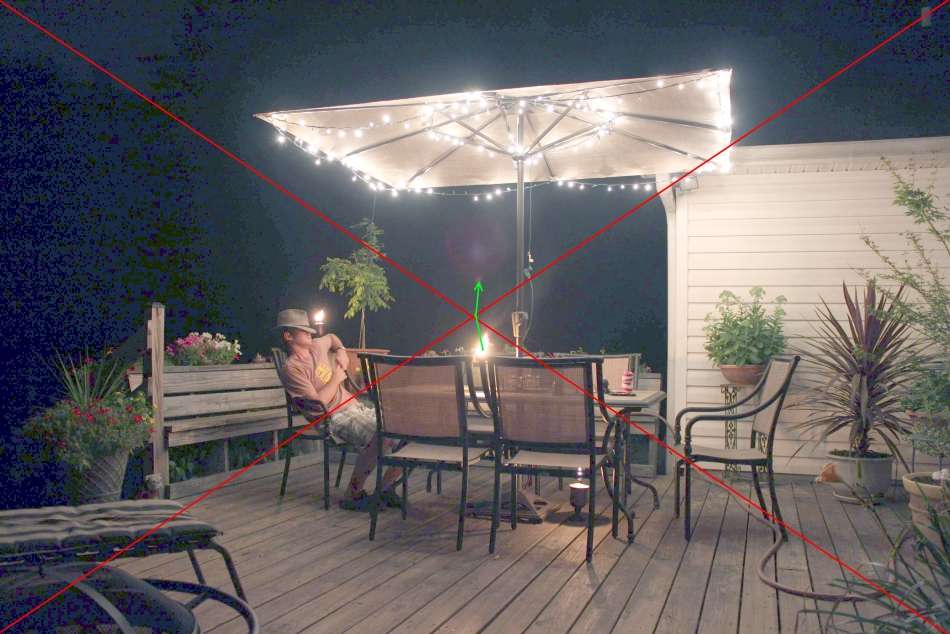
All dimensions are, most of the time, perfectly preserved, which suggests that reflections at planar surfaces are responsible. However, this is not exactly the case in your photo, as:
1- the line (green) that join the light source and its ghost image do not exactly pass through the photo center and
2- the length of the two segments from the center to the light source firstly and to the ghost image secondly aren't the same.
This is due to the fact that the filter on this camera is not plane, but curved.
Let's see how it works on a planar filter with the figure below:
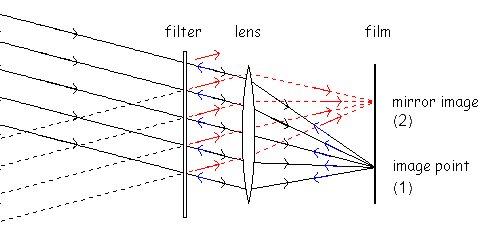
Black arrows indicate the light rays of a distant bright light source that form a regular image point on the film (1). Values for the reflectance of undeveloped photographic film vary from 15% to 40% [see sources 1,2], which makes the film a much stronger reflector than any optical component in the lens.
So, a significant percentage of the light is reflected off the film, partly specular and partly diffuse. (For convenience, we will consider that paths of the reflected light are the same and thus are already drawn for the incident light).
Thus, the blue arrows indicate light reflected from the film. This light encounters the filter, which specularly reflects a small fraction (red arrows). The red rays are parallel and consequently focused onto a point on the film. (2)
The virtual source of the mirror point is traced by the dashed black lines. Note that the blue rays reflected by the film seem odd from the viewpoint of specular reflection; they merely illustrate the fact that all light rays that originate from a single point on the film, and which are collected by the lens, emerge parallel at the filter.
The flare is generally due to the presence of a protective filter in the camera, after the lens. The flare is a mirror ghost of the original bright object, with the image center serving as a point of symmetry (or point reflection).
All dimensions are, most of the time, perfectly preserved, which suggests that reflections at planar surfaces are responsible. However, this is not exactly the case in your photo, as:
1- the line (green) that join the light source and its ghost image do not exactly pass through the photo center and
2- the length of the two segments from the center to the light source firstly and to the ghost image secondly aren't the same.
This is due to the fact that the filter on this camera is not plane, but curved.
Let's see how it works on a planar filter with the figure below:
Black arrows indicate the light rays of a distant bright light source that form a regular image point on the film (1). Values for the reflectance of undeveloped photographic film vary from 15% to 40% [see sources 1,2], which makes the film a much stronger reflector than any optical component in the lens.
So, a significant percentage of the light is reflected off the film, partly specular and partly diffuse. (For convenience, we will consider that paths of the reflected light are the same and thus are already drawn for the incident light).
Thus, the blue arrows indicate light reflected from the film. This light encounters the filter, which specularly reflects a small fraction (red arrows). The red rays are parallel and consequently focused onto a point on the film. (2)
The virtual source of the mirror point is traced by the dashed black lines. Note that the blue rays reflected by the film seem odd from the viewpoint of specular reflection; they merely illustrate the fact that all light rays that originate from a single point on the film, and which are collected by the lens, emerge parallel at the filter.
edit on 24-6-2012 by elevenaugust because: (no reason given)
It looks like the Jack In The Box mascot to me!!!
But I am not expert. It is kind of creepy though. Thanks for sharing it, whether we are just "seeing things" or not!
But I am not expert. It is kind of creepy though. Thanks for sharing it, whether we are just "seeing things" or not!
reply to post by elevenaugust
Wow, thank you!
That was much more in-depth than anything i was expecting; i learned something.
Cheers!
Wow, thank you!
That was much more in-depth than anything i was expecting; i learned something.
Cheers!
reply to post by soulshn
Now that i think about it though; this is a new lens, and i do not have a filter of any type in front of it.
Now that i think about it though; this is a new lens, and i do not have a filter of any type in front of it.
He said behind. Who knows whats really in that lens. Im not takin a 200 dollar lens apart!
Thanks for the apertur and shutter speed. I love playing with my f/1.8 prime lens but i have a 22mm sensor and that sucks..
Thanks for the apertur and shutter speed. I love playing with my f/1.8 prime lens but i have a 22mm sensor and that sucks..
Originally posted by soulshn
reply to post by soulshn
Now that i think about it though; this is a new lens, and i do not have a filter of any type in front of it.
Well, it can also occurs with any external lens, provided that the light source is bright enough.
The lens construction is impressive and there are so much lens in cameras that undesired flares effects cannot be 100% avoided.
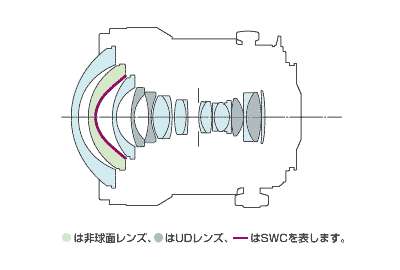
Canon TS-E 17mm f/4 L lens
The risk of being confronted with filter flare reduces with a smaller focal length, a smaller aperture (larger F-number), an increased separation of highlights from the image center, and with a better filter quality. However, by far the most secure way to avoid this type of flare is to omit the filter altogether.
edit on 24-6-2012 by elevenaugust because: (no reason given)
it's odd you should post this, I have not long since got a Canon EOS 400D, I was testing it in various locations, and one was in the "German
tunnel" down near the shore., apparently built by German POWs as an air raid shelter during WWI.
On the left hand side there is what appears to be smoke/mist, as well as them orb thingys.
That tunnel is dark, dry and there is nothing reflective.
Don't mean to hijack your thread, so apologies.

On the left hand side there is what appears to be smoke/mist, as well as them orb thingys.
That tunnel is dark, dry and there is nothing reflective.
Don't mean to hijack your thread, so apologies.
Originally posted by phroziac
Thanks for the apertur and shutter speed. I love playing with my f/1.8 prime lens but i have a 22mm sensor and that sucks..
Very welcome! A nice prime with the low f stop is definitely my next investment; probably the 'nifty fifty' as they like to call it. i'm the same boat with the small sensor.
Originally posted by woogleuk
Don't mean to hijack your thread, so apologies.
No worries, i'm glad to have the input. What creeped me out a little about this one was that i took close to 150 shots last night and this was the only one i put myself in and the only one that i noticed anything strange in.
Cheers!
I like the shot, and the lens flare kind of adds a little "something extra" that works pretty nice with the general theme. I'd probably crop out most
of the patio and put the guy just off center and balance the shot off the "ghost" if it were my shot. Then, the anomaly would be much more visible,
with sort of a narrative emerging as a result. I'd be pretty happy with that photo if it were my own.
Something like this..... I call it "Dreamtime"
Damn...the photo is bigger than I thought. Here's the url - files.abovetopsecret.com...
Something like this..... I call it "Dreamtime"
Damn...the photo is bigger than I thought. Here's the url - files.abovetopsecret.com...
edit on 6/25/2012 by NorEaster because: big photo
Originally posted by NorEaster
I like the shot... something like this..... I call it "Dreamtime"
Thanks for the compliment, i like the name! Thanks for the improvement as well.
Personally my favorite part of the shot was the christmas lights with the long(er) exposure so maybe keep some of them in as well as a few flowers behing me? i do wish i had kicked my legs up but i was working against the self timer and didn't really think it through so i like it much better with the bottom cropped out. Something like this maybe?

Again, thanks for the compliment and the idea to crop it (never struck my mind for some reason).
Cheers!
Originally posted by OutonaLimb
Looks like Michael Jackson in casual garb snuck into your backyard.
Some scary s**t right there!
Get Away! Get Out NOW!!
Ha! Maybe it was Michael's ghost?
Originally posted by soulshn
Originally posted by OutonaLimb
Looks like Michael Jackson in casual garb snuck into your backyard.
Some scary s**t right there!
Get Away! Get Out NOW!!
Ha! Maybe it was Michael's ghost?
You don't believe that MJ really died, do you?
He is alive and kicking, my friend.
Originally posted by OutonaLimb
Originally posted by soulshn
Originally posted by OutonaLimb
Looks like Michael Jackson in casual garb snuck into your backyard.
Some scary s**t right there!
Get Away! Get Out NOW!!
Ha! Maybe it was Michael's ghost?
You don't believe that MJ really died, do you?
He is alive and kicking, my friend.
If anybody is crazy enough to fake their own death, it is this guy. There's a thread for ya!
edit on 28-6-2012 by poopmaster2 because: (no
reason given)
new topics
-
The functionality of boldening and italics is clunky and no post char limit warning?
ATS Freshman's Forum: 34 minutes ago -
Meadows, Giuliani Among 11 Indicted in Arizona in Latest 2020 Election Subversion Case
Mainstream News: 1 hours ago -
Massachusetts Drag Queen Leads Young Kids in Free Palestine Chant
Social Issues and Civil Unrest: 1 hours ago -
Weinstein's conviction overturned
Mainstream News: 2 hours ago -
Supreme Court Oral Arguments 4.25.2024 - Are PRESIDENTS IMMUNE From Later Being Prosecuted.
Above Politics: 4 hours ago -
Krystalnacht on today's most elite Universities?
Social Issues and Civil Unrest: 4 hours ago -
Chris Christie Wishes Death Upon Trump and Ramaswamy
Politicians & People: 4 hours ago -
University of Texas Instantly Shuts Down Anti Israel Protests
Education and Media: 7 hours ago -
Any one suspicious of fever promotions events, major investor Goldman Sachs card only.
The Gray Area: 9 hours ago
top topics
-
Krystalnacht on today's most elite Universities?
Social Issues and Civil Unrest: 4 hours ago, 8 flags -
Weinstein's conviction overturned
Mainstream News: 2 hours ago, 6 flags -
Supreme Court Oral Arguments 4.25.2024 - Are PRESIDENTS IMMUNE From Later Being Prosecuted.
Above Politics: 4 hours ago, 5 flags -
Electrical tricks for saving money
Education and Media: 16 hours ago, 5 flags -
University of Texas Instantly Shuts Down Anti Israel Protests
Education and Media: 7 hours ago, 5 flags -
Meadows, Giuliani Among 11 Indicted in Arizona in Latest 2020 Election Subversion Case
Mainstream News: 1 hours ago, 3 flags -
Chris Christie Wishes Death Upon Trump and Ramaswamy
Politicians & People: 4 hours ago, 2 flags -
Any one suspicious of fever promotions events, major investor Goldman Sachs card only.
The Gray Area: 9 hours ago, 2 flags -
Massachusetts Drag Queen Leads Young Kids in Free Palestine Chant
Social Issues and Civil Unrest: 1 hours ago, 2 flags -
God's Righteousness is Greater than Our Wrath
Religion, Faith, And Theology: 13 hours ago, 1 flags
active topics
-
Candidate TRUMP Now Has Crazy Judge JUAN MERCHAN After Him - The Stormy Daniels Hush-Money Case.
Political Conspiracies • 762 • : Oldcarpy2 -
Supreme Court Oral Arguments 4.25.2024 - Are PRESIDENTS IMMUNE From Later Being Prosecuted.
Above Politics • 52 • : CarlLaFong -
The functionality of boldening and italics is clunky and no post char limit warning?
ATS Freshman's Forum • 4 • : PorkChop96 -
Weinstein's conviction overturned
Mainstream News • 18 • : nugget1 -
University of Texas Instantly Shuts Down Anti Israel Protests
Education and Media • 158 • : Threadbarer -
-@TH3WH17ERABB17- -Q- ---TIME TO SHOW THE WORLD--- -Part- --44--
Dissecting Disinformation • 675 • : Thoughtful3 -
Meadows, Giuliani Among 11 Indicted in Arizona in Latest 2020 Election Subversion Case
Mainstream News • 3 • : network dude -
Any one suspicious of fever promotions events, major investor Goldman Sachs card only.
The Gray Area • 9 • : xuenchen -
President BIDEN Vows to Make Americans Pay More Federal Taxes in 2025 - Political Suicide.
2024 Elections • 145 • : ImagoDei -
Massachusetts Drag Queen Leads Young Kids in Free Palestine Chant
Social Issues and Civil Unrest • 7 • : nugget1
5